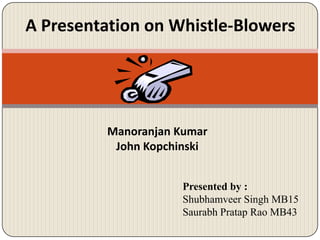
A Presentation on Whistle-Blowers

Manoranjan Kumar
John Kopchinski
Presented by :
Shubhamveer Singh MB15
Saurabh Pratap Rao MB43
Table of Contents
1. Manoranjan Kumar
 Introduction
 Port of Scam
 Blowing the Whistle
 Consequences
2. John Kopchinski
 Introduction
 The Case
 Outcomes
Manoranjan Kumar
(Kandla Port Trust Scam)
Introduction
 Kumar is a 1986-batch Indian Economic Service officer
 He was sent from the Textiles Ministry to the Kandla Port Trust
(KPT) as Chief Vigilance Officer
 Kumar blew the whistle on a multi-crore land scam at the (KPT)

 He exposed the mammoth land scam in which 16,000 acres of
prime land were leased out for a mere rent of Rs. 144/acre
 Kumar prepared a detailed report on the lease of land, which he
submitted to the Shipping Ministry in 2007. He was shifted to
Delhi in January 2008 without a post and was not paid any
salary since August 2008 untill he won the case in 2009
The Port of Scam
 Kandla Port is one of the most important ports servicing western
India
 The Kandla Port Trust owns 2,44,000 acres of land
 Nearly 16000 acres of land belonging to Kandla Port Trust have
been leased out to salt manufacturing firms for as low as Rs.144
per acre
 leases were twice renewed in 1996 and 2000 for a period of four
years
 The land is now said to be worth Rs. two crore per acre
Blowing the whistle
 Kumar blew the whistle in August 2007 by submitting his report
 Kumar's report stated that in 1960s and 70s, 16,000 acres were
leased out arbitrarily to a few parties on nominal rates, without
any valuation or auction
 Kandla Port Trust authorities were aware of the scam and were
doing nothing about it.
 Kumar, along with four other colleagues, was asked to proceed
on leave by the shipping ministry in January 2008
Consequences
 Kumar moved to the Central Administrative Tribunal (CAT)
, which gave orders to the Shipping Ministry for his repatriation

 The Shipping Ministry did not act on the CAT order and went to
Delhi High Court for seeking a stay on CAT order
 A divisional bench of Delhi High Court rejected the Shipping
Ministry's plea to seek a stay on the Central Administrative
Tribunal (CAT) order
 The High Court also observed that KPT must pay his entire
salary which has been held back since August 2008, along with
the arrears'
John Kopchinski
(Sales Representative at Pfizer)
John Kopchinski
"In the Army, I was expected to protect people at all costs. At
Pfizer I was expected to increase profits at all costs, even when
sales meant endangering lives. I couldn't do that.”
John Kopchinski
Introduction
 Former Pfizer sales representative hired by Pfizer when he
left the Army in 1992
 worked in South Florida until he was fired by the company in
2003
 In pursuing a case against Pfizer for fraudulently promoting
drugs that eventually led to the largest health fraud
settlement in US history
 At the time of his dismissal after raising his concerns with the
company, Kopchinski had a baby son and his wife was
pregnant with twins
Continued…..
 He went from earning about $125,000 a year to living off his
retirement fund before landing a job with an insurance
company for $40,000 a year.
 His 2009 qui tam lawsuit launched a massive government
investigation into Pfizer’s illegal and dangerous marketing of
Bextra, a prescription painkiller
 Pfizer paid $1.8 billion to the government to settle the
case, including a $1.3 billion criminal fine — the largest
healthcare fraud settlement in U.S. history
The Case
 Pfizer company was engaged in illegal and unethical marketing
of Bextra, a painkiller, in dangerous doses and for
unapproved, unsafe uses
 The FDA approved Bextra to treat arthritis as well as menstrual
pain in very limited doses. Kopchinski alleged in his qui tam
lawsuit that Pfizer promoted Bextra for uses and in doses that
far exceeded what the FDA had approved.
 This put patients at risk for serious health problems such as
heart attack, stroke and pulmonary embolism (blood clot in the
lung)
Continued…
 Kopchinski exposed the company's illegal sales and marketing
campaign for uses and in doses that endangered patients'
health and lives
 Kopchinski also reported that Pfizer paid doctors money in
various ways to influence them to prescribe and endorse
Bextra for these "off-label" uses
 He first complained to management about aggressive
promotion of Bextra far beyond the uses approved by FDA.
But his concerns were brushed aside, and, over time, the
company kept moving in the wrong direction. He didn't want
to go along with that
Outcomes
 Bextra was withdrawn from the market in 2005
 Pfizer paid $1.8 billion in September 2009 to the government
to settle Kopchinski's qui tam lawsuit
 John Kopchinski received $51.5 million for his allegations
involving the marketing of Bextra

 Pfizer settled four other whistle blower lawsuits at the same
time, bringing the total settlement to $2.3 billion
 Ethisphere, a think tank that focuses on business
ethics, corporate social responsibility, anti-corruption and
sustainability, named Kopchinski number one on its 2009 list
of 100 most influential people in business ethics
References
 http://www.indianexpress.com/news/kandla-port-trustwhistleblower-wins-case-against-shipping-ministry/435519/
accessed on 19/09/13
 http://indiatoday.intoday.in/story/gujarat-land-scam-exposedat-kandla-port accessed on 19/09/13
 http://www.dnaindia.com/india/1436151/report-kandla-porttrusts-manoranjan-kumar accessed on 19/09/13
 http://www.hindustantimes.com/India-news/NewDelhi
accessed on 19/09/13
 www.pfizer.com
Thank You

Whistle blower final

  • 1.
    A Presentation onWhistle-Blowers Manoranjan Kumar John Kopchinski Presented by : Shubhamveer Singh MB15 Saurabh Pratap Rao MB43
  • 2.
    Table of Contents 1.Manoranjan Kumar  Introduction  Port of Scam  Blowing the Whistle  Consequences 2. John Kopchinski  Introduction  The Case  Outcomes
  • 3.
  • 4.
    Introduction  Kumar isa 1986-batch Indian Economic Service officer  He was sent from the Textiles Ministry to the Kandla Port Trust (KPT) as Chief Vigilance Officer  Kumar blew the whistle on a multi-crore land scam at the (KPT)  He exposed the mammoth land scam in which 16,000 acres of prime land were leased out for a mere rent of Rs. 144/acre  Kumar prepared a detailed report on the lease of land, which he submitted to the Shipping Ministry in 2007. He was shifted to Delhi in January 2008 without a post and was not paid any salary since August 2008 untill he won the case in 2009
  • 5.
    The Port ofScam  Kandla Port is one of the most important ports servicing western India  The Kandla Port Trust owns 2,44,000 acres of land  Nearly 16000 acres of land belonging to Kandla Port Trust have been leased out to salt manufacturing firms for as low as Rs.144 per acre  leases were twice renewed in 1996 and 2000 for a period of four years  The land is now said to be worth Rs. two crore per acre
  • 6.
    Blowing the whistle Kumar blew the whistle in August 2007 by submitting his report  Kumar's report stated that in 1960s and 70s, 16,000 acres were leased out arbitrarily to a few parties on nominal rates, without any valuation or auction  Kandla Port Trust authorities were aware of the scam and were doing nothing about it.  Kumar, along with four other colleagues, was asked to proceed on leave by the shipping ministry in January 2008
  • 7.
    Consequences  Kumar movedto the Central Administrative Tribunal (CAT) , which gave orders to the Shipping Ministry for his repatriation  The Shipping Ministry did not act on the CAT order and went to Delhi High Court for seeking a stay on CAT order  A divisional bench of Delhi High Court rejected the Shipping Ministry's plea to seek a stay on the Central Administrative Tribunal (CAT) order  The High Court also observed that KPT must pay his entire salary which has been held back since August 2008, along with the arrears'
  • 8.
  • 9.
    John Kopchinski "In theArmy, I was expected to protect people at all costs. At Pfizer I was expected to increase profits at all costs, even when sales meant endangering lives. I couldn't do that.” John Kopchinski
  • 10.
    Introduction  Former Pfizersales representative hired by Pfizer when he left the Army in 1992  worked in South Florida until he was fired by the company in 2003  In pursuing a case against Pfizer for fraudulently promoting drugs that eventually led to the largest health fraud settlement in US history  At the time of his dismissal after raising his concerns with the company, Kopchinski had a baby son and his wife was pregnant with twins
  • 11.
    Continued…..  He wentfrom earning about $125,000 a year to living off his retirement fund before landing a job with an insurance company for $40,000 a year.  His 2009 qui tam lawsuit launched a massive government investigation into Pfizer’s illegal and dangerous marketing of Bextra, a prescription painkiller  Pfizer paid $1.8 billion to the government to settle the case, including a $1.3 billion criminal fine — the largest healthcare fraud settlement in U.S. history
  • 12.
    The Case  Pfizercompany was engaged in illegal and unethical marketing of Bextra, a painkiller, in dangerous doses and for unapproved, unsafe uses  The FDA approved Bextra to treat arthritis as well as menstrual pain in very limited doses. Kopchinski alleged in his qui tam lawsuit that Pfizer promoted Bextra for uses and in doses that far exceeded what the FDA had approved.  This put patients at risk for serious health problems such as heart attack, stroke and pulmonary embolism (blood clot in the lung)
  • 13.
    Continued…  Kopchinski exposedthe company's illegal sales and marketing campaign for uses and in doses that endangered patients' health and lives  Kopchinski also reported that Pfizer paid doctors money in various ways to influence them to prescribe and endorse Bextra for these "off-label" uses  He first complained to management about aggressive promotion of Bextra far beyond the uses approved by FDA. But his concerns were brushed aside, and, over time, the company kept moving in the wrong direction. He didn't want to go along with that
  • 14.
    Outcomes  Bextra waswithdrawn from the market in 2005  Pfizer paid $1.8 billion in September 2009 to the government to settle Kopchinski's qui tam lawsuit  John Kopchinski received $51.5 million for his allegations involving the marketing of Bextra  Pfizer settled four other whistle blower lawsuits at the same time, bringing the total settlement to $2.3 billion  Ethisphere, a think tank that focuses on business ethics, corporate social responsibility, anti-corruption and sustainability, named Kopchinski number one on its 2009 list of 100 most influential people in business ethics
  • 15.
    References  http://www.indianexpress.com/news/kandla-port-trustwhistleblower-wins-case-against-shipping-ministry/435519/ accessed on19/09/13  http://indiatoday.intoday.in/story/gujarat-land-scam-exposedat-kandla-port accessed on 19/09/13  http://www.dnaindia.com/india/1436151/report-kandla-porttrusts-manoranjan-kumar accessed on 19/09/13  http://www.hindustantimes.com/India-news/NewDelhi accessed on 19/09/13  www.pfizer.com
  • 16.