John C. Maxwell
Presented by: Qadeer Ahmad
About the Book
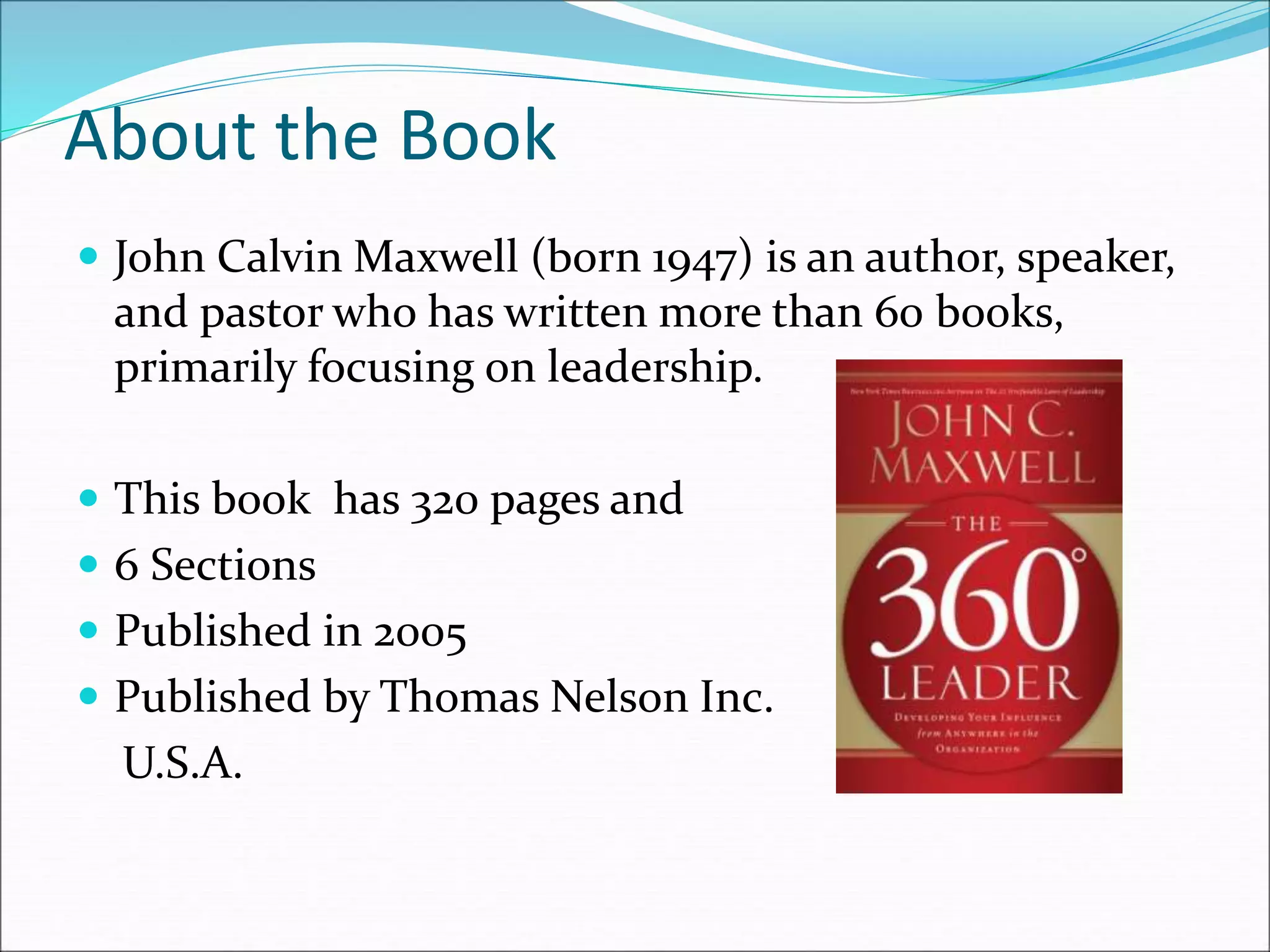
 John Calvin Maxwell (born 1947) is an author, speaker,
and pastor who has written more than 60 books,
primarily focusing on leadership.
 This book has 320 pages and
 6 Sections
 Published in 2005
 Published by Thomas Nelson Inc.
U.S.A.
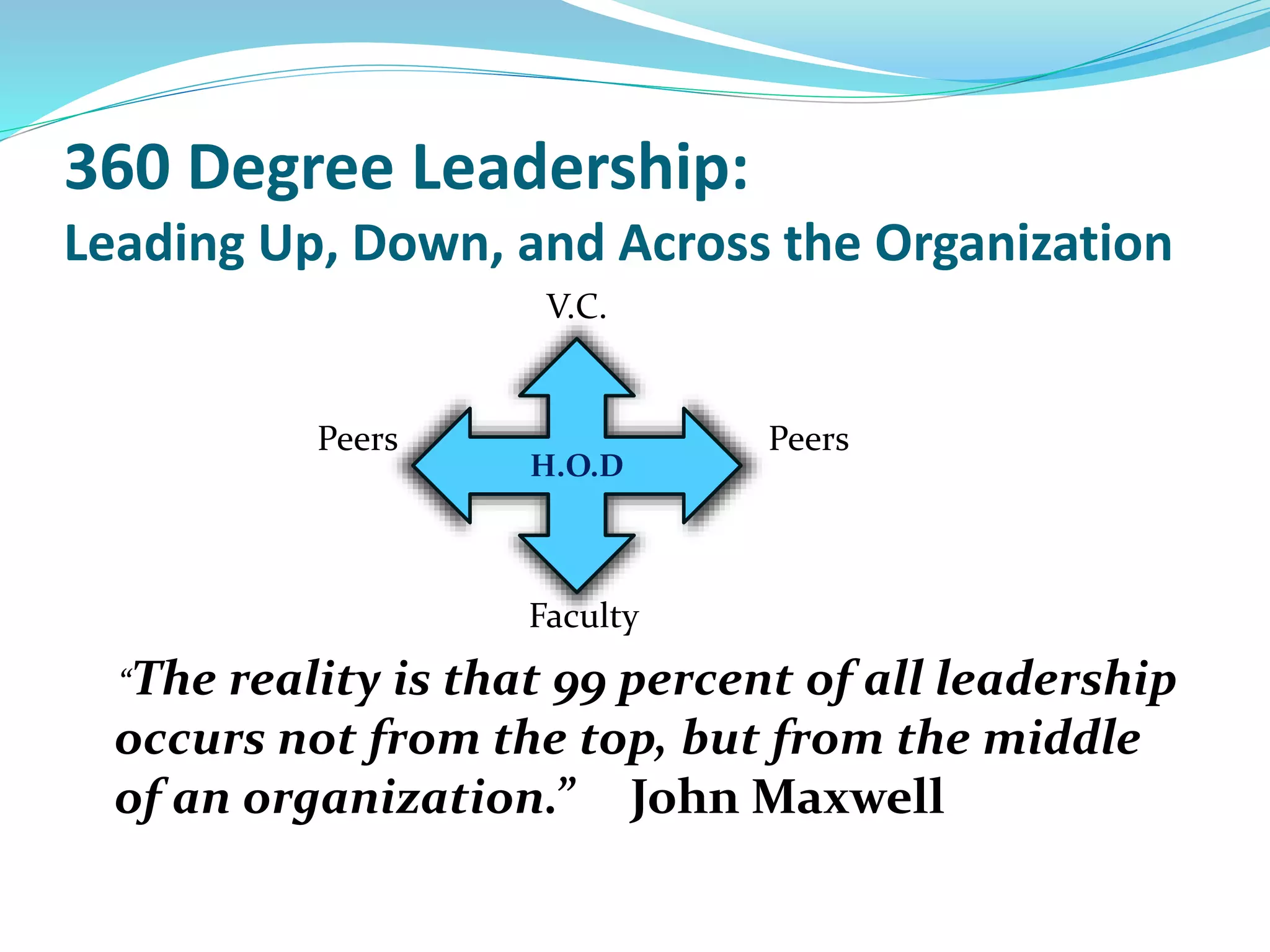
360 Degree Leadership:
Leading Up, Down, and Across the Organization
V.C.
Peers Peers
Faculty
“The reality is that 99 percent of all leadership
occurs not from the top, but from the middle
of an organization.” John Maxwell
H.O.D
Section 1: The Myths of Leading From the
Middle of the Organization
 Myth #1: The Position Myth: "I can't lead if I am not at the
top."
 Myth #2: The Destination Myth: "When I get to the top, then
I'll learn to lead."
 Myth #3: The Influence Myth: "If I were on top, then people
would follow me."
 Myth #4: The Inexperience Myth: "When I get to the top, I'll
be in control."
 Myth #5: The Freedom Myth: "When I get to the top, I'll no
longer be limited."
 Myth #6: The Potential Myth: "I can't reach my potential if I'm
not the top leader."
 Myth #7: The All-or-Nothing Myth: "If I can't get to the top,
then I won't try to lead."
How to resolve those Myths
 Understand that the true measure of leadership is
influence, nothing else.
 Build relationships and gain influence naturally.
 Leadership is a choice you make, not a place you
sit.
 Leadership development is a dynamic process,
and you cannot just wait on being given a
position to start to lead.
 The right to lead must be earned individually with
each person that you meet.
The Five Levels of Leadership
1) Position: People follow because they have to.
Your influence will not extend beyond your lines of authority.
2)Permission: People follow because they want to.
People will follow you beyond your stated lines of authority.
3)Production: People follow because of what you have done
for the organization.
People like you and what you are doing.
4)People Development: People follow because of what you
have done for them.
Here your focus is on developing others; you mentor them and help them
and you make them more valuable.
5)Personhood: People follow because of who you are and
what you represent.
Few people make this level, and only others can put you here. It takes years
of working through the other five levels, growing people and organizations.
1) The Tension Challenge: The Pressure of Being
Caught in the Middle
Factors That Impact the Tension
 Empowerment - How much authority/responsibility does your leader give
you, and how clear are the lines of authority?
 Initiative – How do you balance initiating and not overstepping your
boundaries? How do you know when to push back and how hard to push?
 Environment – What is the leadership DNA of the organization and the
leader?
 Job Parameters – How well do you know your job and how to do it?
 Appreciation – Can you live without the credit?
Section 2: The Challenges 360 Degree Leaders Face
How to Relieve the Tension Challenge
 Become Comfortable with the Middle
 Know What to “Own” and What to Let Go
 Find Quick Access to Answers When Caught in the Middle
 Never Violate Your Position or the Trust of the Leader
 Find a Way to Relieve Stress
2) The Frustration Challenge:
Following an Ineffective Leader
“Your job is not to fix the leader; it’s to add value.”
Maxwell notes there are many types of ineffective leaders; insecure, visionless,
incompetent, selfish, chameleon, political, and controlling ones.
Solution: Add value to the leader.
1) Develop a Solid Relationship With Your Leader
2) Identify and Appreciate Your Leader’s Strengths
3) Commit to Adding Value to Your Leader’s Strengths
4) Get Permission to Develop a Game Plan to Complement
Your Leader’s Weaknesses
5) Expose Your Leader to Good Leadership Resources
6) Publicly Affirm Your Leader
3) The Multi-Hat Challenge: One Head…Many Hats
4) The Ego Challenge: You’re Often Hidden in the Middle
5) The Fulfillment Challenge: Leaders Like the Front More
Than the Middle
6) The Vision Challenge: Championing the Vision is More
Difficult When You Did Not Create It
7) The Influence Challenge
The solution is to become the kind of leader other people want to
follow. And what kind of leader is that?
 People Follow Leaders They Know—Leaders Who Care
 People Follow Leaders They Trust—Leaders With Character
 People Follow Leaders They Respect—Leaders Who Are
Competent
 People Follow Leaders They Admire—Leaders With
Commitment
Section 3: The Principles 360 Degree Leaders
Practice To Lead Up
 Lead-Up Principle #1: Lead Yourself Exceptionally Well
 Lead-Up Principle #2: Lighten Your Leader's Load
 Lead-Up Principle #3: Be Willing to Do What Others Won't
 Lead-Up Principle #4: Do More than Manage - Lead!
 Lead-Up Principle #5: Invest in Relational Chemistry
 Lead-Up Principle #6: Be Prepared Every Time You Take Your
Leader's Time
 Lead-Up Principle #7: Know When to Push and When to Back
Off
 Lead-Up Principle #8: Become a Go-To Player
 Lead-Up Principle #9: Be Better Tomorrow than You Are Today
Section 4: The Principles 360 Degree Leaders Practice
To Lead Across
 Lead-Across Principle #1: Understand, Practice, and
Complete the Leadership Loop
 Lead-Across Principle #2: Put Completing Fellow Leaders
Ahead of Competing with Them
 Lead-Across Principle #3: Be a Friend
 Lead-Across Principle #4: Avoid Office Politics
 Lead-Across Principle #5: Expand Your Circle of
Acquaintances
 Lead-Across Principle #6: Let the Best Idea Win
 Lead-Across Principle #7: Don't Pretend You're Perfect
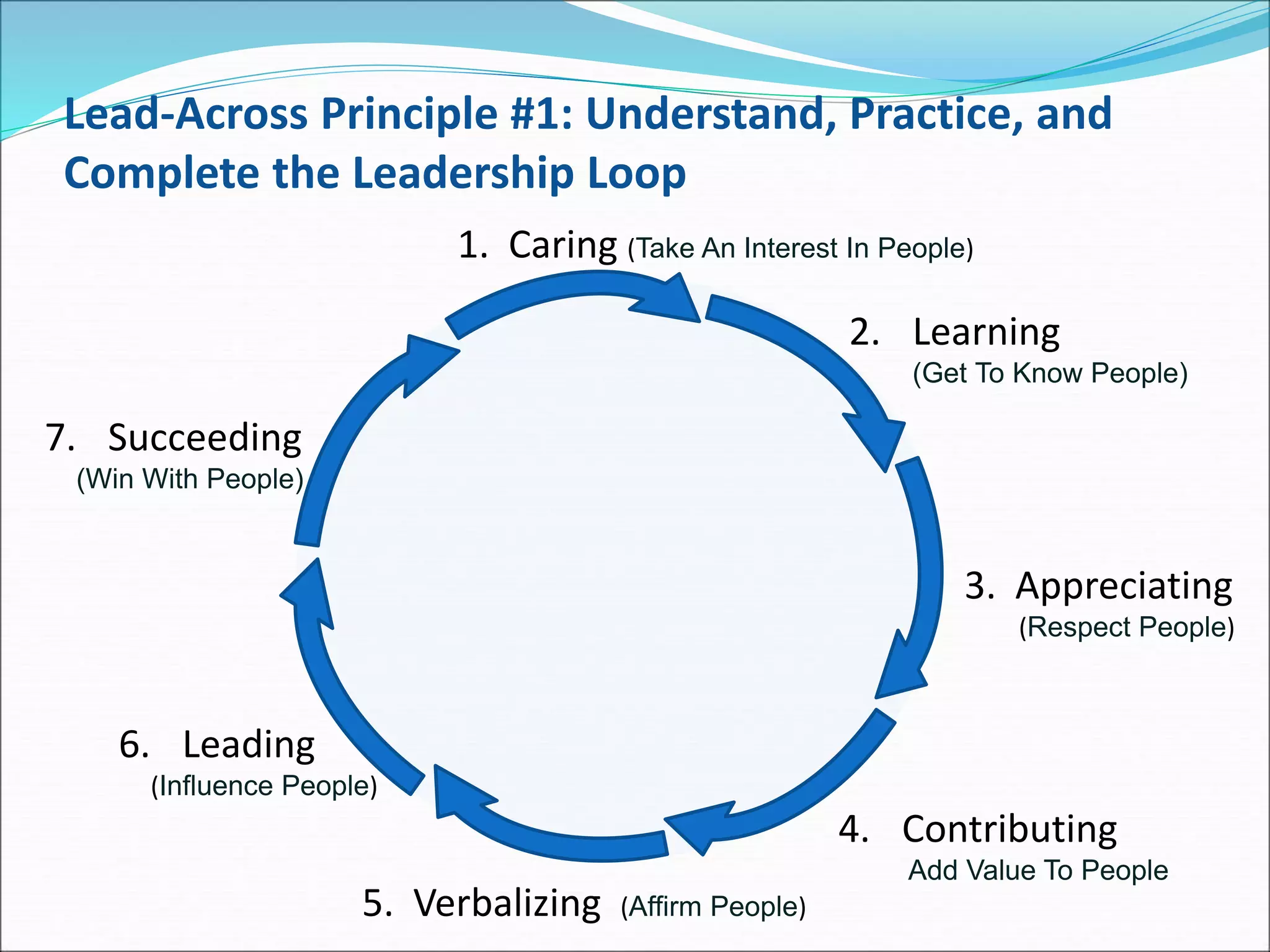
Lead-Across Principle #1: Understand, Practice, and
Complete the Leadership Loop
1. Caring (Take An Interest In People)
6. Leading
(Influence People)
5. Verbalizing (Affirm People)
4. Contributing
Add Value To People
3. Appreciating
(Respect People)
2. Learning
(Get To Know People)
7. Succeeding
(Win With People)
Lead-Across Principle #3: Be a Friend
 Listen!
 Find Common Ground Not Related to Work
 Be Available
 Have A Sense of Humor
 Tell the Truth When Others Don’t
Section 5: The Principles 360 Degree Leaders Practice
To Lead Down
 Lead-Down Principle #1 Walk Slowly Through the Halls
 Lead-Down Principle #2 See Everyone As a "10"
 Lead-Down Principle #3 Develop Each Team Member
as a Person
 Lead-Down Principle #4 Place People in Their Strength
Zones
 Lead-Down Principle #5 Model the Behavior You
Desire
 Lead-Down Principle #6 Transfer the Vision
 Lead-Down Principle #7 Reward for Results
Lead-Down Principle #1 Walk Slowly Through
The Halls
 Slow Down
 Express That You Care
 Create A Healthy Balance Of Personal And
Professional Interest
 Pay Attention When People Start Avoiding You
 Tend To The People And They Will Tend To
The Business
Lead-Down Principle #2 See Everyone As A “10”
 Give Them The “10” Treatment
 See Them As Who They Can Become
 Let Them “Borrow” Your Belief In Them
 Catch Them Doing Something Right
 Believe The Best – Give Others The Benefit Of The
Doubt
Lead-Down Principle #3 Develop Each Team Member
As A Person
 See Development As A Long Term Process
 Discover Each Person’s Dreams and Desires
 Use Organizational Goals For Individual Development
 Help Them Know Themselves
 Be Ready To Have A Hard Conversation
 Celebrate The Right Wins
 Prepare Them For Leadership
Lead-Down Principle #4 Place People In Their
Strength Zones
 Discover Their True Strengths
 Give Them The Right Job
 Identify The Skills They Need And Provide World Class
Training
Lead-Down Principle #5 Model The Behavior You
Desire
 Your Behavior Determines The Culture
 Your Attitude Determines The Atmosphere
 Your Values Determine The Decisions
 Your Investment Determines The Return
 Your Character Determines The Trust
 Your Work Ethic Determines The Productivity
 Your Growth Determines The Potential
Lead-Down Principle #6 Transfer The Vision
Important Elements
 Clarity
 Connection of Past, Present, and Future
 Purpose
 Goals
 Stories
 Passion
Lead-Down Principle #7 Reward For Results
 Give Praise Publicly and Privately
 Don’t Reward Everyone The Same
 Give Perks Beyond Pay
 Promote When Possible
 Remember You Get What You Pay For
Section 6: The Value of 360 Degree Leadership
 Value #1 A Leadership Team Is More Effective than Just
One Leader
 Value #2 Leaders Are Needed at Every Level of the
Organization
 Value #3 Leading Successfully at One Level Is a Qualifier
for Leading at the Next Level
 Value #4 Good Leaders in the Middle Make Better Leaders
at the Top
 Value #5 360-Degree Leaders Possess Qualities Every
Organization Needs
Conclusion
 Remember That Leadership is About Influence
 Develop Yourself---Formulate a Plan
 Invest Your Time and Energy In Others
 Help and Add Value To Your Leader(s)
 Cultivate A Leadership Mindset
 Recognize and Reward Excellence

The 360-Degree Leader - Presentation.ppt

  • 1.
    John C. Maxwell Presentedby: Qadeer Ahmad
  • 2.
    About the Book John Calvin Maxwell (born 1947) is an author, speaker, and pastor who has written more than 60 books, primarily focusing on leadership.  This book has 320 pages and  6 Sections  Published in 2005  Published by Thomas Nelson Inc. U.S.A.
  • 3.
    360 Degree Leadership: LeadingUp, Down, and Across the Organization V.C. Peers Peers Faculty “The reality is that 99 percent of all leadership occurs not from the top, but from the middle of an organization.” John Maxwell H.O.D
  • 4.
    Section 1: TheMyths of Leading From the Middle of the Organization  Myth #1: The Position Myth: "I can't lead if I am not at the top."  Myth #2: The Destination Myth: "When I get to the top, then I'll learn to lead."  Myth #3: The Influence Myth: "If I were on top, then people would follow me."  Myth #4: The Inexperience Myth: "When I get to the top, I'll be in control."  Myth #5: The Freedom Myth: "When I get to the top, I'll no longer be limited."  Myth #6: The Potential Myth: "I can't reach my potential if I'm not the top leader."  Myth #7: The All-or-Nothing Myth: "If I can't get to the top, then I won't try to lead."
  • 5.
    How to resolvethose Myths  Understand that the true measure of leadership is influence, nothing else.  Build relationships and gain influence naturally.  Leadership is a choice you make, not a place you sit.  Leadership development is a dynamic process, and you cannot just wait on being given a position to start to lead.  The right to lead must be earned individually with each person that you meet.
  • 6.
    The Five Levelsof Leadership 1) Position: People follow because they have to. Your influence will not extend beyond your lines of authority. 2)Permission: People follow because they want to. People will follow you beyond your stated lines of authority. 3)Production: People follow because of what you have done for the organization. People like you and what you are doing. 4)People Development: People follow because of what you have done for them. Here your focus is on developing others; you mentor them and help them and you make them more valuable. 5)Personhood: People follow because of who you are and what you represent. Few people make this level, and only others can put you here. It takes years of working through the other five levels, growing people and organizations.
  • 7.
    1) The TensionChallenge: The Pressure of Being Caught in the Middle Factors That Impact the Tension  Empowerment - How much authority/responsibility does your leader give you, and how clear are the lines of authority?  Initiative – How do you balance initiating and not overstepping your boundaries? How do you know when to push back and how hard to push?  Environment – What is the leadership DNA of the organization and the leader?  Job Parameters – How well do you know your job and how to do it?  Appreciation – Can you live without the credit? Section 2: The Challenges 360 Degree Leaders Face
  • 8.
    How to Relievethe Tension Challenge  Become Comfortable with the Middle  Know What to “Own” and What to Let Go  Find Quick Access to Answers When Caught in the Middle  Never Violate Your Position or the Trust of the Leader  Find a Way to Relieve Stress
  • 9.
    2) The FrustrationChallenge: Following an Ineffective Leader “Your job is not to fix the leader; it’s to add value.” Maxwell notes there are many types of ineffective leaders; insecure, visionless, incompetent, selfish, chameleon, political, and controlling ones. Solution: Add value to the leader. 1) Develop a Solid Relationship With Your Leader 2) Identify and Appreciate Your Leader’s Strengths 3) Commit to Adding Value to Your Leader’s Strengths 4) Get Permission to Develop a Game Plan to Complement Your Leader’s Weaknesses 5) Expose Your Leader to Good Leadership Resources 6) Publicly Affirm Your Leader
  • 10.
    3) The Multi-HatChallenge: One Head…Many Hats 4) The Ego Challenge: You’re Often Hidden in the Middle 5) The Fulfillment Challenge: Leaders Like the Front More Than the Middle 6) The Vision Challenge: Championing the Vision is More Difficult When You Did Not Create It 7) The Influence Challenge The solution is to become the kind of leader other people want to follow. And what kind of leader is that?  People Follow Leaders They Know—Leaders Who Care  People Follow Leaders They Trust—Leaders With Character  People Follow Leaders They Respect—Leaders Who Are Competent  People Follow Leaders They Admire—Leaders With Commitment
  • 11.
    Section 3: ThePrinciples 360 Degree Leaders Practice To Lead Up  Lead-Up Principle #1: Lead Yourself Exceptionally Well  Lead-Up Principle #2: Lighten Your Leader's Load  Lead-Up Principle #3: Be Willing to Do What Others Won't  Lead-Up Principle #4: Do More than Manage - Lead!  Lead-Up Principle #5: Invest in Relational Chemistry  Lead-Up Principle #6: Be Prepared Every Time You Take Your Leader's Time  Lead-Up Principle #7: Know When to Push and When to Back Off  Lead-Up Principle #8: Become a Go-To Player  Lead-Up Principle #9: Be Better Tomorrow than You Are Today
  • 12.
    Section 4: ThePrinciples 360 Degree Leaders Practice To Lead Across  Lead-Across Principle #1: Understand, Practice, and Complete the Leadership Loop  Lead-Across Principle #2: Put Completing Fellow Leaders Ahead of Competing with Them  Lead-Across Principle #3: Be a Friend  Lead-Across Principle #4: Avoid Office Politics  Lead-Across Principle #5: Expand Your Circle of Acquaintances  Lead-Across Principle #6: Let the Best Idea Win  Lead-Across Principle #7: Don't Pretend You're Perfect
  • 13.
    Lead-Across Principle #1:Understand, Practice, and Complete the Leadership Loop 1. Caring (Take An Interest In People) 6. Leading (Influence People) 5. Verbalizing (Affirm People) 4. Contributing Add Value To People 3. Appreciating (Respect People) 2. Learning (Get To Know People) 7. Succeeding (Win With People)
  • 14.
    Lead-Across Principle #3:Be a Friend  Listen!  Find Common Ground Not Related to Work  Be Available  Have A Sense of Humor  Tell the Truth When Others Don’t
  • 15.
    Section 5: ThePrinciples 360 Degree Leaders Practice To Lead Down  Lead-Down Principle #1 Walk Slowly Through the Halls  Lead-Down Principle #2 See Everyone As a "10"  Lead-Down Principle #3 Develop Each Team Member as a Person  Lead-Down Principle #4 Place People in Their Strength Zones  Lead-Down Principle #5 Model the Behavior You Desire  Lead-Down Principle #6 Transfer the Vision  Lead-Down Principle #7 Reward for Results
  • 16.
    Lead-Down Principle #1Walk Slowly Through The Halls  Slow Down  Express That You Care  Create A Healthy Balance Of Personal And Professional Interest  Pay Attention When People Start Avoiding You  Tend To The People And They Will Tend To The Business
  • 17.
    Lead-Down Principle #2See Everyone As A “10”  Give Them The “10” Treatment  See Them As Who They Can Become  Let Them “Borrow” Your Belief In Them  Catch Them Doing Something Right  Believe The Best – Give Others The Benefit Of The Doubt
  • 18.
    Lead-Down Principle #3Develop Each Team Member As A Person  See Development As A Long Term Process  Discover Each Person’s Dreams and Desires  Use Organizational Goals For Individual Development  Help Them Know Themselves  Be Ready To Have A Hard Conversation  Celebrate The Right Wins  Prepare Them For Leadership
  • 19.
    Lead-Down Principle #4Place People In Their Strength Zones  Discover Their True Strengths  Give Them The Right Job  Identify The Skills They Need And Provide World Class Training
  • 20.
    Lead-Down Principle #5Model The Behavior You Desire  Your Behavior Determines The Culture  Your Attitude Determines The Atmosphere  Your Values Determine The Decisions  Your Investment Determines The Return  Your Character Determines The Trust  Your Work Ethic Determines The Productivity  Your Growth Determines The Potential
  • 21.
    Lead-Down Principle #6Transfer The Vision Important Elements  Clarity  Connection of Past, Present, and Future  Purpose  Goals  Stories  Passion
  • 22.
    Lead-Down Principle #7Reward For Results  Give Praise Publicly and Privately  Don’t Reward Everyone The Same  Give Perks Beyond Pay  Promote When Possible  Remember You Get What You Pay For
  • 23.
    Section 6: TheValue of 360 Degree Leadership  Value #1 A Leadership Team Is More Effective than Just One Leader  Value #2 Leaders Are Needed at Every Level of the Organization  Value #3 Leading Successfully at One Level Is a Qualifier for Leading at the Next Level  Value #4 Good Leaders in the Middle Make Better Leaders at the Top  Value #5 360-Degree Leaders Possess Qualities Every Organization Needs
  • 24.
    Conclusion  Remember ThatLeadership is About Influence  Develop Yourself---Formulate a Plan  Invest Your Time and Energy In Others  Help and Add Value To Your Leader(s)  Cultivate A Leadership Mindset  Recognize and Reward Excellence

Editor's Notes

  • #5 Notes on: Destination Myth: Leaders develop daily, not in a day. Better to make leadership mistakes that are small rather than large. Influence Myth: Does everyone follow people with leadership positions? Here is a test: make a suggestion about how to accomplish some task in your department. Take note of how receptive people are to your idea. Do they embrace it, or immediately dismiss it? Next do the same thing outside your department and note results. Inexperience Myth: You will not have control at the top. Everyone is accountable to someone, and even if not, influence succeeds beyond authority. The Freedom Myth: As you move up in authority, responsibilities increase, sometimes more than the authority. The Potential Myth: Reality: most people will never be the top leader. How many of you think you will be Chancellor? How about President? The All or Nothing Myth: You can impact others right where you are. In most cases, leading where you are leads to advancement.