VALUES
INTRODUCTION
Values define what is good or bad, right or
wrong. They guide our behaviour wherever we
go and are the primary source of our actions.
Values are relatively permanent and
deeply held desires of individuals.
 Qualities, characteristics, or ideas
about which we feel strongly.
 Our values affect our decisions, goals
and behavior.
 A belief or feeling that someone or
something is worthwhile.
 Values define what is of worth, what is
beneficial, and what is harmful.
 Values are standards to guide your
action, judgments, and attitudes.
 Values influence our preference for goals and
the means to achieve our needs.
 It contain a judgemental element by showcasing
a person’s ideas as to what is right, good or
desirable.
 They are moralistic in nature.
 Most of our basic values are learnt early in life
from family, friends, neighbourhood, school, etc.
 Values of culture may change, but most remain
stable.
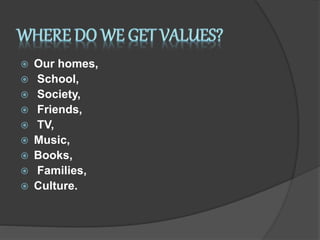
 Our homes,
 School,
 Society,
 Friends,
 TV,
 Music,
 Books,
 Families,
 Culture.
 Values play an important role in the integration
and fulfilment of man’s basic impulses and
desires.
 They build up societies, integrate social
relations.
 They influence people’s behaviour and serve as
criteria for evaluating the actions of others.
 They help in creating norms to guide day-to-day
behaviour.
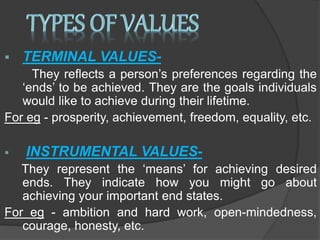
 TERMINAL VALUES-
They reflects a person’s preferences regarding the
‘ends’ to be achieved. They are the goals individuals
would like to achieve during their lifetime.
For eg - prosperity, achievement, freedom, equality, etc.
 INSTRUMENTAL VALUES-
They represent the ‘means’ for achieving desired
ends. They indicate how you might go about
achieving your important end states.
For eg - ambition and hard work, open-mindedness,
courage, honesty, etc.
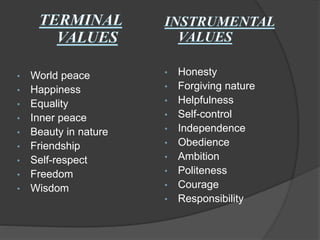
• World peace
• Happiness
• Equality
• Inner peace
• Beauty in nature
• Friendship
• Self-respect
• Freedom
• Wisdom
• Honesty
• Forgiving nature
• Helpfulness
• Self-control
• Independence
• Obedience
• Ambition
• Politeness
• Courage
• Responsibility
MEANING
 An individual’s behavior is also a
function of attitudes.
 An attitude is a learned predisposition,
an evaluative statement- either
favourable or unfavourable- toward a
given object, a person or an event. The
statement ‘I like my job’ reflects my
attitude towards my work.
 Attitudes are different from values.
 Values are the ideals that represent our
beliefs about ideal conduct and contain a
judgemental element.
 Attitudes are narrower as they represent our
feelings, thougths and behavioural
tendencies towards a specific object or
situation.
 Over a period of time, our attitudes, also
undergo a change.
 Attitudes have a past, present and future;
they evolve from past experience, they guide
our current behaviour, and can direct our
development in the future.
SOURCES OF ATTITUDES
Attitudes are basically learned. People are
not born with specific attitudes; rather
they acquire them through a process of
learning- especially from the following:
1. Experience: People gain experience in
forming (developing) attitudes by coming
in direct contact with an attitude object.
Through job experiences, individuals
learn attitudes.
2. Association: People are highly influenced by
the major groups or associations to which
they belong. The influence of groups on the
attitudes of the individual is inversely
proportional to the distance of the group from
the individual.
3. Family: Family exerts influence on the initial
core of attitudes held by an individual.
Individuals develop certain attitudes from
their family members. The family
characterstics influence the individual’s
attitude patterns to which he is initially
exposed.
4. Peer groups: As people approach their
adulthood, they increasingly rely on their
peer groups for approval/attitude. How
others judge an individual largely determines
his self image and approval seeking
behaviour.
5. Society: Social class and religious affiliation
also play a vital role in forming attitudes of an
individual. The culture, language and the
structure of society, all provide an individual
with the boundaries of his initial attitudes. At
a very early age, an individual is taught that
certain attitudes are acceptable and certain
others are not in the society.
6. Personality factors: Personality differences
between individuals play a major role in the
formation of attitudes. This particular area
has been the subject matter of great interest
and it carries a great deal of weight in
organisational behaviour.
COMPONENTS OF AN
ATTITUDE
 A person’s attitude comprises three vital
components: cognitive, affective and
behavioural.
1. Cognitive component: “ I believe
information and beliefs about a particular
person or object”. Beliefs are accepted
facts or truths about a person or an object.
The beliefs are generally based on a
variety of learning experiences, rumours,
misunderstanding, or any other
information. The cognitive component is
sometimes referred to as ‘opinion’.
2. Affective component: “I feel” It basically
consists of the feelings, sentiments, moods
and emotions a person has toward an
individual, event, object or situation. This
component is considered with the evaluation
and emotion and often expressed as like or
dislike, good or bad, pleasing or displeasing,
favourable or unfavourable. The expression
of warmth, love, hate, and other emotional
expressions also belong to the affective
component.
3. Behavioural component: “ I intend” This is
concerned with the way one intends to
behave toward someone or something. In
other words, the behavioural component of
attitude consists of the tendency to act or
reach toward an object in certain specified
ways. Unable to lodge my complaint with a
customer service executive of an electronics
company, I may shout, “ I’ll never call them
again. I’m not going to buy anything from this
company in future.
FUNCTIONS SERVED BY
ATTITUDES
According to D. Katz, attitudes serve four
important functions:
 Adjustment function: people strive to
maximise the rewards and minimise the
penalties in their external environment.
Attitudes are the means for reaching the
desired goals or for avoiding undesirable
results.
 The Ego defensive function: people normally
expend a great deal of their energies in the
process of learning to live with themselves.
Many of our attitudes serve the function of
defending our self-image.
 The Value expression function: value
expressive attitudes, according to katz, not
only give clarity to the self image but also
mould that self image closer to the heart’s
desire. Attitudes make people either bond or
clash. They allow us to tell others our
opinions and views.
 The Knowledge function: the world can be a
confusing and strange place; attitudes help
us to organise our social world, thus making
the world more familiar and predictable.
CHANGING ATTITUDES
Is it possible to change unfavourable
attitude of employee toward a more
favourable direction?
The answer, to a large extent, is yes. Let’s
see how this happens.
 Provide new information: In one classic
study, it was found that union workers
had an anti-management attitude.
However, when some of the workers
were promoted into the
management ranks, their attitudes changed.
They came to know how the company was
doing to help the workers and this
information made them look at managerial
efforts more favourably.
 Changing workplace situation: Managers
may bring change in employee’s attitudes by
changing their workplace situations- that is
by changing such work factors as
compensation, job design and work hours (in
line with employee expectations).
 Employing credible and knowledgeable
communicators: Employees may be willing to
adapt and change quickly, when they come
under the influence of a powerful persuasive
presentation, preferably by someone who is
credible, knowledgeable and convincing. To
this end, it is important to see that the
communicator holds a prestigious position in
the company, enjoys the trust of employees
and is liked by one and all.
 Using “fear appeals” : Low levels of fear
appeals, generally speaking, are ignored by
employees. The warnings do not seem to
bring about required amount of attention
from employees. If moderate levels of fear
arousal are employed, people take note of
the urgency and change their attitudes. High
degrees of fear arousal are, often, rejected
by people because the message itself is
viewed with scepticism.
Values and attitudes

Values and attitudes

  • 2.
    VALUES INTRODUCTION Values define whatis good or bad, right or wrong. They guide our behaviour wherever we go and are the primary source of our actions. Values are relatively permanent and deeply held desires of individuals.
  • 3.
     Qualities, characteristics,or ideas about which we feel strongly.  Our values affect our decisions, goals and behavior.  A belief or feeling that someone or something is worthwhile.  Values define what is of worth, what is beneficial, and what is harmful.  Values are standards to guide your action, judgments, and attitudes.
  • 4.
     Values influenceour preference for goals and the means to achieve our needs.  It contain a judgemental element by showcasing a person’s ideas as to what is right, good or desirable.  They are moralistic in nature.  Most of our basic values are learnt early in life from family, friends, neighbourhood, school, etc.  Values of culture may change, but most remain stable.
  • 5.
     Our homes, School,  Society,  Friends,  TV,  Music,  Books,  Families,  Culture.
  • 6.
     Values playan important role in the integration and fulfilment of man’s basic impulses and desires.  They build up societies, integrate social relations.  They influence people’s behaviour and serve as criteria for evaluating the actions of others.  They help in creating norms to guide day-to-day behaviour.
  • 7.
     TERMINAL VALUES- Theyreflects a person’s preferences regarding the ‘ends’ to be achieved. They are the goals individuals would like to achieve during their lifetime. For eg - prosperity, achievement, freedom, equality, etc.  INSTRUMENTAL VALUES- They represent the ‘means’ for achieving desired ends. They indicate how you might go about achieving your important end states. For eg - ambition and hard work, open-mindedness, courage, honesty, etc.
  • 8.
    • World peace •Happiness • Equality • Inner peace • Beauty in nature • Friendship • Self-respect • Freedom • Wisdom • Honesty • Forgiving nature • Helpfulness • Self-control • Independence • Obedience • Ambition • Politeness • Courage • Responsibility
  • 10.
    MEANING  An individual’sbehavior is also a function of attitudes.  An attitude is a learned predisposition, an evaluative statement- either favourable or unfavourable- toward a given object, a person or an event. The statement ‘I like my job’ reflects my attitude towards my work.  Attitudes are different from values.
  • 11.
     Values arethe ideals that represent our beliefs about ideal conduct and contain a judgemental element.  Attitudes are narrower as they represent our feelings, thougths and behavioural tendencies towards a specific object or situation.  Over a period of time, our attitudes, also undergo a change.  Attitudes have a past, present and future; they evolve from past experience, they guide our current behaviour, and can direct our development in the future.
  • 12.
    SOURCES OF ATTITUDES Attitudesare basically learned. People are not born with specific attitudes; rather they acquire them through a process of learning- especially from the following: 1. Experience: People gain experience in forming (developing) attitudes by coming in direct contact with an attitude object. Through job experiences, individuals learn attitudes.
  • 13.
    2. Association: Peopleare highly influenced by the major groups or associations to which they belong. The influence of groups on the attitudes of the individual is inversely proportional to the distance of the group from the individual. 3. Family: Family exerts influence on the initial core of attitudes held by an individual. Individuals develop certain attitudes from their family members. The family characterstics influence the individual’s attitude patterns to which he is initially exposed.
  • 14.
    4. Peer groups:As people approach their adulthood, they increasingly rely on their peer groups for approval/attitude. How others judge an individual largely determines his self image and approval seeking behaviour. 5. Society: Social class and religious affiliation also play a vital role in forming attitudes of an individual. The culture, language and the structure of society, all provide an individual with the boundaries of his initial attitudes. At a very early age, an individual is taught that certain attitudes are acceptable and certain others are not in the society.
  • 15.
    6. Personality factors:Personality differences between individuals play a major role in the formation of attitudes. This particular area has been the subject matter of great interest and it carries a great deal of weight in organisational behaviour.
  • 16.
    COMPONENTS OF AN ATTITUDE A person’s attitude comprises three vital components: cognitive, affective and behavioural. 1. Cognitive component: “ I believe information and beliefs about a particular person or object”. Beliefs are accepted facts or truths about a person or an object. The beliefs are generally based on a variety of learning experiences, rumours, misunderstanding, or any other information. The cognitive component is sometimes referred to as ‘opinion’.
  • 17.
    2. Affective component:“I feel” It basically consists of the feelings, sentiments, moods and emotions a person has toward an individual, event, object or situation. This component is considered with the evaluation and emotion and often expressed as like or dislike, good or bad, pleasing or displeasing, favourable or unfavourable. The expression of warmth, love, hate, and other emotional expressions also belong to the affective component.
  • 18.
    3. Behavioural component:“ I intend” This is concerned with the way one intends to behave toward someone or something. In other words, the behavioural component of attitude consists of the tendency to act or reach toward an object in certain specified ways. Unable to lodge my complaint with a customer service executive of an electronics company, I may shout, “ I’ll never call them again. I’m not going to buy anything from this company in future.
  • 19.
    FUNCTIONS SERVED BY ATTITUDES Accordingto D. Katz, attitudes serve four important functions:  Adjustment function: people strive to maximise the rewards and minimise the penalties in their external environment. Attitudes are the means for reaching the desired goals or for avoiding undesirable results.
  • 20.
     The Egodefensive function: people normally expend a great deal of their energies in the process of learning to live with themselves. Many of our attitudes serve the function of defending our self-image.  The Value expression function: value expressive attitudes, according to katz, not only give clarity to the self image but also mould that self image closer to the heart’s desire. Attitudes make people either bond or clash. They allow us to tell others our opinions and views.
  • 21.
     The Knowledgefunction: the world can be a confusing and strange place; attitudes help us to organise our social world, thus making the world more familiar and predictable.
  • 22.
    CHANGING ATTITUDES Is itpossible to change unfavourable attitude of employee toward a more favourable direction? The answer, to a large extent, is yes. Let’s see how this happens.  Provide new information: In one classic study, it was found that union workers had an anti-management attitude. However, when some of the workers were promoted into the
  • 23.
    management ranks, theirattitudes changed. They came to know how the company was doing to help the workers and this information made them look at managerial efforts more favourably.  Changing workplace situation: Managers may bring change in employee’s attitudes by changing their workplace situations- that is by changing such work factors as compensation, job design and work hours (in line with employee expectations).
  • 24.
     Employing credibleand knowledgeable communicators: Employees may be willing to adapt and change quickly, when they come under the influence of a powerful persuasive presentation, preferably by someone who is credible, knowledgeable and convincing. To this end, it is important to see that the communicator holds a prestigious position in the company, enjoys the trust of employees and is liked by one and all.
  • 25.
     Using “fearappeals” : Low levels of fear appeals, generally speaking, are ignored by employees. The warnings do not seem to bring about required amount of attention from employees. If moderate levels of fear arousal are employed, people take note of the urgency and change their attitudes. High degrees of fear arousal are, often, rejected by people because the message itself is viewed with scepticism.