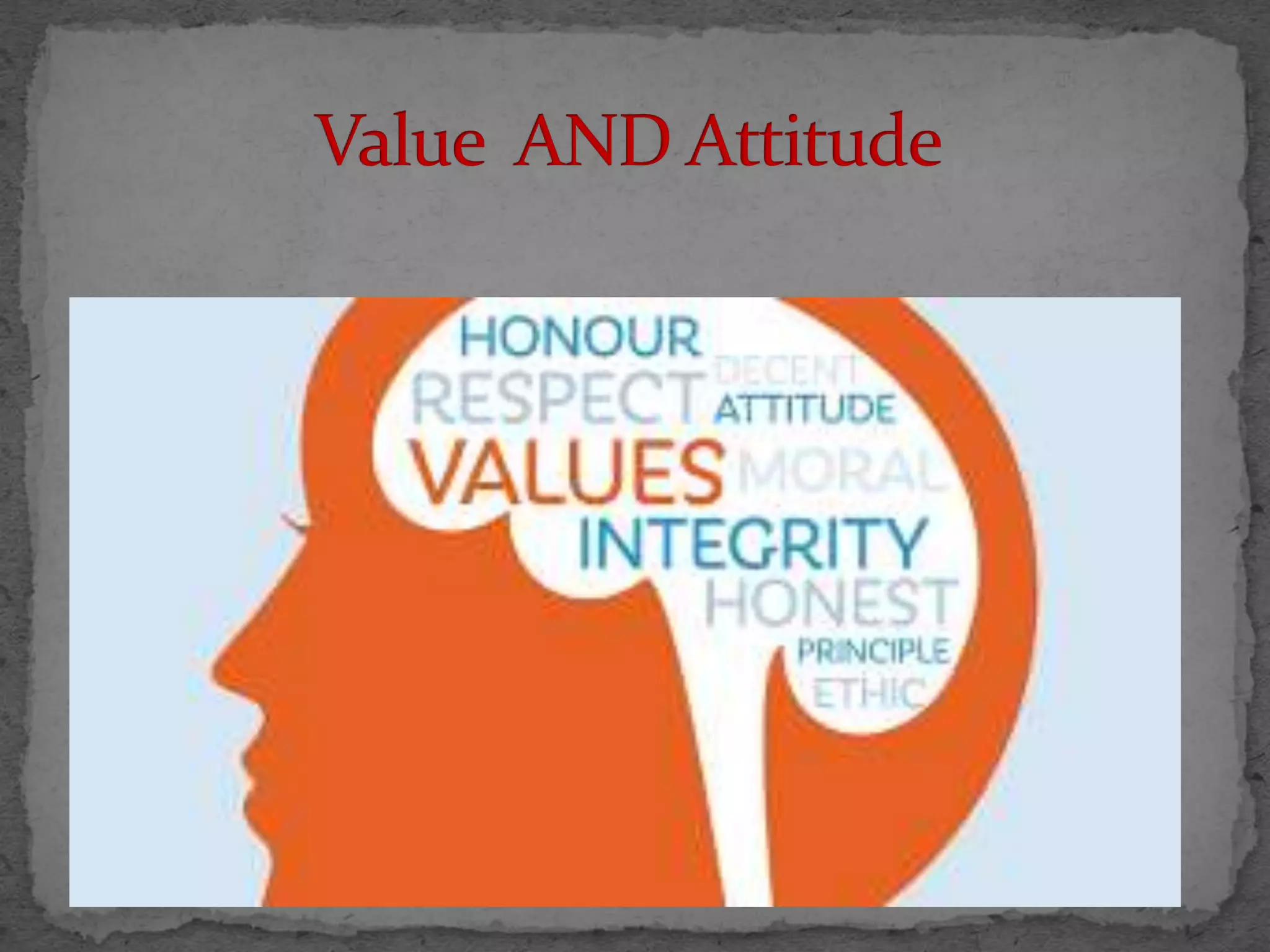
Value and attitude
By / MahmoudShaqria
‫شقريه‬ ‫محمد‬ ‫محمود‬
1-Introduction
2- Definition of value
3- Types of value
4- Characteristics of values
5-Sources of values
6-Definition of attitude
7- Factors to determine attitude
8- Types of attitude
9- Source of attitude
10- Component of attitude
11- Similarities between Values and Attitudes
12- Dissimilarities between Values and Attitudes
As human beings, we all have our own values , beliefs
and attitudes that we have developed throughout the
course of our lives. Our family, friends, community
and the experiences we have had all contribute to our
sense of who we are and how we view the world. As
community services workers, we are often working
with people who are vulnerable and/or who may live a
lifestyle that mainstream society views as being
different or unacceptable.
*Is our sense of what is Right or wrong,
our ethical and moral standards
* Our values are the things we believe are
good/bad, right/wrong,
acceptable/unacceptable and what we
experience when we reflect or analyze our
duties
1-Terminal values.
2-Instrumental values.
*These are values that we think are
most important or most desirable.
*These refer to desirable end states of
existence, the goals a person would
like to achieve during his or her
lifetime.
*Instrumental values deal with views on
acceptable modes of conductor means of
achieving the terminal values.
*These include being honest, sincere,
ethical, and being ambitious. These values
are more focused on personality traits and
character.
These are relatively permanent*
*These are more central to the core of a person.
*Most of our core values are learned early in life from
family, friends, neighborhood school, the mass print,
visual media and other sources within the society.
*Values are loaded with effective thoughts about ideas,
objects, behavior, etc.
*Personal values can be influenced by culture, tradition,
and a combination of internal and external factors
*They influence people’s behavior and serve as criteria
for evaluating the actions of others
-Family: Family is a great source of values. A child learns his first
value from his family.
-Friends &peers: Friends and peers play a vital role in achieving
values.
-Community or society
-School: As a learner, school and teachers also play a very
important role in introducing values.
-Media: such as Print media, electronic media also play the role
of increasing values in the mind of people.
-Relatives: helps to create values in the minds of people.
-Organization: Different organizations and institutions also play a
vital role in creating value.
-Religion.
The way that you think and feel about
something , especially when
this shows in the way you behave
1-Environment
2-Experience
3-Education
-Home: positive or negative influences
-School: peer pressure
-Work: supportive or over critical
supervisor
-Media: television, newspapers, magazines,
radio, movies
-Cultural background
-Religious background
Our behavior changes according to our
experiences with people and events in
our life. If we have a positive
experience with a person, our attitude
toward him becomes positive and
vice versa.
Refers to both formal and informal
education, not just academic
qualifications. Knowledge
strategically applied translates into
wisdom, ensuring success.
1-Positive attitude
2- Negative attitude
3- Neutral attitude
A positive attitude has many benefits which
affect out other kinds of behavior in a
good way
Examples of positive attitude:-
*Happiness
*Confidence
*Satisfaction
A negative attitude is something that each and every person
should avoid. Generally, the people will negative attitude
ignore the good things in life and only think about whether they
will fail. They often find a way out of tough situations by
running away from it. They often compare themselves with
other persons and find the bad in them only
Examples of negative attitude:-
*Anger
*Doubt
*Hate
*Frustration
The people generally tend to ignore the
problems in life. They wait for some other
individual to take care of their problems.
They generally have a lazy life and they
are often unemotional. It is as if they
don’t think about anything that much and
doesn’t care for the same as well.
1-Affective component
2- Behavioral component
3-Cognitive component
Refers to your feelings or emotions
linked to an attitude object. Affective
responses influence attitudes in a
number of ways.
Refers to the way the attitude we have
influences how we act or behave.
Refers to the beliefs, thoughts, and
attributes that we would associate
with an object. Many times a person's
attitude might be based on the
negative and positive attributes they
associate with an object.
1-Values and attitudes are two important
variables influencing cognitive process and
behavior.
2-They are learned and acquired essentially from
the same sources.
3-They endure and are resistant to change.
4-They have a reciprocal influence and are used
interchangeably.
2-
Dissimilarities between Values and
Attitudes:-
 .
Values Attitudes
Values help to guide our behavior.
Attitudes are the response that is a
result of our values.
Values decide what we think as for right,
wrong, good, or unjust.
Attitudes are our likes and dislike
towards things, people, and objects.
Values are more or less permanent in
nature.
Attitudes are changeable with
favorable experiences.
They represent single belief that, guides
actions and judgment across objects and
situations.
They represent several beliefs
focused on a specific object or
situation.
They derived from social and cultural
mores.
These are personal experiences.
Values and attitude

Values and attitude

  • 1.
    Value and attitude By/ MahmoudShaqria ‫شقريه‬ ‫محمد‬ ‫محمود‬
  • 3.
    1-Introduction 2- Definition ofvalue 3- Types of value 4- Characteristics of values 5-Sources of values 6-Definition of attitude 7- Factors to determine attitude 8- Types of attitude 9- Source of attitude 10- Component of attitude 11- Similarities between Values and Attitudes 12- Dissimilarities between Values and Attitudes
  • 4.
    As human beings,we all have our own values , beliefs and attitudes that we have developed throughout the course of our lives. Our family, friends, community and the experiences we have had all contribute to our sense of who we are and how we view the world. As community services workers, we are often working with people who are vulnerable and/or who may live a lifestyle that mainstream society views as being different or unacceptable.
  • 5.
    *Is our senseof what is Right or wrong, our ethical and moral standards * Our values are the things we believe are good/bad, right/wrong, acceptable/unacceptable and what we experience when we reflect or analyze our duties
  • 6.
  • 7.
    *These are valuesthat we think are most important or most desirable. *These refer to desirable end states of existence, the goals a person would like to achieve during his or her lifetime.
  • 8.
    *Instrumental values dealwith views on acceptable modes of conductor means of achieving the terminal values. *These include being honest, sincere, ethical, and being ambitious. These values are more focused on personality traits and character.
  • 9.
    These are relativelypermanent* *These are more central to the core of a person. *Most of our core values are learned early in life from family, friends, neighborhood school, the mass print, visual media and other sources within the society. *Values are loaded with effective thoughts about ideas, objects, behavior, etc. *Personal values can be influenced by culture, tradition, and a combination of internal and external factors *They influence people’s behavior and serve as criteria for evaluating the actions of others
  • 10.
    -Family: Family isa great source of values. A child learns his first value from his family. -Friends &peers: Friends and peers play a vital role in achieving values. -Community or society -School: As a learner, school and teachers also play a very important role in introducing values. -Media: such as Print media, electronic media also play the role of increasing values in the mind of people. -Relatives: helps to create values in the minds of people. -Organization: Different organizations and institutions also play a vital role in creating value. -Religion.
  • 11.
    The way thatyou think and feel about something , especially when this shows in the way you behave
  • 12.
  • 13.
    -Home: positive ornegative influences -School: peer pressure -Work: supportive or over critical supervisor -Media: television, newspapers, magazines, radio, movies -Cultural background -Religious background
  • 14.
    Our behavior changesaccording to our experiences with people and events in our life. If we have a positive experience with a person, our attitude toward him becomes positive and vice versa.
  • 15.
    Refers to bothformal and informal education, not just academic qualifications. Knowledge strategically applied translates into wisdom, ensuring success.
  • 16.
    1-Positive attitude 2- Negativeattitude 3- Neutral attitude
  • 17.
    A positive attitudehas many benefits which affect out other kinds of behavior in a good way Examples of positive attitude:- *Happiness *Confidence *Satisfaction
  • 18.
    A negative attitudeis something that each and every person should avoid. Generally, the people will negative attitude ignore the good things in life and only think about whether they will fail. They often find a way out of tough situations by running away from it. They often compare themselves with other persons and find the bad in them only Examples of negative attitude:- *Anger *Doubt *Hate *Frustration
  • 19.
    The people generallytend to ignore the problems in life. They wait for some other individual to take care of their problems. They generally have a lazy life and they are often unemotional. It is as if they don’t think about anything that much and doesn’t care for the same as well.
  • 21.
    1-Affective component 2- Behavioralcomponent 3-Cognitive component
  • 22.
    Refers to yourfeelings or emotions linked to an attitude object. Affective responses influence attitudes in a number of ways.
  • 23.
    Refers to theway the attitude we have influences how we act or behave.
  • 24.
    Refers to thebeliefs, thoughts, and attributes that we would associate with an object. Many times a person's attitude might be based on the negative and positive attributes they associate with an object.
  • 25.
    1-Values and attitudesare two important variables influencing cognitive process and behavior. 2-They are learned and acquired essentially from the same sources. 3-They endure and are resistant to change. 4-They have a reciprocal influence and are used interchangeably. 2-
  • 26.
    Dissimilarities between Valuesand Attitudes:-  . Values Attitudes Values help to guide our behavior. Attitudes are the response that is a result of our values. Values decide what we think as for right, wrong, good, or unjust. Attitudes are our likes and dislike towards things, people, and objects. Values are more or less permanent in nature. Attitudes are changeable with favorable experiences. They represent single belief that, guides actions and judgment across objects and situations. They represent several beliefs focused on a specific object or situation. They derived from social and cultural mores. These are personal experiences.