By- Durgesh Vaishya
Praveen Kumar
Aalok Rai
Darshana Burman
Roopesh Kumar
Varsha Yadav
Taxation
.
 Taxation refers to the act of a taxing authority actually

levying tax. Taxation as a term applies to all types of
taxes from income to gift to a estate taxes. It is usually
refer to as an act any revenue collected is usually called
Taxation.
History of Taxation
 It is a matter of general belief that taxation are of

recent origin but in ancient time also taxes were levied
in some form on sale and purchase of merchandise or
livestock. It was all over world. In India Kautilya’s
Arthshastra, which deals with he system of Taxation in
a real elaborate & planned manner.
Tax
It was only for the good of his subjects that he
collected taxes from them, just as Sun draws moisture
from the Earth to give it back a thousands fold.
Kalidas in Raghuvansh eulogizing King Dalip
Modern Definition
 Tax is imposition of financial charge or other levying

upon a taxpayer by Government or other functional
equivalent of the state.
Government Policy
 The organisational history of Income-tax Department

starts in the year 1922.In 1961 Direct Tax Advisory
Committee set up- Direct Taxes Administrative
Enquiry Committee constituted & Income Tax Act
, 1961 came into existence which extends to whole
india & became effective from 1st april 1962.
 Every year a Budget is presented before Parliament by
Finance Minister. Most important component of
Budget is Finance Bill, which contains amendments
which are sought to be made in the area of Direct tax
levied by Central Government.
Types of taxesDirect Tax
ii. Indirect Tax
i.
Direct Tax
 The taxes whose burden falls directly on taxpayers are

Direct Tax.
e.g.-Income tax, Wealth tax, Property tax etc.
Indirect Tax
 Indirect taxes are the taxes in which the burden of

paying tax is shifted through a change in price.
e.g.-Custom Duty, Excise Duty, Sales tax, Service tax
etc.
Income Tax
 It is a tax on the income of an Individual or Entity

levied by Government. It was introduce in
1860, discontinued in 1873 & reintroduced in 1880.
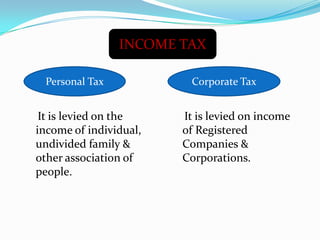
Income TAX
INCOME Tax
Personal TAX
PERSONALTax

It is levied on the
income of individual,
undivided family &
other association of
people.

Corporate TAX
CORPORATETax

It is levied on income
of Registered
Companies &
Corporations.
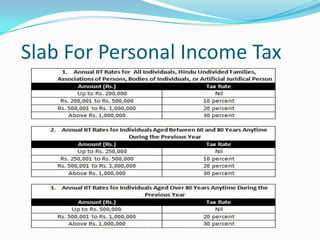
Personal Income Tax
 Income from all the sources are considered.
 Certain rebates, Deductions, Expenditures, Insurances

are not consider for levy tax.
 It is progressive i.e. if income increases tax rate also
increases.
 It is levied on the basis of slabs.
Slab For Personal Income Tax
Corporate Income Tax
 Rationale for Corporate Tax is that a Joint Stock

Company has a separate Entity so taxed separately.
 A Corporation Pays taxes on behalf of income of
Shareholders on Dividends paid to them, & each
Shareholder get a Credit till 1960-61. Now Share
holders don’t get credit because Entity treat as
separate Entity.
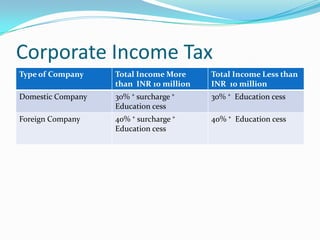
 Corporation pays on flat tax rates & it is different for
Indian companies &Foreign companies.
Corporate Income Tax
Type of Company

Total Income More
than INR 10 million

Total Income Less than
INR 10 million

Domestic Company

30% ⁺ surcharge ⁺
Education cess

30% ⁺ Education cess

Foreign Company

40% ⁺ surcharge ⁺
Education cess

40% ⁺ Education cess
Custom Duty & Octroi
 Custom Duty is levied on Import & Export. From

revenue’s point of view, importance of Export Duty is
limited.
 Since 1991 Custom Duty structure was pruned & now
maximum rate of Custom Duty is 10%.
 Octroi is a tax on goods entering in to Municipality or
any other jurisdiction for use, consumption or sale.
Excise Duty
 Excise Duty is a tax charged on goods produced within

the country. This is opposite to Custom Duty . Its
another name is CENVAT(Central Value Added Tax).
Anti Dumping Duty
 Dumping is said to occur when the goods are exported

by a country to another at a price lower than its normal
value. This is an unfair trade practice which can have a
distortive effect on international trade. In order to
rectify this situation Central Government imposes it.
Sales Tax
 This is the tax imposed on the sales of movable goods.

Sale tax on inter state sale is levied by Union
Government & on intra state sale by state government.
Service Tax
 The tax on paid services you take is Service Tax. Over

past few years, it is expanded to cover new services.
Few of the major service which comes under vicinity of
service tax are telephone, tour
operator, architect, advertising, health center, banking
& financial services etc.
Value Added Tax
 The part of Sales Tax imposed by State government is

called Value Added Tax. It covers more than 220 items.
VAT rates vary based on nature of item &state.
Advantage of Taxes
 It helps to the Government in its revenue which is

used to facilitate people of a country.
 It helps to control inflation.
 It restrict Government to take loan from World Bank.
 It utilizes public money in social walefare.
Disadvantage of Taxes
 It restrict common people to get extra happiness at

some extent.
 If Government misuse tax we don’t have any control on
it.

Taxation

  • 1.
    By- Durgesh Vaishya PraveenKumar Aalok Rai Darshana Burman Roopesh Kumar Varsha Yadav
  • 2.
    Taxation .  Taxation refersto the act of a taxing authority actually levying tax. Taxation as a term applies to all types of taxes from income to gift to a estate taxes. It is usually refer to as an act any revenue collected is usually called Taxation.
  • 3.
    History of Taxation It is a matter of general belief that taxation are of recent origin but in ancient time also taxes were levied in some form on sale and purchase of merchandise or livestock. It was all over world. In India Kautilya’s Arthshastra, which deals with he system of Taxation in a real elaborate & planned manner.
  • 4.
    Tax It was onlyfor the good of his subjects that he collected taxes from them, just as Sun draws moisture from the Earth to give it back a thousands fold. Kalidas in Raghuvansh eulogizing King Dalip
  • 5.
    Modern Definition  Taxis imposition of financial charge or other levying upon a taxpayer by Government or other functional equivalent of the state.
  • 6.
    Government Policy  Theorganisational history of Income-tax Department starts in the year 1922.In 1961 Direct Tax Advisory Committee set up- Direct Taxes Administrative Enquiry Committee constituted & Income Tax Act , 1961 came into existence which extends to whole india & became effective from 1st april 1962.  Every year a Budget is presented before Parliament by Finance Minister. Most important component of Budget is Finance Bill, which contains amendments which are sought to be made in the area of Direct tax levied by Central Government.
  • 7.
    Types of taxesDirectTax ii. Indirect Tax i.
  • 8.
    Direct Tax  Thetaxes whose burden falls directly on taxpayers are Direct Tax. e.g.-Income tax, Wealth tax, Property tax etc.
  • 9.
    Indirect Tax  Indirecttaxes are the taxes in which the burden of paying tax is shifted through a change in price. e.g.-Custom Duty, Excise Duty, Sales tax, Service tax etc.
  • 10.
    Income Tax  Itis a tax on the income of an Individual or Entity levied by Government. It was introduce in 1860, discontinued in 1873 & reintroduced in 1880.
  • 11.
    Income TAX INCOME Tax PersonalTAX PERSONALTax It is levied on the income of individual, undivided family & other association of people. Corporate TAX CORPORATETax It is levied on income of Registered Companies & Corporations.
  • 12.
    Personal Income Tax Income from all the sources are considered.  Certain rebates, Deductions, Expenditures, Insurances are not consider for levy tax.  It is progressive i.e. if income increases tax rate also increases.  It is levied on the basis of slabs.
  • 13.
  • 14.
    Corporate Income Tax Rationale for Corporate Tax is that a Joint Stock Company has a separate Entity so taxed separately.  A Corporation Pays taxes on behalf of income of Shareholders on Dividends paid to them, & each Shareholder get a Credit till 1960-61. Now Share holders don’t get credit because Entity treat as separate Entity.  Corporation pays on flat tax rates & it is different for Indian companies &Foreign companies.
  • 15.
    Corporate Income Tax Typeof Company Total Income More than INR 10 million Total Income Less than INR 10 million Domestic Company 30% ⁺ surcharge ⁺ Education cess 30% ⁺ Education cess Foreign Company 40% ⁺ surcharge ⁺ Education cess 40% ⁺ Education cess
  • 16.
    Custom Duty &Octroi  Custom Duty is levied on Import & Export. From revenue’s point of view, importance of Export Duty is limited.  Since 1991 Custom Duty structure was pruned & now maximum rate of Custom Duty is 10%.  Octroi is a tax on goods entering in to Municipality or any other jurisdiction for use, consumption or sale.
  • 17.
    Excise Duty  ExciseDuty is a tax charged on goods produced within the country. This is opposite to Custom Duty . Its another name is CENVAT(Central Value Added Tax).
  • 18.
    Anti Dumping Duty Dumping is said to occur when the goods are exported by a country to another at a price lower than its normal value. This is an unfair trade practice which can have a distortive effect on international trade. In order to rectify this situation Central Government imposes it.
  • 19.
    Sales Tax  Thisis the tax imposed on the sales of movable goods. Sale tax on inter state sale is levied by Union Government & on intra state sale by state government.
  • 20.
    Service Tax  Thetax on paid services you take is Service Tax. Over past few years, it is expanded to cover new services. Few of the major service which comes under vicinity of service tax are telephone, tour operator, architect, advertising, health center, banking & financial services etc.
  • 21.
    Value Added Tax The part of Sales Tax imposed by State government is called Value Added Tax. It covers more than 220 items. VAT rates vary based on nature of item &state.
  • 22.
    Advantage of Taxes It helps to the Government in its revenue which is used to facilitate people of a country.  It helps to control inflation.  It restrict Government to take loan from World Bank.  It utilizes public money in social walefare.
  • 23.
    Disadvantage of Taxes It restrict common people to get extra happiness at some extent.  If Government misuse tax we don’t have any control on it.