CT Imaging for 	Acute Aortic SyndromeCleveland Clinic Journal of Medicine 2008; 75(1):7-24
ABSTRACTAcute aortic syndrome can be due to acute aortic dissectionintramural hematomapenetrating atherosclerotic ulcerunstable thoracic aneurysmThese life-threatening conditions are clinically indistinguishable, often presenting with acute chest pain.Contrast-enhanced, cardiac-gated MDCT is a highly accurate imaging method for determining the cause of acute aortic syndrome.
KEY POINTSAcute aortic syndrome typically presents with chest pain in patients with a history of hypertension. In young patients with aortic dissection, one should consider Marfansyndrome and other connective tissue abnormalities.Cardiac gating is essential to avoid cardiac motion artifacts when evaluating the aortic root with contrast enhanced multidetectorCT.Urgent surgical repair is often necessary, especially for acute aortic dissection and intramural hematoma in the ascending aorta and aortic arch, unstable or ruptured thoracic aneurysm, and symptomatic penetrating atherosclerotic ulcers.
Risk FactorsAcquired and congenital disorders of the aortic wallBicuspid aortic valveCoarctationConnective tissue disordersEhlers-Danlos syndromeFamilial annuloaorticectasiaFamilial aortic dissectionMarfan syndromeVascular inflammationBehçet diseaseGiant cell arteritisSyphilitic aortitisTakayasuarteritisMultifactorial complex acquired conditionsAtherosclerosis
Diabetes
Dyslipidemia
Hypertension
Renal diseaseIatrogenic factorsEndovascular instrument
Valvular or aortic surgeryModifiable risk factorsCocaine or other illicit drug use
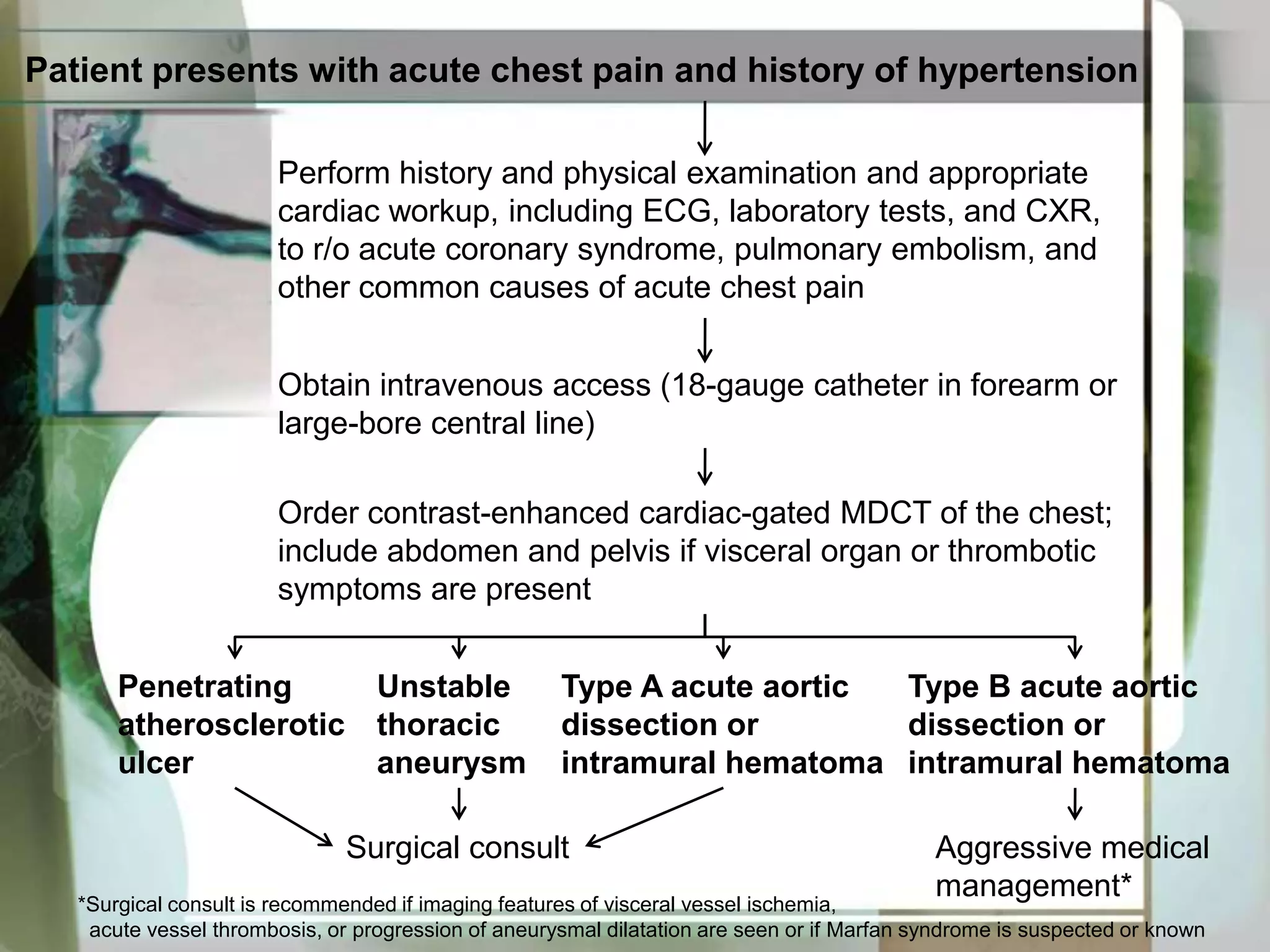
SmokingPatient presents with acute chest pain and history of hypertensionPerform history and physical examination and appropriate cardiac workup, including ECG, laboratory tests, and CXR, to r/o acute coronary syndrome, pulmonary embolism, andother common causes of acute chest painObtain intravenous access (18-gauge catheter in forearm or large-bore central line)Order contrast-enhanced cardiac-gated MDCT of the chest; include abdomen and pelvis if visceral organ or thrombotic symptoms are presentPenetratingatheroscleroticulcerUnstable thoracic aneurysm Type A acute aortic dissection or intramural hematoma Type B acute aortic dissection or intramural hematomaSurgical consultAggressive medicalmanagement**Surgical consult is recommended if imaging features of visceral vessel ischemia,   acute vessel thrombosis, or progression of aneurysmal dilatation are seen or if Marfan syndrome is suspected or known
Imaging Studies for Acute Aortic Syndrome
Left, contrast-enhanced, nongatedCT study with 3-mm slices of the aortic root from a patient with acute aortic syndrome demonstrates cardiac motion artifact mimicking an acute aortic dissection (arrows, left panel). Right, contrast-enhanced, cardiacgated CT with 0.75-mm slices of the aortic root reveals no dissection, although the aortic root is dilated.
Type A DissectionCoronal reformatted image (left) and oblique reformatted image (right) from contrast-enhanced, cardiac-gated CT in a patient with acute aorticsyndrome show a type A aortic dissection involving the aortic root, extending around the aortic valve, and aneurysmaldilatation of the aortic root.
Type A DissectionOblique reformatted images from contrast-enhanced, cardiac-gated CTbefore (left) and after (right) surgical aortic root repair with aortic valve replacement in a patient who initially presented with acute aortic syndrome and had a type A acute aortic dissection with aneurysmal dilatation of the aortic root.
Type B DissectionA coronal reformatted image (left) and an axial image (right) CT show a type B aortic dissection extending from the aortic arch into the abdomen. Hemorrhage from recent rupture is seen in the left and right hemithoraxand in the mediastinum (arrow).
Aortic Intramural HematomaCoronal reformatted image (left) and axial image (middle) CT in a patient with an acute type A intramural hematoma and a penetrating ulcer. Note the eccentric increased attenuation in the lateral aspect of the aortic arch representing the hematoma (arrow, middle panel) and the contrast-filled outpouchinglaterally representing the penetrating ulcer.Follow-up imaging several months later (right) shows that the intramural hematoma resolved although the penetrating ulcer persisted (arrow, right panel).
Aortic Intramural HematomaAcute intramural hematoma is easily recognized in CT without contrast enhancement  by the higher Hounsfield-unit value of the blood products in the wall in comparison with the flowing blood in the lumen, eccentric aortic wall-thickening and displacement of intimal calcifications.

CT Imaging for Acute Aortic Syndrome

  • 1.
    CT Imaging for Acute Aortic SyndromeCleveland Clinic Journal of Medicine 2008; 75(1):7-24
  • 2.
    ABSTRACTAcute aortic syndromecan be due to acute aortic dissectionintramural hematomapenetrating atherosclerotic ulcerunstable thoracic aneurysmThese life-threatening conditions are clinically indistinguishable, often presenting with acute chest pain.Contrast-enhanced, cardiac-gated MDCT is a highly accurate imaging method for determining the cause of acute aortic syndrome.
  • 3.
    KEY POINTSAcute aorticsyndrome typically presents with chest pain in patients with a history of hypertension. In young patients with aortic dissection, one should consider Marfansyndrome and other connective tissue abnormalities.Cardiac gating is essential to avoid cardiac motion artifacts when evaluating the aortic root with contrast enhanced multidetectorCT.Urgent surgical repair is often necessary, especially for acute aortic dissection and intramural hematoma in the ascending aorta and aortic arch, unstable or ruptured thoracic aneurysm, and symptomatic penetrating atherosclerotic ulcers.
  • 4.
    Risk FactorsAcquired andcongenital disorders of the aortic wallBicuspid aortic valveCoarctationConnective tissue disordersEhlers-Danlos syndromeFamilial annuloaorticectasiaFamilial aortic dissectionMarfan syndromeVascular inflammationBehçet diseaseGiant cell arteritisSyphilitic aortitisTakayasuarteritisMultifactorial complex acquired conditionsAtherosclerosis
  • 5.
  • 6.
  • 7.
  • 8.
  • 9.
    Valvular or aorticsurgeryModifiable risk factorsCocaine or other illicit drug use
  • 10.
    SmokingPatient presents withacute chest pain and history of hypertensionPerform history and physical examination and appropriate cardiac workup, including ECG, laboratory tests, and CXR, to r/o acute coronary syndrome, pulmonary embolism, andother common causes of acute chest painObtain intravenous access (18-gauge catheter in forearm or large-bore central line)Order contrast-enhanced cardiac-gated MDCT of the chest; include abdomen and pelvis if visceral organ or thrombotic symptoms are presentPenetratingatheroscleroticulcerUnstable thoracic aneurysm Type A acute aortic dissection or intramural hematoma Type B acute aortic dissection or intramural hematomaSurgical consultAggressive medicalmanagement**Surgical consult is recommended if imaging features of visceral vessel ischemia, acute vessel thrombosis, or progression of aneurysmal dilatation are seen or if Marfan syndrome is suspected or known
  • 11.
    Imaging Studies forAcute Aortic Syndrome
  • 13.
    Left, contrast-enhanced, nongatedCTstudy with 3-mm slices of the aortic root from a patient with acute aortic syndrome demonstrates cardiac motion artifact mimicking an acute aortic dissection (arrows, left panel). Right, contrast-enhanced, cardiacgated CT with 0.75-mm slices of the aortic root reveals no dissection, although the aortic root is dilated.
  • 14.
    Type A DissectionCoronalreformatted image (left) and oblique reformatted image (right) from contrast-enhanced, cardiac-gated CT in a patient with acute aorticsyndrome show a type A aortic dissection involving the aortic root, extending around the aortic valve, and aneurysmaldilatation of the aortic root.
  • 15.
    Type A DissectionObliquereformatted images from contrast-enhanced, cardiac-gated CTbefore (left) and after (right) surgical aortic root repair with aortic valve replacement in a patient who initially presented with acute aortic syndrome and had a type A acute aortic dissection with aneurysmal dilatation of the aortic root.
  • 16.
    Type B DissectionAcoronal reformatted image (left) and an axial image (right) CT show a type B aortic dissection extending from the aortic arch into the abdomen. Hemorrhage from recent rupture is seen in the left and right hemithoraxand in the mediastinum (arrow).
  • 17.
    Aortic Intramural HematomaCoronalreformatted image (left) and axial image (middle) CT in a patient with an acute type A intramural hematoma and a penetrating ulcer. Note the eccentric increased attenuation in the lateral aspect of the aortic arch representing the hematoma (arrow, middle panel) and the contrast-filled outpouchinglaterally representing the penetrating ulcer.Follow-up imaging several months later (right) shows that the intramural hematoma resolved although the penetrating ulcer persisted (arrow, right panel).
  • 18.
    Aortic Intramural HematomaAcuteintramural hematoma is easily recognized in CT without contrast enhancement by the higher Hounsfield-unit value of the blood products in the wall in comparison with the flowing blood in the lumen, eccentric aortic wall-thickening and displacement of intimal calcifications.
  • 19.
    Rupture of theAortaCT in a patient with acute aortic syndrome and hypotension demonstrates aneurysmal dilatation of the descending thoracic aorta with a contained aortic rupture anterolaterally (arrow). A layering left hemithorax is also visible (star).The patient underwent urgent endovascularstent repair.☆
  • 20.
    Unstable Thoracic AneurysmAnaortic aneurysm is defined as a permanent dilation at least 150% of normal size, or larger than 5 cm if in the thoracic aorta or larger than 3 cm if in the abdominal aorta.Dilations are more likely to rupture if they grow at least 1 cm per year or measure 6.0 cm or more (if in the ascending aorta) or 7.2 cm (if in the descending thoracic aorta).Patients are typically treated when a dilation in the ascending aorta reaches 5.5 cm or when one in the descending aorta reaches 6.0 cm; patients with Marfan syndrome should undergo invasive treatment for aneurysms with smaller diameters.
  • 21.
    Unstable Thoracic AneurysmCTsigns of imminent rupture include a high-attenuating crescent in the wall of the aorta, discontinuous calcification in a circumferentially calcified aorta, an aorta that conforms to the neighboring vertebral body (“draped” aorta), and an eccentric nipple shape to the aorta.CT signs of rupture include hemothorax (usually in the left hemithorax) and stranding of the periaorticfat.
  • 22.
    Penetrating Atherosclerotic UlcerCTin a patient with acute aortic syndrome demonstrate a focal contrast-filled outpouching of the distal thoracic aorta consistent with a penetrating atherosclerotic ulcer (arrows)
  • 23.
    Penetrating Atherosclerotic UlcerSurgeryto stabilize disease is recommended for a penetrating ulcer that causes acute aortic syndrome, or in patients with hemodynamic instability, aortic rupture, distal embolization, or a rapidly enlarging aorta.