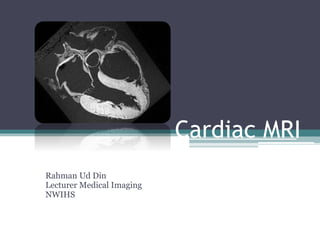
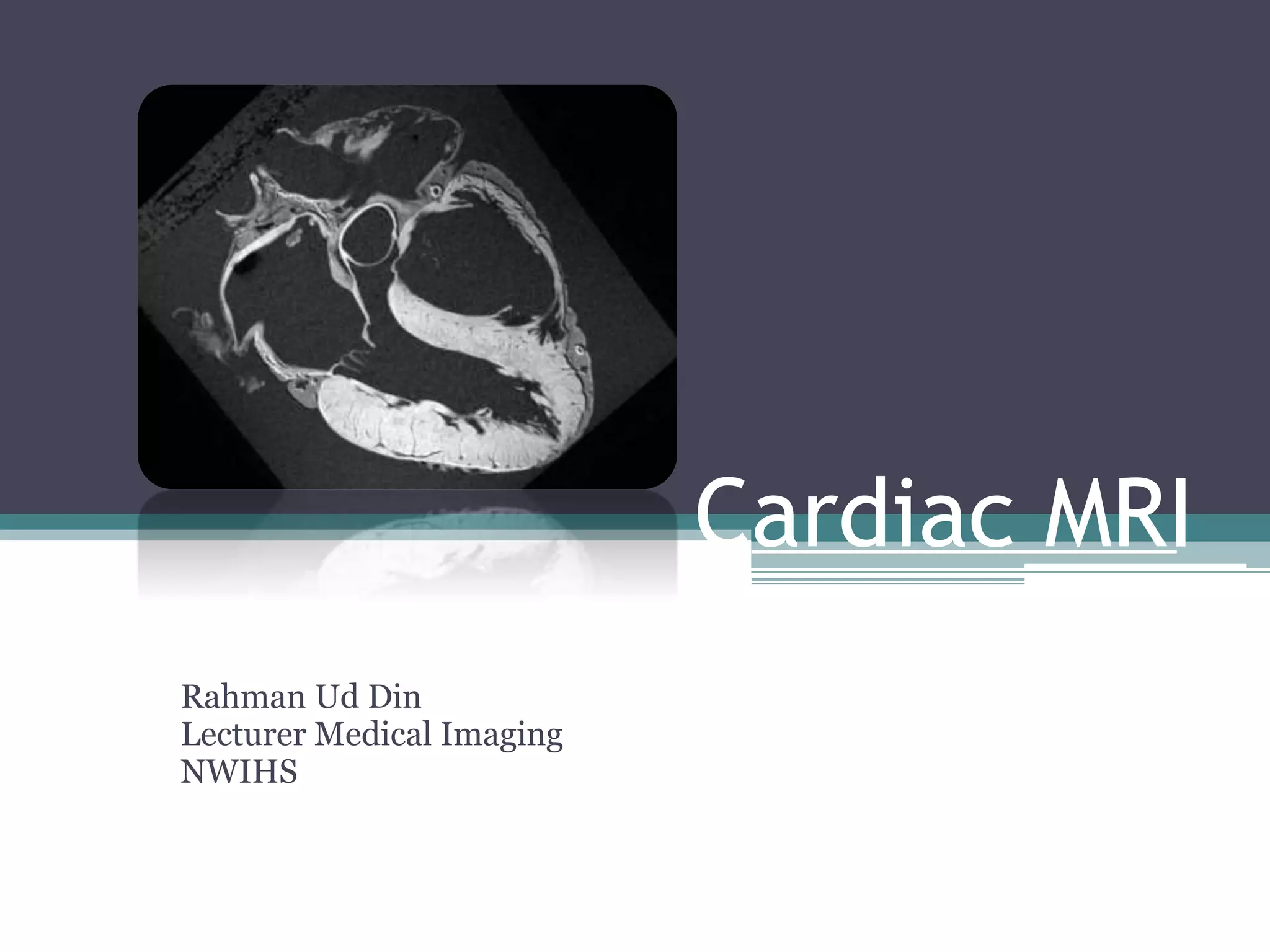
Cardiac MRI
Rahman Ud Din
Lecturer Medical Imaging
NWIHS
Introduction
• CMRI
• Information to assess the abnormality of heart
• Anatomical and functional information
• Acquired or congenital heart diseases
• Modality of choice
▫ ARVD,
▫ Differentiation from constrictive pericarditis from
restrictive pericarditis, aortic dissection
▫ Precise quantification of ventricular dimensions
▫ Myocardial viability and perfusion
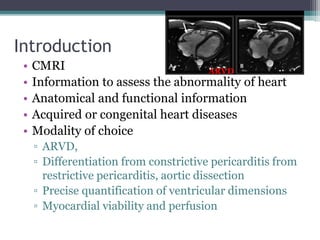
ARVD
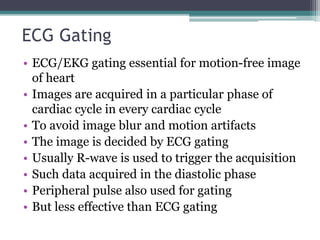
ECG Gating
• ECG/EKG gating essential for motion-free image
of heart
• Images are acquired in a particular phase of
cardiac cycle in every cardiac cycle
• To avoid image blur and motion artifacts
• The image is decided by ECG gating
• Usually R-wave is used to trigger the acquisition
• Such data acquired in the diastolic phase
• Peripheral pulse also used for gating
• But less effective than ECG gating
Imaging Sequences
• Pulse sequences used
▫ Dark-blood sequences
▫ Bright-blood sequences
• Dark-blood tech
• Spin-echo seq; that show the flowing blood as flow
void
• Seqs; include breath-hold turbo or FSE (TSE,
FSE)
• Single shot FSE
• Double inversion recovery FSE (Double-IR-FSE)
Bright blood technique
• GRE seq: based shows blood bright
• Seqs; include spoiled GRE
▫ (turboFLASH/SPGR/T1-FSE)
▫ Balanced SSFP (TrueFISP/FIESTA/balanced TFE)
• Balanced TFE is mainstay seq; in CMRI
• Motion loop is obtained rapid cine imaging (RCI)
• Used RCI used ventricular function
• To calculate EF, SV as well as valvular & RWM
• Phase contrast useful in velocity & flow direction
• Initial CMRI starts from black blood than bright
blood techniques used to assess functions
Imaging planes
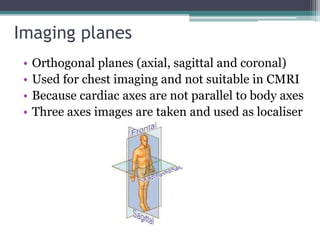
• Orthogonal planes (axial, sagittal and coronal)
• Used for chest imaging and not suitable in CMRI
• Because cardiac axes are not parallel to body axes
• Three axes images are taken and used as localiser
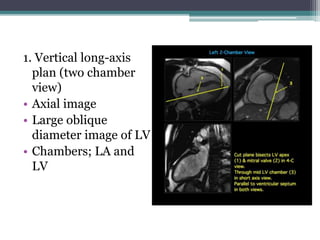
1. Vertical long-axis
plan (two chamber
view)
• Axial image
• Large oblique
diameter image of LV
• Chambers; LA and
LV
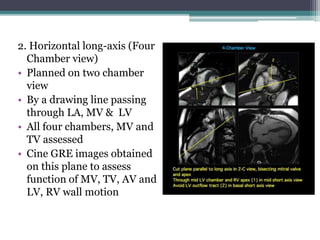
2. Horizontal long-axis (Four
Chamber view)
• Planned on two chamber
view
• By a drawing line passing
through LA, MV & LV
• All four chambers, MV and
TV assessed
• Cine GRE images obtained
on this plane to assess
function of MV, TV, AV and
LV, RV wall motion
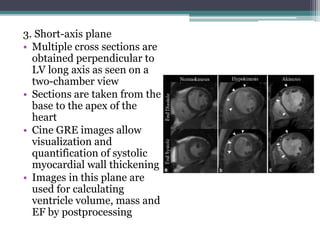
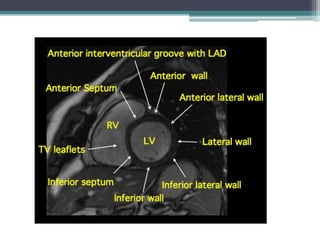
3. Short-axis plane
• Multiple cross sections are
obtained perpendicular to
LV long axis as seen on a
two-chamber view
• Sections are taken from the
base to the apex of the
heart
• Cine GRE images allow
visualization and
quantification of systolic
myocardial wall thickening
• Images in this plane are
used for calculating
ventricle volume, mass and
EF by postprocessing
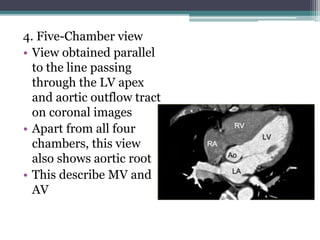
4. Five-Chamber view
• View obtained parallel
to the line passing
through the LV apex
and aortic outflow tract
on coronal images
• Apart from all four
chambers, this view
also shows aortic root
• This describe MV and
AV
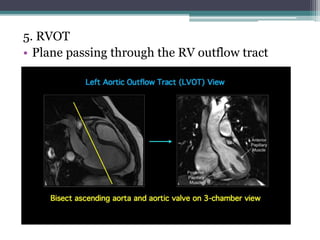
5. RVOT
• Plane passing through the RV outflow tract
Clinical Applications of CMRI
1. Congenital Heart Disease (CHD)
• Complex information about heart anatomy
• When echocardiography fail
• ASD, VSD detected with high sensitivity &
specificity
• Calculate shunt size
• Conditions like
▫ TGA (transposition of Greater Arteries)
▫ Truncus arteriosus
▫ Many anomalies
CMRI in children are having limitation
ASD
Truncus
arteriosus
2. Valvular Heart Disease (VHD)
• Arrhythmogenic right ventricular dysphagia
• Enlargement and dilatation of RV
• Thinning of wall, area of dyskinesia, focal
bulging of free wall in systole
• Decreased EF and impair ventricular filling
during diastole
• HCM (Hypertrophied)
▫ Echo detect but RV involvement is checked CMRI
• RCM (Restrictive) vs Constrictive
▫ Constrictive calcified pericardium, WT + 4mm
• Hemochromatosis
▫ Myocardial iron deposition i.e. Thalasemia
▫ Quantified by T2*-w seq;
4. Ventricular Function
• CMRI more accurate than Echo
• It measure EF, EDV & ESV (end systolic vol)
• Done on short axis image using software
• Balanced SSFP, good contrast b/w blood pool
and myocardium
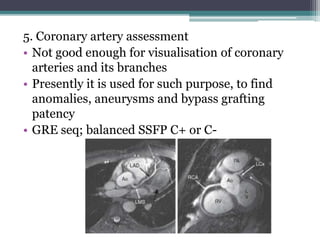
5. Coronary artery assessment
• Not good enough for visualisation of coronary
arteries and its branches
• Presently it is used for such purpose, to find
anomalies, aneurysms and bypass grafting
patency
• GRE seq; balanced SSFP C+ or C-
6. Myocardial perfusion and viability
• IV Gd
• T1-weighted GRE seq; turboFLASH
• Low signal areas of underperfusion on these images
correspond with regions of ischemia or infarct
• Myocardial viability
▫ Viability seq; run after 10-15 minutes after Gd contrast
▫ T1-w GRE or inversion recovery balanced SSFP seq
▫ IR pulse used to suppress myocardium to get LV info
▫ Proper TI is important
▫ Infracted area on viability imaging shows enhancement
▫ This imaging is ‘Bright is dead’
▫ Answer feasibility revascularisation procedure like
angioplasty and bypass or not
▫ CMRI viability is superior compared to the PET
7. Cardiac and Pericardial masses
• CMRI accurate method for cardiac and
pericardial masses evaluation
• Thrombus the most common filling defect in
cardiac chamber
• Gd enhancement differentiate b/w mass or
thrombus
• Most cardiac neoplasm are metastatic
• Primary neoplasm are rare and 80% benign
8. Pericardial disease
• Visualised with spin echo or GRE images
• Normal pericardium seen on SE images
• As a line of low signal intensity located b/w high
signals of pericardial and epicardial fat
• Normal thickness 1-2 mm; more than 4 mm is
considered thickening

Cardiac Magnetic Resonance Imaging

  • 1.
    Cardiac MRI Rahman UdDin Lecturer Medical Imaging NWIHS
  • 2.
    Introduction • CMRI • Informationto assess the abnormality of heart • Anatomical and functional information • Acquired or congenital heart diseases • Modality of choice ▫ ARVD, ▫ Differentiation from constrictive pericarditis from restrictive pericarditis, aortic dissection ▫ Precise quantification of ventricular dimensions ▫ Myocardial viability and perfusion ARVD
  • 3.
    ECG Gating • ECG/EKGgating essential for motion-free image of heart • Images are acquired in a particular phase of cardiac cycle in every cardiac cycle • To avoid image blur and motion artifacts • The image is decided by ECG gating • Usually R-wave is used to trigger the acquisition • Such data acquired in the diastolic phase • Peripheral pulse also used for gating • But less effective than ECG gating
  • 4.
    Imaging Sequences • Pulsesequences used ▫ Dark-blood sequences ▫ Bright-blood sequences • Dark-blood tech • Spin-echo seq; that show the flowing blood as flow void • Seqs; include breath-hold turbo or FSE (TSE, FSE) • Single shot FSE • Double inversion recovery FSE (Double-IR-FSE)
  • 5.
    Bright blood technique •GRE seq: based shows blood bright • Seqs; include spoiled GRE ▫ (turboFLASH/SPGR/T1-FSE) ▫ Balanced SSFP (TrueFISP/FIESTA/balanced TFE) • Balanced TFE is mainstay seq; in CMRI • Motion loop is obtained rapid cine imaging (RCI) • Used RCI used ventricular function • To calculate EF, SV as well as valvular & RWM • Phase contrast useful in velocity & flow direction • Initial CMRI starts from black blood than bright blood techniques used to assess functions
  • 6.
    Imaging planes • Orthogonalplanes (axial, sagittal and coronal) • Used for chest imaging and not suitable in CMRI • Because cardiac axes are not parallel to body axes • Three axes images are taken and used as localiser
  • 7.
    1. Vertical long-axis plan(two chamber view) • Axial image • Large oblique diameter image of LV • Chambers; LA and LV
  • 8.
    2. Horizontal long-axis(Four Chamber view) • Planned on two chamber view • By a drawing line passing through LA, MV & LV • All four chambers, MV and TV assessed • Cine GRE images obtained on this plane to assess function of MV, TV, AV and LV, RV wall motion
  • 9.
    3. Short-axis plane •Multiple cross sections are obtained perpendicular to LV long axis as seen on a two-chamber view • Sections are taken from the base to the apex of the heart • Cine GRE images allow visualization and quantification of systolic myocardial wall thickening • Images in this plane are used for calculating ventricle volume, mass and EF by postprocessing
  • 11.
    4. Five-Chamber view •View obtained parallel to the line passing through the LV apex and aortic outflow tract on coronal images • Apart from all four chambers, this view also shows aortic root • This describe MV and AV
  • 12.
    5. RVOT • Planepassing through the RV outflow tract
  • 13.
    Clinical Applications ofCMRI 1. Congenital Heart Disease (CHD) • Complex information about heart anatomy • When echocardiography fail • ASD, VSD detected with high sensitivity & specificity • Calculate shunt size • Conditions like ▫ TGA (transposition of Greater Arteries) ▫ Truncus arteriosus ▫ Many anomalies CMRI in children are having limitation
  • 14.
  • 15.
    2. Valvular HeartDisease (VHD) • Arrhythmogenic right ventricular dysphagia • Enlargement and dilatation of RV • Thinning of wall, area of dyskinesia, focal bulging of free wall in systole • Decreased EF and impair ventricular filling during diastole • HCM (Hypertrophied) ▫ Echo detect but RV involvement is checked CMRI • RCM (Restrictive) vs Constrictive ▫ Constrictive calcified pericardium, WT + 4mm • Hemochromatosis ▫ Myocardial iron deposition i.e. Thalasemia ▫ Quantified by T2*-w seq;
  • 16.
    4. Ventricular Function •CMRI more accurate than Echo • It measure EF, EDV & ESV (end systolic vol) • Done on short axis image using software • Balanced SSFP, good contrast b/w blood pool and myocardium
  • 17.
    5. Coronary arteryassessment • Not good enough for visualisation of coronary arteries and its branches • Presently it is used for such purpose, to find anomalies, aneurysms and bypass grafting patency • GRE seq; balanced SSFP C+ or C-
  • 18.
    6. Myocardial perfusionand viability • IV Gd • T1-weighted GRE seq; turboFLASH • Low signal areas of underperfusion on these images correspond with regions of ischemia or infarct • Myocardial viability ▫ Viability seq; run after 10-15 minutes after Gd contrast ▫ T1-w GRE or inversion recovery balanced SSFP seq ▫ IR pulse used to suppress myocardium to get LV info ▫ Proper TI is important ▫ Infracted area on viability imaging shows enhancement ▫ This imaging is ‘Bright is dead’ ▫ Answer feasibility revascularisation procedure like angioplasty and bypass or not ▫ CMRI viability is superior compared to the PET
  • 19.
    7. Cardiac andPericardial masses • CMRI accurate method for cardiac and pericardial masses evaluation • Thrombus the most common filling defect in cardiac chamber • Gd enhancement differentiate b/w mass or thrombus • Most cardiac neoplasm are metastatic • Primary neoplasm are rare and 80% benign
  • 20.
    8. Pericardial disease •Visualised with spin echo or GRE images • Normal pericardium seen on SE images • As a line of low signal intensity located b/w high signals of pericardial and epicardial fat • Normal thickness 1-2 mm; more than 4 mm is considered thickening