30th
April 2010
Dr. Fateh Ali Tipoo Sultan
FCPS (Med), FCPS (Card)
Diplomate Certification Board of Cardiac CT
Certification National Board of Echocardiography
Assistant Professor &
Consultant Cardiologist
Aga Khan University Hospital
Diseases of the Aorta
Overview
• Aortic Dissection
• Atypical Aortic Dissection
– Intramural Hematoma
– Penetrating Atherosclerotic Ulcer
• Aortic Aneurysm
• Aortic Atherosclerotic Disease
• Coarctation
• Aortic Trauma
 Transection
2
Aortic Dissection
• Deterioration of medial collagen and elastin
• A tear in the intimal layer allows blood to
enter the intima-media space
• Blood then propagates down this new space
creating a “true” and a “false” lumen
3
Factors Predisposing to Dissection
• Hypertension
• Marfan and Ehler-Danlos
• Coarctation and bicuspid aortic valve
• Pregnancy
• Trauma
• Perforation through an intimal atheromatous
plaque
4
Intimal flap and tear in a patient with acute type A aortic dissection
Meredith E L , Masani N D Eur J
Echocardiogr 2009;10:i31-i39
Predicting death in Patients with
Acute Type A Aortic Dissection
• 547 pts; IRAD; Jan 96-Dec 99
• In hospital mortality 32.5%
• Age > 70 years
• Abrupt onset of chest pain
• Hypotension, Shock, Tamponade
• Kidney failure
• Pulse deficit
• ECG abnormalities
8
Circulation 2002
Clinical Presentation
• Pain 85-96%
Sudden 85%
Severe 90%
Tearing/Ripping 50%
• Syncope
Pain, obstruction, barroreceptors
• Neurological
CVA 5%
Paraparesis or paraplegia
• CHF 7%
• MI rare
9
Physical Findings
• Pulse Deficits ( 50% prox ; 15% distal)
• Aortic Regurgitation – 16-67% of cases
• Neurological Manifestations -6-19%
• CVA – 3-6%
• Altered consciousness or coma
• Spinal artery perfusion – paraplegia,
paraparesis
10
Imaging Modality of Choice
GOALS
• Confirm the diagnosis
• Classify the dissection and determine extent
• Detect pericardial involvement
• Detect and grade AI
CHOICES
• TTE/TEE
• CT
• MRI
• Aortography
11
Procedure Used for the Diagnosis of
Aortic Dissection
12
Am J Cardiology 2002
Sensitivity of the Four Imaging
Modalities
13
Image Modality Overall Type A Type B
TEE 88% 90% 80%
CT 93% 93% 93%
MRI 100% 100% 100%
Aortography 87% 87% 89%
TTE in Aortic Dissection
14
15
TEE in Aortic Dissection
• Hallmark: Dissection flap and entry site
• Dilated aorta
• Aortic insufficiency
• Pericardial and or pleural effusion
16
17
18
19
20
21
22
TEE in Aortic Dissection: Pitfalls
True Dissection Flap Artifacts, Reverberations
Distinct, well-visualized Vague, blurry
Undulates with cardiac cycle Crosses true anatomic barriers
Present in multiple views Does not demonstrate typical
undulation pattern
Separates true from false lumen Does not separate true from false
23
Aortic Dissection on CT
24
25
26
27
28
29
Aortic dissection: Complications
• Rupture
• Tamponade
• Aortic Regurgitation
• Coronary Artery Involvement
• Other Branch Vessel Involvement
30
Aortic Dissection: Mechanism of AR
31
1. Dilatation of
aortic root
2. Pressure from
dissecting hematoma
may depress one leaflet
3. Torn annular
support of the
leaflets
4. Intimal flap prolapse
Aortic Dissection – Pulse Loss
32
Due to direct
compression
Blockade due to flap
of intima
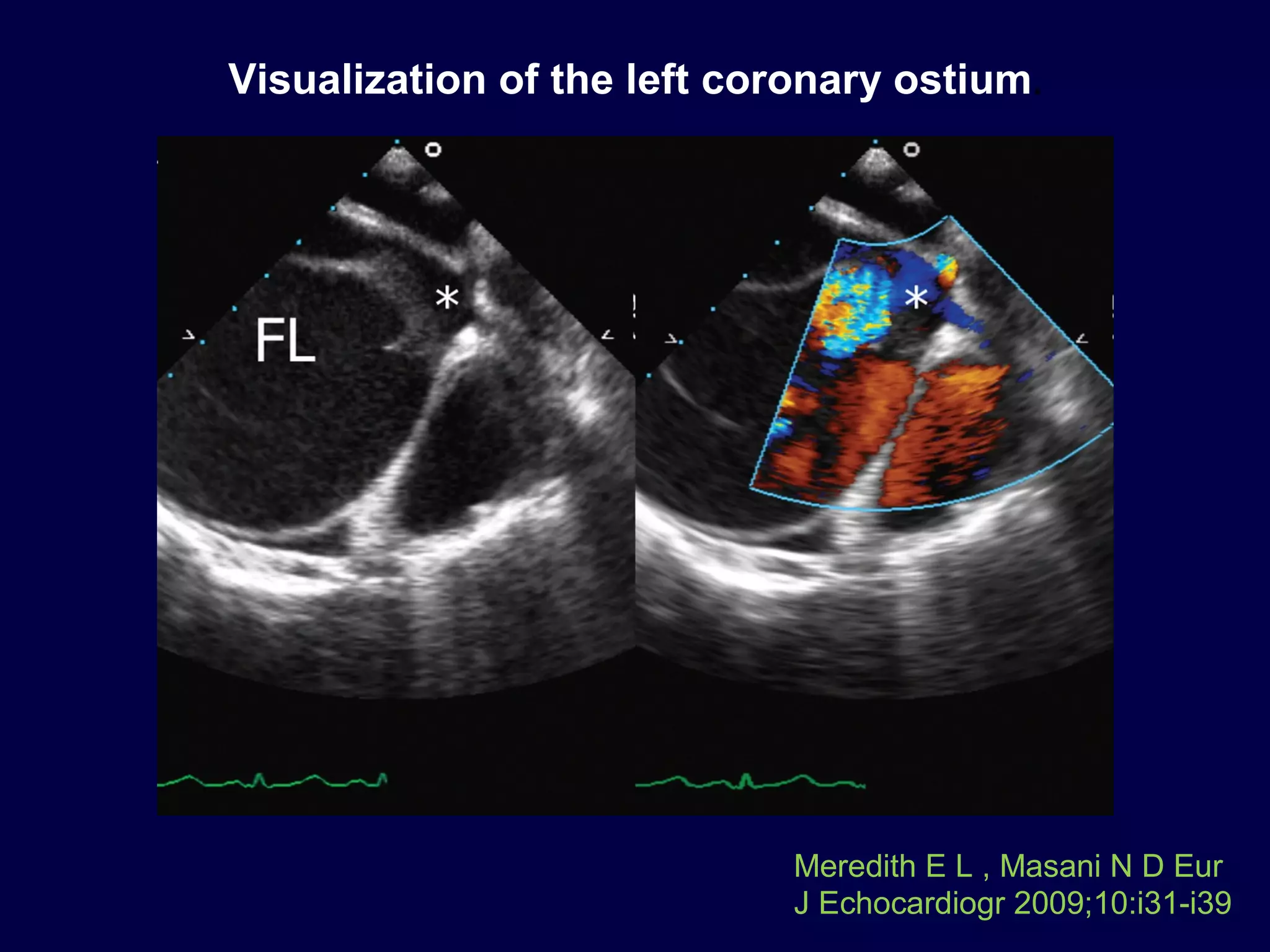
Visualization of the left coronary ostium.
Meredith E L , Masani N D Eur
J Echocardiogr 2009;10:i31-i39
Visualization of the head and neck vessels
Meredith E L , Masani N D Eur J
Echocardiogr 2009;10:i31-i39
Mortality in Acute
Aortic Dissection
35
36
Atypical Aortic Dissection
• Intramural Hematoma
• Penetrating Atherosclerotic Ulcer
37
Intramural Hematoma: Diagnosis
• Contained hemorrhage within the medial
layer of the aortic wall
• Crescentic area along the aortic wall
• Prevalence 10-15% in CT/MRI/TEE
• Normal size lumen
• False negative aortograms
38
Intramural Hematoma
39
Intramural Hematoma on CT
40
Atypical Aortic Dissection: IH
Echo Features
• Localized thickening of Ao wall
– Usually crescentic
– Occasionally circumferential
– Echo-lucent spaces common
• Relatively smooth luminal surface
• Absence of dissection flap
• Maintenance of circular lumen
41
Intramural haematoma.
Meredith E L , Masani N D Eur J
Echocardiogr 2009;10:i31-i39
Intramural Hematoma of the Aorta
Predictors of Progression to Dissection and Rupture
– Location in the ascending aorta
– Initial hematoma thickness > 11mm
– Moderately ectatic aortic diameter with progression
43
Circulation 2002
Circulation 2003
Penetrating Atherosclerotic Ulcer
• Almost exclusively in the descending Ao
• Usually remains localized
• Elderly HTN, evidence for other
atherosclerotic CV disease
• Chest and back pain without associated AR
or neurological deficits
44
Penetrating Atherosclerotic Ulcer
• Natural history is unclear
• No defined strategy
• Surgical repair for
– Pseudoaneurysm
– Transmural rupture
– Continued pain
– Distal embolization
– Aneurysmal dilatation
47
Aortic aneurysm
• Definition: pathological dilatation of the normal
aortic lumen involving one or several segments
• Fusiform (common), saccular
• Pseudoaneurysm: well-defined collection of
blood and connective tissue outside the vessel wall
Thoracic aortic aneurysm
• Descending aorta > ascending aorta
• Cystic media degeneration: weakening aortic
wall (elastic fiber degeneration)
• Marfan syndrome
• Ahterosclerosis
• Syphilis: ascending aorta
• Infectious aortitis / mycotic aneurysm
Thoracic aortic aneurysm
• 40% asymptomatic
• pain
• Symptoms due to mass effect - superior vena
cava syndrome, tracheal deviation
• CT, TEE > TTE
• Surgery: >5cm (mean expansion rate= 0.43 cm/year)
• Op risk: 5%
51
52
Aortic Atherosclerosis
• Atheroma
• Protruding Atheroma
• Complex plaque
– 4mm or more thick and/or mobile component
53
• Atherosclerotic lesions of the aorta detected
by TEE have been recognized as an
important cause of stroke and peripheral
embolic disease
• Using TEE the prevalence of thoracic aortic
atheromas is 27% in patients who have
experienced a previous embolic event
• When atheromas are present the incidence
of stroke is 12% in one year
N Eng J Med 1996;334:1216-21
N Eng J Med 1994;331:1474-9
J Am Coll Cardiol 2000;35:545-54
• Plaque thickness and plaque composition as
assessed by TEE have been identified as
major risk factors for embolic
complications
• A strong association has been demonstrated
between protruding non-calcified plaques
>4mm in the aorta detected by TEE and the
risk of ischemic stroke and peripheral
embolism
N Eng J Med 1994;331:1474-9
Circulation 1997;96:3838-41
• Atheromas in the aortic arch and ascending
or descending aorta identified by TEE may
be the cause of many otherwise unexplained
strokes
• Role of Statins, ACEI, Anticoagulants and
Antiplatelet agents uncertain
Trans-esophageal echocardiogram (horizontal, 0-degree view) of an aortic
arch with large, multi-lobed, ulcerated protruding atheromas (arrows).
Kronzon I , Tunick P A Ann Intern Med
1997;126:629-637
58
Coarctation of Aorta
Definition
A congenital narrowing of upper descending
thoracic aorta adjacent to the site of
attachment of ductus arteriosus
Coarctation of Aorta
Morphology
1. Localized stenosis
* Shelf, projection or infolding of
aortic media into the lumen opposite
the ductus arteriosus
2. Tubular hypoplasia
* Severe with lesser narrowing
61
62
Coarctation on CT
63
Coarctation of Aorta
Pathophysiology
• Narrowed aorta produces increased left
ventricular afterload and wall stress, left
ventricular hypertrophy, and congestive
heart failure
• Systemic perfusion is dependent on the
ductal flow and collateralization in severe
coarctation
Coarctation of Aorta
Indications for operation
1. Reduction of luminal diameter greater
than 50% at any age
2. Upper body hypertension over 150mmHg
in young infant ( not in heart failure )
3. CoA with congestive heart failure
at any age
Blunt Aortic-Brachiocephalic Trauma
66
Fisher et al, 1981
(n=510)
Vignon et al, 1998
(n=25)
Aortic
isthmus
mainly
involved
Aortic Disruption: Anatomical types
67
Complete Subtotal
Partial
Tear
Intimal
Tear
Circulation 1995
68
Thank You

Diseases of the aorta

  • 1.
    30th April 2010 Dr. FatehAli Tipoo Sultan FCPS (Med), FCPS (Card) Diplomate Certification Board of Cardiac CT Certification National Board of Echocardiography Assistant Professor & Consultant Cardiologist Aga Khan University Hospital Diseases of the Aorta
  • 2.
    Overview • Aortic Dissection •Atypical Aortic Dissection – Intramural Hematoma – Penetrating Atherosclerotic Ulcer • Aortic Aneurysm • Aortic Atherosclerotic Disease • Coarctation • Aortic Trauma  Transection 2
  • 3.
    Aortic Dissection • Deteriorationof medial collagen and elastin • A tear in the intimal layer allows blood to enter the intima-media space • Blood then propagates down this new space creating a “true” and a “false” lumen 3
  • 4.
    Factors Predisposing toDissection • Hypertension • Marfan and Ehler-Danlos • Coarctation and bicuspid aortic valve • Pregnancy • Trauma • Perforation through an intimal atheromatous plaque 4
  • 7.
    Intimal flap andtear in a patient with acute type A aortic dissection Meredith E L , Masani N D Eur J Echocardiogr 2009;10:i31-i39
  • 8.
    Predicting death inPatients with Acute Type A Aortic Dissection • 547 pts; IRAD; Jan 96-Dec 99 • In hospital mortality 32.5% • Age > 70 years • Abrupt onset of chest pain • Hypotension, Shock, Tamponade • Kidney failure • Pulse deficit • ECG abnormalities 8 Circulation 2002
  • 9.
    Clinical Presentation • Pain85-96% Sudden 85% Severe 90% Tearing/Ripping 50% • Syncope Pain, obstruction, barroreceptors • Neurological CVA 5% Paraparesis or paraplegia • CHF 7% • MI rare 9
  • 10.
    Physical Findings • PulseDeficits ( 50% prox ; 15% distal) • Aortic Regurgitation – 16-67% of cases • Neurological Manifestations -6-19% • CVA – 3-6% • Altered consciousness or coma • Spinal artery perfusion – paraplegia, paraparesis 10
  • 11.
    Imaging Modality ofChoice GOALS • Confirm the diagnosis • Classify the dissection and determine extent • Detect pericardial involvement • Detect and grade AI CHOICES • TTE/TEE • CT • MRI • Aortography 11
  • 12.
    Procedure Used forthe Diagnosis of Aortic Dissection 12 Am J Cardiology 2002
  • 13.
    Sensitivity of theFour Imaging Modalities 13 Image Modality Overall Type A Type B TEE 88% 90% 80% CT 93% 93% 93% MRI 100% 100% 100% Aortography 87% 87% 89%
  • 14.
    TTE in AorticDissection 14
  • 15.
  • 16.
    TEE in AorticDissection • Hallmark: Dissection flap and entry site • Dilated aorta • Aortic insufficiency • Pericardial and or pleural effusion 16
  • 17.
  • 18.
  • 19.
  • 20.
  • 21.
  • 22.
  • 23.
    TEE in AorticDissection: Pitfalls True Dissection Flap Artifacts, Reverberations Distinct, well-visualized Vague, blurry Undulates with cardiac cycle Crosses true anatomic barriers Present in multiple views Does not demonstrate typical undulation pattern Separates true from false lumen Does not separate true from false 23
  • 24.
  • 25.
  • 26.
  • 27.
  • 28.
  • 29.
  • 30.
    Aortic dissection: Complications •Rupture • Tamponade • Aortic Regurgitation • Coronary Artery Involvement • Other Branch Vessel Involvement 30
  • 31.
    Aortic Dissection: Mechanismof AR 31 1. Dilatation of aortic root 2. Pressure from dissecting hematoma may depress one leaflet 3. Torn annular support of the leaflets 4. Intimal flap prolapse
  • 32.
    Aortic Dissection –Pulse Loss 32 Due to direct compression Blockade due to flap of intima
  • 33.
    Visualization of theleft coronary ostium. Meredith E L , Masani N D Eur J Echocardiogr 2009;10:i31-i39
  • 34.
    Visualization of thehead and neck vessels Meredith E L , Masani N D Eur J Echocardiogr 2009;10:i31-i39
  • 35.
  • 36.
  • 37.
    Atypical Aortic Dissection •Intramural Hematoma • Penetrating Atherosclerotic Ulcer 37
  • 38.
    Intramural Hematoma: Diagnosis •Contained hemorrhage within the medial layer of the aortic wall • Crescentic area along the aortic wall • Prevalence 10-15% in CT/MRI/TEE • Normal size lumen • False negative aortograms 38
  • 39.
  • 40.
  • 41.
    Atypical Aortic Dissection:IH Echo Features • Localized thickening of Ao wall – Usually crescentic – Occasionally circumferential – Echo-lucent spaces common • Relatively smooth luminal surface • Absence of dissection flap • Maintenance of circular lumen 41
  • 42.
    Intramural haematoma. Meredith EL , Masani N D Eur J Echocardiogr 2009;10:i31-i39
  • 43.
    Intramural Hematoma ofthe Aorta Predictors of Progression to Dissection and Rupture – Location in the ascending aorta – Initial hematoma thickness > 11mm – Moderately ectatic aortic diameter with progression 43 Circulation 2002 Circulation 2003
  • 44.
    Penetrating Atherosclerotic Ulcer •Almost exclusively in the descending Ao • Usually remains localized • Elderly HTN, evidence for other atherosclerotic CV disease • Chest and back pain without associated AR or neurological deficits 44
  • 47.
    Penetrating Atherosclerotic Ulcer •Natural history is unclear • No defined strategy • Surgical repair for – Pseudoaneurysm – Transmural rupture – Continued pain – Distal embolization – Aneurysmal dilatation 47
  • 48.
    Aortic aneurysm • Definition:pathological dilatation of the normal aortic lumen involving one or several segments • Fusiform (common), saccular • Pseudoaneurysm: well-defined collection of blood and connective tissue outside the vessel wall
  • 49.
    Thoracic aortic aneurysm •Descending aorta > ascending aorta • Cystic media degeneration: weakening aortic wall (elastic fiber degeneration) • Marfan syndrome • Ahterosclerosis • Syphilis: ascending aorta • Infectious aortitis / mycotic aneurysm
  • 50.
    Thoracic aortic aneurysm •40% asymptomatic • pain • Symptoms due to mass effect - superior vena cava syndrome, tracheal deviation • CT, TEE > TTE • Surgery: >5cm (mean expansion rate= 0.43 cm/year) • Op risk: 5%
  • 51.
  • 52.
  • 53.
    Aortic Atherosclerosis • Atheroma •Protruding Atheroma • Complex plaque – 4mm or more thick and/or mobile component 53
  • 54.
    • Atherosclerotic lesionsof the aorta detected by TEE have been recognized as an important cause of stroke and peripheral embolic disease • Using TEE the prevalence of thoracic aortic atheromas is 27% in patients who have experienced a previous embolic event • When atheromas are present the incidence of stroke is 12% in one year N Eng J Med 1996;334:1216-21 N Eng J Med 1994;331:1474-9 J Am Coll Cardiol 2000;35:545-54
  • 55.
    • Plaque thicknessand plaque composition as assessed by TEE have been identified as major risk factors for embolic complications • A strong association has been demonstrated between protruding non-calcified plaques >4mm in the aorta detected by TEE and the risk of ischemic stroke and peripheral embolism N Eng J Med 1994;331:1474-9 Circulation 1997;96:3838-41
  • 56.
    • Atheromas inthe aortic arch and ascending or descending aorta identified by TEE may be the cause of many otherwise unexplained strokes • Role of Statins, ACEI, Anticoagulants and Antiplatelet agents uncertain
  • 57.
    Trans-esophageal echocardiogram (horizontal,0-degree view) of an aortic arch with large, multi-lobed, ulcerated protruding atheromas (arrows). Kronzon I , Tunick P A Ann Intern Med 1997;126:629-637
  • 58.
  • 59.
    Coarctation of Aorta Definition Acongenital narrowing of upper descending thoracic aorta adjacent to the site of attachment of ductus arteriosus
  • 60.
    Coarctation of Aorta Morphology 1.Localized stenosis * Shelf, projection or infolding of aortic media into the lumen opposite the ductus arteriosus 2. Tubular hypoplasia * Severe with lesser narrowing
  • 61.
  • 62.
  • 63.
  • 64.
    Coarctation of Aorta Pathophysiology •Narrowed aorta produces increased left ventricular afterload and wall stress, left ventricular hypertrophy, and congestive heart failure • Systemic perfusion is dependent on the ductal flow and collateralization in severe coarctation
  • 65.
    Coarctation of Aorta Indicationsfor operation 1. Reduction of luminal diameter greater than 50% at any age 2. Upper body hypertension over 150mmHg in young infant ( not in heart failure ) 3. CoA with congestive heart failure at any age
  • 66.
    Blunt Aortic-Brachiocephalic Trauma 66 Fisheret al, 1981 (n=510) Vignon et al, 1998 (n=25) Aortic isthmus mainly involved
  • 67.
    Aortic Disruption: Anatomicaltypes 67 Complete Subtotal Partial Tear Intimal Tear Circulation 1995
  • 68.

Editor's Notes

  • #8 Intimal flap and tear in a patient with acute type A aortic dissection. (A) In the transoesophageal echocardiography short-axis view, a mobile linear flap is seen in the aortic root, just above the aortic valve leaflets (which can also be seen). The tear in the flap, where the small central true lumen communicates with the false lumen, is shown by the white arrow. (B) In the same patient, a 26-year-old man with no other co-morbidities, a short-axis view just below the origin of the flap, showing a bicuspid aortic valve.
  • #34 Visualization of the left coronary ostium. Transoesophageal echocardiography short-axis view: in the left panel, a small true lumen is seen, from which the left coronary artery (asterisk) arises. Separate origins of the left anterior descending and circumflex branches can be seen—this was invaluable information for the cardiac surgeon. In the right panel, colour flow mapping shows unobstructed flow from true lumen into the left coronary branches.
  • #35 Visualization of the head and neck vessels. Off-axis transoesophageal echocardiography view of the aortic arch. (A) A linear dissection flap is seen. The origins of the left common carotid and subclavian arteries as seen to arise from the smaller, true lumen (white arrows). (B) In the right panel, colour flow mapping shows unobstructed flow from true lumen into the head and neck vessels.
  • #43 Intramural haematoma. In the transoesophageal echocardiography short-axis view, a cross-section of the aortic root is shown. The aortic wall is markedly thickened (white arrowheads). The intima has areas of focal echo brightness, characteristic of atherosclerosis—this is one method of distinguishing IMH from thrombus within the lumen of aortic aneurysm. There is an area of echo lucency within the haematoma, but no dissection flap or false lumen is seen. An echo free rim is seen around the aorta, suggestive of free blood.
  • #58 Transesophageal echocardiogram (horizontal, 0-degree view) of an aortic arch with large, multi-lobed, ulcerated protruding atheromas (arrows).