Dr Awadhesh Kr Sharma
LPS Institute of Cardiology
Kanpur
Coronary CT angiography :
 Noninvasive
 The overall accuracy of 64-row CT angiography included a sensitivity of
87% to 99% and specificity of 93% to 96%.
 For evaluating CAD -most useful in low- to intermediate-risk patients with
angina or anginal equivalent.
 The negative predictive value of coronary CT angiography is uniformly high in
studies, approaching 93% to 100%.
 in other words, coronary CT angiography is an excellent modality for
ruling out coronary disease.
CT Angiography
The basic principle of CT technology is the use of ionizing radiation within a
gantry rotating around the patient in which x-rays are detected on a
detector array and converted through reconstruction algorithms to images.

MDCT
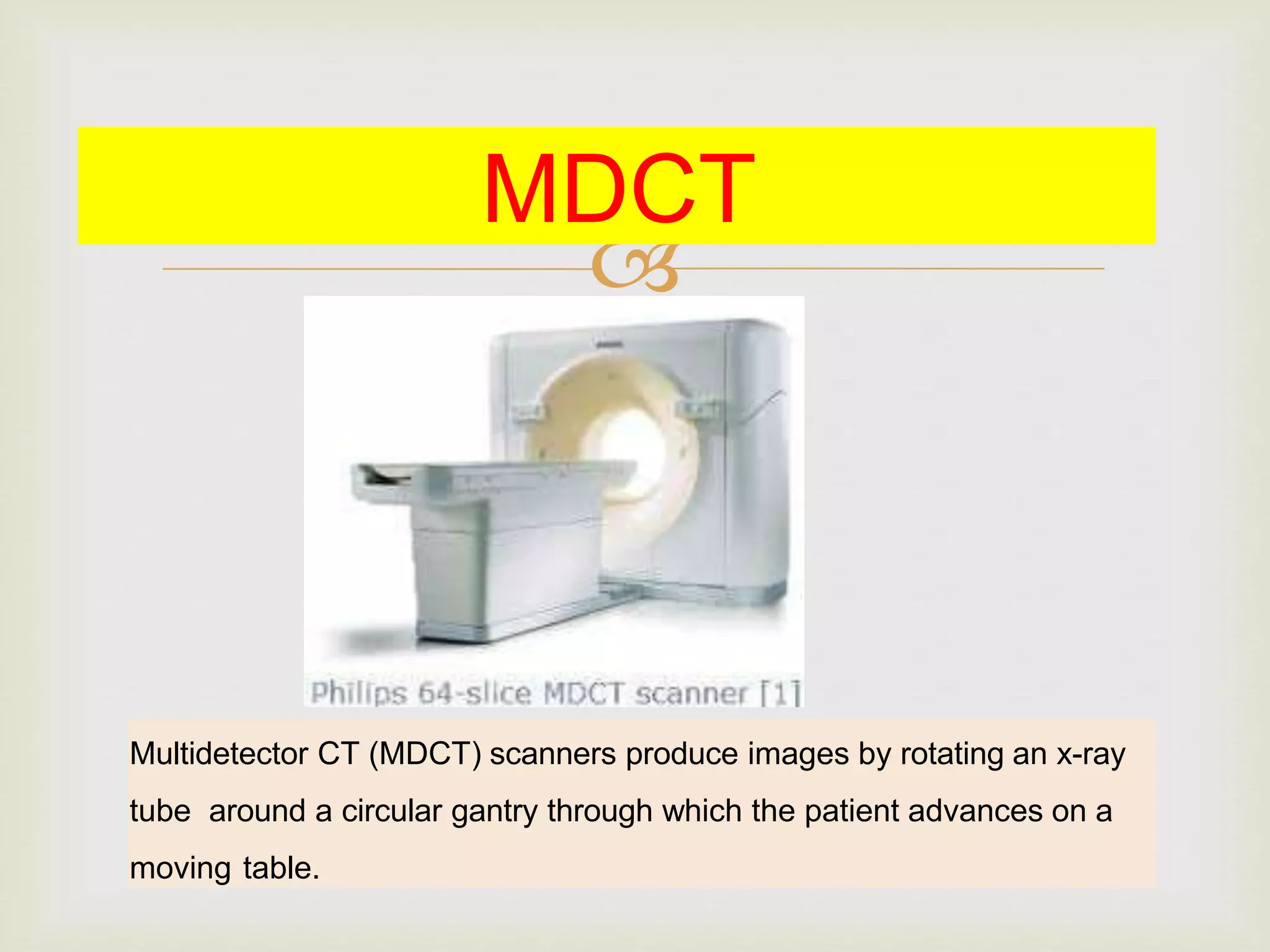
Multidetector CT (MDCT) scanners produce images by rotating an x-ray
tube around a circular gantry through which the patient advances on a
moving table.
Indications:
1. Evaluation of chest pain in patients at low to intermediate pretest probability of
disease.
2. Suspicion of coronary artery anomalies.
3. Pulmonary vein evaluation.
4. Evaluation of cardiac masses.
5. Evaluation of pericardial disease.
6. Assessment of anatomy in complex congenital heart disease.
7. Pre surgical evaluation, particularly before redo open heart surgery.
8. Assessing graft patency after prior bypass surgery.
9. Evaluation of aortic disease.
10. Evaluation of suspected pulmonary embolism.
CONTRAINDICATIONS:
Absolute contraindications :
1. Renal insufficiency. Given the potential for contrast nephropathy, patients with
significant renal insufficiency (i.e., Cr > 1.6 mg/dL) should not undergo contrast-
enhanced CT.
2. Known history of anaphylactic contrast reactions . A prior anaphylactic response
to contrast is generally felt to be an absolute contraindication to intravenous
iodinated contrast administration at many institutions.
3. Pregnancy
4. Clinical instability
Contrast enhanced imaging :
Administration of iodinated contrast media
Relative contraindications
A.Contrast (iodine) allergy. Patients with allergic reactions to contrast should be pretreated
with diphenhydramine and steroids before contrast administration.
B.Recent intravenous iodinated contrast administration. Patients who have received an
intravenous dose of iodinated contrast should avoid contrast-enhanced CT scanning for 24 hours
to reduce the risk of contrast nephropathy.
C.Hyperthyroidism. Iodinated contrast is contraindicated in the setting of uncontrolled
hyperthyroidism due to possible precipitation of thyrotoxicosis.
D.Atrial fibrillation or any irregular heart rhythm, is a contraindication to coronary CT
angiography due to image degradation from suboptimal ECG gating.
E.Inability to breath hold for at least 10 seconds. Image quality will be significantly reduced due
to respiratory motion artifact if the patient cannot comply with breath hold instructions.
F. Morbid obesity
G. Severe coronary calcium
SAFETY
A. Radiation exposure : Radiation doses of cardiac CT scans vary greatly
depending on the scan parameter settings, scan range (cranial-caudal
length of the scan), gender (women receive more radiation due to breast
tissue), and patient body habitus (obesity increases exposure).
● chest x-ray is 0.04 to 0.10 mSv,
● average annual background radiation 3 to 3.6 mSv.
● Invasive diagnostic coronary angiography 2.1 to 4 mSv.
●coronary CT angiography 4 to 11 mSv.
B. Contrast nephropathy : Iodinated contrast media can cause renal
ischemia by reducing renal blood flow or increasing oxygen demand
and may also have a direct toxic effect on tubular epithelial cells.
If a contrast-enhanced CT study is necessary in patients with
significant renal insufficiency, prophylactic measures should be taken
o saline hydration
o n-acetylcysteine
o use of low osmolar agents
o sodium bicarbonate infusion

BREATH HOLDING
 During the test, a breath hold of 15–20 s will need to
be
 performed
 Before the scan, practicing breath holding helps.

ECG GATING
 First, the skin is cleaned.
 Up to 12 self-adhesive electrodes will be attached
to select locations of the skin on the arms, legs
and chest.
 Three ECG leads are attached to obtain an adequate
ECG tracing for CT.
 A noise-free ECG signal is important to synchronize
theECG signal to the raw image data.
CLINICAL APPLICATIONS
A. Coronary calcium scoring
 Coronary calcium is a surrogate marker for coronary atherosclerotic plaque.
Coronary artery calcium score is directly proportional to the overall extent of
atherosclerosis.
 Complete absence of coronary artery calcium makes the presence of significant
coronary luminal obstruction highly unlikely and indicates a very low risk of
future coronary events.
 Men, CKD, diabetics tend to have higher coronary calcium scores.
 Contrast is not necessary because calcium is readily identified secondary to its
very high x-ray attenuation coefficient (high Hounsfield unit score).
The Agatston coronary artery calcium (CAC) score is the most frequently
used scoring system.
It is derived by measuring the area of each calcified coronary lesion and
multiplying it by a coefficient of 1 to 4, depending on the maximum
CT attenuation within that lesion.
The CAC score can be classified into five groups:
1) zero, no coronary calcification;
2)100, mild coronary calcification;
3)> 100 to 399, moderate calcification;
4)>400 to 999, severe calcification;
5)> 1000, extensive calcification.

CORONARY ARTERY
 Coronary artery is a vasa
vasorum that supplies the heart.
 The coronary artery arises just
superior to the aortic valve and
supply the heart
 The aortic valve has three cusps
–
left coronary (LC),
right coronary (RC)
posterior non-coronary (NC)
cusps.
16
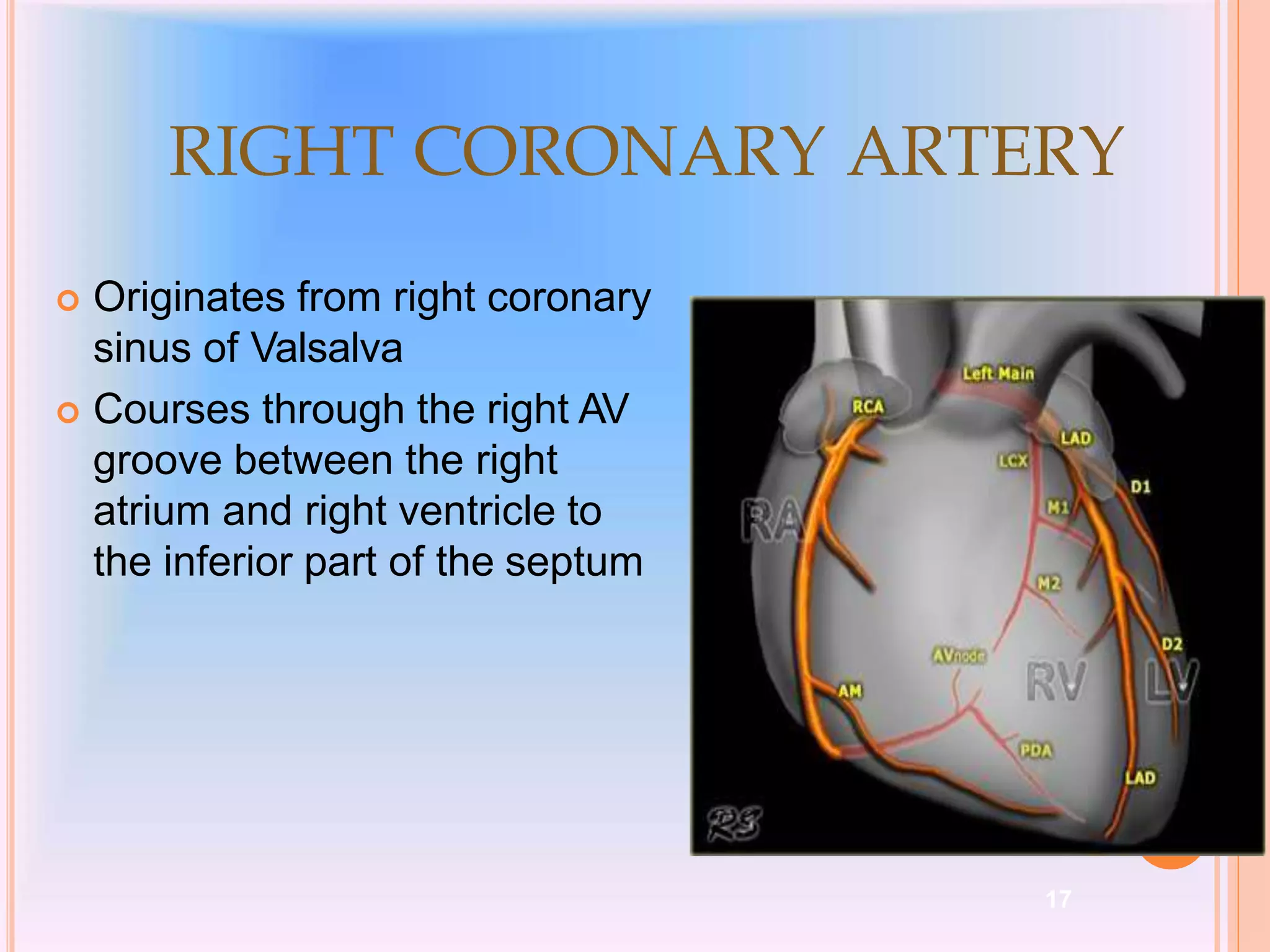
 Originates from right coronary
sinus of Valsalva
 Courses through the right AV
groove between the right
atrium and right ventricle to
the inferior part of the septum
17
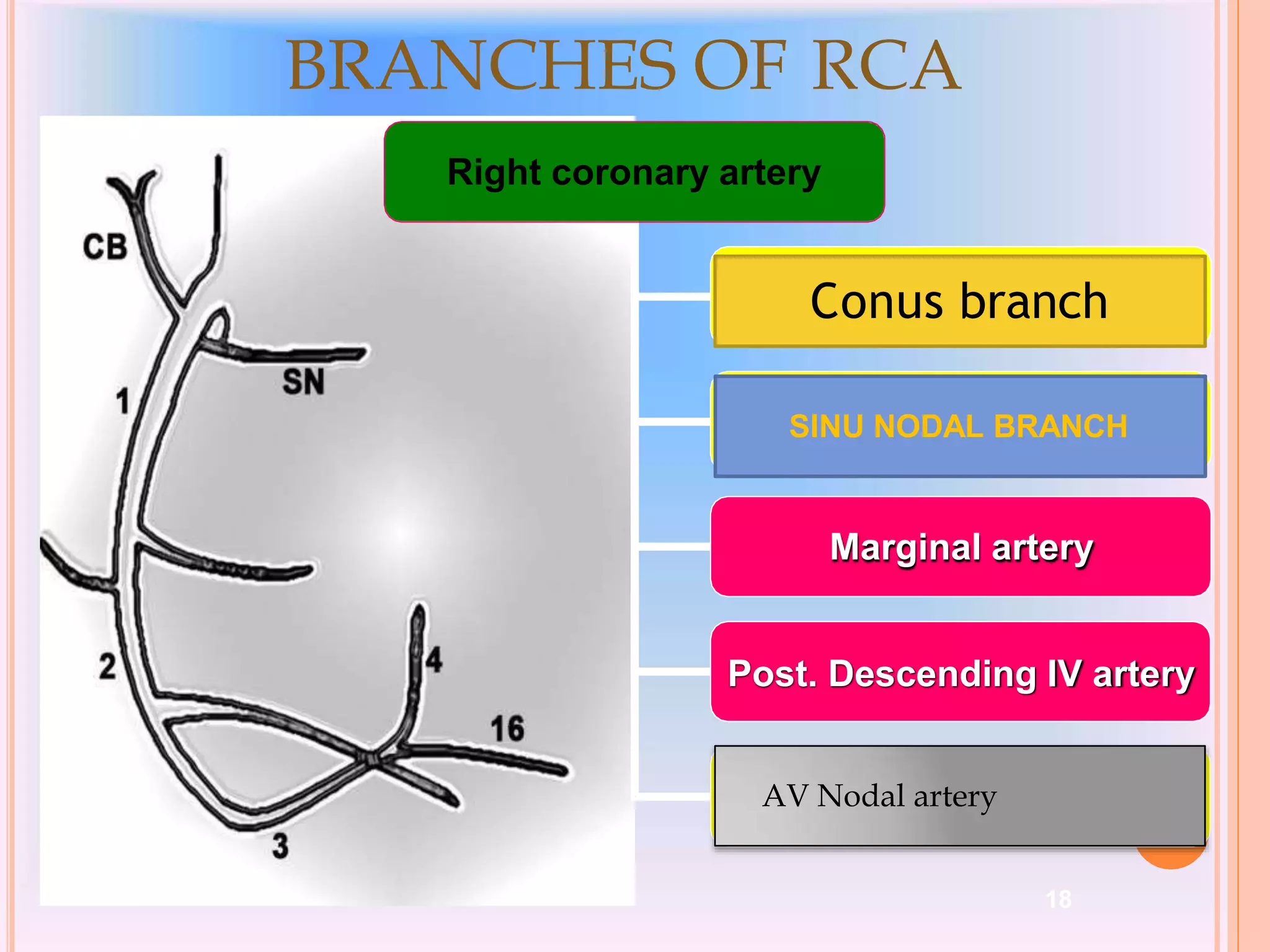
RIGHT CORONARY ARTERY

Right coronary artery
Conus artery
Sinu nodal artery
Marginal artery
Post. Descending IV artery
Conus branch
SINU NODAL BRANCH
18
BRANCHES OF RCA
AV Nodal artery

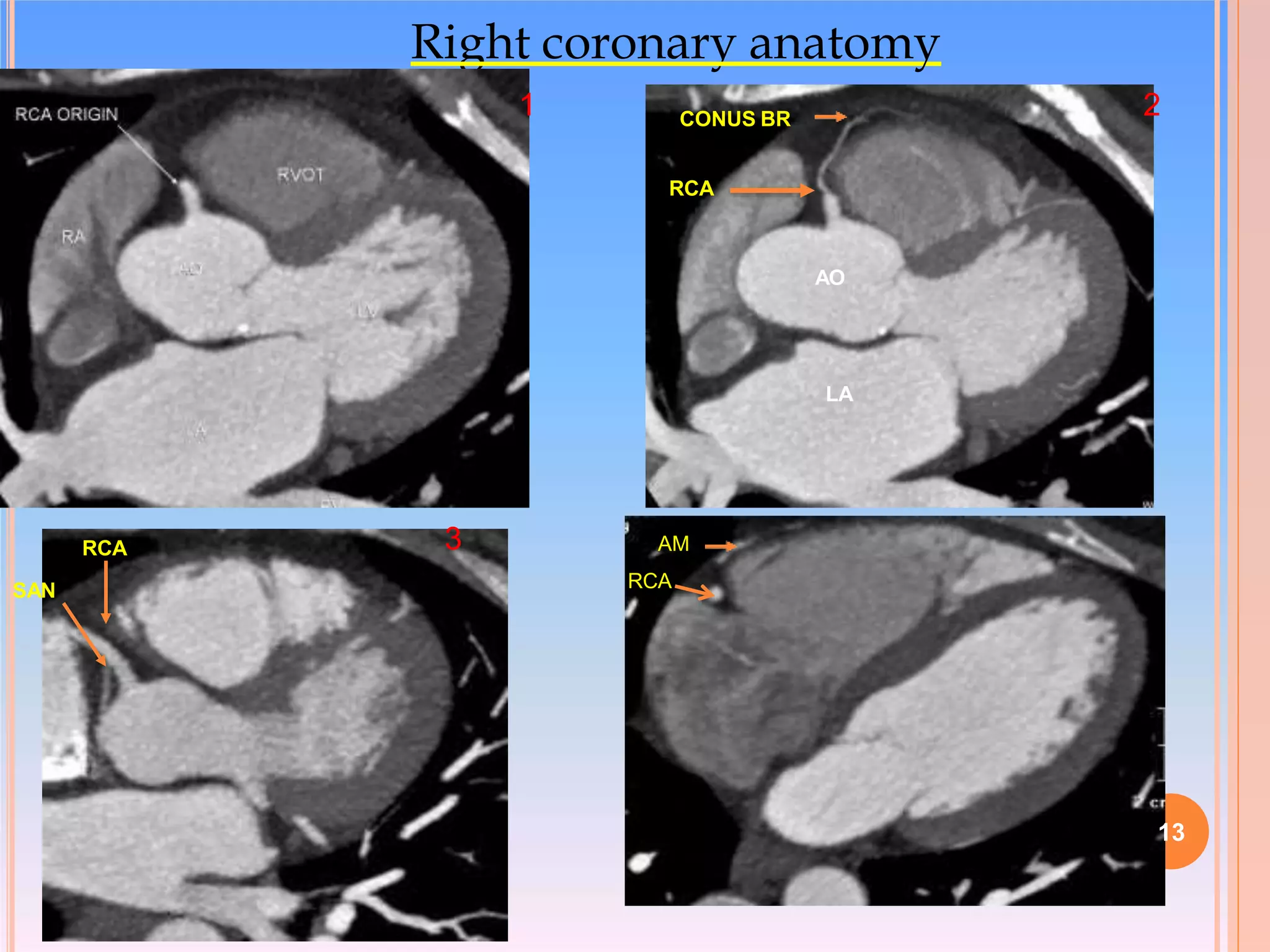
Right coronary anatomy
AO
LA
RCA
CONUS BR
RCA
SAN
1 2
3 4AM
RCA
13
RCA
AM
AM
20
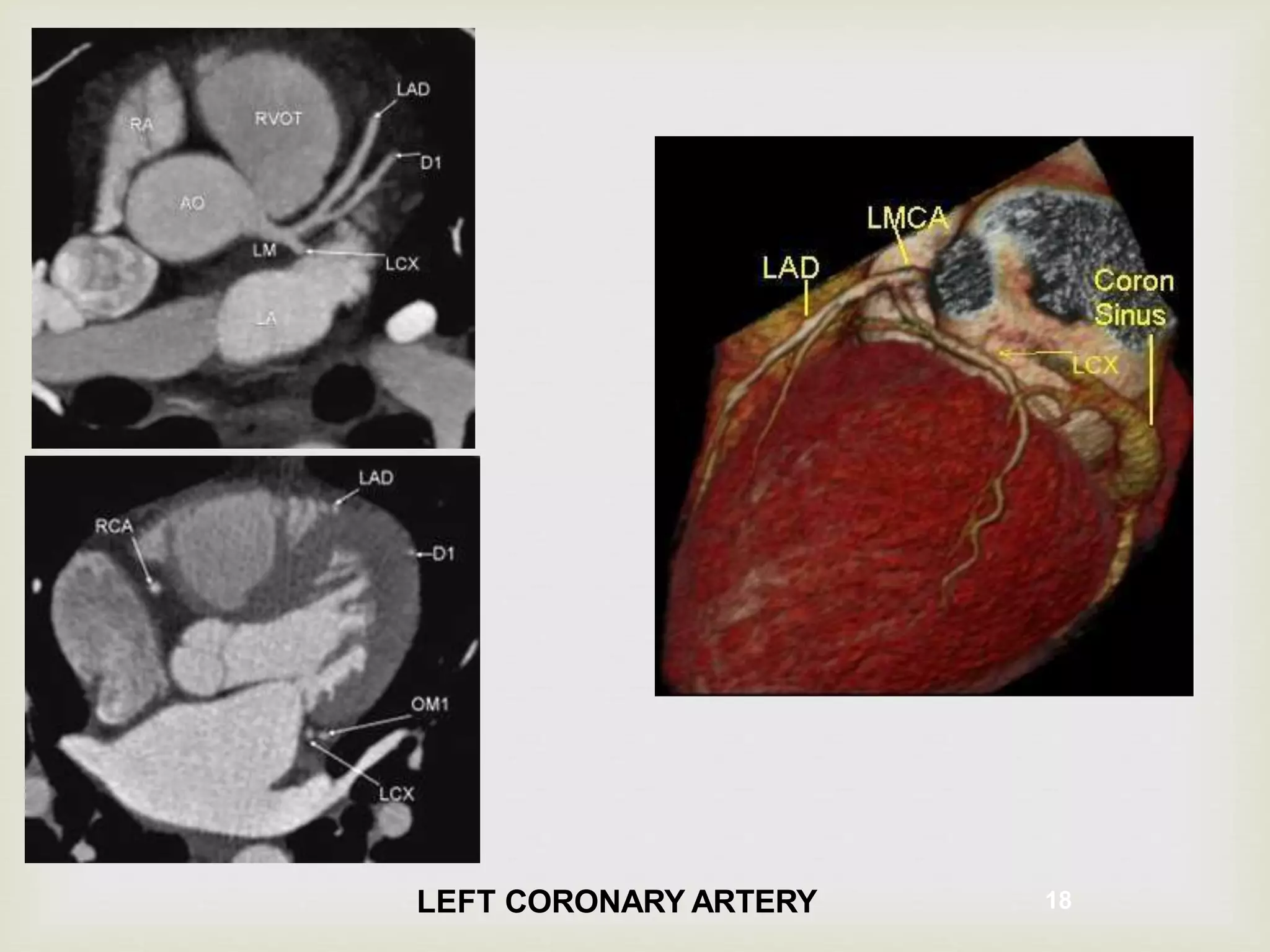
LEFT CORONARY ARTERY 18
57
58

DOMINANCE
 Determined by the arrangement that which artery
reaches the crux & supply posterior descending
artery
 The right coronary artery is dominant in 85% cases.
 8% cases - circumflex br of the left coronary artery
 7% both rt & lt coronary artery supply posterior
IVseptum & inferior surface of the left ventricle-
codominance
21

91
LIMITATIONS OF CARDIAC CT
 Extensive calcifications
 Stents : spatial resolution
 Heart rate: temporal resolution
 Radiation risk
 Small branches/ septal branches
Stent patency:
 Image artifact from metallic stents limits the application in patients with prior
coronary stent procedures.
 Small stents are difficult to evaluate and prone to noninterpretability.
 However, 90% accuracy can be obtained in stents 3 mm or greater in
diameter with the use of sharp kernel and wide display window.
 Quantitative assessment of within-stent contrast density may assist in the
diagnosis.
95

Coronary CT Angiography

  • 1.
    Dr Awadhesh KrSharma LPS Institute of Cardiology Kanpur
  • 2.
    Coronary CT angiography:  Noninvasive  The overall accuracy of 64-row CT angiography included a sensitivity of 87% to 99% and specificity of 93% to 96%.  For evaluating CAD -most useful in low- to intermediate-risk patients with angina or anginal equivalent.  The negative predictive value of coronary CT angiography is uniformly high in studies, approaching 93% to 100%.  in other words, coronary CT angiography is an excellent modality for ruling out coronary disease.
  • 3.
    CT Angiography The basicprinciple of CT technology is the use of ionizing radiation within a gantry rotating around the patient in which x-rays are detected on a detector array and converted through reconstruction algorithms to images.
  • 4.
     MDCT Multidetector CT (MDCT)scanners produce images by rotating an x-ray tube around a circular gantry through which the patient advances on a moving table.
  • 5.
    Indications: 1. Evaluation ofchest pain in patients at low to intermediate pretest probability of disease. 2. Suspicion of coronary artery anomalies. 3. Pulmonary vein evaluation. 4. Evaluation of cardiac masses. 5. Evaluation of pericardial disease. 6. Assessment of anatomy in complex congenital heart disease. 7. Pre surgical evaluation, particularly before redo open heart surgery. 8. Assessing graft patency after prior bypass surgery. 9. Evaluation of aortic disease. 10. Evaluation of suspected pulmonary embolism.
  • 6.
    CONTRAINDICATIONS: Absolute contraindications : 1.Renal insufficiency. Given the potential for contrast nephropathy, patients with significant renal insufficiency (i.e., Cr > 1.6 mg/dL) should not undergo contrast- enhanced CT. 2. Known history of anaphylactic contrast reactions . A prior anaphylactic response to contrast is generally felt to be an absolute contraindication to intravenous iodinated contrast administration at many institutions. 3. Pregnancy 4. Clinical instability Contrast enhanced imaging : Administration of iodinated contrast media
  • 7.
    Relative contraindications A.Contrast (iodine)allergy. Patients with allergic reactions to contrast should be pretreated with diphenhydramine and steroids before contrast administration. B.Recent intravenous iodinated contrast administration. Patients who have received an intravenous dose of iodinated contrast should avoid contrast-enhanced CT scanning for 24 hours to reduce the risk of contrast nephropathy. C.Hyperthyroidism. Iodinated contrast is contraindicated in the setting of uncontrolled hyperthyroidism due to possible precipitation of thyrotoxicosis. D.Atrial fibrillation or any irregular heart rhythm, is a contraindication to coronary CT angiography due to image degradation from suboptimal ECG gating. E.Inability to breath hold for at least 10 seconds. Image quality will be significantly reduced due to respiratory motion artifact if the patient cannot comply with breath hold instructions. F. Morbid obesity G. Severe coronary calcium
  • 8.
    SAFETY A. Radiation exposure: Radiation doses of cardiac CT scans vary greatly depending on the scan parameter settings, scan range (cranial-caudal length of the scan), gender (women receive more radiation due to breast tissue), and patient body habitus (obesity increases exposure). ● chest x-ray is 0.04 to 0.10 mSv, ● average annual background radiation 3 to 3.6 mSv. ● Invasive diagnostic coronary angiography 2.1 to 4 mSv. ●coronary CT angiography 4 to 11 mSv.
  • 9.
    B. Contrast nephropathy: Iodinated contrast media can cause renal ischemia by reducing renal blood flow or increasing oxygen demand and may also have a direct toxic effect on tubular epithelial cells. If a contrast-enhanced CT study is necessary in patients with significant renal insufficiency, prophylactic measures should be taken o saline hydration o n-acetylcysteine o use of low osmolar agents o sodium bicarbonate infusion
  • 11.
     BREATH HOLDING  Duringthe test, a breath hold of 15–20 s will need to be  performed  Before the scan, practicing breath holding helps.
  • 12.
     ECG GATING  First,the skin is cleaned.  Up to 12 self-adhesive electrodes will be attached to select locations of the skin on the arms, legs and chest.  Three ECG leads are attached to obtain an adequate ECG tracing for CT.  A noise-free ECG signal is important to synchronize theECG signal to the raw image data.
  • 13.
    CLINICAL APPLICATIONS A. Coronarycalcium scoring  Coronary calcium is a surrogate marker for coronary atherosclerotic plaque. Coronary artery calcium score is directly proportional to the overall extent of atherosclerosis.  Complete absence of coronary artery calcium makes the presence of significant coronary luminal obstruction highly unlikely and indicates a very low risk of future coronary events.  Men, CKD, diabetics tend to have higher coronary calcium scores.  Contrast is not necessary because calcium is readily identified secondary to its very high x-ray attenuation coefficient (high Hounsfield unit score).
  • 15.
    The Agatston coronaryartery calcium (CAC) score is the most frequently used scoring system. It is derived by measuring the area of each calcified coronary lesion and multiplying it by a coefficient of 1 to 4, depending on the maximum CT attenuation within that lesion. The CAC score can be classified into five groups: 1) zero, no coronary calcification; 2)100, mild coronary calcification; 3)> 100 to 399, moderate calcification; 4)>400 to 999, severe calcification; 5)> 1000, extensive calcification.
  • 16.
     CORONARY ARTERY  Coronaryartery is a vasa vasorum that supplies the heart.  The coronary artery arises just superior to the aortic valve and supply the heart  The aortic valve has three cusps – left coronary (LC), right coronary (RC) posterior non-coronary (NC) cusps. 16
  • 17.
     Originates fromright coronary sinus of Valsalva  Courses through the right AV groove between the right atrium and right ventricle to the inferior part of the septum 17 RIGHT CORONARY ARTERY
  • 18.
     Right coronary artery Conusartery Sinu nodal artery Marginal artery Post. Descending IV artery Conus branch SINU NODAL BRANCH 18 BRANCHES OF RCA AV Nodal artery
  • 19.
     Right coronary anatomy AO LA RCA CONUSBR RCA SAN 1 2 3 4AM RCA 13
  • 20.
  • 21.
  • 22.
  • 23.
  • 24.
     DOMINANCE  Determined bythe arrangement that which artery reaches the crux & supply posterior descending artery  The right coronary artery is dominant in 85% cases.  8% cases - circumflex br of the left coronary artery  7% both rt & lt coronary artery supply posterior IVseptum & inferior surface of the left ventricle- codominance 21
  • 25.
     91 LIMITATIONS OF CARDIACCT  Extensive calcifications  Stents : spatial resolution  Heart rate: temporal resolution  Radiation risk  Small branches/ septal branches
  • 26.
    Stent patency:  Imageartifact from metallic stents limits the application in patients with prior coronary stent procedures.  Small stents are difficult to evaluate and prone to noninterpretability.  However, 90% accuracy can be obtained in stents 3 mm or greater in diameter with the use of sharp kernel and wide display window.  Quantitative assessment of within-stent contrast density may assist in the diagnosis.
  • 27.