Cardiac MRI-Basics
By
Dr.Shaik Asma
Post graduate student
 Cardiac MRI consists of using MRI to
study heart anatomy, physiology, and
pathology.
Advantages
Cardiac MRI offers:
 improved soft tissue definition
 protocol can be tailored to likely
differential diagnoses
◦ a large number of sequences are available
◦ dynamic imaging provides functional
assessment
 no ionizing radiation
◦ MRI safety still requires consideration
Technique
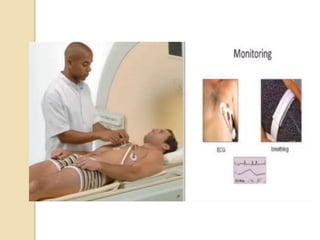
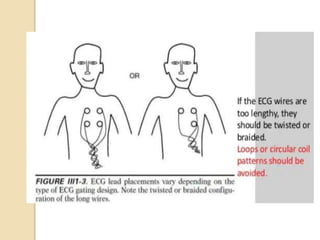
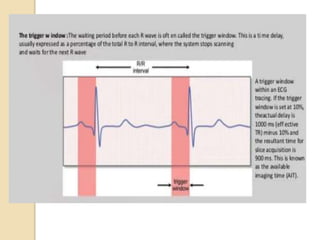
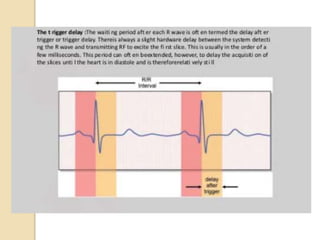
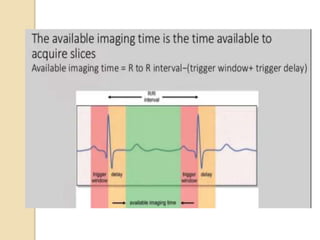
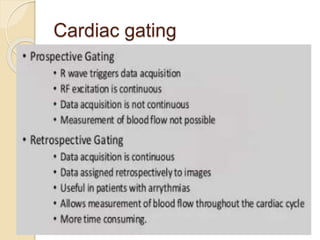
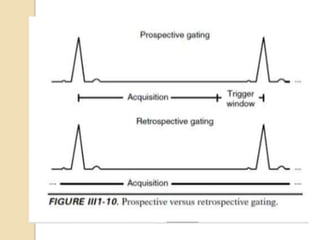
Cardiac gating
MR imaging techniques
 Blood techniques
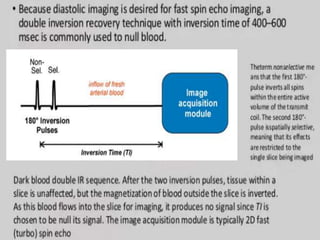
Dark blood
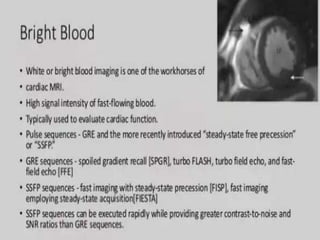
Bright blood
 Imaging sequences
 Imaging planes
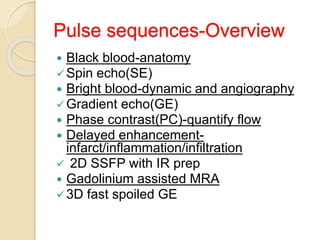
Pulse sequences-Overview
 Black blood-anatomy
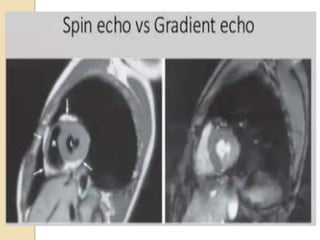
Spin echo(SE)
 Bright blood-dynamic and angiography
Gradient echo(GE)
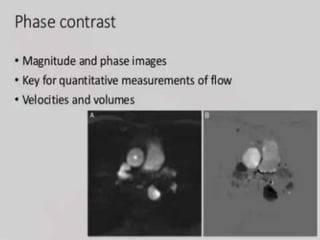
 Phase contrast(PC)-quantify flow
 Delayed enhancement-
infarct/inflammation/infiltration
 2D SSFP with IR prep
 Gadolinium assisted MRA
3D fast spoiled GE
 Basic cardiovascular MR imaging
sequences include black blood imaging
and bright blood imaging.
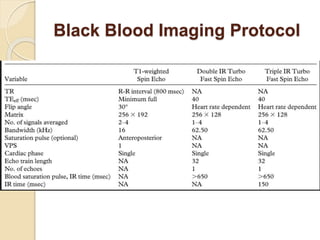
 Black blood imaging is used to depict
anatomy, pericardial and mediastinal
abnormalities, and extra luminal aortic
disease.
 Black blood imaging includes ECG-gated
true spin-echo or fast spin-echo imaging
or inversion-recovery (IR) half-Fourier
single-shot turbo fast-spin-echo
sequences.
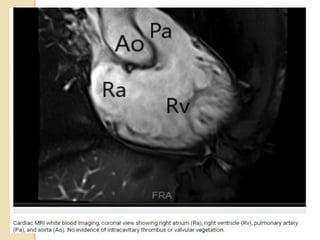
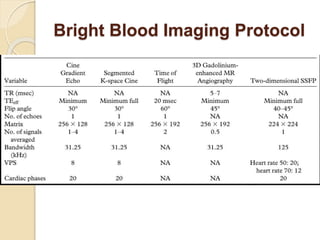
 Bright blood imaging is used to
demonstrate flow and motion and to
image valvular disease.
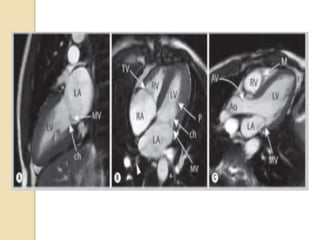
 Bright blood cine sequences include
segmented-k-space small-flip-angle
gradient-echo sequences or fast
imaging with steady-state precession
or refocused steady-state free
precession (SSFP)
Advantages
 Since it uses the residual transverse
magnetization instead of wasting
it,there is increased signal to noise
ratio.
 Since transverse magnetization is
added back to longitudinal
magnetization,the steady state is
reached quicker,in as little as single
TR.
 The TRs are extremely
 The images have both T1and T2
weighted.(The molecules with long T2
and short T1 will have bright
signal(both fat and water)
 Thus bright signal in steady state
white blood images is attributable to
T1 and T2 signal from the blood,not
flow related.
 Gating of white blood images allows
evaluation of dynamic cardiac function
and physiology throughout cardiac
cycle.Examples include motion of
myocardium and valve leaflets.
 Gating in white blood images serve to
time image acquisition during diastolic
phase of cardiac cycle,thereby limiting
cardiac motion artifact.
Black Blood Imaging Protocol
Bright Blood Imaging Protocol
Cine imaging
Cine imaging or cine MRI, are a type of MRI
sequence acquired to capture motion
 For the heart, this is achieved by acquisition at
multiple time points throughout the cardiac
cycle, after synchronisation with the ECG has
been achieved.
 Separate k-spaces are assigned to different
phases or segments of the cardiac cycle.
 Images are reconstructed from each k-
space and shown in a movie.
 This type of imaging technique requires fast
imaging techniques using very short repetition
and echo times such as balanced steady-state
free precession or spoiled gradient
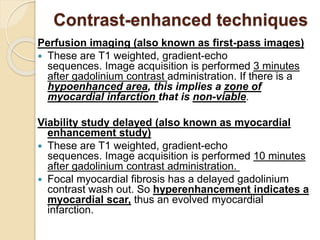
Contrast-enhanced techniques
Perfusion imaging (also known as first-pass images)
 These are T1 weighted, gradient-echo
sequences. Image acquisition is performed 3 minutes
after gadolinium contrast administration. If there is a
hypoenhanced area, this implies a zone of
myocardial infarction that is non-viable.
Viability study delayed (also known as myocardial
enhancement study)
 These are T1 weighted, gradient-echo
sequences. Image acquisition is performed 10 minutes
after gadolinium contrast administration.
 Focal myocardial fibrosis has a delayed gadolinium
contrast wash out. So hyperenhancement indicates a
myocardial scar, thus an evolved myocardial
infarction.
MR planes of imaging
 The two main planes used for cardiac
MRI include the body (scanner) planes
and the cardiac planes.
 Body Planes
Body planes are oriented orthogonal to
the long axis of the body and consist
of axial, sagittal, and coronal planes .
 The axial plane can depict the four
chambers of the heart and the
pericardium simultaneously.
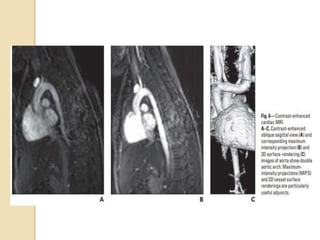
 The sagittal plane can show the great
vessels arising in continuity from the
ventricles.
 The coronal plane can be used to
assess the left ventricular outflow
tract, the left atrium, and the
pulmonary veins.
Cardiac planes
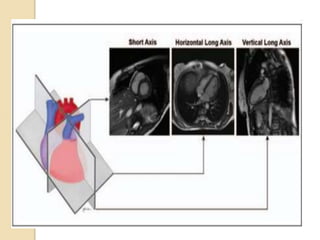
 The standard cardiac planes are
established using the scout images
and include
short axis view
horizontal long axis (four-chamber view)
vertical long axis (two-chamber view)
 These planes are prescribed along a line
extending from the cardiac apex to the
center of the mitral valve (long axis of the
heart) using the axial body plane images.
 The short-axis plane extends perpendicular
to this true long axis of the heart at the level
of the mid left ventricle.
 The horizontal long(4 chamber) axis is
generated by selecting the horizontal plane
that is perpendicular to the short axis
 The vertical long (2 chamber)axis is
prescribed along a vertical plane orthogonal
to the short-axis plane
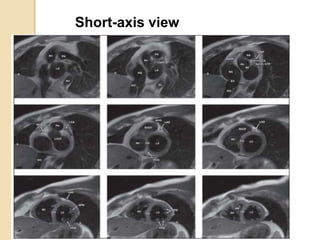
Short axis view
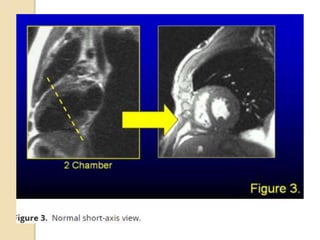
 The short-axis plane extends
perpendicular to this true long axis of
the heart at the level of the mid left
ventricle
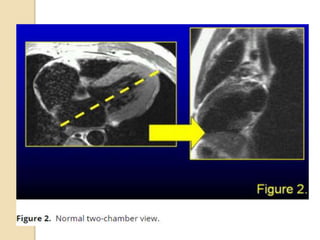
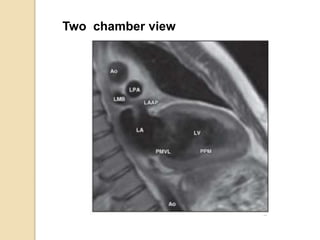
Two chamber view
 To achieve a two-chamber scout view,
a true axial view through the left
ventricle should be obtained, and then
an oblique coronal scout view should
be positioned parallel to the
interventricular septum
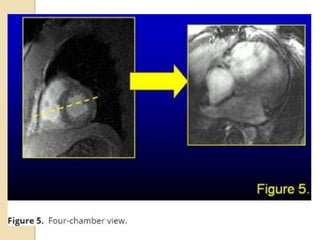
4 chamber view
 The horizontal long axis(4 chamber
view) is generated by selecting the
horizontal plane that is perpendicular
to the short axis
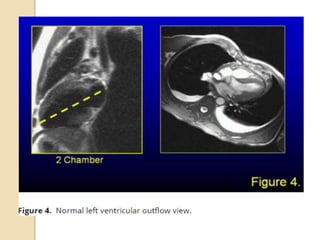
Left ventricular outflow view
 To obtain a long-axis left ventricular
view, an imaging plane should be
positioned from the left ventricular
apex through the mitral valve by using
a two-chamber view depicting the
mitral valve
Planning and acquisition of
standard cardiac views
Short-axis view
Horizontal long axis view
Two chamber view
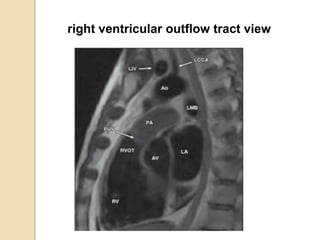
right ventricular outflow tract view
left ventricular outflow tract view
Indications of cardiac MRI
Conclusion
THANK YOU

Cardiac MRI basics

  • 1.
  • 2.
     Cardiac MRIconsists of using MRI to study heart anatomy, physiology, and pathology.
  • 3.
    Advantages Cardiac MRI offers: improved soft tissue definition  protocol can be tailored to likely differential diagnoses ◦ a large number of sequences are available ◦ dynamic imaging provides functional assessment  no ionizing radiation ◦ MRI safety still requires consideration
  • 4.
  • 11.
  • 13.
    MR imaging techniques Blood techniques Dark blood Bright blood  Imaging sequences  Imaging planes
  • 14.
    Pulse sequences-Overview  Blackblood-anatomy Spin echo(SE)  Bright blood-dynamic and angiography Gradient echo(GE)  Phase contrast(PC)-quantify flow  Delayed enhancement- infarct/inflammation/infiltration  2D SSFP with IR prep  Gadolinium assisted MRA 3D fast spoiled GE
  • 15.
     Basic cardiovascularMR imaging sequences include black blood imaging and bright blood imaging.  Black blood imaging is used to depict anatomy, pericardial and mediastinal abnormalities, and extra luminal aortic disease.  Black blood imaging includes ECG-gated true spin-echo or fast spin-echo imaging or inversion-recovery (IR) half-Fourier single-shot turbo fast-spin-echo sequences.
  • 16.
     Bright bloodimaging is used to demonstrate flow and motion and to image valvular disease.  Bright blood cine sequences include segmented-k-space small-flip-angle gradient-echo sequences or fast imaging with steady-state precession or refocused steady-state free precession (SSFP)
  • 22.
    Advantages  Since ituses the residual transverse magnetization instead of wasting it,there is increased signal to noise ratio.  Since transverse magnetization is added back to longitudinal magnetization,the steady state is reached quicker,in as little as single TR.  The TRs are extremely
  • 23.
     The imageshave both T1and T2 weighted.(The molecules with long T2 and short T1 will have bright signal(both fat and water)  Thus bright signal in steady state white blood images is attributable to T1 and T2 signal from the blood,not flow related.
  • 24.
     Gating ofwhite blood images allows evaluation of dynamic cardiac function and physiology throughout cardiac cycle.Examples include motion of myocardium and valve leaflets.  Gating in white blood images serve to time image acquisition during diastolic phase of cardiac cycle,thereby limiting cardiac motion artifact.
  • 26.
  • 27.
  • 28.
    Cine imaging Cine imagingor cine MRI, are a type of MRI sequence acquired to capture motion  For the heart, this is achieved by acquisition at multiple time points throughout the cardiac cycle, after synchronisation with the ECG has been achieved.  Separate k-spaces are assigned to different phases or segments of the cardiac cycle.  Images are reconstructed from each k- space and shown in a movie.  This type of imaging technique requires fast imaging techniques using very short repetition and echo times such as balanced steady-state free precession or spoiled gradient
  • 32.
    Contrast-enhanced techniques Perfusion imaging(also known as first-pass images)  These are T1 weighted, gradient-echo sequences. Image acquisition is performed 3 minutes after gadolinium contrast administration. If there is a hypoenhanced area, this implies a zone of myocardial infarction that is non-viable. Viability study delayed (also known as myocardial enhancement study)  These are T1 weighted, gradient-echo sequences. Image acquisition is performed 10 minutes after gadolinium contrast administration.  Focal myocardial fibrosis has a delayed gadolinium contrast wash out. So hyperenhancement indicates a myocardial scar, thus an evolved myocardial infarction.
  • 35.
    MR planes ofimaging
  • 36.
     The twomain planes used for cardiac MRI include the body (scanner) planes and the cardiac planes.  Body Planes Body planes are oriented orthogonal to the long axis of the body and consist of axial, sagittal, and coronal planes .
  • 37.
     The axialplane can depict the four chambers of the heart and the pericardium simultaneously.  The sagittal plane can show the great vessels arising in continuity from the ventricles.  The coronal plane can be used to assess the left ventricular outflow tract, the left atrium, and the pulmonary veins.
  • 39.
    Cardiac planes  Thestandard cardiac planes are established using the scout images and include short axis view horizontal long axis (four-chamber view) vertical long axis (two-chamber view)
  • 40.
     These planesare prescribed along a line extending from the cardiac apex to the center of the mitral valve (long axis of the heart) using the axial body plane images.  The short-axis plane extends perpendicular to this true long axis of the heart at the level of the mid left ventricle.  The horizontal long(4 chamber) axis is generated by selecting the horizontal plane that is perpendicular to the short axis  The vertical long (2 chamber)axis is prescribed along a vertical plane orthogonal to the short-axis plane
  • 42.
    Short axis view The short-axis plane extends perpendicular to this true long axis of the heart at the level of the mid left ventricle
  • 44.
    Two chamber view To achieve a two-chamber scout view, a true axial view through the left ventricle should be obtained, and then an oblique coronal scout view should be positioned parallel to the interventricular septum
  • 46.
    4 chamber view The horizontal long axis(4 chamber view) is generated by selecting the horizontal plane that is perpendicular to the short axis
  • 48.
    Left ventricular outflowview  To obtain a long-axis left ventricular view, an imaging plane should be positioned from the left ventricular apex through the mitral valve by using a two-chamber view depicting the mitral valve
  • 51.
    Planning and acquisitionof standard cardiac views
  • 52.
  • 53.
  • 54.
  • 55.
  • 56.
  • 58.
  • 60.
  • 61.