COURSE PLAN
What we are going to
discuss??
Developing a course
rationale
Preparing the scope
and sequence plan
Planning the course
content
Sequencing course
content
Choosing course
content
Describing entry and
exit levels
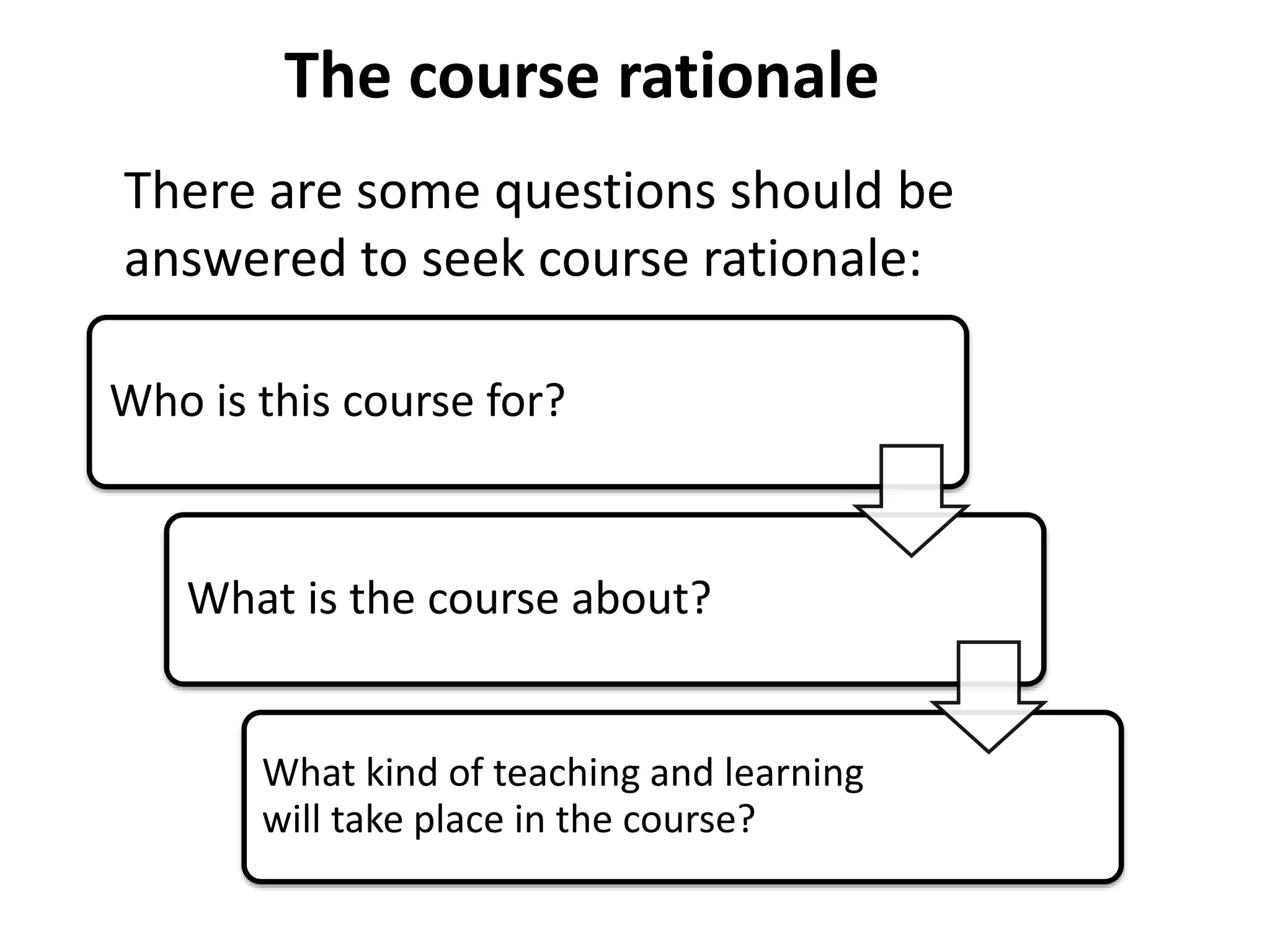
The course rationale
There are some questions should be
answered to seek course rationale:
Who is this course for?
What is the course about?
What kind of teaching and learning
will take place in the course?
Course Rationale
questions
Describing the beliefs,
values and goals that
underlie the course.
The purpose of developing
rationale :
Guiding planning of the various
component s of the course
Emphasizing the kinds of teaching
and learning the course should
exemplify
Providing a check on the consistency
of the various components in terms
of the course values and goals.
Example of a course rationale
This course is designed for working adults who wish to
improve their communication skills in English in order to
improve their employment prospects . It teaches the basic
communication skills needed to communicate in a variety
of different work settings. The course seeks to enable
participants to recognize their strengths and needs in
language learning them the confidence give them
confidence to use English more effectively to achieve their
own goals. It also seeks to develop the participants' skills
in independent learning outside of the classroom.
Course Planners should consider some
aspects such as :
Goal of the course
The kind of teaching and learning they
want the course to exemplify
The role of teachers and learners in the
course
Beliefs and principles the course will
reflect
Describing the entry and exit level
• Knowing students’ level is necessary before
designing course. For instance elementary,
intermediate and advanced level and etc.
• We also can determine the level of students’
language skills from special tests such as TOEFL or
IELTS.
• By knowing students’ proficiency and language
skills, of course it will be one of way to design
certain programs and objective based on the
student’s level.
Choosing course content
• Course Content has to be appropriate with a set
of needs and to cover set of objectives.
• Planners need to decide appropriate course
contents to reflect about some aspects such as
the nature of language, language use, language
learning and etc.
• For instance: in writing course content, planners
perhaps can plan some contents such as :
grammar, functions. Topics, skills and etc.
• Besides choosing course content, planners also
need to choose particular approach to the
content selection based on subject matter
knowledge, learner’s proficiency level and etc.
Choosing Course Content
• Additional Ideas/Sources of Content
Selection from:
– Available literature on the topic
– Published material on the topic
– Review of similar course
– Review test/exam in the area
– Analysis of students’ problems
– Consultation with teachers and specialists
Steps in designing integrated course
design
Determining the Scope and Sequence
Scope Sequence
Purpose of the scope and sequence
To serve as a guideline for
teachers who want to
integrate learning strategies
instruction into their
language and content
curriculum
Criteria of sequencing:
Simple to complex
Chronology
Need
Prerequisite learning
Whole to part or part to whole
Spiral sequencing
Bibliography
• Nursing Education, BT Basavanthappa, 2003
Jaypee Brothers
• Curriculum Development and Evaluation in
Nursing, Sarah B. Keating. Third Edition
• http://www.moe.gov.tt/curriculum_process.html

Course plan

  • 1.
  • 2.
    What we aregoing to discuss?? Developing a course rationale Preparing the scope and sequence plan Planning the course content Sequencing course content Choosing course content Describing entry and exit levels
  • 3.
    The course rationale Thereare some questions should be answered to seek course rationale: Who is this course for? What is the course about? What kind of teaching and learning will take place in the course?
  • 4.
    Course Rationale questions Describing thebeliefs, values and goals that underlie the course. The purpose of developing rationale : Guiding planning of the various component s of the course Emphasizing the kinds of teaching and learning the course should exemplify Providing a check on the consistency of the various components in terms of the course values and goals.
  • 5.
    Example of acourse rationale This course is designed for working adults who wish to improve their communication skills in English in order to improve their employment prospects . It teaches the basic communication skills needed to communicate in a variety of different work settings. The course seeks to enable participants to recognize their strengths and needs in language learning them the confidence give them confidence to use English more effectively to achieve their own goals. It also seeks to develop the participants' skills in independent learning outside of the classroom.
  • 6.
    Course Planners shouldconsider some aspects such as : Goal of the course The kind of teaching and learning they want the course to exemplify The role of teachers and learners in the course Beliefs and principles the course will reflect
  • 7.
    Describing the entryand exit level • Knowing students’ level is necessary before designing course. For instance elementary, intermediate and advanced level and etc. • We also can determine the level of students’ language skills from special tests such as TOEFL or IELTS. • By knowing students’ proficiency and language skills, of course it will be one of way to design certain programs and objective based on the student’s level.
  • 8.
    Choosing course content •Course Content has to be appropriate with a set of needs and to cover set of objectives. • Planners need to decide appropriate course contents to reflect about some aspects such as the nature of language, language use, language learning and etc. • For instance: in writing course content, planners perhaps can plan some contents such as : grammar, functions. Topics, skills and etc. • Besides choosing course content, planners also need to choose particular approach to the content selection based on subject matter knowledge, learner’s proficiency level and etc.
  • 9.
    Choosing Course Content •Additional Ideas/Sources of Content Selection from: – Available literature on the topic – Published material on the topic – Review of similar course – Review test/exam in the area – Analysis of students’ problems – Consultation with teachers and specialists
  • 10.
    Steps in designingintegrated course design
  • 11.
    Determining the Scopeand Sequence Scope Sequence
  • 12.
    Purpose of thescope and sequence To serve as a guideline for teachers who want to integrate learning strategies instruction into their language and content curriculum
  • 13.
    Criteria of sequencing: Simpleto complex Chronology Need Prerequisite learning Whole to part or part to whole Spiral sequencing
  • 14.
    Bibliography • Nursing Education,BT Basavanthappa, 2003 Jaypee Brothers • Curriculum Development and Evaluation in Nursing, Sarah B. Keating. Third Edition • http://www.moe.gov.tt/curriculum_process.html