




OBJECTIVE & ESSAY TYPE
TEST
BY-
PREETI SHARMA
MSC. NSG. 1ST YR.
OBJECTIVE TEST
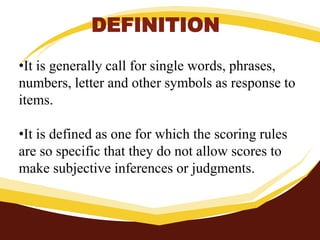
DEFINITION
•It is generally call for single words, phrases,
numbers, letter and other symbols as response to
items.
•It is defined as one for which the scoring rules
are so specific that they do not allow scores to
make subjective inferences or judgments.
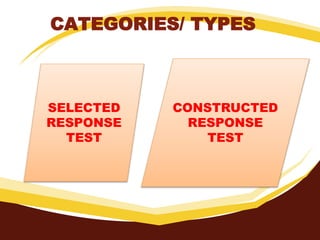
CATEGORIES/ TYPES
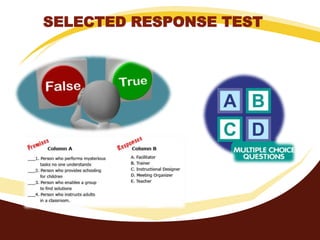
SELECTED
RESPONSE
TEST
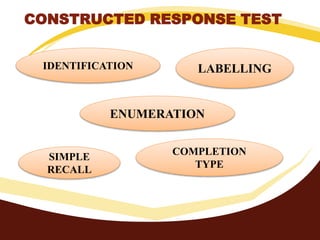
CONSTRUCTED
RESPONSE
TEST
SELECTED RESPONSE TEST
CONSTRUCTED RESPONSE TEST
IDENTIFICATION
ENUMERATION
COMPLETION
TYPE
LABELLING
SIMPLE
RECALL
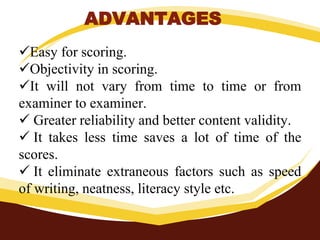
ADVANTAGES
Easy for scoring.
Objectivity in scoring.
It will not vary from time to time or from
examiner to examiner.
 Greater reliability and better content validity.
 It takes less time saves a lot of time of the
scores.
 It eliminate extraneous factors such as speed
of writing, neatness, literacy style etc.
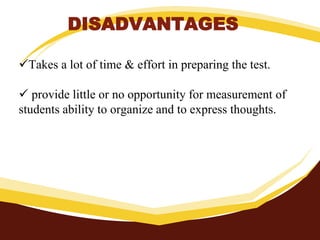
DISADVANTAGES
Takes a lot of time & effort in preparing the test.
 provide little or no opportunity for measurement of
students ability to organize and to express thoughts.
ESSAY TYPE QUESTION
INTRODUCTION
• Education choose essay question over other
forms of assessment because essay items
challenge students to create a response rather
than to simply select a response.
• Some educators use them because essay have the
potential to reveal students abilities to reason,
create, analyse, synthesize and evaluate.
DEFINITION
• An essay type test presents or more questions or
other tasks that require extended written responses
from the person being tested.
- Robert L.E & David A.F
• It requires the student to structure a long written
response upto several paragraphs.
- William W & Stephen GJ
FEATURES
• Questions are should both as formative and
summative assessments.
• They require a great deal of thought and planning.
• Students prepare their own answers.
• They evaluate knowledge areas alone.
• Students handwriting, spelling, neatness, organization and
way of expressing ideas may be considered while scoring
the items.
• No single answer is permitted freedom of response.
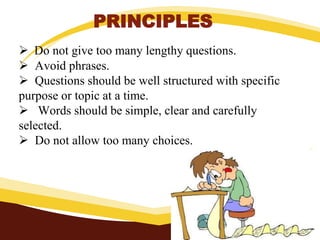
PRINCIPLES
 Do not give too many lengthy questions.
 Avoid phrases.
 Questions should be well structured with specific
purpose or topic at a time.
 Words should be simple, clear and carefully
selected.
 Do not allow too many choices.
TYPES /FORM OF ESSAY TEST
• Restricted Response/ Controlled Response.
• Extended Response/Uncontrolled Response.
Restricted Response Extended Response
Restricted Response Essay Questions
Restricted response usually limits both the
content and the response by restricting the
scope of the topic to be discussed.
Useful for measuring learning outcomes
requiring interpretation and application of
data in a specific area.
EXAMPLE:-
1. Mr. Rogers a ninth grade science teacher,
wants to measure his student ‘ ability to interpret
scientific data’ with a paper pencil test
• Describe the steps that Mr. Rogers would
follow
• Give reasons to justify each steps.
Extended Response Essay Questions
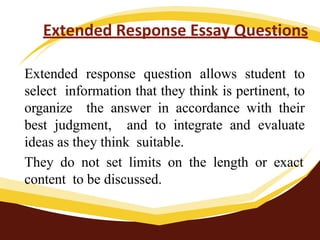
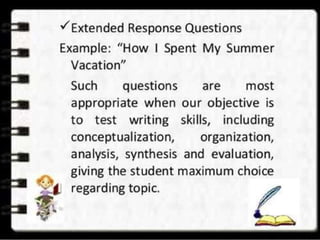
Extended response question allows student to
select information that they think is pertinent, to
organize the answer in accordance with their
best judgment, and to integrate and evaluate
ideas as they think suitable.
They do not set limits on the length or exact
content to be discussed.
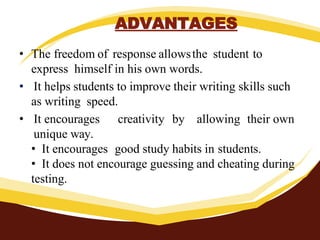
ADVANTAGES
• The freedom of response allowsthe student to
express himself in his own words.
• It helps students to improve their writing skills such
as writing speed.
• It encourages creativity by allowing their own
unique way.
• It encourages good study habits in students.
• It does not encourage guessing and cheating during
testing.
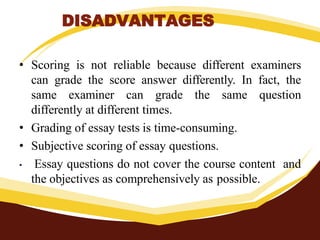
DISADVANTAGES
• Scoring is not reliable because different examiners
can grade the score answer differently. In fact, the
same examiner can grade the same question
differently at different times.
• Grading of essay tests is time-consuming.
• Subjective scoring of essay questions.
• Essay questions do not cover the course content and
the objectives as comprehensively as possible.
SUMMARY
Objective & scoring essay test- preeti sharma

Objective & scoring essay test- preeti sharma

  • 2.
    OBJECTIVE & ESSAYTYPE TEST BY- PREETI SHARMA MSC. NSG. 1ST YR.
  • 3.
  • 4.
    DEFINITION •It is generallycall for single words, phrases, numbers, letter and other symbols as response to items. •It is defined as one for which the scoring rules are so specific that they do not allow scores to make subjective inferences or judgments.
  • 5.
  • 6.
  • 7.
  • 8.
    ADVANTAGES Easy for scoring. Objectivityin scoring. It will not vary from time to time or from examiner to examiner.  Greater reliability and better content validity.  It takes less time saves a lot of time of the scores.  It eliminate extraneous factors such as speed of writing, neatness, literacy style etc.
  • 9.
    DISADVANTAGES Takes a lotof time & effort in preparing the test.  provide little or no opportunity for measurement of students ability to organize and to express thoughts.
  • 10.
  • 11.
    INTRODUCTION • Education chooseessay question over other forms of assessment because essay items challenge students to create a response rather than to simply select a response. • Some educators use them because essay have the potential to reveal students abilities to reason, create, analyse, synthesize and evaluate.
  • 12.
    DEFINITION • An essaytype test presents or more questions or other tasks that require extended written responses from the person being tested. - Robert L.E & David A.F • It requires the student to structure a long written response upto several paragraphs. - William W & Stephen GJ
  • 13.
    FEATURES • Questions areshould both as formative and summative assessments. • They require a great deal of thought and planning. • Students prepare their own answers. • They evaluate knowledge areas alone. • Students handwriting, spelling, neatness, organization and way of expressing ideas may be considered while scoring the items. • No single answer is permitted freedom of response.
  • 14.
    PRINCIPLES  Do notgive too many lengthy questions.  Avoid phrases.  Questions should be well structured with specific purpose or topic at a time.  Words should be simple, clear and carefully selected.  Do not allow too many choices.
  • 16.
    TYPES /FORM OFESSAY TEST • Restricted Response/ Controlled Response. • Extended Response/Uncontrolled Response. Restricted Response Extended Response
  • 17.
    Restricted Response EssayQuestions Restricted response usually limits both the content and the response by restricting the scope of the topic to be discussed. Useful for measuring learning outcomes requiring interpretation and application of data in a specific area.
  • 18.
    EXAMPLE:- 1. Mr. Rogersa ninth grade science teacher, wants to measure his student ‘ ability to interpret scientific data’ with a paper pencil test • Describe the steps that Mr. Rogers would follow • Give reasons to justify each steps.
  • 19.
    Extended Response EssayQuestions Extended response question allows student to select information that they think is pertinent, to organize the answer in accordance with their best judgment, and to integrate and evaluate ideas as they think suitable. They do not set limits on the length or exact content to be discussed.
  • 21.
    ADVANTAGES • The freedomof response allowsthe student to express himself in his own words. • It helps students to improve their writing skills such as writing speed. • It encourages creativity by allowing their own unique way. • It encourages good study habits in students. • It does not encourage guessing and cheating during testing.
  • 22.
    DISADVANTAGES • Scoring isnot reliable because different examiners can grade the score answer differently. In fact, the same examiner can grade the same question differently at different times. • Grading of essay tests is time-consuming. • Subjective scoring of essay questions. • Essay questions do not cover the course content and the objectives as comprehensively as possible.
  • 23.