


Course Planning
and
Syllabus Design
Dimensions of Course
Development
• Developing a course rationale
• Describing entry and exit levels
• Choosing course content
• Sequencing course content
• Planning the course content (syllabus and instructional blocks)
• Preparing the scope and sequence plan
The Course Rationale
It seeks to answer the following questions:
1. Who is this course for?
2. What is this course about?
3. What kind of teaching and learning will take
place in the course?
A course rationale describes the beliefs, values and goals that underlie
the course. It would normally be a two- or three paragraph statement
that has been developed by those involved in planning and teaching a
course that serves to provide the justification for the type of teaching
and learning that will take place in the course.
The Course Rationale
It seeks to answer the following questions:
1. Who is this course for?
2. What is this course about?
3. What kind of teaching and learning will take place in the course?
This course designed for working adults who wish to improve their
communication skills in English in order to improve their employment
prospects. It teaches the basic communication skills needed to
communicate in a variety of different work settings. The course seeks to
enable participants to recognize their strengths and needs in language
learning and to give them the confidence to achieve their own goals. It
also seeks to develop the participants’ skills in independent learning
outside of the classroom.
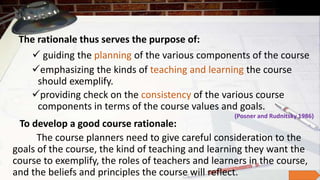
The rationale thus serves the purpose of:
 guiding the planning of the various components of the course
emphasizing the kinds of teaching and learning the course
should exemplify.
providing check on the consistency of the various course
components in terms of the course values and goals.
To develop a good course rationale:
The course planners need to give careful consideration to the
goals of the course, the kind of teaching and learning they want the
course to exemplify, the roles of teachers and learners in the course,
and the beliefs and principles the course will reflect.
(Posner and Rudnitsky 1986)
Describing the Entry and Exit Level
In order to plan a language course, it is necessary to know the level
at which the program will start and the level learners may be expected to
reach at the end of the course. Language programs and commercial
materials typically distinguish between: elementary, intermediate and
advance levels.
Information may be available on students’ entry level from their
results on international proficiency tests such as TOEFL or IELTS. Or
specially designed tests may be needed to determine the level of the
students’ language skills. Information fro proficiency tests will enable the
target level of the program to be assessed and may require adjustments of
the program’s objectives if they appear to be aimed at too high or too low
a level.
Choosing Course Content
Decisions about course content reflect the planner’s assumptions
about the nature of language, language use, and language learning, what
the most essential elements or units of language are, and how these can be
organized as an efficient basis for second language learning.
For example, a writing course could potentially be planned around any of
the following types of content:
grammar (e.g., using the present tense in description)
functions (e.g., describing likes and dislikes)
The choice of a particular approach to content selection will
depend on subject matter knowledge, the learners’ proficiency levels,
current views on second language learning and teaching, conventional
wisdom, and convenience. Information gathered during needs analysis
contributes to the planning of course content, as do additional ideas
from the following sources:
 available literature on the topic
 published materials on the topic
 review of similar course offered elsewhere
 review of tests or exams in the area
 analysis of students' problems
 consultation with teachers familiar with the topic
 consultation with specialist on the area
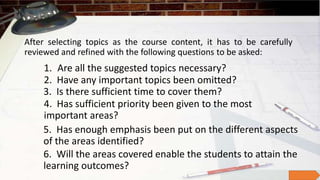
After selecting topics as the course content, it has to be carefully
reviewed and refined with the following questions to be asked:
1. Are all the suggested topics necessary?
2. Have any important topics been omitted?
3. Is there sufficient time to cover them?
4. Has sufficient priority been given to the most
important areas?
5. Has enough emphasis been put on the different aspects
of the areas identified?
6. Will the areas covered enable the students to attain the
learning outcomes?
Determining the scope and Sequence
Scope is concerned with the breadth and depth of coverage of items in
the course, that is, with the following questions:
What range of content will be covered?
To what extent should each topic be covered?
Sequencing of the content involves deciding which content is needed
early in the course and which provides basis for things that will be
learned.
Criteria on Sequencing
A. Simple to Complex
Content presented earlier is thought to be simpler than
the later items. This is typically seen to grammar content, bur
any course content can be graded in terms of difficulty.
Content is sequenced according to order in which events
occur in the real world. E.g. In writing a course, the organization
might be based on the sequence writers are assumed to employ
when composing: 1.) brainstorming, 2.) drafting, 3.) revising, 4.)
editing.
B. Chronology
Criteria on Sequencing
C. Need
Content is sequenced according to when the learners are
most likely to need it outside of the classroom.
The sequence of the content reflects what is necessary at
one point as a foundation for the next step in the learning
process.
D. Prerequisite Learning
Criteria on Sequencing
E. Whole to Part or Part to Whole
Material at the beginning of the course may focus on the
overall organization or structure of the topic before considering
the individual components that make it. Alternatetively, the
course may focus on practicing the parts before the whole. E.g.
Reading a story.
Involves the recycling of items to ensure the learners have
repeated opportunities to learn them.
F. Spiral Sequencing
Developing Instructional Blocks
jhgsiukdjhgnvdk
Preparing the scope and sequence plan
One a course has been planned and organize, it van be described. One
form in which it can be described is a scope and sequence plan. This
might consist of listing of the module or units and their contents and an
indication of how much teaching time each block in the course will
require.
Course planning and syllabus design

Course planning and syllabus design

  • 2.
  • 3.
    Dimensions of Course Development •Developing a course rationale • Describing entry and exit levels • Choosing course content • Sequencing course content • Planning the course content (syllabus and instructional blocks) • Preparing the scope and sequence plan
  • 4.
    The Course Rationale Itseeks to answer the following questions: 1. Who is this course for? 2. What is this course about? 3. What kind of teaching and learning will take place in the course? A course rationale describes the beliefs, values and goals that underlie the course. It would normally be a two- or three paragraph statement that has been developed by those involved in planning and teaching a course that serves to provide the justification for the type of teaching and learning that will take place in the course.
  • 5.
    The Course Rationale Itseeks to answer the following questions: 1. Who is this course for? 2. What is this course about? 3. What kind of teaching and learning will take place in the course? This course designed for working adults who wish to improve their communication skills in English in order to improve their employment prospects. It teaches the basic communication skills needed to communicate in a variety of different work settings. The course seeks to enable participants to recognize their strengths and needs in language learning and to give them the confidence to achieve their own goals. It also seeks to develop the participants’ skills in independent learning outside of the classroom.
  • 6.
    The rationale thusserves the purpose of:  guiding the planning of the various components of the course emphasizing the kinds of teaching and learning the course should exemplify. providing check on the consistency of the various course components in terms of the course values and goals. To develop a good course rationale: The course planners need to give careful consideration to the goals of the course, the kind of teaching and learning they want the course to exemplify, the roles of teachers and learners in the course, and the beliefs and principles the course will reflect. (Posner and Rudnitsky 1986)
  • 7.
    Describing the Entryand Exit Level In order to plan a language course, it is necessary to know the level at which the program will start and the level learners may be expected to reach at the end of the course. Language programs and commercial materials typically distinguish between: elementary, intermediate and advance levels. Information may be available on students’ entry level from their results on international proficiency tests such as TOEFL or IELTS. Or specially designed tests may be needed to determine the level of the students’ language skills. Information fro proficiency tests will enable the target level of the program to be assessed and may require adjustments of the program’s objectives if they appear to be aimed at too high or too low a level.
  • 8.
    Choosing Course Content Decisionsabout course content reflect the planner’s assumptions about the nature of language, language use, and language learning, what the most essential elements or units of language are, and how these can be organized as an efficient basis for second language learning. For example, a writing course could potentially be planned around any of the following types of content: grammar (e.g., using the present tense in description) functions (e.g., describing likes and dislikes)
  • 9.
    The choice ofa particular approach to content selection will depend on subject matter knowledge, the learners’ proficiency levels, current views on second language learning and teaching, conventional wisdom, and convenience. Information gathered during needs analysis contributes to the planning of course content, as do additional ideas from the following sources:  available literature on the topic  published materials on the topic  review of similar course offered elsewhere  review of tests or exams in the area  analysis of students' problems  consultation with teachers familiar with the topic  consultation with specialist on the area
  • 10.
    After selecting topicsas the course content, it has to be carefully reviewed and refined with the following questions to be asked: 1. Are all the suggested topics necessary? 2. Have any important topics been omitted? 3. Is there sufficient time to cover them? 4. Has sufficient priority been given to the most important areas? 5. Has enough emphasis been put on the different aspects of the areas identified? 6. Will the areas covered enable the students to attain the learning outcomes?
  • 11.
    Determining the scopeand Sequence Scope is concerned with the breadth and depth of coverage of items in the course, that is, with the following questions: What range of content will be covered? To what extent should each topic be covered? Sequencing of the content involves deciding which content is needed early in the course and which provides basis for things that will be learned.
  • 12.
    Criteria on Sequencing A.Simple to Complex Content presented earlier is thought to be simpler than the later items. This is typically seen to grammar content, bur any course content can be graded in terms of difficulty. Content is sequenced according to order in which events occur in the real world. E.g. In writing a course, the organization might be based on the sequence writers are assumed to employ when composing: 1.) brainstorming, 2.) drafting, 3.) revising, 4.) editing. B. Chronology
  • 13.
    Criteria on Sequencing C.Need Content is sequenced according to when the learners are most likely to need it outside of the classroom. The sequence of the content reflects what is necessary at one point as a foundation for the next step in the learning process. D. Prerequisite Learning
  • 14.
    Criteria on Sequencing E.Whole to Part or Part to Whole Material at the beginning of the course may focus on the overall organization or structure of the topic before considering the individual components that make it. Alternatetively, the course may focus on practicing the parts before the whole. E.g. Reading a story. Involves the recycling of items to ensure the learners have repeated opportunities to learn them. F. Spiral Sequencing
  • 16.
  • 17.
    Preparing the scopeand sequence plan One a course has been planned and organize, it van be described. One form in which it can be described is a scope and sequence plan. This might consist of listing of the module or units and their contents and an indication of how much teaching time each block in the course will require.