Managing disciplinary
problems
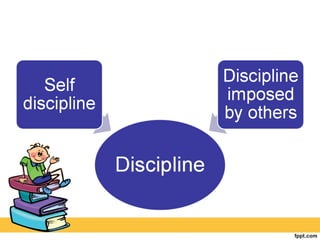
Discipline
• The term discipline refers to the orderly
activities by a person in their progress
towards the attainment of some goal
which either they themselves desire or
which someone desires for them
Importance
• With good discipline, aims of education
can be realised
• Develops good moral character
• Enable a person to live happily and
successfully in a democratic society
Aims of discipline In teaching
learning situation in nursing
education
–To create and maintain conditions in the
teaching learning situation (classroom
or clinical setting) that helps in
attainment of desired objectives
–To create a favourable attitude
among students which is essential
for effective working towards
desired objectives
–To develop the qualities of self control
and cooperation which are the essential
traits for professional functioning
–To create favourable attitude towards
authority where authority is necessary
for the welfare of individual and society
Principles/ general guidelines
• Help students to develop self
discipline. Use discipline to
strengthen the students self control,
self direction and sense of
responsibility. Do not use discipline
for self revenge
• Disciplinary talks should be made
in private/ confidentially
Principles/ general guidelines
for managing disciplinary
problems
–Give students good standards of
conduct, instead of rules
–Use a positive approach, not a
negative approach. Offer a challenge.
Most students respond whole heartedly
to a challenge, if it is within the scope
of their abilities
Principles/ general guidelines
• Definitely relate act of misconduct to the
act of correction, otherwise it is not
educative
• Do not punish the whole group for the
mistake done by one or two individuals
• Do not let disciplinary measures
interfere with other educative activities
Principles/ general guidelines
• Make correction consistent. To favour and
excuse some students and correct others;
to tighten discipline one day and relax on
the next, all tend to lessen the students
respect for the teacher
• Use deferred action in preference to
immediate action, as far as possible
Principles/ general guidelines
• Be certain of guilt before administering
correction. Undeserved correction
produces unfavourable attitude and
embitters the student against the teacher
Preventive measures – effective
classroom management
• Begin classes promptly. Ther should be
no delay in class due to lack of
preparation on the part of teacher
• Plan classroom activities so that all the
students are busy all the time. Idleness
invites trouble.
• The teaching plans of interesting and
vague topics should be blended properly
Effective classroom management
• Assume a position in the classroom so
that all students can see and hear
• Speak clearly, convincingly and sufficiently
loudly. Do not speak in a commanding or
monotonous voice
• Watch for lack of interest, discontent
and misbehaviour and try to stimulate
interest
Effective classroom management
• Assume a cooperative “we” attitude. The
class should be a teacher directed and not
teacher dominated. Give students an
opportunity and responsibility to plan class
activities
• Students themselves should be
taught to speak loudly enough so that
they can be heard, instead of
parroting the students questions and
answers
Effective classroom management
–State the question first and then
address an individual student
–The teacher should always be fully
prepared. Lack of knowledge on subject
matter on the part of the teacher may
lead to loss of respect and ultimately to
disciplinary problems
Effective classroom management
• Use right method of teaching. Make
the subject matter understandable and
interesting
• Do not openly anticipate disorder in
advance by prescribing rules,
punishment and threats for
misconduct that has not yet occurred.
To threaten is to invite opposition

managing disciplinary problems

  • 1.
  • 2.
    Discipline • The termdiscipline refers to the orderly activities by a person in their progress towards the attainment of some goal which either they themselves desire or which someone desires for them
  • 4.
    Importance • With gooddiscipline, aims of education can be realised • Develops good moral character • Enable a person to live happily and successfully in a democratic society
  • 5.
    Aims of disciplineIn teaching learning situation in nursing education –To create and maintain conditions in the teaching learning situation (classroom or clinical setting) that helps in attainment of desired objectives –To create a favourable attitude among students which is essential for effective working towards desired objectives
  • 6.
    –To develop thequalities of self control and cooperation which are the essential traits for professional functioning –To create favourable attitude towards authority where authority is necessary for the welfare of individual and society
  • 7.
    Principles/ general guidelines •Help students to develop self discipline. Use discipline to strengthen the students self control, self direction and sense of responsibility. Do not use discipline for self revenge • Disciplinary talks should be made in private/ confidentially
  • 8.
    Principles/ general guidelines formanaging disciplinary problems –Give students good standards of conduct, instead of rules –Use a positive approach, not a negative approach. Offer a challenge. Most students respond whole heartedly to a challenge, if it is within the scope of their abilities
  • 9.
    Principles/ general guidelines •Definitely relate act of misconduct to the act of correction, otherwise it is not educative • Do not punish the whole group for the mistake done by one or two individuals • Do not let disciplinary measures interfere with other educative activities
  • 10.
    Principles/ general guidelines •Make correction consistent. To favour and excuse some students and correct others; to tighten discipline one day and relax on the next, all tend to lessen the students respect for the teacher • Use deferred action in preference to immediate action, as far as possible
  • 11.
    Principles/ general guidelines •Be certain of guilt before administering correction. Undeserved correction produces unfavourable attitude and embitters the student against the teacher
  • 12.
    Preventive measures –effective classroom management • Begin classes promptly. Ther should be no delay in class due to lack of preparation on the part of teacher • Plan classroom activities so that all the students are busy all the time. Idleness invites trouble. • The teaching plans of interesting and vague topics should be blended properly
  • 13.
    Effective classroom management •Assume a position in the classroom so that all students can see and hear • Speak clearly, convincingly and sufficiently loudly. Do not speak in a commanding or monotonous voice • Watch for lack of interest, discontent and misbehaviour and try to stimulate interest
  • 14.
    Effective classroom management •Assume a cooperative “we” attitude. The class should be a teacher directed and not teacher dominated. Give students an opportunity and responsibility to plan class activities • Students themselves should be taught to speak loudly enough so that they can be heard, instead of parroting the students questions and answers
  • 15.
    Effective classroom management –Statethe question first and then address an individual student –The teacher should always be fully prepared. Lack of knowledge on subject matter on the part of the teacher may lead to loss of respect and ultimately to disciplinary problems
  • 16.
    Effective classroom management •Use right method of teaching. Make the subject matter understandable and interesting • Do not openly anticipate disorder in advance by prescribing rules, punishment and threats for misconduct that has not yet occurred. To threaten is to invite opposition