Curriculum and course design
•
• Prepared by
•
• Ahmed youssef
Defining terms
curriculum
The term curriculum refers to the lessons and academic content
taught in a school or in a specific course or program.
Program :
It’s a general and broad term describes
a plan or schedule of activities, procedures,
a list of items, pieces, performers etc offered within a institution
Syllabus
the subjects or books to be studied in a
particular course, especially a course that leads to an exam
Course ( class )
A limited time educational experience carried out in regular
meetings
Like now we have a course or a class
SITUATION ANALYSIS
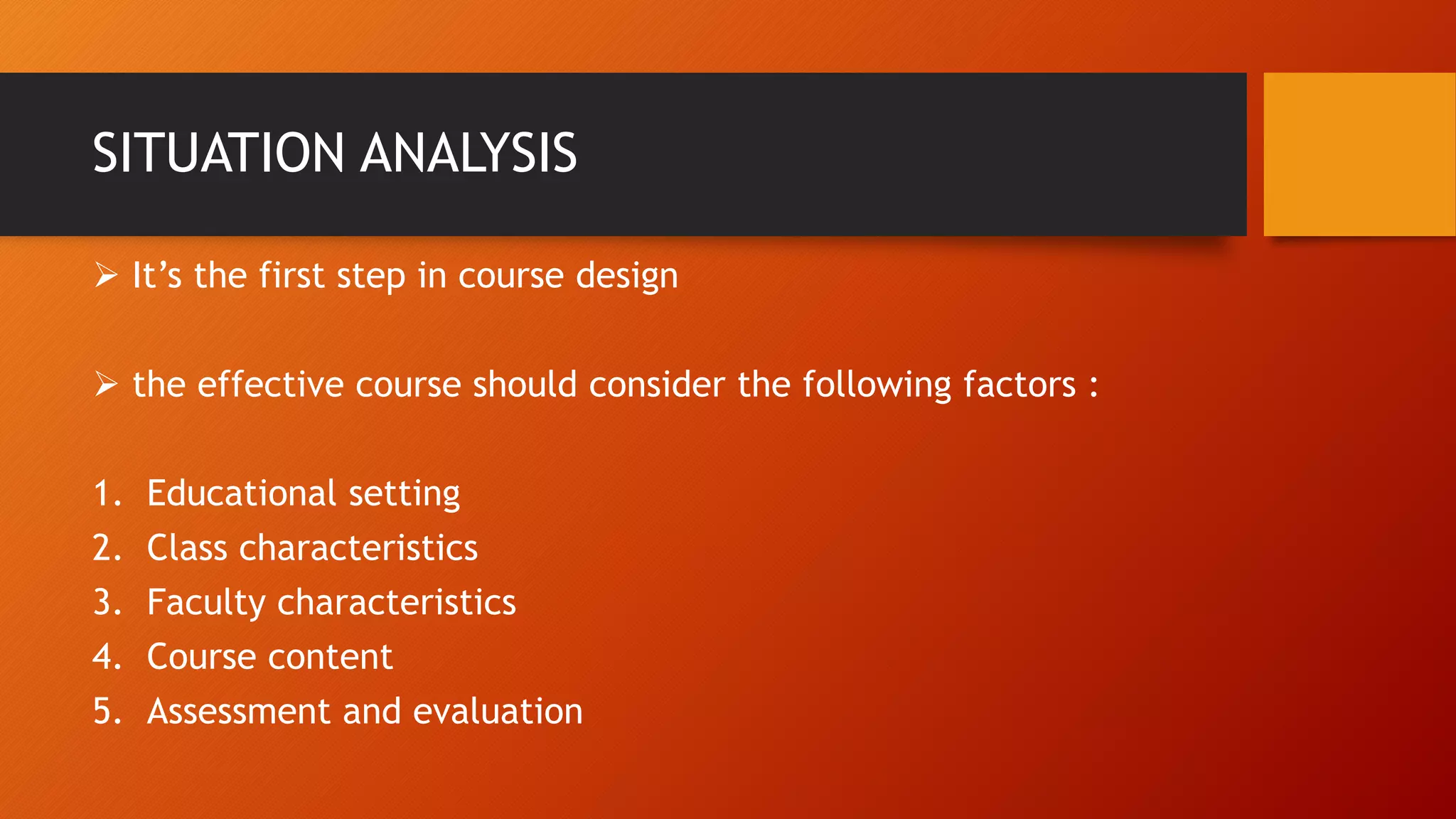
 It’s the first step in course design
 the effective course should consider the following factors :
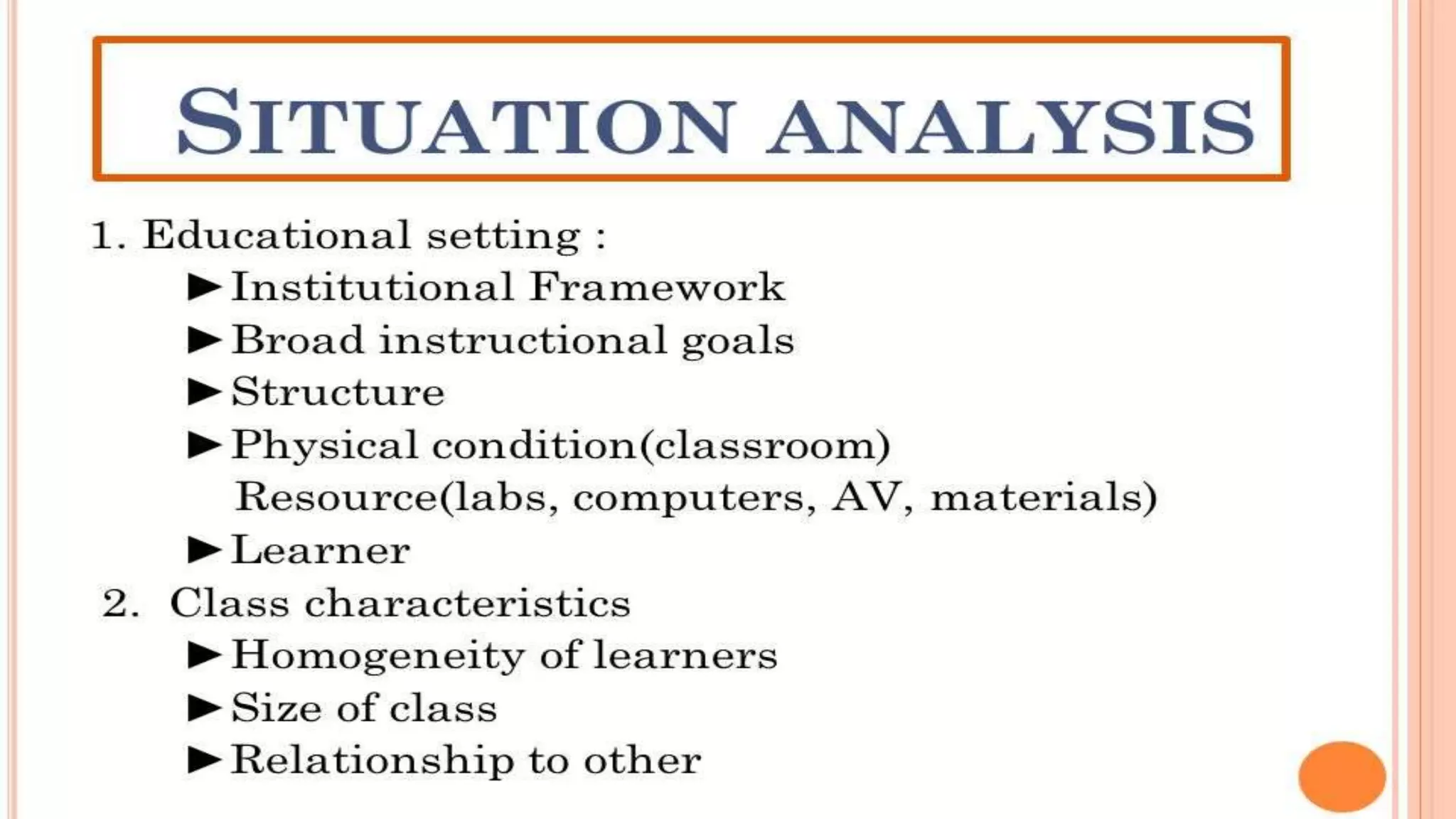
1. Educational setting
2. Class characteristics
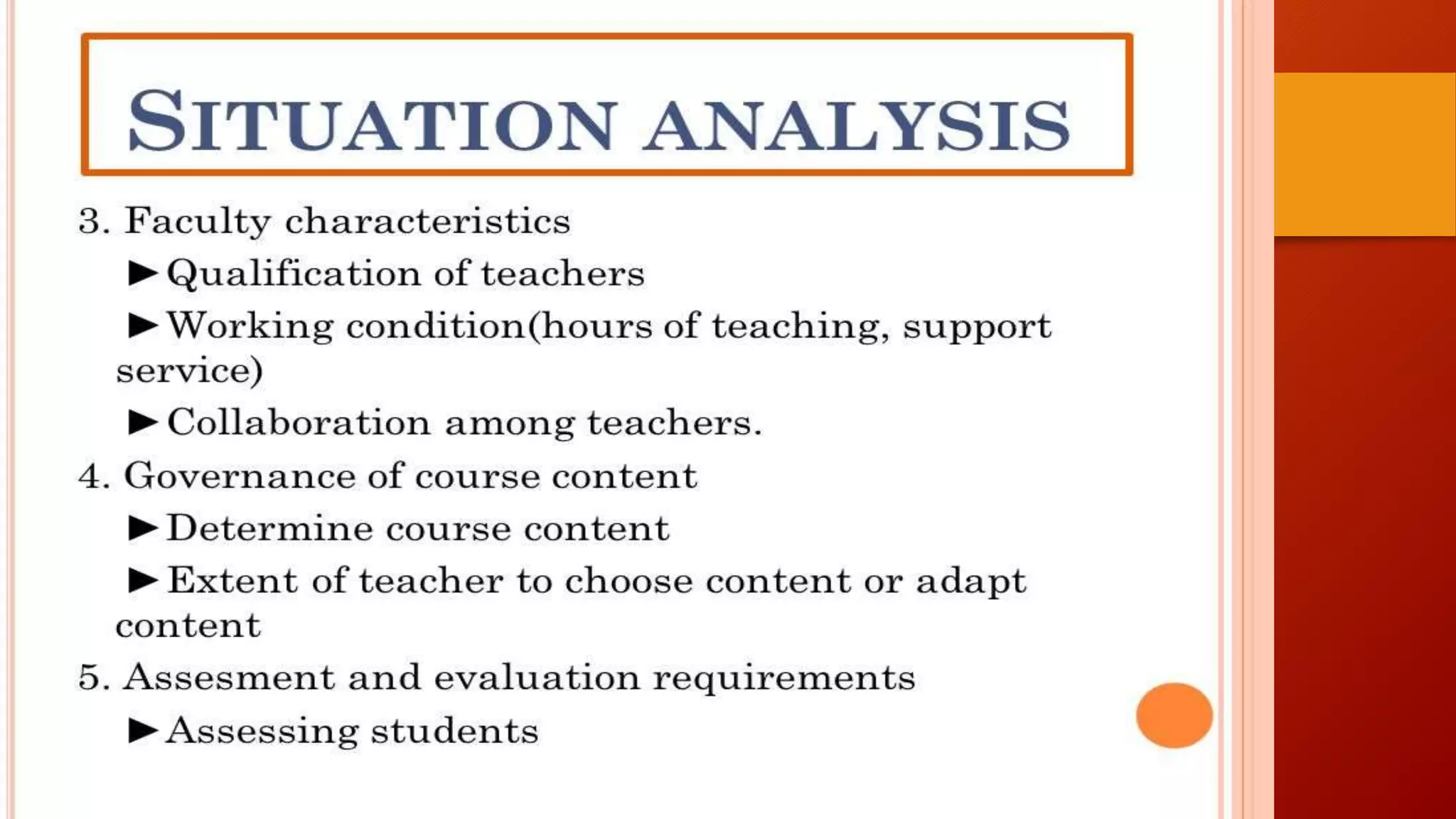
3. Faculty characteristics
4. Course content
5. Assessment and evaluation
The main factors of the SITUATION ANALYSIS IN
CURRICULUM PLANNING
• • Societal Factors
• • Project Factors
• • Institutional Factors
• • Teacher Factors
• • Learner Factors
• • Adoption Factors
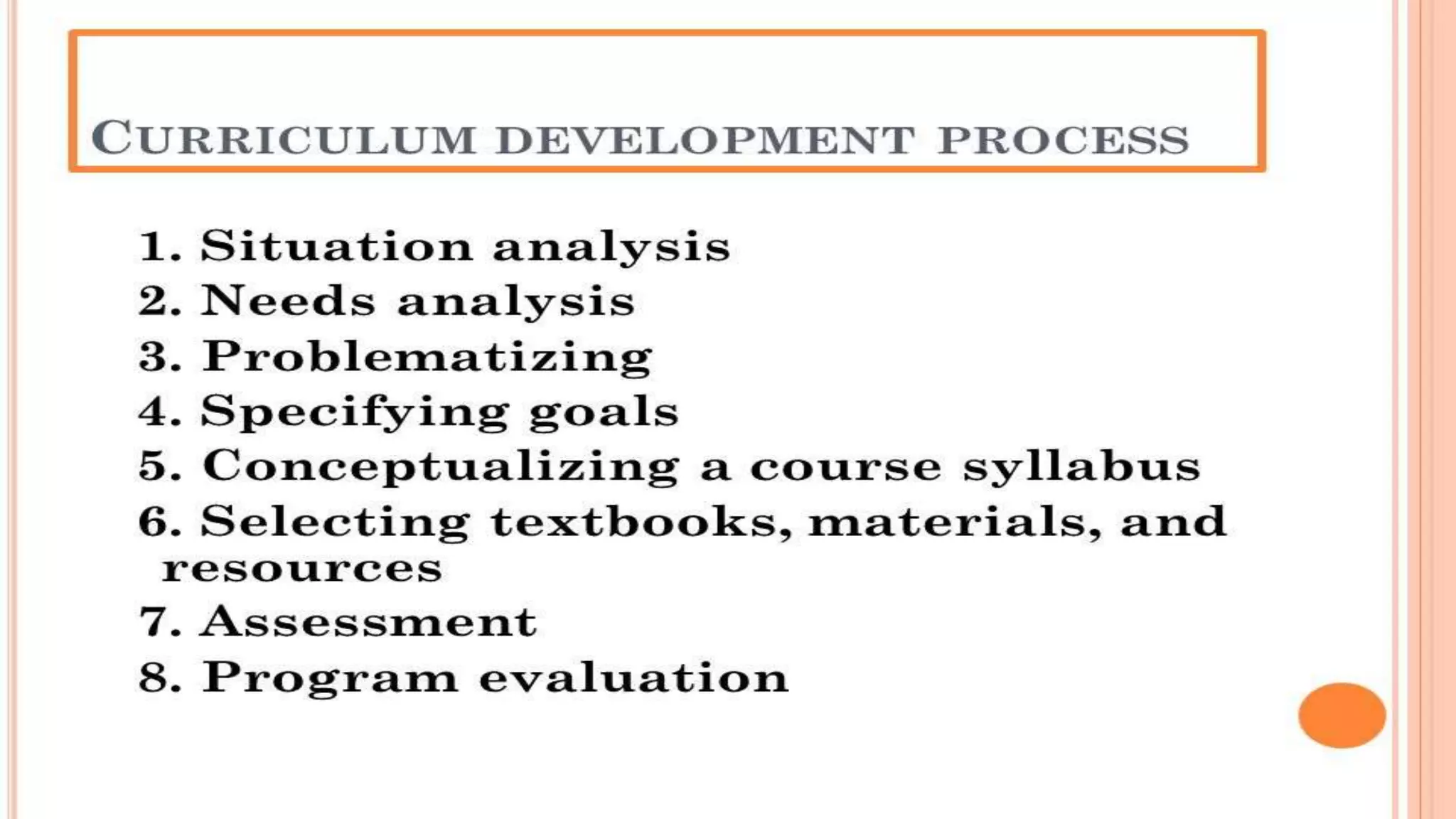
NEEDS ANALYSIS
ESP : English foe Specific Purpose
PROBLEMATIZING
SPECIFYING GOALS
Aims
• Develop moral character and personal discipline.
• Encourage creativeness and critical thinking.
• Broaden scientific and technological knowledge.
• Foster love of humanity.
• Teach the rights and duties of citizenship
• Promote respect for human right.
• Strengthen ethical and spiritual values
goals
 Examples :
To develop a skill in reading,writting ,speaking and listening
To be able to verbally and visually express a point of view
Objectives
• Objectives are the most specific
• 1 General objective: Those objectives that describe
school wide outcomes.
• E.g. Improving students skills
• 2 Specific objective:
• Those objectives describe the outcomes of a particular unit, a
particular subject or a particular program .
• E.g. cognitive, affective domain
objectives
goals
aims
conceptualizing a course syllabus
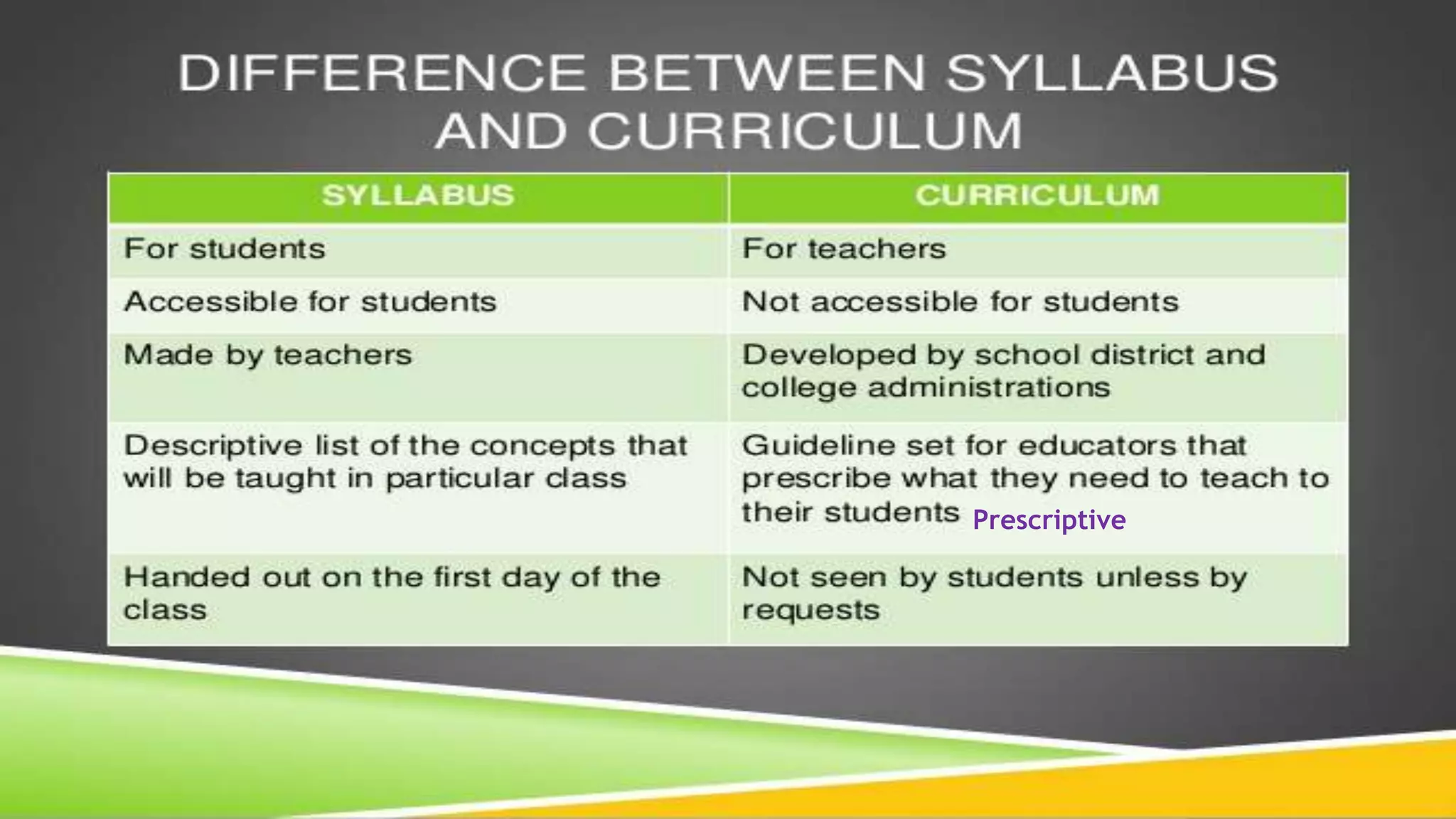
DIFFERENCE BETWEEN SYLLABUS AND
CURRICULUM
Prescriptive
THINGS TO BE CONSIDERED IN MAKING A
SYLLABUS
• The needs, wants, interests of the students.
• The learners learning styles .
• Setting out achievable objectives .
• Having a clear idea of global goals,
i.e. why the course is being run and what are the end goals .
• The physical constraints of the environment you’ll be teaching in.
• The nature of the course, e.g. a Business English Course.
• The order of the syllabus elements.
• To know how to balance skills systems.
Selecting textbooks ,materials ,and resources
criteria for e choosing textbooks for a course
• Textbooks should be appropriate to the teaching environment
(in an English speaking country or in a non-English speaking
environment)
• Meet the pupils’ needs
• Encourage our pupils when they are not motivated.
• The text encourage independent learning.
• attractive in appearance for the students
• Should focus on the four skills in learning languages
• Always we need to consider :
• The Price
• Availability
• The usefulness
• Layout and design
• Instructions
• Methodology
Assessment ( evaluation )
It’s the measuring and evaluating of the progress in the
learners levels and understanding
the assessment Could be through
• Traditional tests
• Quizzes
• Multiple choice test
• Fill in the blanks
• Mid and final exams
Purposes of evaluation
• To evaluate the growth of the pupils.
• To diagnose the weakness and strength of pupils.
• To provide basis for a modification of the curriculum and course.
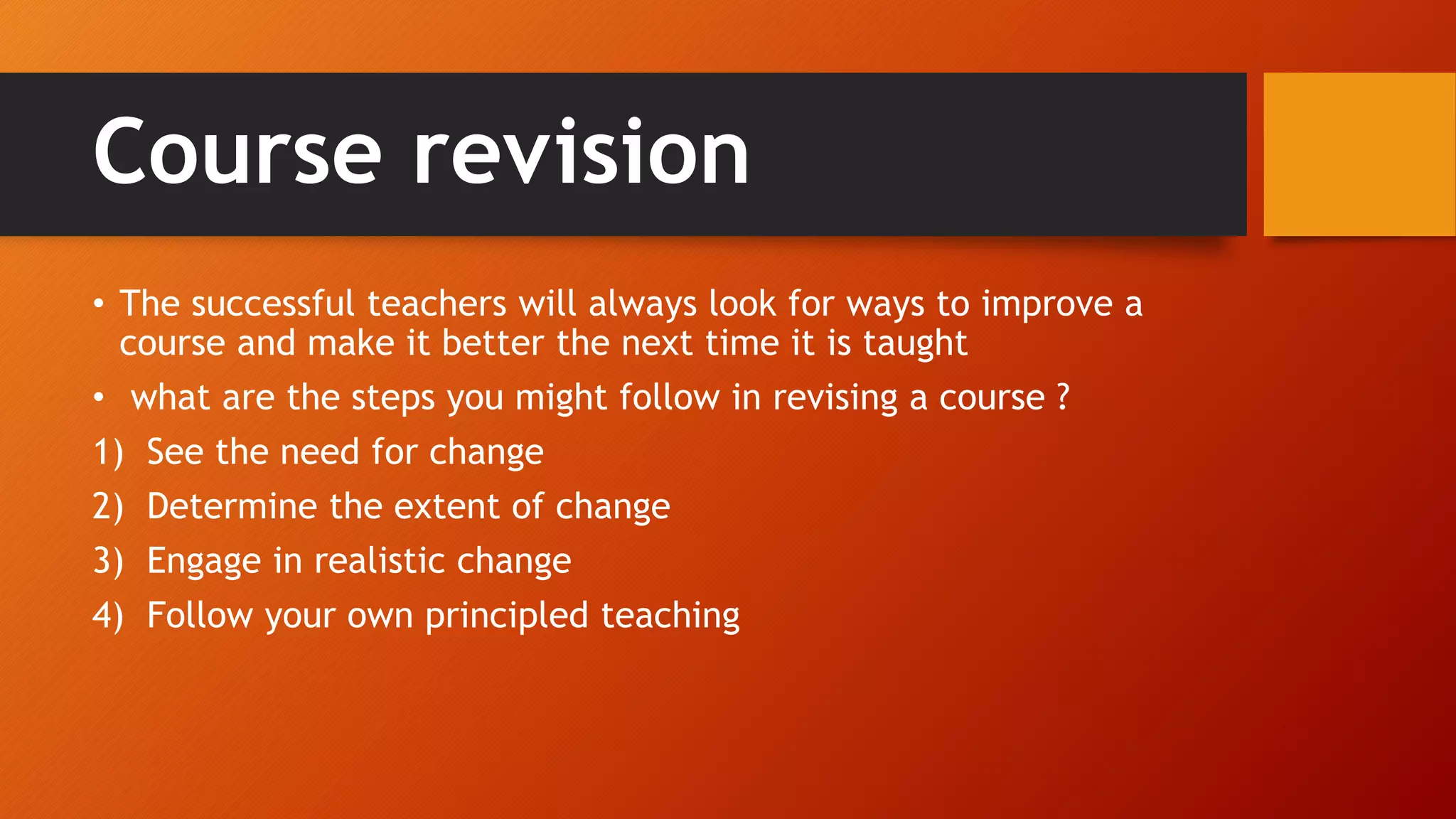
Course revision
• The successful teachers will always look for ways to improve a
course and make it better the next time it is taught
• what are the steps you might follow in revising a course ?
1) See the need for change
2) Determine the extent of change
3) Engage in realistic change
4) Follow your own principled teaching
Curriculum and course design  Prepared by  Ahmed youssef  AHMET YUSUF

Curriculum and course design Prepared by Ahmed youssef AHMET YUSUF

  • 1.
    Curriculum and coursedesign • • Prepared by • • Ahmed youssef
  • 3.
    Defining terms curriculum The termcurriculum refers to the lessons and academic content taught in a school or in a specific course or program. Program : It’s a general and broad term describes a plan or schedule of activities, procedures, a list of items, pieces, performers etc offered within a institution
  • 4.
    Syllabus the subjects orbooks to be studied in a particular course, especially a course that leads to an exam Course ( class ) A limited time educational experience carried out in regular meetings Like now we have a course or a class
  • 5.
    SITUATION ANALYSIS  It’sthe first step in course design  the effective course should consider the following factors : 1. Educational setting 2. Class characteristics 3. Faculty characteristics 4. Course content 5. Assessment and evaluation
  • 8.
    The main factorsof the SITUATION ANALYSIS IN CURRICULUM PLANNING • • Societal Factors • • Project Factors • • Institutional Factors • • Teacher Factors • • Learner Factors • • Adoption Factors
  • 10.
    NEEDS ANALYSIS ESP :English foe Specific Purpose
  • 13.
  • 14.
  • 15.
    Aims • Develop moralcharacter and personal discipline. • Encourage creativeness and critical thinking. • Broaden scientific and technological knowledge. • Foster love of humanity. • Teach the rights and duties of citizenship • Promote respect for human right. • Strengthen ethical and spiritual values
  • 16.
    goals  Examples : Todevelop a skill in reading,writting ,speaking and listening To be able to verbally and visually express a point of view
  • 17.
    Objectives • Objectives arethe most specific • 1 General objective: Those objectives that describe school wide outcomes. • E.g. Improving students skills • 2 Specific objective: • Those objectives describe the outcomes of a particular unit, a particular subject or a particular program . • E.g. cognitive, affective domain
  • 18.
  • 19.
  • 20.
    DIFFERENCE BETWEEN SYLLABUSAND CURRICULUM Prescriptive
  • 21.
    THINGS TO BECONSIDERED IN MAKING A SYLLABUS • The needs, wants, interests of the students. • The learners learning styles . • Setting out achievable objectives . • Having a clear idea of global goals, i.e. why the course is being run and what are the end goals . • The physical constraints of the environment you’ll be teaching in. • The nature of the course, e.g. a Business English Course. • The order of the syllabus elements. • To know how to balance skills systems.
  • 22.
  • 23.
    criteria for echoosing textbooks for a course • Textbooks should be appropriate to the teaching environment (in an English speaking country or in a non-English speaking environment) • Meet the pupils’ needs • Encourage our pupils when they are not motivated. • The text encourage independent learning. • attractive in appearance for the students • Should focus on the four skills in learning languages
  • 24.
    • Always weneed to consider : • The Price • Availability • The usefulness • Layout and design • Instructions • Methodology
  • 25.
    Assessment ( evaluation) It’s the measuring and evaluating of the progress in the learners levels and understanding
  • 26.
    the assessment Couldbe through • Traditional tests • Quizzes • Multiple choice test • Fill in the blanks • Mid and final exams
  • 27.
    Purposes of evaluation •To evaluate the growth of the pupils. • To diagnose the weakness and strength of pupils. • To provide basis for a modification of the curriculum and course.
  • 28.
    Course revision • Thesuccessful teachers will always look for ways to improve a course and make it better the next time it is taught • what are the steps you might follow in revising a course ? 1) See the need for change 2) Determine the extent of change 3) Engage in realistic change 4) Follow your own principled teaching