Course Planning and Syllabus
Design in Language Teaching
By:
MA. Águeda Castillo
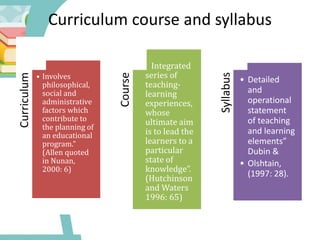
Curriculum course and syllabusCurriculum
• Involves
philosophical,
social and
administrative
factors which
contribute to
the planning of
an educational
program.”
(Allen quoted
in Nunan,
2000: 6)
Course
• Integrated
series of
teaching-
learning
experiences,
whose
ultimate aim
is to lead the
learners to a
particular
state of
knowledge”.
(Hutchinson
and Waters
1996: 65)
Syllabus
• Detailed
and
operational
statement
of teaching
and learning
elements”
Dubin &
• Olshtain,
(1997: 28).
SYLLABUS CONCEPT on either side of
Athlantic
• In Britain, ‘syllabus’ refers to the content or
subject matter of an individual subject,
whereas ‘curriculum’ stands for the totality of
content to be taught and aims to be realized
within one school or educational system.
• In the USA ‘curriculum’ tends the synonymous
with ‘syllabus’ in the British sense.
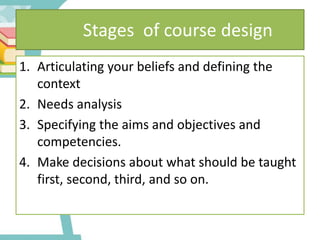
Stages of course design
1. Articulating your beliefs and defining the
context
2. Needs analysis
3. Specifying the aims and objectives and
competencies.
4. Make decisions about what should be taught
first, second, third, and so on.
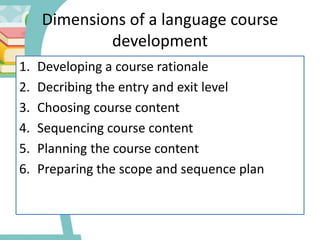
Dimensions of a language course
development
1. Developing a course rationale
2. Decribing the entry and exit level
3. Choosing course content
4. Sequencing course content
5. Planning the course content
6. Preparing the scope and sequence plan
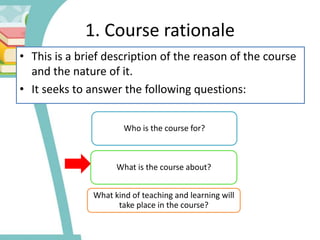
1. Course rationale
• This is a brief description of the reason of the course
and the nature of it.
• It seeks to answer the following questions:
Who is the course for?
What is the course about?
What kind of teaching and learning will
take place in the course?
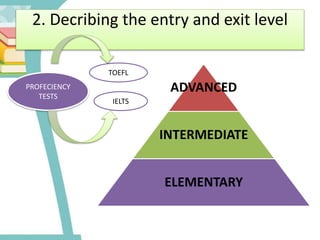
2. Decribing the entry and exit level
ADVANCED
INTERMEDIATE
ELEMENTARY
PROFECIENCY
TESTS
IELTS
TOEFL
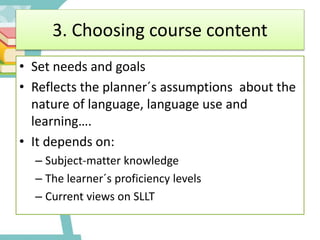
3. Choosing course content
• Set needs and goals
• Reflects the planner´s assumptions about the
nature of language, language use and
learning….
• It depends on:
– Subject-matter knowledge
– The learner´s proficiency levels
– Current views on SLLT
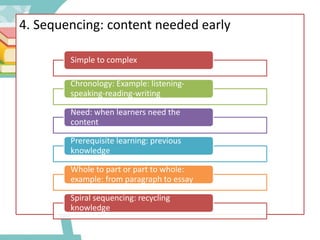
4. Sequencing: content needed early
Simple to complex
Chronology: Example: listening-
speaking-reading-writing
Need: when learners need the
content
Prerequisite learning: previous
knowledge
Whole to part or part to whole:
example: from paragraph to essay
Spiral sequencing: recycling
knowledge
5. Planning the course structure
• Steps:
1. Selecting a syllabus framework
2. developing instructional blocks
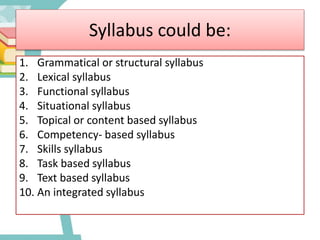
Syllabus could be:
1. Grammatical or structural syllabus
2. Lexical syllabus
3. Functional syllabus
4. Situational syllabus
5. Topical or content based syllabus
6. Competency- based syllabus
7. Skills syllabus
8. Task based syllabus
9. Text based syllabus
10. An integrated syllabus
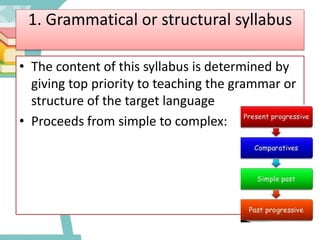
1. Grammatical or structural syllabus
• The content of this syllabus is determined by
giving top priority to teaching the grammar or
structure of the target language
• Proceeds from simple to complex:
2. Lexical syllabus
• Students will learn new vocabulary in
order to talk about different topics.
• Vocabulary is the key
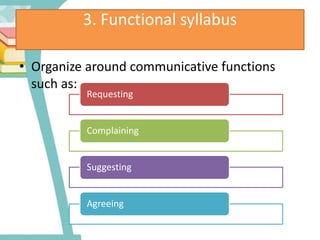
3. Functional syllabus
• Organize around communicative functions
such as:
Requesting
Complaining
Suggesting
Agreeing
4. Situational syllabus
• Is organized around the language needen in
specific situations
• Example:
– At the airport
– At the restaurant, ect.
Presents language in context but specific
situations may not transfer to other sotuations.
5. Topical or content based syllabus
• Is organized around themes, topics, or other
units of content.
• The target language is a vehicle
• Advantages:
– authentic, meaningful, and challenging material
(reading/writing)
– students’ enhanced motivation
– more self-paced autonomous learning (learner-
centered)
6. Competency- based syllabus
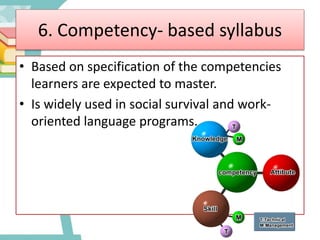
• Based on specification of the competencies
learners are expected to master.
• Is widely used in social survival and work-
oriented language programs.
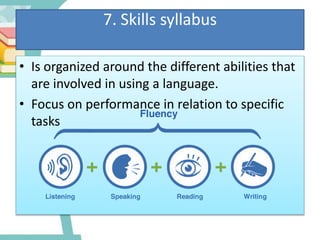
7. Skills syllabus
• Is organized around the different abilities that
are involved in using a language.
• Focus on performance in relation to specific
tasks
8. Task based syllabus
• Tasks should be relevant to the real world
language needs of the student.
• It is organized around tasks that learners will
accomplish in the target language.
• Example:
– Reading a map and giving directions
– Reading instructions to find a solution to a
problem
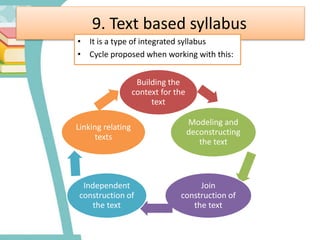
9. Text based syllabus
• It is a type of integrated syllabus
• Cycle proposed when working with this:
Building the
context for the
text
Modeling and
deconstructing
the text
Join
construction of
the text
Independent
construction of
the text
Linking relating
texts
10. An integrated syllabus
• It´s a combination of types of instructional
content needed to address the complex goals
of the program.
• Example:
– A syllabus might be organized grammatically first
and then moved to functional…
Developing instructional blocks
• Deals with course sections to make it more
teachable and learnable, to provide
progression in level of difficulty and to create
overall coherence and structure for the
course.
• Example:
– Modules
– Units
Elements of a successful unit
• Length: sufficient but not too much material
included
• Development: one activity leads into the next.
(no option for random choices)
• Coherence
• Pacing: time managements within unit
activities development.
• Outcome: related outcomes
6. Preparing the scope and sequence
plan
• Consists of a list of the modules or units and
their contents and indication of how much
teaching time each block will require.
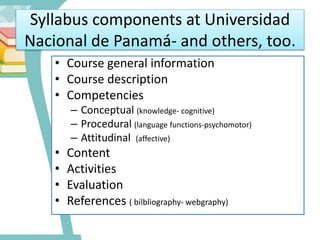
Syllabus components at Universidad
Nacional de Panamá- and others, too.
• Course general information
• Course description
• Competencies
– Conceptual (knowledge- cognitive)
– Procedural (language functions-psychomotor)
– Attitudinal (affective)
• Content
• Activities
• Evaluation
• References ( bilbliography- webgraphy)
Writing competencies
• What is a competency?
– A competency is the capability to apply or use a
set of related knowledge, skills, and abilities
required to successfully perform "critical work
functions" or tasks in a defined work setting.
Difference between competency and
learning objectives
• Competencies define the applied skills and
knowledge that enable people to successfully
perform their work.
• Learning objectives are specific to a course of
instruction.
Elements of a competency
• Verb
• Object
• Purpose
Example :
Utilizes different methods for interacting
with people from diverse cultural,
socioeconomic, educational, racial, ethnic and
professional backgrounds.
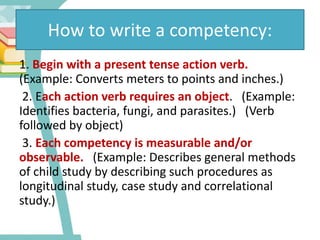
How to write a competency:
1. Begin with a present tense action verb.
(Example: Converts meters to points and inches.)
2. Each action verb requires an object. (Example:
Identifies bacteria, fungi, and parasites.) (Verb
followed by object)
3. Each competency is measurable and/or
observable. (Example: Describes general methods
of child study by describing such procedures as
longitudinal study, case study and correlational
study.)
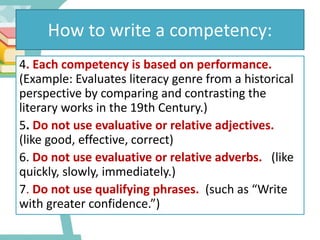
How to write a competency:
4. Each competency is based on performance.
(Example: Evaluates literacy genre from a historical
perspective by comparing and contrasting the
literary works in the 19th Century.)
5. Do not use evaluative or relative adjectives.
(like good, effective, correct)
6. Do not use evaluative or relative adverbs. (like
quickly, slowly, immediately.)
7. Do not use qualifying phrases. (such as “Write
with greater confidence.”)

Course planning and syllabus design in language teaching

  • 1.
    Course Planning andSyllabus Design in Language Teaching By: MA. Águeda Castillo
  • 2.
    Curriculum course andsyllabusCurriculum • Involves philosophical, social and administrative factors which contribute to the planning of an educational program.” (Allen quoted in Nunan, 2000: 6) Course • Integrated series of teaching- learning experiences, whose ultimate aim is to lead the learners to a particular state of knowledge”. (Hutchinson and Waters 1996: 65) Syllabus • Detailed and operational statement of teaching and learning elements” Dubin & • Olshtain, (1997: 28).
  • 3.
    SYLLABUS CONCEPT oneither side of Athlantic • In Britain, ‘syllabus’ refers to the content or subject matter of an individual subject, whereas ‘curriculum’ stands for the totality of content to be taught and aims to be realized within one school or educational system. • In the USA ‘curriculum’ tends the synonymous with ‘syllabus’ in the British sense.
  • 4.
    Stages of coursedesign 1. Articulating your beliefs and defining the context 2. Needs analysis 3. Specifying the aims and objectives and competencies. 4. Make decisions about what should be taught first, second, third, and so on.
  • 5.
    Dimensions of alanguage course development 1. Developing a course rationale 2. Decribing the entry and exit level 3. Choosing course content 4. Sequencing course content 5. Planning the course content 6. Preparing the scope and sequence plan
  • 6.
    1. Course rationale •This is a brief description of the reason of the course and the nature of it. • It seeks to answer the following questions: Who is the course for? What is the course about? What kind of teaching and learning will take place in the course?
  • 7.
    2. Decribing theentry and exit level ADVANCED INTERMEDIATE ELEMENTARY PROFECIENCY TESTS IELTS TOEFL
  • 8.
    3. Choosing coursecontent • Set needs and goals • Reflects the planner´s assumptions about the nature of language, language use and learning…. • It depends on: – Subject-matter knowledge – The learner´s proficiency levels – Current views on SLLT
  • 9.
    4. Sequencing: contentneeded early Simple to complex Chronology: Example: listening- speaking-reading-writing Need: when learners need the content Prerequisite learning: previous knowledge Whole to part or part to whole: example: from paragraph to essay Spiral sequencing: recycling knowledge
  • 10.
    5. Planning thecourse structure • Steps: 1. Selecting a syllabus framework 2. developing instructional blocks
  • 11.
    Syllabus could be: 1.Grammatical or structural syllabus 2. Lexical syllabus 3. Functional syllabus 4. Situational syllabus 5. Topical or content based syllabus 6. Competency- based syllabus 7. Skills syllabus 8. Task based syllabus 9. Text based syllabus 10. An integrated syllabus
  • 12.
    1. Grammatical orstructural syllabus • The content of this syllabus is determined by giving top priority to teaching the grammar or structure of the target language • Proceeds from simple to complex:
  • 13.
    2. Lexical syllabus •Students will learn new vocabulary in order to talk about different topics. • Vocabulary is the key
  • 14.
    3. Functional syllabus •Organize around communicative functions such as: Requesting Complaining Suggesting Agreeing
  • 15.
    4. Situational syllabus •Is organized around the language needen in specific situations • Example: – At the airport – At the restaurant, ect. Presents language in context but specific situations may not transfer to other sotuations.
  • 16.
    5. Topical orcontent based syllabus • Is organized around themes, topics, or other units of content. • The target language is a vehicle • Advantages: – authentic, meaningful, and challenging material (reading/writing) – students’ enhanced motivation – more self-paced autonomous learning (learner- centered)
  • 17.
    6. Competency- basedsyllabus • Based on specification of the competencies learners are expected to master. • Is widely used in social survival and work- oriented language programs.
  • 18.
    7. Skills syllabus •Is organized around the different abilities that are involved in using a language. • Focus on performance in relation to specific tasks
  • 19.
    8. Task basedsyllabus • Tasks should be relevant to the real world language needs of the student. • It is organized around tasks that learners will accomplish in the target language. • Example: – Reading a map and giving directions – Reading instructions to find a solution to a problem
  • 20.
    9. Text basedsyllabus • It is a type of integrated syllabus • Cycle proposed when working with this: Building the context for the text Modeling and deconstructing the text Join construction of the text Independent construction of the text Linking relating texts
  • 21.
    10. An integratedsyllabus • It´s a combination of types of instructional content needed to address the complex goals of the program. • Example: – A syllabus might be organized grammatically first and then moved to functional…
  • 22.
    Developing instructional blocks •Deals with course sections to make it more teachable and learnable, to provide progression in level of difficulty and to create overall coherence and structure for the course. • Example: – Modules – Units
  • 23.
    Elements of asuccessful unit • Length: sufficient but not too much material included • Development: one activity leads into the next. (no option for random choices) • Coherence • Pacing: time managements within unit activities development. • Outcome: related outcomes
  • 24.
    6. Preparing thescope and sequence plan • Consists of a list of the modules or units and their contents and indication of how much teaching time each block will require.
  • 25.
    Syllabus components atUniversidad Nacional de Panamá- and others, too. • Course general information • Course description • Competencies – Conceptual (knowledge- cognitive) – Procedural (language functions-psychomotor) – Attitudinal (affective) • Content • Activities • Evaluation • References ( bilbliography- webgraphy)
  • 26.
    Writing competencies • Whatis a competency? – A competency is the capability to apply or use a set of related knowledge, skills, and abilities required to successfully perform "critical work functions" or tasks in a defined work setting.
  • 27.
    Difference between competencyand learning objectives • Competencies define the applied skills and knowledge that enable people to successfully perform their work. • Learning objectives are specific to a course of instruction.
  • 28.
    Elements of acompetency • Verb • Object • Purpose Example : Utilizes different methods for interacting with people from diverse cultural, socioeconomic, educational, racial, ethnic and professional backgrounds.
  • 29.
    How to writea competency: 1. Begin with a present tense action verb. (Example: Converts meters to points and inches.) 2. Each action verb requires an object. (Example: Identifies bacteria, fungi, and parasites.) (Verb followed by object) 3. Each competency is measurable and/or observable. (Example: Describes general methods of child study by describing such procedures as longitudinal study, case study and correlational study.)
  • 30.
    How to writea competency: 4. Each competency is based on performance. (Example: Evaluates literacy genre from a historical perspective by comparing and contrasting the literary works in the 19th Century.) 5. Do not use evaluative or relative adjectives. (like good, effective, correct) 6. Do not use evaluative or relative adverbs. (like quickly, slowly, immediately.) 7. Do not use qualifying phrases. (such as “Write with greater confidence.”)