What is curriculum?

What is syllabus?
The course rationale
 Who is this for?
 What is the course about?
 What kindof teaching and learning will
  take place in the course?
DESCRIBING THE ENTRY AND
          EXIT LEVEL


 To plan a language course
An approach is used in language
 program planning           to identify
 different levels of performance.
Language program and Commercial
 materials
CHOOSING COURSE CONTEN
• To develop to address a
  specific set of needs.
• To cover a given set of
  objectives.
DETERMINING THE SCOPE AND SEQUENCE
  Simple and complex
  Chronology
  Need
  Prerequisite learning
  Whole to part or part to
   whole
  Spiaral sequencing
PLANNING THE COURSE
             STRUCTURE
Two aspects of the process:
  – Selection a Syllables Framework
     Major element
     The basis for course focus
     The basis for course content
  – Developing Instructional Blocks
     The process used to make decisions about content
     Self-contained learning sequence
Selecting
      a
  syllabus
framework
GRAMMATICAL SYLLABUS

• IT IS BASED ON GRAMMAR

• FOR PLANING A GENERAL COURSE

• FOR BEGINNING LEVEL

• REMAINS A CORE COMPONENTS
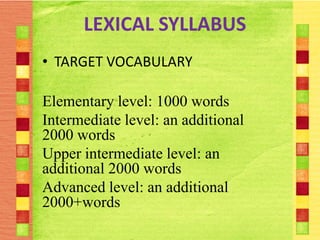
LEXICAL SYLLABUS
• TARGET VOCABULARY

Elementary level: 1000 words
Intermediate level: an additional
2000 words
Upper intermediate level: an
additional 2000 words
Advanced level: an additional
2000+words
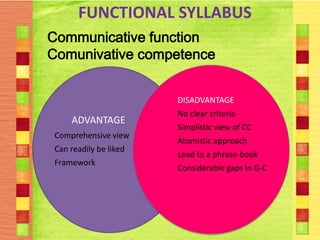
FUNCTIONAL SYLLABUS
Communicative function
Comunivative competence


                       DISADVANTAGE
                       No clear criteria
    ADVANTAGE
                       Simplistic view of CC
Comprehensive view
                       Atomistic approach
Can readily be liked
                       Lead to a phrase-book
Framework
                       Considerable gaps in G-C
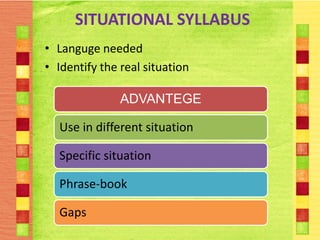
SITUATIONAL SYLLABUS
• Languge needed
• Identify the real situation

               ADVANTEGE

  Use in different situation

  Specific situation

  Phrase-book

  Gaps
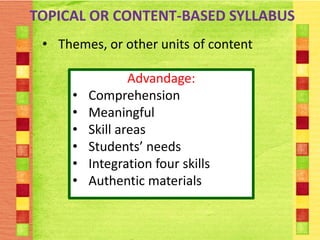
TOPICAL OR CONTENT-BASED SYLLABUS
 • Themes, or other units of content

                  Advandage:
      •   Comprehension
      •   Meaningful
      •   Skill areas
      •   Students’ needs
      •   Integration four skills
      •   Authentic materials
COMPETENCY-BASED SYLLABUS


•   Competencies learners
•   To specific situations and activities
•   Skills, knowladge, and attitudes
•   Particular tasks ans activities
SKILLS SYLLABUS
• Different underlying abilities
• Basic reference skills
• Identify the microskills underlying the use of
   the four macroskills of
   listening, speaking, reading, & writing
The advantages of skills-based syllabuses:
 Behavior / performance
 Skills
 teachable and learnable units
 →provide a practical framework for designing
    courses and teaching materials
TASK BASED SYLLABUS

• Tasks and activities
Examples:
  a) finding a solution to a puzzle
  b) reading a map and giving directions
  c) reading a set of instruments and
assembling a toy
AN INTEGRATES SYLLABUS


• Syllabus framework
• Teching
• Macrolevel and microlevel
DETERMINING
INSTRUCTIONAL
    BLOCKS
• MODULES
This is a self-contained and independent
learning sequence.
• UNITS
 Length
Development
Coherence
Pacing
Outcome
PREPARING THE SCOPE AND
      SEQUENCE PLAN
A listing of the module/ unit
Contents
 An indication of how much
 teaching time
By: Dayra Yanangómez

Course planning and syllabus design

  • 2.
  • 3.
    The course rationale Who is this for?  What is the course about?  What kindof teaching and learning will take place in the course?
  • 4.
    DESCRIBING THE ENTRYAND EXIT LEVEL  To plan a language course An approach is used in language program planning to identify different levels of performance. Language program and Commercial materials
  • 5.
    CHOOSING COURSE CONTEN •To develop to address a specific set of needs. • To cover a given set of objectives.
  • 6.
    DETERMINING THE SCOPEAND SEQUENCE Simple and complex Chronology Need Prerequisite learning Whole to part or part to whole Spiaral sequencing
  • 7.
    PLANNING THE COURSE STRUCTURE Two aspects of the process: – Selection a Syllables Framework Major element The basis for course focus The basis for course content – Developing Instructional Blocks The process used to make decisions about content Self-contained learning sequence
  • 8.
    Selecting a syllabus framework
  • 9.
    GRAMMATICAL SYLLABUS • ITIS BASED ON GRAMMAR • FOR PLANING A GENERAL COURSE • FOR BEGINNING LEVEL • REMAINS A CORE COMPONENTS
  • 10.
    LEXICAL SYLLABUS • TARGETVOCABULARY Elementary level: 1000 words Intermediate level: an additional 2000 words Upper intermediate level: an additional 2000 words Advanced level: an additional 2000+words
  • 11.
    FUNCTIONAL SYLLABUS Communicative function Comunivativecompetence DISADVANTAGE No clear criteria ADVANTAGE Simplistic view of CC Comprehensive view Atomistic approach Can readily be liked Lead to a phrase-book Framework Considerable gaps in G-C
  • 12.
    SITUATIONAL SYLLABUS • Langugeneeded • Identify the real situation ADVANTEGE Use in different situation Specific situation Phrase-book Gaps
  • 13.
    TOPICAL OR CONTENT-BASEDSYLLABUS • Themes, or other units of content Advandage: • Comprehension • Meaningful • Skill areas • Students’ needs • Integration four skills • Authentic materials
  • 14.
    COMPETENCY-BASED SYLLABUS • Competencies learners • To specific situations and activities • Skills, knowladge, and attitudes • Particular tasks ans activities
  • 15.
    SKILLS SYLLABUS • Differentunderlying abilities • Basic reference skills • Identify the microskills underlying the use of the four macroskills of listening, speaking, reading, & writing The advantages of skills-based syllabuses:  Behavior / performance  Skills  teachable and learnable units →provide a practical framework for designing courses and teaching materials
  • 16.
    TASK BASED SYLLABUS •Tasks and activities Examples: a) finding a solution to a puzzle b) reading a map and giving directions c) reading a set of instruments and assembling a toy
  • 17.
    AN INTEGRATES SYLLABUS •Syllabus framework • Teching • Macrolevel and microlevel
  • 18.
  • 19.
    • MODULES This isa self-contained and independent learning sequence. • UNITS  Length Development Coherence Pacing Outcome
  • 20.
    PREPARING THE SCOPEAND SEQUENCE PLAN A listing of the module/ unit Contents  An indication of how much teaching time
  • 21.