
Prepared by:-
Pratibha Srivastava
Associate Professor
Rama university
Introduction
The changes that are occurring in the social
and cultural life of the society as a results of impact
of advancement in the science based technology
are broadly describes as modernization. Since
education is a multi polar process, it is influenced
by the modernization in different ways. Due to
globalization and liberalization, changes occurring
in other parts of the world will also influence the
education pattern of a country.
Definition
Education
Education is the development of all those
capacities in the individual, which will enables him
to control his environment and fulfill possibilities.
(John Dewry, 2000)
According to Mahatma Gandhi, education is the
all round drawing out of the best in child and man –
body, mind and spirit.
Nursing Education
Nursing education is a professional education
which is consciously and systematically planned
and implemented through instruction and discipline
and aims the harmonious development of the
physical, intellectual, social, emotional, spiritual and
aesthetic power or abilities of the student in order to
render professional nursing care to people of all
ages in all phases of health and illness, in a variety
of setting in the best or highest possible manner.
Aims of Nursing Education
1. Harmonious development
2. Inculcating the right attitude
3. Knowledge and skill aim
4. Emphasis on high – tech – high touch approach
5. Prepare students to take up a proactive role in
nursing
6. Professional development
7. Assist to build a promising career
8. Social aim
9. To prepare global nurses
Trends in Nursing Education
• Curriculum changes
• Innovations in teaching and learning
• Educational quality assurance
• More reliance on technology
• Emphasis in high – tech – high touch approach
6. Preparation of global nurses
7. Transnational acceptance
8. Ensuring a promising career
9. Emergence of new specialists
10. Increased opportunities for higher studies
11. Diminishing government role
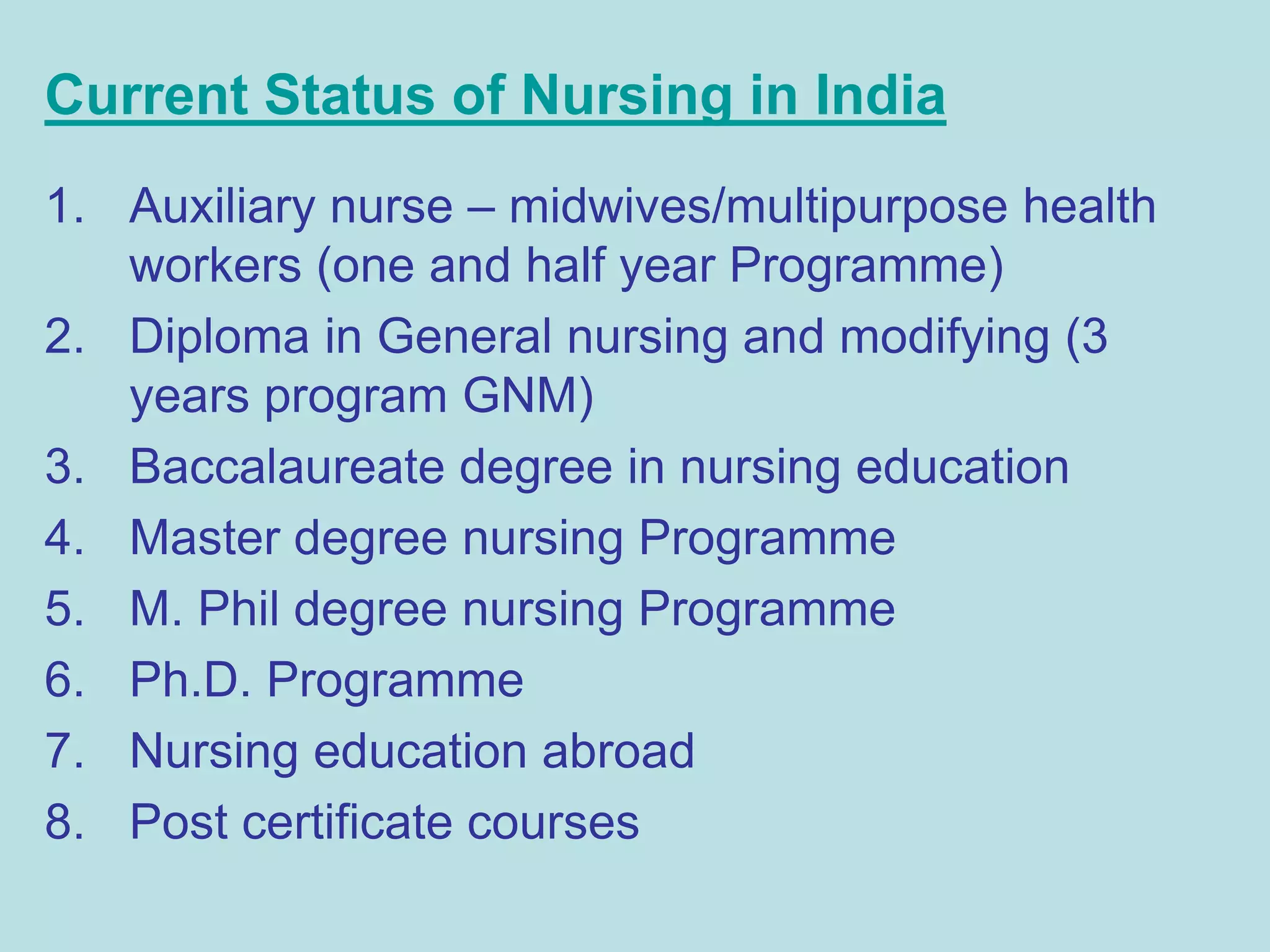
Current Status of Nursing in India
1. Auxiliary nurse – midwives/multipurpose health
workers (one and half year Programme)
2. Diploma in General nursing and modifying (3
years program GNM)
3. Baccalaureate degree in nursing education
4. Master degree nursing Programme
5. M. Phil degree nursing Programme
6. Ph.D. Programme
7. Nursing education abroad
8. Post certificate courses
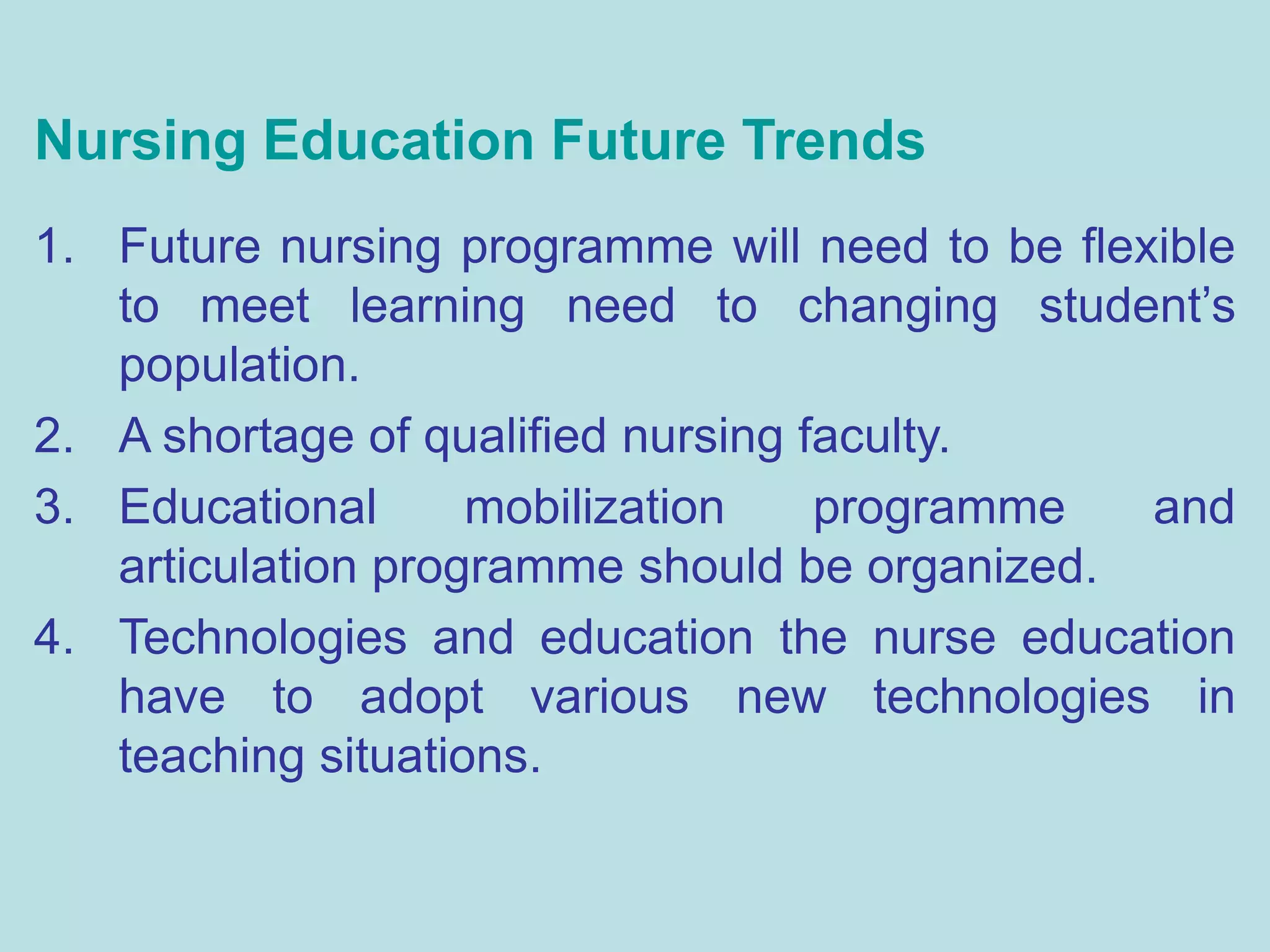
Nursing Education Future Trends
1. Future nursing programme will need to be flexible
to meet learning need to changing student’s
population.
2. A shortage of qualified nursing faculty.
3. Educational mobilization programme and
articulation programme should be organized.
4. Technologies and education the nurse education
have to adopt various new technologies in
teaching situations.
Current trends in nursing education

Current trends in nursing education

  • 1.
  • 2.
    Introduction The changes thatare occurring in the social and cultural life of the society as a results of impact of advancement in the science based technology are broadly describes as modernization. Since education is a multi polar process, it is influenced by the modernization in different ways. Due to globalization and liberalization, changes occurring in other parts of the world will also influence the education pattern of a country.
  • 3.
    Definition Education Education is thedevelopment of all those capacities in the individual, which will enables him to control his environment and fulfill possibilities. (John Dewry, 2000) According to Mahatma Gandhi, education is the all round drawing out of the best in child and man – body, mind and spirit.
  • 4.
    Nursing Education Nursing educationis a professional education which is consciously and systematically planned and implemented through instruction and discipline and aims the harmonious development of the physical, intellectual, social, emotional, spiritual and aesthetic power or abilities of the student in order to render professional nursing care to people of all ages in all phases of health and illness, in a variety of setting in the best or highest possible manner.
  • 5.
    Aims of NursingEducation 1. Harmonious development 2. Inculcating the right attitude 3. Knowledge and skill aim 4. Emphasis on high – tech – high touch approach 5. Prepare students to take up a proactive role in nursing 6. Professional development 7. Assist to build a promising career 8. Social aim 9. To prepare global nurses
  • 6.
    Trends in NursingEducation • Curriculum changes • Innovations in teaching and learning • Educational quality assurance • More reliance on technology • Emphasis in high – tech – high touch approach
  • 7.
    6. Preparation ofglobal nurses 7. Transnational acceptance 8. Ensuring a promising career 9. Emergence of new specialists 10. Increased opportunities for higher studies 11. Diminishing government role
  • 8.
    Current Status ofNursing in India 1. Auxiliary nurse – midwives/multipurpose health workers (one and half year Programme) 2. Diploma in General nursing and modifying (3 years program GNM) 3. Baccalaureate degree in nursing education 4. Master degree nursing Programme 5. M. Phil degree nursing Programme 6. Ph.D. Programme 7. Nursing education abroad 8. Post certificate courses
  • 9.
    Nursing Education FutureTrends 1. Future nursing programme will need to be flexible to meet learning need to changing student’s population. 2. A shortage of qualified nursing faculty. 3. Educational mobilization programme and articulation programme should be organized. 4. Technologies and education the nurse education have to adopt various new technologies in teaching situations.