Course planning andsyllabus
design
(Richards,2001)
UNIMINUTO
Teaching practicum 2
Prof.AlexanderBenito
Syllabus design vsMethodology
Syllabus design is seenasbeing concerned
essentially with the selection and gradingof
content, while methodology is concerned
with the selection of learning tasks and
activities.
[The syllabus] replaces the concept of 'method', and
the syllabus is now seenasan instrument by which
the teacher, with the help of the syllabus designer,
can achieve adegree of 'fit' between theneeds and
aims of the learner (associal being and as
individual)and the activities which willtake place in
the classroom. (Yalden 1984: 14)
Definition
Thecourse rationale
Who is the coursefor?
What is the courseabout?
Whatkind of teaching and learning will take
place in thecourse?
Describingthe entry andexit level
At whichlevel the learners will start andthe level
they are expectedto reachat the endof the
course?
Choosingthe course content
Thisreflects the planners’ assumptions about thenature of
language, language use, language learning, what the units
of language are, and how these can beorganized.
Thisalso depends on the type of syllabus frameworkthat
will be used asthe basisof thecourse.
Determining the scopeandthe
sequence
• Scopeis concerned with the breadth and
depth of coverage of items in the course, that
is, with the followingquestions:
What rangeof content will becovered?
Towhat extent shouldeachtopicbe studied?
Thesequence
• Thesequencing involves deciding which is content is needed early in the
courseand which provides abasisfor things that will be learnedlater.
Sequencingmay be basedon the following criteria.
Simpleto complex
Chronology
e.g. Proficiency course. L,S,R,W.
Writing course. (1) brainstorming; (2) drafting; (3) revising; (4)editing.
Need. According to when learners are most likely to need it outside of the
classroom.
e.g.
•
•
•
•
•
•
i. basid literacy skills
ii. personal identification
iii. money
iv. shopping
v. time anddates
vi. ( …)
Planninga course structure
• This step involves mapping the course
structure into aform and sequence that
provide asuitable basis for teaching.Two
aspects of this process, required more
detailed planning: selecting a
syllabus framework and developing
instructional blocks.
Syllabusframework
• Asyllabus describes the major elements that will
be used in planning alanguage course and
provides the basisfor its instructional focus and
content.
Factors that influenceplanners:
Knowledge and beliefs about the subject
area.
Research and theory.
Common practice .
Trends.
Instructional blocks
• An instructional block is aself-contained learning
sequencethat hasits own goals and objectives and
that also reflects the overall objectives for the course.
Three purposes:
•
•
•
to make the course more teachable andlearnable
to provide aprogression in level ofdifficulty
to create overall coherence and structure forthe
course
Thesecould be planned by modulesand by units.
Amodule
• Thisis aself-contained and independent learning
sequencewith its own objectives. E.g.a120-hour
course might be divided into four modules of 30
hours each.
• Assessment is carried out at the end of each
module.
• Modules allow for flexible organization ofa
course and can give learners asenseof
achievement becauseobjectives are more
immediate andspecific.
Aunit
• This teaching block is normallly longer than a
single lesson but shorter than amodule and is
the commonest way of organizing coursesand
teaching materials. It is normally agroup of
lessonsthat is planned around asingle
instructional focus.
• Aunit seeksto provide astructuredsequence
of activities that lead toward alearning
outcome.
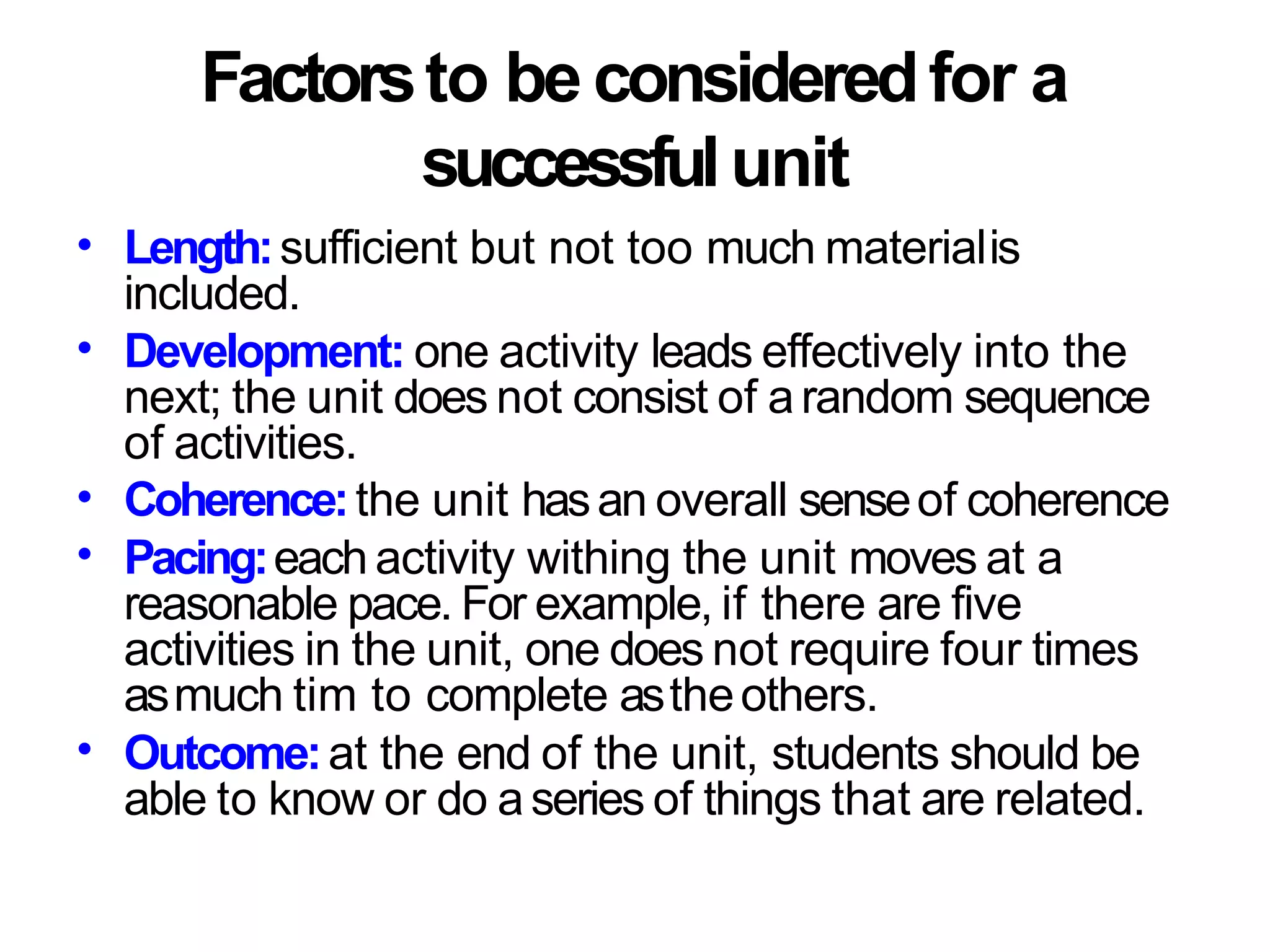
Factorsto be consideredfor a
successfulunit
• Length:sufficient but not too much materialis
included.
Development: one activity leads effectively into the
next; the unit does not consist of arandom sequence
of activities.
Coherence:the unit hasan overall senseof coherence
Pacing:each activity withing the unit moves at a
reasonable pace. For example, if there are five
activities in the unit, one does not require four times
asmuch tim to complete astheothers.
Outcome:at the end of the unit, students should be
able to know or do aseries of things that are related.
•
•
•
•

Course planning and syllabus design

  • 1.
  • 2.
    Syllabus design vsMethodology Syllabusdesign is seenasbeing concerned essentially with the selection and gradingof content, while methodology is concerned with the selection of learning tasks and activities.
  • 3.
    [The syllabus] replacesthe concept of 'method', and the syllabus is now seenasan instrument by which the teacher, with the help of the syllabus designer, can achieve adegree of 'fit' between theneeds and aims of the learner (associal being and as individual)and the activities which willtake place in the classroom. (Yalden 1984: 14) Definition
  • 4.
    Thecourse rationale Who isthe coursefor? What is the courseabout? Whatkind of teaching and learning will take place in thecourse?
  • 5.
    Describingthe entry andexitlevel At whichlevel the learners will start andthe level they are expectedto reachat the endof the course?
  • 6.
    Choosingthe course content Thisreflectsthe planners’ assumptions about thenature of language, language use, language learning, what the units of language are, and how these can beorganized. Thisalso depends on the type of syllabus frameworkthat will be used asthe basisof thecourse.
  • 7.
    Determining the scopeandthe sequence •Scopeis concerned with the breadth and depth of coverage of items in the course, that is, with the followingquestions: What rangeof content will becovered? Towhat extent shouldeachtopicbe studied?
  • 8.
    Thesequence • Thesequencing involvesdeciding which is content is needed early in the courseand which provides abasisfor things that will be learnedlater. Sequencingmay be basedon the following criteria. Simpleto complex Chronology e.g. Proficiency course. L,S,R,W. Writing course. (1) brainstorming; (2) drafting; (3) revising; (4)editing. Need. According to when learners are most likely to need it outside of the classroom. e.g. • • • • • • i. basid literacy skills ii. personal identification iii. money iv. shopping v. time anddates vi. ( …)
  • 9.
    Planninga course structure •This step involves mapping the course structure into aform and sequence that provide asuitable basis for teaching.Two aspects of this process, required more detailed planning: selecting a syllabus framework and developing instructional blocks.
  • 10.
    Syllabusframework • Asyllabus describesthe major elements that will be used in planning alanguage course and provides the basisfor its instructional focus and content. Factors that influenceplanners: Knowledge and beliefs about the subject area. Research and theory. Common practice . Trends.
  • 11.
    Instructional blocks • Aninstructional block is aself-contained learning sequencethat hasits own goals and objectives and that also reflects the overall objectives for the course. Three purposes: • • • to make the course more teachable andlearnable to provide aprogression in level ofdifficulty to create overall coherence and structure forthe course Thesecould be planned by modulesand by units.
  • 12.
    Amodule • Thisis aself-containedand independent learning sequencewith its own objectives. E.g.a120-hour course might be divided into four modules of 30 hours each. • Assessment is carried out at the end of each module. • Modules allow for flexible organization ofa course and can give learners asenseof achievement becauseobjectives are more immediate andspecific.
  • 13.
    Aunit • This teachingblock is normallly longer than a single lesson but shorter than amodule and is the commonest way of organizing coursesand teaching materials. It is normally agroup of lessonsthat is planned around asingle instructional focus. • Aunit seeksto provide astructuredsequence of activities that lead toward alearning outcome.
  • 14.
    Factorsto be consideredfora successfulunit • Length:sufficient but not too much materialis included. Development: one activity leads effectively into the next; the unit does not consist of arandom sequence of activities. Coherence:the unit hasan overall senseof coherence Pacing:each activity withing the unit moves at a reasonable pace. For example, if there are five activities in the unit, one does not require four times asmuch tim to complete astheothers. Outcome:at the end of the unit, students should be able to know or do aseries of things that are related. • • • •