Linux-wpan: IEEE 802.15.4
and 6LoWPAN in Linux
Linaro Connect BUD17
2017-03-06, Budapest
Stefan Schmidt
stefan@osg.samsung.com
Samsung Open Source Group
Agenda
● Motivation
● Linux-wpan Project
● Hardware
● Configuration
● Communication
● Edge Node OS
Motivation
IEEE 802.15.4
● IEEE specifications for Low-Rate Wireless
Personal Area Networks
● Not only low-rate, but also low-power
● Designed for small sensors to run months/years
on battery with the right duty cycle
● 127 bytes MTU and 250 kbit/s
● Sometimes confused with ZigBee as it is used
as PHY and MAC layer there
6LoWPAN
● A series of IETF specifications, started in 2007
● IPv6 over LoWPAN (IEEE 802.15.4)
● Direct IP addressing of nodes
● Adaptation layer between data-link and network
layer
● Address autoconfiguration
● Frame encapsulation and fragmentation
● Header compressions
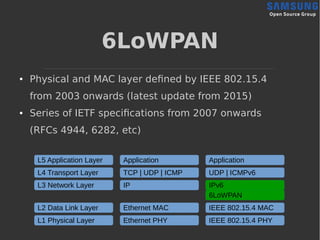
6LoWPAN
● Physical and MAC layer defined by IEEE 802.15.4
from 2003 onwards (latest update from 2015)
● Series of IETF specifications from 2007 onwards
(RFCs 4944, 6282, etc)
L3 Network Layer
L4 Transport Layer
L1 Physical Layer
L5 Application Layer
L2 Data Link Layer
IP
TCP | UDP | ICMP
Ethernet PHY
Application
Ethernet MAC
IPv6
UDP | ICMPv6
6LoWPAN
IEEE 802.15.4 PHY
Application
IEEE 802.15.4 MAC
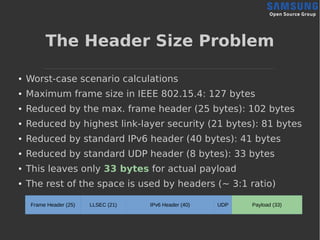
The Header Size Problem
● Worst-case scenario calculations
● Maximum frame size in IEEE 802.15.4: 127 bytes
● Reduced by the max. frame header (25 bytes): 102 bytes
● Reduced by highest link-layer security (21 bytes): 81 bytes
● Reduced by standard IPv6 header (40 bytes): 41 bytes
● Reduced by standard UDP header (8 bytes): 33 bytes
● This leaves only 33 bytes for actual payload
● The rest of the space is used by headers (~ 3:1 ratio)
Frame Header (25) LLSEC (21) IPv6 Header (40) UDP Payload (33)
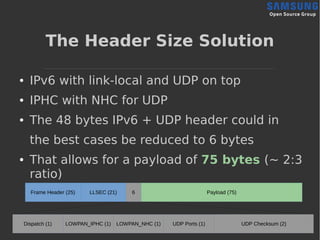
The Header Size Solution
● IPv6 with link-local and UDP on top
● IPHC with NHC for UDP
● The 48 bytes IPv6 + UDP header could in
the best cases be reduced to 6 bytes
● That allows for a payload of 75 bytes (~ 2:3
ratio)
Frame Header (25) LLSEC (21) 6 Payload (75)
Dispatch (1) LOWPAN_IPHC (1) LOWPAN_NHC (1) UDP Ports (1) UDP Checksum (2)
Linux-wpan
● Platforms already running Linux would benefit from
native IEEE 802.15.4 and 6LoWPAN subsystems
● IEEE 802.15.4 transceivers can easily be added to
existing hardware designs
● Battery powered sensors on the other hand are
more likely to run an OS like RIOT or Contiki
● Example 1: Google OnHub AP which already comes
with, de-activated, IEEE 802.15.4 hardware
● Example 2: Ci40 Creator board as home IoT hub
Linux-wpan Project
Linux-wpan Project
● IEEE 802.15.4 and 6LoWPAN support in mainline
● Started in 2008 as linux-zigbee project, from 2012
mainline
● New project name to avoid confusion: linux-wpan
● Normal kernel development model
● Patches are posted and reviewed on the mailing list
● Small community: 2 core devs and ~4 additional people
for specific drivers
● Linux-wpan mailing list (~96 people), IRC (~29 people)
Current Status
● ieee802154 layer with softMAC driver for various
transceivers
●
6LoWPAN with fragmentation and reassembly (RFC 4944)
●
Header compression with IPHC and NHC for UDP
(RFC 6282), shared with Bluetooth subsystem
●
Link Layer Security
●
Testing between Linux, RIOT and Contiki
●
Mainline 4.1 onwards recommended
●
Active development, newer is better :-)
Hardware
Development Boards
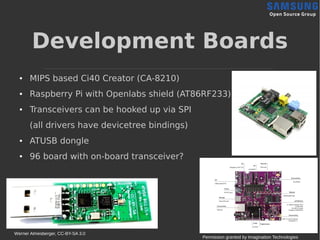
● MIPS based Ci40 Creator (CA-8210)
● Raspberry Pi with Openlabs shield (AT86RF233)
● Transceivers can be hooked up via SPI
(all drivers have devicetree bindings)
● ATUSB dongle
● 96 board with on-board transceiver?
Werner Almesberger, CC-BY-SA 3.0
Permission granted by Imagination Technologies
Hardware
Requirements
● Very easy to add to your current dev
board or product
● Free SPI port plus some additional free
GPIO pins (number varies by transceiver)
● Off the shelf modules or directly added to
your design
● Alternatively you could use USB
Devicetree Bindings
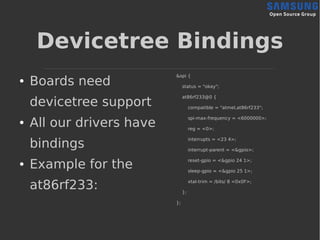
● Boards need
devicetree support
● All our drivers have
bindings
● Example for the
at86rf233:
&spi {
status = "okay";
at86rf233@0 {
compatible = "atmel,at86rf233";
spi-max-frequency = <6000000>;
reg = <0>;
interrupts = <23 4>;
interrupt-parent = <&gpio>;
reset-gpio = <&gpio 24 1>;
sleep-gpio = <&gpio 25 1>;
xtal-trim = /bits/ 8 <0x0F>;
};
};
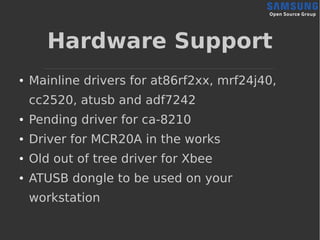
Hardware Support
● Mainline drivers for at86rf2xx, mrf24j40,
cc2520, atusb and adf7242
● Pending driver for ca-8210
● Driver for MCR20A in the works
● Old out of tree driver for Xbee
● ATUSB dongle to be used on your
workstation
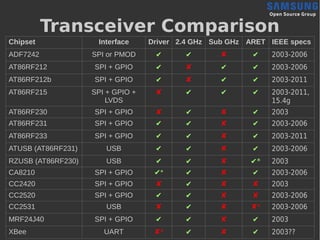
Transceiver Comparison
Chipset Interface Driver 2.4 GHz Sub GHz ARET IEEE specs
ADF7242 SPI or PMOD ✔ ✔ ✘ ✔ 2003-2006
AT86RF212 SPI + GPIO ✔ ✘ ✔ ✔ 2003-2006
AT86RF212b SPI + GPIO ✔ ✘ ✔ ✔ 2003-2011
AT86RF215 SPI + GPIO +
LVDS
✘ ✔ ✔ ✔ 2003-2011,
15.4g
AT86RF230 SPI + GPIO ✘ ✔ ✘ ✔ 2003
AT86RF231 SPI + GPIO ✔ ✔ ✘ ✔ 2003-2006
AT86RF233 SPI + GPIO ✔ ✔ ✘ ✔ 2003-2011
ATUSB (AT86RF231) USB ✔ ✔ ✘ ✔ 2003-2006
RZUSB (AT86RF230) USB ✔ ✔ ✘ ✔* 2003
CA8210 SPI + GPIO ✔* ✔ ✘ ✔ 2003-2006
CC2420 SPI + GPIO ✘ ✔ ✘ ✘ 2003
CC2520 SPI + GPIO ✔ ✔ ✘ ✘ 2003-2006
CC2531 USB ✘ ✔ ✘ ✘* 2003-2006
MRF24J40 SPI + GPIO ✔ ✔ ✘ ✔ 2003
XBee UART ✘* ✔ ✘ ✔ 2003??
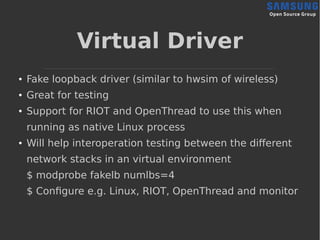
Virtual Driver
● Fake loopback driver (similar to hwsim of wireless)
● Great for testing
● Support for RIOT and OpenThread to use this when
running as native Linux process
● Will help interoperation testing between the different
network stacks in an virtual environment
$ modprobe fakelb numlbs=4
$ Configure e.g. Linux, RIOT, OpenThread and monitor
Configuration
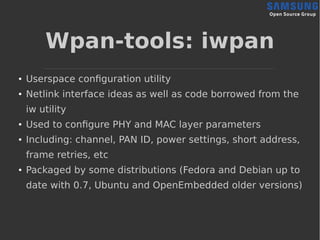
Wpan-tools: iwpan
● Userspace configuration utility
● Netlink interface ideas as well as code borrowed from the
iw utility
●
Used to configure PHY and MAC layer parameters
● Including: channel, PAN ID, power settings, short address,
frame retries, etc
●
Packaged by some distributions (Fedora and Debian up to
date with 0.7, Ubuntu and OpenEmbedded older versions)
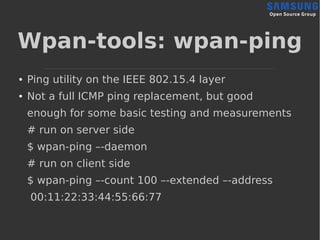
Wpan-tools: wpan-ping
● Ping utility on the IEEE 802.15.4 layer
● Not a full ICMP ping replacement, but good
enough for some basic testing and measurements
# run on server side
$ wpan-ping –-daemon
# run on client side
$ wpan-ping –-count 100 –-extended –-address
00:11:22:33:44:55:66:77
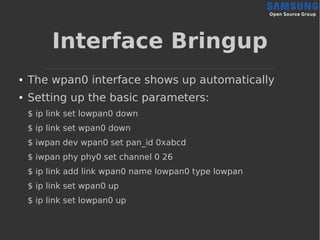
Interface Bringup
● The wpan0 interface shows up automatically
● Setting up the basic parameters:
$ ip link set lowpan0 down
$ ip link set wpan0 down
$ iwpan dev wpan0 set pan_id 0xabcd
$ iwpan phy phy0 set channel 0 26
$ ip link add link wpan0 name lowpan0 type lowpan
$ ip link set wpan0 up
$ ip link set lowpan0 up
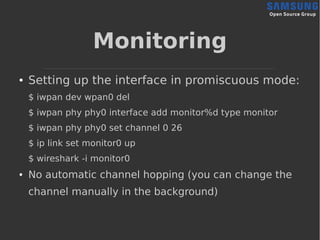
Monitoring
● Setting up the interface in promiscuous mode:
$ iwpan dev wpan0 del
$ iwpan phy phy0 interface add monitor%d type monitor
$ iwpan phy phy0 set channel 0 26
$ ip link set monitor0 up
$ wireshark -i monitor0
● No automatic channel hopping (you can change the
channel manually in the background)
Communication
AF_INET6 Socket
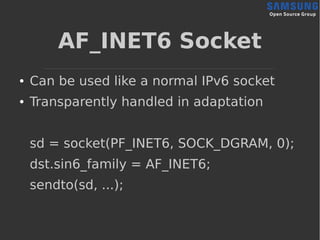
● Can be used like a normal IPv6 socket
● Transparently handled in adaptation
sd = socket(PF_INET6, SOCK_DGRAM, 0);
dst.sin6_family = AF_INET6;
sendto(sd, ...);
AF_IEEE802154 Socket
●
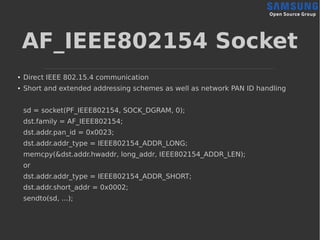
Direct IEEE 802.15.4 communication
●
Short and extended addressing schemes as well as network PAN ID handling
sd = socket(PF_IEEE802154, SOCK_DGRAM, 0);
dst.family = AF_IEEE802154;
dst.addr.pan_id = 0x0023;
dst.addr.addr_type = IEEE802154_ADDR_LONG;
memcpy(&dst.addr.hwaddr, long_addr, IEEE802154_ADDR_LEN);
or
dst.addr.addr_type = IEEE802154_ADDR_SHORT;
dst.addr.short_addr = 0x0002;
sendto(sd, ...);
Edge Node OS
Edge Node OS
● Linux most likely to serve as border
router of such networks
● Different operating system running on the
smaller edge nodes of a network
● Picked the ones with IEEE 802.15.4 and
6LoWPAN support
Operating Systems
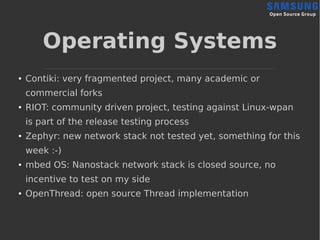
● Contiki: very fragmented project, many academic or
commercial forks
● RIOT: community driven project, testing against Linux-wpan
is part of the release testing process
● Zephyr: new network stack not tested yet, something for this
week :-)
● mbed OS: Nanostack network stack is closed source, no
incentive to test on my side
● OpenThread: open source Thread implementation
Comparison
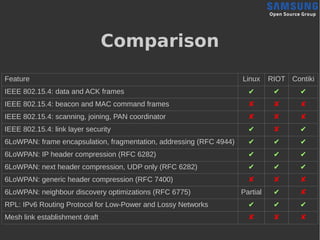
Feature Linux RIOT Contiki
IEEE 802.15.4: data and ACK frames ✔ ✔ ✔
IEEE 802.15.4: beacon and MAC command frames ✘ ✘ ✘
IEEE 802.15.4: scanning, joining, PAN coordinator ✘ ✘ ✘
IEEE 802.15.4: link layer security ✔ ✘ ✔
6LoWPAN: frame encapsulation, fragmentation, addressing (RFC 4944) ✔ ✔ ✔
6LoWPAN: IP header compression (RFC 6282) ✔ ✔ ✔
6LoWPAN: next header compression, UDP only (RFC 6282) ✔ ✔ ✔
6LoWPAN: generic header compression (RFC 7400) ✘ ✘ ✘
6LoWPAN: neighbour discovery optimizations (RFC 6775) Partial ✔ ✘
RPL: IPv6 Routing Protocol for Low-Power and Lossy Networks ✔ ✔ ✔
Mesh link establishment draft ✘ ✘ ✘
Future
Linux-wpan Future
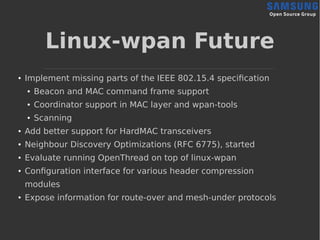
●
Implement missing parts of the IEEE 802.15.4 specification
● Beacon and MAC command frame support
● Coordinator support in MAC layer and wpan-tools
● Scanning
● Add better support for HardMAC transceivers
● Neighbour Discovery Optimizations (RFC 6775), started
●
Evaluate running OpenThread on top of linux-wpan
●
Configuration interface for various header compression
modules
●
Expose information for route-over and mesh-under protocols
Summary
Take away
● Running an IEEE 802.15.4 wireless
network under Linux is not hard
● Tooling and kernel support is already
there
● Border router scenario most likely use
case but nodes or routers also possible
Thank you!
http://www.slideshare.net/SamsungOSG
References
● IEEE 802.15.4 specification (PHY and MAC layer)
http://standards.ieee.org/about/get/802/802.15.html
● RFC 4944: Transmission of IPv6 Packets over IEEE 802.15.4 Networks
https://tools.ietf.org/html/rfc4944
● RFC 6282: Compression Format for IPv6 Datagrams over IEEE 802.15.4-Based Networks
https://tools.ietf.org/html/rfc6282
● RFC 7400: 6LoWPAN-GHC: Generic Header Compression for IPv6 over Low-Power Wireless
Personal Area Networks (6LoWPANs)
https://tools.ietf.org/html/rfc7400
● Linux-wpan source and project pages
https://github.com/linux-wpan
http://wpan.cakelab.org/

Linux-wpan: IEEE 802.15.4 and 6LoWPAN in the Linux Kernel - BUD17-120

  • 1.
    Linux-wpan: IEEE 802.15.4 and6LoWPAN in Linux Linaro Connect BUD17 2017-03-06, Budapest Stefan Schmidt stefan@osg.samsung.com Samsung Open Source Group
  • 2.
    Agenda ● Motivation ● Linux-wpanProject ● Hardware ● Configuration ● Communication ● Edge Node OS
  • 3.
  • 4.
    IEEE 802.15.4 ● IEEEspecifications for Low-Rate Wireless Personal Area Networks ● Not only low-rate, but also low-power ● Designed for small sensors to run months/years on battery with the right duty cycle ● 127 bytes MTU and 250 kbit/s ● Sometimes confused with ZigBee as it is used as PHY and MAC layer there
  • 5.
    6LoWPAN ● A seriesof IETF specifications, started in 2007 ● IPv6 over LoWPAN (IEEE 802.15.4) ● Direct IP addressing of nodes ● Adaptation layer between data-link and network layer ● Address autoconfiguration ● Frame encapsulation and fragmentation ● Header compressions
  • 6.
    6LoWPAN ● Physical andMAC layer defined by IEEE 802.15.4 from 2003 onwards (latest update from 2015) ● Series of IETF specifications from 2007 onwards (RFCs 4944, 6282, etc) L3 Network Layer L4 Transport Layer L1 Physical Layer L5 Application Layer L2 Data Link Layer IP TCP | UDP | ICMP Ethernet PHY Application Ethernet MAC IPv6 UDP | ICMPv6 6LoWPAN IEEE 802.15.4 PHY Application IEEE 802.15.4 MAC
  • 7.
    The Header SizeProblem ● Worst-case scenario calculations ● Maximum frame size in IEEE 802.15.4: 127 bytes ● Reduced by the max. frame header (25 bytes): 102 bytes ● Reduced by highest link-layer security (21 bytes): 81 bytes ● Reduced by standard IPv6 header (40 bytes): 41 bytes ● Reduced by standard UDP header (8 bytes): 33 bytes ● This leaves only 33 bytes for actual payload ● The rest of the space is used by headers (~ 3:1 ratio) Frame Header (25) LLSEC (21) IPv6 Header (40) UDP Payload (33)
  • 8.
    The Header SizeSolution ● IPv6 with link-local and UDP on top ● IPHC with NHC for UDP ● The 48 bytes IPv6 + UDP header could in the best cases be reduced to 6 bytes ● That allows for a payload of 75 bytes (~ 2:3 ratio) Frame Header (25) LLSEC (21) 6 Payload (75) Dispatch (1) LOWPAN_IPHC (1) LOWPAN_NHC (1) UDP Ports (1) UDP Checksum (2)
  • 9.
    Linux-wpan ● Platforms alreadyrunning Linux would benefit from native IEEE 802.15.4 and 6LoWPAN subsystems ● IEEE 802.15.4 transceivers can easily be added to existing hardware designs ● Battery powered sensors on the other hand are more likely to run an OS like RIOT or Contiki ● Example 1: Google OnHub AP which already comes with, de-activated, IEEE 802.15.4 hardware ● Example 2: Ci40 Creator board as home IoT hub
  • 10.
  • 11.
    Linux-wpan Project ● IEEE802.15.4 and 6LoWPAN support in mainline ● Started in 2008 as linux-zigbee project, from 2012 mainline ● New project name to avoid confusion: linux-wpan ● Normal kernel development model ● Patches are posted and reviewed on the mailing list ● Small community: 2 core devs and ~4 additional people for specific drivers ● Linux-wpan mailing list (~96 people), IRC (~29 people)
  • 12.
    Current Status ● ieee802154layer with softMAC driver for various transceivers ● 6LoWPAN with fragmentation and reassembly (RFC 4944) ● Header compression with IPHC and NHC for UDP (RFC 6282), shared with Bluetooth subsystem ● Link Layer Security ● Testing between Linux, RIOT and Contiki ● Mainline 4.1 onwards recommended ● Active development, newer is better :-)
  • 13.
  • 14.
    Development Boards ● MIPSbased Ci40 Creator (CA-8210) ● Raspberry Pi with Openlabs shield (AT86RF233) ● Transceivers can be hooked up via SPI (all drivers have devicetree bindings) ● ATUSB dongle ● 96 board with on-board transceiver? Werner Almesberger, CC-BY-SA 3.0 Permission granted by Imagination Technologies
  • 15.
    Hardware Requirements ● Very easyto add to your current dev board or product ● Free SPI port plus some additional free GPIO pins (number varies by transceiver) ● Off the shelf modules or directly added to your design ● Alternatively you could use USB
  • 16.
    Devicetree Bindings ● Boardsneed devicetree support ● All our drivers have bindings ● Example for the at86rf233: &spi { status = "okay"; at86rf233@0 { compatible = "atmel,at86rf233"; spi-max-frequency = <6000000>; reg = <0>; interrupts = <23 4>; interrupt-parent = <&gpio>; reset-gpio = <&gpio 24 1>; sleep-gpio = <&gpio 25 1>; xtal-trim = /bits/ 8 <0x0F>; }; };
  • 17.
    Hardware Support ● Mainlinedrivers for at86rf2xx, mrf24j40, cc2520, atusb and adf7242 ● Pending driver for ca-8210 ● Driver for MCR20A in the works ● Old out of tree driver for Xbee ● ATUSB dongle to be used on your workstation
  • 18.
    Transceiver Comparison Chipset InterfaceDriver 2.4 GHz Sub GHz ARET IEEE specs ADF7242 SPI or PMOD ✔ ✔ ✘ ✔ 2003-2006 AT86RF212 SPI + GPIO ✔ ✘ ✔ ✔ 2003-2006 AT86RF212b SPI + GPIO ✔ ✘ ✔ ✔ 2003-2011 AT86RF215 SPI + GPIO + LVDS ✘ ✔ ✔ ✔ 2003-2011, 15.4g AT86RF230 SPI + GPIO ✘ ✔ ✘ ✔ 2003 AT86RF231 SPI + GPIO ✔ ✔ ✘ ✔ 2003-2006 AT86RF233 SPI + GPIO ✔ ✔ ✘ ✔ 2003-2011 ATUSB (AT86RF231) USB ✔ ✔ ✘ ✔ 2003-2006 RZUSB (AT86RF230) USB ✔ ✔ ✘ ✔* 2003 CA8210 SPI + GPIO ✔* ✔ ✘ ✔ 2003-2006 CC2420 SPI + GPIO ✘ ✔ ✘ ✘ 2003 CC2520 SPI + GPIO ✔ ✔ ✘ ✘ 2003-2006 CC2531 USB ✘ ✔ ✘ ✘* 2003-2006 MRF24J40 SPI + GPIO ✔ ✔ ✘ ✔ 2003 XBee UART ✘* ✔ ✘ ✔ 2003??
  • 19.
    Virtual Driver ● Fakeloopback driver (similar to hwsim of wireless) ● Great for testing ● Support for RIOT and OpenThread to use this when running as native Linux process ● Will help interoperation testing between the different network stacks in an virtual environment $ modprobe fakelb numlbs=4 $ Configure e.g. Linux, RIOT, OpenThread and monitor
  • 20.
  • 21.
    Wpan-tools: iwpan ● Userspaceconfiguration utility ● Netlink interface ideas as well as code borrowed from the iw utility ● Used to configure PHY and MAC layer parameters ● Including: channel, PAN ID, power settings, short address, frame retries, etc ● Packaged by some distributions (Fedora and Debian up to date with 0.7, Ubuntu and OpenEmbedded older versions)
  • 22.
    Wpan-tools: wpan-ping ● Pingutility on the IEEE 802.15.4 layer ● Not a full ICMP ping replacement, but good enough for some basic testing and measurements # run on server side $ wpan-ping –-daemon # run on client side $ wpan-ping –-count 100 –-extended –-address 00:11:22:33:44:55:66:77
  • 23.
    Interface Bringup ● Thewpan0 interface shows up automatically ● Setting up the basic parameters: $ ip link set lowpan0 down $ ip link set wpan0 down $ iwpan dev wpan0 set pan_id 0xabcd $ iwpan phy phy0 set channel 0 26 $ ip link add link wpan0 name lowpan0 type lowpan $ ip link set wpan0 up $ ip link set lowpan0 up
  • 24.
    Monitoring ● Setting upthe interface in promiscuous mode: $ iwpan dev wpan0 del $ iwpan phy phy0 interface add monitor%d type monitor $ iwpan phy phy0 set channel 0 26 $ ip link set monitor0 up $ wireshark -i monitor0 ● No automatic channel hopping (you can change the channel manually in the background)
  • 25.
  • 26.
    AF_INET6 Socket ● Canbe used like a normal IPv6 socket ● Transparently handled in adaptation sd = socket(PF_INET6, SOCK_DGRAM, 0); dst.sin6_family = AF_INET6; sendto(sd, ...);
  • 27.
    AF_IEEE802154 Socket ● Direct IEEE802.15.4 communication ● Short and extended addressing schemes as well as network PAN ID handling sd = socket(PF_IEEE802154, SOCK_DGRAM, 0); dst.family = AF_IEEE802154; dst.addr.pan_id = 0x0023; dst.addr.addr_type = IEEE802154_ADDR_LONG; memcpy(&dst.addr.hwaddr, long_addr, IEEE802154_ADDR_LEN); or dst.addr.addr_type = IEEE802154_ADDR_SHORT; dst.addr.short_addr = 0x0002; sendto(sd, ...);
  • 28.
  • 29.
    Edge Node OS ●Linux most likely to serve as border router of such networks ● Different operating system running on the smaller edge nodes of a network ● Picked the ones with IEEE 802.15.4 and 6LoWPAN support
  • 30.
    Operating Systems ● Contiki:very fragmented project, many academic or commercial forks ● RIOT: community driven project, testing against Linux-wpan is part of the release testing process ● Zephyr: new network stack not tested yet, something for this week :-) ● mbed OS: Nanostack network stack is closed source, no incentive to test on my side ● OpenThread: open source Thread implementation
  • 31.
    Comparison Feature Linux RIOTContiki IEEE 802.15.4: data and ACK frames ✔ ✔ ✔ IEEE 802.15.4: beacon and MAC command frames ✘ ✘ ✘ IEEE 802.15.4: scanning, joining, PAN coordinator ✘ ✘ ✘ IEEE 802.15.4: link layer security ✔ ✘ ✔ 6LoWPAN: frame encapsulation, fragmentation, addressing (RFC 4944) ✔ ✔ ✔ 6LoWPAN: IP header compression (RFC 6282) ✔ ✔ ✔ 6LoWPAN: next header compression, UDP only (RFC 6282) ✔ ✔ ✔ 6LoWPAN: generic header compression (RFC 7400) ✘ ✘ ✘ 6LoWPAN: neighbour discovery optimizations (RFC 6775) Partial ✔ ✘ RPL: IPv6 Routing Protocol for Low-Power and Lossy Networks ✔ ✔ ✔ Mesh link establishment draft ✘ ✘ ✘
  • 32.
  • 33.
    Linux-wpan Future ● Implement missingparts of the IEEE 802.15.4 specification ● Beacon and MAC command frame support ● Coordinator support in MAC layer and wpan-tools ● Scanning ● Add better support for HardMAC transceivers ● Neighbour Discovery Optimizations (RFC 6775), started ● Evaluate running OpenThread on top of linux-wpan ● Configuration interface for various header compression modules ● Expose information for route-over and mesh-under protocols
  • 34.
  • 35.
    Take away ● Runningan IEEE 802.15.4 wireless network under Linux is not hard ● Tooling and kernel support is already there ● Border router scenario most likely use case but nodes or routers also possible
  • 36.
  • 37.
    References ● IEEE 802.15.4specification (PHY and MAC layer) http://standards.ieee.org/about/get/802/802.15.html ● RFC 4944: Transmission of IPv6 Packets over IEEE 802.15.4 Networks https://tools.ietf.org/html/rfc4944 ● RFC 6282: Compression Format for IPv6 Datagrams over IEEE 802.15.4-Based Networks https://tools.ietf.org/html/rfc6282 ● RFC 7400: 6LoWPAN-GHC: Generic Header Compression for IPv6 over Low-Power Wireless Personal Area Networks (6LoWPANs) https://tools.ietf.org/html/rfc7400 ● Linux-wpan source and project pages https://github.com/linux-wpan http://wpan.cakelab.org/