Robert Bosch Centre for Cyber-Physical Systems

Bluetooth Low Energy:
An insight
Saptadeep Pal

Amrit Anand
Overview


Universal short-range wireless Capability



2.4 GHz ISM Band



Available globally for unlicensed users



Achievable data-rate of 0.2 Mbit/s



Used mainly for low-powered devices and IoT to collect sensor data



Low power requirements, operating for "months or years" on a button
cell



Small size and low cost



Compatibility with a large installed base of mobile phones, tablets
and computers
Bluetooth Vs Bluetooth Low Energy
Technical Specification

Classic Bluetooth technology

Bluetooth low energy technology

Distance/Range
Over the air data rate

100 m (330 ft)
1–3 Mbit/s

50 m (160 ft)
1 Mbit/s

Application throughput

0.7–2.1 Mbit/s

0.27 Mbit/s

Active slaves

7

Not defined; implementation dependent

Security

56/128-bit and application layer user defined

128-bit AES with Counter Mode CBC-MAC and
application layer user defined

Robustness

Adaptive fast frequency hopping, FEC,
fast ACK

Adaptive frequency hopping, Lazy
Acknowledgement, 24-bit CRC, 32-bit
Message Integrity Check

Latency (from a non-connected state)

Typically 100 ms

6 ms

Total time to send data (det.battery life)

100 ms

3 ms[citation needed], <3 ms[25]

Voice capable
Network topology

Yes
Scatternet

No
Star-bus

Power consumption

1 as the reference

0.01 to 0.5 (depending on use case)

Peak current consumption

<30 mA

<15 mA

Service discovery
Profile concept

Yes
Yes

Yes
Yes

Primary use cases

Mobile phones, gaming, headsets, stereo
audio streaming, automotive, PCs, security,
proximity, healthcare, sports & fitness, etc.

Mobile phones, gaming, PCs, watches, sports
and fitness, healthcare, security & proximity,
automotive, home electronics, automation,
Industrial, etc.
History of BLE


Bluetooth LE was originally introduced under the name Wibree by Nokia in
2006



It was merged into the main Bluetooth standard in 2010, when the Bluetooth
Core Specification Version 4.0 was adopted



In 2011, the Bluetooth Special Interest Group announced the Bluetooth
SMART logo scheme, intended to clarify compatibility between LE devices



Bluetooth Smart Ready indicates a dual-mode device, typically a laptop or
smartphone, whose hardware is compatible with both Classic and LE
Bluetooth peripherals



Bluetooth Smart indicates an LE-only device, typically a battery-operated
sensor, which requires either a SMART Ready or another SMART device in order
to function



iPhone 4S was the first ever commercial device to include BLE
Modulation Technique: Adaptive Frequency Hopping Spread Spectrum



Resists Interference and multi-path effects



Provides a form of multiple access among co-located devices in different
piconets



Total Bandwidth of 80 MHz is divided into 40 channels of 2 MHz each



FH occurs by jumping from one frequency to other using a pseudo-random
sequence



Hopping sequence shared across entire piconet
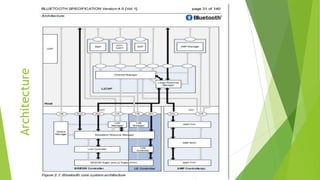
Architecture
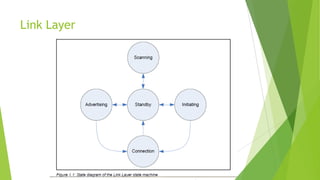
Link Layer
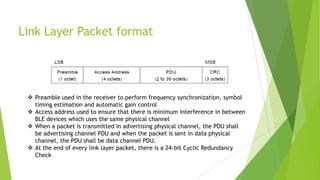
Link Layer Packet format

 Preamble used in the receiver to perform frequency synchronization, symbol
timing estimation and automatic gain control
 Access address used to ensure that there is minimum interference in between
BLE devices which uses the same physical channel
 When a packet is transmitted in advertising physical channel, the PDU shall
be advertising channel PDU and when the packet is sent in data physical
channel, the PDU shall be data channel PDU.
 At the end of every link layer packet, there is a 24-bit Cyclic Redundancy
Check
Open areas of Research


Automotive Technology



Consumer Wellness



Smart Energy



Home Automation



Security & Proximity



Sports and Fitness
There is an INNNOVATION World Cup every year conducted by Bluetooth SIG
THANK YOU

Bluetooth low energy

  • 1.
    Robert Bosch Centrefor Cyber-Physical Systems Bluetooth Low Energy: An insight Saptadeep Pal Amrit Anand
  • 2.
    Overview  Universal short-range wirelessCapability  2.4 GHz ISM Band  Available globally for unlicensed users  Achievable data-rate of 0.2 Mbit/s  Used mainly for low-powered devices and IoT to collect sensor data  Low power requirements, operating for "months or years" on a button cell  Small size and low cost  Compatibility with a large installed base of mobile phones, tablets and computers
  • 3.
    Bluetooth Vs BluetoothLow Energy Technical Specification Classic Bluetooth technology Bluetooth low energy technology Distance/Range Over the air data rate 100 m (330 ft) 1–3 Mbit/s 50 m (160 ft) 1 Mbit/s Application throughput 0.7–2.1 Mbit/s 0.27 Mbit/s Active slaves 7 Not defined; implementation dependent Security 56/128-bit and application layer user defined 128-bit AES with Counter Mode CBC-MAC and application layer user defined Robustness Adaptive fast frequency hopping, FEC, fast ACK Adaptive frequency hopping, Lazy Acknowledgement, 24-bit CRC, 32-bit Message Integrity Check Latency (from a non-connected state) Typically 100 ms 6 ms Total time to send data (det.battery life) 100 ms 3 ms[citation needed], <3 ms[25] Voice capable Network topology Yes Scatternet No Star-bus Power consumption 1 as the reference 0.01 to 0.5 (depending on use case) Peak current consumption <30 mA <15 mA Service discovery Profile concept Yes Yes Yes Yes Primary use cases Mobile phones, gaming, headsets, stereo audio streaming, automotive, PCs, security, proximity, healthcare, sports & fitness, etc. Mobile phones, gaming, PCs, watches, sports and fitness, healthcare, security & proximity, automotive, home electronics, automation, Industrial, etc.
  • 4.
    History of BLE  BluetoothLE was originally introduced under the name Wibree by Nokia in 2006  It was merged into the main Bluetooth standard in 2010, when the Bluetooth Core Specification Version 4.0 was adopted  In 2011, the Bluetooth Special Interest Group announced the Bluetooth SMART logo scheme, intended to clarify compatibility between LE devices  Bluetooth Smart Ready indicates a dual-mode device, typically a laptop or smartphone, whose hardware is compatible with both Classic and LE Bluetooth peripherals  Bluetooth Smart indicates an LE-only device, typically a battery-operated sensor, which requires either a SMART Ready or another SMART device in order to function  iPhone 4S was the first ever commercial device to include BLE
  • 5.
    Modulation Technique: AdaptiveFrequency Hopping Spread Spectrum  Resists Interference and multi-path effects  Provides a form of multiple access among co-located devices in different piconets  Total Bandwidth of 80 MHz is divided into 40 channels of 2 MHz each  FH occurs by jumping from one frequency to other using a pseudo-random sequence  Hopping sequence shared across entire piconet
  • 6.
  • 7.
  • 8.
    Link Layer Packetformat  Preamble used in the receiver to perform frequency synchronization, symbol timing estimation and automatic gain control  Access address used to ensure that there is minimum interference in between BLE devices which uses the same physical channel  When a packet is transmitted in advertising physical channel, the PDU shall be advertising channel PDU and when the packet is sent in data physical channel, the PDU shall be data channel PDU.  At the end of every link layer packet, there is a 24-bit Cyclic Redundancy Check
  • 9.
    Open areas ofResearch  Automotive Technology  Consumer Wellness  Smart Energy  Home Automation  Security & Proximity  Sports and Fitness There is an INNNOVATION World Cup every year conducted by Bluetooth SIG
  • 10.