Mobile & Ad Hoc Network
Chandra Prakash
Assistant Professor
LPU
1Chandra Prakash, LPU
Course Overview
Textbook:
• C. Siva Ram Murthy and B.S. Manoj, Ad Hoc Wireless
Networks: Architectures and Protocols , Pearson Education,
Inc.
• C.K Toh, Ad Hoc Mobile Wireless Networks, Pearson
Education, 2007
+ ( Research Papers literature)
Goal: Fundamental, design issues, solution to these issues–
architecture & protocol , developments in ad-Hoc Field
2Chandra Prakash, LPU
Related Sites
• Advanced Network Technologies Division, NIST,
– Wireless Ad Hoc Networks, http://w3.antd.nist.gov/wahn_home.shtml
• Autonomous Networks Research Group, USC
– WSN bibliography, http://ceng.usc.edu/~anrg/SensorNetBib.html
• IETF MANET WG
– http://www.ietf.org/html.charters/manet-charter.html
• IEEE 802 WG
– http://grouper.ieee.org/groups/802/dots.html
• Virtual lab
http://virtual-labs.ac.in/cse28/ant/ant/7/references/
3Chandra Prakash, LPU
Objectives of the Chapter
 Introduction
 Fundamentals of Wireless Communication Technology
 The Electromagnetic Spectrum
 Radio Propagation Mechanisms
 Characteristics of the Wireless Channel
 Evolution of mobile Cellular Networks
 Generations of Cellular Mobile Communication
 GSM, GPRS,CDMA ,PCS, UMTS
 Wireless LANs, Wi-Fi
 IEEE 802 Networking Standard
4 Chandra Prakash, LPU
We know
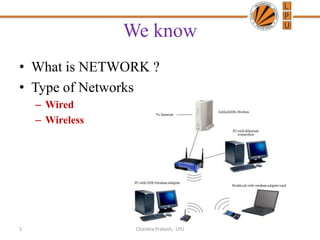
• What is NETWORK ?
• Type of Networks
– Wired
– Wireless
5 Chandra Prakash, LPU
Introduction
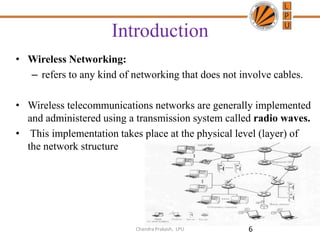
• Wireless Networking:
– refers to any kind of networking that does not involve cables.
• Wireless telecommunications networks are generally implemented
and administered using a transmission system called radio waves.
• This implementation takes place at the physical level (layer) of
the network structure
6Chandra Prakash, LPU
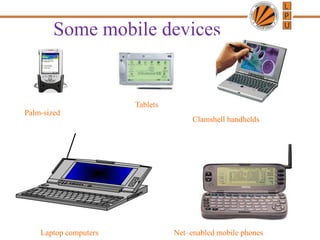
Some mobile devices
Clamshell handhelds
Tablets
Net–enabled mobile phones
Palm-sized
Laptop computers
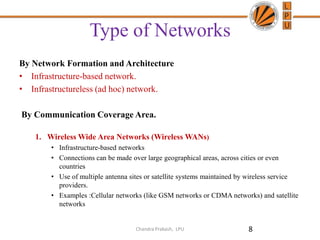
Type of Networks
By Network Formation and Architecture
• Infrastructure-based network.
• Infrastructureless (ad hoc) network.
By Communication Coverage Area.
1. Wireless Wide Area Networks (Wireless WANs)
• Infrastructure-based networks
• Connections can be made over large geographical areas, across cities or even
countries
• Use of multiple antenna sites or satellite systems maintained by wireless service
providers.
• Examples :Cellular networks (like GSM networks or CDMA networks) and satellite
networks
8Chandra Prakash, LPU
Type of Networks
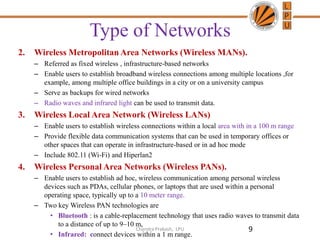
2. Wireless Metropolitan Area Networks (Wireless MANs).
– Referred as fixed wireless , infrastructure-based networks
– Enable users to establish broadband wireless connections among multiple locations ,for
example, among multiple office buildings in a city or on a university campus
– Serve as backups for wired networks
– Radio waves and infrared light can be used to transmit data.
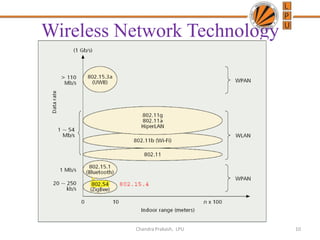
3. Wireless Local Area Network (Wireless LANs)
– Enable users to establish wireless connections within a local area with in a 100 m range
– Provide flexible data communication systems that can be used in temporary offices or
other spaces that can operate in infrastructure-based or in ad hoc mode
– Include 802.11 (Wi-Fi) and Hiperlan2
4. Wireless Personal Area Networks (Wireless PANs).
– Enable users to establish ad hoc, wireless communication among personal wireless
devices such as PDAs, cellular phones, or laptops that are used within a personal
operating space, typically up to a 10 meter range.
– Two key Wireless PAN technologies are
• Bluetooth : is a cable-replacement technology that uses radio waves to transmit data
to a distance of up to 9–10 m,
• Infrared: connect devices within a 1 m range.
9Chandra Prakash, LPU
Wireless Network Technology
10Chandra Prakash, LPU
Wireless Networks
• Wireless Networks
– Infrastructured Network
• Cellular Network (3GPP or 3GPP2)
• Wireless LAN (IEEE 802.11)
– Infrastructureless Network
• Ad Hoc Network
11
Internet
WLAN
Cellular
[Mobile/Wireless] Ad Hoc NetworksChandra Prakash, LPU
Fundamental of Wireless Networks
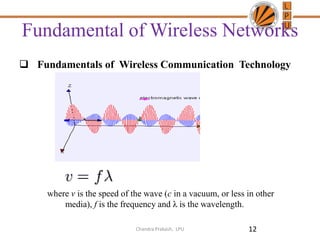
 Fundamentals of Wireless Communication Technology
where v is the speed of the wave (c in a vacuum, or less in other
media), f is the frequency and λ is the wavelength.
12Chandra Prakash, LPU
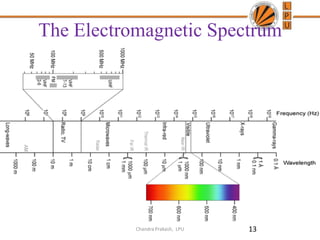
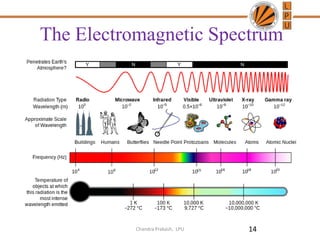
The Electromagnetic Spectrum
13Chandra Prakash, LPU
The Electromagnetic Spectrum
14Chandra Prakash, LPU
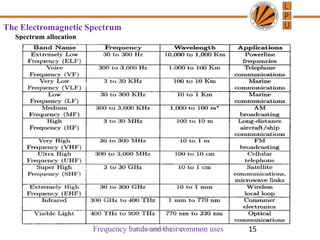
The Electromagnetic Spectrum
Spectrum allocation
15Frequency bands and their common usesChandra Prakash, LPU
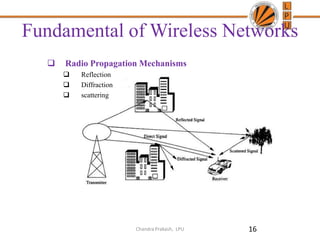
Fundamental of Wireless Networks
 Radio Propagation Mechanisms
 Reflection
 Diffraction
 scattering
16Chandra Prakash, LPU
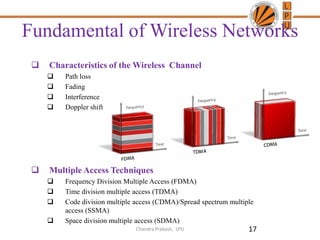
Fundamental of Wireless Networks
 Characteristics of the Wireless Channel
 Path loss
 Fading
 Interference
 Doppler shift
 Multiple Access Techniques
 Frequency Division Multiple Access (FDMA)
 Time division multiple access (TDMA)
 Code division multiple access (CDMA)/Spread spectrum multiple
access (SSMA)
 Space division multiple access (SDMA)
17Chandra Prakash, LPU
Frequency Division Multiple Access
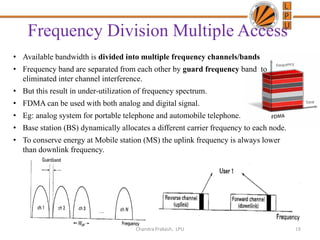
• Available bandwidth is divided into multiple frequency channels/bands
• Frequency band are separated from each other by guard frequency band to
eliminated inter channel interference.
• But this result in under-utilization of frequency spectrum.
• FDMA can be used with both analog and digital signal.
• Eg: analog system for portable telephone and automobile telephone.
• Base station (BS) dynamically allocates a different carrier frequency to each node.
• To conserve energy at Mobile station (MS) the uplink frequency is always lower
than downlink frequency.
18Chandra Prakash, LPU
Time Division Multiple Access
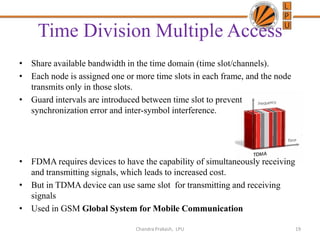
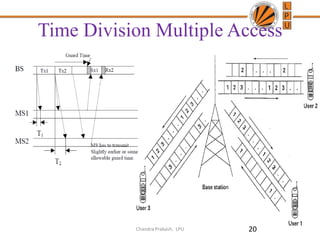
• Share available bandwidth in the time domain (time slot/channels).
• Each node is assigned one or more time slots in each frame, and the node
transmits only in those slots.
• Guard intervals are introduced between time slot to prevent
synchronization error and inter-symbol interference.
• FDMA requires devices to have the capability of simultaneously receiving
and transmitting signals, which leads to increased cost.
• But in TDMA device can use same slot for transmitting and receiving
signals
• Used in GSM Global System for Mobile Communication
19Chandra Prakash, LPU
Time Division Multiple Access
20Chandra Prakash, LPU
Code Division Multiple Access
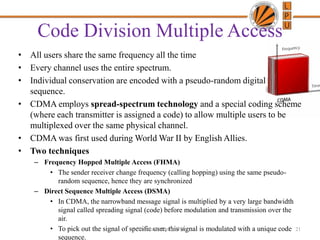
• All users share the same frequency all the time
• Every channel uses the entire spectrum.
• Individual conservation are encoded with a pseudo-random digital
sequence.
• CDMA employs spread-spectrum technology and a special coding scheme
(where each transmitter is assigned a code) to allow multiple users to be
multiplexed over the same physical channel.
• CDMA was first used during World War II by English Allies.
• Two techniques
– Frequency Hopped Multiple Access (FHMA)
• The sender receiver change frequency (calling hopping) using the same pseudo-
random sequence, hence they are synchronized
– Direct Sequence Multiple Access (DSMA)
• In CDMA, the narrowband message signal is multiplied by a very large bandwidth
signal called spreading signal (code) before modulation and transmission over the
air.
• To pick out the signal of specific user, this signal is modulated with a unique code
sequence.
21Chandra Prakash, LPU
Difference in TDMA,FDMA and
CDMA
An analogy to the problem of multiple access is a room (channel) in
which people wish to talk to each other simultaneously. To avoid
confusion, people could take turns speaking (time division), speak at
different pitches (frequency division), or speak in different languages
(code division).
CDMA is analogous to the last example where people speaking the same
language can understand each other, but other languages are
perceived as noise and rejected. Similarly, in radio CDMA, each
group of users is given a shared code. Many codes occupy the same
channel, but only users associated with a particular code can
communicate.
22Chandra Prakash, LPU
Space division multiple access
• FDMA TDMA and CDMA transmits signal in all direction
(omnidirectional in nature )
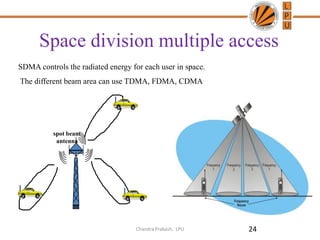
• SDMA uses directional transmitters/antennas to over angular
regions.
• Different area/region can be served using the same frequency
channel.
• Best suited to satellite systems.
• Use spot beam antennas
• The different beam area can use TDMA, FDMA, CDMA
• Sectorized antenna can be thought of as a SDMA
• Adaptive antennas can be used in the future (simultaneously steer
energy in the direction of many users)
23Chandra Prakash, LPU
Space division multiple access
24
spot beam
antenna
SDMA controls the radiated energy for each user in space.
The different beam area can use TDMA, FDMA, CDMA
Chandra Prakash, LPU
Wireless Network Setup
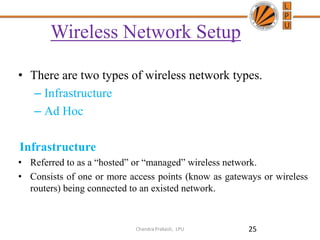
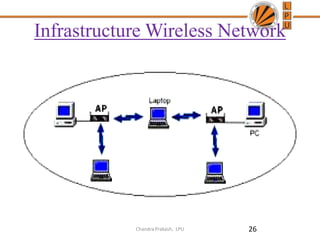
• There are two types of wireless network types.
– Infrastructure
– Ad Hoc
Infrastructure
• Referred to as a “hosted” or “managed” wireless network.
• Consists of one or more access points (know as gateways or wireless
routers) being connected to an existed network.
25Chandra Prakash, LPU
Infrastructure Wireless Network
26Chandra Prakash, LPU
Ad-Hoc Wireless Network
• Also referred to as an “unmanaged” or “peer to peer” wireless
network
• it consists of each device connecting directly to each other.
• Allow someone sitting outside in the garden with a laptop to
communicate with his desktop computer in the house and access the
Internet.
27Chandra Prakash, LPU
The MANET problem
• Mobile
Random and perhaps constantly changing
• Ad-hoc
Not engineered
• Networks
Elastic data applications which use networks to communicate
28Chandra Prakash, LPU
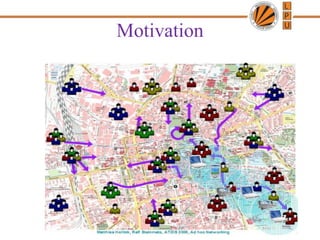
Motivation
Chandra Prakash, LPU 29
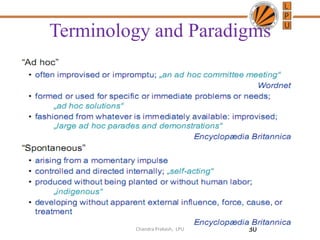
Terminology and Paradigms
Chandra Prakash, LPU 30
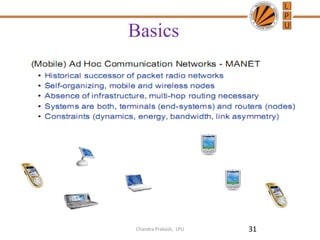
Basics
Chandra Prakash, LPU 31
Wireless Ad-hoc Network
• A wireless ad-hoc network is a decentralized type of wireless
network.
• The network is ad hoc because it does not rely on a pre-existing
infrastructure, such as routers in wired networks or access points in
managed (infrastructure) wireless networks. Instead,
each node participates in routing by forwarding data for other nodes,
and so the determination of which nodes forward data is made
dynamically based on the network connectivity.
• In addition to the classic routing, ad hoc networks can
use flooding for forwarding the data.
32Chandra Prakash, LPU
Mobile Ad-hoc Network
• Self-configuring network of mobile routers (and associated
hosts) connected by wireless links
• This union forms a random topology
• Routers move randomly free
• Topology changes rapidly and unpredictably
• Standalone fashion or connected to the larger Internet
• While MANETs are self contained, they can also be tied to an
IP-based global or local network – Hybrid MANETs
• Suitable for emergency situations like natural or human-
induced disasters, military conflicts, emergency medical
situations, etc.
33Chandra Prakash, LPU
Fundamental Concepts
• Ad hoc networks are autonomous networks operating either in
isolation or as “stub networks” connecting to a fixed network
• Do not necessarily rely on existing infrastructure
– No “access point”
• Each node serves as a router and forwards packets for other nodes in
the network
• Topology of the network continuously changes
34 Chandra Prakash, LPU
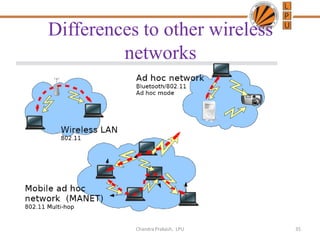
Differences to other wireless
networks
35Chandra Prakash, LPU
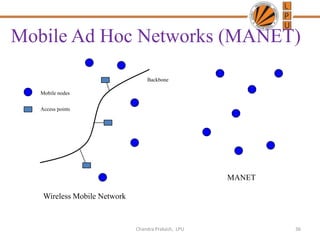
Mobile Ad Hoc Networks (MANET)
36
Mobile nodes
Access points
Backbone
Wireless Mobile Network
MANET
Chandra Prakash, LPU
Ad Hoc Networks vs. …
• Ad hoc networks vs. Wireless mobile networks
– Infrastructureless vs. Infrastructured Network
– All devices of an ad hoc network are likely to have similar
constraints
• Ad hoc networks vs. Peer-to-peer networks
– P2P devices use existing networked structures such as Internet
– All P2P networks are not ad hoc network
• Because NOT all ad hoc network utilize an existing structure
for the communication among devices
37Chandra Prakash, LPU
Ad hoc networks
• Temporary network composed of mobile nodes without
preexisting communication infrastructure, such as Access
Point (AP) and Base Station (BS).
– Each node plays the role of router for multi-hop routing.
• Self-organizing network without infrastructure networks
– Started from DARPA PRNet in 1970
• Cooperative nodes (wireless)
– Each node decode-and-forward packets for other nodes
• Multi-hop packet forwarding through wireless links
– Proactive/reactive/hybrid routing protocols
• Most works based on CSMA/CA to solve the interference
problem
– IEEE 802.11 MAC
38Chandra Prakash, LPU
Ad Hoc Network
39
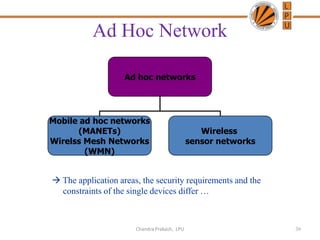
Ad hoc networks
Mobile ad hoc networks
(MANETs)
Wirelss Mesh Networks
(WMN)
Wireless
sensor networks
 The application areas, the security requirements and the
constraints of the single devices differ …
Chandra Prakash, LPU
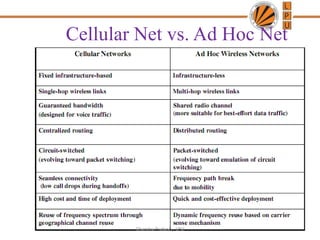
Cellular Net vs. Ad Hoc Net
40Chandra Prakash, LPU
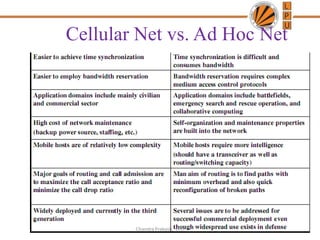
Cellular Net vs. Ad Hoc Net
41Chandra Prakash, LPU
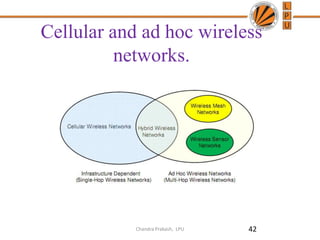
Cellular and ad hoc wireless
networks.
42Chandra Prakash, LPU
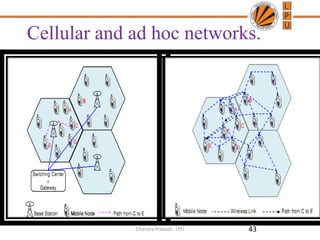
Cellular and ad hoc networks.
43Chandra Prakash, LPU
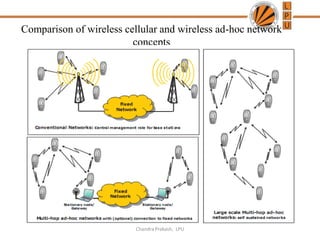
Comparison of wireless cellular and wireless ad-hoc network
concepts
44Chandra Prakash, LPU
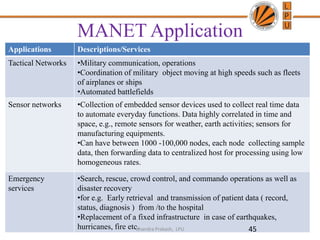
MANET Application
Applications Descriptions/Services
Tactical Networks •Military communication, operations
•Coordination of military object moving at high speeds such as fleets
of airplanes or ships
•Automated battlefields
Sensor networks •Collection of embedded sensor devices used to collect real time data
to automate everyday functions. Data highly correlated in time and
space, e.g., remote sensors for weather, earth activities; sensors for
manufacturing equipments.
•Can have between 1000 -100,000 nodes, each node collecting sample
data, then forwarding data to centralized host for processing using low
homogeneous rates.
Emergency
services
•Search, rescue, crowd control, and commando operations as well as
disaster recovery
•for e.g. Early retrieval and transmission of patient data ( record,
status, diagnosis ) from /to the hospital
•Replacement of a fixed infrastructure in case of earthquakes,
hurricanes, fire etc. 45Chandra Prakash, LPU
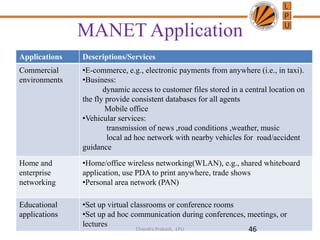
MANET Application
Applications Descriptions/Services
Commercial
environments
•E-commerce, e.g., electronic payments from anywhere (i.e., in taxi).
•Business:
dynamic access to customer files stored in a central location on
the fly provide consistent databases for all agents
Mobile office
•Vehicular services:
transmission of news ,road conditions ,weather, music
local ad hoc network with nearby vehicles for road/accident
guidance
Home and
enterprise
networking
•Home/office wireless networking(WLAN), e.g., shared whiteboard
application, use PDA to print anywhere, trade shows
•Personal area network (PAN)
Educational
applications
•Set up virtual classrooms or conference rooms
•Set up ad hoc communication during conferences, meetings, or
lectures
46Chandra Prakash, LPU
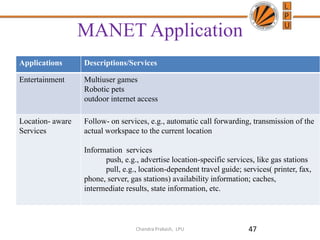
MANET Application
Applications Descriptions/Services
Entertainment Multiuser games
Robotic pets
outdoor internet access
Location- aware
Services
Follow- on services, e.g., automatic call forwarding, transmission of the
actual workspace to the current location
Information services
push, e.g., advertise location-specific services, like gas stations
pull, e.g., location-dependent travel guide; services( printer, fax,
phone, server, gas stations) availability information; caches,
intermediate results, state information, etc.
47Chandra Prakash, LPU
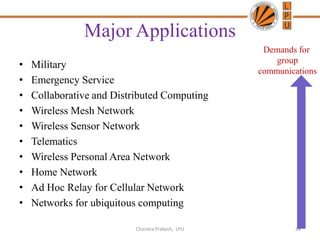
Major Applications
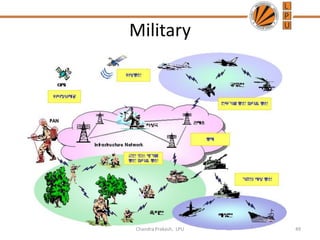
• Military
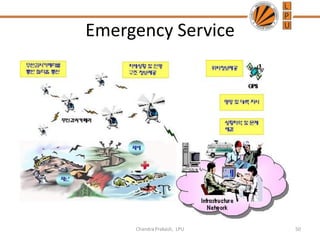
• Emergency Service
• Collaborative and Distributed Computing
• Wireless Mesh Network
• Wireless Sensor Network
• Telematics
• Wireless Personal Area Network
• Home Network
• Ad Hoc Relay for Cellular Network
• Networks for ubiquitous computing
48
Demands for
group
communications
Chandra Prakash, LPU
Military
49Chandra Prakash, LPU
Emergency Service
50Chandra Prakash, LPU
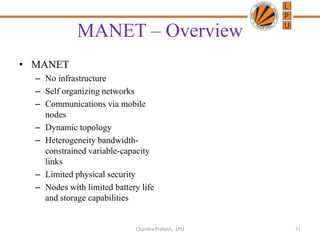
MANET – Overview
• MANET
– No infrastructure
– Self organizing networks
– Communications via mobile
nodes
– Dynamic topology
– Heterogeneity bandwidth-
constrained variable-capacity
links
– Limited physical security
– Nodes with limited battery life
and storage capabilities
51Chandra Prakash, LPU
Issues in Ad Hoc Networks
• Medium access scheme
• Routing
• Multicasting
• Transport layer protocol
• QoS provisioning
• Security
• Energy management
• Addressing and service discovery
• Scalability
• Deployment considerations
52Chandra Prakash, LPU

Lecture 1 mobile and adhoc network- introduction

  • 1.
    Mobile & AdHoc Network Chandra Prakash Assistant Professor LPU 1Chandra Prakash, LPU
  • 2.
    Course Overview Textbook: • C.Siva Ram Murthy and B.S. Manoj, Ad Hoc Wireless Networks: Architectures and Protocols , Pearson Education, Inc. • C.K Toh, Ad Hoc Mobile Wireless Networks, Pearson Education, 2007 + ( Research Papers literature) Goal: Fundamental, design issues, solution to these issues– architecture & protocol , developments in ad-Hoc Field 2Chandra Prakash, LPU
  • 3.
    Related Sites • AdvancedNetwork Technologies Division, NIST, – Wireless Ad Hoc Networks, http://w3.antd.nist.gov/wahn_home.shtml • Autonomous Networks Research Group, USC – WSN bibliography, http://ceng.usc.edu/~anrg/SensorNetBib.html • IETF MANET WG – http://www.ietf.org/html.charters/manet-charter.html • IEEE 802 WG – http://grouper.ieee.org/groups/802/dots.html • Virtual lab http://virtual-labs.ac.in/cse28/ant/ant/7/references/ 3Chandra Prakash, LPU
  • 4.
    Objectives of theChapter  Introduction  Fundamentals of Wireless Communication Technology  The Electromagnetic Spectrum  Radio Propagation Mechanisms  Characteristics of the Wireless Channel  Evolution of mobile Cellular Networks  Generations of Cellular Mobile Communication  GSM, GPRS,CDMA ,PCS, UMTS  Wireless LANs, Wi-Fi  IEEE 802 Networking Standard 4 Chandra Prakash, LPU
  • 5.
    We know • Whatis NETWORK ? • Type of Networks – Wired – Wireless 5 Chandra Prakash, LPU
  • 6.
    Introduction • Wireless Networking: –refers to any kind of networking that does not involve cables. • Wireless telecommunications networks are generally implemented and administered using a transmission system called radio waves. • This implementation takes place at the physical level (layer) of the network structure 6Chandra Prakash, LPU
  • 7.
    Some mobile devices Clamshellhandhelds Tablets Net–enabled mobile phones Palm-sized Laptop computers
  • 8.
    Type of Networks ByNetwork Formation and Architecture • Infrastructure-based network. • Infrastructureless (ad hoc) network. By Communication Coverage Area. 1. Wireless Wide Area Networks (Wireless WANs) • Infrastructure-based networks • Connections can be made over large geographical areas, across cities or even countries • Use of multiple antenna sites or satellite systems maintained by wireless service providers. • Examples :Cellular networks (like GSM networks or CDMA networks) and satellite networks 8Chandra Prakash, LPU
  • 9.
    Type of Networks 2.Wireless Metropolitan Area Networks (Wireless MANs). – Referred as fixed wireless , infrastructure-based networks – Enable users to establish broadband wireless connections among multiple locations ,for example, among multiple office buildings in a city or on a university campus – Serve as backups for wired networks – Radio waves and infrared light can be used to transmit data. 3. Wireless Local Area Network (Wireless LANs) – Enable users to establish wireless connections within a local area with in a 100 m range – Provide flexible data communication systems that can be used in temporary offices or other spaces that can operate in infrastructure-based or in ad hoc mode – Include 802.11 (Wi-Fi) and Hiperlan2 4. Wireless Personal Area Networks (Wireless PANs). – Enable users to establish ad hoc, wireless communication among personal wireless devices such as PDAs, cellular phones, or laptops that are used within a personal operating space, typically up to a 10 meter range. – Two key Wireless PAN technologies are • Bluetooth : is a cable-replacement technology that uses radio waves to transmit data to a distance of up to 9–10 m, • Infrared: connect devices within a 1 m range. 9Chandra Prakash, LPU
  • 10.
  • 11.
    Wireless Networks • WirelessNetworks – Infrastructured Network • Cellular Network (3GPP or 3GPP2) • Wireless LAN (IEEE 802.11) – Infrastructureless Network • Ad Hoc Network 11 Internet WLAN Cellular [Mobile/Wireless] Ad Hoc NetworksChandra Prakash, LPU
  • 12.
    Fundamental of WirelessNetworks  Fundamentals of Wireless Communication Technology where v is the speed of the wave (c in a vacuum, or less in other media), f is the frequency and λ is the wavelength. 12Chandra Prakash, LPU
  • 13.
  • 14.
  • 15.
    The Electromagnetic Spectrum Spectrumallocation 15Frequency bands and their common usesChandra Prakash, LPU
  • 16.
    Fundamental of WirelessNetworks  Radio Propagation Mechanisms  Reflection  Diffraction  scattering 16Chandra Prakash, LPU
  • 17.
    Fundamental of WirelessNetworks  Characteristics of the Wireless Channel  Path loss  Fading  Interference  Doppler shift  Multiple Access Techniques  Frequency Division Multiple Access (FDMA)  Time division multiple access (TDMA)  Code division multiple access (CDMA)/Spread spectrum multiple access (SSMA)  Space division multiple access (SDMA) 17Chandra Prakash, LPU
  • 18.
    Frequency Division MultipleAccess • Available bandwidth is divided into multiple frequency channels/bands • Frequency band are separated from each other by guard frequency band to eliminated inter channel interference. • But this result in under-utilization of frequency spectrum. • FDMA can be used with both analog and digital signal. • Eg: analog system for portable telephone and automobile telephone. • Base station (BS) dynamically allocates a different carrier frequency to each node. • To conserve energy at Mobile station (MS) the uplink frequency is always lower than downlink frequency. 18Chandra Prakash, LPU
  • 19.
    Time Division MultipleAccess • Share available bandwidth in the time domain (time slot/channels). • Each node is assigned one or more time slots in each frame, and the node transmits only in those slots. • Guard intervals are introduced between time slot to prevent synchronization error and inter-symbol interference. • FDMA requires devices to have the capability of simultaneously receiving and transmitting signals, which leads to increased cost. • But in TDMA device can use same slot for transmitting and receiving signals • Used in GSM Global System for Mobile Communication 19Chandra Prakash, LPU
  • 20.
    Time Division MultipleAccess 20Chandra Prakash, LPU
  • 21.
    Code Division MultipleAccess • All users share the same frequency all the time • Every channel uses the entire spectrum. • Individual conservation are encoded with a pseudo-random digital sequence. • CDMA employs spread-spectrum technology and a special coding scheme (where each transmitter is assigned a code) to allow multiple users to be multiplexed over the same physical channel. • CDMA was first used during World War II by English Allies. • Two techniques – Frequency Hopped Multiple Access (FHMA) • The sender receiver change frequency (calling hopping) using the same pseudo- random sequence, hence they are synchronized – Direct Sequence Multiple Access (DSMA) • In CDMA, the narrowband message signal is multiplied by a very large bandwidth signal called spreading signal (code) before modulation and transmission over the air. • To pick out the signal of specific user, this signal is modulated with a unique code sequence. 21Chandra Prakash, LPU
  • 22.
    Difference in TDMA,FDMAand CDMA An analogy to the problem of multiple access is a room (channel) in which people wish to talk to each other simultaneously. To avoid confusion, people could take turns speaking (time division), speak at different pitches (frequency division), or speak in different languages (code division). CDMA is analogous to the last example where people speaking the same language can understand each other, but other languages are perceived as noise and rejected. Similarly, in radio CDMA, each group of users is given a shared code. Many codes occupy the same channel, but only users associated with a particular code can communicate. 22Chandra Prakash, LPU
  • 23.
    Space division multipleaccess • FDMA TDMA and CDMA transmits signal in all direction (omnidirectional in nature ) • SDMA uses directional transmitters/antennas to over angular regions. • Different area/region can be served using the same frequency channel. • Best suited to satellite systems. • Use spot beam antennas • The different beam area can use TDMA, FDMA, CDMA • Sectorized antenna can be thought of as a SDMA • Adaptive antennas can be used in the future (simultaneously steer energy in the direction of many users) 23Chandra Prakash, LPU
  • 24.
    Space division multipleaccess 24 spot beam antenna SDMA controls the radiated energy for each user in space. The different beam area can use TDMA, FDMA, CDMA Chandra Prakash, LPU
  • 25.
    Wireless Network Setup •There are two types of wireless network types. – Infrastructure – Ad Hoc Infrastructure • Referred to as a “hosted” or “managed” wireless network. • Consists of one or more access points (know as gateways or wireless routers) being connected to an existed network. 25Chandra Prakash, LPU
  • 26.
  • 27.
    Ad-Hoc Wireless Network •Also referred to as an “unmanaged” or “peer to peer” wireless network • it consists of each device connecting directly to each other. • Allow someone sitting outside in the garden with a laptop to communicate with his desktop computer in the house and access the Internet. 27Chandra Prakash, LPU
  • 28.
    The MANET problem •Mobile Random and perhaps constantly changing • Ad-hoc Not engineered • Networks Elastic data applications which use networks to communicate 28Chandra Prakash, LPU
  • 29.
  • 30.
  • 31.
  • 32.
    Wireless Ad-hoc Network •A wireless ad-hoc network is a decentralized type of wireless network. • The network is ad hoc because it does not rely on a pre-existing infrastructure, such as routers in wired networks or access points in managed (infrastructure) wireless networks. Instead, each node participates in routing by forwarding data for other nodes, and so the determination of which nodes forward data is made dynamically based on the network connectivity. • In addition to the classic routing, ad hoc networks can use flooding for forwarding the data. 32Chandra Prakash, LPU
  • 33.
    Mobile Ad-hoc Network •Self-configuring network of mobile routers (and associated hosts) connected by wireless links • This union forms a random topology • Routers move randomly free • Topology changes rapidly and unpredictably • Standalone fashion or connected to the larger Internet • While MANETs are self contained, they can also be tied to an IP-based global or local network – Hybrid MANETs • Suitable for emergency situations like natural or human- induced disasters, military conflicts, emergency medical situations, etc. 33Chandra Prakash, LPU
  • 34.
    Fundamental Concepts • Adhoc networks are autonomous networks operating either in isolation or as “stub networks” connecting to a fixed network • Do not necessarily rely on existing infrastructure – No “access point” • Each node serves as a router and forwards packets for other nodes in the network • Topology of the network continuously changes 34 Chandra Prakash, LPU
  • 35.
    Differences to otherwireless networks 35Chandra Prakash, LPU
  • 36.
    Mobile Ad HocNetworks (MANET) 36 Mobile nodes Access points Backbone Wireless Mobile Network MANET Chandra Prakash, LPU
  • 37.
    Ad Hoc Networksvs. … • Ad hoc networks vs. Wireless mobile networks – Infrastructureless vs. Infrastructured Network – All devices of an ad hoc network are likely to have similar constraints • Ad hoc networks vs. Peer-to-peer networks – P2P devices use existing networked structures such as Internet – All P2P networks are not ad hoc network • Because NOT all ad hoc network utilize an existing structure for the communication among devices 37Chandra Prakash, LPU
  • 38.
    Ad hoc networks •Temporary network composed of mobile nodes without preexisting communication infrastructure, such as Access Point (AP) and Base Station (BS). – Each node plays the role of router for multi-hop routing. • Self-organizing network without infrastructure networks – Started from DARPA PRNet in 1970 • Cooperative nodes (wireless) – Each node decode-and-forward packets for other nodes • Multi-hop packet forwarding through wireless links – Proactive/reactive/hybrid routing protocols • Most works based on CSMA/CA to solve the interference problem – IEEE 802.11 MAC 38Chandra Prakash, LPU
  • 39.
    Ad Hoc Network 39 Adhoc networks Mobile ad hoc networks (MANETs) Wirelss Mesh Networks (WMN) Wireless sensor networks  The application areas, the security requirements and the constraints of the single devices differ … Chandra Prakash, LPU
  • 40.
    Cellular Net vs.Ad Hoc Net 40Chandra Prakash, LPU
  • 41.
    Cellular Net vs.Ad Hoc Net 41Chandra Prakash, LPU
  • 42.
    Cellular and adhoc wireless networks. 42Chandra Prakash, LPU
  • 43.
    Cellular and adhoc networks. 43Chandra Prakash, LPU
  • 44.
    Comparison of wirelesscellular and wireless ad-hoc network concepts 44Chandra Prakash, LPU
  • 45.
    MANET Application Applications Descriptions/Services TacticalNetworks •Military communication, operations •Coordination of military object moving at high speeds such as fleets of airplanes or ships •Automated battlefields Sensor networks •Collection of embedded sensor devices used to collect real time data to automate everyday functions. Data highly correlated in time and space, e.g., remote sensors for weather, earth activities; sensors for manufacturing equipments. •Can have between 1000 -100,000 nodes, each node collecting sample data, then forwarding data to centralized host for processing using low homogeneous rates. Emergency services •Search, rescue, crowd control, and commando operations as well as disaster recovery •for e.g. Early retrieval and transmission of patient data ( record, status, diagnosis ) from /to the hospital •Replacement of a fixed infrastructure in case of earthquakes, hurricanes, fire etc. 45Chandra Prakash, LPU
  • 46.
    MANET Application Applications Descriptions/Services Commercial environments •E-commerce,e.g., electronic payments from anywhere (i.e., in taxi). •Business: dynamic access to customer files stored in a central location on the fly provide consistent databases for all agents Mobile office •Vehicular services: transmission of news ,road conditions ,weather, music local ad hoc network with nearby vehicles for road/accident guidance Home and enterprise networking •Home/office wireless networking(WLAN), e.g., shared whiteboard application, use PDA to print anywhere, trade shows •Personal area network (PAN) Educational applications •Set up virtual classrooms or conference rooms •Set up ad hoc communication during conferences, meetings, or lectures 46Chandra Prakash, LPU
  • 47.
    MANET Application Applications Descriptions/Services EntertainmentMultiuser games Robotic pets outdoor internet access Location- aware Services Follow- on services, e.g., automatic call forwarding, transmission of the actual workspace to the current location Information services push, e.g., advertise location-specific services, like gas stations pull, e.g., location-dependent travel guide; services( printer, fax, phone, server, gas stations) availability information; caches, intermediate results, state information, etc. 47Chandra Prakash, LPU
  • 48.
    Major Applications • Military •Emergency Service • Collaborative and Distributed Computing • Wireless Mesh Network • Wireless Sensor Network • Telematics • Wireless Personal Area Network • Home Network • Ad Hoc Relay for Cellular Network • Networks for ubiquitous computing 48 Demands for group communications Chandra Prakash, LPU
  • 49.
  • 50.
  • 51.
    MANET – Overview •MANET – No infrastructure – Self organizing networks – Communications via mobile nodes – Dynamic topology – Heterogeneity bandwidth- constrained variable-capacity links – Limited physical security – Nodes with limited battery life and storage capabilities 51Chandra Prakash, LPU
  • 52.
    Issues in AdHoc Networks • Medium access scheme • Routing • Multicasting • Transport layer protocol • QoS provisioning • Security • Energy management • Addressing and service discovery • Scalability • Deployment considerations 52Chandra Prakash, LPU