MAP SKILLS  REVISION  PART 1
ACCESS INFORMATION  POINT
TODAY WE WILL FOCUS ON SKILLS  REVISION
TO BE ABLE TO INTEPRET OS MAPS AT 1:25 000 & 1:50 000 TO BE ABLE TO UNDERSTAND 3 & 4 FIGURE GRID REFERENCES TO BE ABLE TO CALCULATE DISTANCES FROM SCALE TO BE ABLE TO DESCRIBE ALL THE DIFFERENT TYPES OF LAND USE ON A MAP TO BE ABLE TO UNDERSTAND PATTERNS AND DISTRIBUTIONS ON MAPS (CHOROPLETH, DOT MAPS) TO BE ABLE TO INTERPRET PHOTOGRAPHS & SKETCHES (INCLUDING SATELLITE & AERIAL PHOTOGRAPHS) OBJECTIVES
TICK OFF WHEN YOU HAVE REVISED  AND KNOW EACH SECTION ON YOUR CHECK  LIST
Don’t forget you must answer all questions in section A.  There is normally 3 parts to section A  IT WILL BE A LOCATION IN THE UK SECTION A Section A is worth 25 marks and tests your OS map skills and other skills.  There are also some other skills marks in the other questions on both exam papers.
QUESTION 1 Study  Figure 1 , the Ordnance Survey map extract for Reading in southern England. MAKE SURE THIS  IS IN FRONT OF YOU NOW
Points to remember about OS maps You will always have a either a 1:25 000 or a 1:50 000 scale map.  The one in front of you is 1:50 000 scale  1:25 000 means that 1cm on the map is equal to 25 000 cm in real life.  This means 1cm is equal to 250m on the ground or 4cm is equal to 1km 1:50 000 means 1cm is equal to 500m on the ground or 2cm is equal to 1km The top of an OS map is always North You will always be given an OS key for that map it includes the scale as a bar to help you work out distances
USING A MAP KEY Ordnance survey maps use a series of symbols to indicate features of the landscape.  In the examination you will be given a key to the symbols.  This is exactly the same as the one you now have in front of you.  Study this lots at home.  You are not expected to know it off be heart but a good general understanding of some of the key features will help you save time in the exam. Take care with the following symbols that are often confused. Look at your symbol key now
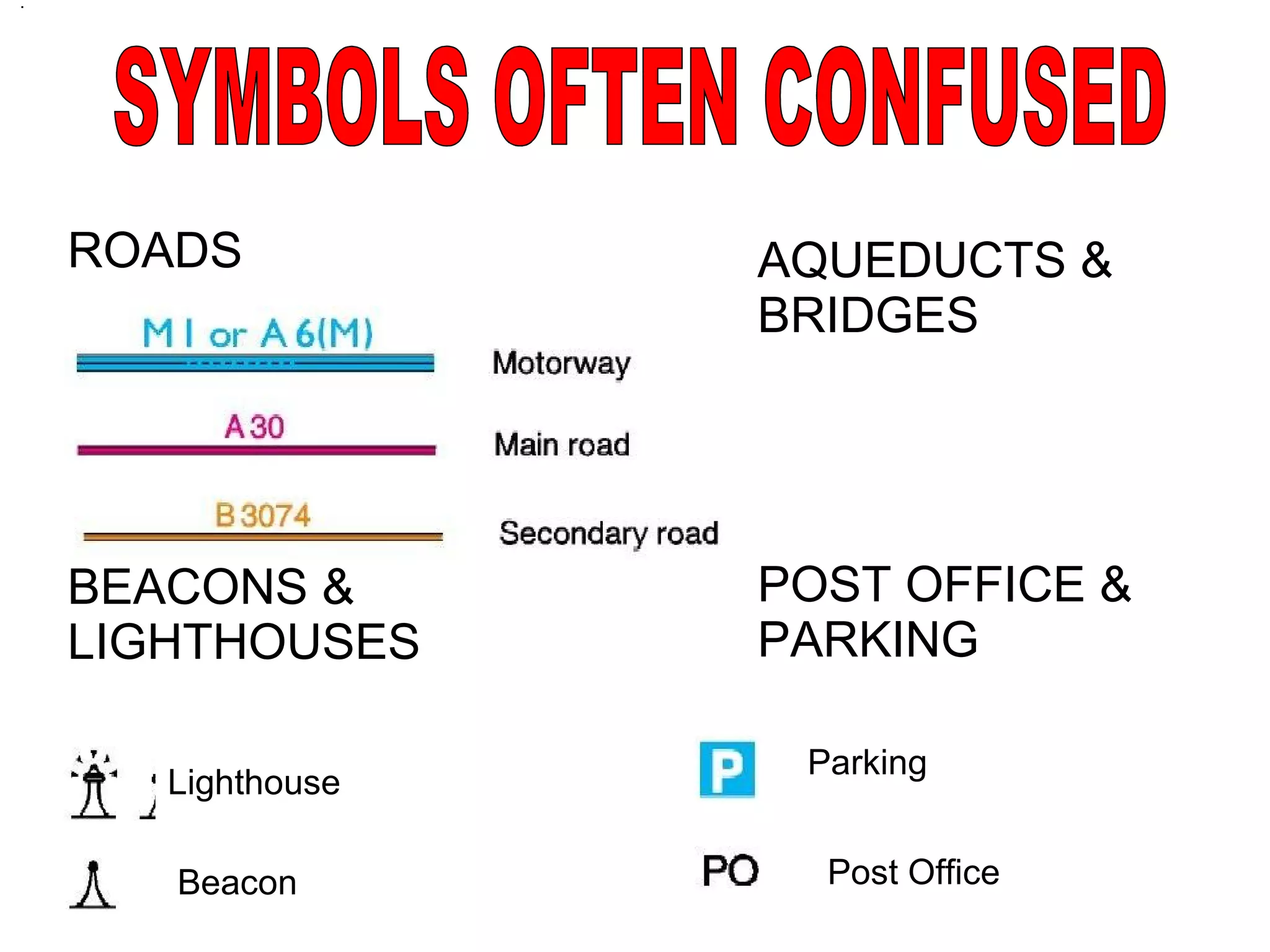
AQUEDUCTS & BRIDGES POST OFFICE & PARKING ROADS BEACONS & LIGHTHOUSES SYMBOLS OFTEN CONFUSED Lighthouse Beacon Parking Post Office
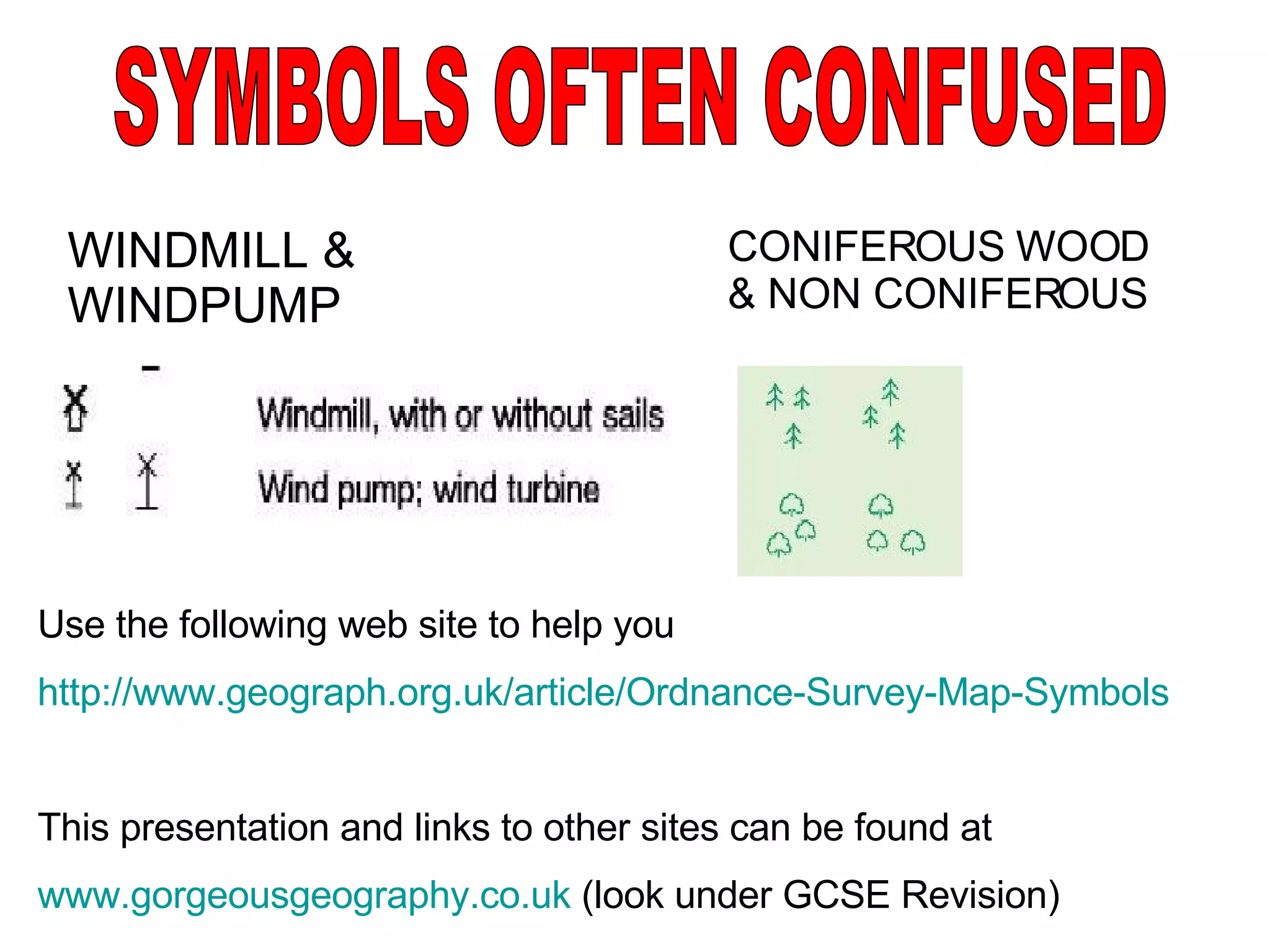
WINDMILL & WINDPUMP SYMBOLS OFTEN CONFUSED CONIFEROUS WOOD & NON CONIFEROUS Use the following web site to help you http://www.geograph.org.uk/article/Ordnance-Survey-Map-Symbols This presentation and links to other sites can be found at www.gorgeousgeography.co.uk  (look under GCSE Revision)
GRID REFERENCES PUT YOUR HAND UP IF YOU KNOW THEM
4-figure grid references
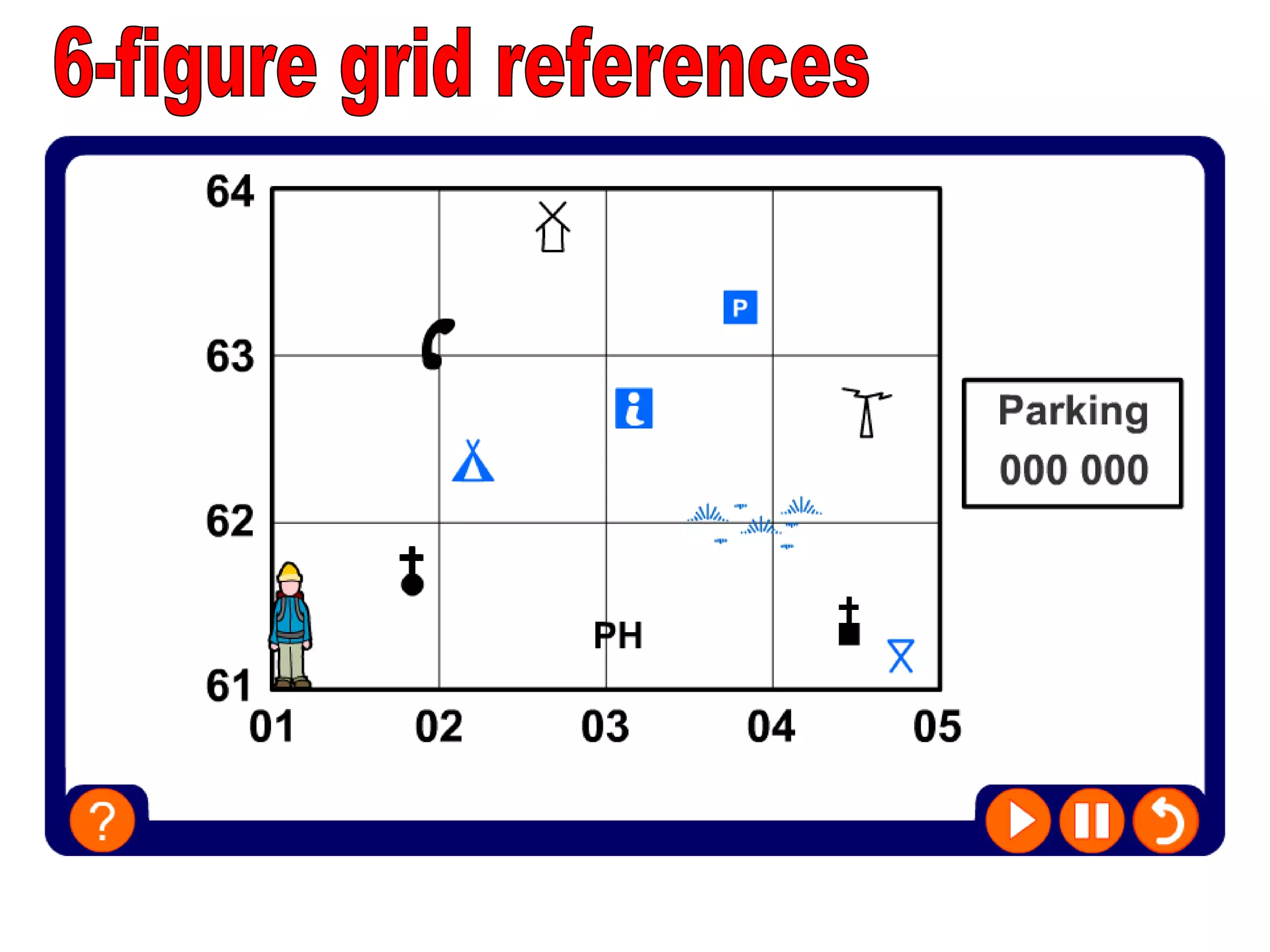
6-figure grid references
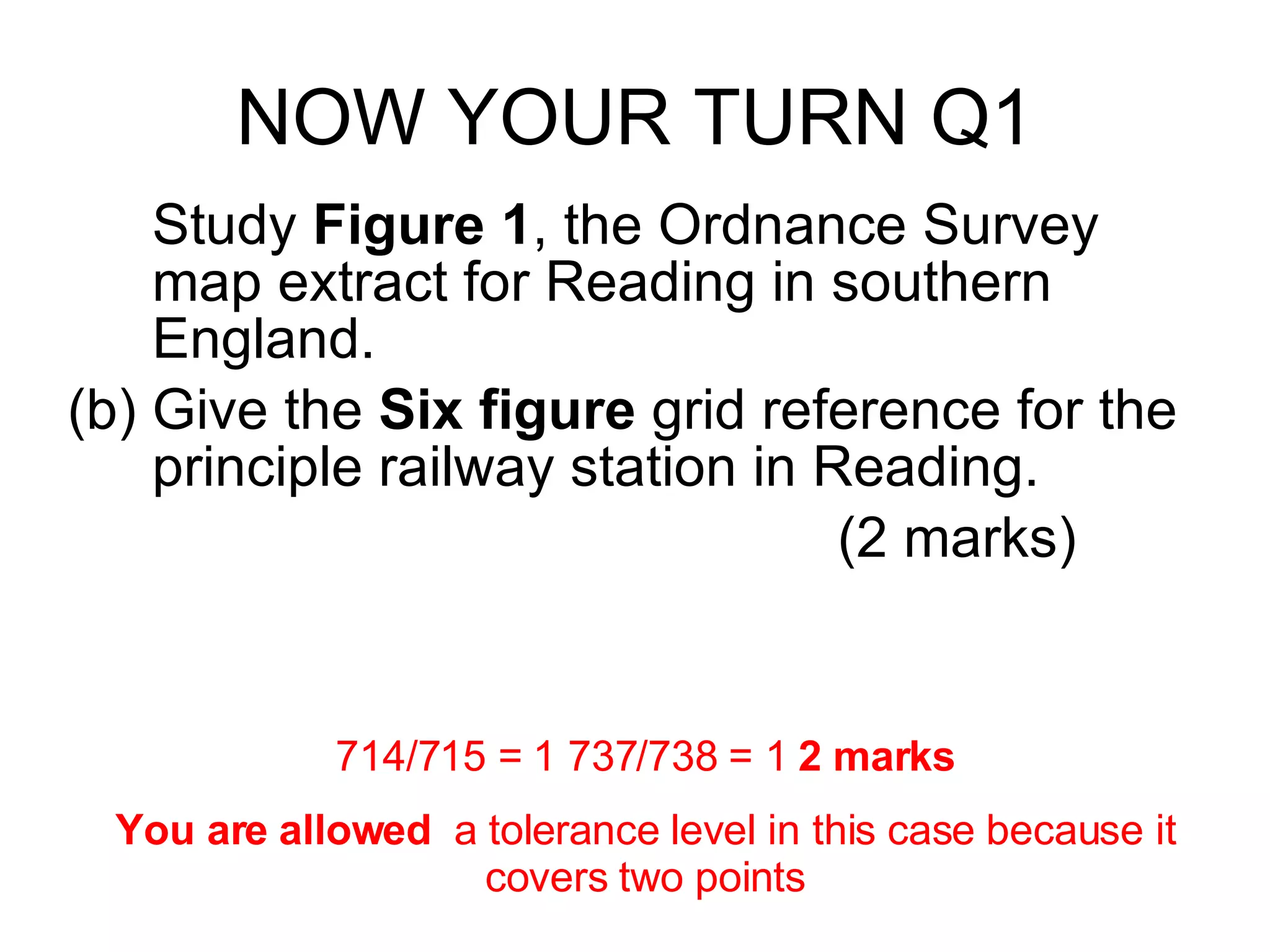
NOW YOUR TURN Q1 Study  Figure 1 , the Ordnance Survey map extract for Reading in southern England. Give the  Six figure  grid reference for the principle railway station in Reading. (2 marks) 714/715 = 1 737/738 = 1  2 marks You are allowed  a tolerance level in this case because it covers two points
WHAT DO YOU NEED TO KNOW Study  Figure 1 , the Ordnance Survey map extract for Reading in southern England. (b) Measure the  distance  along the M4 between the motorway service area in grid square  6769  and the  western  edge of the map. (1 marks)
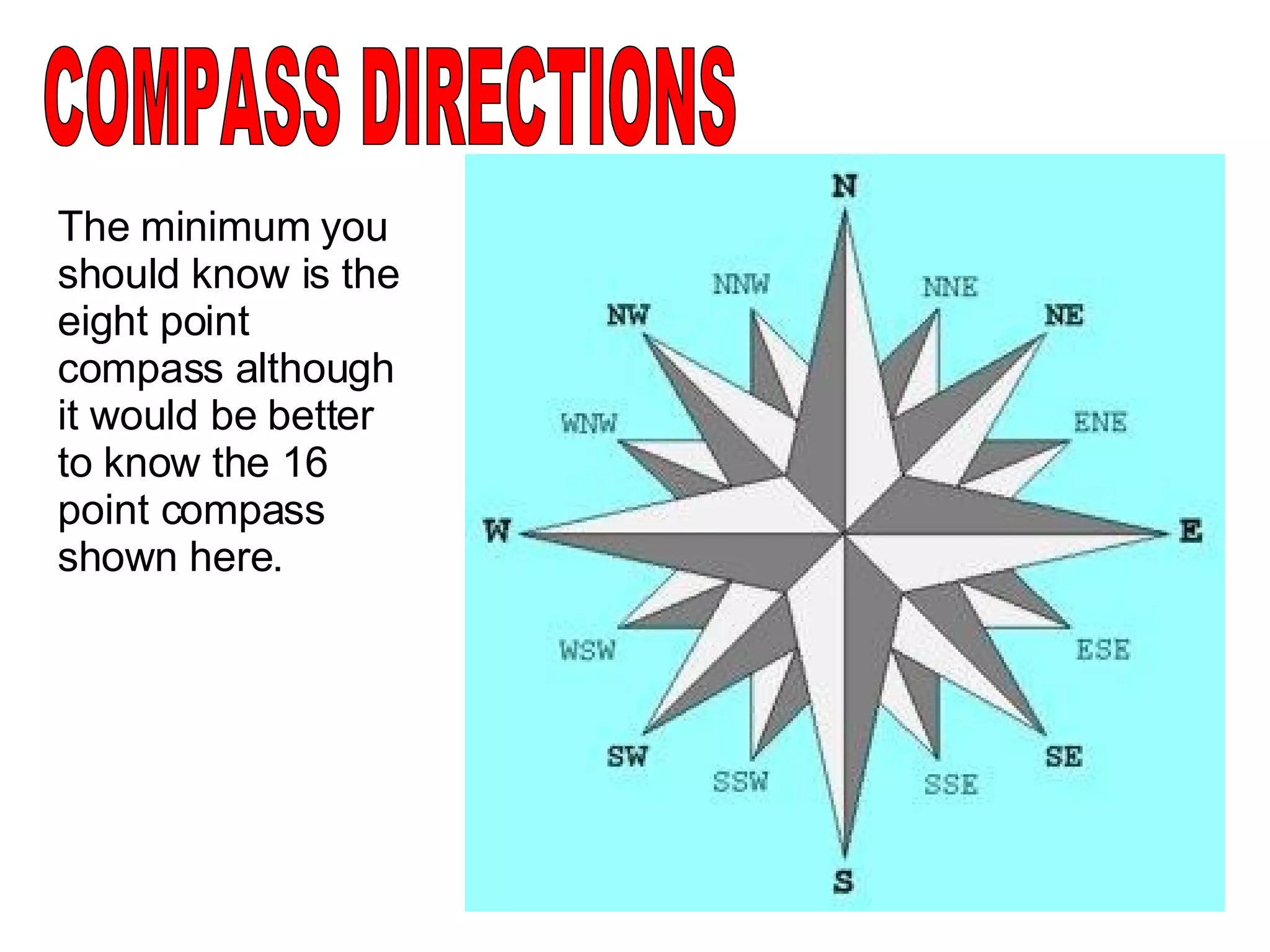
COMPASS DIRECTIONS The minimum you should know is the eight point compass although it would be better to know the 16 point compass shown here.
MEASURING DISTANCE You can do this using two different methods. Use your ruler to pivot and add up the centimetres as you travel along the line then calculate using the scale line.  Use a piece of paper to make marks on it as you twist it. REMEMBER WHICH EVER WAY YOU USE YOU MUST USE THE SCALE TO WORK OUT THE DISTANCE IN KILOMETRES (FOR A 1:50,000 MEASURE IN CM AND THEN DIVIDE BY 2 AS 1 KM IS EQUAL TO 2CM)
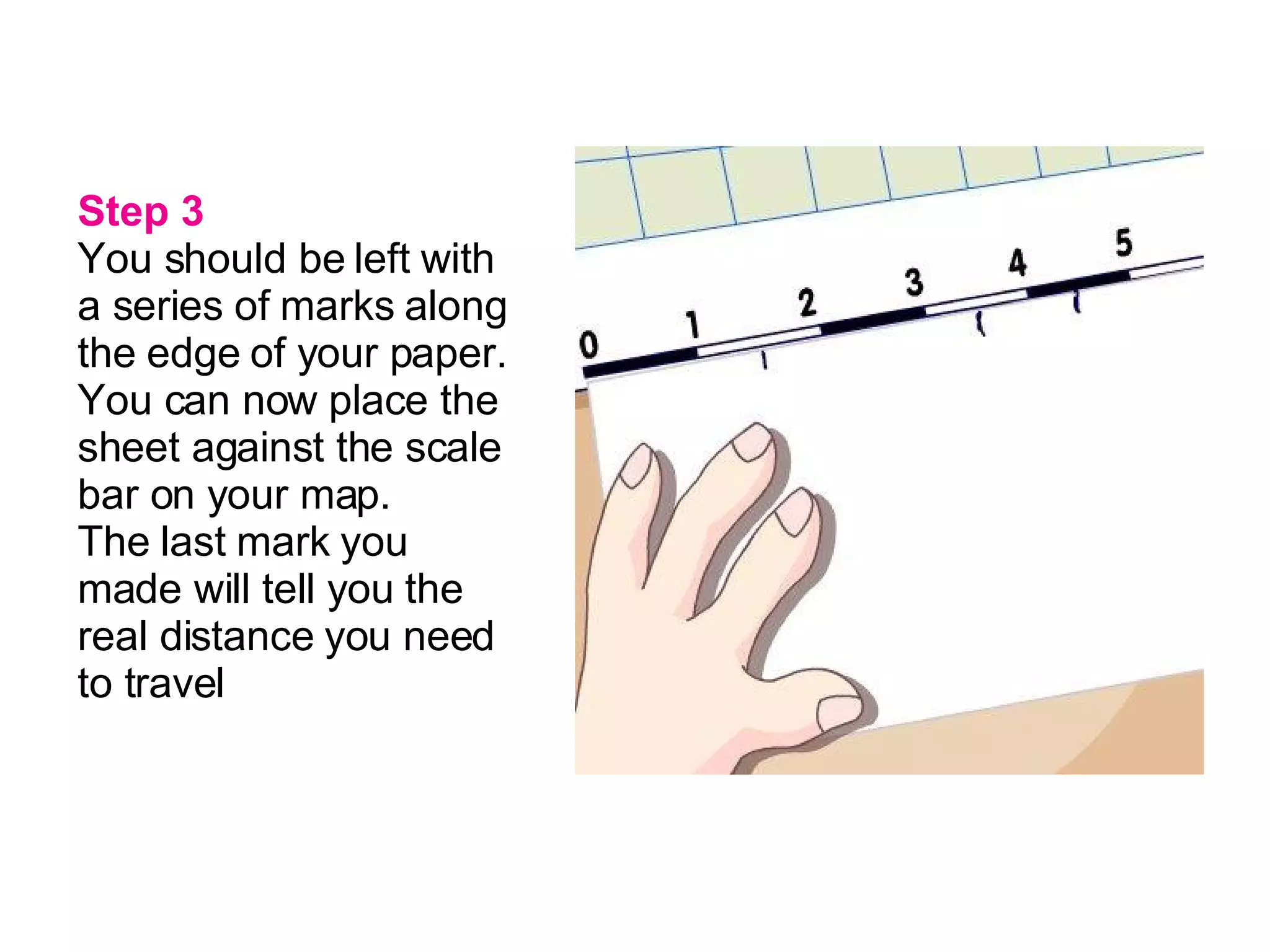
On the paper's edge Another method of measuring distance is to take a sheet of paper and place the corner of a straight edge on your starting point. Now pivot the paper until the edge follows the route that you want to take. Step 1 Every time the route disappears or moves away from the straight edge of your paper, make a small mark on the edge and pivot the paper so the edge is back on course.
Step 2 Repeat this process until you reach your destination
Step 3 You should be left with a series of marks along the edge of your paper. You can now place the sheet against the scale bar on your map.   The last mark you made will tell you the real distance you need to travel
QUESTION 1b Study  Figure 1 , the Ordnance Survey map extract for Reading in southern England. (b) Measure the distance along the M4 between the motorway service area in grid square 6769 and the western edge of the map. (1 marks) 6 kilometres  1 mark
QUESTION 1C Study  Figure 1 , the Ordnance Survey map extract for Reading in southern England. (c) Compare  the  relief  and  land uses  in grid squares 7877 and 6677. (2 marks)
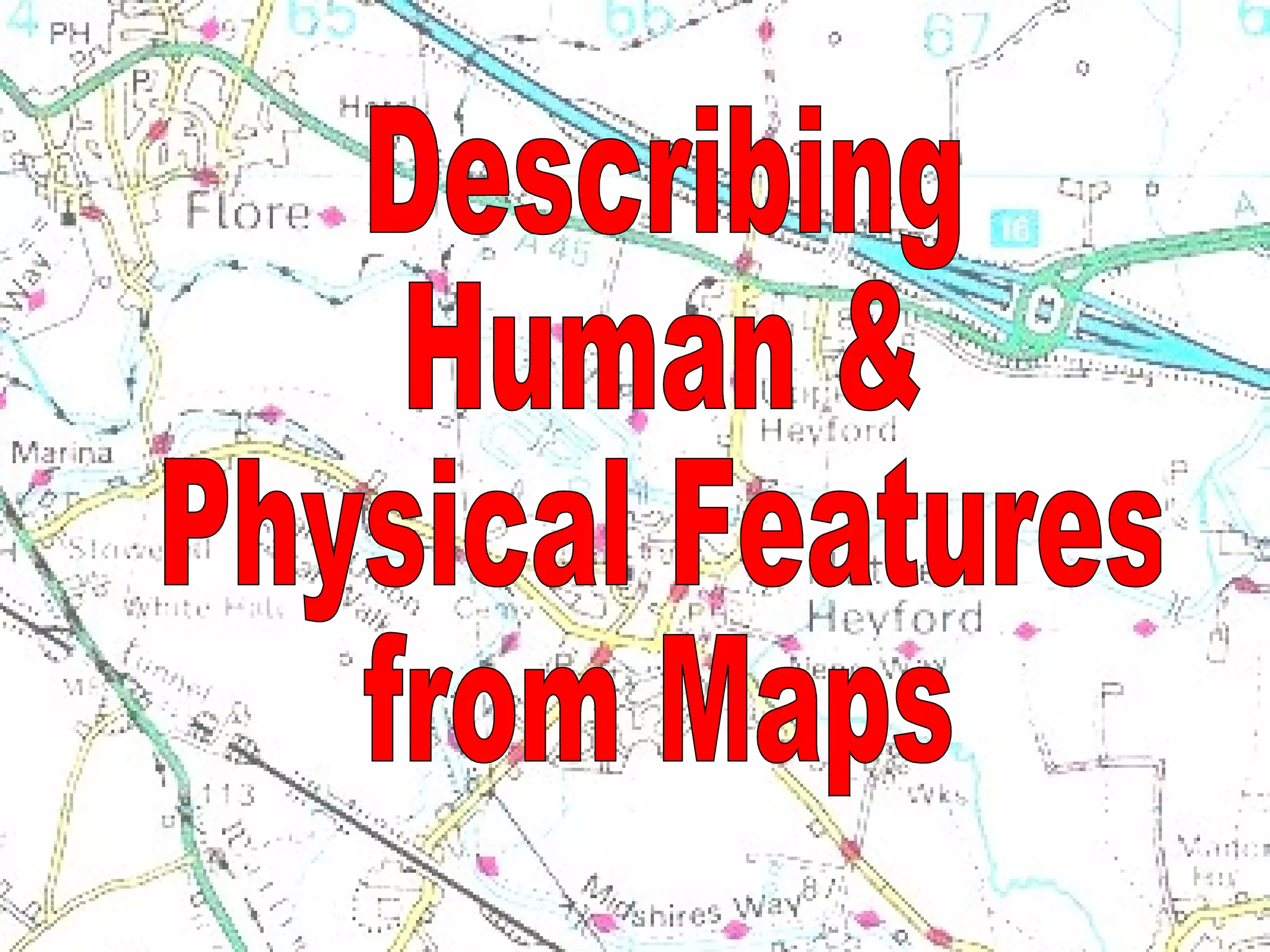
Describing  Human &  Physical Features  from Maps
RELIEF My goodness, I am quite  RELIEVED  I got to the top Relief means the height and shape of the land.  I like to remember it by thinking about how relieved I am when I get to the top. – This associates it with land height and shape.  Take care with the spelling though.
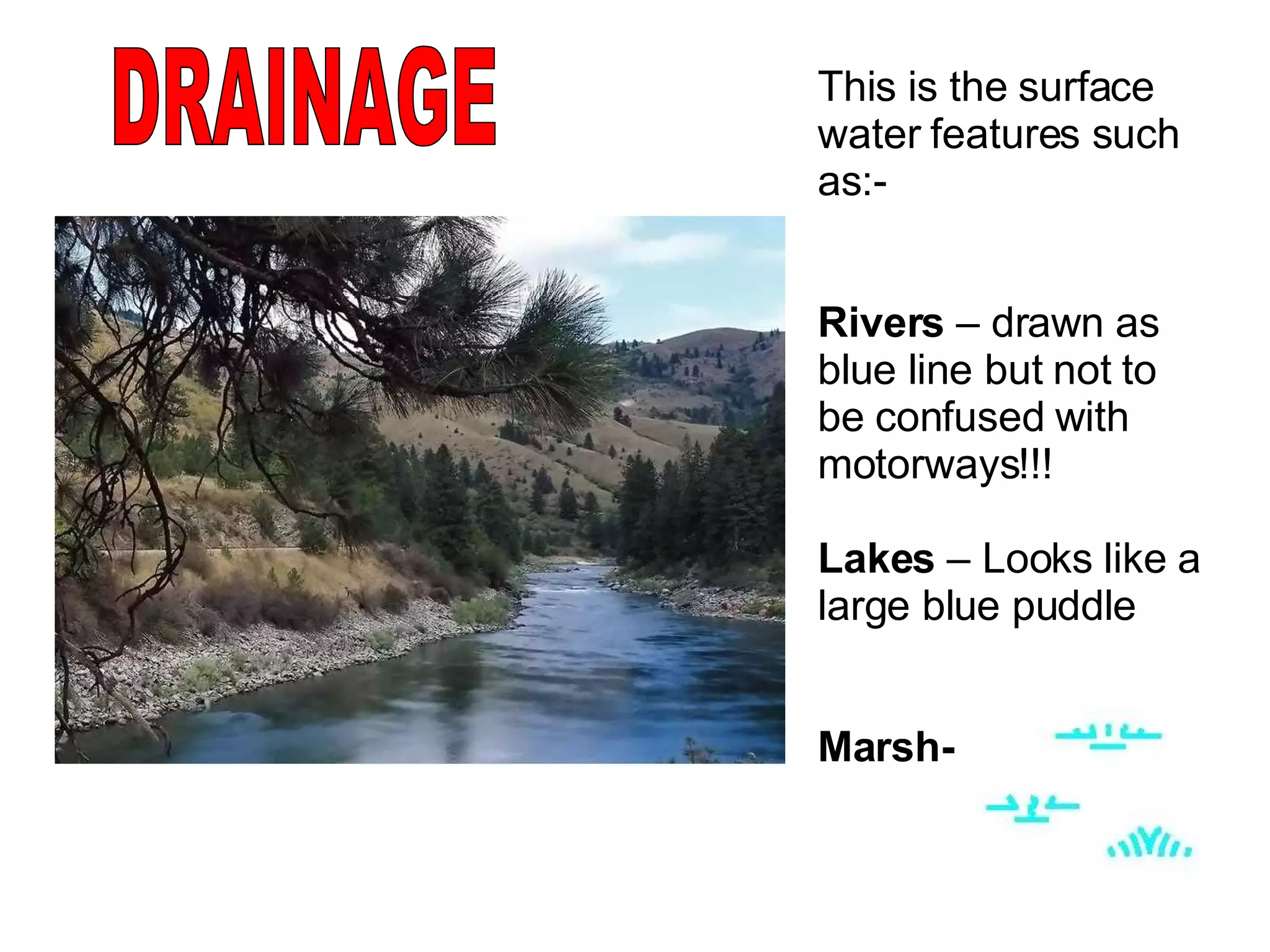
DRAINAGE This is the surface water features such as:-  Rivers  – drawn as blue line but not to be confused with motorways!!! Lakes  – Looks like a large blue puddle Marsh-
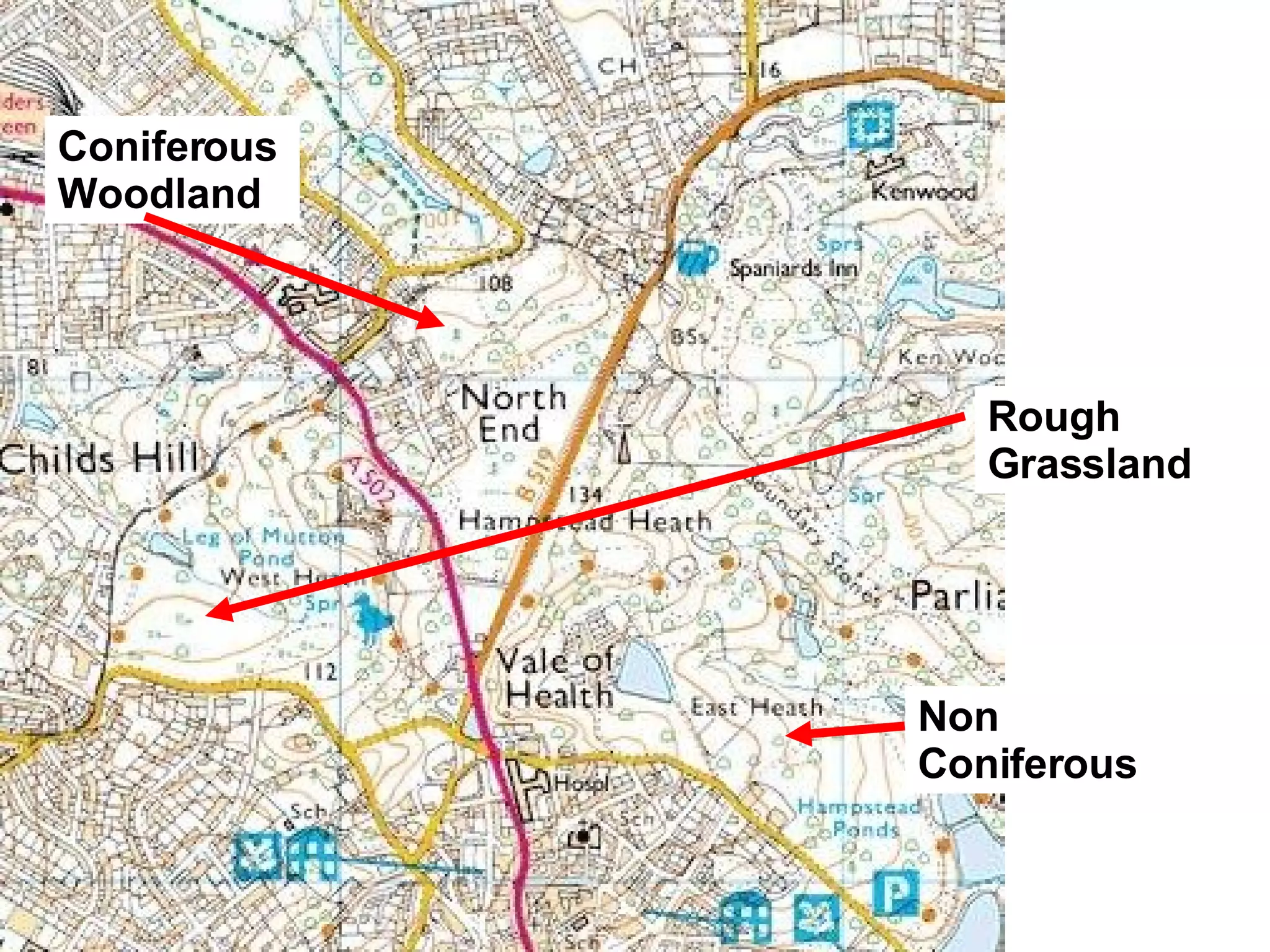
VEGETATION This includes the obvious green wooded areas but look out for  which means rough grassland.  On the OS 1:25 000 map vegetation is shown in more detail – check the symbols key carefully Rough Grassland Coniferous Trees Non Coniferous Trees
Vegetation
Rough Grassland Coniferous Woodland Non Coniferous
LAND USE When asked what the land use is you must explain what the land is  USED  for. In this case depending on which grid square you can see a variety of land uses e.g. a golf course, residential areas, lakes used for recreation, Roads,  Allotments and many more.
SETTLEMENT This includes:- Its location – Where is it? Its shape – (linear, star shaped, nucleated) Its pattern – (nucleated, dispersed or evenly spread)
PATTERNS OF COMMUNICATION This includes:- Canals Railways Roads  don’t forget to know the difference between A roads, Motorways, B Roads, Rough Tracks.  Look at your OS key carefully
River Motorway
Four  Figure Grid Reference 7877
Four  Figure Grid Reference 6677
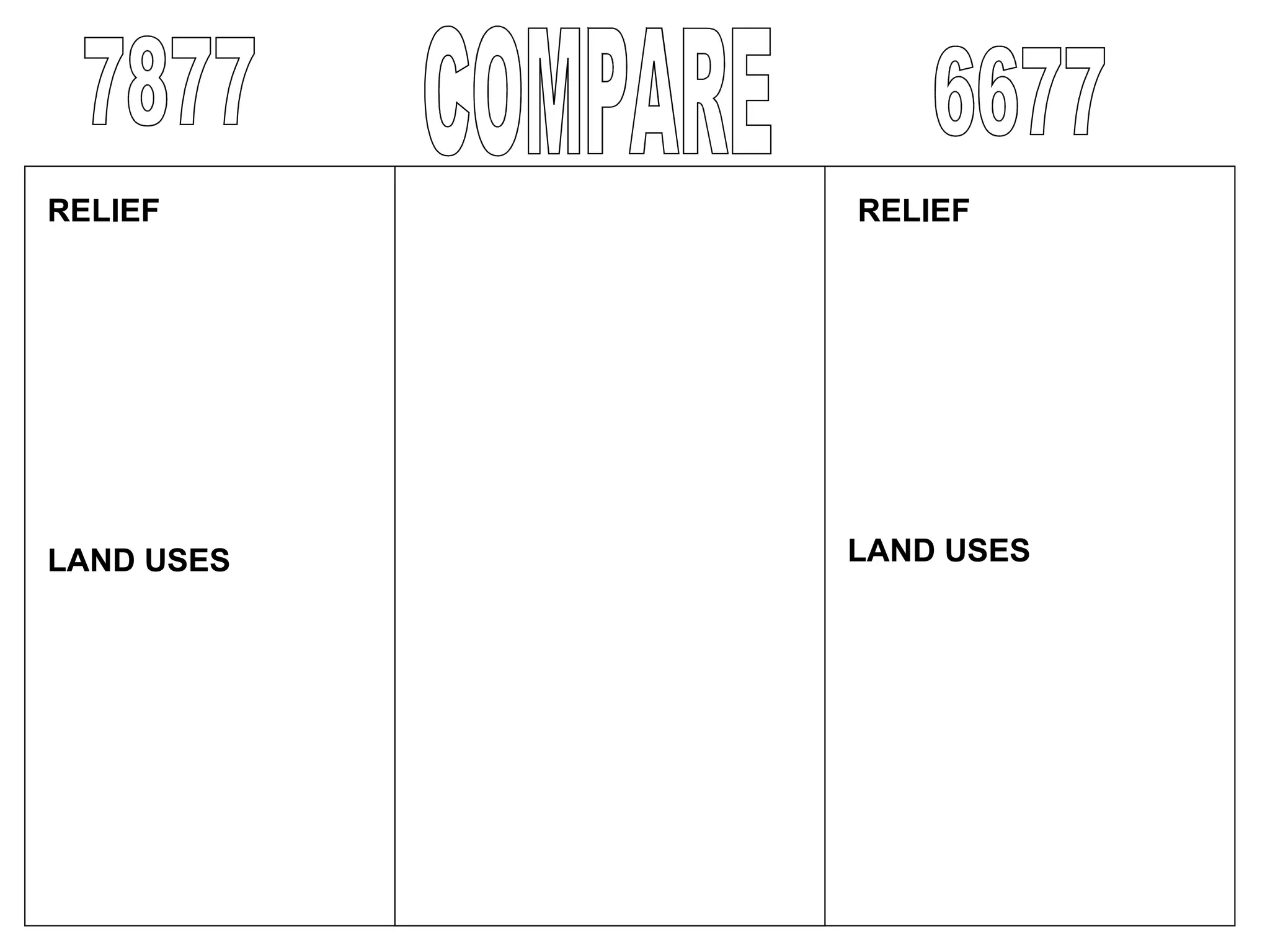
7877 6677 RELIEF RELIEF LAND USES LAND USES COMPARE
Four  Figure Grid Reference 7877 Four  Figure Grid Reference 6677
COMPARE The word  COMPARE  in an exam means you must do the following Don’t list the features of each grid square You must compare so use words like the ones below HIGH ER   STEEP ER   DENS ER   SPARS ER Use connectives such as  WHERE AS  – as this will force you to compare 3. Use figures to  COMPARE  e.g. site one is 3m higher than site 2 for example.
7877 6677 RELIEF RELIEF LAND USES LAND USES COMPARE
ANSWER LEVEL 1: May be listed, and separate accounts, and imbalanced, i.e. land use or relief only, e.g. in 7877 school, telephone, railway, houses main road, low land, two contours 40 and 50 metres, etc. In 6677 river, transmission line, road, woodland, sloping land, 40 – 90 metres. May be only  2 simple points . IF YOU WANT TO GET MORE THAN 2 POINTS YOU MUST COMPARE LEVEL 2: (3 – 4 marks) Clear contrasts made; reference to land use and relief, e.g. 6677 has much steeper land, heights vary from below 40 metres to over 90 metres, max height of 110 metres, whereas in 7877 the relief is lower, from below 40 metres to over 50 metres. In 6677 there is only a minor road whereas in 7877 there is a main road. Max 3 if only Relief described.  4 marks
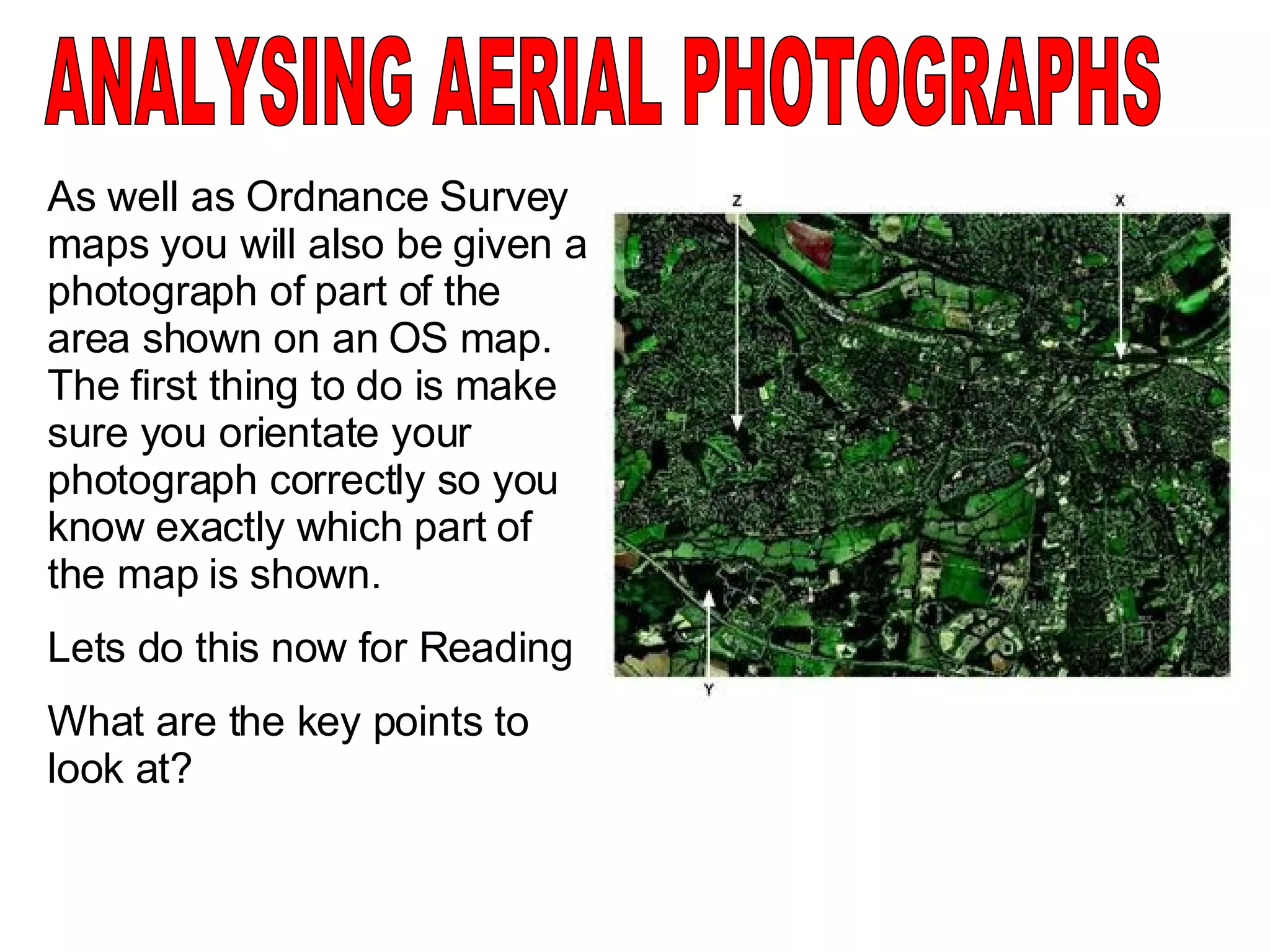
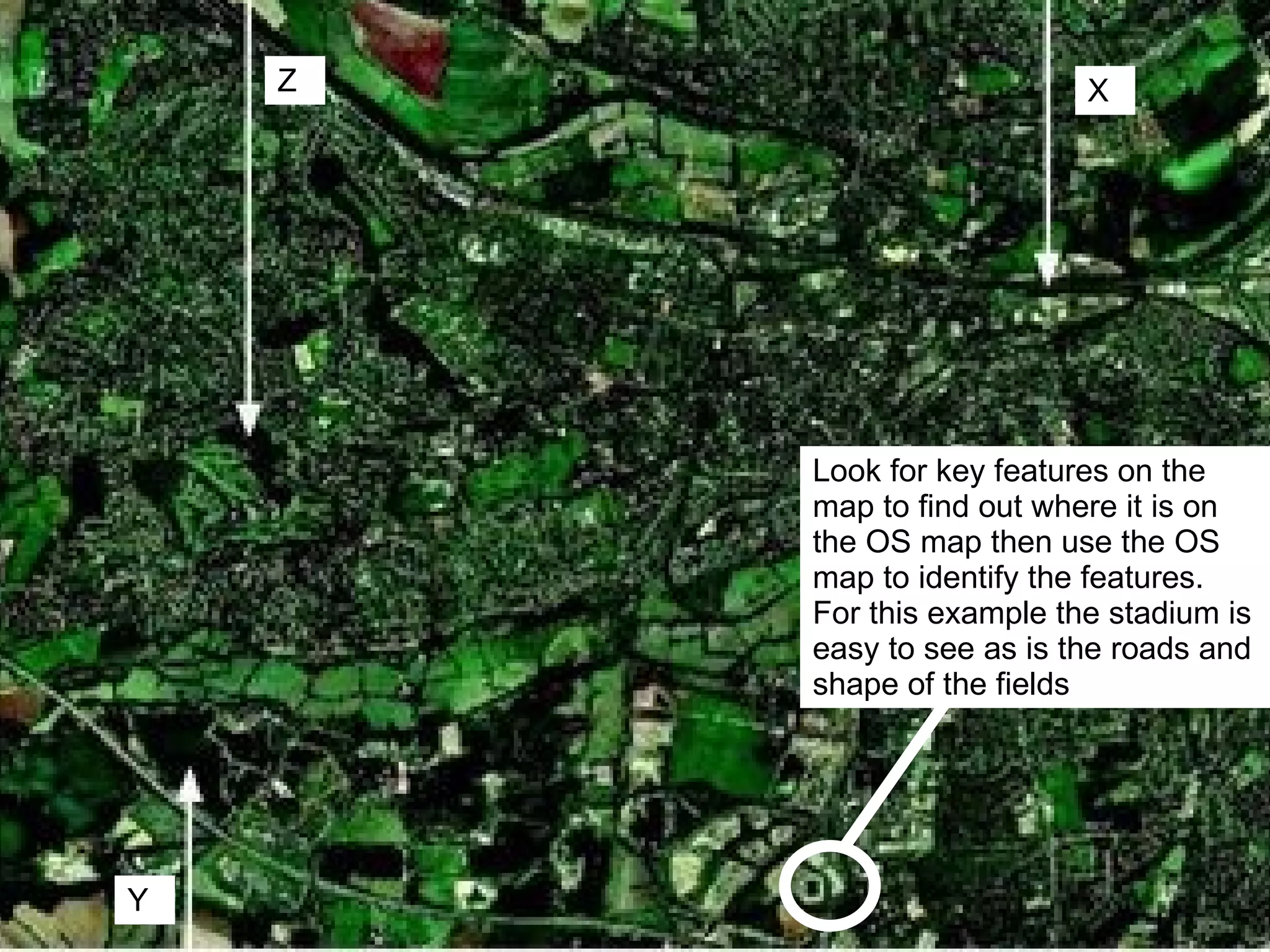
QUESTION 2 Study  Figure 1 , the ordnance survey map extract and  Figure 2 , on the next page, an aerial photograph of reading Name the land uses shown at X, Y and Z on the aerial photograph (3 marks)
ANALYSING AERIAL PHOTOGRAPHS As well as Ordnance Survey maps you will also be given a photograph of part of the area shown on an OS map.  The first thing to do is make sure you orientate your photograph correctly so you know exactly which part of the map is shown. Lets do this now for Reading What are the key points to look at?
Y X Z Look for key features on the map to find out where it is on the OS map then use the OS map to identify the features.  For this example the stadium is easy to see as is the roads and shape of the fields
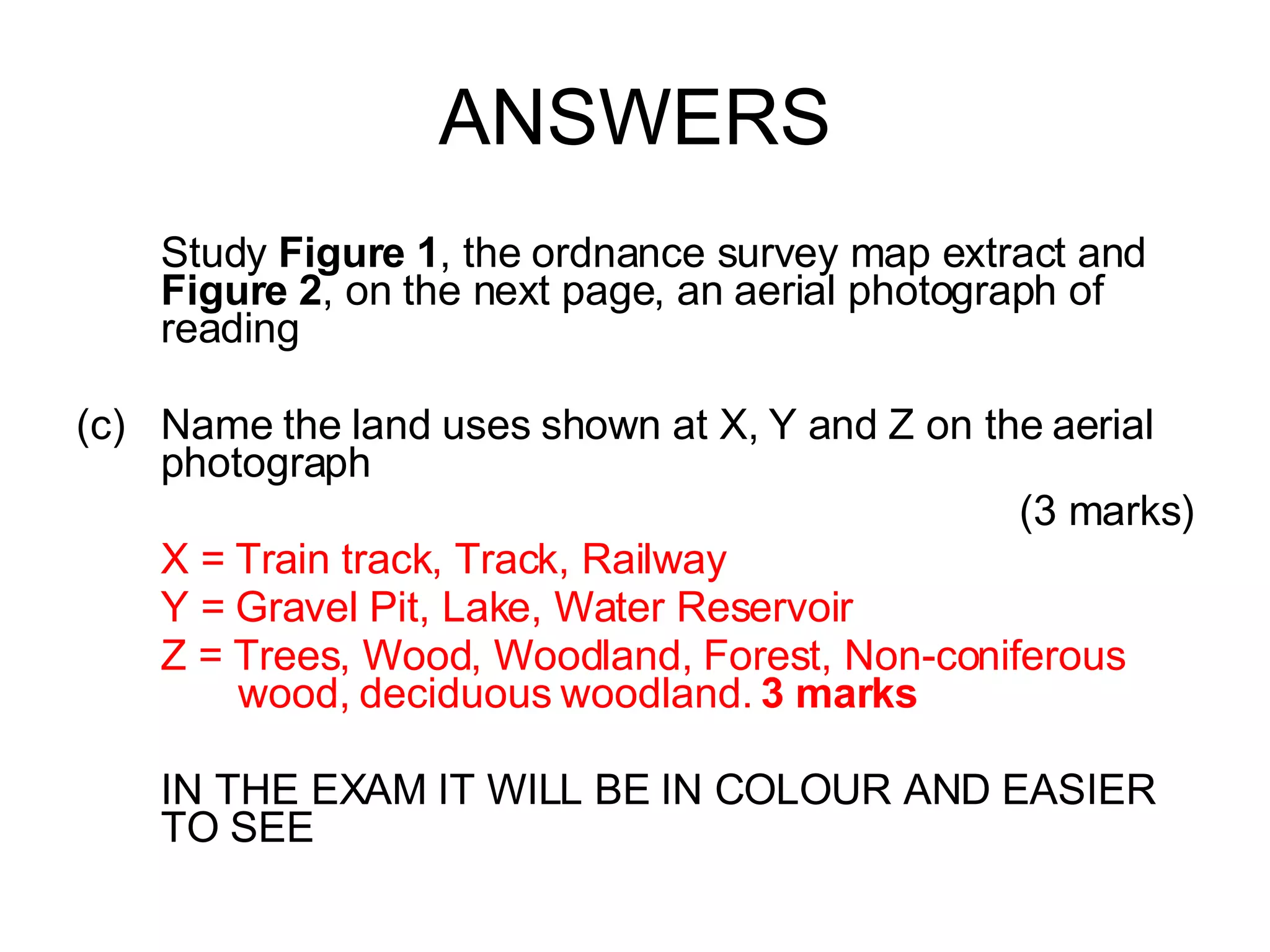
ANSWERS Study  Figure 1 , the ordnance survey map extract and  Figure 2 , on the next page, an aerial photograph of reading Name the land uses shown at X, Y and Z on the aerial photograph (3 marks) X = Train track, Track, Railway  Y = Gravel Pit, Lake, Water Reservoir Z = Trees, Wood, Woodland, Forest, Non-coniferous    wood, deciduous woodland.  3 marks IN THE EXAM IT WILL BE IN COLOUR AND EASIER TO SEE
Question 2B (b) Describe  and  explain  the shape of the built –up area of Reading.  Use  evidence  from the  photograph  and the  Ordnance Survey map  in your answer.
A CHECK LIST TO HELP YOU TO  DESCRIBE FEATURES ON A MAP
Includes settlement, vegetation and communications but also industry, recreational areas and agriculture Site  – height, slope, landform, water supply, resources Situation  – relate site to relief and drainage and other settlements Route focus, bridging point Shape  – linear or star shaped, dispersed, nucleated Land Use Settlement Types, Direction Landforms followed or avoided Influence of settlement Woodland  – location, amount, plantations or natural woodland Rough Pasture  – location, amount Communications Vegetation Number of rivers Direction of flow Width Straight or winding Tributaries Human influence – straightening  Lakes, marshes or floodplains Contour patterns Landforms Steepness of slopes Heights (general height, maximum, lowers) Valleys  – number, shape, gradient, Drainage Relief
ANSWERS Level 1: (1 – 2 marks) only descriptive e.g. follows roads, most to south of  Railway. Level 2: (3 – 4 marks) needs both description and explanation for top Level 2, although may lack detail from map/photo, e.g. star shaped along roads for good communications, avoids flood plains of rivers, most south of the railway line and River Thames where more flat land. May only be description  or  explanation for  3 marks . Level 3: (5 – 6 marks) detail from use of map and photo, e.g.  star shaped  along main lines of communication, e.g.  Purley on Thames (6575)  area close to both main road and railway. Town largely built-up between railway to north and the M4 to the  south  except for Caversham area over the bridge to the north. Reading avoids the  floodplains and lakes  in the  low lying valleys  of the rivers, e.g. the Thames, Holy Brook – these areas would be prone to  flooding  and make them unsuitable for settlement. Can refer to map and/or photograph. Shape words accepted = cross-shaped, clover leaf, butterfly. No credit for site or morphology features.  6 marks
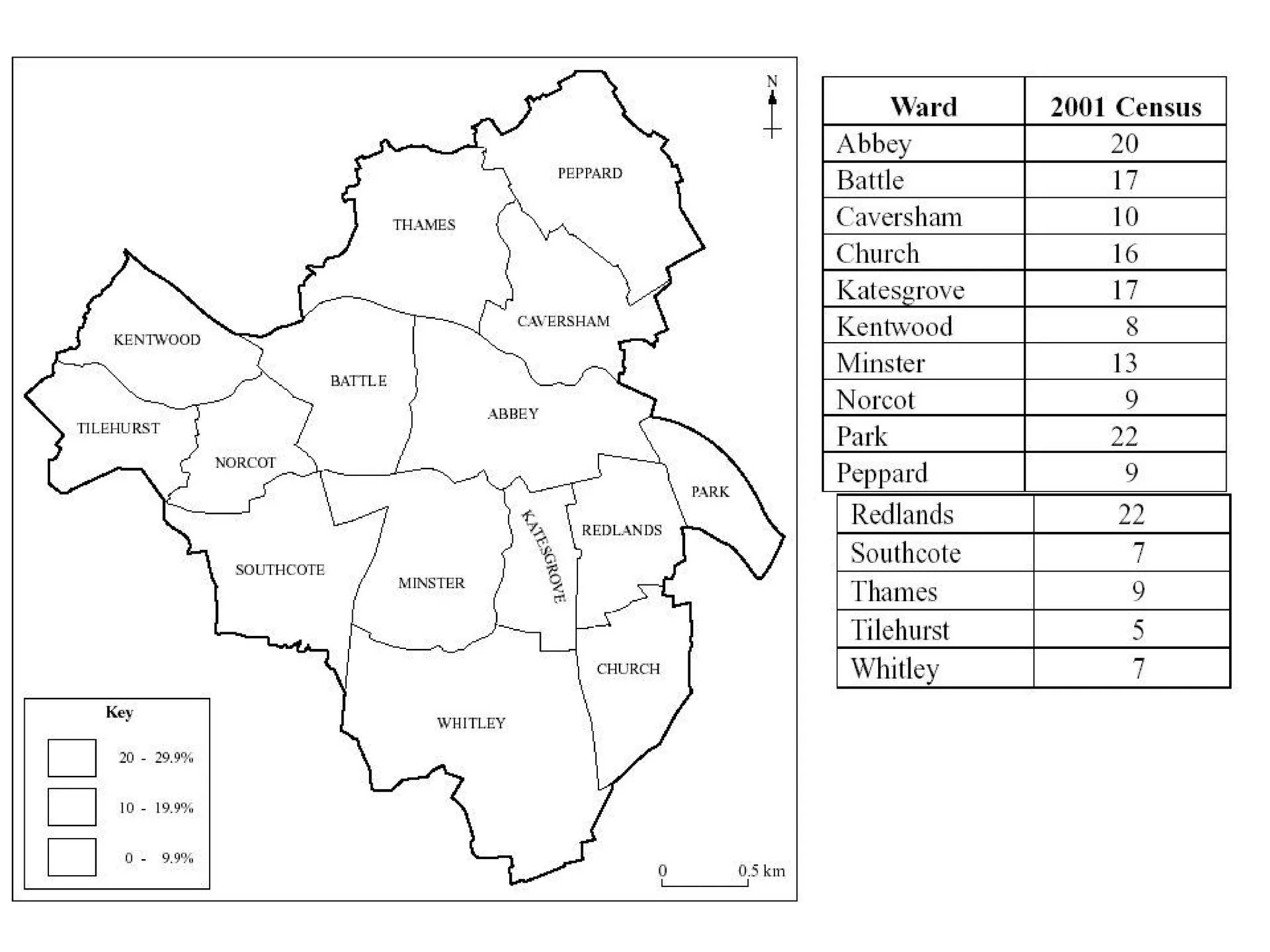
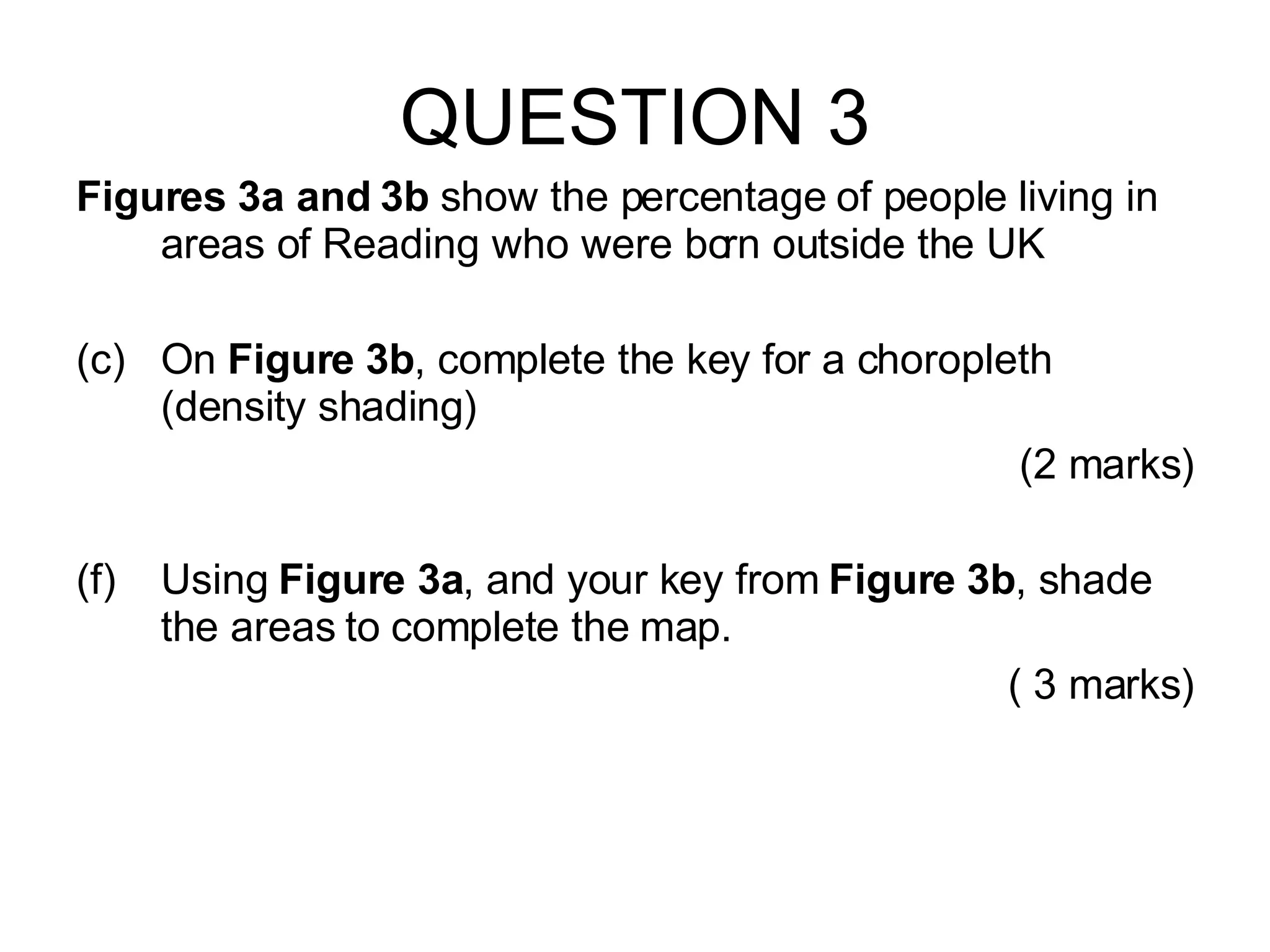
QUESTION 3 Figures 3a and 3b  show the percentage of people living in areas of Reading who were born outside the UK On  Figure 3b , complete the  key  for a  choropleth  (density shading) (2 marks) Using  Figure 3a , and your  key  from  Figure 3b ,  shade the areas to complete the map. ( 3 marks)
TYPES OF MAPS YOU WILL HAVE TO KNOW HOW TO READ
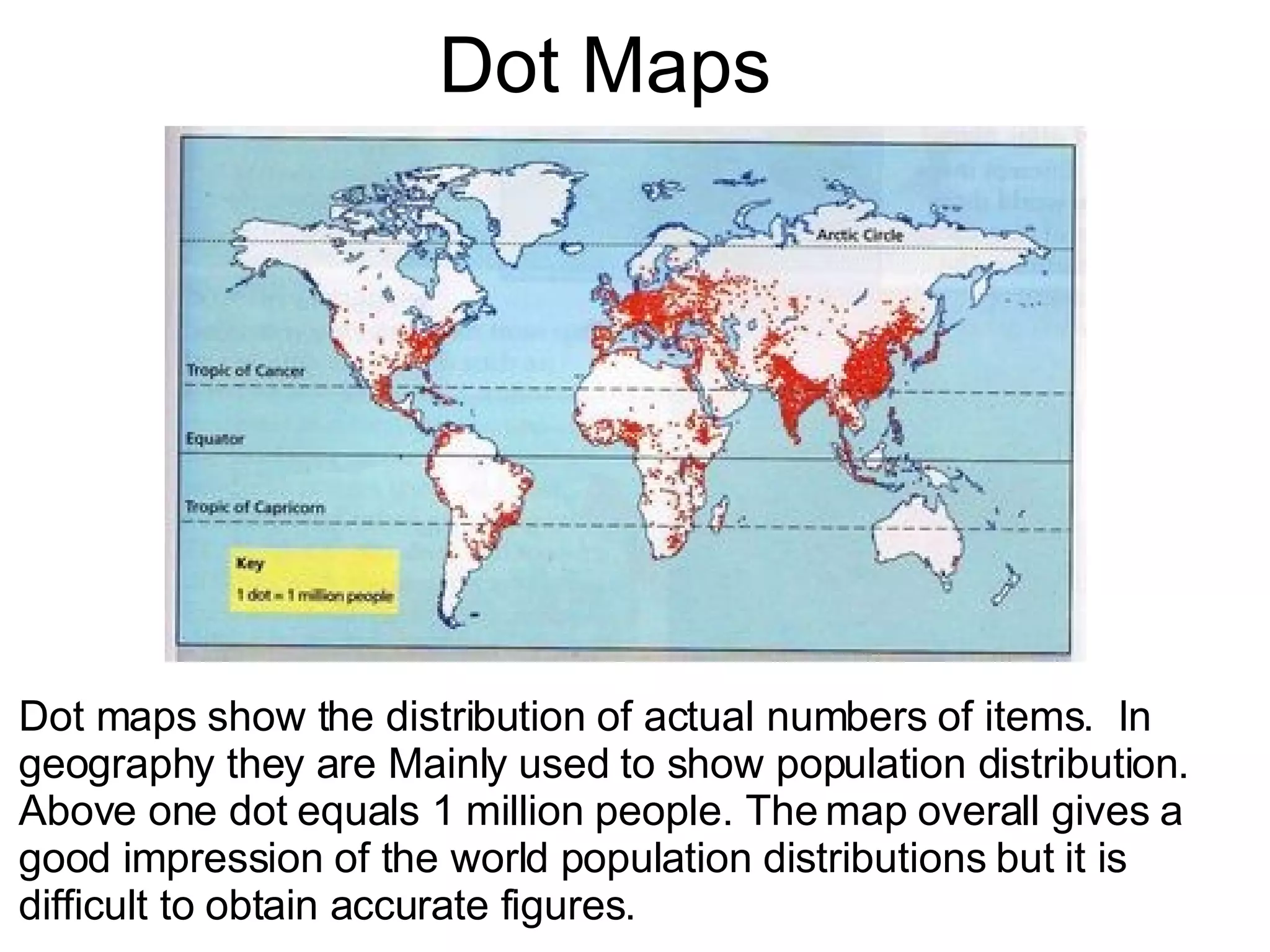
Dot Maps Dot maps show the distribution of actual numbers of items.  In geography they are Mainly used to show population distribution.  Above one dot equals 1 million people. The map overall gives a good impression of the world population distributions but it is  difficult to obtain accurate figures.
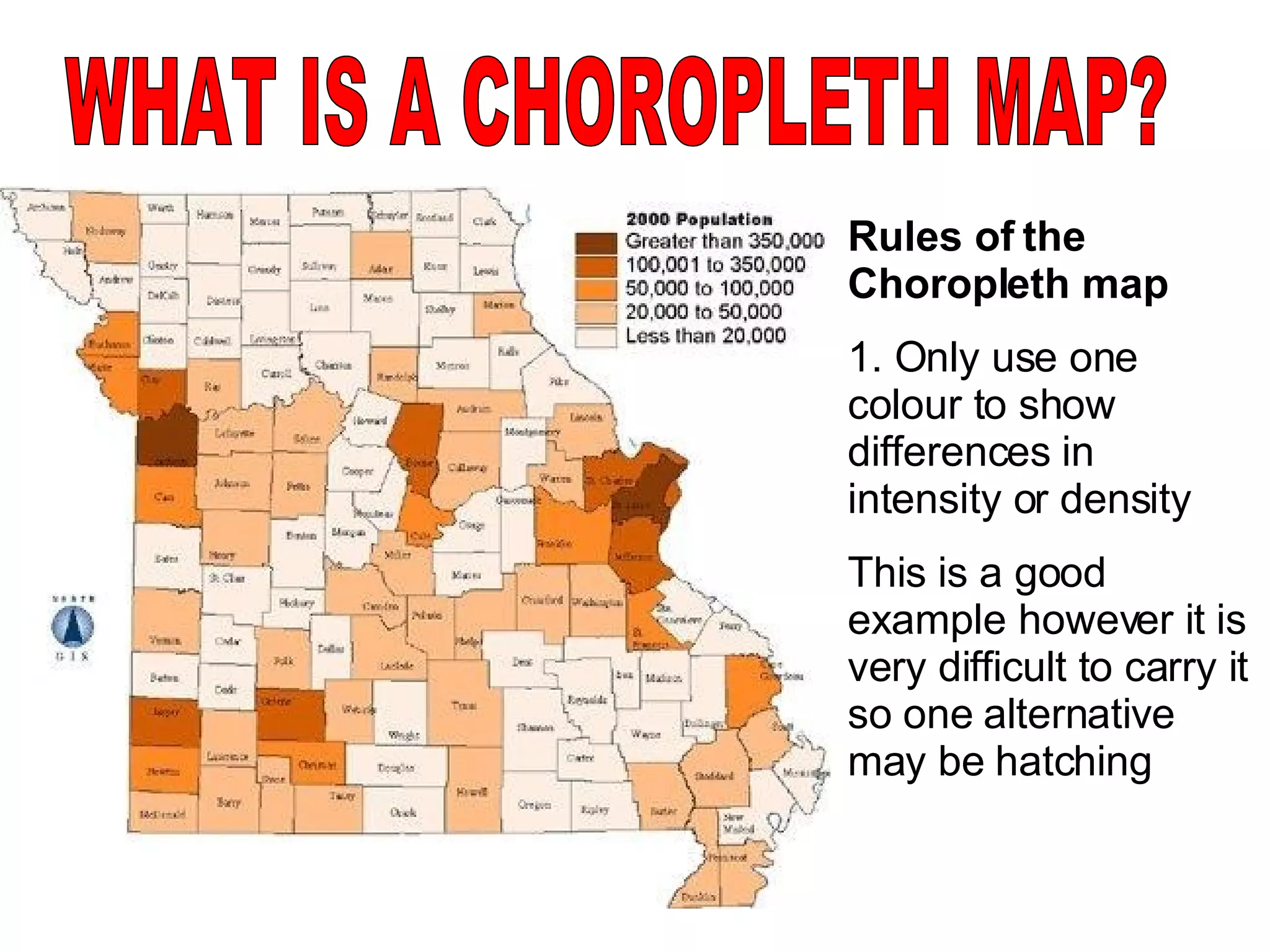
Rules of the Choropleth map 1. Only use one colour to show differences in intensity or density This is a good example however it is very difficult to carry it so one alternative may be hatching WHAT IS A CHOROPLETH MAP?
 
QUESTION 3 Figures 3a and 3b  show the percentage of people living in areas of Reading who were born outside the UK On  Figure 3b , complete the key for a choropleth (density shading) (2 marks) Using  Figure 3a , and your key from  Figure 3b , shade the areas to complete the map. ( 3 marks)
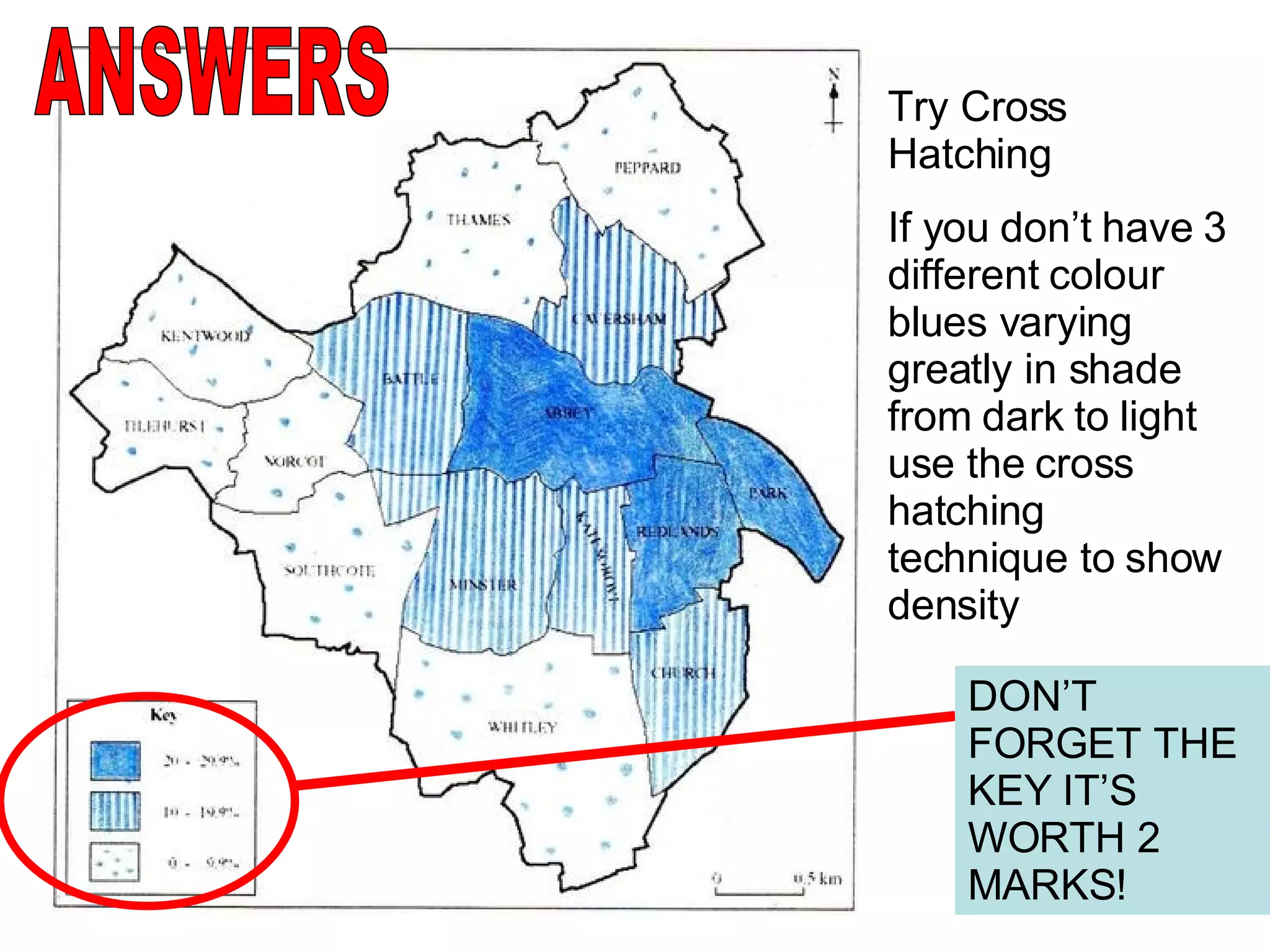
Try Cross Hatching If you don’t have 3 different colour blues varying greatly in shade from dark to light use the cross hatching technique to show density ANSWERS DON’T FORGET THE KEY IT’S WORTH 2 MARKS!
QUESTION 3C Using  Figure 3b , describe the pattern of people born outside the UK in Reading. (4 marks) WHAT SHOULD YOU THINK ABOUT WHEN DESCRIBING PATTERNS? GROUP PLACES TOGETHER AND GIVE LOCATIONAL EXAMPLES EITHER USING COMPASS DIRECTIONS OR USING LANGUAGE SUCH AS IN THE CBD, OUTSKIRTS OR EDGE.  USE THE EVIDENCE (FIGURES) FROM THE MAPS EG. THE AREAS WITH THE HIGH PERCENTAGES ARE… IF IT ASKS FOR A DESCRIPTION THEN ONLY GIVE A DESCRIPTION DON’T WASTE TIME ON AN EXPLANATION
ANSWERS Level 1: (1 – 2 marks) Basic – may only cover individual wards e.g. the % are lowest in Whitley or Tilehurst, highest in Park or Redlands. Level 2: (3 – 4 marks) Clear – reference to  pattern by grouping of wards  and or clear locational information, e.g. wards with the lowest % - e.g. Whitley and Tilehurst are on the  outskirts / to the far west and south . Wards with the high % include Park and Redlands on the edge of Reading/ in the east, etc. Accept description of pattern produced by candidate.  4 marks
EQUIPMENT TO TAKE INTO THE EXAM SHARP PENCILS RUBBER RULER PROTRACTOR COLOURED PENCILS PENCIL SHARPENER CAUCULATOR
PLENARY
13 QUESTIONS What is a Choropleth map? What words can you use to make you compare? What does 1:50 000 actually mean? What two ways can you measure distance on a map? What does relief mean? How is relief shown on a map (3 ways) What is Land Use? Name the points starting at North and working clockwise on a 16 point compass. What 3 ways can settlement be described on a map? How are communications shown on a map? What is hatching? What can you use to describe patterns from maps? What does a dot map show?
TAKE CARE WHEN USING MAPS
COMPLETE 2007 PAST EXAM QUESTION READY FOR PART 2 TOMORROW. HOMEWORK

Year 11 Revision Of Skills

  • 1.
    MAP SKILLS REVISION PART 1
  • 2.
  • 3.
    TODAY WE WILLFOCUS ON SKILLS REVISION
  • 4.
    TO BE ABLETO INTEPRET OS MAPS AT 1:25 000 & 1:50 000 TO BE ABLE TO UNDERSTAND 3 & 4 FIGURE GRID REFERENCES TO BE ABLE TO CALCULATE DISTANCES FROM SCALE TO BE ABLE TO DESCRIBE ALL THE DIFFERENT TYPES OF LAND USE ON A MAP TO BE ABLE TO UNDERSTAND PATTERNS AND DISTRIBUTIONS ON MAPS (CHOROPLETH, DOT MAPS) TO BE ABLE TO INTERPRET PHOTOGRAPHS & SKETCHES (INCLUDING SATELLITE & AERIAL PHOTOGRAPHS) OBJECTIVES
  • 5.
    TICK OFF WHENYOU HAVE REVISED AND KNOW EACH SECTION ON YOUR CHECK LIST
  • 6.
    Don’t forget youmust answer all questions in section A. There is normally 3 parts to section A IT WILL BE A LOCATION IN THE UK SECTION A Section A is worth 25 marks and tests your OS map skills and other skills. There are also some other skills marks in the other questions on both exam papers.
  • 7.
    QUESTION 1 Study Figure 1 , the Ordnance Survey map extract for Reading in southern England. MAKE SURE THIS IS IN FRONT OF YOU NOW
  • 8.
    Points to rememberabout OS maps You will always have a either a 1:25 000 or a 1:50 000 scale map. The one in front of you is 1:50 000 scale 1:25 000 means that 1cm on the map is equal to 25 000 cm in real life. This means 1cm is equal to 250m on the ground or 4cm is equal to 1km 1:50 000 means 1cm is equal to 500m on the ground or 2cm is equal to 1km The top of an OS map is always North You will always be given an OS key for that map it includes the scale as a bar to help you work out distances
  • 9.
    USING A MAPKEY Ordnance survey maps use a series of symbols to indicate features of the landscape. In the examination you will be given a key to the symbols. This is exactly the same as the one you now have in front of you. Study this lots at home. You are not expected to know it off be heart but a good general understanding of some of the key features will help you save time in the exam. Take care with the following symbols that are often confused. Look at your symbol key now
  • 10.
    AQUEDUCTS & BRIDGESPOST OFFICE & PARKING ROADS BEACONS & LIGHTHOUSES SYMBOLS OFTEN CONFUSED Lighthouse Beacon Parking Post Office
  • 11.
    WINDMILL & WINDPUMPSYMBOLS OFTEN CONFUSED CONIFEROUS WOOD & NON CONIFEROUS Use the following web site to help you http://www.geograph.org.uk/article/Ordnance-Survey-Map-Symbols This presentation and links to other sites can be found at www.gorgeousgeography.co.uk (look under GCSE Revision)
  • 12.
    GRID REFERENCES PUTYOUR HAND UP IF YOU KNOW THEM
  • 13.
  • 14.
  • 15.
  • 16.
  • 17.
    NOW YOUR TURNQ1 Study Figure 1 , the Ordnance Survey map extract for Reading in southern England. Give the Six figure grid reference for the principle railway station in Reading. (2 marks) 714/715 = 1 737/738 = 1 2 marks You are allowed a tolerance level in this case because it covers two points
  • 18.
    WHAT DO YOUNEED TO KNOW Study Figure 1 , the Ordnance Survey map extract for Reading in southern England. (b) Measure the distance along the M4 between the motorway service area in grid square 6769 and the western edge of the map. (1 marks)
  • 19.
    COMPASS DIRECTIONS Theminimum you should know is the eight point compass although it would be better to know the 16 point compass shown here.
  • 20.
    MEASURING DISTANCE Youcan do this using two different methods. Use your ruler to pivot and add up the centimetres as you travel along the line then calculate using the scale line. Use a piece of paper to make marks on it as you twist it. REMEMBER WHICH EVER WAY YOU USE YOU MUST USE THE SCALE TO WORK OUT THE DISTANCE IN KILOMETRES (FOR A 1:50,000 MEASURE IN CM AND THEN DIVIDE BY 2 AS 1 KM IS EQUAL TO 2CM)
  • 21.
    On the paper'sedge Another method of measuring distance is to take a sheet of paper and place the corner of a straight edge on your starting point. Now pivot the paper until the edge follows the route that you want to take. Step 1 Every time the route disappears or moves away from the straight edge of your paper, make a small mark on the edge and pivot the paper so the edge is back on course.
  • 22.
    Step 2 Repeatthis process until you reach your destination
  • 23.
    Step 3 Youshould be left with a series of marks along the edge of your paper. You can now place the sheet against the scale bar on your map. The last mark you made will tell you the real distance you need to travel
  • 24.
    QUESTION 1b Study Figure 1 , the Ordnance Survey map extract for Reading in southern England. (b) Measure the distance along the M4 between the motorway service area in grid square 6769 and the western edge of the map. (1 marks) 6 kilometres 1 mark
  • 25.
    QUESTION 1C Study Figure 1 , the Ordnance Survey map extract for Reading in southern England. (c) Compare the relief and land uses in grid squares 7877 and 6677. (2 marks)
  • 26.
    Describing Human& Physical Features from Maps
  • 27.
    RELIEF My goodness,I am quite RELIEVED I got to the top Relief means the height and shape of the land. I like to remember it by thinking about how relieved I am when I get to the top. – This associates it with land height and shape. Take care with the spelling though.
  • 28.
    DRAINAGE This isthe surface water features such as:- Rivers – drawn as blue line but not to be confused with motorways!!! Lakes – Looks like a large blue puddle Marsh-
  • 29.
    VEGETATION This includesthe obvious green wooded areas but look out for which means rough grassland. On the OS 1:25 000 map vegetation is shown in more detail – check the symbols key carefully Rough Grassland Coniferous Trees Non Coniferous Trees
  • 30.
  • 31.
    Rough Grassland ConiferousWoodland Non Coniferous
  • 32.
    LAND USE Whenasked what the land use is you must explain what the land is USED for. In this case depending on which grid square you can see a variety of land uses e.g. a golf course, residential areas, lakes used for recreation, Roads, Allotments and many more.
  • 33.
    SETTLEMENT This includes:-Its location – Where is it? Its shape – (linear, star shaped, nucleated) Its pattern – (nucleated, dispersed or evenly spread)
  • 34.
    PATTERNS OF COMMUNICATIONThis includes:- Canals Railways Roads don’t forget to know the difference between A roads, Motorways, B Roads, Rough Tracks. Look at your OS key carefully
  • 35.
  • 36.
    Four FigureGrid Reference 7877
  • 37.
    Four FigureGrid Reference 6677
  • 38.
    7877 6677 RELIEFRELIEF LAND USES LAND USES COMPARE
  • 39.
    Four FigureGrid Reference 7877 Four Figure Grid Reference 6677
  • 40.
    COMPARE The word COMPARE in an exam means you must do the following Don’t list the features of each grid square You must compare so use words like the ones below HIGH ER STEEP ER DENS ER SPARS ER Use connectives such as WHERE AS – as this will force you to compare 3. Use figures to COMPARE e.g. site one is 3m higher than site 2 for example.
  • 41.
    7877 6677 RELIEFRELIEF LAND USES LAND USES COMPARE
  • 42.
    ANSWER LEVEL 1:May be listed, and separate accounts, and imbalanced, i.e. land use or relief only, e.g. in 7877 school, telephone, railway, houses main road, low land, two contours 40 and 50 metres, etc. In 6677 river, transmission line, road, woodland, sloping land, 40 – 90 metres. May be only 2 simple points . IF YOU WANT TO GET MORE THAN 2 POINTS YOU MUST COMPARE LEVEL 2: (3 – 4 marks) Clear contrasts made; reference to land use and relief, e.g. 6677 has much steeper land, heights vary from below 40 metres to over 90 metres, max height of 110 metres, whereas in 7877 the relief is lower, from below 40 metres to over 50 metres. In 6677 there is only a minor road whereas in 7877 there is a main road. Max 3 if only Relief described. 4 marks
  • 43.
    QUESTION 2 Study Figure 1 , the ordnance survey map extract and Figure 2 , on the next page, an aerial photograph of reading Name the land uses shown at X, Y and Z on the aerial photograph (3 marks)
  • 44.
    ANALYSING AERIAL PHOTOGRAPHSAs well as Ordnance Survey maps you will also be given a photograph of part of the area shown on an OS map. The first thing to do is make sure you orientate your photograph correctly so you know exactly which part of the map is shown. Lets do this now for Reading What are the key points to look at?
  • 45.
    Y X ZLook for key features on the map to find out where it is on the OS map then use the OS map to identify the features. For this example the stadium is easy to see as is the roads and shape of the fields
  • 46.
    ANSWERS Study Figure 1 , the ordnance survey map extract and Figure 2 , on the next page, an aerial photograph of reading Name the land uses shown at X, Y and Z on the aerial photograph (3 marks) X = Train track, Track, Railway Y = Gravel Pit, Lake, Water Reservoir Z = Trees, Wood, Woodland, Forest, Non-coniferous wood, deciduous woodland. 3 marks IN THE EXAM IT WILL BE IN COLOUR AND EASIER TO SEE
  • 47.
    Question 2B (b)Describe and explain the shape of the built –up area of Reading. Use evidence from the photograph and the Ordnance Survey map in your answer.
  • 48.
    A CHECK LISTTO HELP YOU TO DESCRIBE FEATURES ON A MAP
  • 49.
    Includes settlement, vegetationand communications but also industry, recreational areas and agriculture Site – height, slope, landform, water supply, resources Situation – relate site to relief and drainage and other settlements Route focus, bridging point Shape – linear or star shaped, dispersed, nucleated Land Use Settlement Types, Direction Landforms followed or avoided Influence of settlement Woodland – location, amount, plantations or natural woodland Rough Pasture – location, amount Communications Vegetation Number of rivers Direction of flow Width Straight or winding Tributaries Human influence – straightening Lakes, marshes or floodplains Contour patterns Landforms Steepness of slopes Heights (general height, maximum, lowers) Valleys – number, shape, gradient, Drainage Relief
  • 50.
    ANSWERS Level 1:(1 – 2 marks) only descriptive e.g. follows roads, most to south of Railway. Level 2: (3 – 4 marks) needs both description and explanation for top Level 2, although may lack detail from map/photo, e.g. star shaped along roads for good communications, avoids flood plains of rivers, most south of the railway line and River Thames where more flat land. May only be description or explanation for 3 marks . Level 3: (5 – 6 marks) detail from use of map and photo, e.g. star shaped along main lines of communication, e.g. Purley on Thames (6575) area close to both main road and railway. Town largely built-up between railway to north and the M4 to the south except for Caversham area over the bridge to the north. Reading avoids the floodplains and lakes in the low lying valleys of the rivers, e.g. the Thames, Holy Brook – these areas would be prone to flooding and make them unsuitable for settlement. Can refer to map and/or photograph. Shape words accepted = cross-shaped, clover leaf, butterfly. No credit for site or morphology features. 6 marks
  • 51.
    QUESTION 3 Figures3a and 3b show the percentage of people living in areas of Reading who were born outside the UK On Figure 3b , complete the key for a choropleth (density shading) (2 marks) Using Figure 3a , and your key from Figure 3b , shade the areas to complete the map. ( 3 marks)
  • 52.
    TYPES OF MAPSYOU WILL HAVE TO KNOW HOW TO READ
  • 53.
    Dot Maps Dotmaps show the distribution of actual numbers of items. In geography they are Mainly used to show population distribution. Above one dot equals 1 million people. The map overall gives a good impression of the world population distributions but it is difficult to obtain accurate figures.
  • 54.
    Rules of theChoropleth map 1. Only use one colour to show differences in intensity or density This is a good example however it is very difficult to carry it so one alternative may be hatching WHAT IS A CHOROPLETH MAP?
  • 55.
  • 56.
    QUESTION 3 Figures3a and 3b show the percentage of people living in areas of Reading who were born outside the UK On Figure 3b , complete the key for a choropleth (density shading) (2 marks) Using Figure 3a , and your key from Figure 3b , shade the areas to complete the map. ( 3 marks)
  • 57.
    Try Cross HatchingIf you don’t have 3 different colour blues varying greatly in shade from dark to light use the cross hatching technique to show density ANSWERS DON’T FORGET THE KEY IT’S WORTH 2 MARKS!
  • 58.
    QUESTION 3C Using Figure 3b , describe the pattern of people born outside the UK in Reading. (4 marks) WHAT SHOULD YOU THINK ABOUT WHEN DESCRIBING PATTERNS? GROUP PLACES TOGETHER AND GIVE LOCATIONAL EXAMPLES EITHER USING COMPASS DIRECTIONS OR USING LANGUAGE SUCH AS IN THE CBD, OUTSKIRTS OR EDGE. USE THE EVIDENCE (FIGURES) FROM THE MAPS EG. THE AREAS WITH THE HIGH PERCENTAGES ARE… IF IT ASKS FOR A DESCRIPTION THEN ONLY GIVE A DESCRIPTION DON’T WASTE TIME ON AN EXPLANATION
  • 59.
    ANSWERS Level 1:(1 – 2 marks) Basic – may only cover individual wards e.g. the % are lowest in Whitley or Tilehurst, highest in Park or Redlands. Level 2: (3 – 4 marks) Clear – reference to pattern by grouping of wards and or clear locational information, e.g. wards with the lowest % - e.g. Whitley and Tilehurst are on the outskirts / to the far west and south . Wards with the high % include Park and Redlands on the edge of Reading/ in the east, etc. Accept description of pattern produced by candidate. 4 marks
  • 60.
    EQUIPMENT TO TAKEINTO THE EXAM SHARP PENCILS RUBBER RULER PROTRACTOR COLOURED PENCILS PENCIL SHARPENER CAUCULATOR
  • 61.
  • 62.
    13 QUESTIONS Whatis a Choropleth map? What words can you use to make you compare? What does 1:50 000 actually mean? What two ways can you measure distance on a map? What does relief mean? How is relief shown on a map (3 ways) What is Land Use? Name the points starting at North and working clockwise on a 16 point compass. What 3 ways can settlement be described on a map? How are communications shown on a map? What is hatching? What can you use to describe patterns from maps? What does a dot map show?
  • 63.
    TAKE CARE WHENUSING MAPS
  • 64.
    COMPLETE 2007 PASTEXAM QUESTION READY FOR PART 2 TOMORROW. HOMEWORK