sample


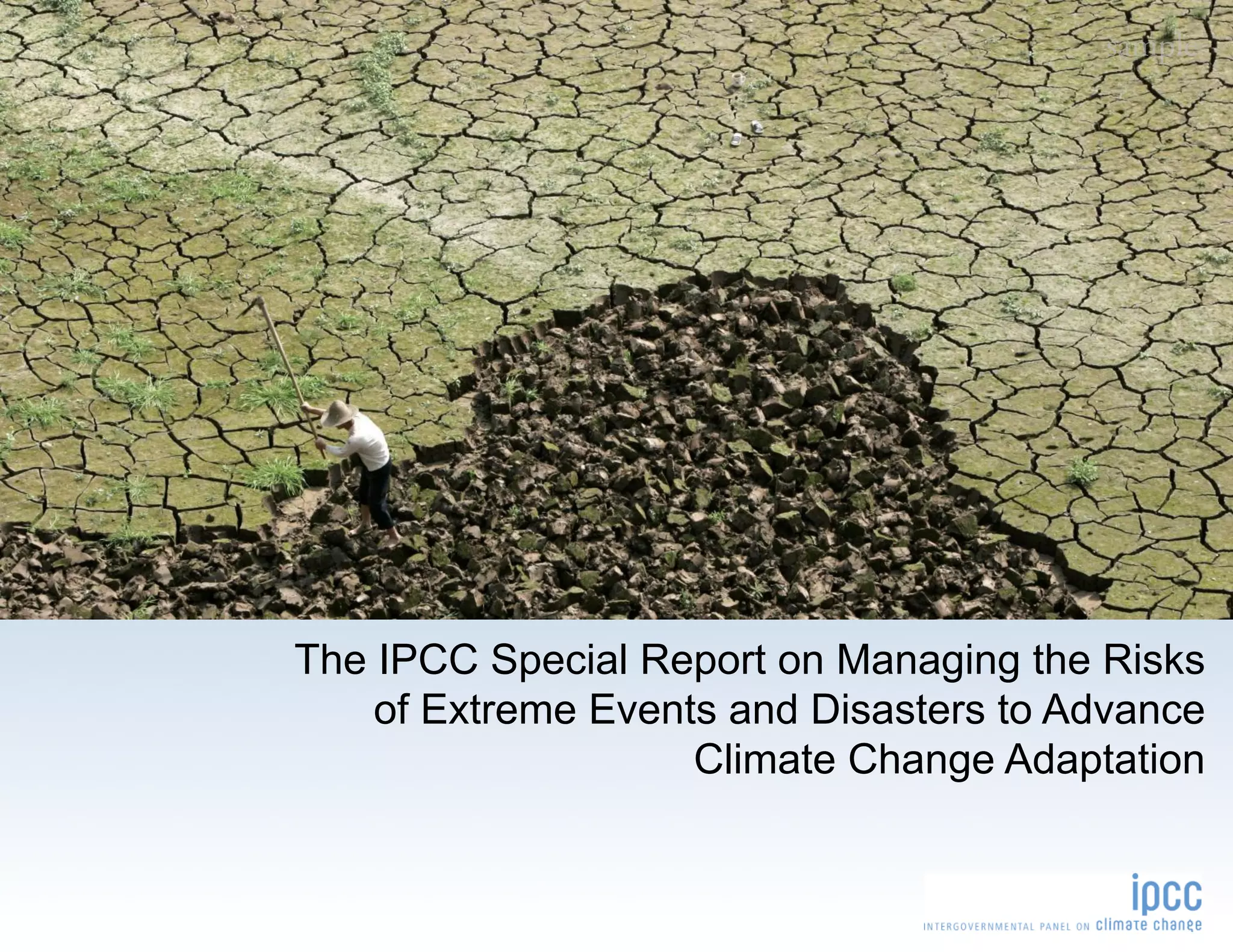
The IPCC Special Report on Managing the Risks
    of Extreme Events and Disasters to Advance
                    Climate Change Adaptation
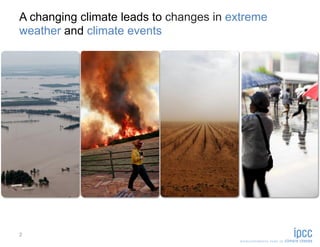
A changing climate leads to changes in extreme
weather and climate events


2
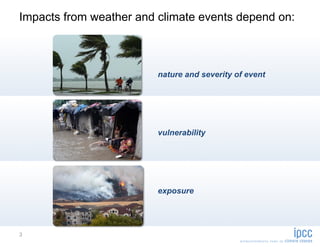
Impacts from weather and climate events depend on:


                         nature and severity of event


                         vulnerability


                         exposure


3
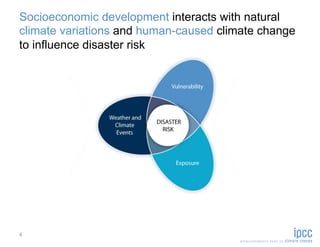
Socioeconomic development interacts with natural
climate variations and human-caused climate change
to influence disaster risk


4
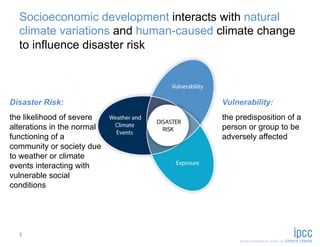
Socioeconomic development interacts with natural
  climate variations and human-caused climate change
  to influence disaster risk


Disaster Risk:                        Vulnerability:
the likelihood of severe              the predisposition of a
alterations in the normal             person or group to be
functioning of a                      adversely affected
community or society due
to weather or climate
events interacting with
vulnerable social
conditions


  5
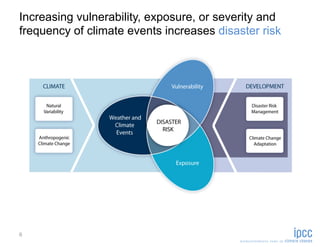
Increasing vulnerability, exposure, or severity and
frequency of climate events increases disaster risk


6
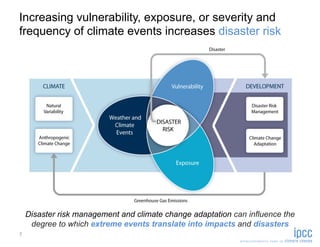
Increasing vulnerability, exposure, or severity and
frequency of climate events increases disaster risk


    Disaster risk management and climate change adaptation can influence the
     degree to which extreme events translate into impacts and disasters
7
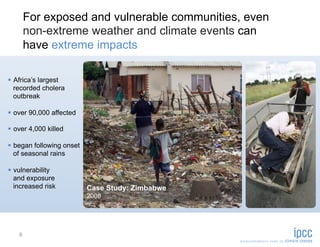
For exposed and vulnerable communities, even
        non-extreme weather and climate events can
        have extreme impacts

  Africa’s largest
   recorded cholera
   outbreak

  over 90,000 affected

  over 4,000 killed         Looking for a good example here.

  began following onset
   of seasonal rains

  vulnerability
   and exposure
   increased risk          Case Study: Zimbabwe
                           2008


    8
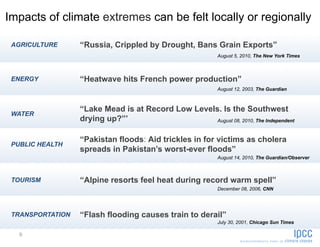
Impacts of climate extremes can be felt locally or regionally

 AGRICULTURE      “Russia, Crippled by Drought, Bans Grain Exports”
                                                            August 5, 2010, The New York Times


 ENERGY           “Heatwave hits French power production”
                                                            August 12, 2003, The Guardian


                  “Lake Mead is at Record Low Levels. Is the Southwest
 WATER
                  drying up?”’                      August 08, 2010, The Independent


                  “Pakistan floods: Aid trickles in for victims as cholera
 PUBLIC HEALTH
                  spreads in Pakistan’s worst-ever floods”
                                                            August 14, 2010, The Guardian/Observer


 TOURISM          “Alpine resorts feel heat during record warm spell”
                                                            December 08, 2006, CNN


 TRANSPORTATION   “Flash flooding causes train to derail”
                                                            July 30, 2001, Chicago Sun Times

   9
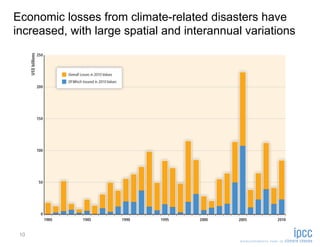
Economic losses from climate-related disasters have
increased, with large spatial and interannual variations


 10
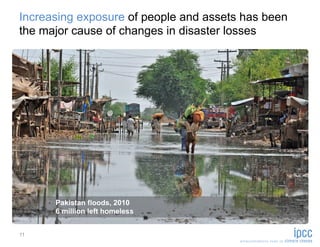
Increasing exposure of people and assets has been
the major cause of changes in disaster losses


      Pakistan floods, 2010
      6 million left homeless


11
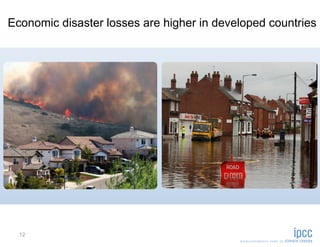
Economic disaster losses are higher in developed countries


  12
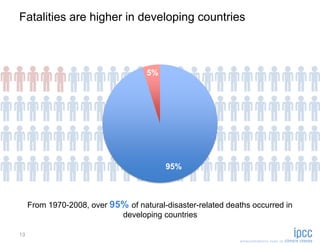
Fatalities are higher in developing countries


     From 1970-2008, over 95% of natural-disaster-related deaths occurred in
                            developing countries

13
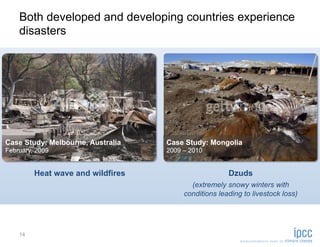
Both developed and developing countries experience
    disasters


Case Study: Melbourne, Australia   Case Study: Mongolia
February, 2009                     2009 – 2010


         Heat wave and wildfires                      Dzuds
                                          (extremely snowy winters with
                                        conditions leading to livestock loss)


    14
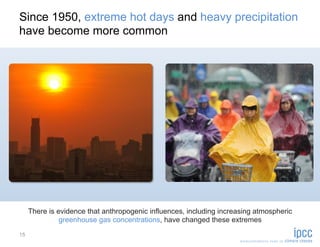
Since 1950, extreme hot days and heavy precipitation
have become more common


     There is evidence that anthropogenic influences, including increasing atmospheric
               greenhouse gas concentrations, have changed these extremes
15
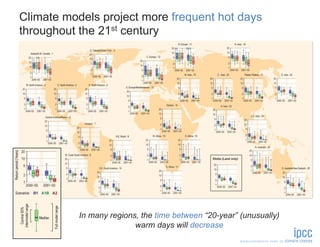
Climate models project more frequent hot days
throughout the 21st century


           In many regions, the time between “20-year” (unusually)
                          warm days will decrease
16
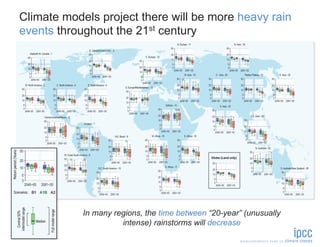
Climate models project there will be more heavy rain
events throughout the 21st century


            In many regions, the time between “20-year” (unusually
                      intense) rainstorms will decrease
17
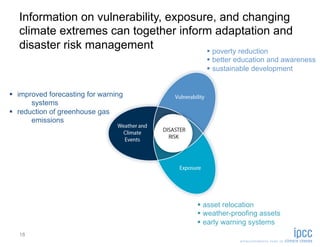
Information on vulnerability, exposure, and changing
   climate extremes can together inform adaptation and
   disaster risk management               poverty reduction
                                            better education and awareness
                                            sustainable development


  improved forecasting for warning
       systems
  reduction of greenhouse gas
       emissions


                                          asset relocation
                                          weather-proofing assets
                                          early warning systems
   18
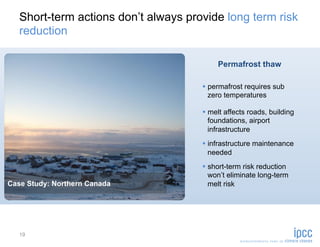
Short-term actions don’t always provide long term risk
   reduction

                                           Permafrost thaw

                                        permafrost requires sub
                                         zero temperatures

                                        melt affects roads, building
                                         foundations, airport
                                         infrastructure
                                        infrastructure maintenance
                                         needed
                                        short-term risk reduction
                                         won’t eliminate long-term
Case Study: Northern Canada              melt risk


   19
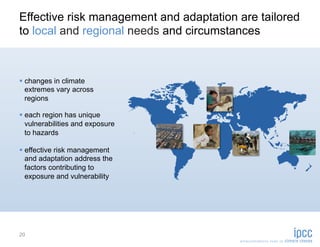
Effective risk management and adaptation are tailored
to local and regional needs and circumstances


  changes in climate
   extremes vary across
   regions

  each region has unique
   vulnerabilities and exposure
   to hazards

  effective risk management
   and adaptation address the
   factors contributing to
   exposure and vulnerability


20
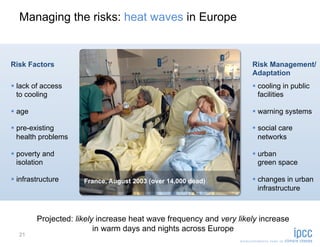
Managing the risks: heat waves in Europe


Risk Factors                                                         Risk Management/
                                                                     Adaptation
  lack of access                                                      cooling in public
   to cooling                                                           facilities

  age                                                                 warning systems

  pre-existing                                                        social care
   health problems                                                      networks

  poverty and                                                         urban
   isolation                                                            green space

  infrastructure     France, August 2003 (over 14,000 dead)           changes in urban
                                                                        infrastructure


         Projected: likely increase heat wave frequency and very likely increase
                          in warm days and nights across Europe
  21
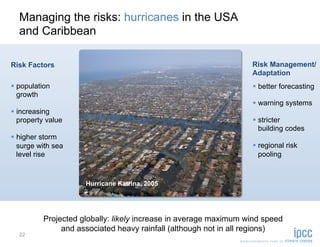
Managing the risks: hurricanes in the USA
  and Caribbean

Risk Factors                                                      Risk Management/
                                                                  Adaptation
  population                                                       better forecasting
   growth
                                                                    warning systems
  increasing
   property value                                                   stricter
                                                                     building codes
  higher storm
   surge with sea                                                   regional risk
   level rise                                                        pooling


                     Hurricane Katrina, 2005


          Projected globally: likely increase in average maximum wind speed
               and associated heavy rainfall (although not in all regions)
  22
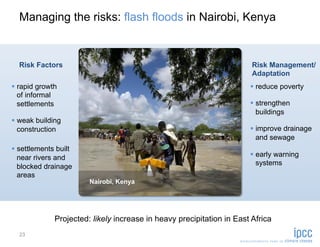
Managing the risks: flash floods in Nairobi, Kenya


  Risk Factors                                                          Risk Management/
                                                                        Adaptation
  rapid growth                                                          reduce poverty
   of informal
   settlements                                                           strengthen
                                                                          buildings
  weak building
   construction                                                          improve drainage
                                                                          and sewage
  settlements built
   near rivers and                                                       early warning
                                                                          systems
   blocked drainage
   areas
                        Nairobi, Kenya


              Projected: likely increase in heavy precipitation in East Africa
  23
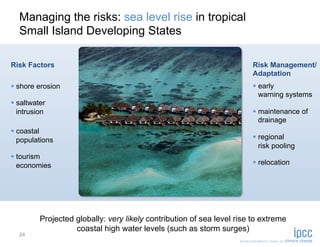
Managing the risks: sea level rise in tropical
  Small Island Developing States

Risk Factors                                                             Risk Management/
                                                                         Adaptation
  shore erosion                                                           early
                                                                            warning systems
  saltwater
   intrusion                                                               maintenance of
                                                                            drainage
  coastal
   populations                                                             regional
                                                                            risk pooling
  tourism
   economies                                                               relocation


          Projected globally: very likely contribution of sea level rise to extreme
                    coastal high water levels (such as storm surges)
  24
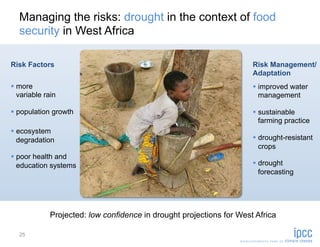
Managing the risks: drought in the context of food
   security in West Africa

Risk Factors                                                          Risk Management/
                                                                      Adaptation
  more                                                                 improved water
   variable rain                                                         management

  population growth                                                    sustainable
                                                                         farming practice
  ecosystem
   degradation                                                          drought-resistant
                                                                         crops
  poor health and
   education systems                                                    drought
                                                                         forecasting


             Projected: low confidence in drought projections for West Africa

   25
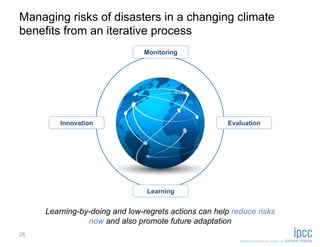
Managing risks of disasters in a changing climate
benefits from an iterative process
                                Monitoring


         Innovation                                    Evaluation


                                Learning


     Learning-by-doing and low-regrets actions can help reduce risks
                now and also promote future adaptation
26
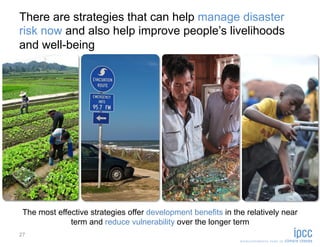
There are strategies that can help manage disaster
risk now and also help improve people’s livelihoods
and well-being


 The most effective strategies offer development benefits in the relatively near
              term and reduce vulnerability over the longer term
27
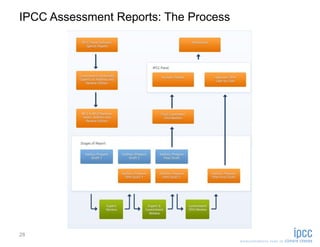
IPCC Assessment Reports: The Process


28

IPCC Report on Extreme Weather in Warming World

  • 1.
    sample The IPCC SpecialReport on Managing the Risks of Extreme Events and Disasters to Advance Climate Change Adaptation
  • 2.
    A changing climateleads to changes in extreme weather and climate events 2
  • 3.
    Impacts from weatherand climate events depend on: nature and severity of event vulnerability exposure 3
  • 4.
    Socioeconomic development interactswith natural climate variations and human-caused climate change to influence disaster risk 4
  • 5.
    Socioeconomic development interactswith natural climate variations and human-caused climate change to influence disaster risk Disaster Risk: Vulnerability: the likelihood of severe the predisposition of a alterations in the normal person or group to be functioning of a adversely affected community or society due to weather or climate events interacting with vulnerable social conditions 5
  • 6.
    Increasing vulnerability, exposure,or severity and frequency of climate events increases disaster risk 6
  • 7.
    Increasing vulnerability, exposure,or severity and frequency of climate events increases disaster risk Disaster risk management and climate change adaptation can influence the degree to which extreme events translate into impacts and disasters 7
  • 8.
    For exposed andvulnerable communities, even non-extreme weather and climate events can have extreme impacts   Africa’s largest recorded cholera outbreak   over 90,000 affected   over 4,000 killed Looking for a good example here.   began following onset of seasonal rains   vulnerability and exposure increased risk Case Study: Zimbabwe 2008 8
  • 9.
    Impacts of climateextremes can be felt locally or regionally AGRICULTURE “Russia, Crippled by Drought, Bans Grain Exports” August 5, 2010, The New York Times ENERGY “Heatwave hits French power production” August 12, 2003, The Guardian “Lake Mead is at Record Low Levels. Is the Southwest WATER drying up?”’ August 08, 2010, The Independent “Pakistan floods: Aid trickles in for victims as cholera PUBLIC HEALTH spreads in Pakistan’s worst-ever floods” August 14, 2010, The Guardian/Observer TOURISM “Alpine resorts feel heat during record warm spell” December 08, 2006, CNN TRANSPORTATION “Flash flooding causes train to derail” July 30, 2001, Chicago Sun Times 9
  • 10.
    Economic losses fromclimate-related disasters have increased, with large spatial and interannual variations 10
  • 11.
    Increasing exposure ofpeople and assets has been the major cause of changes in disaster losses Pakistan floods, 2010 6 million left homeless 11
  • 12.
    Economic disaster lossesare higher in developed countries 12
  • 13.
    Fatalities are higherin developing countries From 1970-2008, over 95% of natural-disaster-related deaths occurred in developing countries 13
  • 14.
    Both developed anddeveloping countries experience disasters Case Study: Melbourne, Australia Case Study: Mongolia February, 2009 2009 – 2010 Heat wave and wildfires Dzuds (extremely snowy winters with conditions leading to livestock loss) 14
  • 15.
    Since 1950, extremehot days and heavy precipitation have become more common There is evidence that anthropogenic influences, including increasing atmospheric greenhouse gas concentrations, have changed these extremes 15
  • 16.
    Climate models projectmore frequent hot days throughout the 21st century In many regions, the time between “20-year” (unusually) warm days will decrease 16
  • 17.
    Climate models projectthere will be more heavy rain events throughout the 21st century In many regions, the time between “20-year” (unusually intense) rainstorms will decrease 17
  • 18.
    Information on vulnerability,exposure, and changing climate extremes can together inform adaptation and disaster risk management   poverty reduction   better education and awareness   sustainable development   improved forecasting for warning systems   reduction of greenhouse gas emissions   asset relocation   weather-proofing assets   early warning systems 18
  • 19.
    Short-term actions don’talways provide long term risk reduction Permafrost thaw   permafrost requires sub zero temperatures   melt affects roads, building foundations, airport infrastructure   infrastructure maintenance needed   short-term risk reduction won’t eliminate long-term Case Study: Northern Canada melt risk 19
  • 20.
    Effective risk managementand adaptation are tailored to local and regional needs and circumstances   changes in climate extremes vary across regions   each region has unique vulnerabilities and exposure to hazards   effective risk management and adaptation address the factors contributing to exposure and vulnerability 20
  • 21.
    Managing the risks:heat waves in Europe Risk Factors Risk Management/ Adaptation   lack of access   cooling in public to cooling facilities   age   warning systems   pre-existing   social care health problems networks   poverty and   urban isolation green space   infrastructure France, August 2003 (over 14,000 dead)   changes in urban infrastructure Projected: likely increase heat wave frequency and very likely increase in warm days and nights across Europe 21
  • 22.
    Managing the risks:hurricanes in the USA and Caribbean Risk Factors Risk Management/ Adaptation   population   better forecasting growth   warning systems   increasing property value   stricter building codes   higher storm surge with sea   regional risk level rise pooling Hurricane Katrina, 2005 Projected globally: likely increase in average maximum wind speed and associated heavy rainfall (although not in all regions) 22
  • 23.
    Managing the risks:flash floods in Nairobi, Kenya Risk Factors Risk Management/ Adaptation   rapid growth   reduce poverty of informal settlements   strengthen buildings   weak building construction   improve drainage and sewage   settlements built near rivers and   early warning systems blocked drainage areas Nairobi, Kenya Projected: likely increase in heavy precipitation in East Africa 23
  • 24.
    Managing the risks:sea level rise in tropical Small Island Developing States Risk Factors Risk Management/ Adaptation   shore erosion   early warning systems   saltwater intrusion   maintenance of drainage   coastal populations   regional risk pooling   tourism economies   relocation Projected globally: very likely contribution of sea level rise to extreme coastal high water levels (such as storm surges) 24
  • 25.
    Managing the risks:drought in the context of food security in West Africa Risk Factors Risk Management/ Adaptation   more   improved water variable rain management   population growth   sustainable farming practice   ecosystem degradation   drought-resistant crops   poor health and education systems   drought forecasting Projected: low confidence in drought projections for West Africa 25
  • 26.
    Managing risks ofdisasters in a changing climate benefits from an iterative process Monitoring Innovation Evaluation Learning Learning-by-doing and low-regrets actions can help reduce risks now and also promote future adaptation 26
  • 27.
    There are strategiesthat can help manage disaster risk now and also help improve people’s livelihoods and well-being The most effective strategies offer development benefits in the relatively near term and reduce vulnerability over the longer term 27
  • 28.