Sensory receptors,
sensory pathways &
sensory cortex
Prof. Vajira Weerasinghe
Professor of Physiology
www.slideshare.net/vajira54
Sensory functions
• Humans do not have receptor for every
possible stimuli
• There are different sensory modalities that
human brain can perceive
• Arrival of information is sensation
Sensory Functions
• General Sensations
Physical (touch, pressure, vibration, stretch)
Temperature
Pain
Chemical
• Special Sensations
Vision
Hearing
Taste
Smell
Modality specificity
• Stimulation of a receptor usually produces only
one sensation
modality specific
• But some receptors are stimulated by more
than one sensory modality (polymodal)
eg. free nerve endings
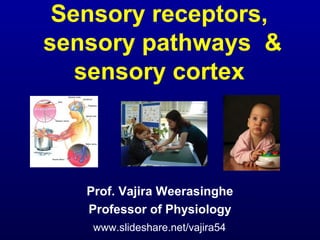
Sensory pathway
• Once a receptor is stimulated
impulse travels through a particular pathway
known as sensory pathway or ascending pathway
up to the brain
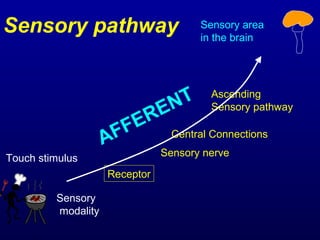
Receptor
Sensory
modality
Sensory nerve
Central Connections
Ascending
Sensory pathway
Sensory area
in the brain
Touch stimulus
AFFERENT
Sensory pathway
Receptors
• Receptor cells are specific cells that are
sensitive to different forms of energy from the
environment
• These cells contain membrane receptors
coupled to ion channels
• They transform the stimulus into electrical
signals
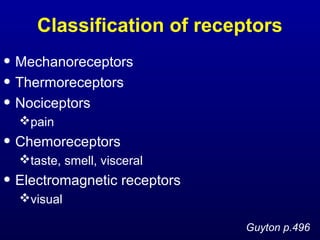
Classification of receptors
• Mechanoreceptors
• Thermoreceptors
• Nociceptors
pain
• Chemoreceptors
taste, smell, visceral
• Electromagnetic receptors
visual
Guyton p.496
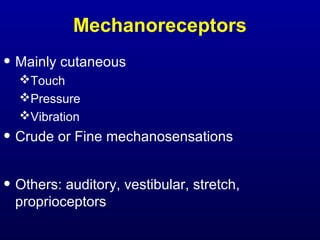
Mechanoreceptors
• Mainly cutaneous
Touch
Pressure
Vibration
• Crude or Fine mechanosensations
• Others: auditory, vestibular, stretch,
proprioceptors
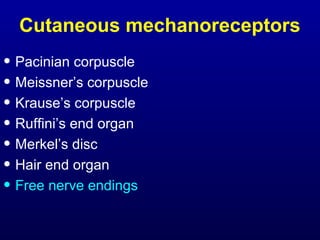
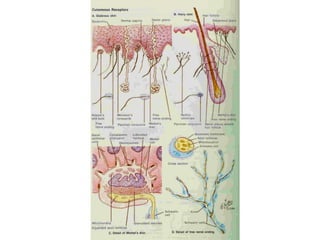
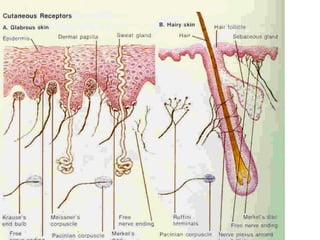
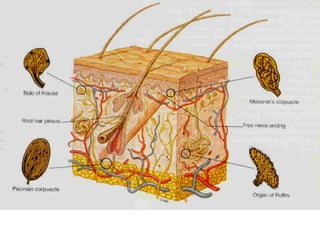
Cutaneous mechanoreceptors
• Pacinian corpuscle
• Meissner’s corpuscle
• Krause’s corpuscle
• Ruffini’s end organ
• Merkel’s disc
• Hair end organ
• Free nerve endings
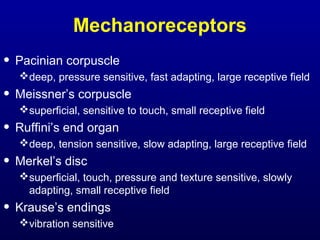
Mechanoreceptors
• Pacinian corpuscle
deep, pressure sensitive, fast adapting, large receptive field
• Meissner’s corpuscle
superficial, sensitive to touch, small receptive field
• Ruffini’s end organ
deep, tension sensitive, slow adapting, large receptive field
• Merkel’s disc
superficial, touch, pressure and texture sensitive, slowly
adapting, small receptive field
• Krause’s endings
vibration sensitive
Mechanoreceptors
• Hair end organ
• Free nerve endings
Crude mechanosensations
(Pain, temperature)
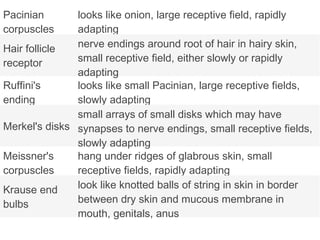
Pacinian
corpuscles
looks like onion, large receptive field, rapidly
adapting
Hair follicle
receptor
nerve endings around root of hair in hairy skin,
small receptive field, either slowly or rapidly
adapting
Ruffini's
ending
looks like small Pacinian, large receptive fields,
slowly adapting
Merkel's disks
small arrays of small disks which may have
synapses to nerve endings, small receptive fields,
slowly adapting
Meissner's
corpuscles
hang under ridges of glabrous skin, small
receptive fields, rapidly adapting
Krause end
bulbs
look like knotted balls of string in skin in border
between dry skin and mucous membrane in
mouth, genitals, anus
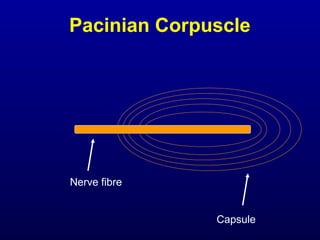
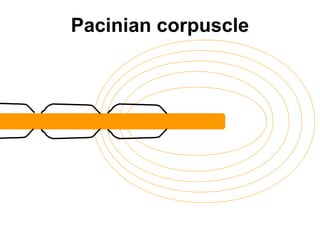
Pacinian Corpuscle
Capsule
Nerve fibre
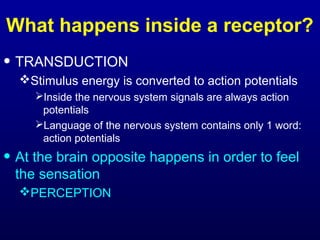
What happens inside a receptor?
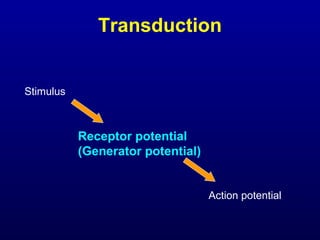
• TRANSDUCTION
Stimulus energy is converted to action potentials
Inside the nervous system signals are always action
potentials
Language of the nervous system contains only 1 word:
action potentials
• At the brain opposite happens in order to feel
the sensation
PERCEPTION
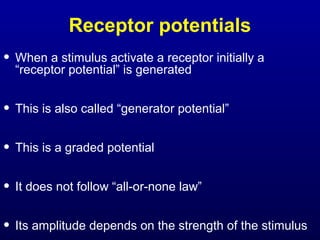
Receptor potentials
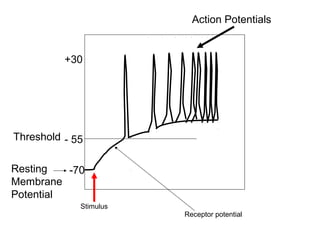
• When a stimulus activate a receptor initially a
“receptor potential” is generated
• This is also called “generator potential”
• This is a graded potential
• It does not follow “all-or-none law”
• Its amplitude depends on the strength of the stimulus
Transduction
Stimulus
Receptor potential
(Generator potential)
Action potential
Action Potentials
Threshold
Resting
Membrane
Potential
-70
- 55
+30
Stimulus
Receptor potential
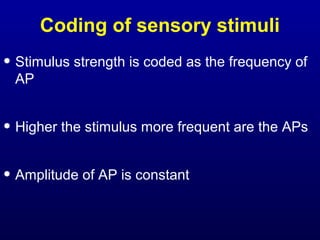
Coding of sensory stimuli
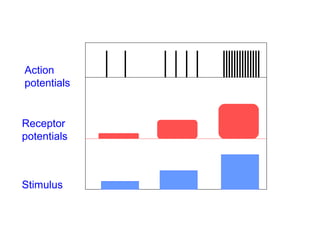
• Stimulus strength is coded as the frequency of
AP
• Higher the stimulus more frequent are the APs
• Amplitude of AP is constant
Stimulus
Receptor
potentials
Action
potentials
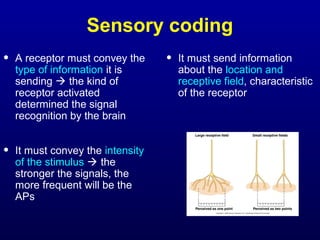
Sensory coding
• A receptor must convey the
type of information it is
sending  the kind of
receptor activated
determined the signal
recognition by the brain
• It must convey the intensity
of the stimulus  the
stronger the signals, the
more frequent will be the
APs
• It must send information
about the location and
receptive field, characteristic
of the receptor
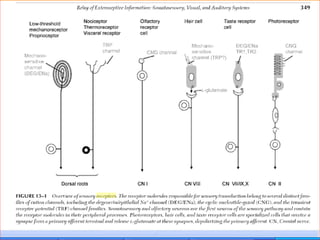
Transduction in different receptors
• Different receptors have different ion channels
• Their opening causes receptor potential
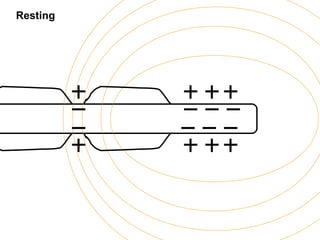
Receptor potential generation
in the Pacinian corpuscle
Pacinian corpuscle
Resting
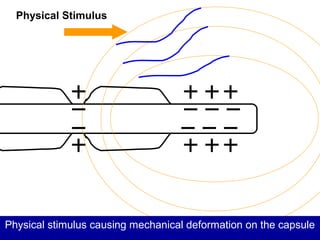
Physical Stimulus
Physical stimulus causing mechanical deformation on the capsule
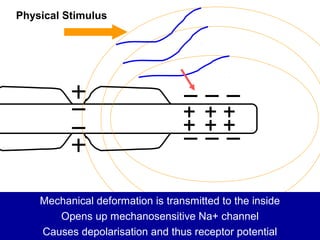
Physical Stimulus
Mechanical deformation is transmitted to the inside
Opens up mechanosensitive Na+ channel
Causes depolarisation and thus receptor potential
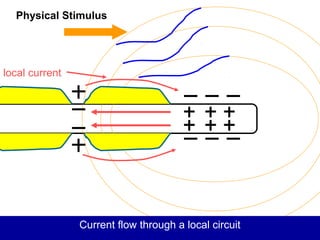
Physical Stimulus
local current
Current flow through a local circuit
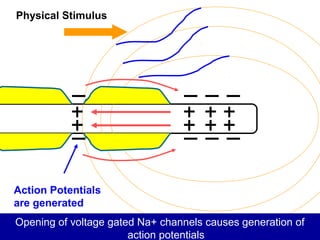
Physical Stimulus
Action Potentials
are generated
Opening of voltage gated Na+ channels causes generation of
action potentials
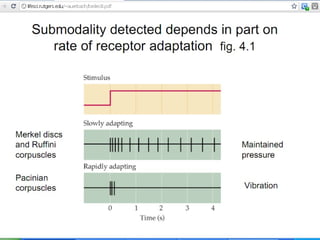
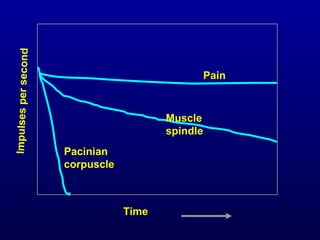
Adaptation
• “getting used to”
• after a period of time sensory receptors adapt
partially or
completely
• different types
Rapidly adapting receptors
slowly adapting receptors
Adaptation
• after a period of time sensory receptors adapt
partially or completely
• different types
fast adapting receptors
slowly adapting receptors
Pacinian
corpuscle
Muscle
spindle
Pain
Time
Impulsespersecond
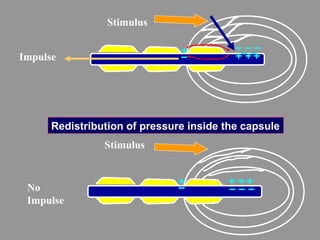
Mechanism of adaptation
• In the Pacinian corpuscle
mechanical deformation is transmitted throughout
the capsule and pressure redistributes
Na+ channels inactivates after some time
Impulse
Stimulus
Redistribution of pressure inside the capsule
No
Impulse
Stimulus
• Rapidly adapting receptors
phasic or rate or movement receptors
detect changes in stimulus strength
eg. Pacinian corpuscle, hair end-organ
• Slowly adapting receptors
tonic receptors
detect continuous stimulus strength
eg. muscle spindles, Golgi tendon organ, baroreceptors,
Ruffini endings and Merkel’s discs, pain receptors
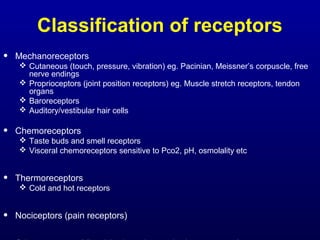
Classification of receptors
• Mechanoreceptors
 Cutaneous (touch, pressure, vibration) eg. Pacinian, Meissner’s corpuscle, free
nerve endings
 Proprioceptors (joint position receptors) eg. Muscle stretch receptors, tendon
organs
 Baroreceptors
 Auditory/vestibular hair cells
• Chemoreceptors
 Taste buds and smell receptors
 Visceral chemoreceptors sensitive to Pco2, pH, osmolality etc
• Thermoreceptors
 Cold and hot receptors
• Nociceptors (pain receptors)
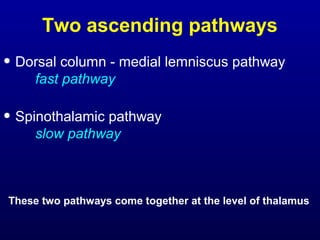
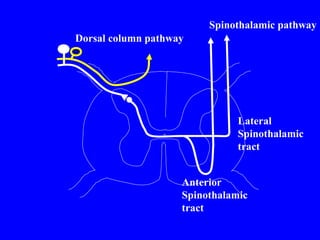
Two ascending pathways
• Dorsal column - medial lemniscus pathway
fast pathway
• Spinothalamic pathway
slow pathway
These two pathways come together at the level of thalamus
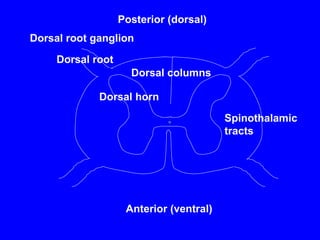
Dorsal root
Dorsal columns
Dorsal horn
Dorsal root ganglion
Spinothalamic
tracts
Posterior (dorsal)
Anterior (ventral)
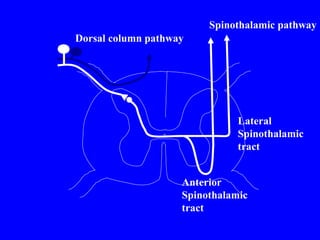
Dorsal column pathway
Spinothalamic pathway
Lateral
Spinothalamic
tract
Anterior
Spinothalamic
tract
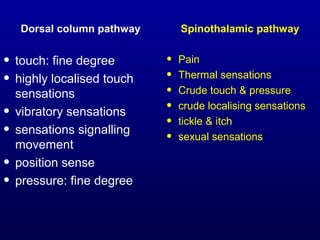
Dorsal column pathway Spinothalamic pathway
• touch: fine degree
• highly localised touch
sensations
• vibratory sensations
• sensations signalling
movement
• position sense
• pressure: fine degree
• Pain
• Thermal sensations
• Crude touch & pressure
• crude localising sensations
• tickle & itch
• sexual sensations
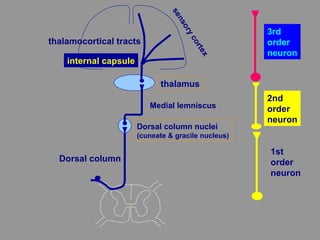
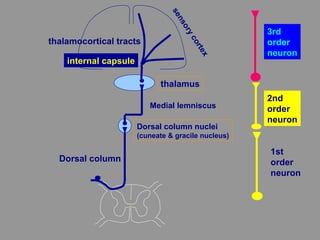
Dorsal column nuclei
(cuneate & gracile nucleus)
Dorsal column
Medial lemniscus
thalamus
thalamocortical tracts
sensorycortex
internal capsule
1st
order
neuron
2nd
order
neuron
3rd
order
neuron
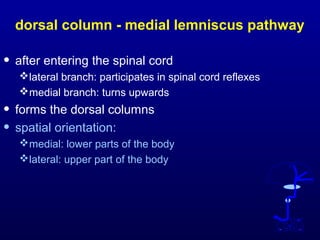
dorsal column - medial lemniscus pathway
• after entering the spinal cord
lateral branch: participates in spinal cord reflexes
medial branch: turns upwards
• forms the dorsal columns
• spatial orientation:
medial: lower parts of the body
lateral: upper part of the body
dorsal column - medial lemniscus pathway
• synapse in the dorsal column nuclei
nucleus cuneatus & nucleus gracilus
• 2nd order neuron cross over to the opposite
side and ascends upwards as medial
lemniscus
• as this travels along the brain stem fibres
from head and neck are joined (trigeminal)
• ends in the thalamus (ventrobasal complex)
 ventral posterolateral nuclei
dorsal column - medial lemniscus pathway
• spatial orientation in the thalamus
medial: upper part of the body
lateral: lower part of the body
Dorsal column nuclei
(cuneate & gracile nucleus)
Dorsal column
Medial lemniscus
thalamus
thalamocortical tracts
sensorycortex
internal capsule
1st
order
neuron
2nd
order
neuron
3rd
order
neuron
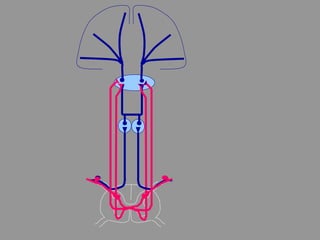
spinothalamic pathway
• after entering the spinal cord
synapse in the dorsal horn
• cross over to the opposite side
• divide in to two tracts
lateral spinothalamic tract:
pain and temperature
anterior spinothalamic tract
crude touch
spinothalamic pathway
• spatial orientation
medial: upper part of the body
lateral: lower part of the body
Dorsal column pathway
Spinothalamic pathway
Lateral
Spinothalamic
tract
Anterior
Spinothalamic
tract
Thalamocortical tracts
• from the thalamus 3rd order neuron ascends up
through the internal capsule
• up to the sensory cortex
• thalamocortical radiation
tracts diverge
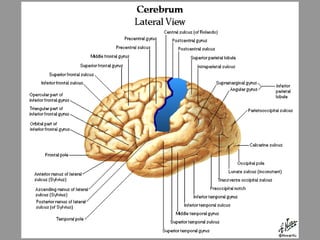
Sensory cortical areas
• parietal cortex
• a distinct spatial orientation exists
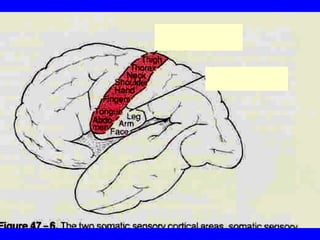
Sensory cortex
• Different areas of the body are represented
in different cortical areas in the sensory
cortex
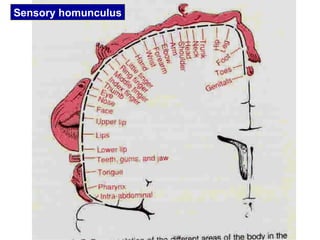
• Sensory homunculus
somatotopic representation
not proportionate
distorted map
upside down map
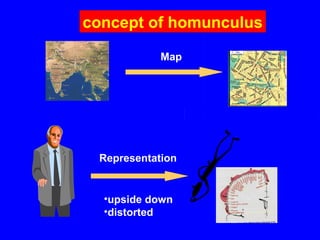
Representation
•upside down
•distorted
concept of homunculus
Map
Sensory homunculus
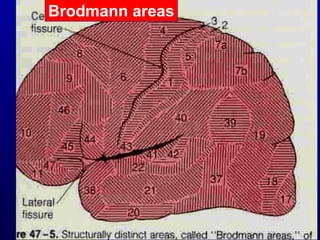
Brodmann areas
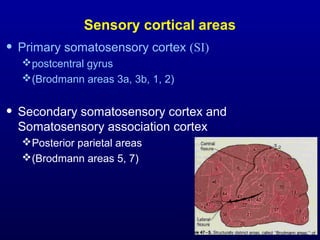
Sensory cortical areas
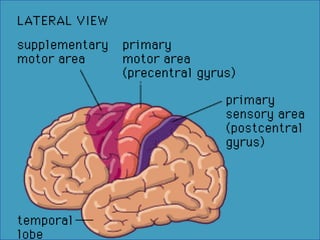
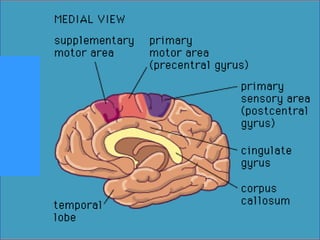
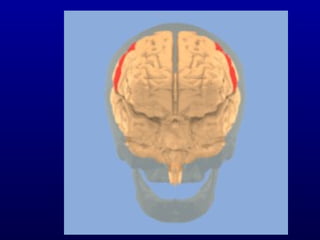
• Primary somatosensory cortex (SI)
postcentral gyrus
(Brodmann areas 3a, 3b, 1, 2)
• Secondary somatosensory cortex and
Somatosensory association cortex
Posterior parietal areas
(Brodmann areas 5, 7)
Somatosensory cortex
•Functions
To localise somatic sensations
To judge critical degree of pressure
To identify objects by their weight,
shape, form - stereognosis
To judge texture of materials
To localise pain & temperature
Somatosensory cortex
•Damage to the sensory cortex results in
decreased sensory thresholds
inability to discriminate the properties of
tactile stimuli
Inability to identify objects by touch
(astereognosis)
Secondary somatosensory cortex and
Somatosensory association cortex
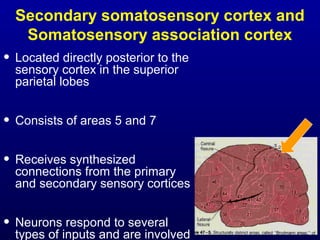
• Located directly posterior to the
sensory cortex in the superior
parietal lobes
• Consists of areas 5 and 7
• Receives synthesized
connections from the primary
and secondary sensory cortices
• Neurons respond to several
types of inputs and are involved
Secondary somatosensory cortex and
Somatosensory association cortex
• Damage can cause
Tactile agnosia
inability to recognize objects even though the objects can
be felt
Spatial neglect
This typically happens with non-dominant hemisphere
lesions
Neglect can be so severe that the individual even denies
that their left side belongs to them
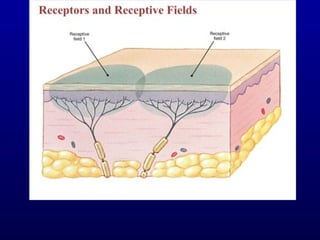
Receptive fields
• The receptor area which when stimulated
results in a response of a particular sensory
neuron
• Receptive fields of adjacent neurons overlap
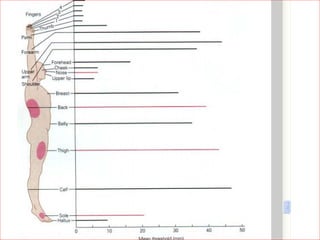
Two-Point Discrimination
• Whether a stimulus feels like one sensation or two
distinct sensations depends on the size of the
receptive fields of the sensory receptors
• Different areas of the body have sensory receptors
with different sized receptive fields
• Smaller receptive fields result in greater sensitivity
• Fingers are more sensitive than backs
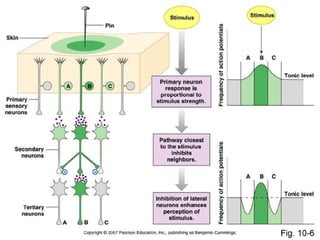
Lateral Inhibition
• The capacity of an excited neuron to reduce the activity of its
neighbors
• When the skin is touched by an object
 several sensory neurons in the skin next to one another are stimulated
 neurons that are firing suppress the stimulation of neighbouring neurons
 only the neurons that are most stimulated and least inhibited will fire
 so the firing pattern tends to concentrate at stimulus peaks
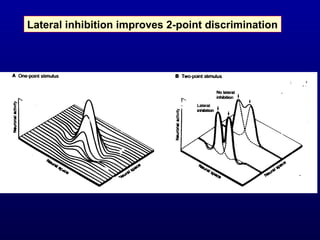
• Lateral inhibition increases the contrast and sharpness
• Weaker signals get weaker, stronger signals get stronger
Lateral inhibition improves 2-point discrimination
Sensory abnormalities
• Various types of sensory abnormalities can
occur when the sensory pathways are
damaged
• Sensory loss, altered sensations or pain
could occur as a result
• In addition, motor pathways could also be
affected resulting in motor weakness
Types of sensory abnormalities
• Sensory loss
• Anaesthesia
absence of sensation
• Paraesthesia (numbness or pins-needles-
sensation)
altered sensation
• Neuropathic pain
• Hemianaesthesia
Loss of sensation of one half of the body
• Astereognosis
• Spatial neglect
Localisation of the abnormality
• Peripheral nerve
innervated area affected
• Roots
dermatomal pattern of sensory loss
• Spinal cord
a sensory level
• Internal capsule
one half of the body
• Cortical areas
Other features
Examples of sensory lesions or
sensory disorders
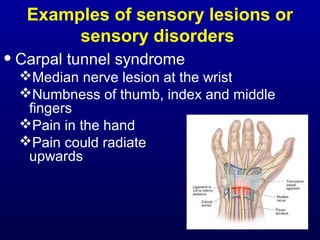
•Carpal tunnel syndrome
Median nerve lesion at the wrist
Numbness of thumb, index and middle
fingers
Pain in the hand
Pain could radiate
upwards
Examples of sensory lesions or
sensory disorders
•Polyneuropathy
All sensory nerves of
both upper and lower
limbs are degenerated
Numbness of hands
and feet
Glove and stocking
type of sensory loss
Diabetic or nutritional
neuropathy
Examples of sensory lesions or
sensory disorders
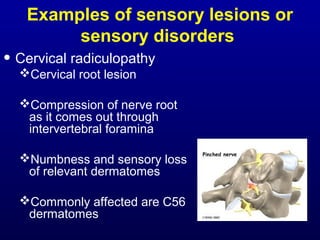
• Cervical radiculopathy
Cervical root lesion
Compression of nerve root
as it comes out through
intervertebral foramina
Numbness and sensory loss
of relevant dermatomes
Commonly affected are C56
dermatomes
Examples of sensory lesions or
sensory disorders
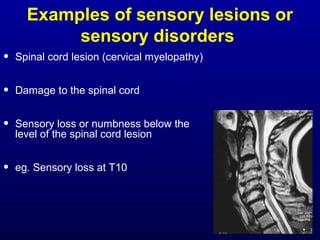
• Spinal cord lesion (cervical myelopathy)
• Damage to the spinal cord
• Sensory loss or numbness below the
level of the spinal cord lesion
• eg. Sensory loss at T10
Examples of sensory lesions or
sensory disorders
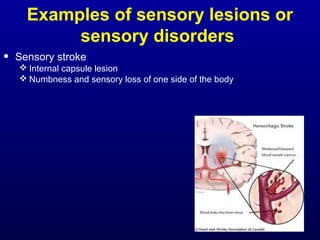
• Sensory stroke
 Internal capsule lesion
 Numbness and sensory loss of one side of the body
Examples of sensory lesions or
sensory disorders
• Dorsal column disease (eg. Diabetes, tabes dorsalis)
• Dorsal column pathways are affected
• Vibration, proprioception affected early in disease process
Examples of sensory lesions or
sensory disorders
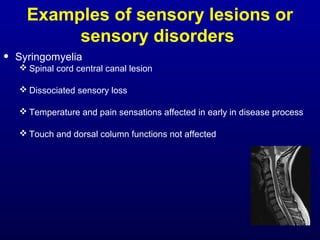
• Syringomyelia
 Spinal cord central canal lesion
 Dissociated sensory loss
 Temperature and pain sensations affected in early in disease process
 Touch and dorsal column functions not affected

Y2 s1 sensory system

  • 1.
    Sensory receptors, sensory pathways& sensory cortex Prof. Vajira Weerasinghe Professor of Physiology www.slideshare.net/vajira54
  • 2.
    Sensory functions • Humansdo not have receptor for every possible stimuli • There are different sensory modalities that human brain can perceive • Arrival of information is sensation
  • 3.
    Sensory Functions • GeneralSensations Physical (touch, pressure, vibration, stretch) Temperature Pain Chemical • Special Sensations Vision Hearing Taste Smell
  • 4.
    Modality specificity • Stimulationof a receptor usually produces only one sensation modality specific • But some receptors are stimulated by more than one sensory modality (polymodal) eg. free nerve endings
  • 5.
    Sensory pathway • Oncea receptor is stimulated impulse travels through a particular pathway known as sensory pathway or ascending pathway up to the brain
  • 6.
    Receptor Sensory modality Sensory nerve Central Connections Ascending Sensorypathway Sensory area in the brain Touch stimulus AFFERENT Sensory pathway
  • 7.
    Receptors • Receptor cellsare specific cells that are sensitive to different forms of energy from the environment • These cells contain membrane receptors coupled to ion channels • They transform the stimulus into electrical signals
  • 8.
    Classification of receptors •Mechanoreceptors • Thermoreceptors • Nociceptors pain • Chemoreceptors taste, smell, visceral • Electromagnetic receptors visual Guyton p.496
  • 9.
    Mechanoreceptors • Mainly cutaneous Touch Pressure Vibration •Crude or Fine mechanosensations • Others: auditory, vestibular, stretch, proprioceptors
  • 10.
    Cutaneous mechanoreceptors • Paciniancorpuscle • Meissner’s corpuscle • Krause’s corpuscle • Ruffini’s end organ • Merkel’s disc • Hair end organ • Free nerve endings
  • 11.
    Mechanoreceptors • Pacinian corpuscle deep,pressure sensitive, fast adapting, large receptive field • Meissner’s corpuscle superficial, sensitive to touch, small receptive field • Ruffini’s end organ deep, tension sensitive, slow adapting, large receptive field • Merkel’s disc superficial, touch, pressure and texture sensitive, slowly adapting, small receptive field • Krause’s endings vibration sensitive
  • 12.
    Mechanoreceptors • Hair endorgan • Free nerve endings Crude mechanosensations (Pain, temperature)
  • 16.
    Pacinian corpuscles looks like onion,large receptive field, rapidly adapting Hair follicle receptor nerve endings around root of hair in hairy skin, small receptive field, either slowly or rapidly adapting Ruffini's ending looks like small Pacinian, large receptive fields, slowly adapting Merkel's disks small arrays of small disks which may have synapses to nerve endings, small receptive fields, slowly adapting Meissner's corpuscles hang under ridges of glabrous skin, small receptive fields, rapidly adapting Krause end bulbs look like knotted balls of string in skin in border between dry skin and mucous membrane in mouth, genitals, anus
  • 17.
  • 18.
    What happens insidea receptor? • TRANSDUCTION Stimulus energy is converted to action potentials Inside the nervous system signals are always action potentials Language of the nervous system contains only 1 word: action potentials • At the brain opposite happens in order to feel the sensation PERCEPTION
  • 19.
    Receptor potentials • Whena stimulus activate a receptor initially a “receptor potential” is generated • This is also called “generator potential” • This is a graded potential • It does not follow “all-or-none law” • Its amplitude depends on the strength of the stimulus
  • 20.
  • 21.
  • 22.
    Coding of sensorystimuli • Stimulus strength is coded as the frequency of AP • Higher the stimulus more frequent are the APs • Amplitude of AP is constant
  • 23.
  • 24.
    Sensory coding • Areceptor must convey the type of information it is sending  the kind of receptor activated determined the signal recognition by the brain • It must convey the intensity of the stimulus  the stronger the signals, the more frequent will be the APs • It must send information about the location and receptive field, characteristic of the receptor
  • 25.
    Transduction in differentreceptors • Different receptors have different ion channels • Their opening causes receptor potential
  • 27.
    Receptor potential generation inthe Pacinian corpuscle
  • 28.
  • 29.
  • 30.
    Physical Stimulus Physical stimuluscausing mechanical deformation on the capsule
  • 31.
    Physical Stimulus Mechanical deformationis transmitted to the inside Opens up mechanosensitive Na+ channel Causes depolarisation and thus receptor potential
  • 32.
    Physical Stimulus local current Currentflow through a local circuit
  • 33.
    Physical Stimulus Action Potentials aregenerated Opening of voltage gated Na+ channels causes generation of action potentials
  • 34.
    Adaptation • “getting usedto” • after a period of time sensory receptors adapt partially or completely • different types Rapidly adapting receptors slowly adapting receptors
  • 35.
    Adaptation • after aperiod of time sensory receptors adapt partially or completely • different types fast adapting receptors slowly adapting receptors
  • 36.
  • 37.
    Mechanism of adaptation •In the Pacinian corpuscle mechanical deformation is transmitted throughout the capsule and pressure redistributes Na+ channels inactivates after some time
  • 38.
    Impulse Stimulus Redistribution of pressureinside the capsule No Impulse Stimulus
  • 39.
    • Rapidly adaptingreceptors phasic or rate or movement receptors detect changes in stimulus strength eg. Pacinian corpuscle, hair end-organ • Slowly adapting receptors tonic receptors detect continuous stimulus strength eg. muscle spindles, Golgi tendon organ, baroreceptors, Ruffini endings and Merkel’s discs, pain receptors
  • 40.
    Classification of receptors •Mechanoreceptors  Cutaneous (touch, pressure, vibration) eg. Pacinian, Meissner’s corpuscle, free nerve endings  Proprioceptors (joint position receptors) eg. Muscle stretch receptors, tendon organs  Baroreceptors  Auditory/vestibular hair cells • Chemoreceptors  Taste buds and smell receptors  Visceral chemoreceptors sensitive to Pco2, pH, osmolality etc • Thermoreceptors  Cold and hot receptors • Nociceptors (pain receptors)
  • 41.
    Two ascending pathways •Dorsal column - medial lemniscus pathway fast pathway • Spinothalamic pathway slow pathway These two pathways come together at the level of thalamus
  • 42.
    Dorsal root Dorsal columns Dorsalhorn Dorsal root ganglion Spinothalamic tracts Posterior (dorsal) Anterior (ventral)
  • 43.
    Dorsal column pathway Spinothalamicpathway Lateral Spinothalamic tract Anterior Spinothalamic tract
  • 44.
    Dorsal column pathwaySpinothalamic pathway • touch: fine degree • highly localised touch sensations • vibratory sensations • sensations signalling movement • position sense • pressure: fine degree • Pain • Thermal sensations • Crude touch & pressure • crude localising sensations • tickle & itch • sexual sensations
  • 45.
    Dorsal column nuclei (cuneate& gracile nucleus) Dorsal column Medial lemniscus thalamus thalamocortical tracts sensorycortex internal capsule 1st order neuron 2nd order neuron 3rd order neuron
  • 46.
    dorsal column -medial lemniscus pathway • after entering the spinal cord lateral branch: participates in spinal cord reflexes medial branch: turns upwards • forms the dorsal columns • spatial orientation: medial: lower parts of the body lateral: upper part of the body
  • 47.
    dorsal column -medial lemniscus pathway • synapse in the dorsal column nuclei nucleus cuneatus & nucleus gracilus • 2nd order neuron cross over to the opposite side and ascends upwards as medial lemniscus • as this travels along the brain stem fibres from head and neck are joined (trigeminal) • ends in the thalamus (ventrobasal complex)  ventral posterolateral nuclei
  • 48.
    dorsal column -medial lemniscus pathway • spatial orientation in the thalamus medial: upper part of the body lateral: lower part of the body
  • 49.
    Dorsal column nuclei (cuneate& gracile nucleus) Dorsal column Medial lemniscus thalamus thalamocortical tracts sensorycortex internal capsule 1st order neuron 2nd order neuron 3rd order neuron
  • 50.
    spinothalamic pathway • afterentering the spinal cord synapse in the dorsal horn • cross over to the opposite side • divide in to two tracts lateral spinothalamic tract: pain and temperature anterior spinothalamic tract crude touch
  • 51.
    spinothalamic pathway • spatialorientation medial: upper part of the body lateral: lower part of the body
  • 53.
    Dorsal column pathway Spinothalamicpathway Lateral Spinothalamic tract Anterior Spinothalamic tract
  • 54.
    Thalamocortical tracts • fromthe thalamus 3rd order neuron ascends up through the internal capsule • up to the sensory cortex • thalamocortical radiation tracts diverge
  • 55.
    Sensory cortical areas •parietal cortex • a distinct spatial orientation exists
  • 61.
    Sensory cortex • Differentareas of the body are represented in different cortical areas in the sensory cortex • Sensory homunculus somatotopic representation not proportionate distorted map upside down map
  • 62.
  • 63.
  • 64.
  • 65.
    Sensory cortical areas •Primary somatosensory cortex (SI) postcentral gyrus (Brodmann areas 3a, 3b, 1, 2) • Secondary somatosensory cortex and Somatosensory association cortex Posterior parietal areas (Brodmann areas 5, 7)
  • 66.
    Somatosensory cortex •Functions To localisesomatic sensations To judge critical degree of pressure To identify objects by their weight, shape, form - stereognosis To judge texture of materials To localise pain & temperature
  • 67.
    Somatosensory cortex •Damage tothe sensory cortex results in decreased sensory thresholds inability to discriminate the properties of tactile stimuli Inability to identify objects by touch (astereognosis)
  • 68.
    Secondary somatosensory cortexand Somatosensory association cortex • Located directly posterior to the sensory cortex in the superior parietal lobes • Consists of areas 5 and 7 • Receives synthesized connections from the primary and secondary sensory cortices • Neurons respond to several types of inputs and are involved
  • 69.
    Secondary somatosensory cortexand Somatosensory association cortex • Damage can cause Tactile agnosia inability to recognize objects even though the objects can be felt Spatial neglect This typically happens with non-dominant hemisphere lesions Neglect can be so severe that the individual even denies that their left side belongs to them
  • 70.
    Receptive fields • Thereceptor area which when stimulated results in a response of a particular sensory neuron • Receptive fields of adjacent neurons overlap
  • 72.
    Two-Point Discrimination • Whethera stimulus feels like one sensation or two distinct sensations depends on the size of the receptive fields of the sensory receptors • Different areas of the body have sensory receptors with different sized receptive fields • Smaller receptive fields result in greater sensitivity • Fingers are more sensitive than backs
  • 74.
    Lateral Inhibition • Thecapacity of an excited neuron to reduce the activity of its neighbors • When the skin is touched by an object  several sensory neurons in the skin next to one another are stimulated  neurons that are firing suppress the stimulation of neighbouring neurons  only the neurons that are most stimulated and least inhibited will fire  so the firing pattern tends to concentrate at stimulus peaks • Lateral inhibition increases the contrast and sharpness • Weaker signals get weaker, stronger signals get stronger
  • 76.
    Lateral inhibition improves2-point discrimination
  • 77.
    Sensory abnormalities • Varioustypes of sensory abnormalities can occur when the sensory pathways are damaged • Sensory loss, altered sensations or pain could occur as a result • In addition, motor pathways could also be affected resulting in motor weakness
  • 78.
    Types of sensoryabnormalities • Sensory loss • Anaesthesia absence of sensation • Paraesthesia (numbness or pins-needles- sensation) altered sensation • Neuropathic pain • Hemianaesthesia Loss of sensation of one half of the body • Astereognosis • Spatial neglect
  • 79.
    Localisation of theabnormality • Peripheral nerve innervated area affected • Roots dermatomal pattern of sensory loss • Spinal cord a sensory level • Internal capsule one half of the body • Cortical areas Other features
  • 80.
    Examples of sensorylesions or sensory disorders •Carpal tunnel syndrome Median nerve lesion at the wrist Numbness of thumb, index and middle fingers Pain in the hand Pain could radiate upwards
  • 81.
    Examples of sensorylesions or sensory disorders •Polyneuropathy All sensory nerves of both upper and lower limbs are degenerated Numbness of hands and feet Glove and stocking type of sensory loss Diabetic or nutritional neuropathy
  • 82.
    Examples of sensorylesions or sensory disorders • Cervical radiculopathy Cervical root lesion Compression of nerve root as it comes out through intervertebral foramina Numbness and sensory loss of relevant dermatomes Commonly affected are C56 dermatomes
  • 83.
    Examples of sensorylesions or sensory disorders • Spinal cord lesion (cervical myelopathy) • Damage to the spinal cord • Sensory loss or numbness below the level of the spinal cord lesion • eg. Sensory loss at T10
  • 84.
    Examples of sensorylesions or sensory disorders • Sensory stroke  Internal capsule lesion  Numbness and sensory loss of one side of the body
  • 85.
    Examples of sensorylesions or sensory disorders • Dorsal column disease (eg. Diabetes, tabes dorsalis) • Dorsal column pathways are affected • Vibration, proprioception affected early in disease process
  • 86.
    Examples of sensorylesions or sensory disorders • Syringomyelia  Spinal cord central canal lesion  Dissociated sensory loss  Temperature and pain sensations affected in early in disease process  Touch and dorsal column functions not affected