Welcome
Done by,

      PL.Sriram
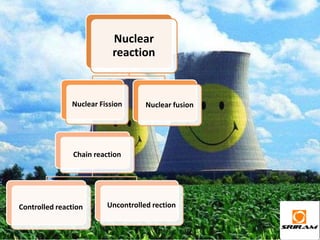
Nuclear
                           reaction


               Nuclear Fission      Nuclear fusion


                Chain reaction


Controlled reaction      Uncontrolled rection
Reaction
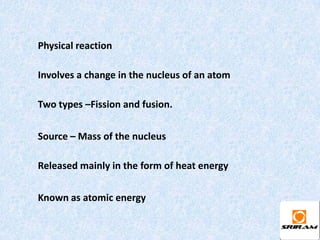
Physical reaction

Involves a change in the nucleus of an atom

Two types –Fission and fusion.


Source – Mass of the nucleus

Released mainly in the form of heat energy


Known as atomic energy
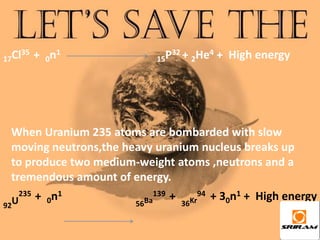
17Cl35 + 0n1               15P32 + 2He4 + High energy


 When Uranium 235 atoms are bombarded with slow
 moving neutrons,the heavy uranium nucleus breaks up
 to produce two medium-weight atoms ,neutrons and a
 tremendous amount of energy.
     235   + 0n1           139   +       94   + 30n1 + High energy
 U
92                     56Ba          36Kr
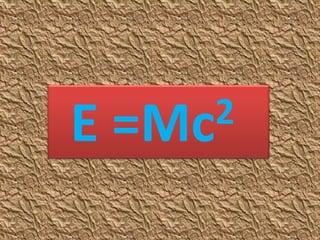
E   =Mc 2
FISSION AND FUSION
 Fission means ‘to split’

 German scientist otto hann and strassman
discovered that when a 92U235 nucleus is bombarded
by thermal neutrons,it splits up into two smalller
nuclei of barium and Krypton along with the release
of three neutrons
 The process in which the heavy nucleus of a radioactive
atom (such as uranium,thorium and plutonium) splits up
into smaller nuclei when bombarded with low energy
neutrons is known as nuclear fission.
The sum of masses of the smaller nuclei formed in a
fission reaction is a little less than that of the mass of the
original heavy nucleus


So,there is a small loss of mass in the nuclear fission
process.


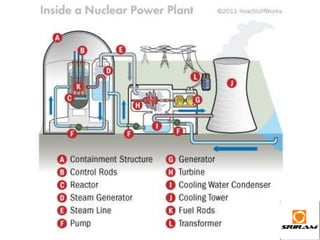
 This energy is used for generating electricity.
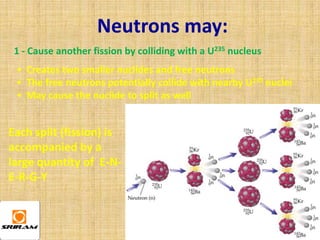
Neutrons may:
 1 - Cause another fission by colliding with a U235 nucleus
 • Creates two smaller nuclides and free neutrons
 • The free neutrons potentially collide with nearby U235 nuclei
 • May cause the nuclide to split as well


Each split (fission) is
accompanied by a
large quantity of E-N-
E-R-G-Y
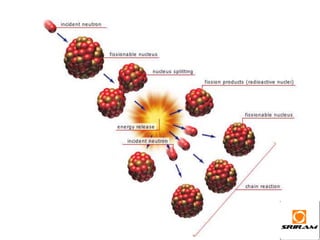
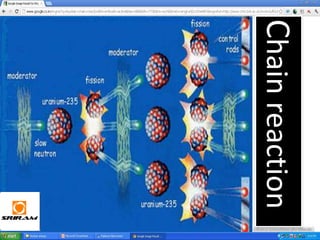
Chain reaction

 When  the neutrons in the fission reaction continuously
bombard with heavy nuclei then , a continuous self
sustaining nuclear chain reaction happens.


 Sometimes,I t becomes uncontrolllable and that is
the atom bomb.


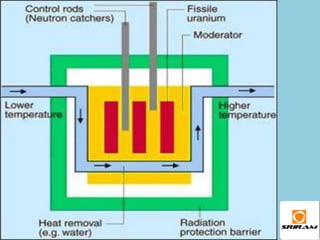
 To control it boron rods are used because boron has
the property to absorb neutrons.
Chain reaction
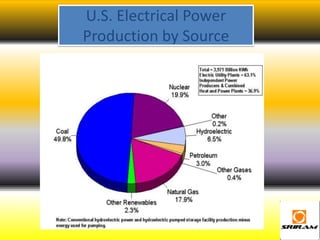
U.S. Electrical Power
Production by Source
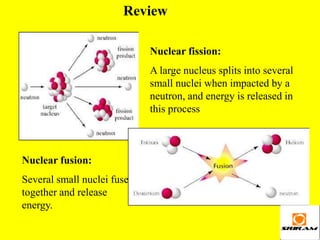
Review

                            Nuclear fission:
                            A large nucleus splits into several
                            small nuclei when impacted by a
                            neutron, and energy is released in
                            this process


Nuclear fusion:
Several small nuclei fuse
together and release
energy.
Advantages

Produces tremendous energy from a small amount
of nuclear fuel.

Once the nuclear fuel is filled,the plant can go for
years together.

Does not produce greenhouse gases like CO2
Disadvantages
Difficult to dispose the radioactive waste from the
nuclear fission reaction.

Risk of accidents in Nuclear reactors

High cost of installation of nuclear power plants
and limited availability of uranium.
Thank you

Nuclear fission

  • 1.
  • 2.
    Done by, PL.Sriram
  • 4.
    Nuclear reaction Nuclear Fission Nuclear fusion Chain reaction Controlled reaction Uncontrolled rection
  • 5.
  • 6.
    Physical reaction Involves achange in the nucleus of an atom Two types –Fission and fusion. Source – Mass of the nucleus Released mainly in the form of heat energy Known as atomic energy
  • 7.
    17Cl35 + 0n1 15P32 + 2He4 + High energy When Uranium 235 atoms are bombarded with slow moving neutrons,the heavy uranium nucleus breaks up to produce two medium-weight atoms ,neutrons and a tremendous amount of energy. 235 + 0n1 139 + 94 + 30n1 + High energy U 92 56Ba 36Kr
  • 8.
    E =Mc 2
  • 9.
  • 10.
     Fission means‘to split’  German scientist otto hann and strassman discovered that when a 92U235 nucleus is bombarded by thermal neutrons,it splits up into two smalller nuclei of barium and Krypton along with the release of three neutrons  The process in which the heavy nucleus of a radioactive atom (such as uranium,thorium and plutonium) splits up into smaller nuclei when bombarded with low energy neutrons is known as nuclear fission.
  • 12.
    The sum ofmasses of the smaller nuclei formed in a fission reaction is a little less than that of the mass of the original heavy nucleus So,there is a small loss of mass in the nuclear fission process. This energy is used for generating electricity.
  • 13.
    Neutrons may: 1- Cause another fission by colliding with a U235 nucleus • Creates two smaller nuclides and free neutrons • The free neutrons potentially collide with nearby U235 nuclei • May cause the nuclide to split as well Each split (fission) is accompanied by a large quantity of E-N- E-R-G-Y
  • 14.
    Chain reaction  When the neutrons in the fission reaction continuously bombard with heavy nuclei then , a continuous self sustaining nuclear chain reaction happens.  Sometimes,I t becomes uncontrolllable and that is the atom bomb.  To control it boron rods are used because boron has the property to absorb neutrons.
  • 15.
  • 18.
  • 19.
    Review Nuclear fission: A large nucleus splits into several small nuclei when impacted by a neutron, and energy is released in this process Nuclear fusion: Several small nuclei fuse together and release energy.
  • 20.
    Advantages Produces tremendous energyfrom a small amount of nuclear fuel. Once the nuclear fuel is filled,the plant can go for years together. Does not produce greenhouse gases like CO2
  • 21.
    Disadvantages Difficult to disposethe radioactive waste from the nuclear fission reaction. Risk of accidents in Nuclear reactors High cost of installation of nuclear power plants and limited availability of uranium.
  • 22.