Crystalline Defects
The ideal crystal has an infinite 3D repetition of identical units, which may be atoms or molecules.

Real crystals are limited in size, and they have some disorder in stacking which are called defects.

Point Defects

A Point Defect involves a single atom change to the normal crystal array.

There are three major types of point defect: Vacancies, Interstitials and Impurities.

They may be built-in with the original crystal growth, or activated by heat.

They may be the result of radiation, or electric current etc, etc.

Vacancies

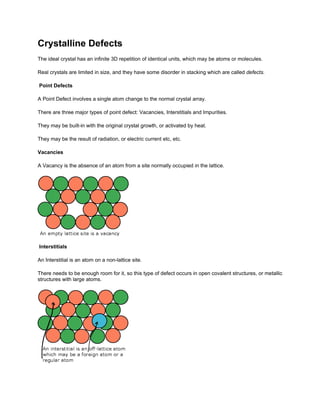
A Vacancy is the absence of an atom from a site normally occupied in the lattice.


Interstitials

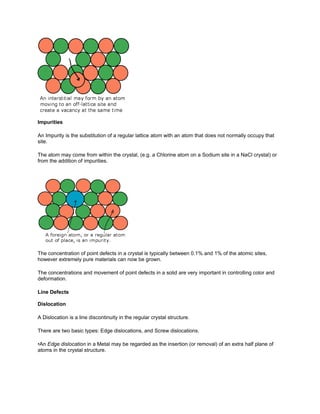
An Interstitial is an atom on a non-lattice site.

There needs to be enough room for it, so this type of defect occurs in open covalent structures, or metallic
structures with large atoms.
Impurities

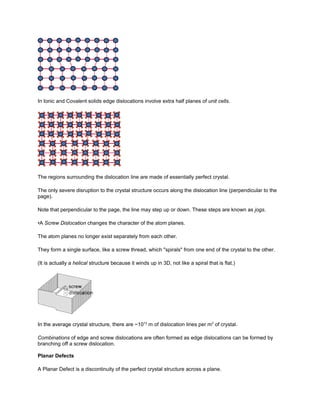
An Impurity is the substitution of a regular lattice atom with an atom that does not normally occupy that
site.

The atom may come from within the crystal, (e.g. a Chlorine atom on a Sodium site in a NaCl crystal) or
from the addition of impurities.


The concentration of point defects in a crystal is typically between 0.1% and 1% of the atomic sites,
however extremely pure materials can now be grown.

The concentrations and movement of point defects in a solid are very important in controlling color and
deformation.

Line Defects

Dislocation

A Dislocation is a line discontinuity in the regular crystal structure.

There are two basic types: Edge dislocations, and Screw dislocations.

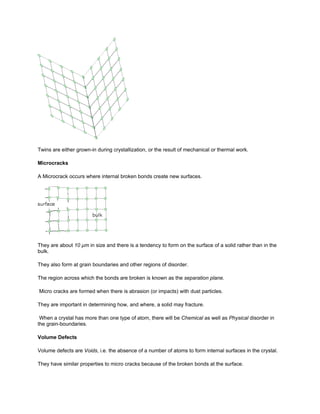
•An Edge dislocation in a Metal may be regarded as the insertion (or removal) of an extra half plane of
atoms in the crystal structure.
In Ionic and Covalent solids edge dislocations involve extra half planes of unit cells.


The regions surrounding the dislocation line are made of essentially perfect crystal.

The only severe disruption to the crystal structure occurs along the dislocation line (perpendicular to the
page).

Note that perpendicular to the page, the line may step up or down. These steps are known as jogs.

•A Screw Dislocation changes the character of the atom planes.

The atom planes no longer exist separately from each other.

They form a single surface, like a screw thread, which "spirals" from one end of the crystal to the other.

(It is actually a helical structure because it winds up in 3D, not like a spiral that is flat.)


In the average crystal structure, there are ~1012 m of dislocation lines per m3 of crystal.

Combinations of edge and screw dislocations are often formed as edge dislocations can be formed by
branching off a screw dislocation.

Planar Defects

A Planar Defect is a discontinuity of the perfect crystal structure across a plane.
Grain Boundaries

A Grain Boundary is a general planar defect that separates regions of different crystalline orientation (i.e.
grains) within a polycrystalline solid.


The atoms in the grain boundary will not be in perfect crystalline arrangement.

Grain boundaries are usually the result of uneven growth when the solid is crystallizing.

Grain sizes vary from 1 µm to 1 mm.

Tilt Boundaries

A Tilt Boundary, between two slightly mis-aligned grains appears as an array of edge dislocations.


Twin Boundaries

A Twin Boundary happens when the crystals on either side of a plane are mirror images of each other.

The boundary between the twinned crystals will be a single plane of atoms.

There is no region of disorder and the boundary atoms can be viewed as belonging to the crystal
structures of both twins
Twins are either grown-in during crystallization, or the result of mechanical or thermal work.

Microcracks

A Microcrack occurs where internal broken bonds create new surfaces.


They are about 10 µm in size and there is a tendency to form on the surface of a solid rather than in the
bulk.

They also form at grain boundaries and other regions of disorder.

The region across which the bonds are broken is known as the separation plane.

Micro cracks are formed when there is abrasion (or impacts) with dust particles.

They are important in determining how, and where, a solid may fracture.

 When a crystal has more than one type of atom, there will be Chemical as well as Physical disorder in
the grain-boundaries.

Volume Defects

Volume defects are Voids, i.e. the absence of a number of atoms to form internal surfaces in the crystal.

They have similar properties to micro cracks because of the broken bonds at the surface.
Defects

Defects

  • 1.
    Crystalline Defects The idealcrystal has an infinite 3D repetition of identical units, which may be atoms or molecules. Real crystals are limited in size, and they have some disorder in stacking which are called defects. Point Defects A Point Defect involves a single atom change to the normal crystal array. There are three major types of point defect: Vacancies, Interstitials and Impurities. They may be built-in with the original crystal growth, or activated by heat. They may be the result of radiation, or electric current etc, etc. Vacancies A Vacancy is the absence of an atom from a site normally occupied in the lattice. Interstitials An Interstitial is an atom on a non-lattice site. There needs to be enough room for it, so this type of defect occurs in open covalent structures, or metallic structures with large atoms.
  • 2.
    Impurities An Impurity isthe substitution of a regular lattice atom with an atom that does not normally occupy that site. The atom may come from within the crystal, (e.g. a Chlorine atom on a Sodium site in a NaCl crystal) or from the addition of impurities. The concentration of point defects in a crystal is typically between 0.1% and 1% of the atomic sites, however extremely pure materials can now be grown. The concentrations and movement of point defects in a solid are very important in controlling color and deformation. Line Defects Dislocation A Dislocation is a line discontinuity in the regular crystal structure. There are two basic types: Edge dislocations, and Screw dislocations. •An Edge dislocation in a Metal may be regarded as the insertion (or removal) of an extra half plane of atoms in the crystal structure.
  • 3.
    In Ionic andCovalent solids edge dislocations involve extra half planes of unit cells. The regions surrounding the dislocation line are made of essentially perfect crystal. The only severe disruption to the crystal structure occurs along the dislocation line (perpendicular to the page). Note that perpendicular to the page, the line may step up or down. These steps are known as jogs. •A Screw Dislocation changes the character of the atom planes. The atom planes no longer exist separately from each other. They form a single surface, like a screw thread, which "spirals" from one end of the crystal to the other. (It is actually a helical structure because it winds up in 3D, not like a spiral that is flat.) In the average crystal structure, there are ~1012 m of dislocation lines per m3 of crystal. Combinations of edge and screw dislocations are often formed as edge dislocations can be formed by branching off a screw dislocation. Planar Defects A Planar Defect is a discontinuity of the perfect crystal structure across a plane.
  • 4.
    Grain Boundaries A GrainBoundary is a general planar defect that separates regions of different crystalline orientation (i.e. grains) within a polycrystalline solid. The atoms in the grain boundary will not be in perfect crystalline arrangement. Grain boundaries are usually the result of uneven growth when the solid is crystallizing. Grain sizes vary from 1 µm to 1 mm. Tilt Boundaries A Tilt Boundary, between two slightly mis-aligned grains appears as an array of edge dislocations. Twin Boundaries A Twin Boundary happens when the crystals on either side of a plane are mirror images of each other. The boundary between the twinned crystals will be a single plane of atoms. There is no region of disorder and the boundary atoms can be viewed as belonging to the crystal structures of both twins
  • 5.
    Twins are eithergrown-in during crystallization, or the result of mechanical or thermal work. Microcracks A Microcrack occurs where internal broken bonds create new surfaces. They are about 10 µm in size and there is a tendency to form on the surface of a solid rather than in the bulk. They also form at grain boundaries and other regions of disorder. The region across which the bonds are broken is known as the separation plane. Micro cracks are formed when there is abrasion (or impacts) with dust particles. They are important in determining how, and where, a solid may fracture. When a crystal has more than one type of atom, there will be Chemical as well as Physical disorder in the grain-boundaries. Volume Defects Volume defects are Voids, i.e. the absence of a number of atoms to form internal surfaces in the crystal. They have similar properties to micro cracks because of the broken bonds at the surface.