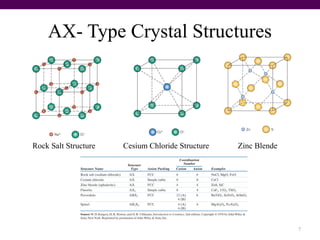
This document discusses different types of ceramic materials and their crystal structures. It begins by defining ceramics as mostly ionically bonded compounds between metals and nonmetals, or covalently bonded nonmetals. Traditional ceramics include products like china, bricks and tiles, while advanced ceramics have properties making them suitable for applications like semiconductor chips, turbine blades, and optical fibers. The document then focuses on the crystal structures of ionic ceramic compounds, describing structures like sodium chloride, cesium chloride and zinc blende based on the ratio of cation to anion radii. It notes other factors that influence crystal structure and gives examples of materials that form each type of structure.