Materials for H2 storage
Presented by
Mahfooz Alam
(17ETMM10)
#Ref: Materials for Hydrogen Storage: Past, Present, and Future; by Puru Jena; J. Phys. Chem. Lett., 2011, 2 (3),
pp 206–211,DOI: 10.1021/jz1015372
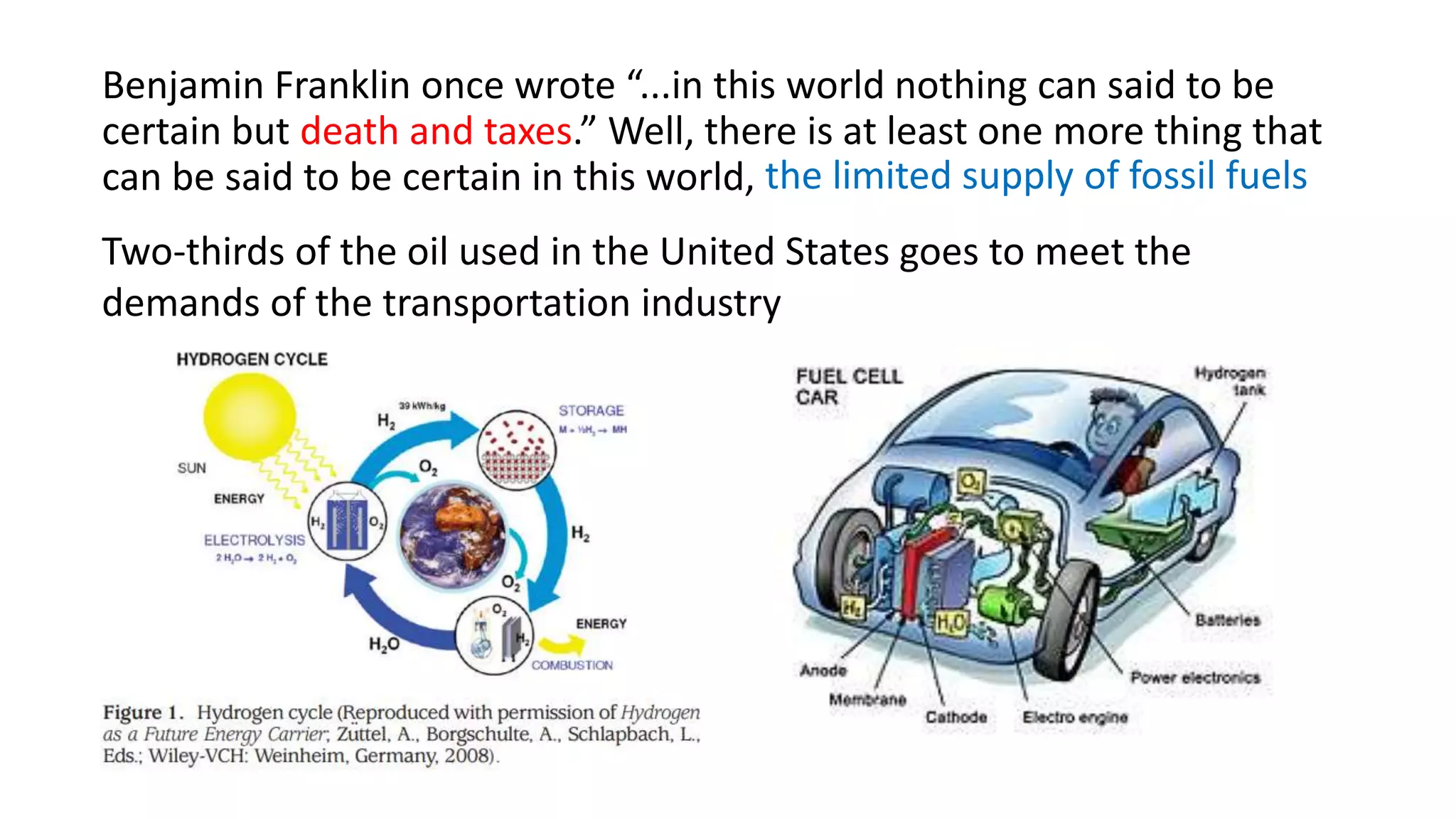
Benjamin Franklin once wrote “...in this world nothing can said to be
certain but death and taxes.” Well, there is at least one more thing that
can be said to be certain in this world, the limited supply of fossil fuels
Two-thirds of the oil used in the United States goes to meet the
demands of the transportation industry
Problems with H2
• Hydrogen is not an energy source but rather an energy carrier. It is
not freely available in nature and needs to be produced from water or
other organic compounds.
• Currently, hydrogen is stored either in high pressure tanks or in liquid
form(critical temp=33K) in cryogenic tanks. The energy density of
hydrogen even at 690 bar or in liquid form(at 20K) is 4.4 and 8.4 MJ/L
where that of gasoline is 31.6 MJ/L.(1ltr to 4ltrs).
• The alternative is to use solid materials for hydrogen storage. It has
been known for more than a century that hydrogen can be stored
reversibly in metals such as Pd. Unfortunately, these metals are heavy
and are not suitable for commercial automotive applications
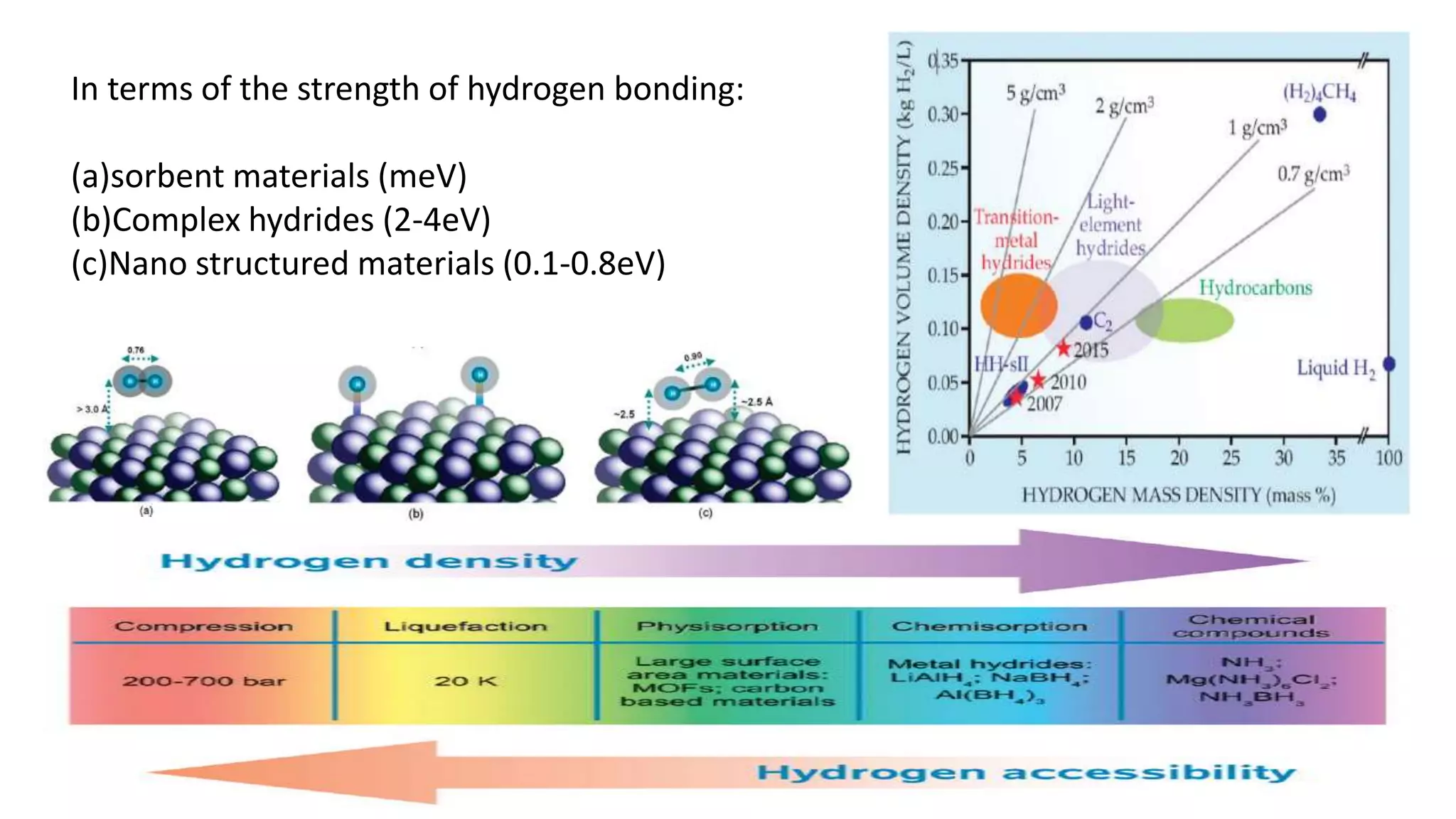
In terms of the strength of hydrogen bonding:
(a)sorbent materials (meV)
(b)Complex hydrides (2-4eV)
(c)Nano structured materials (0.1-0.8eV)
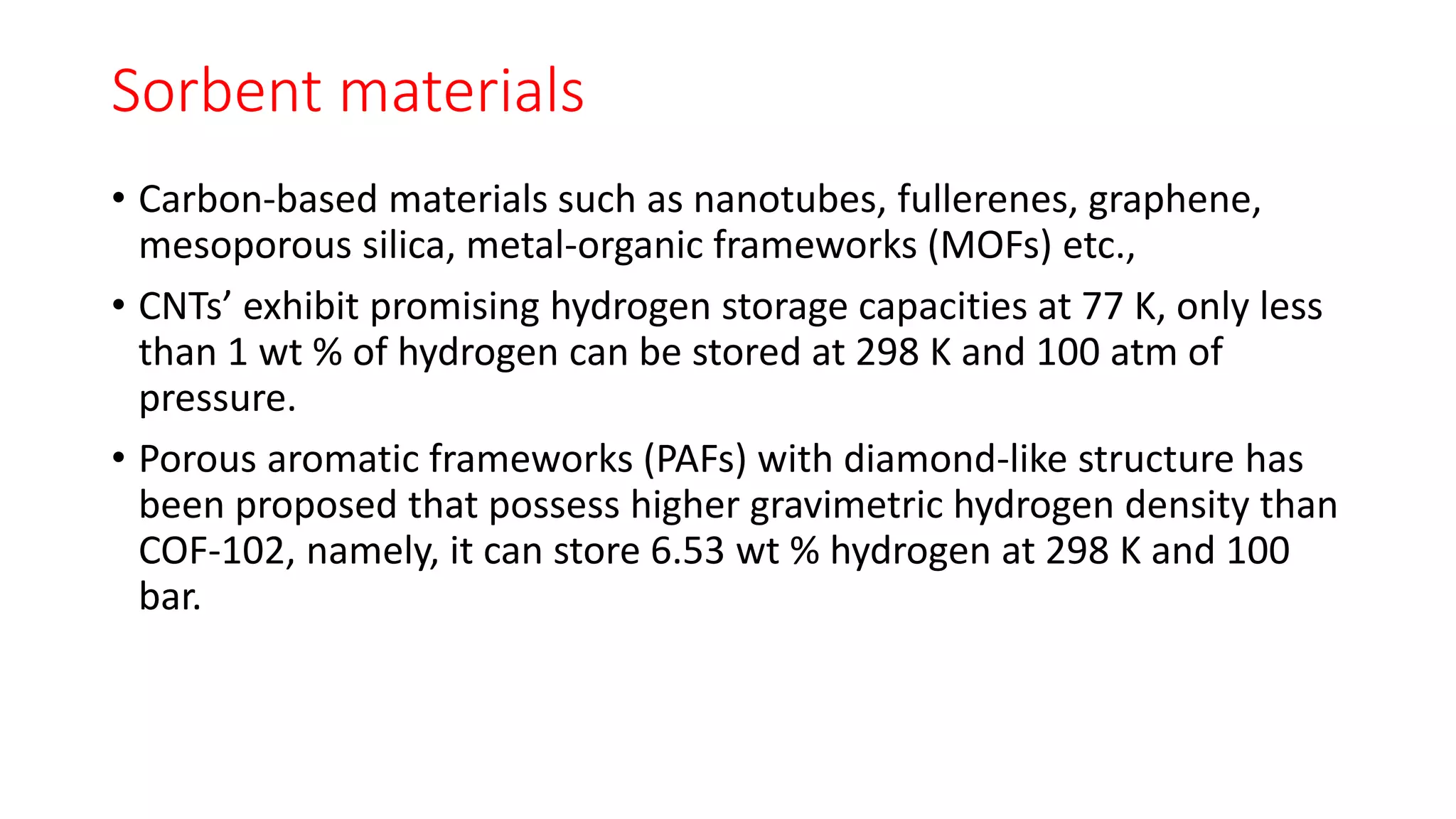
Sorbent materials
• Carbon-based materials such as nanotubes, fullerenes, graphene,
mesoporous silica, metal-organic frameworks (MOFs) etc.,
• CNTs’ exhibit promising hydrogen storage capacities at 77 K, only less
than 1 wt % of hydrogen can be stored at 298 K and 100 atm of
pressure.
• Porous aromatic frameworks (PAFs) with diamond-like structure has
been proposed that possess higher gravimetric hydrogen density than
COF-102, namely, it can store 6.53 wt % hydrogen at 298 K and 100
bar.
Complex hydrides
2100C, 3.7wt%
2500C, 1.9wt%
• These are heavy
• Expensive
• Works at high temperatures
only
• Some are not reversible
Clathrate hydrates: (H2)4CH4
(referred to as H4M), with 33.4%
molecular hydrogen by mass or 50%
total hydrogen if one includes the
four hydrogen atoms within each
methane molecule.
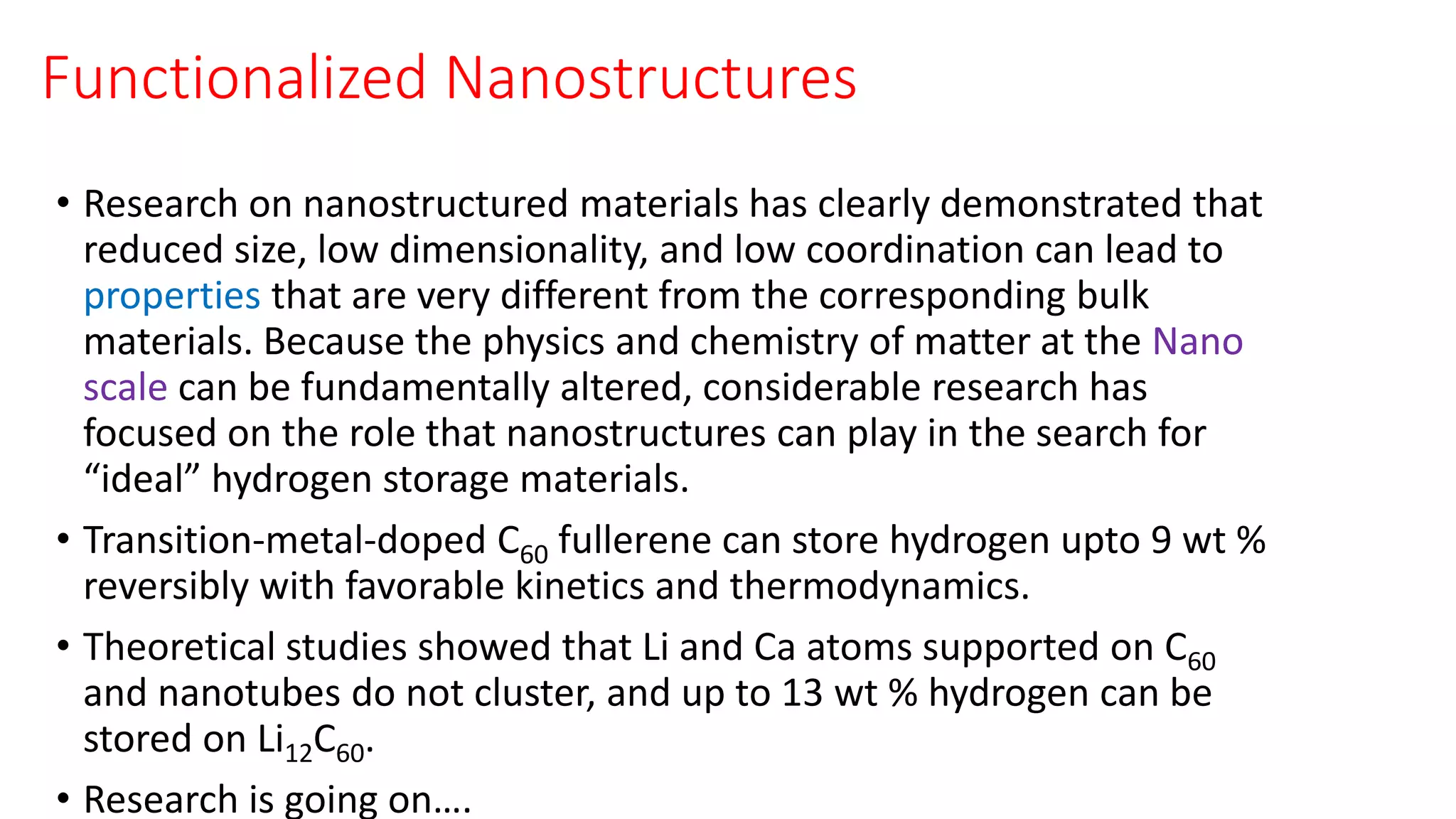
Functionalized Nanostructures
• Research on nanostructured materials has clearly demonstrated that
reduced size, low dimensionality, and low coordination can lead to
properties that are very different from the corresponding bulk
materials. Because the physics and chemistry of matter at the Nano
scale can be fundamentally altered, considerable research has
focused on the role that nanostructures can play in the search for
“ideal” hydrogen storage materials.
• Transition-metal-doped C60 fullerene can store hydrogen upto 9 wt %
reversibly with favorable kinetics and thermodynamics.
• Theoretical studies showed that Li and Ca atoms supported on C60
and nanotubes do not cluster, and up to 13 wt % hydrogen can be
stored on Li12C60.
• Research is going on….
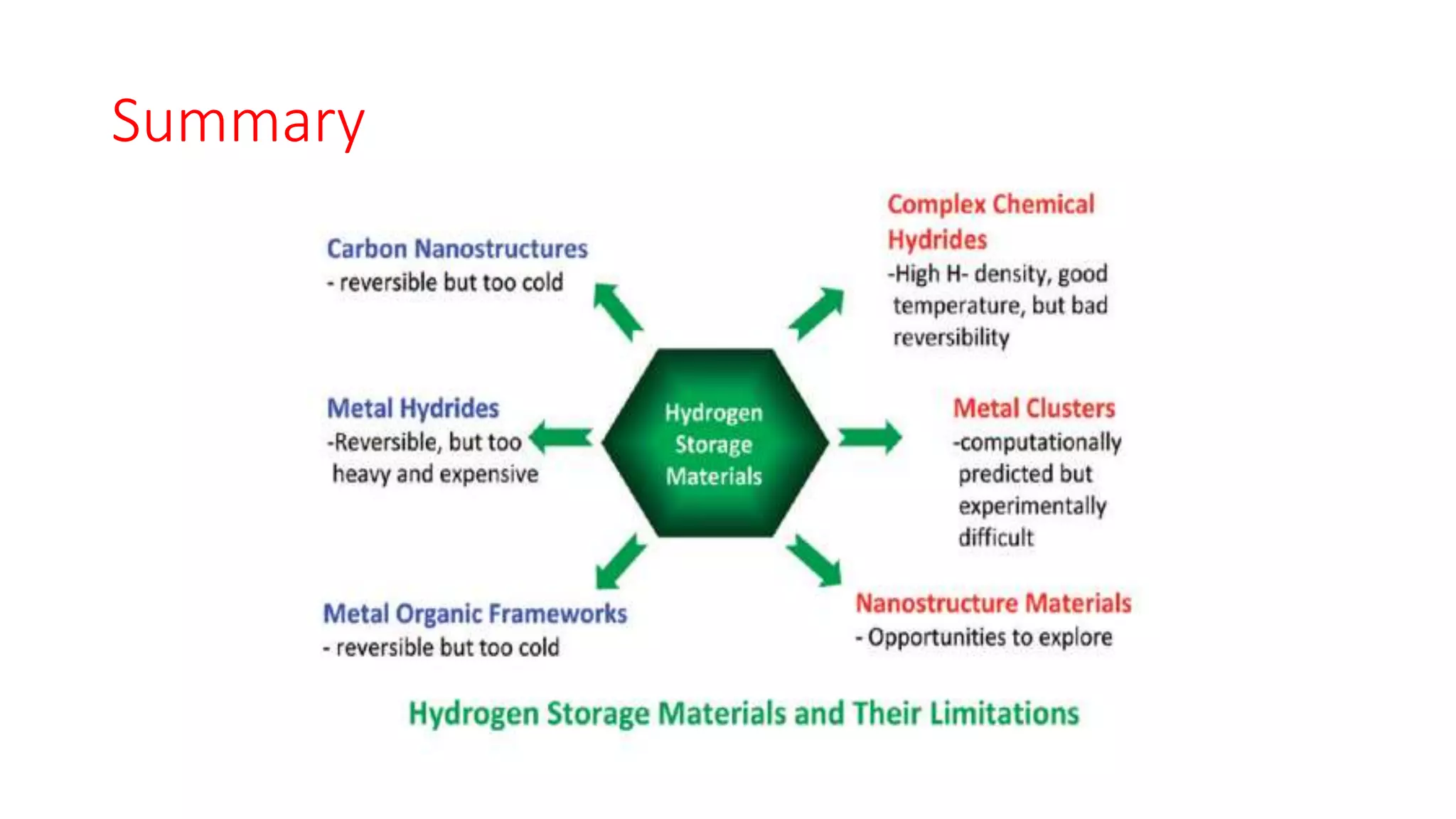
Summary
Conclusions
• Nanostructured materials provide opportunities but are yet to
emerge as practical materials.
• Much research still needs to be done to identify appropriate catalysts,
study the existence of stable intermediate phases and their crystal
structure, and understand the kinetics.
“….water will furnish an inexhaustible source of heat and light, of an intensity of which
coal is not capable...When the deposits of coal are exhausted we shall heat and warm
ourselves with water. Water will be the coal of the future.” said Jules Verne in “The
Mysteriuos Island”
Thank you all
Questions?

mahfooz_materials for h2 storage

  • 1.
    Materials for H2storage Presented by Mahfooz Alam (17ETMM10) #Ref: Materials for Hydrogen Storage: Past, Present, and Future; by Puru Jena; J. Phys. Chem. Lett., 2011, 2 (3), pp 206–211,DOI: 10.1021/jz1015372
  • 2.
    Benjamin Franklin oncewrote “...in this world nothing can said to be certain but death and taxes.” Well, there is at least one more thing that can be said to be certain in this world, the limited supply of fossil fuels Two-thirds of the oil used in the United States goes to meet the demands of the transportation industry
  • 3.
    Problems with H2 •Hydrogen is not an energy source but rather an energy carrier. It is not freely available in nature and needs to be produced from water or other organic compounds. • Currently, hydrogen is stored either in high pressure tanks or in liquid form(critical temp=33K) in cryogenic tanks. The energy density of hydrogen even at 690 bar or in liquid form(at 20K) is 4.4 and 8.4 MJ/L where that of gasoline is 31.6 MJ/L.(1ltr to 4ltrs). • The alternative is to use solid materials for hydrogen storage. It has been known for more than a century that hydrogen can be stored reversibly in metals such as Pd. Unfortunately, these metals are heavy and are not suitable for commercial automotive applications
  • 4.
    In terms ofthe strength of hydrogen bonding: (a)sorbent materials (meV) (b)Complex hydrides (2-4eV) (c)Nano structured materials (0.1-0.8eV)
  • 5.
    Sorbent materials • Carbon-basedmaterials such as nanotubes, fullerenes, graphene, mesoporous silica, metal-organic frameworks (MOFs) etc., • CNTs’ exhibit promising hydrogen storage capacities at 77 K, only less than 1 wt % of hydrogen can be stored at 298 K and 100 atm of pressure. • Porous aromatic frameworks (PAFs) with diamond-like structure has been proposed that possess higher gravimetric hydrogen density than COF-102, namely, it can store 6.53 wt % hydrogen at 298 K and 100 bar.
  • 6.
    Complex hydrides 2100C, 3.7wt% 2500C,1.9wt% • These are heavy • Expensive • Works at high temperatures only • Some are not reversible Clathrate hydrates: (H2)4CH4 (referred to as H4M), with 33.4% molecular hydrogen by mass or 50% total hydrogen if one includes the four hydrogen atoms within each methane molecule.
  • 7.
    Functionalized Nanostructures • Researchon nanostructured materials has clearly demonstrated that reduced size, low dimensionality, and low coordination can lead to properties that are very different from the corresponding bulk materials. Because the physics and chemistry of matter at the Nano scale can be fundamentally altered, considerable research has focused on the role that nanostructures can play in the search for “ideal” hydrogen storage materials. • Transition-metal-doped C60 fullerene can store hydrogen upto 9 wt % reversibly with favorable kinetics and thermodynamics. • Theoretical studies showed that Li and Ca atoms supported on C60 and nanotubes do not cluster, and up to 13 wt % hydrogen can be stored on Li12C60. • Research is going on….
  • 8.
  • 9.
    Conclusions • Nanostructured materialsprovide opportunities but are yet to emerge as practical materials. • Much research still needs to be done to identify appropriate catalysts, study the existence of stable intermediate phases and their crystal structure, and understand the kinetics. “….water will furnish an inexhaustible source of heat and light, of an intensity of which coal is not capable...When the deposits of coal are exhausted we shall heat and warm ourselves with water. Water will be the coal of the future.” said Jules Verne in “The Mysteriuos Island”
  • 10.