CHAPTER 4
ENZYME
CATALYSIS
ENZYME CATALYSIS
 Application of Hydrolytic Enzymes.
 Enzyme Immobilization Technology:
- Methods of enzyme immobilization.
- Immobilized enzyme kinetics.
SUBCHAPTER
INTRODUCTION
OBJECTIVE OF THIS CHAPTER:
 To study some of the applications
of enzymes.
 To examine immobilized enzyme
catalyst formulations (allow
sustained, continuous use of the
enzyme).
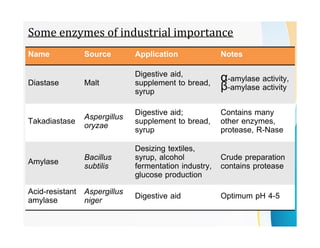
Some enzymes of industrial importance
Name Source Application Notes
Diastase Malt
Digestive aid,
supplement to bread,
syrup
α-amylase activity,
β-amylase activity
Takadiastase Aspergillus
oryzae
Digestive aid;
supplement to bread,
syrup
Contains many
other enzymes,
protease, R-Nase
Amylase Bacillus
subtilis
Desizing textiles,
syrup, alcohol
fermentation industry,
glucose production
Crude preparation
contains protease
Acid-resistant
amylase
Aspergillus
niger Digestive aid Optimum pH 4-5
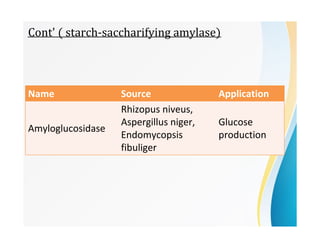
Cont' ( starch-saccharifying amylase)
Name Source Application
Amyloglucosidase
Rhizopus niveus,
Aspergillus niger,
Endomycopsis
fibuliger
Glucose
production
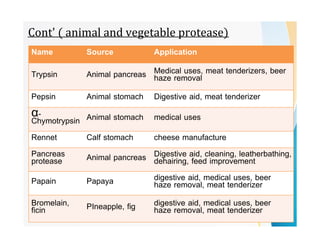
Cont' ( animal and vegetable protease)
Name Source Application
Trypsin Animal pancreas Medical uses, meat tenderizers, beer
haze removal
Pepsin Animal stomach Digestive aid, meat tenderizer
α-
Chymotrypsin Animal stomach medical uses
Rennet Calf stomach cheese manufacture
Pancreas
protease Animal pancreas Digestive aid, cleaning, leatherbathing,
dehairing, feed improvement
Papain Papaya digestive aid, medical uses, beer
haze removal, meat tenderizer
Bromelain,
ficin PIneapple, fig digestive aid, medical uses, beer
haze removal, meat tenderizer
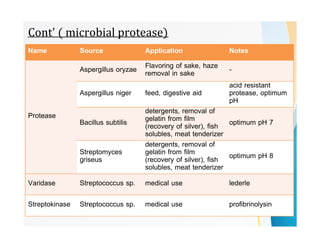
Cont' ( microbial protease)
Name Source Application Notes
Protease
Aspergillus oryzae Flavoring of sake, haze
removal in sake -
Aspergillus niger feed, digestive aid
acid resistant
protease, optimum
pH
Bacillus subtilis
detergents, removal of
gelatin from film
(recovery of silver), fish
solubles, meat tenderizer
optimum pH 7
Streptomyces
griseus
detergents, removal of
gelatin from film
(recovery of silver), fish
solubles, meat tenderizer
optimum pH 8
Varidase Streptococcus sp. medical use lederle
Streptokinase Streptococcus sp. medical use profibrinolysin
APPLICATION OF
HYDROLYTIC ENZYMES
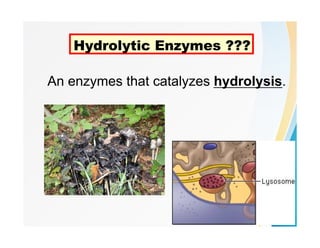
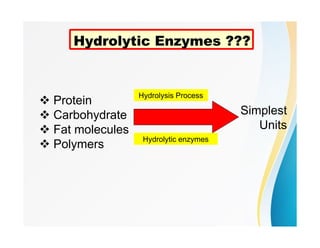
Hydrolytic Enzymes ???
An enzymes that catalyzes hydrolysis.
 Protein
 Carbohydrate
 Fat molecules
 Polymers
Simplest
Units
Hydrolysis Process
Hydrolytic Enzymes ???
Hydrolytic enzymes
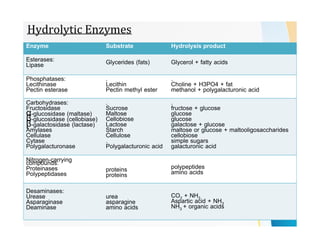
Hydrolytic Enzymes
Enzyme Substrate Hydrolysis product
Esterases:
Lipase Glycerides (fats) Glycerol + fatty acids
Phosphatases:
Lecithinase
Pectin esterase
.
Lecithin
Pectin methyl ester
.
Choline + H3PO4 + fat
methanol + polygalacturonic acid
Carbohydrases:
Fructosidase
α-glucosidase (maltase)
β-glucosidase (cellobiase)
β-galactosidase (lactase)
Amylases
Cellulase
Cytase
Polygalacturonase
.
Sucrose
Maltose
Cellobiose
Lactose
Starch
Cellulose
.
Polygalacturonic acid
.
fructose + glucose
glucose
glucose
galactose + glucose
maltose or glucose + maltooligosaccharides
cellobiose
simple sugars
galacturonic acid
Nitrogen-carryingcompounds:
Proteinases
Polypeptidases proteins
proteins
polypeptides
amino acids
Desaminases:
Urease
Asparaginase
Deaminase
urea
asparagine
amino acids
CO2 + NH3
Aspartic acid + NH3
NH3 + organic acids
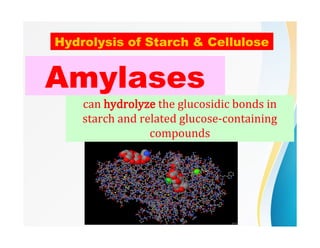
Hydrolysis of Starch & Cellulose
Amylases
can hydrolyze the glucosidic bonds in
starch and related glucose-containing
compounds
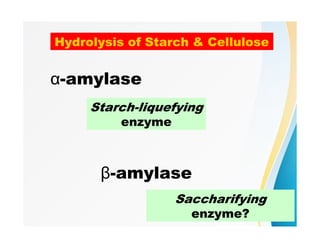
Saccharifying
enzyme?
Hydrolysis of Starch & Cellulose
α-amylase
β-amylase
Starch-liquefying
enzyme
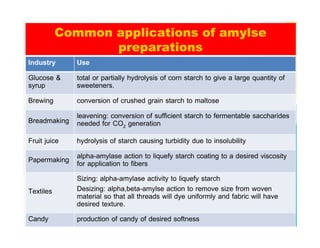
Industry Use
Glucose &
syrup
total or partially hydrolysis of corn starch to give a large quantity of
sweeteners.
Brewing conversion of crushed grain starch to maltose
Breadmaking leavening: conversion of sufficient starch to fermentable saccharides
needed for CO2 generation
Fruit juice hydrolysis of starch causing turbidity due to insolubility
Papermaking alpha-amylase action to liquefy starch coating to a desired viscosity
for application to fibers
Textiles
Sizing: alpha-amylase activity to liquefy starch
Desizing: alpha,beta-amylse action to remove size from woven
material so that all threads will dye uniformly and fabric will have
desired texture.
Candy production of candy of desired softness
Common applications of amylse
preparations
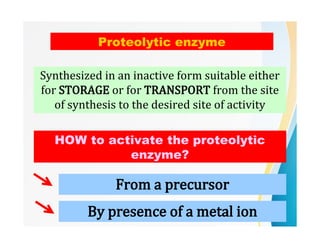
Proteolytic enzyme
Synthesized in an inactive form suitable either
for STORAGE or for TRANSPORT from the site
of synthesis to the desired site of activity
HOW to activate the proteolytic
enzyme?
From a precursor
By presence of a metal ion
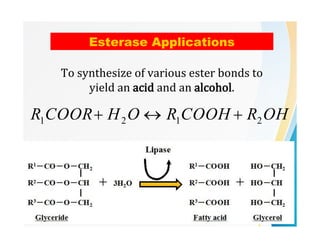
OHRCOOHROHCOORR 2121 
Esterase Applications
To synthesize of various ester bonds to
yield an acid and an alcohol.
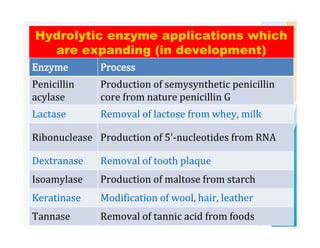
Hydrolytic enzyme applications which
are expanding (in development)
Enzyme Process
Penicillin
acylase
Production of semysynthetic penicillin
core from nature penicillin G
Lactase Removal of lactose from whey, milk
Ribonuclease Production of 5'-nucleotides from RNA
Dextranase Removal of tooth plaque
Isoamylase Production of maltose from starch
Keratinase Modification of wool, hair, leather
Tannase Removal of tannic acid from foods
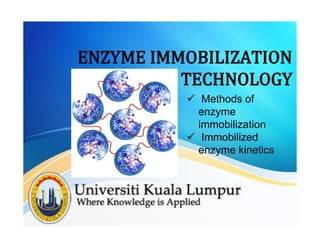
ENZYME IMMOBILIZATION
TECHNOLOGY
 Methods of
enzyme
immobilization
 Immobilized
enzyme kinetics
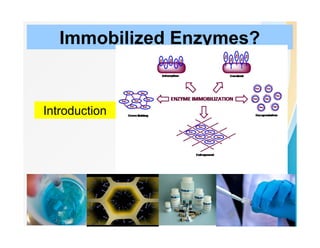
Immobilized Enzymes?
Introduction
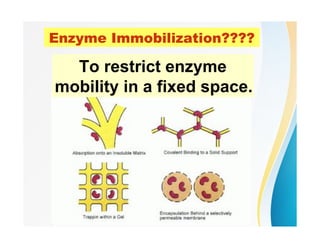
Enzyme Immobilization????
To restrict enzyme
mobility in a fixed space.
Enzyme Immobilization????
Immbolized enzymes are
ATTACHED
to an insoluble suppport medium or
enclosed by the support medium
which is also known as a CARRIER
In some cases, the enzymes molecules are
cross-linked to each other so that their
movement is restricted but their catalytic
activities are retained.
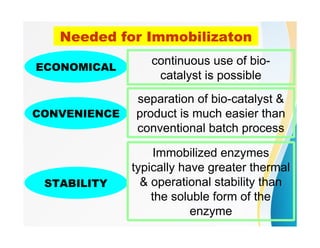
Needed for Immobilizaton
ECONOMICAL
CONVENIENCE
STABILITY
continuous use of bio-
catalyst is possible
separation of bio-catalyst &
product is much easier than
conventional batch process
Immobilized enzymes
typically have greater thermal
& operational stability than
the soluble form of the
enzyme
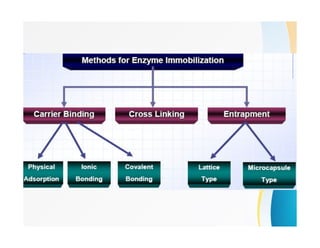
Methods for Enzyme
Immobilization
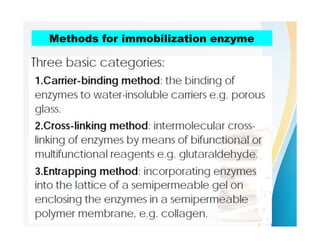
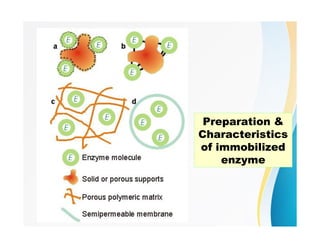
Methods for immobilization enzyme
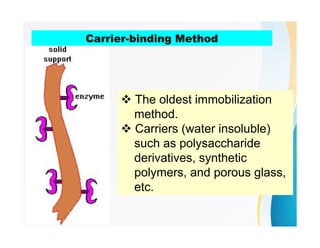
Carrier-binding Method
 The oldest immobilization
method.
 Carriers (water insoluble)
such as polysaccharide
derivatives, synthetic
polymers, and porous glass,
etc.
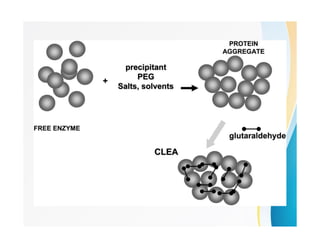
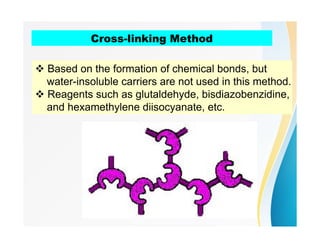
Cross-linking Method
 Based on the formation of chemical bonds, but
water-insoluble carriers are not used in this method.
 Reagents such as glutaldehyde, bisdiazobenzidine,
and hexamethylene diisocyanate, etc.
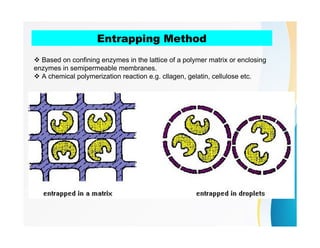
Entrapping Method
 Based on confining enzymes in the lattice of a polymer matrix or enclosing
enzymes in semipermeable membranes.
 A chemical polymerization reaction e.g. cllagen, gelatin, cellulose etc.
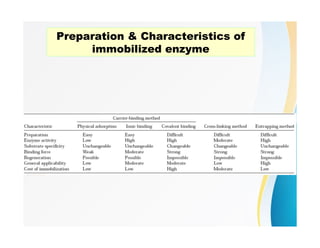
Preparation &
Characteristics
of immobilized
enzyme
Preparation & Characteristics of
immobilized enzyme
Benefits of immobilizing and ENZYME
 Multiple or repetitive use of a single batch of
enzymes.
 The ability to stop the reaction rapidly by removing
the enzyme from the reaction solution (or vice
versa).
 Enzymes are usually stabilized by bounding.
 Product is not contaminated with the enzyme
(especially useful in the food and pharmaceutical
industries).
 Analytical purposes - long 1/2-life, predictable
decay rates, elimination of reagent preparation, etc.
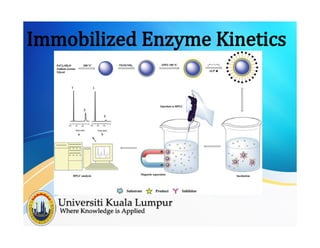
Immobilized Enzyme Kinetics

enzyme catalysis

  • 1.
  • 2.
    ENZYME CATALYSIS  Applicationof Hydrolytic Enzymes.  Enzyme Immobilization Technology: - Methods of enzyme immobilization. - Immobilized enzyme kinetics. SUBCHAPTER
  • 3.
  • 4.
    OBJECTIVE OF THISCHAPTER:  To study some of the applications of enzymes.  To examine immobilized enzyme catalyst formulations (allow sustained, continuous use of the enzyme).
  • 5.
    Some enzymes ofindustrial importance Name Source Application Notes Diastase Malt Digestive aid, supplement to bread, syrup α-amylase activity, β-amylase activity Takadiastase Aspergillus oryzae Digestive aid; supplement to bread, syrup Contains many other enzymes, protease, R-Nase Amylase Bacillus subtilis Desizing textiles, syrup, alcohol fermentation industry, glucose production Crude preparation contains protease Acid-resistant amylase Aspergillus niger Digestive aid Optimum pH 4-5
  • 6.
    Cont' ( starch-saccharifyingamylase) Name Source Application Amyloglucosidase Rhizopus niveus, Aspergillus niger, Endomycopsis fibuliger Glucose production
  • 7.
    Cont' ( animaland vegetable protease) Name Source Application Trypsin Animal pancreas Medical uses, meat tenderizers, beer haze removal Pepsin Animal stomach Digestive aid, meat tenderizer α- Chymotrypsin Animal stomach medical uses Rennet Calf stomach cheese manufacture Pancreas protease Animal pancreas Digestive aid, cleaning, leatherbathing, dehairing, feed improvement Papain Papaya digestive aid, medical uses, beer haze removal, meat tenderizer Bromelain, ficin PIneapple, fig digestive aid, medical uses, beer haze removal, meat tenderizer
  • 8.
    Cont' ( microbialprotease) Name Source Application Notes Protease Aspergillus oryzae Flavoring of sake, haze removal in sake - Aspergillus niger feed, digestive aid acid resistant protease, optimum pH Bacillus subtilis detergents, removal of gelatin from film (recovery of silver), fish solubles, meat tenderizer optimum pH 7 Streptomyces griseus detergents, removal of gelatin from film (recovery of silver), fish solubles, meat tenderizer optimum pH 8 Varidase Streptococcus sp. medical use lederle Streptokinase Streptococcus sp. medical use profibrinolysin
  • 9.
  • 10.
    Hydrolytic Enzymes ??? Anenzymes that catalyzes hydrolysis.
  • 11.
     Protein  Carbohydrate Fat molecules  Polymers Simplest Units Hydrolysis Process Hydrolytic Enzymes ??? Hydrolytic enzymes
  • 12.
    Hydrolytic Enzymes Enzyme SubstrateHydrolysis product Esterases: Lipase Glycerides (fats) Glycerol + fatty acids Phosphatases: Lecithinase Pectin esterase . Lecithin Pectin methyl ester . Choline + H3PO4 + fat methanol + polygalacturonic acid Carbohydrases: Fructosidase α-glucosidase (maltase) β-glucosidase (cellobiase) β-galactosidase (lactase) Amylases Cellulase Cytase Polygalacturonase . Sucrose Maltose Cellobiose Lactose Starch Cellulose . Polygalacturonic acid . fructose + glucose glucose glucose galactose + glucose maltose or glucose + maltooligosaccharides cellobiose simple sugars galacturonic acid Nitrogen-carryingcompounds: Proteinases Polypeptidases proteins proteins polypeptides amino acids Desaminases: Urease Asparaginase Deaminase urea asparagine amino acids CO2 + NH3 Aspartic acid + NH3 NH3 + organic acids
  • 13.
    Hydrolysis of Starch& Cellulose Amylases can hydrolyze the glucosidic bonds in starch and related glucose-containing compounds
  • 14.
    Saccharifying enzyme? Hydrolysis of Starch& Cellulose α-amylase β-amylase Starch-liquefying enzyme
  • 15.
    Industry Use Glucose & syrup totalor partially hydrolysis of corn starch to give a large quantity of sweeteners. Brewing conversion of crushed grain starch to maltose Breadmaking leavening: conversion of sufficient starch to fermentable saccharides needed for CO2 generation Fruit juice hydrolysis of starch causing turbidity due to insolubility Papermaking alpha-amylase action to liquefy starch coating to a desired viscosity for application to fibers Textiles Sizing: alpha-amylase activity to liquefy starch Desizing: alpha,beta-amylse action to remove size from woven material so that all threads will dye uniformly and fabric will have desired texture. Candy production of candy of desired softness Common applications of amylse preparations
  • 16.
    Proteolytic enzyme Synthesized inan inactive form suitable either for STORAGE or for TRANSPORT from the site of synthesis to the desired site of activity HOW to activate the proteolytic enzyme? From a precursor By presence of a metal ion
  • 17.
    OHRCOOHROHCOORR 2121  EsteraseApplications To synthesize of various ester bonds to yield an acid and an alcohol.
  • 18.
    Hydrolytic enzyme applicationswhich are expanding (in development) Enzyme Process Penicillin acylase Production of semysynthetic penicillin core from nature penicillin G Lactase Removal of lactose from whey, milk Ribonuclease Production of 5'-nucleotides from RNA Dextranase Removal of tooth plaque Isoamylase Production of maltose from starch Keratinase Modification of wool, hair, leather Tannase Removal of tannic acid from foods
  • 19.
    ENZYME IMMOBILIZATION TECHNOLOGY  Methodsof enzyme immobilization  Immobilized enzyme kinetics
  • 20.
  • 21.
    Enzyme Immobilization???? To restrictenzyme mobility in a fixed space.
  • 22.
    Enzyme Immobilization???? Immbolized enzymesare ATTACHED to an insoluble suppport medium or enclosed by the support medium which is also known as a CARRIER In some cases, the enzymes molecules are cross-linked to each other so that their movement is restricted but their catalytic activities are retained.
  • 24.
    Needed for Immobilizaton ECONOMICAL CONVENIENCE STABILITY continuoususe of bio- catalyst is possible separation of bio-catalyst & product is much easier than conventional batch process Immobilized enzymes typically have greater thermal & operational stability than the soluble form of the enzyme
  • 25.
  • 27.
  • 28.
    Carrier-binding Method  Theoldest immobilization method.  Carriers (water insoluble) such as polysaccharide derivatives, synthetic polymers, and porous glass, etc.
  • 29.
    Cross-linking Method  Basedon the formation of chemical bonds, but water-insoluble carriers are not used in this method.  Reagents such as glutaldehyde, bisdiazobenzidine, and hexamethylene diisocyanate, etc.
  • 30.
    Entrapping Method  Basedon confining enzymes in the lattice of a polymer matrix or enclosing enzymes in semipermeable membranes.  A chemical polymerization reaction e.g. cllagen, gelatin, cellulose etc.
  • 31.
  • 32.
    Preparation & Characteristicsof immobilized enzyme
  • 33.
    Benefits of immobilizingand ENZYME  Multiple or repetitive use of a single batch of enzymes.  The ability to stop the reaction rapidly by removing the enzyme from the reaction solution (or vice versa).  Enzymes are usually stabilized by bounding.  Product is not contaminated with the enzyme (especially useful in the food and pharmaceutical industries).  Analytical purposes - long 1/2-life, predictable decay rates, elimination of reagent preparation, etc.
  • 34.