X RAY CRYSTALLOGRAPHY
PRESENTED BY: AYESHA KABEER
UNIVERSITY OF GUJRAT SIALKOT SUBCAMPUS
X-RAY CRYSTALLOGRAPHY
INTRODUCTION:
 X-ray Crystallography is a scientific method of determining the
precise positions/arrangements of atoms in a crystal where beams of
X-ray strikes a crystal and causes the beam of light to diffract into
many specific directions
OR
 X-ray crystallography is a technique used for determining the atomic
and molecular structure of a crystal, in which the crystalline atoms
cause a beam of incident X-rays to diffract into many specific
directions.
X- RAY CRYSTALLOGRAPHY
APPARATUS:
X- RAY CRYSTALLOGRAPHY
APPARATUS:
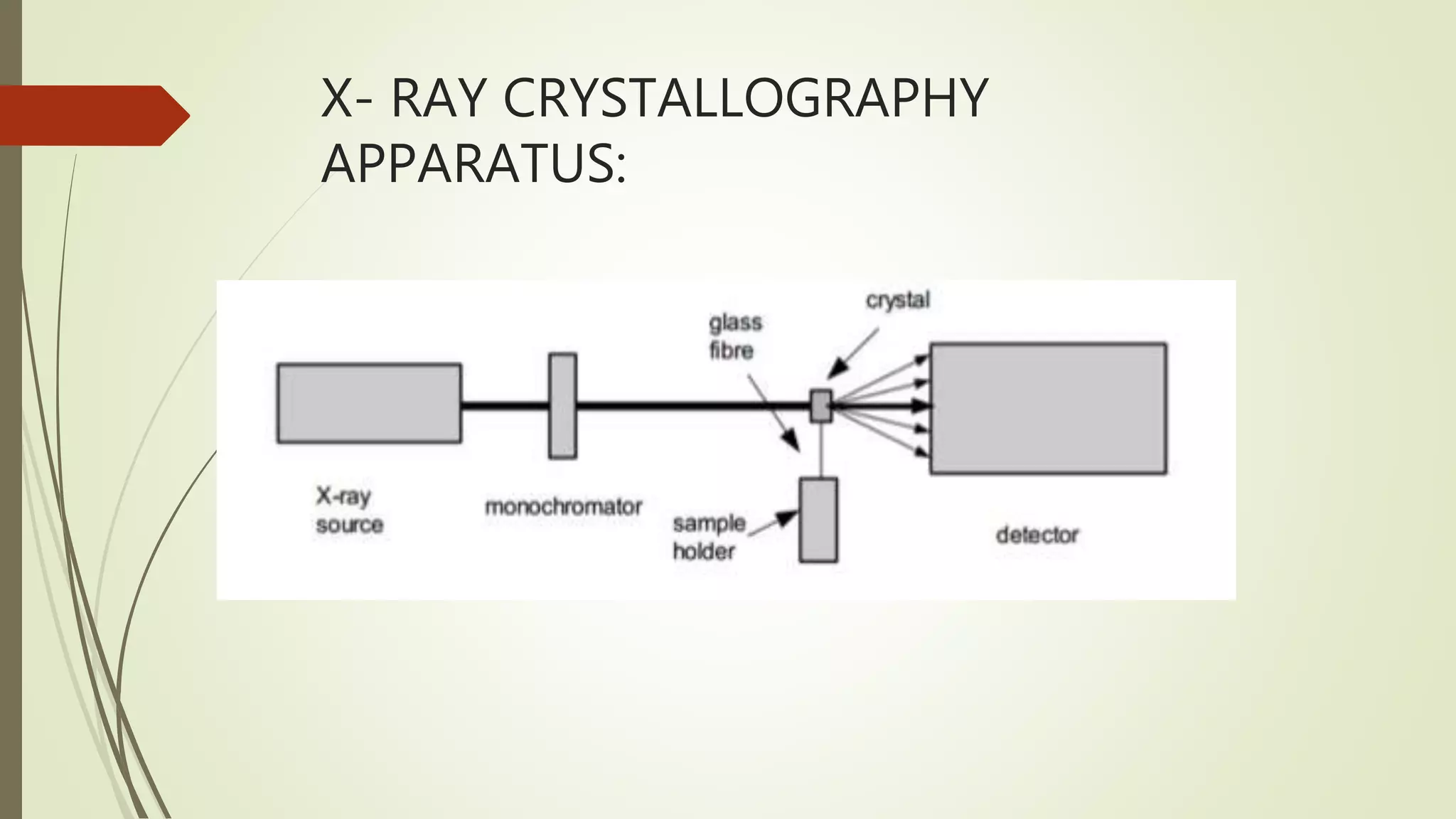
 X-RAY SOURCE
 FILTERS, MONOCHROMATORS AND COLLIMATORS
 DIFFRACTOMETER
 SAMPLE HOLDER
 CRYSTAL
 X-RAY DETECTORS
 X-RAY SOURCES
 X-rays are produced by accelerating electrons into a metal target
 There are several sources of X-rays, such some radioactive materials and
synchrotrons. Synchrotrons produce a significantly higher flux of X-rays and the
wavelength of the radiation may changed, as necessary.
 A high-flux source offers many advantages including reduced experimental time
and smaller allowable crystal sizes.
X- RAY CRYSTALLOGRAPHY
APPARATUS:
 FILTERS, MONOCHROMATORS AND COLLIMATORS
 To obtain the best results, the X-ray beam used in the diffraction experiment
should all be of a single wavelength and they should be as parallel as possible.
To accomplish this in practice, we use filters, monochromators and collimators.
 The filter is a material that begins to absorb X-rays strongly between the ∝and β.
This allows us to obtain only the ∝ band.
 A monochromator is a very stable single crystal that further filters the radiation
to make it as monochromatic as possible.
 A collimator is a tube containing smaller tubes (ca. 0.5 mm) that attempts to
reduce the dispersion of the X-ray beam and limits the diameter of the beam.
X- RAY CRYSTALLOGRAPHY
APPARATUS:
 DIFFRACTOMETER:
 A device for rotating the crystal and the detector so that the entire diffraction
pattern can be recorded under the control of a computer.
 CRYSTAL:
 There are numerous methods to obtain crystals of sufficient size and quality for
X-ray diffraction experiments in which two of them are:
1. Crystallization
2. Sublimation
X- RAY CRYSTALLOGRAPHY
APPARATUS:
 X-RAY DETECTORS:
 X-rays may be detected by a variety of different devices. The major distinction
between detectors is in the number of reflections they are able to collect at a
single time.
1. Point detectors can only collect a single reflection at a given time and, because of
this deficit, are not as useful for routine crystallography.
2. Area detectors can collect many reflections simultaneously and are thus preferred
for routine data collection. Examples of such detectors include CMOS detectors,
photon counters, CCD cameras, Image Plates, multi-wire detectors and even X-
ray film (in the past).
X- RAY CRYSTALLOGRAPHY
APPARATUS:
 Protein purification
 Protein crystallization
o Grow homogeneous single crystals
o Formation of crystal can be done by highly concentrated solution of the protein
and adding reagents to reduce the solubility.
 Data collection
o Measure intensities with diffractometer
 Structure solution( phasing or phase determination)
o Molecular replacements
o Heavy atom methods
 Structure determination (model building and refinement)
o Resolution
X- RAY CRYSTALLOGRAPHY
PROCEDURE:
X- RAY
CRYSTALLOGRAPHY
PROCEDURE:
 The method revealed the structure and function of many biological molecules,
including vitamins, drugs, proteins and nucleic acids such as DNA.
 Used to study many materials which form crystals like salts, metals, minerals,
semiconductors, as well as various inorganic, organic and biological molecules.
 Determine electron density, the mean positions of the atoms in the crystal, their
chemical bonds, their disorder and various other information.
X- RAY CRYSTALLOGRAPHY
USES:
 X-Ray crystallography allows researchers today to see how certain
factors may effect protein structure
 Allows researchers today to see how secondary protein structures in
protein residues can fold depending on different environmental factors
X- RAY CRYSTALLOGRAPHY
CONCLUSIONS:

X - RAY CRYSTALLOGRAPHY TECHNIQUE

  • 1.
    X RAY CRYSTALLOGRAPHY PRESENTEDBY: AYESHA KABEER UNIVERSITY OF GUJRAT SIALKOT SUBCAMPUS
  • 2.
    X-RAY CRYSTALLOGRAPHY INTRODUCTION:  X-rayCrystallography is a scientific method of determining the precise positions/arrangements of atoms in a crystal where beams of X-ray strikes a crystal and causes the beam of light to diffract into many specific directions OR  X-ray crystallography is a technique used for determining the atomic and molecular structure of a crystal, in which the crystalline atoms cause a beam of incident X-rays to diffract into many specific directions.
  • 3.
  • 4.
    X- RAY CRYSTALLOGRAPHY APPARATUS: X-RAY SOURCE  FILTERS, MONOCHROMATORS AND COLLIMATORS  DIFFRACTOMETER  SAMPLE HOLDER  CRYSTAL  X-RAY DETECTORS
  • 5.
     X-RAY SOURCES X-rays are produced by accelerating electrons into a metal target  There are several sources of X-rays, such some radioactive materials and synchrotrons. Synchrotrons produce a significantly higher flux of X-rays and the wavelength of the radiation may changed, as necessary.  A high-flux source offers many advantages including reduced experimental time and smaller allowable crystal sizes. X- RAY CRYSTALLOGRAPHY APPARATUS:
  • 6.
     FILTERS, MONOCHROMATORSAND COLLIMATORS  To obtain the best results, the X-ray beam used in the diffraction experiment should all be of a single wavelength and they should be as parallel as possible. To accomplish this in practice, we use filters, monochromators and collimators.  The filter is a material that begins to absorb X-rays strongly between the ∝and β. This allows us to obtain only the ∝ band.  A monochromator is a very stable single crystal that further filters the radiation to make it as monochromatic as possible.  A collimator is a tube containing smaller tubes (ca. 0.5 mm) that attempts to reduce the dispersion of the X-ray beam and limits the diameter of the beam. X- RAY CRYSTALLOGRAPHY APPARATUS:
  • 7.
     DIFFRACTOMETER:  Adevice for rotating the crystal and the detector so that the entire diffraction pattern can be recorded under the control of a computer.  CRYSTAL:  There are numerous methods to obtain crystals of sufficient size and quality for X-ray diffraction experiments in which two of them are: 1. Crystallization 2. Sublimation X- RAY CRYSTALLOGRAPHY APPARATUS:
  • 8.
     X-RAY DETECTORS: X-rays may be detected by a variety of different devices. The major distinction between detectors is in the number of reflections they are able to collect at a single time. 1. Point detectors can only collect a single reflection at a given time and, because of this deficit, are not as useful for routine crystallography. 2. Area detectors can collect many reflections simultaneously and are thus preferred for routine data collection. Examples of such detectors include CMOS detectors, photon counters, CCD cameras, Image Plates, multi-wire detectors and even X- ray film (in the past). X- RAY CRYSTALLOGRAPHY APPARATUS:
  • 9.
     Protein purification Protein crystallization o Grow homogeneous single crystals o Formation of crystal can be done by highly concentrated solution of the protein and adding reagents to reduce the solubility.  Data collection o Measure intensities with diffractometer  Structure solution( phasing or phase determination) o Molecular replacements o Heavy atom methods  Structure determination (model building and refinement) o Resolution X- RAY CRYSTALLOGRAPHY PROCEDURE:
  • 10.
  • 11.
     The methodrevealed the structure and function of many biological molecules, including vitamins, drugs, proteins and nucleic acids such as DNA.  Used to study many materials which form crystals like salts, metals, minerals, semiconductors, as well as various inorganic, organic and biological molecules.  Determine electron density, the mean positions of the atoms in the crystal, their chemical bonds, their disorder and various other information. X- RAY CRYSTALLOGRAPHY USES:
  • 12.
     X-Ray crystallographyallows researchers today to see how certain factors may effect protein structure  Allows researchers today to see how secondary protein structures in protein residues can fold depending on different environmental factors X- RAY CRYSTALLOGRAPHY CONCLUSIONS: