X-RAY DIFFRACTION
PRESENTED BY:- KAJAL PRADHAN
M.PHARM SEM-1
PHARMACEUTICS
TYPES OF CRYSTALS & APPLICATIONS OF
SOME BASIC INFORMATION:-
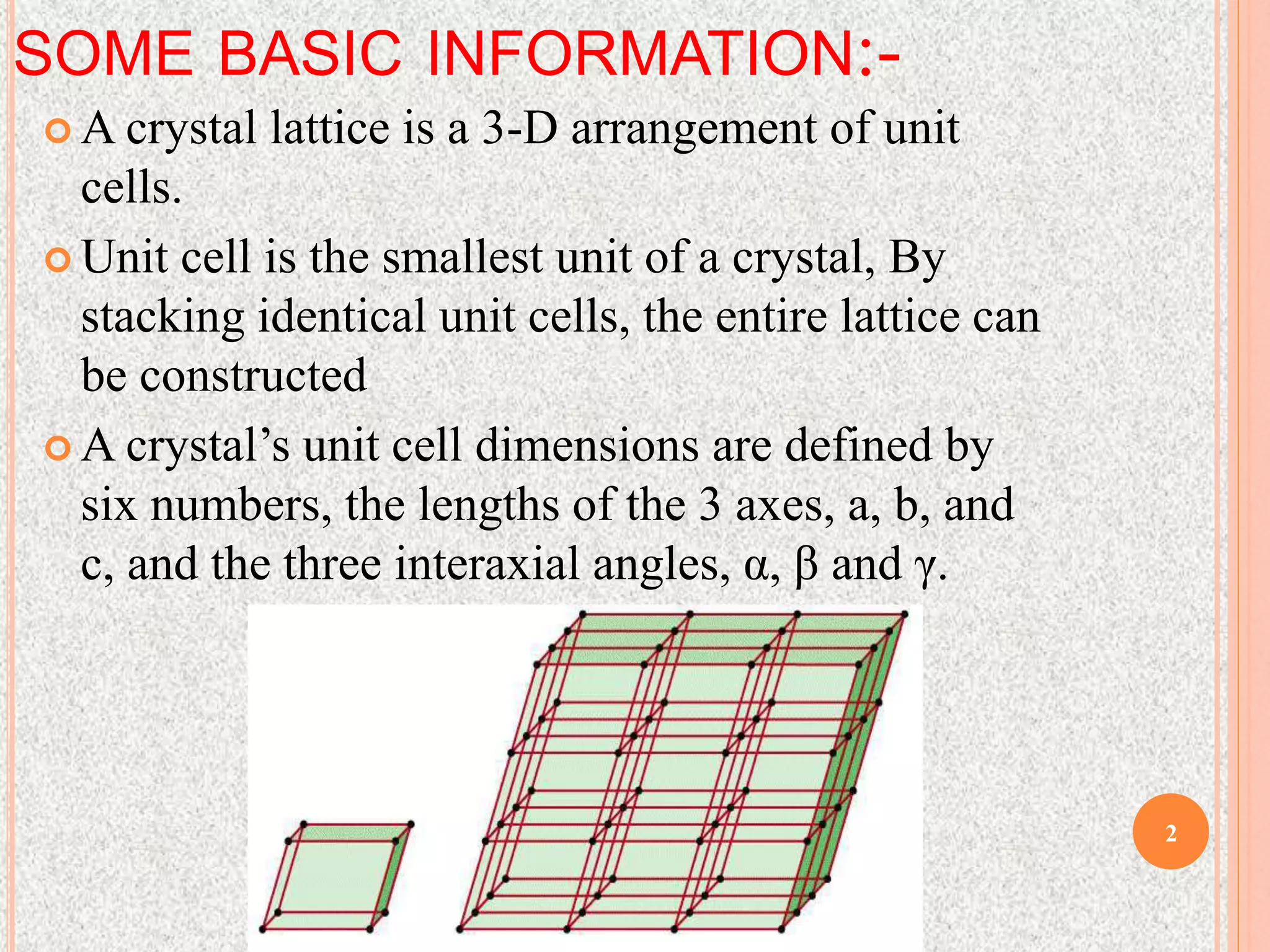
 A crystal lattice is a 3-D arrangement of unit
cells.
 Unit cell is the smallest unit of a crystal, By
stacking identical unit cells, the entire lattice can
be constructed
 A crystal’s unit cell dimensions are defined by
six numbers, the lengths of the 3 axes, a, b, and
c, and the three interaxial angles, α, β and γ.
2
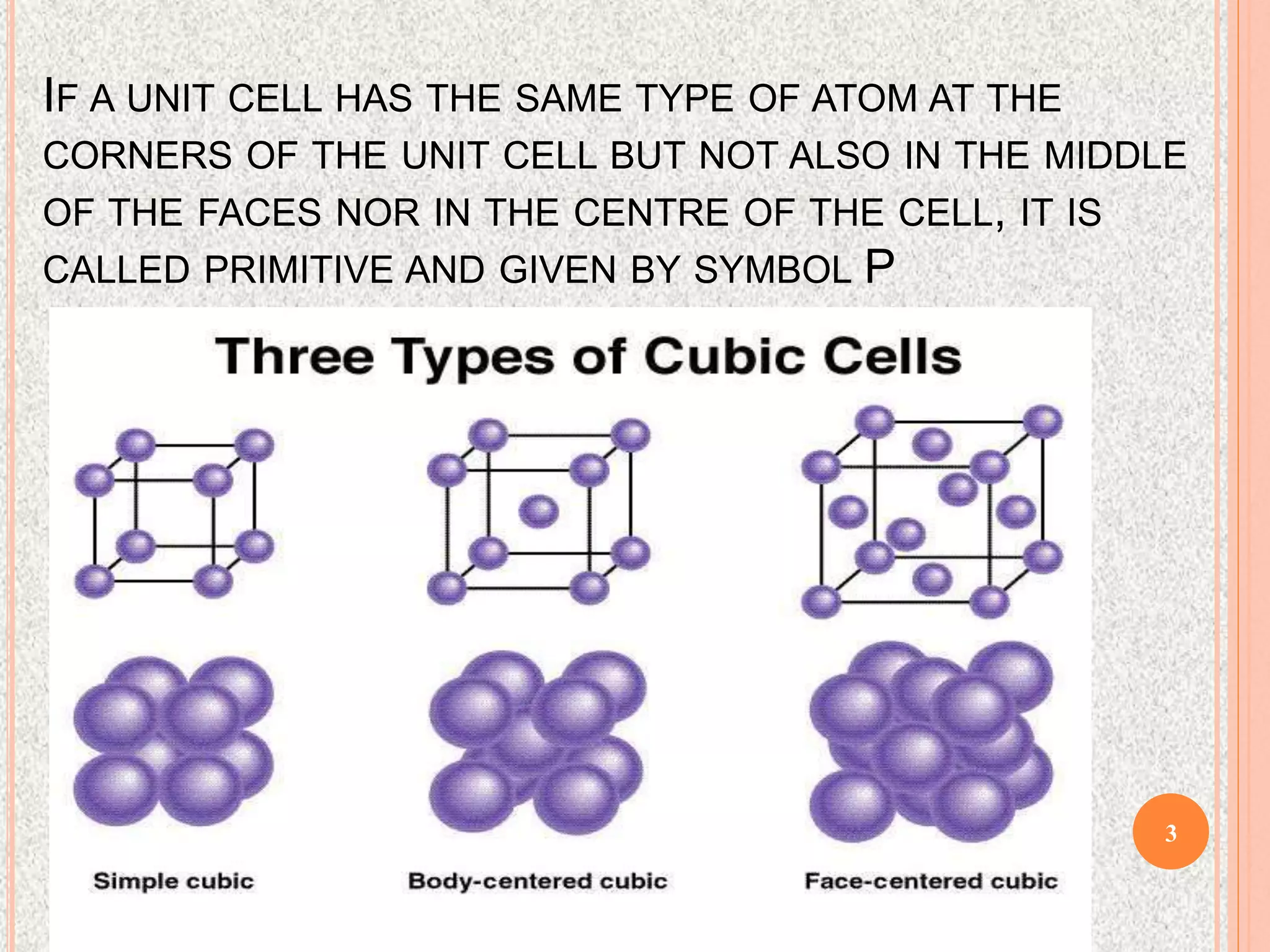
IF A UNIT CELL HAS THE SAME TYPE OF ATOM AT THE
CORNERS OF THE UNIT CELL BUT NOT ALSO IN THE MIDDLE
OF THE FACES NOR IN THE CENTRE OF THE CELL, IT IS
CALLED PRIMITIVE AND GIVEN BY SYMBOL P
3
4
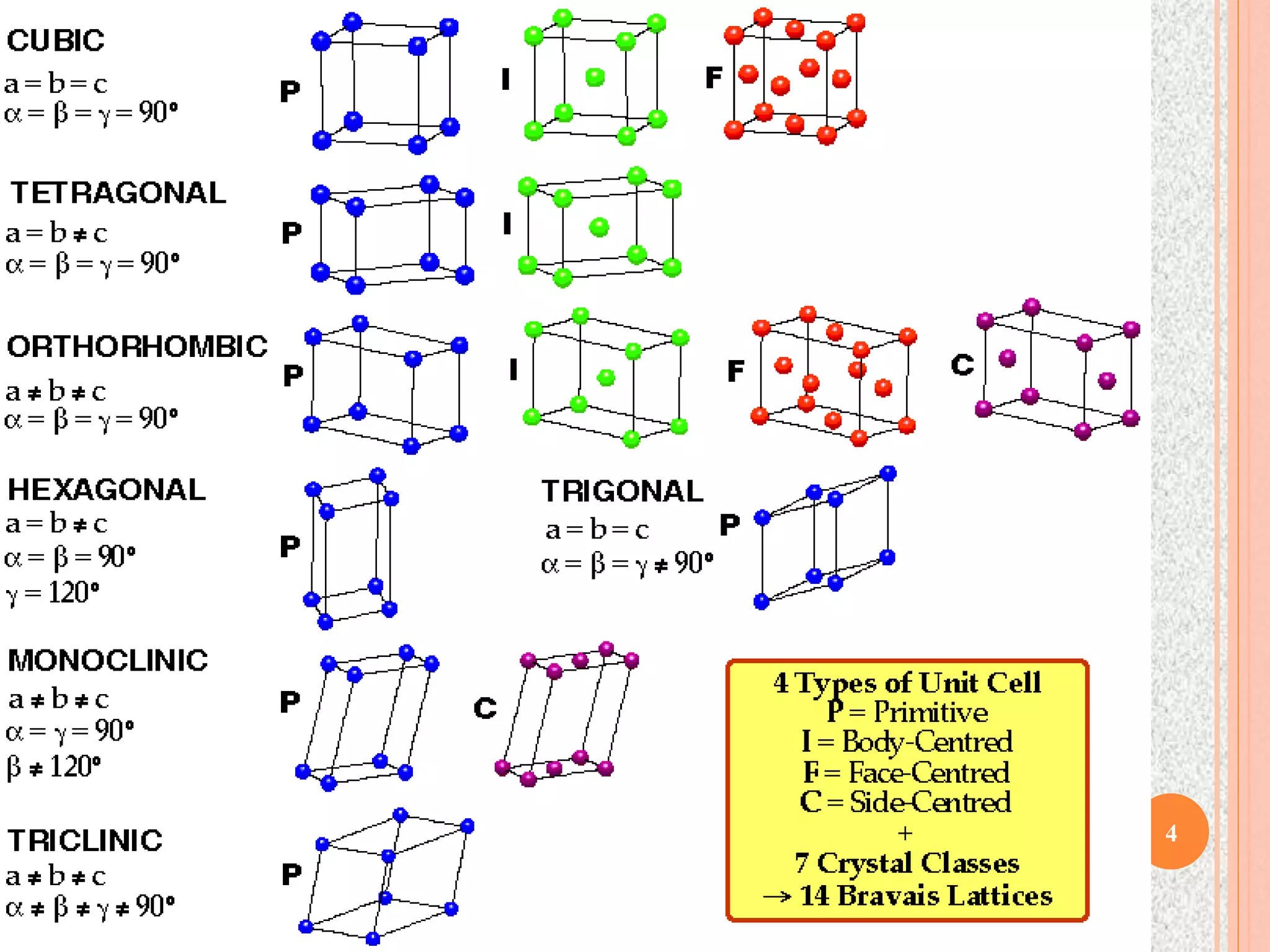
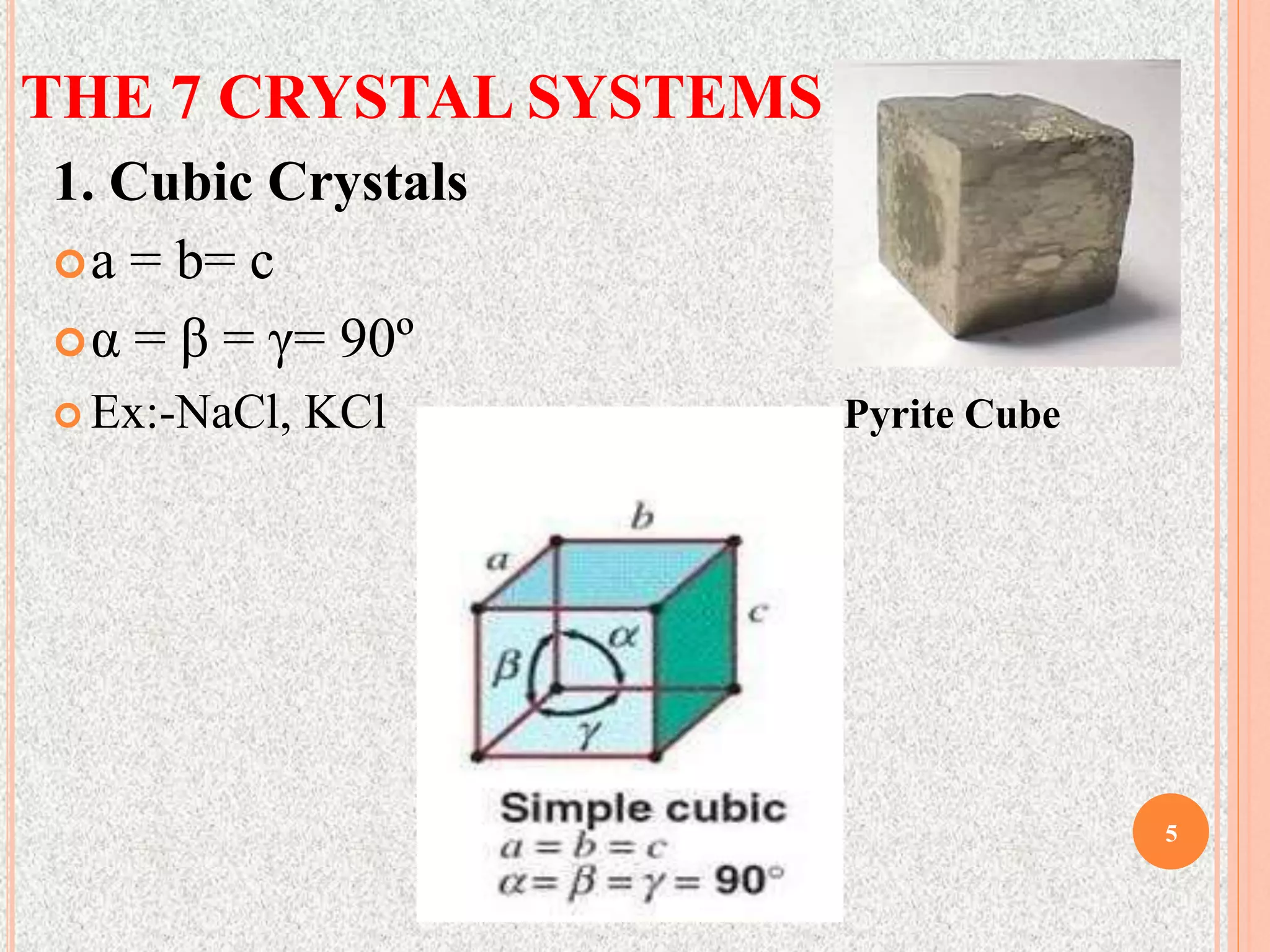
THE 7 CRYSTAL SYSTEMS
1. Cubic Crystals
a = b= c
α = β = γ= 90º
 Ex:-NaCl, KCl Pyrite Cube
5
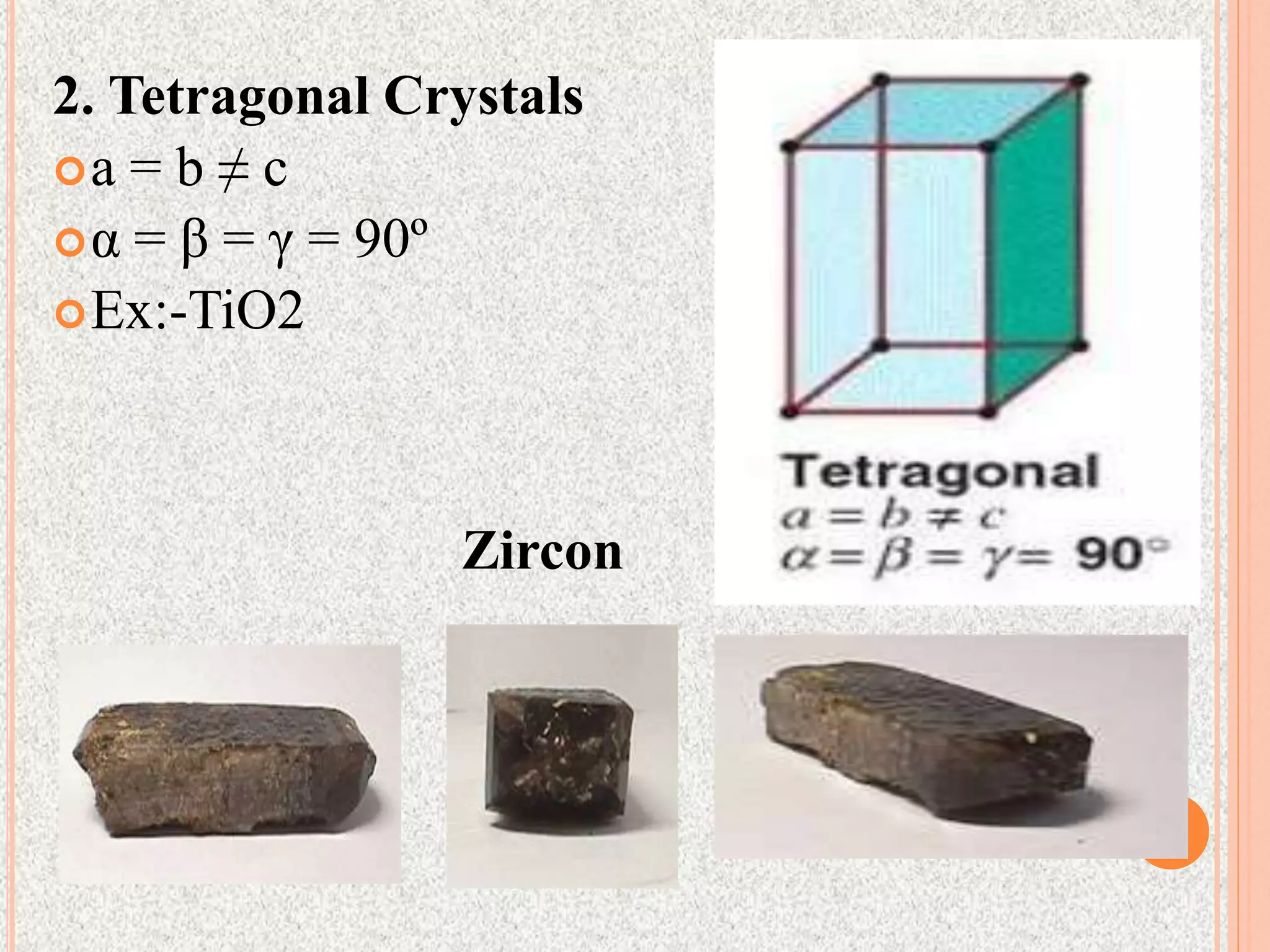
2. Tetragonal Crystals
a = b ≠ c
α = β = γ = 90º
Ex:-TiO2
Zircon
6
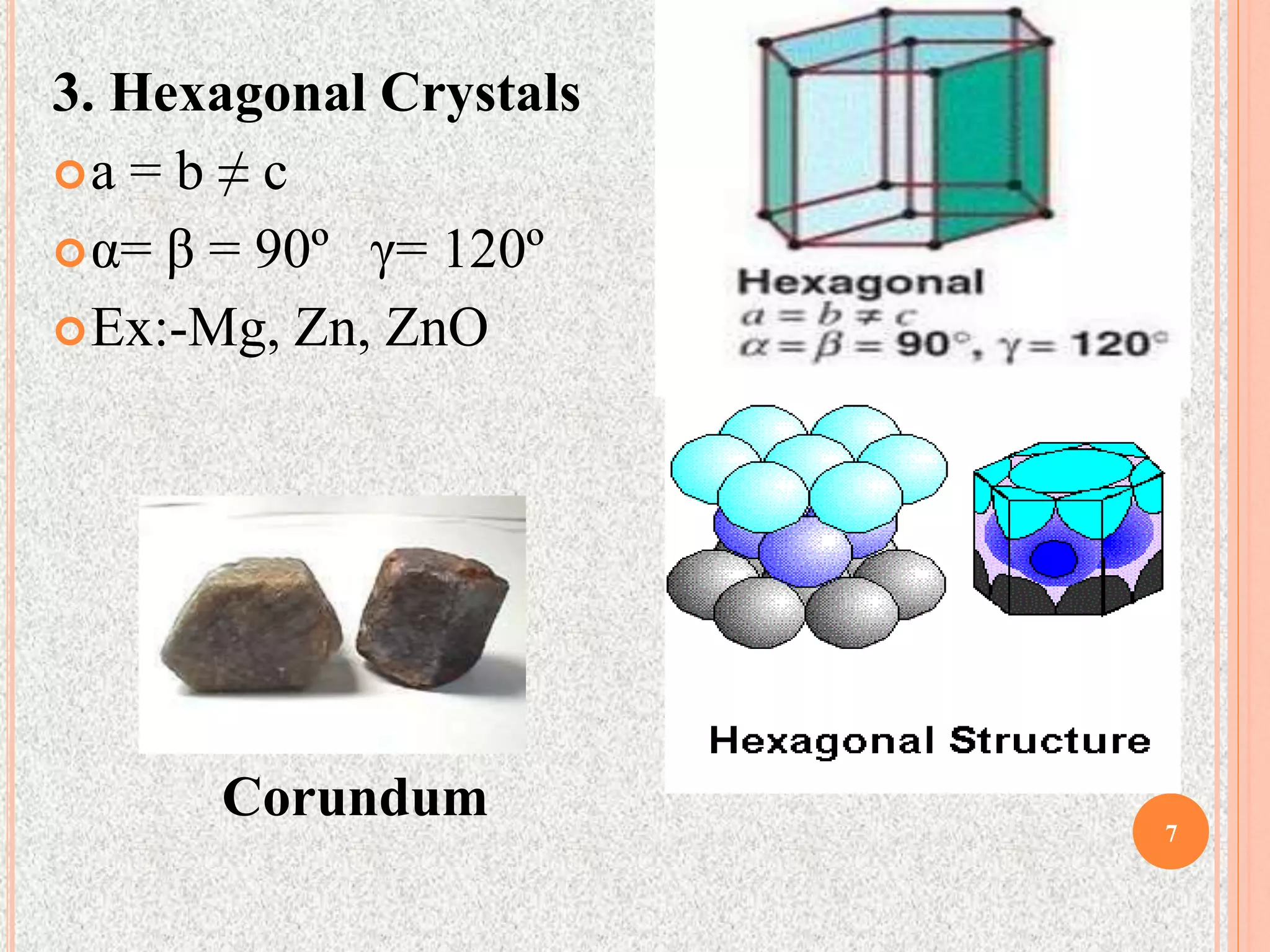
3. Hexagonal Crystals
a = b ≠ c
α= β = 90º γ= 120º
Ex:-Mg, Zn, ZnO
Corundum 7
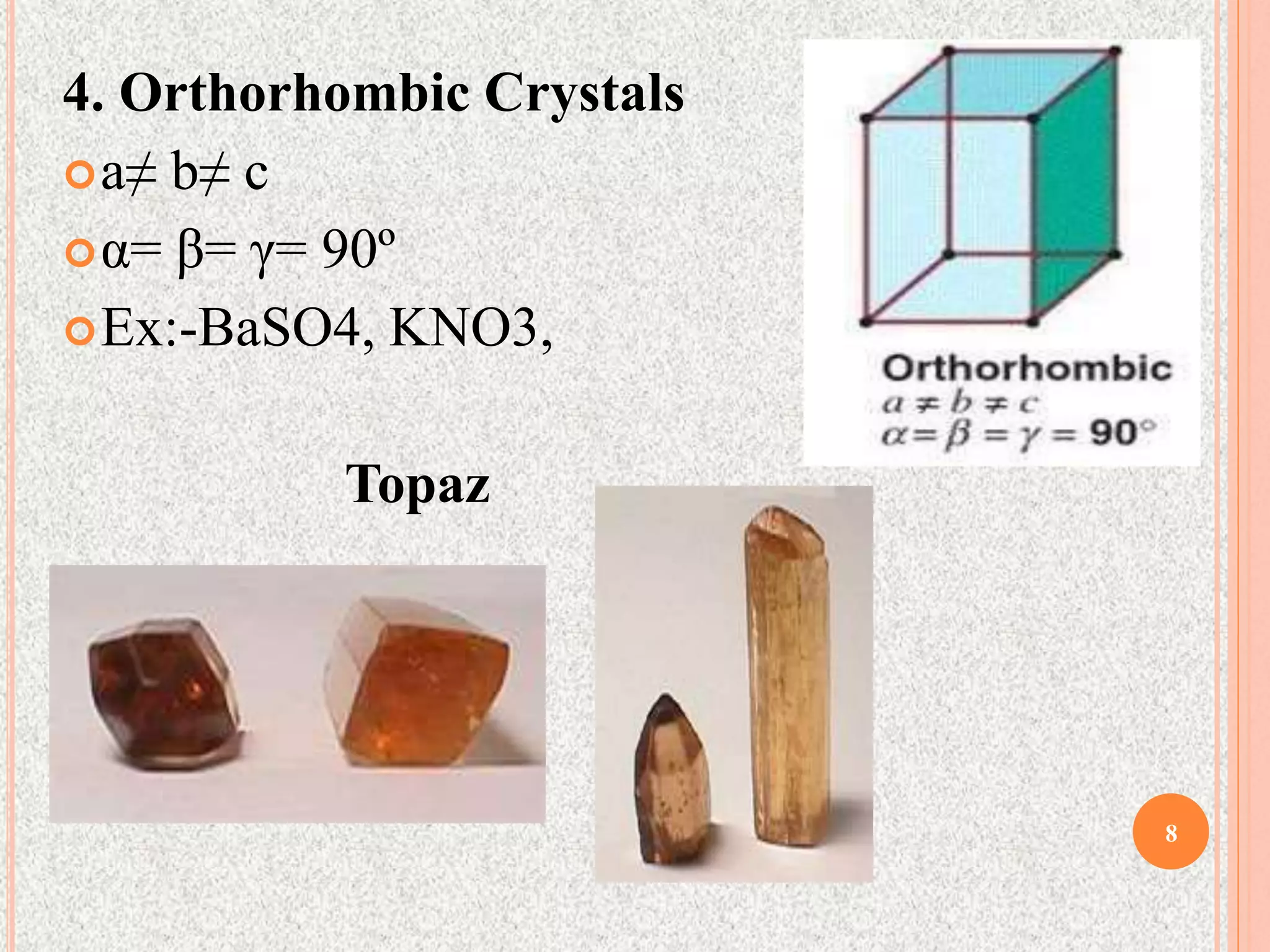
4. Orthorhombic Crystals
a≠ b≠ c
α= β= γ= 90º
Ex:-BaSO4, KNO3,
Topaz
8
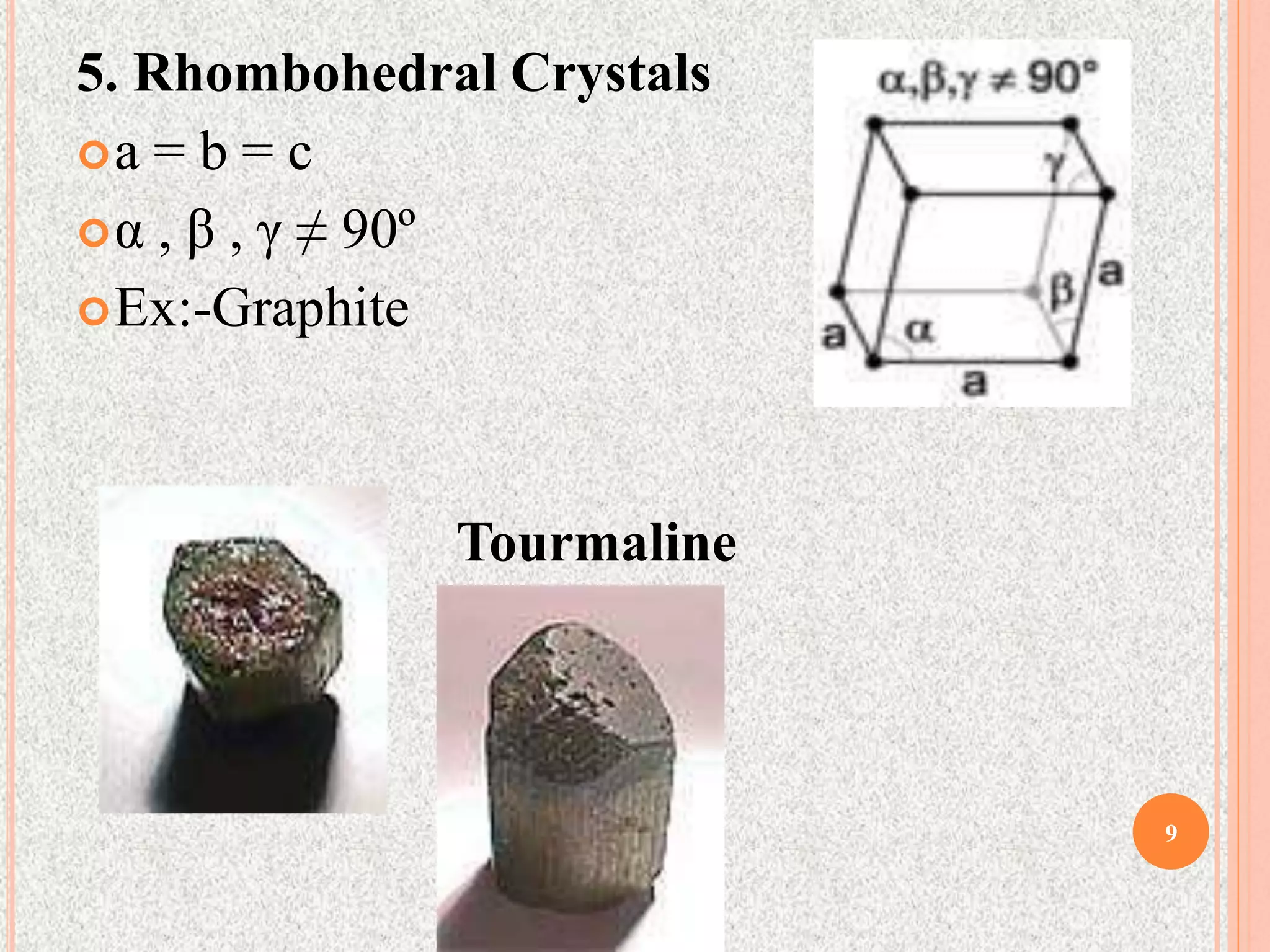
5. Rhombohedral Crystals
a = b = c
α , β , γ ≠ 90º
Ex:-Graphite
Tourmaline
9
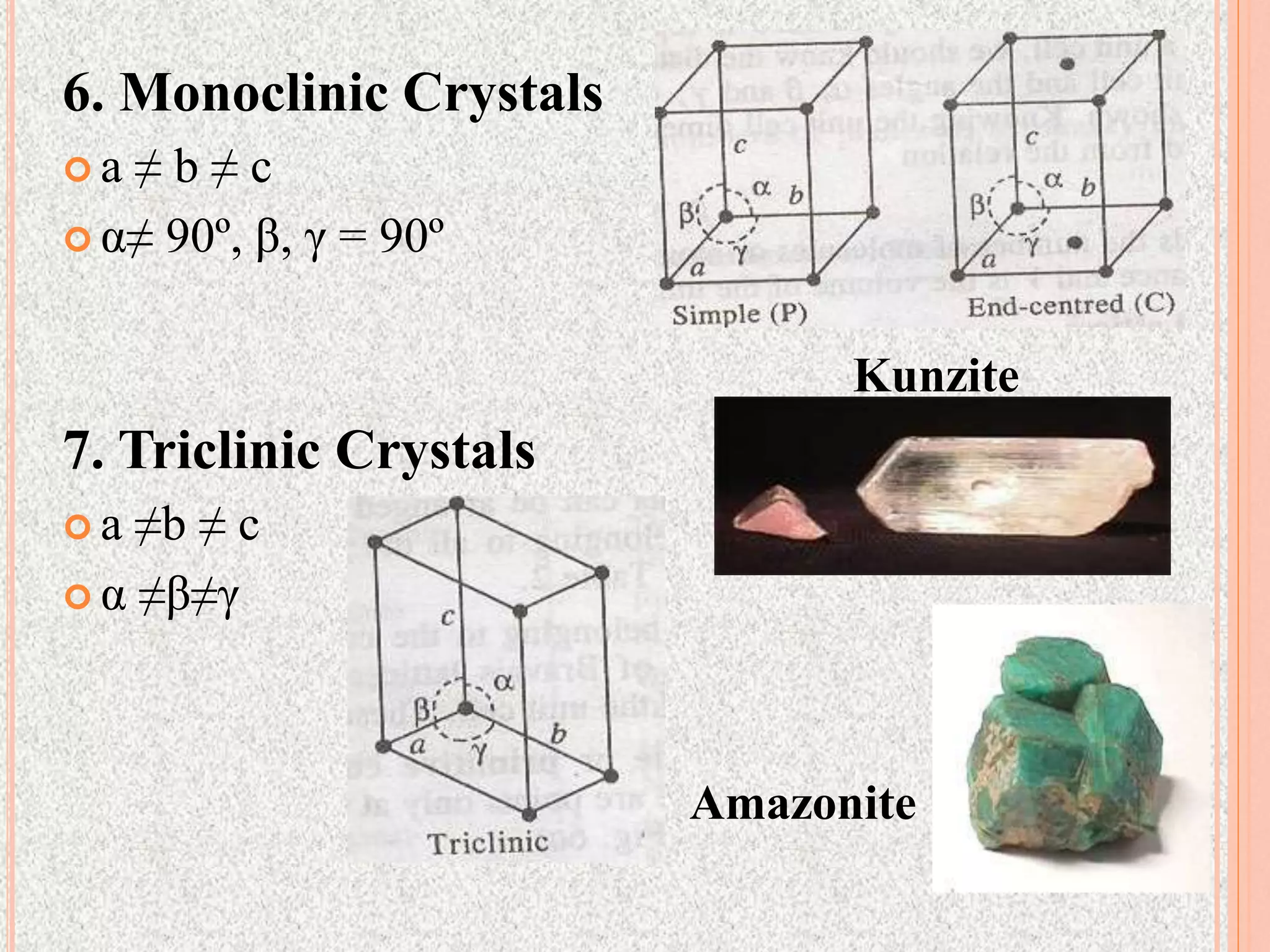
6. Monoclinic Crystals
 a ≠ b ≠ c
 α≠ 90º, β, γ = 90º
Kunzite
7. Triclinic Crystals
 a ≠b ≠ c
 α ≠β≠γ
Amazonite 10
APPLICATION X-RAY
CRYSTALLOGRAPHY
11
1. Structure of crystals
2. Polymer
characterisation
3. State of anneal in
metals
4. Particle size
determination
a) Spot counting method
b) Broadening of
diffraction lines
c) Low-angle scattering
5.Applications of
diffraction methods to
complexes
a) Determination of cis-
trans isomerism
b) Determination of
linkage isomerism
6.Miscellaneous
applications
1.STRUCTURE OF CRYSTALS
X-ray Diffraction Method is non-destructive
and gives information on the molecular
structure of the sample.
The patterns obtained of unknown compound
are characteristic of the particular compounds
from which the crystal was formed.
Comparing diffraction patterns from crystal of
unknown composition with patterns from
crystal of known compounds permits the
identification of unknown crystalline compound
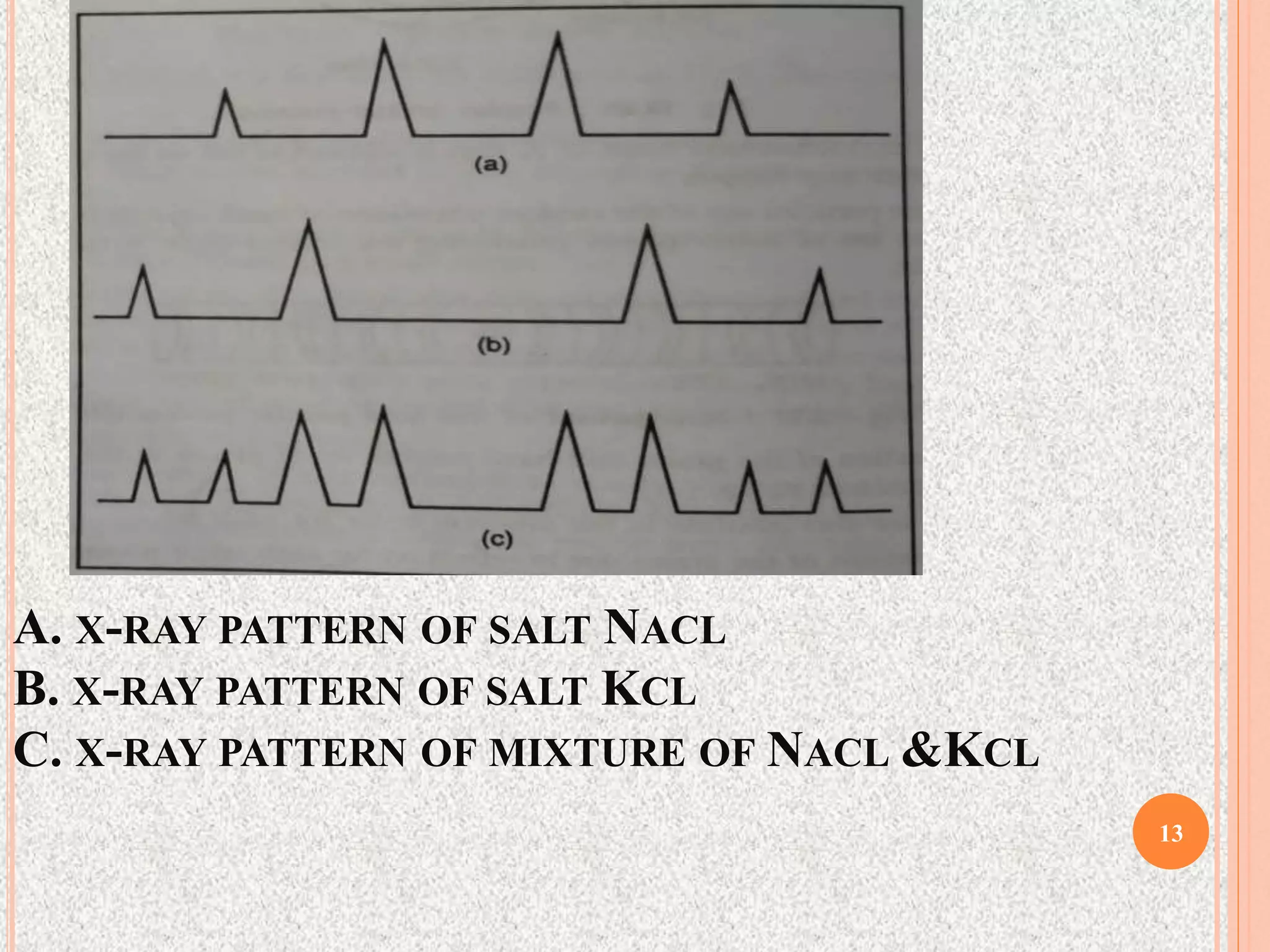
This method can also be used to distinguish
between a mixture of crystals.
12
A. X-RAY PATTERN OF SALT NACL
B. X-RAY PATTERN OF SALT KCL
C. X-RAY PATTERN OF MIXTURE OF NACL &KCL
13
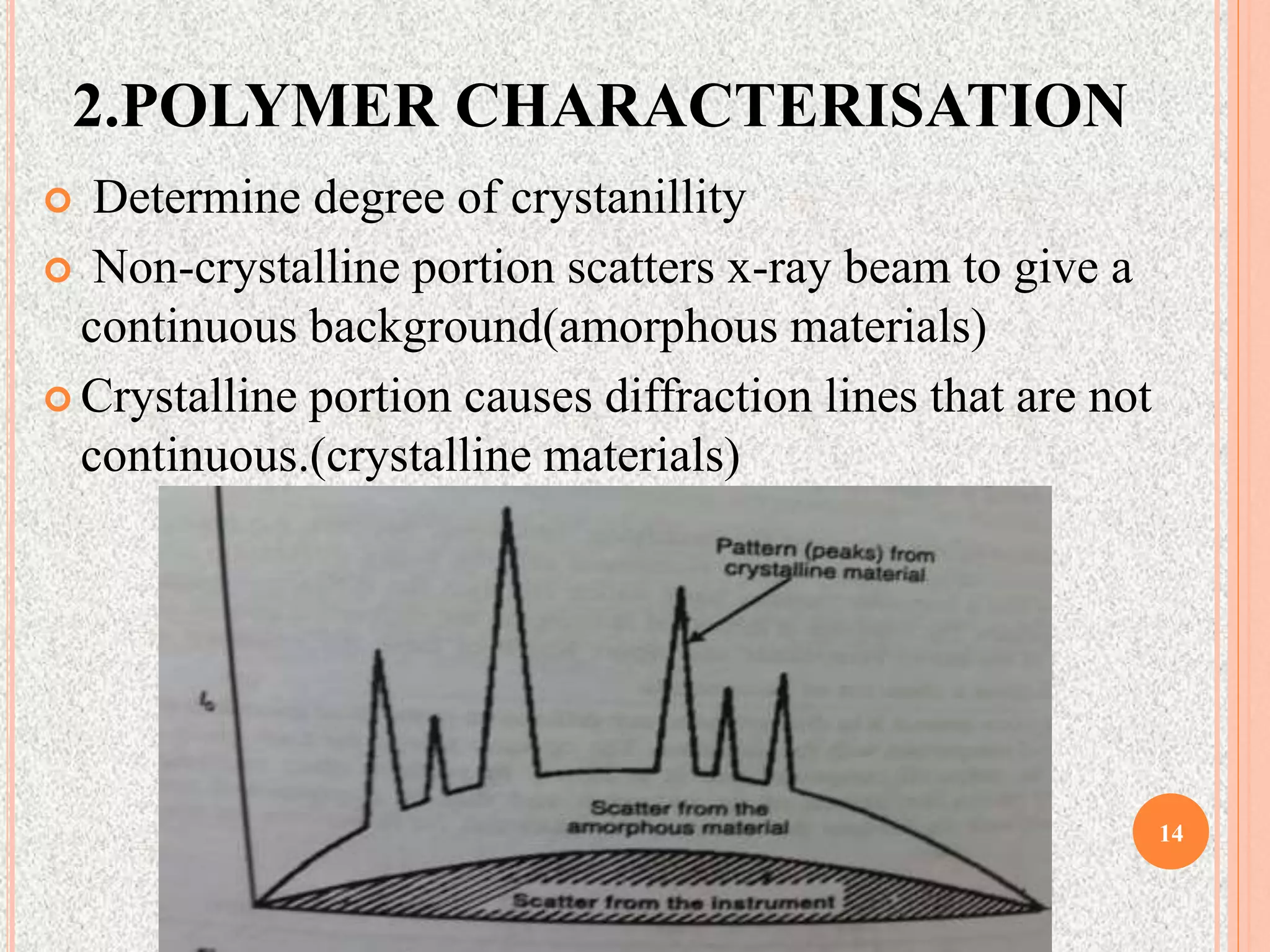
2.POLYMER CHARACTERISATION
 Determine degree of crystanillity
 Non-crystalline portion scatters x-ray beam to give a
continuous background(amorphous materials)
 Crystalline portion causes diffraction lines that are not
continuous.(crystalline materials)
14
3.STATE OF ANNEAL IN METALS:
>A property of metals than can be determined by X-ray
diffraction is the state of anneal.
>Well-annealed metals are in well-ordered crystal form
and give sharp diffraction lines.
>If the metal is subjected to drilling, hammering, or
bending, it becomes fatigued," i.e.its crystals become
broken. Fatigue weakens the metal and can result in the
metal breaking.
>It is occasionally necessary to check moving parts for
metal fatigue,such as airplane wings.This check can be
done by x-ray diffraction without removing the part from
its position and without weakning,it in the process of
testing
15
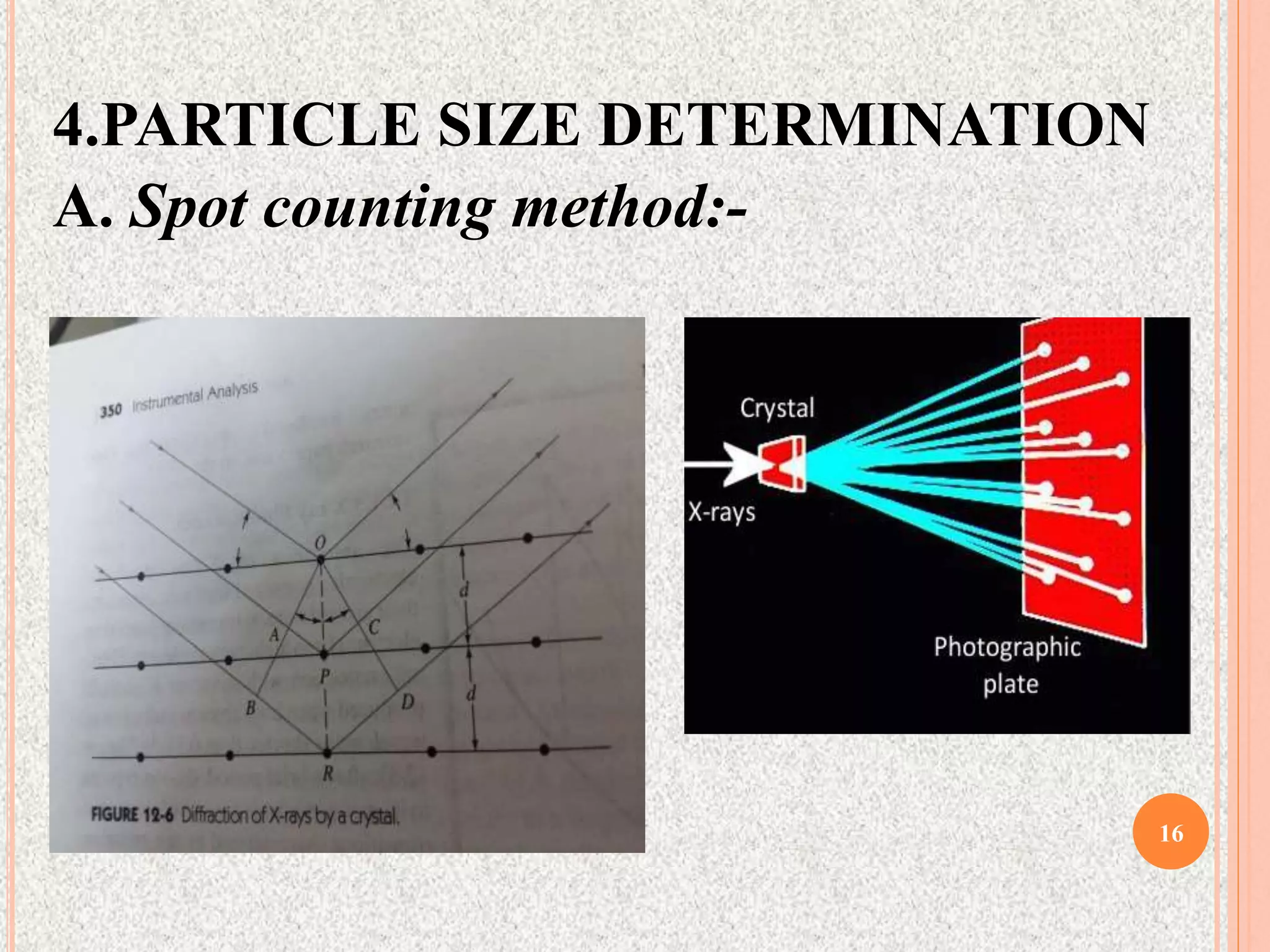
4.PARTICLE SIZE DETERMINATION
A. Spot counting method:-
16
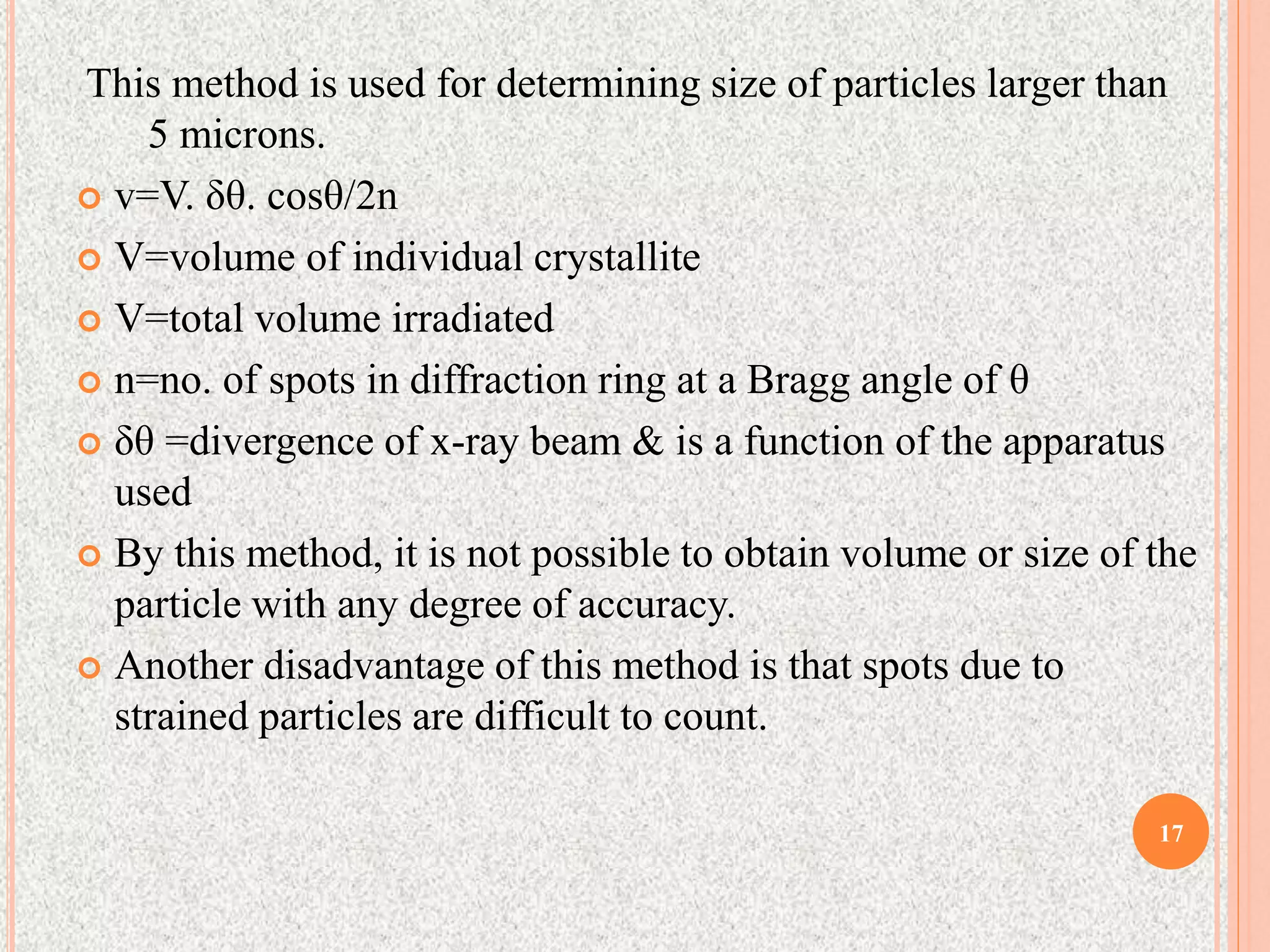
This method is used for determining size of particles larger than
5 microns.
 v=V. δθ. cosθ/2n
 V=volume of individual crystallite
 V=total volume irradiated
 n=no. of spots in diffraction ring at a Bragg angle of θ
 δθ =divergence of x-ray beam & is a function of the apparatus
used
 By this method, it is not possible to obtain volume or size of the
particle with any degree of accuracy.
 Another disadvantage of this method is that spots due to
strained particles are difficult to count.
17
18
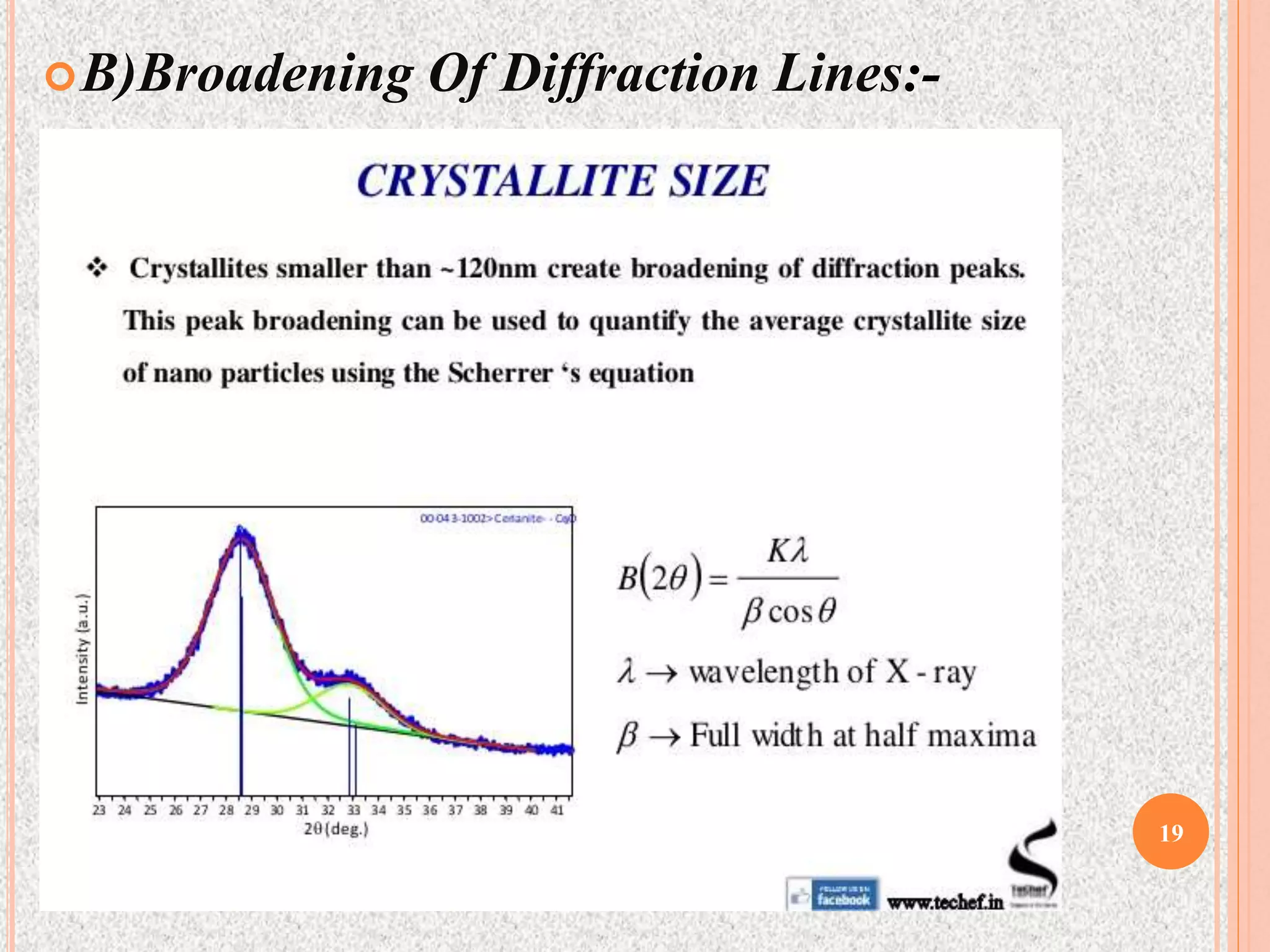
B)Broadening Of Diffraction Lines:-
19
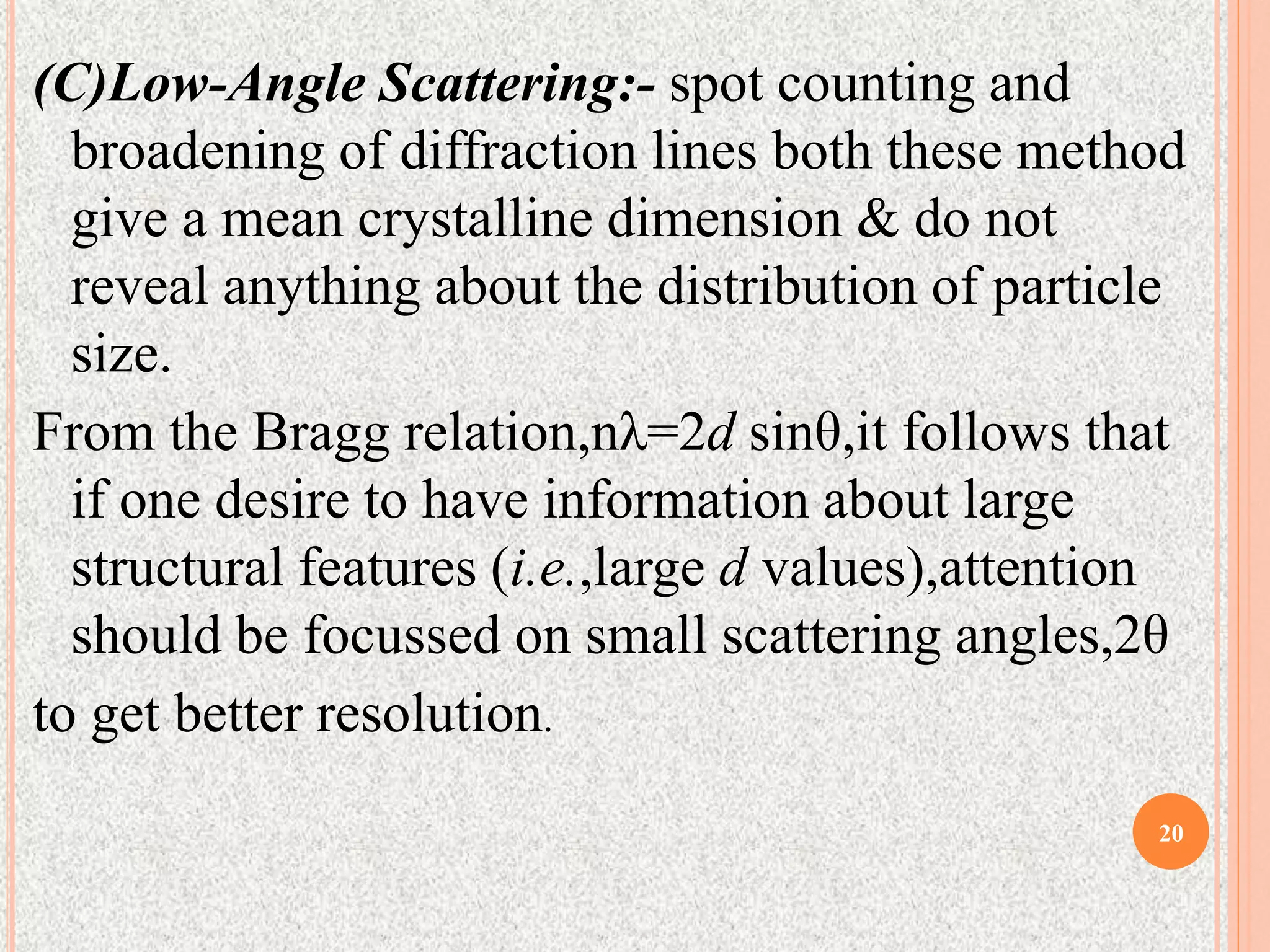
(C)Low-Angle Scattering:- spot counting and
broadening of diffraction lines both these method
give a mean crystalline dimension & do not
reveal anything about the distribution of particle
size.
From the Bragg relation,nλ=2d sinθ,it follows that
if one desire to have information about large
structural features (i.e.,large d values),attention
should be focussed on small scattering angles,2θ
to get better resolution.
20
5.APPLICATIONS OF DIFFRACTION METHODS
TO COMPLEXES
A. Determination of Cis-Trans Isomerism-X-ray
diffraction study has been used to make the
distinction between cis and trans isomers of a
complex
B. Determination of Linkage Isomerism: By X-
ray studies, it becomes possible to identify linkage
isomers of complexes.
21
MISCELLANEOUS APPLICATIONS
 Soil Classification Based On Crystallinity
 Analysis Of Industrial Dusts
 Assessment Of Weathering &
Degradation Of Minerals & Polymers
 Study Of Corrosion Products
 Examination Of Tooth Enamel & Dentine
 Examination Of Bone State & Tissue
State
 Structure Of DNA&RNA
22
REFERENCES:-
WILEY-INDIA EDITION Analytical
Chemistry By Open Learning, X-RAY
Methods By Clive Whiston
Instrumental Methods Of Chemical
Analysis By G.R.Chatwal
23
24

Types of crystals & Application of x ray

  • 1.
    X-RAY DIFFRACTION PRESENTED BY:-KAJAL PRADHAN M.PHARM SEM-1 PHARMACEUTICS TYPES OF CRYSTALS & APPLICATIONS OF
  • 2.
    SOME BASIC INFORMATION:- A crystal lattice is a 3-D arrangement of unit cells.  Unit cell is the smallest unit of a crystal, By stacking identical unit cells, the entire lattice can be constructed  A crystal’s unit cell dimensions are defined by six numbers, the lengths of the 3 axes, a, b, and c, and the three interaxial angles, α, β and γ. 2
  • 3.
    IF A UNITCELL HAS THE SAME TYPE OF ATOM AT THE CORNERS OF THE UNIT CELL BUT NOT ALSO IN THE MIDDLE OF THE FACES NOR IN THE CENTRE OF THE CELL, IT IS CALLED PRIMITIVE AND GIVEN BY SYMBOL P 3
  • 4.
  • 5.
    THE 7 CRYSTALSYSTEMS 1. Cubic Crystals a = b= c α = β = γ= 90º  Ex:-NaCl, KCl Pyrite Cube 5
  • 6.
    2. Tetragonal Crystals a= b ≠ c α = β = γ = 90º Ex:-TiO2 Zircon 6
  • 7.
    3. Hexagonal Crystals a= b ≠ c α= β = 90º γ= 120º Ex:-Mg, Zn, ZnO Corundum 7
  • 8.
    4. Orthorhombic Crystals a≠b≠ c α= β= γ= 90º Ex:-BaSO4, KNO3, Topaz 8
  • 9.
    5. Rhombohedral Crystals a= b = c α , β , γ ≠ 90º Ex:-Graphite Tourmaline 9
  • 10.
    6. Monoclinic Crystals a ≠ b ≠ c  α≠ 90º, β, γ = 90º Kunzite 7. Triclinic Crystals  a ≠b ≠ c  α ≠β≠γ Amazonite 10
  • 11.
    APPLICATION X-RAY CRYSTALLOGRAPHY 11 1. Structureof crystals 2. Polymer characterisation 3. State of anneal in metals 4. Particle size determination a) Spot counting method b) Broadening of diffraction lines c) Low-angle scattering 5.Applications of diffraction methods to complexes a) Determination of cis- trans isomerism b) Determination of linkage isomerism 6.Miscellaneous applications
  • 12.
    1.STRUCTURE OF CRYSTALS X-rayDiffraction Method is non-destructive and gives information on the molecular structure of the sample. The patterns obtained of unknown compound are characteristic of the particular compounds from which the crystal was formed. Comparing diffraction patterns from crystal of unknown composition with patterns from crystal of known compounds permits the identification of unknown crystalline compound This method can also be used to distinguish between a mixture of crystals. 12
  • 13.
    A. X-RAY PATTERNOF SALT NACL B. X-RAY PATTERN OF SALT KCL C. X-RAY PATTERN OF MIXTURE OF NACL &KCL 13
  • 14.
    2.POLYMER CHARACTERISATION  Determinedegree of crystanillity  Non-crystalline portion scatters x-ray beam to give a continuous background(amorphous materials)  Crystalline portion causes diffraction lines that are not continuous.(crystalline materials) 14
  • 15.
    3.STATE OF ANNEALIN METALS: >A property of metals than can be determined by X-ray diffraction is the state of anneal. >Well-annealed metals are in well-ordered crystal form and give sharp diffraction lines. >If the metal is subjected to drilling, hammering, or bending, it becomes fatigued," i.e.its crystals become broken. Fatigue weakens the metal and can result in the metal breaking. >It is occasionally necessary to check moving parts for metal fatigue,such as airplane wings.This check can be done by x-ray diffraction without removing the part from its position and without weakning,it in the process of testing 15
  • 16.
    4.PARTICLE SIZE DETERMINATION A.Spot counting method:- 16
  • 17.
    This method isused for determining size of particles larger than 5 microns.  v=V. δθ. cosθ/2n  V=volume of individual crystallite  V=total volume irradiated  n=no. of spots in diffraction ring at a Bragg angle of θ  δθ =divergence of x-ray beam & is a function of the apparatus used  By this method, it is not possible to obtain volume or size of the particle with any degree of accuracy.  Another disadvantage of this method is that spots due to strained particles are difficult to count. 17
  • 18.
  • 19.
  • 20.
    (C)Low-Angle Scattering:- spotcounting and broadening of diffraction lines both these method give a mean crystalline dimension & do not reveal anything about the distribution of particle size. From the Bragg relation,nλ=2d sinθ,it follows that if one desire to have information about large structural features (i.e.,large d values),attention should be focussed on small scattering angles,2θ to get better resolution. 20
  • 21.
    5.APPLICATIONS OF DIFFRACTIONMETHODS TO COMPLEXES A. Determination of Cis-Trans Isomerism-X-ray diffraction study has been used to make the distinction between cis and trans isomers of a complex B. Determination of Linkage Isomerism: By X- ray studies, it becomes possible to identify linkage isomers of complexes. 21
  • 22.
    MISCELLANEOUS APPLICATIONS  SoilClassification Based On Crystallinity  Analysis Of Industrial Dusts  Assessment Of Weathering & Degradation Of Minerals & Polymers  Study Of Corrosion Products  Examination Of Tooth Enamel & Dentine  Examination Of Bone State & Tissue State  Structure Of DNA&RNA 22
  • 23.
    REFERENCES:- WILEY-INDIA EDITION Analytical ChemistryBy Open Learning, X-RAY Methods By Clive Whiston Instrumental Methods Of Chemical Analysis By G.R.Chatwal 23
  • 24.