Submitted to:
Dr. D. Manjula
Asst. Professor,
Department of Pharmaceutics,
College of Pharmaceutical Sciences, DSU
Dayananda sagar college of Pharmacy,
Banglore.
Presented by:
Arpitha.B. M
M Pharm (I SEM),
Department of Pharmaceutics,
College of Pharmaceutical Sciences, DSU
Dayananda Sagar College of Pharmacy,
Banglore.
Regulatory requirement for
approval of Biologics
• Introduction
• Sources and types of biologics
• Difference between biologics and chemical drugs
• Regulatory authority for biologics
• Development and approval process
• Biological license application (BLA)
• Reference
COPS DSU Department of Pharmaceutics 2
CONTENTS
Introduction
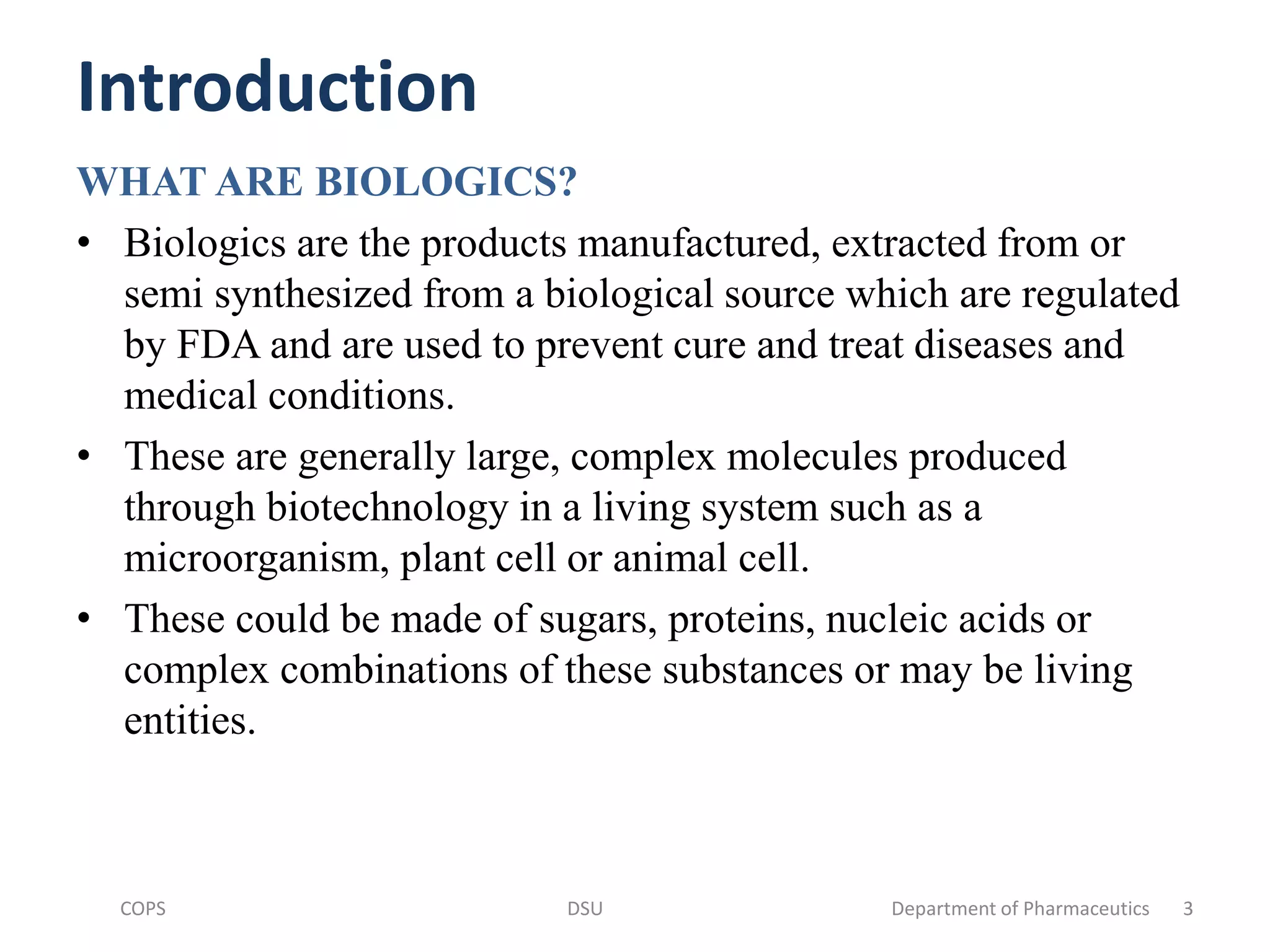
WHAT ARE BIOLOGICS?
• Biologics are the products manufactured, extracted from or
semi synthesized from a biological source which are regulated
by FDA and are used to prevent cure and treat diseases and
medical conditions.
• These are generally large, complex molecules produced
through biotechnology in a living system such as a
microorganism, plant cell or animal cell.
• These could be made of sugars, proteins, nucleic acids or
complex combinations of these substances or may be living
entities.
COPS DSU Department of Pharmaceutics 3
• These are complex mixtures that are not easily
identifiable and charcterized these tend to be heat
sensitive and susceptible to microbial contamination
hence, it is necessary to use aspetic principles from
intial manufacturing process.
• EXAMPLES: Botox, Herceptin, Vaccines, Enbrel
COPS DSU Department of Pharmaceutics 4
History
 A significant advancement in scientific community in
areas of vaccinology, immunology resulted in
vaccines for small pox, rabies , typhoid and antitoxins
for diphtheria and tetanus.
 These products resulted in wide utilization for public
health , but were not under pressure to ensure that
products were safe.
 13 children died at St. Louis in october 1901 after
receiving diphtheria antitoxin that was
contaminated with tetanus toxin.
5COPS DSU Department of Pharmaceutics
 9 children died from administration of contaminated
small pox vaccine in camden , New Jersey.
 These tragedy resulted in the Biologics Control Act
of 1902.
 “Any virus, serum, toxin, antitoxin, therapeutic
serum, vaccine, blood, blood component or
derivative, allergenic product, or analogous products,
or trivalent arsenic compound such as arsphenamine
applicable to the prevention, treatment, or cure of
diseases or injuries in man.” ----Biologics.
 Provisions of the Biological Control Act included
licensure requirements for both establishments and
COPS DSU Department of Pharmaceutics 6
products, labelling requirements, facility inspection
requirements, and penalties for violations including
suspension and revocation of licenses.
 Earlier BCA authorized Hygienic Laboratory to issue
regulations implementing provisions of the act
 In 1934 ,the Hygienic Laboratory was renamed as
National Institute of Health(NIH) and by 1948 was
known as Division of Biologics control within
National Microbiological Institute(NMI).
 In 1944 the Biologics Control Act was incorporated
into section 351 of the Public Health Service Act
(PHSA) .
COPS DSU Department of Pharmaceutics 7
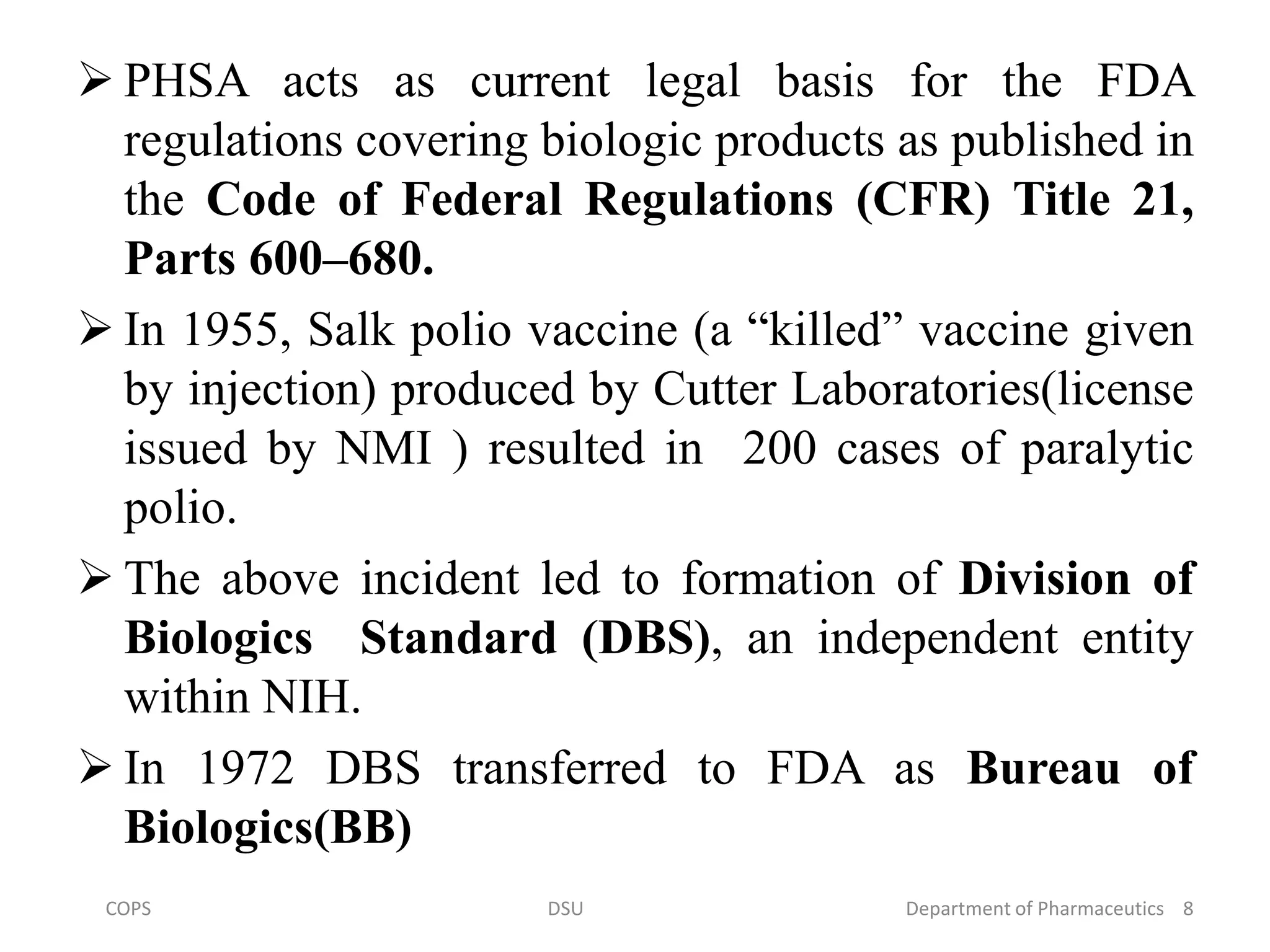
 PHSA acts as current legal basis for the FDA
regulations covering biologic products as published in
the Code of Federal Regulations (CFR) Title 21,
Parts 600–680.
 In 1955, Salk polio vaccine (a “killed” vaccine given
by injection) produced by Cutter Laboratories(license
issued by NMI ) resulted in 200 cases of paralytic
polio.
 The above incident led to formation of Division of
Biologics Standard (DBS), an independent entity
within NIH.
 In 1972 DBS transferred to FDA as Bureau of
Biologics(BB)
COPS DSU Department of Pharmaceutics 8
 In 1982 BB was merged with Bureau of Drugs to
form National Centre for Drugs and Biologics
(NCDB).
 In 1988, NCDB was split into two centres, the
Center for Biologics Evaluation and Research
(CBER) and the Center for Drugs Evaluation and
Research (CDER) were created .
COPS DSU Department of Pharmaceutics 9
COPS DSU Department of Pharmaceutics 10
• Biologics control act- 1902
• Authorized hygienic laboratory
• In 1934 hygienic laboratory renamed to NIH
• In 1948 divisions of biologics control within
NMI
• In 1944 BCA incorporated into Section 351 of
PHSA (CFR tittle 21 parts 600-680)
•In 1955 salk polio vaccine - DBS
•In 1972 DBS transferred to FDA as Bureau of Biologics
•In 1982 BB merged with NCDB (National centre for
drugs and biologics)
•In 1988 NCDB Splitted into 2 centres
•1.CBER and 2. CDER
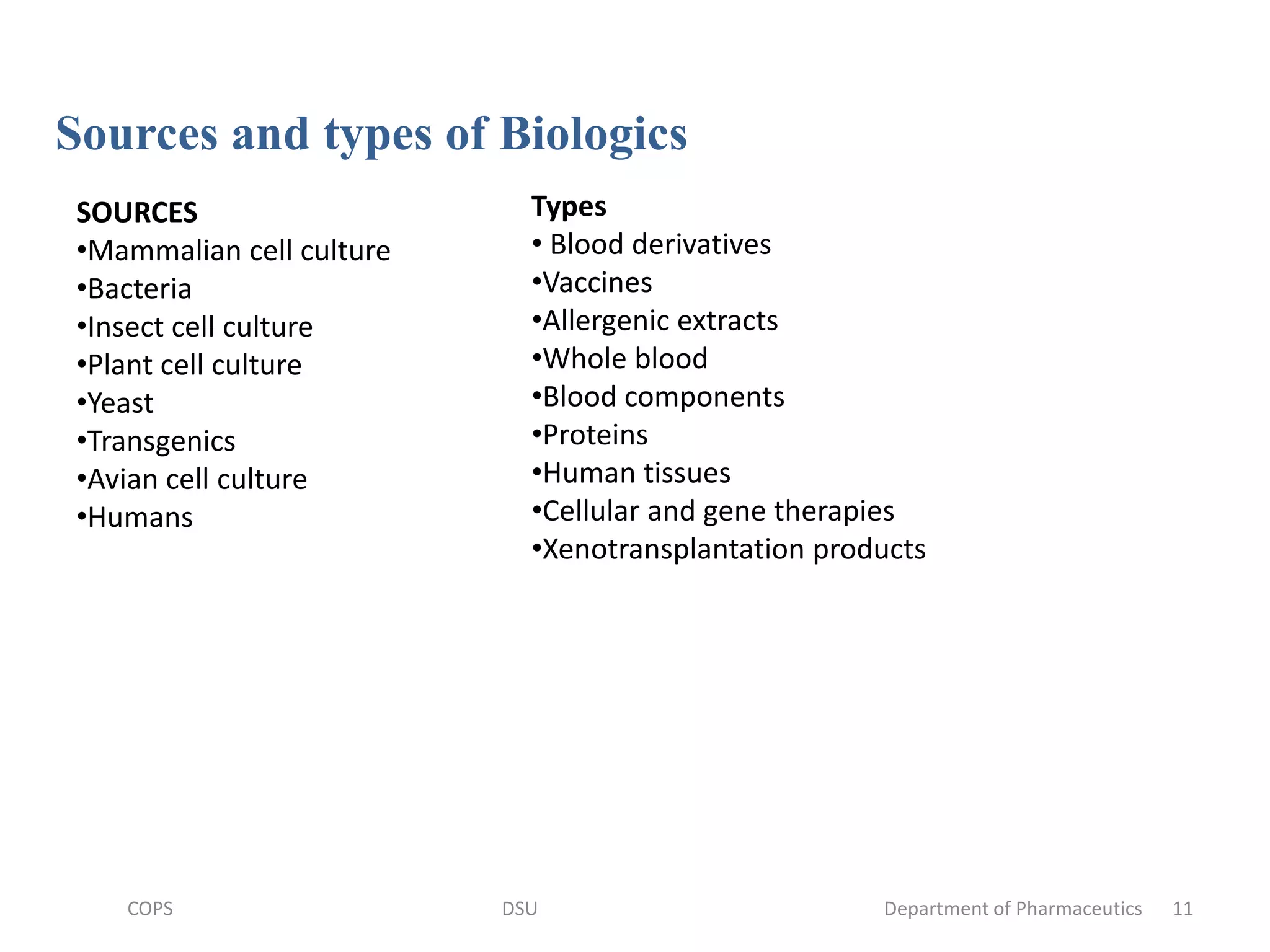
SOURCES
•Mammalian cell culture
•Bacteria
•Insect cell culture
•Plant cell culture
•Yeast
•Transgenics
•Avian cell culture
•Humans
Types
• Blood derivatives
•Vaccines
•Allergenic extracts
•Whole blood
•Blood components
•Proteins
•Human tissues
•Cellular and gene therapies
•Xenotransplantation products
COPS DSU Department of Pharmaceutics 11
Sources and types of Biologics
Difference b/w biologics & chemical
drug
COPS DSU Department of Pharmaceutics 12
Properties Biologics Chemical drug
Size Large Small
Structure Complex Simple
Stability Unstable Stable
Modification Impossible to ensure
identical copy
Identical copy can be made
Manufacturing Many options Well defined
Characterization Impossible Easy
REGULATORY AUTHORITY FOR
BIOLOGICS
• Center for biologics evalution and research (CBER)
is the center within FDA that regulates biological
products for human use under applicable Federal laws
including the Public Health Services Act (PHS) and
the Federal, Food, Drug and Cosmetics Act
• CBER protects and advances the public health by
ensuring that biological products are safe and
effective.
• FDA's regulatory authority for the approval of
biologics resides in (PHS) Act. Biologics are
COPS DSU Department of Pharmaceutics 13
subjected to regulation under Federal, Food, Drug
And Cosmetics act (FD&C) Act.
• Some medical devices which are used to produce
biologics are regulated by CBER under FD&C Act's
medical device amendments of 1976.
• FDA also reviews new biological products and new
indications and usage for already approved products
on the market for the treatment of known diseases.
• It protects against threats of emerging infectious
diseases.
• It provides the public with information to promote
safe and appropriate use
COPS DSU Department of Pharmaceutics 14
DEVELOPMENT AND APPROVAL
PROCESS
• Advertising and Labeling
• Investigational New Drug Application (IND) or
Device exemption process (IDE)
• Expanded Access
• Premarket Approval (PMA)
• Biologics License Application (BLA) New Drug
Application Process (NDA).
• Biologics Approvals By Year.
COPS DSU Department of Pharmaceutics 15
BIOLOGICS LICENSE APPLICATION
(BLA)
• The Biologics License Application (BLA) is a request
for permission introduce or deliver for introduction a
Biologic product into the market.
• It is mainly regulated by 21 CFR 600-800. It is
submitted by any legal person or entity, who engaged
in manufacture or an applicant for a license who takes
responsibilty for compliance with product and
establishment of standards.
• A Biologic License application generally applies to
vaccines and other Allergenic drug products and
cellular and genetic therapies.
COPS DSU Department of Pharmaceutics 16
COPS DSU Department of Pharmaceutics 17
COPS DSU Department of Pharmaceutics 18
COPS DSU Department of Pharmaceutics 19
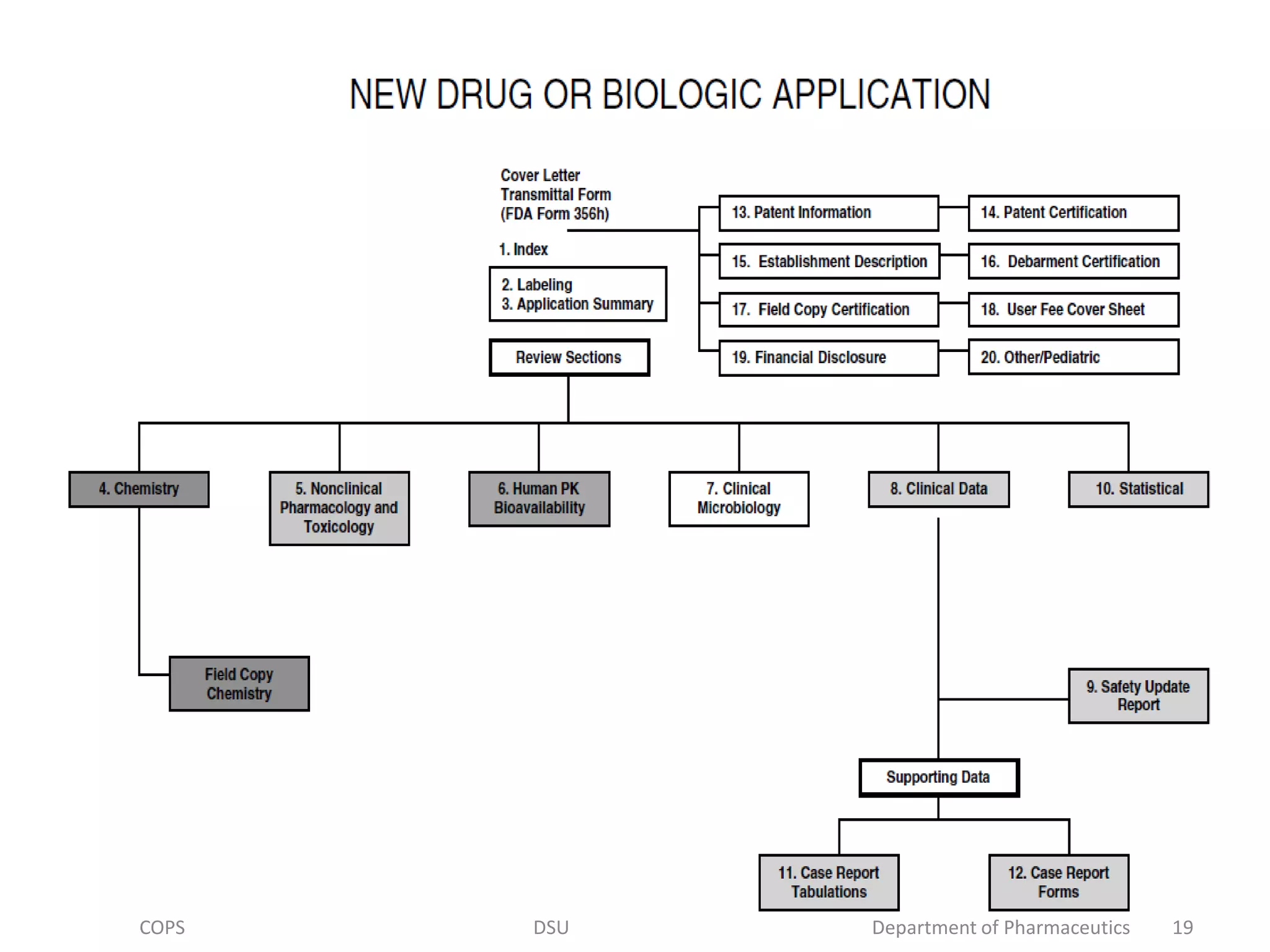
• A cover letter should always accompany any FDA submission.
Addressed below are the Form FDA 356(h), the cover letter, and all
20 sections of the BLA application.
• Before each section is addressed individually, it is worth
emphasizing the importance of the application form [Form FDA
356(h)], the cover letter, and the first three sections.
• Cover Letter: It consists of basic administrative information
requested about the BLA application (e.g., sponsor name and
address, etc.). The cover letter should provide at least seven types of
information:
1. Name and address of sponsor and others
2. Product name
3.Reason for submission(e.g original submission, supplement,
amendment, etc.).
4.Information contained in the submission..
5.Agreements with the FDA.
6.Other documents relating to submission.
7.special circumstances.
8.Fast track review.
COPS DSU Department of Pharmaceutics 20
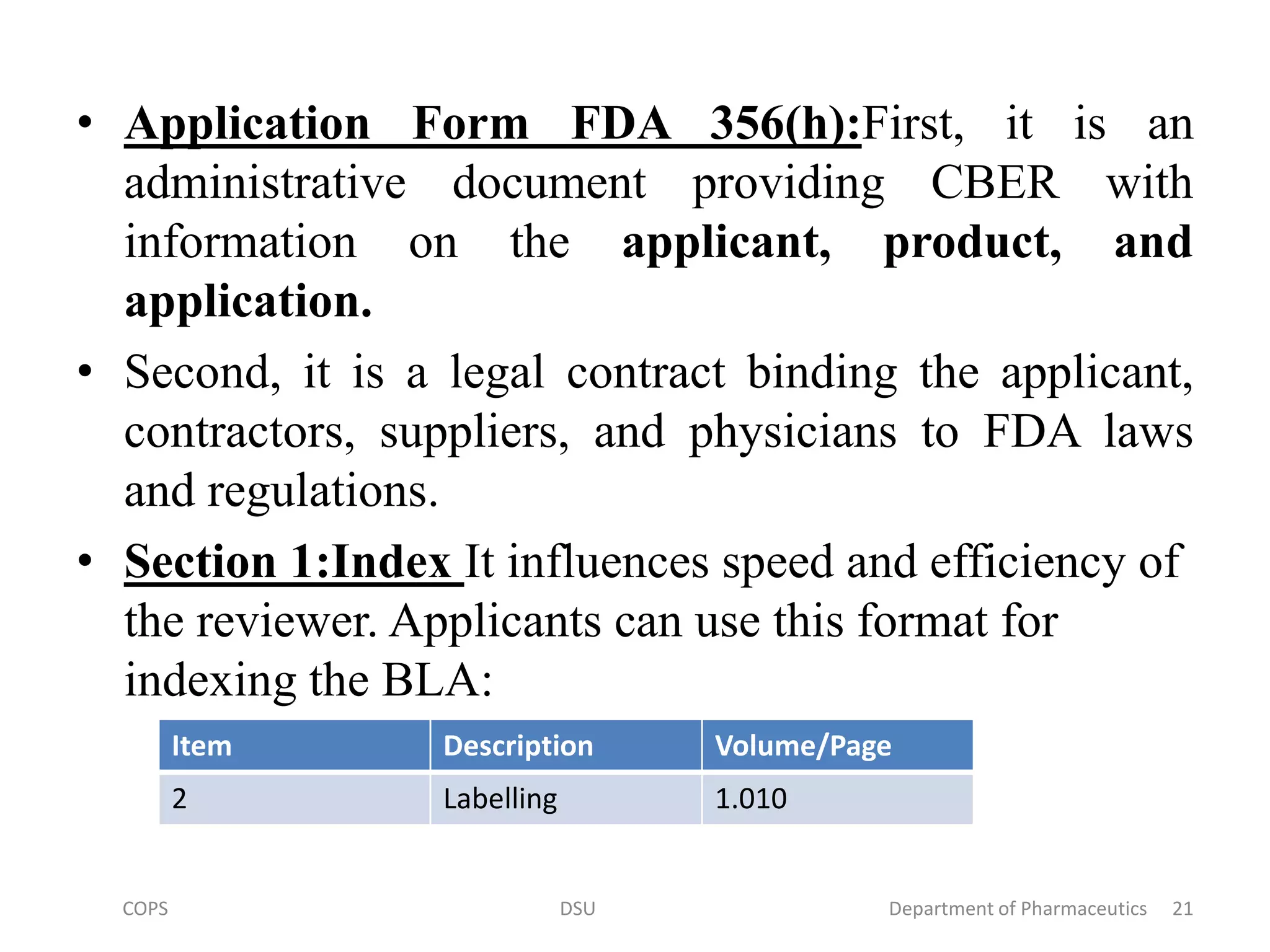
• Application Form FDA 356(h):First, it is an
administrative document providing CBER with
information on the applicant, product, and
application.
• Second, it is a legal contract binding the applicant,
contractors, suppliers, and physicians to FDA laws
and regulations.
• Section 1:Index It influences speed and efficiency of
the reviewer. Applicants can use this format for
indexing the BLA:
COPS DSU Department of Pharmaceutics 21
Item Description Volume/Page
2 Labelling 1.010
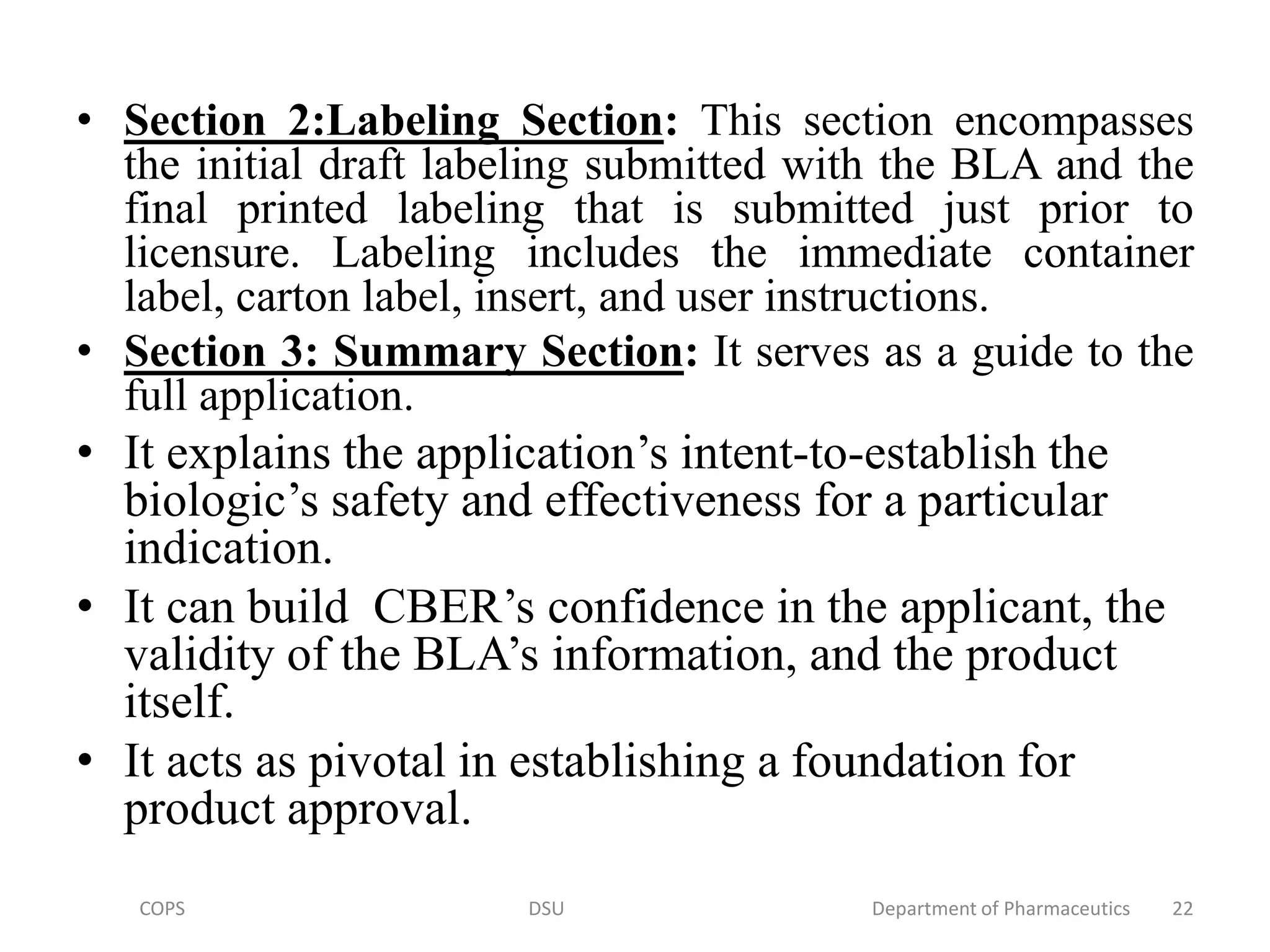
• Section 2:Labeling Section: This section encompasses
the initial draft labeling submitted with the BLA and the
final printed labeling that is submitted just prior to
licensure. Labeling includes the immediate container
label, carton label, insert, and user instructions.
• Section 3: Summary Section: It serves as a guide to the
full application.
• It explains the application’s intent-to-establish the
biologic’s safety and effectiveness for a particular
indication.
• It can build CBER’s confidence in the applicant, the
validity of the BLA’s information, and the product
itself.
• It acts as pivotal in establishing a foundation for
product approval.
COPS DSU Department of Pharmaceutics 22
Summary Format includes
1. Description of drug and formulation
2. Annotated draft insert
3. Product pharmacological class
4. Scientific rationale for use of product
5. Clinical benefits
6. Foreign marketing history
7. CMC summary
a. Drug substance
b. Drug product
c. Stability
d. Investigational summary (listing of batches used in
the clinical studies)
COPS DSU Department of Pharmaceutics 23
8. Nonclinical summary
a. Pharmacology
b. Toxicology
9. Human pharmacokinetics and bioavailability
10.Microbiological summary
11. Clinical summary
12.Benefit/risk relationship
Section 4: Chemistry Section
The BLA’s chemistry section is composed of three
parts:
1. Chemistry, manufacturing, and controls information;
2. Samples;
3. Methods validation package.
COPS DSU Department of Pharmaceutics 24
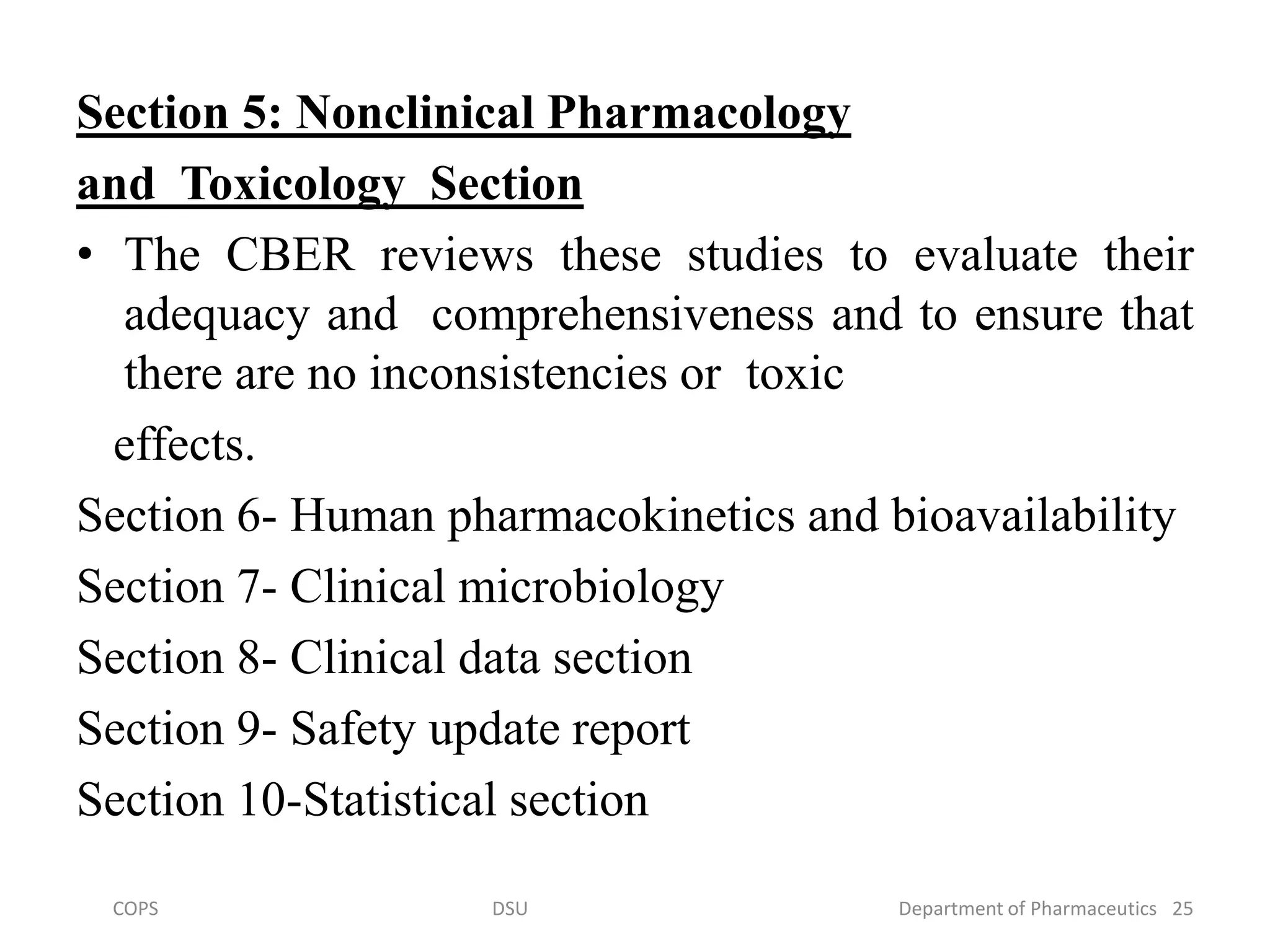
Section 5: Nonclinical Pharmacology
and Toxicology Section
• The CBER reviews these studies to evaluate their
adequacy and comprehensiveness and to ensure that
there are no inconsistencies or toxic
effects.
Section 6- Human pharmacokinetics and bioavailability
Section 7- Clinical microbiology
Section 8- Clinical data section
Section 9- Safety update report
Section 10-Statistical section
COPS DSU Department of Pharmaceutics 25
• Section 11- Case report tabulations
• Section 12- Case report forms
• Section 13- Patent information
• Section 14- Patent certification
• Section 15- Establishment description
• Section 16- Debarment certification
• Section 17- Field copy certification
• Section 18- User fee cover sheet
• Section 19- Financial information
• Section 20- Other
COPS DSU Department of Pharmaceutics 26
• Establishment compliance with Good Manufacturing
Practice (GMP) is now primarily assessed during the
preapproval inspection performed by the FDA prior
to final approval of the BLA.
• In Aug 2001 , CBER & CDER issued a draft
guidance document. This document is labelled as “
Draft----Not For Implementation.”
• This guidance is of special interest to biologics
manufacture for two reasons:
i)It is labeled as not for implementation.
ii)It is specifically restricted to “specified”
biotechnology product.
COPS DSU Department of Pharmaceutics 27
Specified biotechnology products originally termed
“well characterized biological product” is applied to
four distinct class of products.
i)Therapeutic DNA plasmid products.
ii)Therapeutic synthetic peptide products of 40 or fewer
amino acids.
iii)Monoclonal antibody products for in vivo use.
iv)Therapeutic recombinant DNA derived products.
COPS DSU Department of Pharmaceutics 28
BLA Review Process
 Then current CBER BLA review process is
developed to meet requirements of Prescription Drug
User Fee Act(PDUFA) of 1996.
 According to this act FDA agreed to institute
standards and timelines in exchange for user fees paid
by BLA sponsors.
 The goal is to standardize both review process and
review content.
 CBER issued no. of guidance documents which
provide type of information to be included in BLA for
each biologic product class:
COPS DSU Department of Pharmaceutics 29
 Few of them Guidance for Industry for the Submission of
Chemistry, Manufacturing , and Controls Information for a
Therapeutic Recombinant DNA-Derived Product or a Monoclonal
Antibody Product for in vivo Use - August 1996
 Guidance For the Submission of chemistry, Manufacturing and
Controls Information and Establishment description for Autologous
Somatic Cell Therapy Products - January 10, 1997
 Guidance for Industry- Changes to an Approved application for
Specified Biotechnology and Specified Synthetic Biological
Products - July 24, 1997.
 The review committee will intially review BLA to make a refusal to
file(RTF) decision within 60days.
 If the review committee determines that BLA is complete for filing
purpose it will be filed and a complete review is performed as
outlined in SOPP 8405.
 Following complete review CBER will issue either a complete
response letter , indicating that there are deficiencies or an Approval
letter , indicating a marketing license be granted.
COPS DSU Department of Pharmaceutics 30
AMENDING THE LICENSE APPLICATION: During the
review of the BLA , FDA’s request to address unresolved
issues regarding the original submission and a response to
such a request is generally referred to as an amendment.
Or
A change to any unapproved application is called an
Amendment (IND, BLA, and NDA).
SUPPLEMENT TO THE ORIGINAL BLA: Amendments are
submitted to update or modify an unapproved BLA,
supplements are submitted to modify approved license
applications.
 The holder of an approved BLA may seek to change its
manufacturing methods, expand the product’s indication, or
make other changes that reflect new technology or make its
product or processes more competitive.
COPS DSU Department of Pharmaceutics 31
ASSEMBLING AND SUBMITTING
THE BLA
 Submission of BLAs in electronic format would
speed the review process and also eliminates handling
of vast amt of paper.
 Many guidance documents have been published
providing information about filing of the BLA in
electronic format — with either the conventional
356h format or the new CTD format.
COPS DSU Department of Pharmaceutics 32
REVISED Guidance for Industry: Providing
Regulatory Submissions to the Center for Biologics
Evaluation and Research (CBER) in Electronic Format-
Biologics Marketing Applications [Biologics License
Application (BLA), Product License Application (PLA)/
Establishment License Application (ELA) and New
Drug Application (NDA)] — November 12, 1999.
• Draft Guidance for Industry: Submitting Marketing
Applications According to the ICH-CTD Forma
General Considerations - September 5, 2001
COPS DSU Department of Pharmaceutics 33
 The CTD is a five modular format for global use.
Module1:Administrative information (region
specific). For the United States, included in this
section are the Form FDA 356(h), draft labeling, and
three integrated summaries.
Module 2: Summaries and overview.
Module 3: Information on product quality.
Module 4: Nonclinical study reports.
Module 5: Clinical study reports.
COPS DSU Department of Pharmaceutics 34
Reference
• The Pharmaceutical Regulatory Process ;second
edition;edited by Ira R.Berry Robert P.Martin;page
number 103.
• https://www.fda.gov/vaccines-blood-
biologics/development-approval-process-cber
COPS DSU Department of Pharmaceutics 35
COPS DSU Department of Pharmaceutics 36

Regulatory requirement for approval of Biologics

  • 1.
    Submitted to: Dr. D.Manjula Asst. Professor, Department of Pharmaceutics, College of Pharmaceutical Sciences, DSU Dayananda sagar college of Pharmacy, Banglore. Presented by: Arpitha.B. M M Pharm (I SEM), Department of Pharmaceutics, College of Pharmaceutical Sciences, DSU Dayananda Sagar College of Pharmacy, Banglore. Regulatory requirement for approval of Biologics
  • 2.
    • Introduction • Sourcesand types of biologics • Difference between biologics and chemical drugs • Regulatory authority for biologics • Development and approval process • Biological license application (BLA) • Reference COPS DSU Department of Pharmaceutics 2 CONTENTS
  • 3.
    Introduction WHAT ARE BIOLOGICS? •Biologics are the products manufactured, extracted from or semi synthesized from a biological source which are regulated by FDA and are used to prevent cure and treat diseases and medical conditions. • These are generally large, complex molecules produced through biotechnology in a living system such as a microorganism, plant cell or animal cell. • These could be made of sugars, proteins, nucleic acids or complex combinations of these substances or may be living entities. COPS DSU Department of Pharmaceutics 3
  • 4.
    • These arecomplex mixtures that are not easily identifiable and charcterized these tend to be heat sensitive and susceptible to microbial contamination hence, it is necessary to use aspetic principles from intial manufacturing process. • EXAMPLES: Botox, Herceptin, Vaccines, Enbrel COPS DSU Department of Pharmaceutics 4
  • 5.
    History  A significantadvancement in scientific community in areas of vaccinology, immunology resulted in vaccines for small pox, rabies , typhoid and antitoxins for diphtheria and tetanus.  These products resulted in wide utilization for public health , but were not under pressure to ensure that products were safe.  13 children died at St. Louis in october 1901 after receiving diphtheria antitoxin that was contaminated with tetanus toxin. 5COPS DSU Department of Pharmaceutics
  • 6.
     9 childrendied from administration of contaminated small pox vaccine in camden , New Jersey.  These tragedy resulted in the Biologics Control Act of 1902.  “Any virus, serum, toxin, antitoxin, therapeutic serum, vaccine, blood, blood component or derivative, allergenic product, or analogous products, or trivalent arsenic compound such as arsphenamine applicable to the prevention, treatment, or cure of diseases or injuries in man.” ----Biologics.  Provisions of the Biological Control Act included licensure requirements for both establishments and COPS DSU Department of Pharmaceutics 6
  • 7.
    products, labelling requirements,facility inspection requirements, and penalties for violations including suspension and revocation of licenses.  Earlier BCA authorized Hygienic Laboratory to issue regulations implementing provisions of the act  In 1934 ,the Hygienic Laboratory was renamed as National Institute of Health(NIH) and by 1948 was known as Division of Biologics control within National Microbiological Institute(NMI).  In 1944 the Biologics Control Act was incorporated into section 351 of the Public Health Service Act (PHSA) . COPS DSU Department of Pharmaceutics 7
  • 8.
     PHSA actsas current legal basis for the FDA regulations covering biologic products as published in the Code of Federal Regulations (CFR) Title 21, Parts 600–680.  In 1955, Salk polio vaccine (a “killed” vaccine given by injection) produced by Cutter Laboratories(license issued by NMI ) resulted in 200 cases of paralytic polio.  The above incident led to formation of Division of Biologics Standard (DBS), an independent entity within NIH.  In 1972 DBS transferred to FDA as Bureau of Biologics(BB) COPS DSU Department of Pharmaceutics 8
  • 9.
     In 1982BB was merged with Bureau of Drugs to form National Centre for Drugs and Biologics (NCDB).  In 1988, NCDB was split into two centres, the Center for Biologics Evaluation and Research (CBER) and the Center for Drugs Evaluation and Research (CDER) were created . COPS DSU Department of Pharmaceutics 9
  • 10.
    COPS DSU Departmentof Pharmaceutics 10 • Biologics control act- 1902 • Authorized hygienic laboratory • In 1934 hygienic laboratory renamed to NIH • In 1948 divisions of biologics control within NMI • In 1944 BCA incorporated into Section 351 of PHSA (CFR tittle 21 parts 600-680) •In 1955 salk polio vaccine - DBS •In 1972 DBS transferred to FDA as Bureau of Biologics •In 1982 BB merged with NCDB (National centre for drugs and biologics) •In 1988 NCDB Splitted into 2 centres •1.CBER and 2. CDER
  • 11.
    SOURCES •Mammalian cell culture •Bacteria •Insectcell culture •Plant cell culture •Yeast •Transgenics •Avian cell culture •Humans Types • Blood derivatives •Vaccines •Allergenic extracts •Whole blood •Blood components •Proteins •Human tissues •Cellular and gene therapies •Xenotransplantation products COPS DSU Department of Pharmaceutics 11 Sources and types of Biologics
  • 12.
    Difference b/w biologics& chemical drug COPS DSU Department of Pharmaceutics 12 Properties Biologics Chemical drug Size Large Small Structure Complex Simple Stability Unstable Stable Modification Impossible to ensure identical copy Identical copy can be made Manufacturing Many options Well defined Characterization Impossible Easy
  • 13.
    REGULATORY AUTHORITY FOR BIOLOGICS •Center for biologics evalution and research (CBER) is the center within FDA that regulates biological products for human use under applicable Federal laws including the Public Health Services Act (PHS) and the Federal, Food, Drug and Cosmetics Act • CBER protects and advances the public health by ensuring that biological products are safe and effective. • FDA's regulatory authority for the approval of biologics resides in (PHS) Act. Biologics are COPS DSU Department of Pharmaceutics 13
  • 14.
    subjected to regulationunder Federal, Food, Drug And Cosmetics act (FD&C) Act. • Some medical devices which are used to produce biologics are regulated by CBER under FD&C Act's medical device amendments of 1976. • FDA also reviews new biological products and new indications and usage for already approved products on the market for the treatment of known diseases. • It protects against threats of emerging infectious diseases. • It provides the public with information to promote safe and appropriate use COPS DSU Department of Pharmaceutics 14
  • 15.
    DEVELOPMENT AND APPROVAL PROCESS •Advertising and Labeling • Investigational New Drug Application (IND) or Device exemption process (IDE) • Expanded Access • Premarket Approval (PMA) • Biologics License Application (BLA) New Drug Application Process (NDA). • Biologics Approvals By Year. COPS DSU Department of Pharmaceutics 15
  • 16.
    BIOLOGICS LICENSE APPLICATION (BLA) •The Biologics License Application (BLA) is a request for permission introduce or deliver for introduction a Biologic product into the market. • It is mainly regulated by 21 CFR 600-800. It is submitted by any legal person or entity, who engaged in manufacture or an applicant for a license who takes responsibilty for compliance with product and establishment of standards. • A Biologic License application generally applies to vaccines and other Allergenic drug products and cellular and genetic therapies. COPS DSU Department of Pharmaceutics 16
  • 17.
    COPS DSU Departmentof Pharmaceutics 17
  • 18.
    COPS DSU Departmentof Pharmaceutics 18
  • 19.
    COPS DSU Departmentof Pharmaceutics 19
  • 20.
    • A coverletter should always accompany any FDA submission. Addressed below are the Form FDA 356(h), the cover letter, and all 20 sections of the BLA application. • Before each section is addressed individually, it is worth emphasizing the importance of the application form [Form FDA 356(h)], the cover letter, and the first three sections. • Cover Letter: It consists of basic administrative information requested about the BLA application (e.g., sponsor name and address, etc.). The cover letter should provide at least seven types of information: 1. Name and address of sponsor and others 2. Product name 3.Reason for submission(e.g original submission, supplement, amendment, etc.). 4.Information contained in the submission.. 5.Agreements with the FDA. 6.Other documents relating to submission. 7.special circumstances. 8.Fast track review. COPS DSU Department of Pharmaceutics 20
  • 21.
    • Application FormFDA 356(h):First, it is an administrative document providing CBER with information on the applicant, product, and application. • Second, it is a legal contract binding the applicant, contractors, suppliers, and physicians to FDA laws and regulations. • Section 1:Index It influences speed and efficiency of the reviewer. Applicants can use this format for indexing the BLA: COPS DSU Department of Pharmaceutics 21 Item Description Volume/Page 2 Labelling 1.010
  • 22.
    • Section 2:LabelingSection: This section encompasses the initial draft labeling submitted with the BLA and the final printed labeling that is submitted just prior to licensure. Labeling includes the immediate container label, carton label, insert, and user instructions. • Section 3: Summary Section: It serves as a guide to the full application. • It explains the application’s intent-to-establish the biologic’s safety and effectiveness for a particular indication. • It can build CBER’s confidence in the applicant, the validity of the BLA’s information, and the product itself. • It acts as pivotal in establishing a foundation for product approval. COPS DSU Department of Pharmaceutics 22
  • 23.
    Summary Format includes 1.Description of drug and formulation 2. Annotated draft insert 3. Product pharmacological class 4. Scientific rationale for use of product 5. Clinical benefits 6. Foreign marketing history 7. CMC summary a. Drug substance b. Drug product c. Stability d. Investigational summary (listing of batches used in the clinical studies) COPS DSU Department of Pharmaceutics 23
  • 24.
    8. Nonclinical summary a.Pharmacology b. Toxicology 9. Human pharmacokinetics and bioavailability 10.Microbiological summary 11. Clinical summary 12.Benefit/risk relationship Section 4: Chemistry Section The BLA’s chemistry section is composed of three parts: 1. Chemistry, manufacturing, and controls information; 2. Samples; 3. Methods validation package. COPS DSU Department of Pharmaceutics 24
  • 25.
    Section 5: NonclinicalPharmacology and Toxicology Section • The CBER reviews these studies to evaluate their adequacy and comprehensiveness and to ensure that there are no inconsistencies or toxic effects. Section 6- Human pharmacokinetics and bioavailability Section 7- Clinical microbiology Section 8- Clinical data section Section 9- Safety update report Section 10-Statistical section COPS DSU Department of Pharmaceutics 25
  • 26.
    • Section 11-Case report tabulations • Section 12- Case report forms • Section 13- Patent information • Section 14- Patent certification • Section 15- Establishment description • Section 16- Debarment certification • Section 17- Field copy certification • Section 18- User fee cover sheet • Section 19- Financial information • Section 20- Other COPS DSU Department of Pharmaceutics 26
  • 27.
    • Establishment compliancewith Good Manufacturing Practice (GMP) is now primarily assessed during the preapproval inspection performed by the FDA prior to final approval of the BLA. • In Aug 2001 , CBER & CDER issued a draft guidance document. This document is labelled as “ Draft----Not For Implementation.” • This guidance is of special interest to biologics manufacture for two reasons: i)It is labeled as not for implementation. ii)It is specifically restricted to “specified” biotechnology product. COPS DSU Department of Pharmaceutics 27
  • 28.
    Specified biotechnology productsoriginally termed “well characterized biological product” is applied to four distinct class of products. i)Therapeutic DNA plasmid products. ii)Therapeutic synthetic peptide products of 40 or fewer amino acids. iii)Monoclonal antibody products for in vivo use. iv)Therapeutic recombinant DNA derived products. COPS DSU Department of Pharmaceutics 28
  • 29.
    BLA Review Process Then current CBER BLA review process is developed to meet requirements of Prescription Drug User Fee Act(PDUFA) of 1996.  According to this act FDA agreed to institute standards and timelines in exchange for user fees paid by BLA sponsors.  The goal is to standardize both review process and review content.  CBER issued no. of guidance documents which provide type of information to be included in BLA for each biologic product class: COPS DSU Department of Pharmaceutics 29
  • 30.
     Few ofthem Guidance for Industry for the Submission of Chemistry, Manufacturing , and Controls Information for a Therapeutic Recombinant DNA-Derived Product or a Monoclonal Antibody Product for in vivo Use - August 1996  Guidance For the Submission of chemistry, Manufacturing and Controls Information and Establishment description for Autologous Somatic Cell Therapy Products - January 10, 1997  Guidance for Industry- Changes to an Approved application for Specified Biotechnology and Specified Synthetic Biological Products - July 24, 1997.  The review committee will intially review BLA to make a refusal to file(RTF) decision within 60days.  If the review committee determines that BLA is complete for filing purpose it will be filed and a complete review is performed as outlined in SOPP 8405.  Following complete review CBER will issue either a complete response letter , indicating that there are deficiencies or an Approval letter , indicating a marketing license be granted. COPS DSU Department of Pharmaceutics 30
  • 31.
    AMENDING THE LICENSEAPPLICATION: During the review of the BLA , FDA’s request to address unresolved issues regarding the original submission and a response to such a request is generally referred to as an amendment. Or A change to any unapproved application is called an Amendment (IND, BLA, and NDA). SUPPLEMENT TO THE ORIGINAL BLA: Amendments are submitted to update or modify an unapproved BLA, supplements are submitted to modify approved license applications.  The holder of an approved BLA may seek to change its manufacturing methods, expand the product’s indication, or make other changes that reflect new technology or make its product or processes more competitive. COPS DSU Department of Pharmaceutics 31
  • 32.
    ASSEMBLING AND SUBMITTING THEBLA  Submission of BLAs in electronic format would speed the review process and also eliminates handling of vast amt of paper.  Many guidance documents have been published providing information about filing of the BLA in electronic format — with either the conventional 356h format or the new CTD format. COPS DSU Department of Pharmaceutics 32
  • 33.
    REVISED Guidance forIndustry: Providing Regulatory Submissions to the Center for Biologics Evaluation and Research (CBER) in Electronic Format- Biologics Marketing Applications [Biologics License Application (BLA), Product License Application (PLA)/ Establishment License Application (ELA) and New Drug Application (NDA)] — November 12, 1999. • Draft Guidance for Industry: Submitting Marketing Applications According to the ICH-CTD Forma General Considerations - September 5, 2001 COPS DSU Department of Pharmaceutics 33
  • 34.
     The CTDis a five modular format for global use. Module1:Administrative information (region specific). For the United States, included in this section are the Form FDA 356(h), draft labeling, and three integrated summaries. Module 2: Summaries and overview. Module 3: Information on product quality. Module 4: Nonclinical study reports. Module 5: Clinical study reports. COPS DSU Department of Pharmaceutics 34
  • 35.
    Reference • The PharmaceuticalRegulatory Process ;second edition;edited by Ira R.Berry Robert P.Martin;page number 103. • https://www.fda.gov/vaccines-blood- biologics/development-approval-process-cber COPS DSU Department of Pharmaceutics 35
  • 36.
    COPS DSU Departmentof Pharmaceutics 36