From: Tripura University (A central University)
Suryamaninagar, Agartala, Tripura (W), Pin No.: 799022
Presented By: Mr. Shubham Sutradhar
Semester: 1st; Course: M.pharm
Enrol. No.:1906240003
Presented to: Mr. Rajat Ghosh (Asst. Professor)
(Department of Pharmacy)
(Tripura University)
 Introduction of Mass Spectroscopy
 Basic principle
 Mass spectrometer
 Working principle
 Instrumentation of Mass Spectroscopy
 Ionisation Techniques
 Mass Spectrometric Analyzers
 Applications of Mass Spectroscopy
15-12-2020 2
Mass Spectroscopy
Mass spectrometry is an analytical technique that involves the
study in the gas phase of ionized molecules with the aim of one or
more of the following:
 Molecular weight determination
 Structural characterization
 Gas phase reactivity study
 Qualitative and quantitative analysis of components in a mixture
15-12-2020 3
Basic Principle:
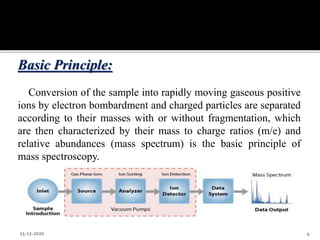
Conversion of the sample into rapidly moving gaseous positive
ions by electron bombardment and charged particles are separated
according to their masses with or without fragmentation, which
are then characterized by their mass to charge ratios (m/e) and
relative abundances (mass spectrum) is the basic principle of
mass spectroscopy.
15-12-2020 4
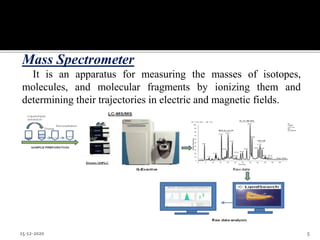
Mass Spectrometer
It is an apparatus for measuring the masses of isotopes,
molecules, and molecular fragments by ionizing them and
determining their trajectories in electric and magnetic fields.
15-12-2020 5
 In this technique, molecules are bombarded with a beam of
energetic electrons.
 The molecules are ionized and broken up into many
fragments, some of which are positive ions. Each kind of ion
has a particular ratio of mass to charge, i.e. m/e ratio (value).
 For most ions, the charge is one and thus, m/e ratio is simply
the molecular mass of the ion.
 The ions pass through magnetic and electric fields to reach
detector where they are detected and signals are recorded to
give a mass spectra.
15-12-2020 6
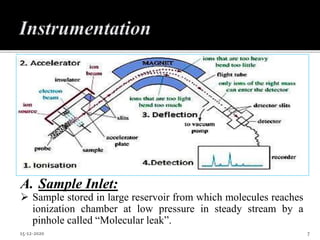
A. Sample Inlet:
 Sample stored in large reservoir from which molecules reaches
ionization chamber at low pressure in steady stream by a
pinhole called “Molecular leak”.
15-12-2020 7
B. Ionization:
 Atoms are ionized by knocking one or more electrons off to
give positive ions by bombardment with a stream of electrons.
 Most of the positive ions formed will carry charge of +1.
Types of Ionization:
 Electron Impact Ionization (EI)
 Chemical Ionization (CI)
 Desorption Ionization (FI, FAB, MALDI, SALDI)
 Spray Ionization (APCI, APPI, ESI)
 Gas discharge ion sources (e.g. Inductively Couple, Plasma)
 Ambient Ionization (DESI, LAESI)
15-12-2020 8
C. Acceleration:
 Ions are accelerated so that they all have same kinetic energy.
 Positive ions pass through 3 slits with voltage in decreasing
order.
 Middle slit carries intermediate and final one at zero volts.
D. Deflection:
 Ions are deflected by a magnetic field due to difference in their
masses.
 The lighter the mass, more they are deflected.
 It also depends upon the no. of +ve charge an ion is carrying;
the more +ve charge, more it will be deflected.
15-12-2020 9
E. Detection:
 The beam of ions passing through the mass analyzer is
detected by detector on the basis of m/e ratio.
 When an ion hit the metal box, charge is neutralized by an
electron jumping from metal on to the ion.
Types of analyzers:
 Quadrupole mass analysers
 Time of Flight analysers (TOF)
 Ion trap analyser
 Ion cyclotron analyser
 Magnetic sector mass analysers
 Double focussing analysers
15-12-2020 10
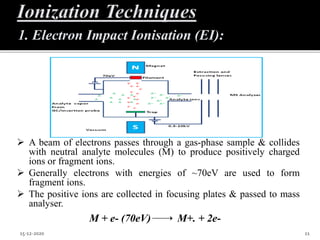
 A beam of electrons passes through a gas-phase sample & collides
with neutral analyte molecules (M) to produce positively charged
ions or fragment ions.
 Generally electrons with energies of ~70eV are used to form
fragment ions.
 The positive ions are collected in focusing plates & passed to mass
analyser.
15-12-2020 11
1. Electron Impact Ionisation (EI):
M + e- (70eV) M+. + 2e-
15-12-2020 12
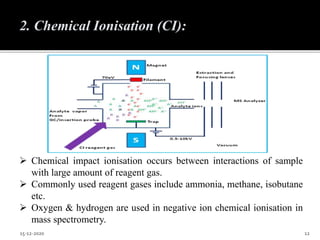
2. Chemical Ionisation (CI):
 Chemical impact ionisation occurs between interactions of sample
with large amount of reagent gas.
 Commonly used reagent gases include ammonia, methane, isobutane
etc.
 Oxygen & hydrogen are used in negative ion chemical ionisation in
mass spectrometry.
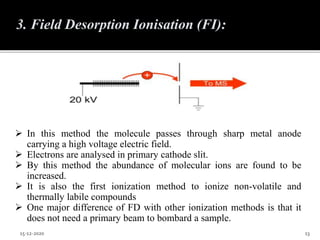
 In this method the molecule passes through sharp metal anode
carrying a high voltage electric field.
 Electrons are analysed in primary cathode slit.
 By this method the abundance of molecular ions are found to be
increased.
 It is also the first ionization method to ionize non-volatile and
thermally labile compounds
 One major difference of FD with other ionization methods is that it
does not need a primary beam to bombard a sample.
15-12-2020 13
3. Field Desorption Ionisation (FI):
15-12-2020 14
4. Fast Atomic Bombardment (FAB):
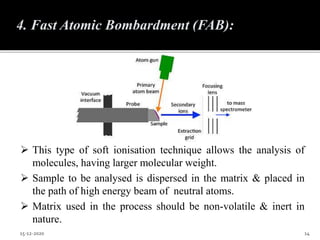
 This type of soft ionisation technique allows the analysis of
molecules, having larger molecular weight.
 Sample to be analysed is dispersed in the matrix & placed in
the path of high energy beam of neutral atoms.
 Matrix used in the process should be non-volatile & inert in
nature.
 The matrix can be made of glycerol, thioglycerol,
diethanolamine 3-nitrobenzyl alcohol, 18-crown-6 ether,
sulfolane, triethanolamine, &2-nitrophenyloctyl ether.
 Xenon & Argon like neutral gas ionised by hot filament & the
focused beam bombards the sample.
 Beam collides to the sample, a series of molecular reactions
occur & analyse in MS analyser.
 Both +ve & -ve ions are formed & could be analysed by this
method.
 insulin, amino glycosides, phospholipids, etc. can be analysed
by FAB.
15-12-2020 15
15-12-2020 16
5. Matrix Assisted Laser Desorption Ionisation
(MALDI):
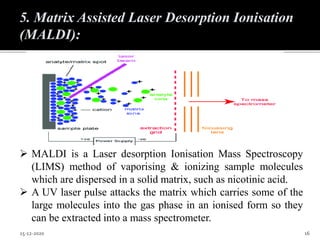
 MALDI is a Laser desorption Ionisation Mass Spectroscopy
(LIMS) method of vaporising & ionizing sample molecules
which are dispersed in a solid matrix, such as nicotinic acid.
 A UV laser pulse attacks the matrix which carries some of the
large molecules into the gas phase in an ionised form so they
can be extracted into a mass spectrometer.
 Ionization is done at very low pressure (<10–6 torr), hence it is
a very soft ionization technique & is a good ion source for
biomolecules.
 it was introduced for the ionization of peptides and proteins,
soon there after this technique was able to analyze other type
of biomolecules, such as oligosaccharides, glycolipids,
nucleotides, and synthetic polymers.
 MALDI is often used with time-of-flights mass spectrometers
(TOF) due to the pulsing nature of the technique, and the mass
range capability. Molecular weights upto few hundreds of
daltons could be measured.
15-12-2020 17
15-12-2020 18
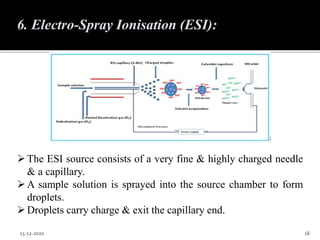
6. Electro-Spray Ionisation (ESI):
The ESI source consists of a very fine & highly charged needle
& a capillary.
A sample solution is sprayed into the source chamber to form
droplets.
Droplets carry charge & exit the capillary end.
A heat or dry gas called desolvation gas is applied to the
charged droplets to cause solvent evaporation.
As the solvent evaporates, the droplets disappear leaving highly
charged analyte molecules.
This very soft ionisation method is used mainly for
thermolabile chemicals.
ESI allows production of single or multiple charged ions (both
+ve & -ve in high yield).
15-12-2020 19
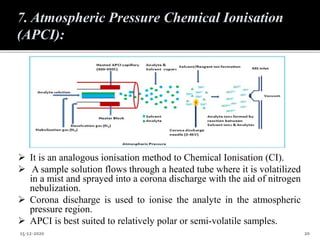
 It is an analogous ionisation method to Chemical Ionisation (CI).
 A sample solution flows through a heated tube where it is volatilized
in a mist and sprayed into a corona discharge with the aid of nitrogen
nebulization.
 Corona discharge is used to ionise the analyte in the atmospheric
pressure region.
 APCI is best suited to relatively polar or semi-volatile samples.
15-12-2020 20
7. Atmospheric Pressure Chemical Ionisation
(APCI):
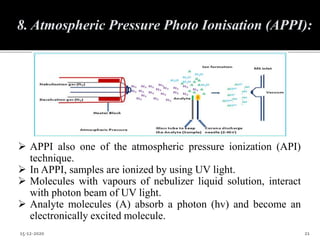
 APPI also one of the atmospheric pressure ionization (API)
technique.
 In APPI, samples are ionized by using UV light.
 Molecules with vapours of nebulizer liquid solution, interact
with photon beam of UV light.
 Analyte molecules (A) absorb a photon (hv) and become an
electronically excited molecule.
15-12-2020 21
8. Atmospheric Pressure Photo Ionisation (APPI):
If the ionization energy (IE) of analyte molecules is lower than
the energy of photon, then the analyte molecule releases
energetic electron and becomes the radical cation & moves
forward to the MS analyzer.
APPI is relatively less popular ionization technique for LCMS
instruments when it compared with ESI and APCI.
It is good for low to moderately polar compounds like
polycyclic aromatics, steroids, some mycotic toxins etc.
15-12-2020 22
15-12-2020 23
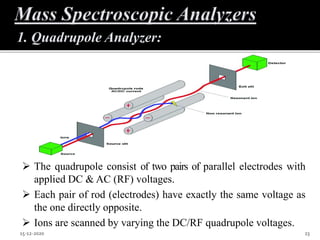
1. Quadrupole Analyzer:
 The quadrupole consist of two pairs of parallel electrodes with
applied DC & AC (RF) voltages.
 Each pair of rod (electrodes) have exactly the same voltage as
the one directly opposite.
 Ions are scanned by varying the DC/RF quadrupole voltages.
 For given dc and ac voltages, only ions of a certain mass-to-
charge ratio (m/z) can pass through the quadrupole filter and
all other ions are thrown out of their original path.
 A mass spectrum is obtained by the detector by monitoring the
ions passing through the quadrupole filter as the voltages on
the rods are varied.
15-12-2020 24
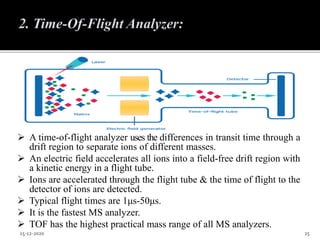
 A time-of-flight analyzer uses the differences in transit time through a
drift region to separate ions of different masses.
 An electric field accelerates all ions into a field-free drift region with
a kinetic energy in a flight tube.
 Ions are accelerated through the flight tube & the time of flight to the
detector of ions are detected.
 Typical flight times are 1μs-50μs.
 It is the fastest MS analyzer.
 TOF has the highest practical mass range of all MS analyzers.
15-12-2020 25
1. Environmental monitoring and analysis: soil, water and air
pollutants, water quality, etc.;
2. Geochemistry: age determination, soil and rock composition, oil
and gas surveying;
3. Chemical and Petrochemical industry: Quality control;
4. Identify structures of biomolecules: carbohydrates, nucleic acids
etc.;
5. Sequencing of biopolymers: proteins and oligosaccharides;
6. Determination of molecular mass: peptides, proteins, and
oligonucleotides;
7. Monitoring gases in patients breath during surgery;
8. Identification of drugs & its metabolites abuse in blood, urine, and
saliva;
9. Analyses of aerosol particles;
10. Determination of pesticides residues in food.
15-12-2020 26
1. https://www.cif.iastate.edu/mass-spec/ms-tutorial
2. http://premierbiosoft.com/tech_notes/mass-spectrometry.html
3. https://microbenotes.com/mass-spectrometry-ms-principle-working-instrumentation-steps-
applications/
4. http://chemed.chem.purdue.edu/genchem/history/isotope.html
5. http://premierbiosoft.com/tech_notes/mass-spectrometry.html
6. https://www.google.com/search?q=what+is+mass+spectrometer&oq=what+is+mass+spec&aqs=chro
me.1.69i57j0l5.9575j0j7&sourceid=chrome&ie=UTF-8
7. https://www.chem.pitt.edu/facilities/mass-spectrometry/mass-spectrometry-introduction
8. https://www.google.com/search?q=mass+spectrometer+HD&sxsrf=ACYBGNS778Qod2Rvc3II7CaA
dSKZeZSpFQ:1573910165990&source=lnms&tbm=isch&sa=X&ved=2ahUKEwiMteii6O7lAhUVO
isKHZ5DA8MQ_AUoAnoECA0QBA&biw=1366&bih=657#imgrc=-VMcbvjD7xfz6M:
9. https://www.slideshare.net/solairajananant/mass-spectrometry-38534267
10. https://www.slideshare.net/akshukumarsharma/mass-spectroscopy-55382941
11. http://www.ccamp.res.in/sites/default/files/Components%20of%20Mass%20Spectrometer_PB_C-
CAMP.pdf
12. https://www.cif.iastate.edu/mass-spec/ms-tutorial
13. https://en.wikipedia.org/wiki/Mass_spectrometry
14. https://www.ncbi.nlm.nih.gov/pubmed/16784548
15-12-2020 27

Mass spectroscopy & it's instrumentations

  • 1.
    From: Tripura University(A central University) Suryamaninagar, Agartala, Tripura (W), Pin No.: 799022 Presented By: Mr. Shubham Sutradhar Semester: 1st; Course: M.pharm Enrol. No.:1906240003 Presented to: Mr. Rajat Ghosh (Asst. Professor) (Department of Pharmacy) (Tripura University)
  • 2.
     Introduction ofMass Spectroscopy  Basic principle  Mass spectrometer  Working principle  Instrumentation of Mass Spectroscopy  Ionisation Techniques  Mass Spectrometric Analyzers  Applications of Mass Spectroscopy 15-12-2020 2
  • 3.
    Mass Spectroscopy Mass spectrometryis an analytical technique that involves the study in the gas phase of ionized molecules with the aim of one or more of the following:  Molecular weight determination  Structural characterization  Gas phase reactivity study  Qualitative and quantitative analysis of components in a mixture 15-12-2020 3
  • 4.
    Basic Principle: Conversion ofthe sample into rapidly moving gaseous positive ions by electron bombardment and charged particles are separated according to their masses with or without fragmentation, which are then characterized by their mass to charge ratios (m/e) and relative abundances (mass spectrum) is the basic principle of mass spectroscopy. 15-12-2020 4
  • 5.
    Mass Spectrometer It isan apparatus for measuring the masses of isotopes, molecules, and molecular fragments by ionizing them and determining their trajectories in electric and magnetic fields. 15-12-2020 5
  • 6.
     In thistechnique, molecules are bombarded with a beam of energetic electrons.  The molecules are ionized and broken up into many fragments, some of which are positive ions. Each kind of ion has a particular ratio of mass to charge, i.e. m/e ratio (value).  For most ions, the charge is one and thus, m/e ratio is simply the molecular mass of the ion.  The ions pass through magnetic and electric fields to reach detector where they are detected and signals are recorded to give a mass spectra. 15-12-2020 6
  • 7.
    A. Sample Inlet: Sample stored in large reservoir from which molecules reaches ionization chamber at low pressure in steady stream by a pinhole called “Molecular leak”. 15-12-2020 7
  • 8.
    B. Ionization:  Atomsare ionized by knocking one or more electrons off to give positive ions by bombardment with a stream of electrons.  Most of the positive ions formed will carry charge of +1. Types of Ionization:  Electron Impact Ionization (EI)  Chemical Ionization (CI)  Desorption Ionization (FI, FAB, MALDI, SALDI)  Spray Ionization (APCI, APPI, ESI)  Gas discharge ion sources (e.g. Inductively Couple, Plasma)  Ambient Ionization (DESI, LAESI) 15-12-2020 8
  • 9.
    C. Acceleration:  Ionsare accelerated so that they all have same kinetic energy.  Positive ions pass through 3 slits with voltage in decreasing order.  Middle slit carries intermediate and final one at zero volts. D. Deflection:  Ions are deflected by a magnetic field due to difference in their masses.  The lighter the mass, more they are deflected.  It also depends upon the no. of +ve charge an ion is carrying; the more +ve charge, more it will be deflected. 15-12-2020 9
  • 10.
    E. Detection:  Thebeam of ions passing through the mass analyzer is detected by detector on the basis of m/e ratio.  When an ion hit the metal box, charge is neutralized by an electron jumping from metal on to the ion. Types of analyzers:  Quadrupole mass analysers  Time of Flight analysers (TOF)  Ion trap analyser  Ion cyclotron analyser  Magnetic sector mass analysers  Double focussing analysers 15-12-2020 10
  • 11.
     A beamof electrons passes through a gas-phase sample & collides with neutral analyte molecules (M) to produce positively charged ions or fragment ions.  Generally electrons with energies of ~70eV are used to form fragment ions.  The positive ions are collected in focusing plates & passed to mass analyser. 15-12-2020 11 1. Electron Impact Ionisation (EI): M + e- (70eV) M+. + 2e-
  • 12.
    15-12-2020 12 2. ChemicalIonisation (CI):  Chemical impact ionisation occurs between interactions of sample with large amount of reagent gas.  Commonly used reagent gases include ammonia, methane, isobutane etc.  Oxygen & hydrogen are used in negative ion chemical ionisation in mass spectrometry.
  • 13.
     In thismethod the molecule passes through sharp metal anode carrying a high voltage electric field.  Electrons are analysed in primary cathode slit.  By this method the abundance of molecular ions are found to be increased.  It is also the first ionization method to ionize non-volatile and thermally labile compounds  One major difference of FD with other ionization methods is that it does not need a primary beam to bombard a sample. 15-12-2020 13 3. Field Desorption Ionisation (FI):
  • 14.
    15-12-2020 14 4. FastAtomic Bombardment (FAB):  This type of soft ionisation technique allows the analysis of molecules, having larger molecular weight.  Sample to be analysed is dispersed in the matrix & placed in the path of high energy beam of neutral atoms.  Matrix used in the process should be non-volatile & inert in nature.
  • 15.
     The matrixcan be made of glycerol, thioglycerol, diethanolamine 3-nitrobenzyl alcohol, 18-crown-6 ether, sulfolane, triethanolamine, &2-nitrophenyloctyl ether.  Xenon & Argon like neutral gas ionised by hot filament & the focused beam bombards the sample.  Beam collides to the sample, a series of molecular reactions occur & analyse in MS analyser.  Both +ve & -ve ions are formed & could be analysed by this method.  insulin, amino glycosides, phospholipids, etc. can be analysed by FAB. 15-12-2020 15
  • 16.
    15-12-2020 16 5. MatrixAssisted Laser Desorption Ionisation (MALDI):  MALDI is a Laser desorption Ionisation Mass Spectroscopy (LIMS) method of vaporising & ionizing sample molecules which are dispersed in a solid matrix, such as nicotinic acid.  A UV laser pulse attacks the matrix which carries some of the large molecules into the gas phase in an ionised form so they can be extracted into a mass spectrometer.
  • 17.
     Ionization isdone at very low pressure (<10–6 torr), hence it is a very soft ionization technique & is a good ion source for biomolecules.  it was introduced for the ionization of peptides and proteins, soon there after this technique was able to analyze other type of biomolecules, such as oligosaccharides, glycolipids, nucleotides, and synthetic polymers.  MALDI is often used with time-of-flights mass spectrometers (TOF) due to the pulsing nature of the technique, and the mass range capability. Molecular weights upto few hundreds of daltons could be measured. 15-12-2020 17
  • 18.
    15-12-2020 18 6. Electro-SprayIonisation (ESI): The ESI source consists of a very fine & highly charged needle & a capillary. A sample solution is sprayed into the source chamber to form droplets. Droplets carry charge & exit the capillary end.
  • 19.
    A heat ordry gas called desolvation gas is applied to the charged droplets to cause solvent evaporation. As the solvent evaporates, the droplets disappear leaving highly charged analyte molecules. This very soft ionisation method is used mainly for thermolabile chemicals. ESI allows production of single or multiple charged ions (both +ve & -ve in high yield). 15-12-2020 19
  • 20.
     It isan analogous ionisation method to Chemical Ionisation (CI).  A sample solution flows through a heated tube where it is volatilized in a mist and sprayed into a corona discharge with the aid of nitrogen nebulization.  Corona discharge is used to ionise the analyte in the atmospheric pressure region.  APCI is best suited to relatively polar or semi-volatile samples. 15-12-2020 20 7. Atmospheric Pressure Chemical Ionisation (APCI):
  • 21.
     APPI alsoone of the atmospheric pressure ionization (API) technique.  In APPI, samples are ionized by using UV light.  Molecules with vapours of nebulizer liquid solution, interact with photon beam of UV light.  Analyte molecules (A) absorb a photon (hv) and become an electronically excited molecule. 15-12-2020 21 8. Atmospheric Pressure Photo Ionisation (APPI):
  • 22.
    If the ionizationenergy (IE) of analyte molecules is lower than the energy of photon, then the analyte molecule releases energetic electron and becomes the radical cation & moves forward to the MS analyzer. APPI is relatively less popular ionization technique for LCMS instruments when it compared with ESI and APCI. It is good for low to moderately polar compounds like polycyclic aromatics, steroids, some mycotic toxins etc. 15-12-2020 22
  • 23.
    15-12-2020 23 1. QuadrupoleAnalyzer:  The quadrupole consist of two pairs of parallel electrodes with applied DC & AC (RF) voltages.  Each pair of rod (electrodes) have exactly the same voltage as the one directly opposite.  Ions are scanned by varying the DC/RF quadrupole voltages.
  • 24.
     For givendc and ac voltages, only ions of a certain mass-to- charge ratio (m/z) can pass through the quadrupole filter and all other ions are thrown out of their original path.  A mass spectrum is obtained by the detector by monitoring the ions passing through the quadrupole filter as the voltages on the rods are varied. 15-12-2020 24
  • 25.
     A time-of-flightanalyzer uses the differences in transit time through a drift region to separate ions of different masses.  An electric field accelerates all ions into a field-free drift region with a kinetic energy in a flight tube.  Ions are accelerated through the flight tube & the time of flight to the detector of ions are detected.  Typical flight times are 1μs-50μs.  It is the fastest MS analyzer.  TOF has the highest practical mass range of all MS analyzers. 15-12-2020 25
  • 26.
    1. Environmental monitoringand analysis: soil, water and air pollutants, water quality, etc.; 2. Geochemistry: age determination, soil and rock composition, oil and gas surveying; 3. Chemical and Petrochemical industry: Quality control; 4. Identify structures of biomolecules: carbohydrates, nucleic acids etc.; 5. Sequencing of biopolymers: proteins and oligosaccharides; 6. Determination of molecular mass: peptides, proteins, and oligonucleotides; 7. Monitoring gases in patients breath during surgery; 8. Identification of drugs & its metabolites abuse in blood, urine, and saliva; 9. Analyses of aerosol particles; 10. Determination of pesticides residues in food. 15-12-2020 26
  • 27.
    1. https://www.cif.iastate.edu/mass-spec/ms-tutorial 2. http://premierbiosoft.com/tech_notes/mass-spectrometry.html 3.https://microbenotes.com/mass-spectrometry-ms-principle-working-instrumentation-steps- applications/ 4. http://chemed.chem.purdue.edu/genchem/history/isotope.html 5. http://premierbiosoft.com/tech_notes/mass-spectrometry.html 6. https://www.google.com/search?q=what+is+mass+spectrometer&oq=what+is+mass+spec&aqs=chro me.1.69i57j0l5.9575j0j7&sourceid=chrome&ie=UTF-8 7. https://www.chem.pitt.edu/facilities/mass-spectrometry/mass-spectrometry-introduction 8. https://www.google.com/search?q=mass+spectrometer+HD&sxsrf=ACYBGNS778Qod2Rvc3II7CaA dSKZeZSpFQ:1573910165990&source=lnms&tbm=isch&sa=X&ved=2ahUKEwiMteii6O7lAhUVO isKHZ5DA8MQ_AUoAnoECA0QBA&biw=1366&bih=657#imgrc=-VMcbvjD7xfz6M: 9. https://www.slideshare.net/solairajananant/mass-spectrometry-38534267 10. https://www.slideshare.net/akshukumarsharma/mass-spectroscopy-55382941 11. http://www.ccamp.res.in/sites/default/files/Components%20of%20Mass%20Spectrometer_PB_C- CAMP.pdf 12. https://www.cif.iastate.edu/mass-spec/ms-tutorial 13. https://en.wikipedia.org/wiki/Mass_spectrometry 14. https://www.ncbi.nlm.nih.gov/pubmed/16784548 15-12-2020 27