Submitted to:
Dr. D. Manjula
Asst. Professor,
Department of Pharmaceutics,
COPS, DSU
Banglore.
Presented by:
Arpitha. B. M
M Pharm (II SEM),
Department of Pharmaceutics,
COPS, DSU
Banglore.
Emollients, Rheological additives:
classification and application.
Emollients
• Emollients contribute to the moisturizing, lubricating, protecting,
conditioning, and softening performance of cosmetic formulations. Though
the chemical structures of emollients are well-defined, the relationship
between these structures and such performance features can be strengthened
through quantifying fundamental properties.
• CTFA (The Cosmetic, Toiletry and Fragrance Association) dictionary
defines emollients as “cosmetic ingredients which help to maintain the soft,
smooth, and pliable appearance of the skin.
• They are mainly lipids and oils, which hydrate and improve the skin
softness, flexibility, and smoothness
• Emollients function by their ability to remain on the skin surface or in the
stratum corneum to act as lubricant, to reduce flaking, and to improve the
appearance of the skin.”
COPS, DSU Dept. of Pharmaceutics Emolients and Rheological additives 2
• Emollients are also described as refattening additives or refatteners in
case of bath products.
• The word “refattener” refers to substances improving the lipid
content of the upper layers of the skin; they prevent defattening and
drying out of the skin.
• Several emollients showing strong lipophilic character are identified
as occlusive ingredients; they are fatty/oily materials that remain on
the skin surface and reduce transepidermal water loss.
• CTFA dictionary defines “occlusives” as: “cosmetic ingredients which
retard the evaporation of water from the skin surface; by blocking the
evaporative loss of water, occlusive materials increase the water
content of the skin.”
• Overall, emollients and refatteners are oils and fats derived from
natural origins or obtained by chemical synthesis
COPS, DSU Dept. of Pharmaceutics Emolients and Rheological additives 3
Classified as
• nonpolar (paraffin’s and isoparaffin’s)
• polar substances (esters and triglycerides);
• Their chemical structure influence the interaction with the skin
surface and affect their sensorial properties.
• As a class, they comprise lipids, oils and their derivatives, fatty acid
esters, lanolin derivatives, and silicones and their organo-functional
derivatives.
COPS, DSU Dept. of Pharmaceutics Emolients and Rheological additives 4
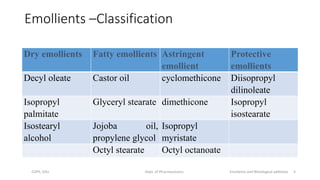
Emollients –Classification
Dry emollients Fatty emollients Astringent
emollient
Protective
emollients
Decyl oleate Castor oil cyclomethicone Diisopropyl
dilinoleate
Isopropyl
palmitate
Glyceryl stearate dimethicone Isopropyl
isostearate
Isostearyl
alcohol
Jojoba oil,
propylene glycol
Isopropyl
myristate
Octyl stearate Octyl octanoate
COPS, DSU Dept. of Pharmaceutics Emolients and Rheological additives 5
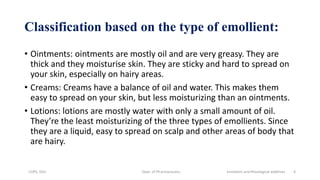
Classification based on the type of emollient:
• Ointments: ointments are mostly oil and are very greasy. They are
thick and they moisturise skin. They are sticky and hard to spread on
your skin, especially on hairy areas.
• Creams: Creams have a balance of oil and water. This makes them
easy to spread on your skin, but less moisturizing than an ointments.
• Lotions: lotions are mostly water with only a small amount of oil.
They’re the least moisturizing of the three types of emollients. Since
they are a liquid, easy to spread on scalp and other areas of body that
are hairy.
COPS, DSU Dept. of Pharmaceutics Emolients and Rheological additives 6
Applications:
• Emollients are effective for soothing and healing dry skin due to
almost any cause, including:
• For eczema and psoriasis.
• Atopic dermatitis
• Hypothyroidism
• Diabetes
• Kidney disease
• Emollients can treat other skin conditions like skin irritations such as
burns from radiation treatments and diaper rash.
• Emollients can help improve and control all the symptoms and heal
skin whatever the cause.
COPS, DSU Dept. of Pharmaceutics Emolients and Rheological additives 7
RHEOLOGICALADDITIVES
• Rheology is the branch of physics that deals with the deformation and flow
of matter, especially the non-newtonian flow of liquids and the plastic flow
of solids.
• Today’s successful cosmetics products need the right rheological properties
and the correct choice of rheological additives enhances the product in
production, storage stability and application.
• Rheological additives for aqueous and non-aqueous formulations are
valuable and proven tools for personal care, skin care, decorative cosmetics.
All can benefit from rheological additives.
• The category of rheological additives can be split into two distinct areas:
• additives that can be used to modify water and
• additives that can be used to modify liquids other than water.
COPS, DSU Dept. of Pharmaceutics Emolients and Rheological additives 8
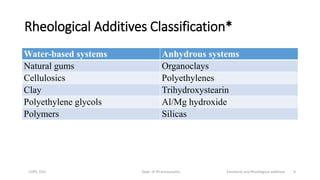
Rheological Additives Classification*
Water-based systems Anhydrous systems
Natural gums Organoclays
Cellulosics Polyethylenes
Clay Trihydroxystearin
Polyethylene glycols Al/Mg hydroxide
Polymers Silicas
COPS, DSU Dept. of Pharmaceutics Emolients and Rheological additives 9
Natural gums:
• May be able to fulfil a particular need more efficiently than synthetic gums.
When those cases arise, formulators can still call on carrageenan, guar,
karaya, tragacanth, and xanthan gums to give them a variety of rheologies
and viscosities as well as some salt and pH tolerance, depending on the
ingredient chosen.
• As with many other additives for water-based systems, these gums are
basically used as rheological modifiers in the water phase of emulsions.
• Synergistic effects can also be achieved by the combination of some of the
natural gums with clay products, such as the use of xanthan or guar gum
with aluminum magnesium silicate.
COPS, DSU Dept. of Pharmaceutics Emolients and Rheological additives 10
Cellulose
• Cellulose is another naturally occurring polysaccharide, and through chemical
modifications it accounts for a family of rheological additives that includes cellulose gum,
hydroxyethylcellulose, methylcellulose, and hydroxypropyl cellulose.
• Due to the modifications, some of the derivatives display excellent salt tolerance,
surfactant compatibility, or film-forming properties, which make them particularly useful
in certain shampoos, hair care products, and shaving products.
• Clays for rheological effects are available in four primary types: bentonites, hectorites,
synthetic hectorites, and magnesium aluminum silicates. Bentonites are based on
aluminum silicates, while hectorites are based on magnesium silicates.
• The different chemistries and the differences in the natural formations of these clays
account for the different properties. Hectorites tend to build a higher amount of viscosity
than the other additives, based on their smaller particle size and larger surface area.
• These materials typically produce pseudoplastic rheology in water-based systems and are
used primarily for viscosity enhancement, low control, and emulsion stability.
COPS, DSU Dept. of Pharmaceutics Emolients and Rheological additives 11
Polyethylene glycols (PEGs);
• consist of variable molecular weight polymers of ethylene oxide.
• These materials are soluble not only in water but also in alcohols and
glycols; they are used as thickeners, humectants, and lubricants in
creams and lotions, and as co-gelling aids for antiperspirant sticks.
• The higher the molecular weight, the more effective the polymer is in
providing viscosity.
• PEGs below a molecular weight of 700 are liquid at room
temperature.
COPS, DSU Dept. of Pharmaceutics Emolients and Rheological additives 12
Synthetic polymers:
• Are used extensively in cosmetics to build pseudoplastic viscosity,
create clear gels, and stabilize emulsions.
• The main base used for most cosmetic polymers is acrylic acid, and
the polymer is described as a homopolymer (made entirely of one
kind of polymer), copolymer (combinations of more than one type of
polymer), or cross-polymer (copolymers with a cross-linking agent).
• These materials are supplied in a tightly coiled acid form and become
effective only when uncoiled by neutralization with a base.
• Their effectiveness comes from both long-chain entanglement and
hydrogen bonding; they are typically used at concentrations ranging
from 0.1% to 0.5%.
COPS, DSU Dept. of Pharmaceutics Emolients and Rheological additives 13
• Salt sensitivity and the inability to withstand high levels of shear are
the two limitations formulators must bear in mind.
• The carbomers and variations based on similar chemistry have
become the most widely used polymers in cosmetics, and are
available in a variety of grades from a number of suppliers.
COPS, DSU Dept. of Pharmaceutics Emolients and Rheological additives14
Organoclays:
• Are reaction products of hydrophilic clays with long-chain quaternary
compounds, for example, quaternium-18 hectorite.
• The quaternary ammonium compound provides compatibility with
nonaqueous liquids, allowing the primary clay rheology to be
expressed in nonaqueous systems such as oils, esters, and silicones
through a hydrogen bonding structure between platelets.
• The organoclays are the rheological additives of choice in nail
lacquers, antiperspirant roll-ons, aerosols, and waterproof mascaras,
due to their thickening and suspending abilities.
COPS, DSU Dept. of Pharmaceutics Emolients and Rheological additives 15
• To be fully dispersed, organoclay powders need chemical activation
and very high shear, though they are available as gels in fully activated
and sheared forms in a number of cosmetic oils for users that do not
have high shear capability.
• Organoclay gels are unaffected by high temperature or high shear
processing, though laminar flow can reduce the viscosity of the
overall system.
COPS, DSU Dept. of Pharmaceutics Emolients and Rheological additives 16
Polyethylenes
• Polyethylenes and their variants are used for their thickening and
suspending properties in anhydrous systems such as lipsticks,
antiperspirant sticks, and mascaras.
• They improve water resistance, form films, improve heat stability, and
can form clear gels when quickly cooled, allowing the formation of a
fine thixotropic crystal structure. To achieve good properties, the
additive needs to be heated to 80 0C or higher, depending on the
grade of polyethylene.
COPS, DSU Dept. of Pharmaceutics Emolients and Rheological additives 17
Trihydroxy stearin
• Is a castor oil-derived rheological additive that provides a high degree
of thixotropy and viscosity.
• It is used to help stiffen lipsticks and antiperspirant sticks, thicken
emulsions, and, together with organoclays, control the flow and
recovery time in mascaras.
• Heat and shear under carefully controlled conditions are necessary
for full rheological development.
• Aluminum magnesium hydroxide stéarate is a complex of the
hydroxide and stearic acid, which can form gels in a number of
cosmetic oils.
• It can suspend pigments and some other active ingredients and can
increase the temperature stability of the formula.
COPS, DSU Dept. of Pharmaceutics Emolients and Rheological additives 18
Silicas, or silicon dioxides
• Build their thixotropic structures in oil systems through a network of
long chains and hydrogen bonds.
• These very fine particulates are either porous or not, depending on
their manufacturing process.
• The liquid process (hydrated silicas) yields a very porous material that
can absorb oils, while the vapor or "fumed" process yields a higher
surface area and a significantly reduced bulk density.
• Silicas are used for viscosity building, for creating thixotropy, and for
providing suspension properties.
COPS, DSU Dept. of Pharmaceutics Emolients and Rheological additives 19
CONSIDERATIONS
• Care must be taken to avoid high shear processing after the addition of a silica,
since it can destroy the hydrogen-bonded network.
• The decision of which rheological additive to use in a certain situation is up to the
formulator.
• As in many cases, the final answer can be reached by several different paths.
• By being cognizant of the different rheological additives available and the
advantages and drawbacks of each one, a formulator will be able to narrow the
search but might not always be able to identify the best available additive for the
job.
• Though there are some additives that are used more often in certain products
than others, that alone should not be considered as a determining factor when
formulating.
• The type of rheology required, the temperature requirements, compatibility with
other formulation ingredients, ultimate formula pH, the need for clarity, and
available processing equipment must enter into the decision.
COPS, DSU Dept. of Pharmaceutics Emolients and Rheological additives 20
APPLICATIONS
• Used as thickners and suspending agent
• The viscosity of creams and lotion may affect the rate of absorption of the
products by the skin.
• A greater release of active ingredients is generally possible from the softer,
less viscous bases.
• The viscosity of semi-solid products may affect absorption of these topical
products due to the effect of viscosity on the rate of diffusion of the active
ingredients.
• The rate of absorption of an ordinary suspension differs from thixotropic
suspension from containers.
• Thixotropy is useful in the formulation of pharmaceutical suspension and
emulsion. They must be easily poured
COPS, DSU Dept. of Pharmaceutics Emolients and Rheological additives 21
REFERENCE
1. https://www.ncbi.nlm.nih.gov/pmc/articles/PMC4885180
2. Ranucci, J.A., and Silverstein, I.B., in Pharmaceutical Dosage Forms,
2nd ed.,Vol. 3, p. 243; Lieberman, H.A., et al., eds., Marcel Dekker, Inc.
New York, 1998
COPS, DSU Dept. of Pharmaceutics Emolients and Rheological additives 22
COPS, DSU Dept. of Pharmaceutics Emolients and Rheological additives 23

Emollients rheological additives classification and application

  • 1.
    Submitted to: Dr. D.Manjula Asst. Professor, Department of Pharmaceutics, COPS, DSU Banglore. Presented by: Arpitha. B. M M Pharm (II SEM), Department of Pharmaceutics, COPS, DSU Banglore. Emollients, Rheological additives: classification and application.
  • 2.
    Emollients • Emollients contributeto the moisturizing, lubricating, protecting, conditioning, and softening performance of cosmetic formulations. Though the chemical structures of emollients are well-defined, the relationship between these structures and such performance features can be strengthened through quantifying fundamental properties. • CTFA (The Cosmetic, Toiletry and Fragrance Association) dictionary defines emollients as “cosmetic ingredients which help to maintain the soft, smooth, and pliable appearance of the skin. • They are mainly lipids and oils, which hydrate and improve the skin softness, flexibility, and smoothness • Emollients function by their ability to remain on the skin surface or in the stratum corneum to act as lubricant, to reduce flaking, and to improve the appearance of the skin.” COPS, DSU Dept. of Pharmaceutics Emolients and Rheological additives 2
  • 3.
    • Emollients arealso described as refattening additives or refatteners in case of bath products. • The word “refattener” refers to substances improving the lipid content of the upper layers of the skin; they prevent defattening and drying out of the skin. • Several emollients showing strong lipophilic character are identified as occlusive ingredients; they are fatty/oily materials that remain on the skin surface and reduce transepidermal water loss. • CTFA dictionary defines “occlusives” as: “cosmetic ingredients which retard the evaporation of water from the skin surface; by blocking the evaporative loss of water, occlusive materials increase the water content of the skin.” • Overall, emollients and refatteners are oils and fats derived from natural origins or obtained by chemical synthesis COPS, DSU Dept. of Pharmaceutics Emolients and Rheological additives 3
  • 4.
    Classified as • nonpolar(paraffin’s and isoparaffin’s) • polar substances (esters and triglycerides); • Their chemical structure influence the interaction with the skin surface and affect their sensorial properties. • As a class, they comprise lipids, oils and their derivatives, fatty acid esters, lanolin derivatives, and silicones and their organo-functional derivatives. COPS, DSU Dept. of Pharmaceutics Emolients and Rheological additives 4
  • 5.
    Emollients –Classification Dry emollientsFatty emollients Astringent emollient Protective emollients Decyl oleate Castor oil cyclomethicone Diisopropyl dilinoleate Isopropyl palmitate Glyceryl stearate dimethicone Isopropyl isostearate Isostearyl alcohol Jojoba oil, propylene glycol Isopropyl myristate Octyl stearate Octyl octanoate COPS, DSU Dept. of Pharmaceutics Emolients and Rheological additives 5
  • 6.
    Classification based onthe type of emollient: • Ointments: ointments are mostly oil and are very greasy. They are thick and they moisturise skin. They are sticky and hard to spread on your skin, especially on hairy areas. • Creams: Creams have a balance of oil and water. This makes them easy to spread on your skin, but less moisturizing than an ointments. • Lotions: lotions are mostly water with only a small amount of oil. They’re the least moisturizing of the three types of emollients. Since they are a liquid, easy to spread on scalp and other areas of body that are hairy. COPS, DSU Dept. of Pharmaceutics Emolients and Rheological additives 6
  • 7.
    Applications: • Emollients areeffective for soothing and healing dry skin due to almost any cause, including: • For eczema and psoriasis. • Atopic dermatitis • Hypothyroidism • Diabetes • Kidney disease • Emollients can treat other skin conditions like skin irritations such as burns from radiation treatments and diaper rash. • Emollients can help improve and control all the symptoms and heal skin whatever the cause. COPS, DSU Dept. of Pharmaceutics Emolients and Rheological additives 7
  • 8.
    RHEOLOGICALADDITIVES • Rheology isthe branch of physics that deals with the deformation and flow of matter, especially the non-newtonian flow of liquids and the plastic flow of solids. • Today’s successful cosmetics products need the right rheological properties and the correct choice of rheological additives enhances the product in production, storage stability and application. • Rheological additives for aqueous and non-aqueous formulations are valuable and proven tools for personal care, skin care, decorative cosmetics. All can benefit from rheological additives. • The category of rheological additives can be split into two distinct areas: • additives that can be used to modify water and • additives that can be used to modify liquids other than water. COPS, DSU Dept. of Pharmaceutics Emolients and Rheological additives 8
  • 9.
    Rheological Additives Classification* Water-basedsystems Anhydrous systems Natural gums Organoclays Cellulosics Polyethylenes Clay Trihydroxystearin Polyethylene glycols Al/Mg hydroxide Polymers Silicas COPS, DSU Dept. of Pharmaceutics Emolients and Rheological additives 9
  • 10.
    Natural gums: • Maybe able to fulfil a particular need more efficiently than synthetic gums. When those cases arise, formulators can still call on carrageenan, guar, karaya, tragacanth, and xanthan gums to give them a variety of rheologies and viscosities as well as some salt and pH tolerance, depending on the ingredient chosen. • As with many other additives for water-based systems, these gums are basically used as rheological modifiers in the water phase of emulsions. • Synergistic effects can also be achieved by the combination of some of the natural gums with clay products, such as the use of xanthan or guar gum with aluminum magnesium silicate. COPS, DSU Dept. of Pharmaceutics Emolients and Rheological additives 10
  • 11.
    Cellulose • Cellulose isanother naturally occurring polysaccharide, and through chemical modifications it accounts for a family of rheological additives that includes cellulose gum, hydroxyethylcellulose, methylcellulose, and hydroxypropyl cellulose. • Due to the modifications, some of the derivatives display excellent salt tolerance, surfactant compatibility, or film-forming properties, which make them particularly useful in certain shampoos, hair care products, and shaving products. • Clays for rheological effects are available in four primary types: bentonites, hectorites, synthetic hectorites, and magnesium aluminum silicates. Bentonites are based on aluminum silicates, while hectorites are based on magnesium silicates. • The different chemistries and the differences in the natural formations of these clays account for the different properties. Hectorites tend to build a higher amount of viscosity than the other additives, based on their smaller particle size and larger surface area. • These materials typically produce pseudoplastic rheology in water-based systems and are used primarily for viscosity enhancement, low control, and emulsion stability. COPS, DSU Dept. of Pharmaceutics Emolients and Rheological additives 11
  • 12.
    Polyethylene glycols (PEGs); •consist of variable molecular weight polymers of ethylene oxide. • These materials are soluble not only in water but also in alcohols and glycols; they are used as thickeners, humectants, and lubricants in creams and lotions, and as co-gelling aids for antiperspirant sticks. • The higher the molecular weight, the more effective the polymer is in providing viscosity. • PEGs below a molecular weight of 700 are liquid at room temperature. COPS, DSU Dept. of Pharmaceutics Emolients and Rheological additives 12
  • 13.
    Synthetic polymers: • Areused extensively in cosmetics to build pseudoplastic viscosity, create clear gels, and stabilize emulsions. • The main base used for most cosmetic polymers is acrylic acid, and the polymer is described as a homopolymer (made entirely of one kind of polymer), copolymer (combinations of more than one type of polymer), or cross-polymer (copolymers with a cross-linking agent). • These materials are supplied in a tightly coiled acid form and become effective only when uncoiled by neutralization with a base. • Their effectiveness comes from both long-chain entanglement and hydrogen bonding; they are typically used at concentrations ranging from 0.1% to 0.5%. COPS, DSU Dept. of Pharmaceutics Emolients and Rheological additives 13
  • 14.
    • Salt sensitivityand the inability to withstand high levels of shear are the two limitations formulators must bear in mind. • The carbomers and variations based on similar chemistry have become the most widely used polymers in cosmetics, and are available in a variety of grades from a number of suppliers. COPS, DSU Dept. of Pharmaceutics Emolients and Rheological additives14
  • 15.
    Organoclays: • Are reactionproducts of hydrophilic clays with long-chain quaternary compounds, for example, quaternium-18 hectorite. • The quaternary ammonium compound provides compatibility with nonaqueous liquids, allowing the primary clay rheology to be expressed in nonaqueous systems such as oils, esters, and silicones through a hydrogen bonding structure between platelets. • The organoclays are the rheological additives of choice in nail lacquers, antiperspirant roll-ons, aerosols, and waterproof mascaras, due to their thickening and suspending abilities. COPS, DSU Dept. of Pharmaceutics Emolients and Rheological additives 15
  • 16.
    • To befully dispersed, organoclay powders need chemical activation and very high shear, though they are available as gels in fully activated and sheared forms in a number of cosmetic oils for users that do not have high shear capability. • Organoclay gels are unaffected by high temperature or high shear processing, though laminar flow can reduce the viscosity of the overall system. COPS, DSU Dept. of Pharmaceutics Emolients and Rheological additives 16
  • 17.
    Polyethylenes • Polyethylenes andtheir variants are used for their thickening and suspending properties in anhydrous systems such as lipsticks, antiperspirant sticks, and mascaras. • They improve water resistance, form films, improve heat stability, and can form clear gels when quickly cooled, allowing the formation of a fine thixotropic crystal structure. To achieve good properties, the additive needs to be heated to 80 0C or higher, depending on the grade of polyethylene. COPS, DSU Dept. of Pharmaceutics Emolients and Rheological additives 17
  • 18.
    Trihydroxy stearin • Isa castor oil-derived rheological additive that provides a high degree of thixotropy and viscosity. • It is used to help stiffen lipsticks and antiperspirant sticks, thicken emulsions, and, together with organoclays, control the flow and recovery time in mascaras. • Heat and shear under carefully controlled conditions are necessary for full rheological development. • Aluminum magnesium hydroxide stéarate is a complex of the hydroxide and stearic acid, which can form gels in a number of cosmetic oils. • It can suspend pigments and some other active ingredients and can increase the temperature stability of the formula. COPS, DSU Dept. of Pharmaceutics Emolients and Rheological additives 18
  • 19.
    Silicas, or silicondioxides • Build their thixotropic structures in oil systems through a network of long chains and hydrogen bonds. • These very fine particulates are either porous or not, depending on their manufacturing process. • The liquid process (hydrated silicas) yields a very porous material that can absorb oils, while the vapor or "fumed" process yields a higher surface area and a significantly reduced bulk density. • Silicas are used for viscosity building, for creating thixotropy, and for providing suspension properties. COPS, DSU Dept. of Pharmaceutics Emolients and Rheological additives 19
  • 20.
    CONSIDERATIONS • Care mustbe taken to avoid high shear processing after the addition of a silica, since it can destroy the hydrogen-bonded network. • The decision of which rheological additive to use in a certain situation is up to the formulator. • As in many cases, the final answer can be reached by several different paths. • By being cognizant of the different rheological additives available and the advantages and drawbacks of each one, a formulator will be able to narrow the search but might not always be able to identify the best available additive for the job. • Though there are some additives that are used more often in certain products than others, that alone should not be considered as a determining factor when formulating. • The type of rheology required, the temperature requirements, compatibility with other formulation ingredients, ultimate formula pH, the need for clarity, and available processing equipment must enter into the decision. COPS, DSU Dept. of Pharmaceutics Emolients and Rheological additives 20
  • 21.
    APPLICATIONS • Used asthickners and suspending agent • The viscosity of creams and lotion may affect the rate of absorption of the products by the skin. • A greater release of active ingredients is generally possible from the softer, less viscous bases. • The viscosity of semi-solid products may affect absorption of these topical products due to the effect of viscosity on the rate of diffusion of the active ingredients. • The rate of absorption of an ordinary suspension differs from thixotropic suspension from containers. • Thixotropy is useful in the formulation of pharmaceutical suspension and emulsion. They must be easily poured COPS, DSU Dept. of Pharmaceutics Emolients and Rheological additives 21
  • 22.
    REFERENCE 1. https://www.ncbi.nlm.nih.gov/pmc/articles/PMC4885180 2. Ranucci,J.A., and Silverstein, I.B., in Pharmaceutical Dosage Forms, 2nd ed.,Vol. 3, p. 243; Lieberman, H.A., et al., eds., Marcel Dekker, Inc. New York, 1998 COPS, DSU Dept. of Pharmaceutics Emolients and Rheological additives 22
  • 23.
    COPS, DSU Dept.of Pharmaceutics Emolients and Rheological additives 23