HOT-STAGE
MICROSCOPY
Prepared by: Sarah Khallad
MSc Pharmaceutical Sciences
1
Contents
• Introduction
• Hot-Stage Microscope Instrumentation
• Applications of hot stage microscopy in pharmaceuticals:
1. Morphology studies
2. Amorphous/crystalline form characterization
3. Polymorphism
4. Cocrystal Screening
5. Particle size distribution and characterization of an API in a
tablet
6. Solvates/hydrate screening
7. Miscibility
8. Thermal analysis by surface characterization (TASC)
2
Hot stage microscopy (HSM)
• Coupling of thermal analysis with microscopy for the
solid-state characterization of materials as a function of
temperature and time.
• In pharmaceuticals HSM is used to support DSC and
TGA observations and to detect small changes in the
sample that may be missed by DSC and TGA during a
thermal experiment.
• Like Desolvation, recrystallization, phase transitions
and minor changes in the surface.
3
Hot-Stage Microscope
• The hot-stage microscope is an optical microscope
equipped with heating and cooling units which allow
observation of a sample under the change of temperature.
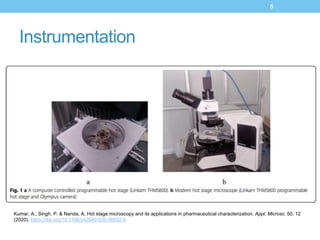
• A typical modern hot stage microscope consists of:
1. Computer controlled programmable hot stage
2. Optical microscope for real time observation
3. Polarizing filters
4. Digital camera for recording thermal events
5. Computer and software to control the hot stage and to
carry out the analysis of the thermographs generated
during a thermal event.
4
Instrumentation
5
Kumar, A., Singh, P. & Nanda, A. Hot stage microscopy and its applications in pharmaceutical characterization. Appl. Microsc. 50, 12
(2020). https://doi.org/10.1186/s42649-020-00032-9
Hot Stage (with glass slide).
Control unit & 2 types of hot stage.
Cont.
6
https://en.donho.com.tw/mettler-toledo-hot-stage-microscopy-
systems.html
Cont.
• The sample is heated in a sapphire crucible or glass
slide, either in an open or a closed environment and can
be equipped with a liquid nitrogen unit for rapid
cooling, high pressure pumps or purge gas.
• The temperature of a modern computer controlled hot
stage can be varied from − 200 °C to 600 °C.
7
8
• A part from this basic setup, a hot stage microscope can
be coupled with various other characterization
techniques such as Fourier Transform Infrared
Spectroscopy (FTIR) or Differential scanning Calorimetry
(DSC), high pressure unit or with other non-optical
imaging tools such as scanning electron microscopy
(SEM), and Raman and mass spectroscopy to avail the
simultaneous benefits of both the techniques.
9
Applications of Hot Stage Microscopy in
Pharmaceuticals
1-Morphology studies
• Physical features or morphology of a sample under
investigation.
• A wealth of information on how the sample changes when
heated can be obtained by HSM studies.
• Avoiding the misinterpretation of the results obtained from
DSC/TGA and prevents flawed conclusions
10
2- Amorphous/crystalline form
characterization
• The amorphous form of API is preferred in the
pharmaceutical industry due to their higher solubility and
dissolution rates over crystalline forms.
• Amorphous and crystalline forms can be easily
distinguished using a hot stage microscope equipped with
a polarizing filter;
Crystalline materials are known to show birefringence,
while amorphous compounds lack birefringence, hence
can be easily distinguished from crystalline compounds.
11
Birefringence
Kumar, A., Singh, P. & Nanda, A. Hot stage microscopy and its applications in pharmaceutical characterization. Appl.
Microsc. 50, 12 (2020). https://doi.org/10.1186/s42649-020-00032-9
12
Cont.
• HSM can be useful to study the conversion of an
amorphous API to crystalline form under the effect of
heating.
• To study the effect of storage, especially exposure to heat
and humidity.
• Other than this HSM allows one to observe the
recrystallization process and measure the crystal
growth rate.
13
3- Polymorphism
• Polymorphism is the ability of a substance to exhibit more
than one crystalline structure.
• Different polymorphs of an API may differ in
physicochemical properties and stability.
• It is also possible to study polymorphs which cannot be
grown in a laboratory due to thermodynamic energy
factors, these polymorphs can be grown and studied
thermally on a hot stage.
14
“At 175.1 °C the melting of form III was observed in
HSM which was missed by DSC.”
M.R. Bakar, Z.K. Nagy, C.D. Rielly, A combined approach of differential scanning calorimetry and hot-stage microscopy with image analysis in the
investigation of sulfathiazole polymorphism. J. Therm. Anal. Calorim. 99(2), 609–619 (2010). https://doi.org/10.1007/s10973-009-0001-z
15
M.R. Bakar, Z.K. Nagy, C.D. Rielly, A combined approach of differential scanning calorimetry and hot-stage microscopy with image
analysis in the investigation of sulfathiazole polymorphism. J. Therm. Anal. Calorim. 99(2), 609–619 (2010).
https://doi.org/10.1007/s10973-009-0001-z
16
4- Cocrystal Screening
• Cocrystals are multicomponent solid forms consisting two
or more different molecules non covalently bonded to
each other in same the crystal lattice.
• Cocrystals have recently gained a lot of attention in
academia due to their ability to modulate
physicochemical properties of an API.
• Screening through HSM is rapid, solvent free and
requires small quantities of API and coformer.
• Kofler contact method (also known as Kofler mixed
fusion)
17
Kavanagh ON, Croker DM, Walker GM, Zaworotko MJ. Pharmaceutical cocrystals: from serendipity to design to application. Drug Discov Today. 2019 Mar;24(3):796-804. doi:
10.1016/j.drudis.2018.11.023. Epub 2018 Dec 3. PMID: 30521935.
18
Cocrystal Screening of API with Glutaric Acid
19
Cocrystal Screening ofAPI with GlutaricAcid cont.
D.P. McNamara, S.L. Childs, J. Giordano, A. Iarriccio, J. Cassidy, M.S. Shet, R. Mannion, E. O'Donnell, A. Park, Use of a glutaric acid
cocrystal to improve oral bioavailability of a low solubility API. Pharm. Res. 23(8), 1888–1897 (2006). https://doi.org/10.1007/s11095-006-
9032-3
-Glutaric acid was chosen as the potential coformer based on melt experiments
because of its good aqueous solubility, stability and melting point.
20
5- Particle size distribution and characterization
of an API in a tablet
• Particle size distribution has a profound effect on the
processability of raw and finished products, which in turn
effects the dissolution, bioavailability, stability profile
and thus ensures the quality, safety and efficacy of the
finished formulation.
• Although there are methods to determine the particle size
of API in a tablet but they have their own limitations such
as the inability to differentiate between agglomerates
of the tablet constituents.
21
22
Cont.
23
24
6- Solvates/hydrate screening
• Solvates are formed when solvent molecules get
incorporated in the host compound structure. When water
gets incorporated in the host compound, these type of
solvates are called hydrates.
• Hot stage microscopy can also be used for
solvate/hydrate screening since it allows the visual
observation of the gas evolved during the desolvation
of the sample under heat.
25
A. Jacobs, F.M. Noa, Hybrid salt–cocrystal solvate: P-coumaric acid and quinine system. J. Chem. Crystallogr. 44(2), 57–62 (2014). https://doi.org/10.1007/
26
7- Pharmaceutical Incompatibility and Miscibility
• DSC has been successfully used for detection of compatibility
in the binary mixture of the drug and excipient.
• HSM has proven to be advantageous as the interactions can
be visually observed which was limited in DSC studies.
Hence HSM can be used to supplement the data obtained
from DSC to detect possible compatibility or incompatibility.
• Thus, HSM can serve as a rapid, green and cheaper
approach for detecting pharmaceutical incompatibilities and
to observe the miscibility of API and excipients into one another
which can find application in the screening of excipients
compatible with the API and polymers for preparation of solid
dispersions.
27
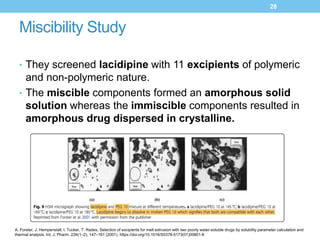
Miscibility Study
• They screened lacidipine with 11 excipients of polymeric
and non-polymeric nature.
• The miscible components formed an amorphous solid
solution whereas the immiscible components resulted in
amorphous drug dispersed in crystalline.
A. Forster, J. Hempenstall, I. Tucker, T. Rades, Selection of excipients for melt extrusion with two poorly water-soluble drugs by solubility parameter calculation and
thermal analysis. Int. J. Pharm. 226(1–2), 147–161 (2001). https://doi.org/10.1016/S0378-5173(01)00801-8
28
M. Alhijjaj, M. Reading, P. Belton, S. Qi, Thermal analysis by structural characterization as a method for assessing heterogeneity in complex solid pharmaceutical dosage forms. Anal. Chem.
87(21), 10848–10855 (2015).
8-Thermal analysis by surface characterization (TASC)
29
M. Reading, Thermal analysis by structural characterization (TASC): Structural and thermo-rheological information from hot stage microscopy. Microscopy
Today 25(5), 18–23 (2017). https://doi.org/10.1017/S1551929517000815
30
References:
• Kumar, A., Singh, P. & Nanda, A. Hot stage microscopy and its applications in pharmaceutical characterization. Appl.
Microsc. 50, 12 (2020). https://doi.org/10.1186/s42649-020-00032-9
• M.R. Bakar, Z.K. Nagy, C.D. Rielly, A combined approach of differential scanning calorimetry and hot-stage microscopy with
image analysis in the investigation of sulfathiazole polymorphism. J. Therm. Anal. Calorim. 99(2), 609–619 (2010).
https://doi.org/10.1007/s10973-009-0001-z
• M.R. Bakar, Z.K. Nagy, C.D. Rielly, A combined approach of differential scanning calorimetry and hot-stage microscopy with
image analysis in the investigation of sulfathiazole polymorphism. J. Therm. Anal. Calorim. 99(2), 609–619 (2010).
https://doi.org/10.1007/s10973-009-0001-z
• Kavanagh ON, Croker DM, Walker GM, Zaworotko MJ. Pharmaceutical cocrystals: from serendipity to design to application.
Drug Discov Today. 2019 Mar;24(3):796-804. doi: 10.1016/j.drudis.2018.11.023. Epub 2018 Dec 3. PMID: 30521935.
• D.P. McNamara, S.L. Childs, J. Giordano, A. Iarriccio, J. Cassidy, M.S. Shet, R. Mannion, E. O'Donnell, A. Park, Use of a
glutaric acid cocrystal to improve oral bioavailability of a low solubility API. Pharm. Res. 23(8), 1888–1897 (2006).
https://doi.org/10.1007/s11095-006-9032-3
• A. Jacobs, F.M. Noa, Hybrid salt–cocrystal solvate: P-coumaric acid and quinine system. J. Chem. Crystallogr. 44(2), 57–62
(2014). https://doi.org/10.1007/
• A. Forster, J. Hempenstall, I. Tucker, T. Rades, Selection of excipients for melt extrusion with two poorly water-soluble drugs by
solubility parameter calculation and thermal analysis. Int. J. Pharm. 226(1–2), 147–161 (2001). https://doi.org/10.1016/S0378-
5173(01)00801-8
• M. Alhijjaj, M. Reading, P. Belton, S. Qi, Thermal analysis by structural characterization as a method for assessing
heterogeneity in complex solid pharmaceutical dosage forms. Anal. Chem. 87(21), 10848–10855 (2015).
• M. Reading, Thermal analysis by structural characterization (TASC): Structural and thermo-rheological information from hot
stage microscopy. Microscopy Today 25(5), 18–23 (2017). https://doi.org/10.1017/S1551929517000815
31

HSM

  • 1.
    HOT-STAGE MICROSCOPY Prepared by: SarahKhallad MSc Pharmaceutical Sciences 1
  • 2.
    Contents • Introduction • Hot-StageMicroscope Instrumentation • Applications of hot stage microscopy in pharmaceuticals: 1. Morphology studies 2. Amorphous/crystalline form characterization 3. Polymorphism 4. Cocrystal Screening 5. Particle size distribution and characterization of an API in a tablet 6. Solvates/hydrate screening 7. Miscibility 8. Thermal analysis by surface characterization (TASC) 2
  • 3.
    Hot stage microscopy(HSM) • Coupling of thermal analysis with microscopy for the solid-state characterization of materials as a function of temperature and time. • In pharmaceuticals HSM is used to support DSC and TGA observations and to detect small changes in the sample that may be missed by DSC and TGA during a thermal experiment. • Like Desolvation, recrystallization, phase transitions and minor changes in the surface. 3
  • 4.
    Hot-Stage Microscope • Thehot-stage microscope is an optical microscope equipped with heating and cooling units which allow observation of a sample under the change of temperature. • A typical modern hot stage microscope consists of: 1. Computer controlled programmable hot stage 2. Optical microscope for real time observation 3. Polarizing filters 4. Digital camera for recording thermal events 5. Computer and software to control the hot stage and to carry out the analysis of the thermographs generated during a thermal event. 4
  • 5.
    Instrumentation 5 Kumar, A., Singh,P. & Nanda, A. Hot stage microscopy and its applications in pharmaceutical characterization. Appl. Microsc. 50, 12 (2020). https://doi.org/10.1186/s42649-020-00032-9
  • 6.
    Hot Stage (withglass slide). Control unit & 2 types of hot stage. Cont. 6 https://en.donho.com.tw/mettler-toledo-hot-stage-microscopy- systems.html
  • 7.
    Cont. • The sampleis heated in a sapphire crucible or glass slide, either in an open or a closed environment and can be equipped with a liquid nitrogen unit for rapid cooling, high pressure pumps or purge gas. • The temperature of a modern computer controlled hot stage can be varied from − 200 °C to 600 °C. 7
  • 8.
  • 9.
    • A partfrom this basic setup, a hot stage microscope can be coupled with various other characterization techniques such as Fourier Transform Infrared Spectroscopy (FTIR) or Differential scanning Calorimetry (DSC), high pressure unit or with other non-optical imaging tools such as scanning electron microscopy (SEM), and Raman and mass spectroscopy to avail the simultaneous benefits of both the techniques. 9
  • 10.
    Applications of HotStage Microscopy in Pharmaceuticals 1-Morphology studies • Physical features or morphology of a sample under investigation. • A wealth of information on how the sample changes when heated can be obtained by HSM studies. • Avoiding the misinterpretation of the results obtained from DSC/TGA and prevents flawed conclusions 10
  • 11.
    2- Amorphous/crystalline form characterization •The amorphous form of API is preferred in the pharmaceutical industry due to their higher solubility and dissolution rates over crystalline forms. • Amorphous and crystalline forms can be easily distinguished using a hot stage microscope equipped with a polarizing filter; Crystalline materials are known to show birefringence, while amorphous compounds lack birefringence, hence can be easily distinguished from crystalline compounds. 11
  • 12.
    Birefringence Kumar, A., Singh,P. & Nanda, A. Hot stage microscopy and its applications in pharmaceutical characterization. Appl. Microsc. 50, 12 (2020). https://doi.org/10.1186/s42649-020-00032-9 12
  • 13.
    Cont. • HSM canbe useful to study the conversion of an amorphous API to crystalline form under the effect of heating. • To study the effect of storage, especially exposure to heat and humidity. • Other than this HSM allows one to observe the recrystallization process and measure the crystal growth rate. 13
  • 14.
    3- Polymorphism • Polymorphismis the ability of a substance to exhibit more than one crystalline structure. • Different polymorphs of an API may differ in physicochemical properties and stability. • It is also possible to study polymorphs which cannot be grown in a laboratory due to thermodynamic energy factors, these polymorphs can be grown and studied thermally on a hot stage. 14
  • 15.
    “At 175.1 °Cthe melting of form III was observed in HSM which was missed by DSC.” M.R. Bakar, Z.K. Nagy, C.D. Rielly, A combined approach of differential scanning calorimetry and hot-stage microscopy with image analysis in the investigation of sulfathiazole polymorphism. J. Therm. Anal. Calorim. 99(2), 609–619 (2010). https://doi.org/10.1007/s10973-009-0001-z 15
  • 16.
    M.R. Bakar, Z.K.Nagy, C.D. Rielly, A combined approach of differential scanning calorimetry and hot-stage microscopy with image analysis in the investigation of sulfathiazole polymorphism. J. Therm. Anal. Calorim. 99(2), 609–619 (2010). https://doi.org/10.1007/s10973-009-0001-z 16
  • 17.
    4- Cocrystal Screening •Cocrystals are multicomponent solid forms consisting two or more different molecules non covalently bonded to each other in same the crystal lattice. • Cocrystals have recently gained a lot of attention in academia due to their ability to modulate physicochemical properties of an API. • Screening through HSM is rapid, solvent free and requires small quantities of API and coformer. • Kofler contact method (also known as Kofler mixed fusion) 17
  • 18.
    Kavanagh ON, CrokerDM, Walker GM, Zaworotko MJ. Pharmaceutical cocrystals: from serendipity to design to application. Drug Discov Today. 2019 Mar;24(3):796-804. doi: 10.1016/j.drudis.2018.11.023. Epub 2018 Dec 3. PMID: 30521935. 18
  • 19.
    Cocrystal Screening ofAPI with Glutaric Acid 19
  • 20.
    Cocrystal Screening ofAPIwith GlutaricAcid cont. D.P. McNamara, S.L. Childs, J. Giordano, A. Iarriccio, J. Cassidy, M.S. Shet, R. Mannion, E. O'Donnell, A. Park, Use of a glutaric acid cocrystal to improve oral bioavailability of a low solubility API. Pharm. Res. 23(8), 1888–1897 (2006). https://doi.org/10.1007/s11095-006- 9032-3 -Glutaric acid was chosen as the potential coformer based on melt experiments because of its good aqueous solubility, stability and melting point. 20
  • 21.
    5- Particle sizedistribution and characterization of an API in a tablet • Particle size distribution has a profound effect on the processability of raw and finished products, which in turn effects the dissolution, bioavailability, stability profile and thus ensures the quality, safety and efficacy of the finished formulation. • Although there are methods to determine the particle size of API in a tablet but they have their own limitations such as the inability to differentiate between agglomerates of the tablet constituents. 21
  • 22.
  • 23.
  • 24.
  • 25.
    6- Solvates/hydrate screening •Solvates are formed when solvent molecules get incorporated in the host compound structure. When water gets incorporated in the host compound, these type of solvates are called hydrates. • Hot stage microscopy can also be used for solvate/hydrate screening since it allows the visual observation of the gas evolved during the desolvation of the sample under heat. 25
  • 26.
    A. Jacobs, F.M.Noa, Hybrid salt–cocrystal solvate: P-coumaric acid and quinine system. J. Chem. Crystallogr. 44(2), 57–62 (2014). https://doi.org/10.1007/ 26
  • 27.
    7- Pharmaceutical Incompatibilityand Miscibility • DSC has been successfully used for detection of compatibility in the binary mixture of the drug and excipient. • HSM has proven to be advantageous as the interactions can be visually observed which was limited in DSC studies. Hence HSM can be used to supplement the data obtained from DSC to detect possible compatibility or incompatibility. • Thus, HSM can serve as a rapid, green and cheaper approach for detecting pharmaceutical incompatibilities and to observe the miscibility of API and excipients into one another which can find application in the screening of excipients compatible with the API and polymers for preparation of solid dispersions. 27
  • 28.
    Miscibility Study • Theyscreened lacidipine with 11 excipients of polymeric and non-polymeric nature. • The miscible components formed an amorphous solid solution whereas the immiscible components resulted in amorphous drug dispersed in crystalline. A. Forster, J. Hempenstall, I. Tucker, T. Rades, Selection of excipients for melt extrusion with two poorly water-soluble drugs by solubility parameter calculation and thermal analysis. Int. J. Pharm. 226(1–2), 147–161 (2001). https://doi.org/10.1016/S0378-5173(01)00801-8 28
  • 29.
    M. Alhijjaj, M.Reading, P. Belton, S. Qi, Thermal analysis by structural characterization as a method for assessing heterogeneity in complex solid pharmaceutical dosage forms. Anal. Chem. 87(21), 10848–10855 (2015). 8-Thermal analysis by surface characterization (TASC) 29
  • 30.
    M. Reading, Thermalanalysis by structural characterization (TASC): Structural and thermo-rheological information from hot stage microscopy. Microscopy Today 25(5), 18–23 (2017). https://doi.org/10.1017/S1551929517000815 30
  • 31.
    References: • Kumar, A.,Singh, P. & Nanda, A. Hot stage microscopy and its applications in pharmaceutical characterization. Appl. Microsc. 50, 12 (2020). https://doi.org/10.1186/s42649-020-00032-9 • M.R. Bakar, Z.K. Nagy, C.D. Rielly, A combined approach of differential scanning calorimetry and hot-stage microscopy with image analysis in the investigation of sulfathiazole polymorphism. J. Therm. Anal. Calorim. 99(2), 609–619 (2010). https://doi.org/10.1007/s10973-009-0001-z • M.R. Bakar, Z.K. Nagy, C.D. Rielly, A combined approach of differential scanning calorimetry and hot-stage microscopy with image analysis in the investigation of sulfathiazole polymorphism. J. Therm. Anal. Calorim. 99(2), 609–619 (2010). https://doi.org/10.1007/s10973-009-0001-z • Kavanagh ON, Croker DM, Walker GM, Zaworotko MJ. Pharmaceutical cocrystals: from serendipity to design to application. Drug Discov Today. 2019 Mar;24(3):796-804. doi: 10.1016/j.drudis.2018.11.023. Epub 2018 Dec 3. PMID: 30521935. • D.P. McNamara, S.L. Childs, J. Giordano, A. Iarriccio, J. Cassidy, M.S. Shet, R. Mannion, E. O'Donnell, A. Park, Use of a glutaric acid cocrystal to improve oral bioavailability of a low solubility API. Pharm. Res. 23(8), 1888–1897 (2006). https://doi.org/10.1007/s11095-006-9032-3 • A. Jacobs, F.M. Noa, Hybrid salt–cocrystal solvate: P-coumaric acid and quinine system. J. Chem. Crystallogr. 44(2), 57–62 (2014). https://doi.org/10.1007/ • A. Forster, J. Hempenstall, I. Tucker, T. Rades, Selection of excipients for melt extrusion with two poorly water-soluble drugs by solubility parameter calculation and thermal analysis. Int. J. Pharm. 226(1–2), 147–161 (2001). https://doi.org/10.1016/S0378- 5173(01)00801-8 • M. Alhijjaj, M. Reading, P. Belton, S. Qi, Thermal analysis by structural characterization as a method for assessing heterogeneity in complex solid pharmaceutical dosage forms. Anal. Chem. 87(21), 10848–10855 (2015). • M. Reading, Thermal analysis by structural characterization (TASC): Structural and thermo-rheological information from hot stage microscopy. Microscopy Today 25(5), 18–23 (2017). https://doi.org/10.1017/S1551929517000815 31