WUCHERERIA BANCOFTI
BY:- RAGHWENDRA SAH
BSc.MLT 2016
OBJECTIVES
• INTRODUCTION
• LIFE CYCLE
• PATHOGENESIS
• DIAGNOSIS
INTRODUCTION
• Term bancroftian filariasis refers to the lymphatic filariasis .
• Symptoms of brancroftian filariasis had been mentioned as elephantiatis
arabicum in the ancient hindu literature.
• Caused by the filarial worm, W. bancrofti.
• Direct host – human.
• Intermediate host – mosquito.
Habitat
Adult filarial worms are found in the lymphatic vessels, specially in the
lymph node of the humans and other vertebrates.
Microfilariae are found in peripheral blood.
Occasionally, these microfilariae are also found in chylous urine or in
hydrocele fluid.
Morphology
Adult, microfilaria (1st stage larva and 3rd stage larva i.e. L3) are the important
morphological forms of W. bancrofti.
ADULT WORM
• Minute, whitish, thread like and are filariform in shape with a smooth surface.
• Both the anterior and posterior ends are tapering.
• Anterior or head end is slightly swollen and is surmounted by two rows of
sessile papillae.
• Posterior end contains anus at its terminal end.
• Obtain nourish from lymph of lymphatic system.
ADULT WORM Continued…….
CHARACTER MALE FEMALE
Length 40 mm (4 cm) Vary length from 80 mm to 100 mm,
Longer than male
Breadth 0.1 mm Vary breadth from 0.24 mm to 0.3 mm
Posterior end Sharply curved ventrally Curved tail
Tail Posses two spicules of unequal
length
Absent
• Female are ovoviviparous.
• As lays egg containing well developed embryos, microfilariae
MICROFILARIA
• First stage larva.
• Found in peripheral blood and often in hydrocele fluid and chylous urine.
• 244 µm to 296 µm in length.
• 7.5 µm to 10 µm in diameter.
• Unstained specimens – transparent and colorless with bluntly rounded
anterior end and pointed tail end.
• Covered by hyaline sheath. And moves backwards and forwards within this
sheath, which projects at both ends of the microfilariae.
• Internal structures can be visualized by the fixed stained preparation.
MICROFILARIA Continued…….
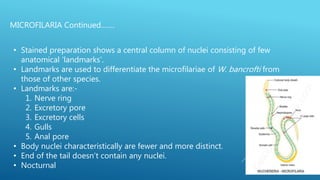
• Stained preparation shows a central column of nuclei consisting of few
anatomical ‘landmarks’.
• Landmarks are used to differentiate the microfilariae of W. bancrofti from
those of other species.
• Landmarks are:-
1. Nerve ring
2. Excretory pore
3. Excretory cells
4. Gulls
5. Anal pore
• Body nuclei characteristically are fewer and more distinct.
• End of the tail doesn’t contain any nuclei.
• Nocturnal
Infective form( 3rd stage larva)
• Third stage larva is the infective form of filarial worm for human.
• Found only in mosquito vectors.
• Elongated, filariform.
• Measure 1.4µm to 2µm in length and 18µm to 23µm in breadth.
LIFE CYCLE
• Life cycle is completed in two hosts.
• Definitive host : man
• Intermediate host : mosquitoes (Culex quinquefasciatus, Anopheles and Aedes
species)
PATHOGENESIS AND PATHOLOGY
• 1st stage (circulating) and 3rd stage (infective stage) are not pathogenic.
• Both 4th stage and adult worms, whether living or dead, present in the
lymphatic vessels are pathogenic.
• The following stages occur sequentially in the pathogenesis of lymphatic
filariasis:
1. Dilation of lymphatic vessels (lymphangiovarix)
2. Inflammation of lymphatic vessels (lymphangitis)
3. Obstruction of the lymph nodes
LYMPHANGIOVARIX
• Caused by an intense inflammatory reaction provoked by :
a. Presence of adult worms.
b. Developing larvae and metabolic products released during the moulting
of the larvae.
c. Unsheathing of the microfilariae during moulting.
LYMPHANGITIS
• With the progress of infection, lymphangitis develop gradually.
• Characterized by the presence of dilated, inflamed and thickened
lymphatic vessels associated with erythema, odema and tender painful
areas.
OBSTRUCTION OF LYMPH NODES
• This stage of lymphangitis is followed by the fibrotic degenerative changes
in the lymphatic vessels proximal to the lymph nodes.
• Lymph nodes show fibrotic necrosis, sclerosis and obstruction of the
proximal lymphatic channels.
• Valve proximal to the worms also show degenerative changes.
OBSTRUCTION OF LYMPH NODES Continued…..
• Obstruction of the lymph flow is caused by
1. Presence of worms in the lumen.
2. Endothelial cell proliferation and the thickening of lymphatic vessels as
well as focal necrosis.
3. Cellular changes, giant cell formation and fibrosis of the affected
lymphatic vessels proximal to the worm.
• Obstruction of the lymph flow leads to the classical features of obstruction or
elephantiasis.
CLINICAL MANIFESTATIONS
• Lymphatic filariasis and occult filariasis are the two distinct groups of
clinical entities caused by W. bancrofti.
Lymphatic Filariasis
• Caused by the juvenile and adult worms of W. bancrofti
• Clinical manifestations of the condition depend on the stages of the
diseases as follows:
1. Endemic normal
2. Asymptomatic stage
3. Acute filariasis
Lymphatic filariasis continued…..
4. Chronic filariasis
5. Less frequent lesions : Include granuloma of the spleen and
other organs, and presence of adult W. bancrofti in the anterior
chamber of the eye.
ENDEMIC NORMAL
• In endemic for filariasis, a certain proportion of the population living in
these area do not show any overt clinical manifestations of the disease
or any microfilariae in their blood even though they are exposed to the
3rd stage larvae.
• Difficult to know whether these people have undetectable filarial
infection or are free from the infection.
ACUTE FILARIASIS
• Acute filariasis or inflammatory phase is caused by antigens released
from female adult worms.
• Microfilariae causes no inflammatory changes.
• Condition is characterized by :
Filarial fever
Lymphoedema
Lymphadenitis
Adenolymphangitis
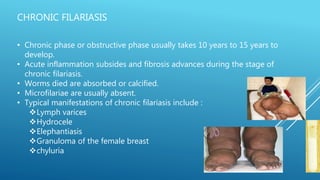
CHRONIC FILARIASIS
• Chronic phase or obstructive phase usually takes 10 years to 15 years to
develop.
• Acute inflammation subsides and fibrosis advances during the stage of
chronic filariasis.
• Worms died are absorbed or calcified.
• Microfilariae are usually absent.
• Typical manifestations of chronic filariasis include :
Lymph varices
Hydrocele
Elephantiasis
Granuloma of the female breast
chyluria
OCCULT FILARIASIS
• Denotes the condition of hypersensitivity reaction of the host to the
microfilarial antigens.
• Characteristically, microfilariae are not found in the peripheral blood the
classical features of lymphatic filariasis are absent.
• Tropical pulmonary eosinophilia{TPE} is the most important manifestation
of occult filariasis.
Tropical pulmonary eosinophilia(TPE)
 A manifestation of Occult filariasis.
 Low fever, loss of weight, paroxysmal cough with scanty
sputum, dyspnoea, asthmatic wheezing & splenomegaly.
 Blood eosinophil count – above 3000/mm3. IgG levels ↑.
 Chest Xray – increased broncho vascular markings,
diffuse mottled shadows resembling Miliary TB.
 Marked eosinophilia, increased IgE.
 Lung opacities and cough and wheeze.
 No microfilariae in blood but in lung.
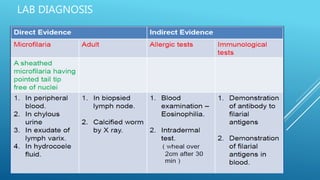
LAB DIAGNOSIS
LAB DIAGNOSIS Continued……
As the clinical manifestations are not specific, the laboratory diagnosis, therefore,
plays an important role to:
1. Establish the filarial aetiology of the condition.
2. Determine the course of filarial treatment.
3. Control the filariasis in the community.
SPECIMENS
• Peripheral blood is the specimen of choice.
• Other less important specimens are chylous urine and hydrocele fluid.
• Definitive diagnosis by demonstration of the microfilariae in clinical
specimens.
LAB DIAGNOSIS Continued……
METHODS OF EXAMINATION
1. Blood microscopy
2. DEC provocation test
3. QBC
4. Urine microscopy
5. Microscopy of hydrocele fluid and lymph node aspiration
LAB DIAGNOSIS Continued……
1. Blood microscopy
Blood is collected as follows:
• Nocturnal period: Between 10 P.M. and 4 A.M in night.
• Sub periodic nocturnal: Between 8 P.M and 10 P.M during the night.
• Sub periodic diurnal: Between 2 P.M and 6 P.M in the afternoon.
 Microfilariae can be demonstrated in the blood by microscopy by the following
methods:
I. DIRECT WET MOUNT
• 2-3 drop of blood is placed on slide and covered by cover slide
and observed.
• Live microfilariae are identified by their characterstic serpentine movemen
the blood plasma.
LAB DIAGNOSIS Continued……
II. STAINED THICK BLOOD FILM
• Stained by Giemsa or Leishman stain delafield’s haematoxylin or
Polychrome methylene blue stains.
• Dehemoglobinise the smear before staining.
• Commonly used method.
• Presence of sheath but the absence of nuclei in the tail end of
microfilariae.
III. Concentration of blood
• Knott’s method of concentration by sedimentation
• Membrane filtration concentration methods using Nuclepore membrane
filter or Millipore membrane filter Sensitive method
LAB DIAGNOSIS Continued……
2. DCE provocation test
• In test, diethyl carbamazine(DEC) is given orally, stimulate nocturnal periodic
microfilariae to circulate in the peripheral blood during the day time.
• 2-8 mg/kg body wt.
• After 30 min blood collected.
LAB DIAGNOSIS Continued……
3. QBC
• Used to frequently demonstrate the circulating microfilariae in the blood
NOTE:
Microfilariae not found in peripheral blood in following
cases :-
1. During early allergic manifestations
2. In occult filariasis
3. Case of Elephantiasis – due to lymphatic obstruction
4. After an attack of lymphangitis, due to death of adult worm.
LAB DIAGNOSIS Continued……
URINE MICROSCOPY
• Specimen – chylous urine (10-20) ml early morning urine.
• Demonstration of microfilariae.
HYDROCELE FLUID AND LYMPH NODE ASPIRATION
• Demonstration of microfilariae.
• Same as urine microscopy except that the ether is used to dissolve
fat globule.
SEROLOGICAL TESTS
• Antibody based immunoassay( indirect haemagglutination test,
indirect fluorescent test, ELISA, radioimmuno assay, etc
THANK YOU
STAY AWAY FROM MOSQUITO
Infected
mosquito
bite human
and release
L3 larva Entered
through the
punctured
wound
Reach the
peripheral
lymphatic
vessels
Migrate to inguinal
lymphnode to
metamorphose leads
sexually adult and
coiled form
Microfilariae
discharged
after 8-12
month of
infection
Circulate in
blood till 6-24
month, If not
taken by
mosquito then
died
Microfilaria
e loose
their sheath
within 2-6
hrs of
arrival
Some quickly
migrate out of
stomach to
thoracic
muscle within
4-17hrs
Next 48
hrs, larva
goes in 1st
stage; L1
During 3rd-
7th days, L1
moult to L2,
called 2nd
stage larva
By the 10th -11th
days, L2 moult to
L3, migrate to
salivary gland and
release from the
tip of proboscis
LIFE CYCLE OF W. bancrofti
HUMAN
MOSQUITO

W. brancrofi.

  • 1.
  • 2.
    OBJECTIVES • INTRODUCTION • LIFECYCLE • PATHOGENESIS • DIAGNOSIS
  • 3.
    INTRODUCTION • Term bancroftianfilariasis refers to the lymphatic filariasis . • Symptoms of brancroftian filariasis had been mentioned as elephantiatis arabicum in the ancient hindu literature. • Caused by the filarial worm, W. bancrofti. • Direct host – human. • Intermediate host – mosquito.
  • 4.
    Habitat Adult filarial wormsare found in the lymphatic vessels, specially in the lymph node of the humans and other vertebrates. Microfilariae are found in peripheral blood. Occasionally, these microfilariae are also found in chylous urine or in hydrocele fluid.
  • 5.
    Morphology Adult, microfilaria (1ststage larva and 3rd stage larva i.e. L3) are the important morphological forms of W. bancrofti. ADULT WORM • Minute, whitish, thread like and are filariform in shape with a smooth surface. • Both the anterior and posterior ends are tapering. • Anterior or head end is slightly swollen and is surmounted by two rows of sessile papillae. • Posterior end contains anus at its terminal end. • Obtain nourish from lymph of lymphatic system.
  • 6.
    ADULT WORM Continued……. CHARACTERMALE FEMALE Length 40 mm (4 cm) Vary length from 80 mm to 100 mm, Longer than male Breadth 0.1 mm Vary breadth from 0.24 mm to 0.3 mm Posterior end Sharply curved ventrally Curved tail Tail Posses two spicules of unequal length Absent • Female are ovoviviparous. • As lays egg containing well developed embryos, microfilariae
  • 7.
    MICROFILARIA • First stagelarva. • Found in peripheral blood and often in hydrocele fluid and chylous urine. • 244 µm to 296 µm in length. • 7.5 µm to 10 µm in diameter. • Unstained specimens – transparent and colorless with bluntly rounded anterior end and pointed tail end. • Covered by hyaline sheath. And moves backwards and forwards within this sheath, which projects at both ends of the microfilariae. • Internal structures can be visualized by the fixed stained preparation.
  • 8.
    MICROFILARIA Continued……. • Stainedpreparation shows a central column of nuclei consisting of few anatomical ‘landmarks’. • Landmarks are used to differentiate the microfilariae of W. bancrofti from those of other species. • Landmarks are:- 1. Nerve ring 2. Excretory pore 3. Excretory cells 4. Gulls 5. Anal pore • Body nuclei characteristically are fewer and more distinct. • End of the tail doesn’t contain any nuclei. • Nocturnal
  • 9.
    Infective form( 3rdstage larva) • Third stage larva is the infective form of filarial worm for human. • Found only in mosquito vectors. • Elongated, filariform. • Measure 1.4µm to 2µm in length and 18µm to 23µm in breadth.
  • 10.
    LIFE CYCLE • Lifecycle is completed in two hosts. • Definitive host : man • Intermediate host : mosquitoes (Culex quinquefasciatus, Anopheles and Aedes species)
  • 11.
    PATHOGENESIS AND PATHOLOGY •1st stage (circulating) and 3rd stage (infective stage) are not pathogenic. • Both 4th stage and adult worms, whether living or dead, present in the lymphatic vessels are pathogenic. • The following stages occur sequentially in the pathogenesis of lymphatic filariasis: 1. Dilation of lymphatic vessels (lymphangiovarix) 2. Inflammation of lymphatic vessels (lymphangitis) 3. Obstruction of the lymph nodes
  • 12.
    LYMPHANGIOVARIX • Caused byan intense inflammatory reaction provoked by : a. Presence of adult worms. b. Developing larvae and metabolic products released during the moulting of the larvae. c. Unsheathing of the microfilariae during moulting.
  • 13.
    LYMPHANGITIS • With theprogress of infection, lymphangitis develop gradually. • Characterized by the presence of dilated, inflamed and thickened lymphatic vessels associated with erythema, odema and tender painful areas. OBSTRUCTION OF LYMPH NODES • This stage of lymphangitis is followed by the fibrotic degenerative changes in the lymphatic vessels proximal to the lymph nodes. • Lymph nodes show fibrotic necrosis, sclerosis and obstruction of the proximal lymphatic channels. • Valve proximal to the worms also show degenerative changes.
  • 14.
    OBSTRUCTION OF LYMPHNODES Continued….. • Obstruction of the lymph flow is caused by 1. Presence of worms in the lumen. 2. Endothelial cell proliferation and the thickening of lymphatic vessels as well as focal necrosis. 3. Cellular changes, giant cell formation and fibrosis of the affected lymphatic vessels proximal to the worm. • Obstruction of the lymph flow leads to the classical features of obstruction or elephantiasis.
  • 15.
    CLINICAL MANIFESTATIONS • Lymphaticfilariasis and occult filariasis are the two distinct groups of clinical entities caused by W. bancrofti. Lymphatic Filariasis • Caused by the juvenile and adult worms of W. bancrofti • Clinical manifestations of the condition depend on the stages of the diseases as follows: 1. Endemic normal 2. Asymptomatic stage 3. Acute filariasis
  • 16.
    Lymphatic filariasis continued….. 4.Chronic filariasis 5. Less frequent lesions : Include granuloma of the spleen and other organs, and presence of adult W. bancrofti in the anterior chamber of the eye.
  • 17.
    ENDEMIC NORMAL • Inendemic for filariasis, a certain proportion of the population living in these area do not show any overt clinical manifestations of the disease or any microfilariae in their blood even though they are exposed to the 3rd stage larvae. • Difficult to know whether these people have undetectable filarial infection or are free from the infection.
  • 18.
    ACUTE FILARIASIS • Acutefilariasis or inflammatory phase is caused by antigens released from female adult worms. • Microfilariae causes no inflammatory changes. • Condition is characterized by : Filarial fever Lymphoedema Lymphadenitis Adenolymphangitis
  • 19.
    CHRONIC FILARIASIS • Chronicphase or obstructive phase usually takes 10 years to 15 years to develop. • Acute inflammation subsides and fibrosis advances during the stage of chronic filariasis. • Worms died are absorbed or calcified. • Microfilariae are usually absent. • Typical manifestations of chronic filariasis include : Lymph varices Hydrocele Elephantiasis Granuloma of the female breast chyluria
  • 20.
    OCCULT FILARIASIS • Denotesthe condition of hypersensitivity reaction of the host to the microfilarial antigens. • Characteristically, microfilariae are not found in the peripheral blood the classical features of lymphatic filariasis are absent. • Tropical pulmonary eosinophilia{TPE} is the most important manifestation of occult filariasis.
  • 21.
    Tropical pulmonary eosinophilia(TPE) A manifestation of Occult filariasis.  Low fever, loss of weight, paroxysmal cough with scanty sputum, dyspnoea, asthmatic wheezing & splenomegaly.  Blood eosinophil count – above 3000/mm3. IgG levels ↑.  Chest Xray – increased broncho vascular markings, diffuse mottled shadows resembling Miliary TB.  Marked eosinophilia, increased IgE.  Lung opacities and cough and wheeze.  No microfilariae in blood but in lung.
  • 23.
  • 24.
    LAB DIAGNOSIS Continued…… Asthe clinical manifestations are not specific, the laboratory diagnosis, therefore, plays an important role to: 1. Establish the filarial aetiology of the condition. 2. Determine the course of filarial treatment. 3. Control the filariasis in the community. SPECIMENS • Peripheral blood is the specimen of choice. • Other less important specimens are chylous urine and hydrocele fluid. • Definitive diagnosis by demonstration of the microfilariae in clinical specimens.
  • 25.
    LAB DIAGNOSIS Continued…… METHODSOF EXAMINATION 1. Blood microscopy 2. DEC provocation test 3. QBC 4. Urine microscopy 5. Microscopy of hydrocele fluid and lymph node aspiration
  • 26.
    LAB DIAGNOSIS Continued…… 1.Blood microscopy Blood is collected as follows: • Nocturnal period: Between 10 P.M. and 4 A.M in night. • Sub periodic nocturnal: Between 8 P.M and 10 P.M during the night. • Sub periodic diurnal: Between 2 P.M and 6 P.M in the afternoon.  Microfilariae can be demonstrated in the blood by microscopy by the following methods: I. DIRECT WET MOUNT • 2-3 drop of blood is placed on slide and covered by cover slide and observed. • Live microfilariae are identified by their characterstic serpentine movemen the blood plasma.
  • 27.
    LAB DIAGNOSIS Continued…… II.STAINED THICK BLOOD FILM • Stained by Giemsa or Leishman stain delafield’s haematoxylin or Polychrome methylene blue stains. • Dehemoglobinise the smear before staining. • Commonly used method. • Presence of sheath but the absence of nuclei in the tail end of microfilariae. III. Concentration of blood • Knott’s method of concentration by sedimentation • Membrane filtration concentration methods using Nuclepore membrane filter or Millipore membrane filter Sensitive method
  • 28.
    LAB DIAGNOSIS Continued…… 2.DCE provocation test • In test, diethyl carbamazine(DEC) is given orally, stimulate nocturnal periodic microfilariae to circulate in the peripheral blood during the day time. • 2-8 mg/kg body wt. • After 30 min blood collected.
  • 29.
    LAB DIAGNOSIS Continued…… 3.QBC • Used to frequently demonstrate the circulating microfilariae in the blood NOTE: Microfilariae not found in peripheral blood in following cases :- 1. During early allergic manifestations 2. In occult filariasis 3. Case of Elephantiasis – due to lymphatic obstruction 4. After an attack of lymphangitis, due to death of adult worm.
  • 30.
    LAB DIAGNOSIS Continued…… URINEMICROSCOPY • Specimen – chylous urine (10-20) ml early morning urine. • Demonstration of microfilariae. HYDROCELE FLUID AND LYMPH NODE ASPIRATION • Demonstration of microfilariae. • Same as urine microscopy except that the ether is used to dissolve fat globule. SEROLOGICAL TESTS • Antibody based immunoassay( indirect haemagglutination test, indirect fluorescent test, ELISA, radioimmuno assay, etc
  • 31.
    THANK YOU STAY AWAYFROM MOSQUITO
  • 33.
    Infected mosquito bite human and release L3larva Entered through the punctured wound Reach the peripheral lymphatic vessels Migrate to inguinal lymphnode to metamorphose leads sexually adult and coiled form Microfilariae discharged after 8-12 month of infection Circulate in blood till 6-24 month, If not taken by mosquito then died Microfilaria e loose their sheath within 2-6 hrs of arrival Some quickly migrate out of stomach to thoracic muscle within 4-17hrs Next 48 hrs, larva goes in 1st stage; L1 During 3rd- 7th days, L1 moult to L2, called 2nd stage larva By the 10th -11th days, L2 moult to L3, migrate to salivary gland and release from the tip of proboscis LIFE CYCLE OF W. bancrofti HUMAN MOSQUITO