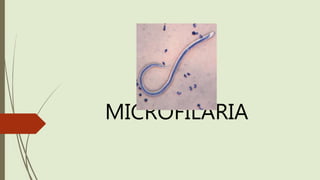
MICROFILARIA
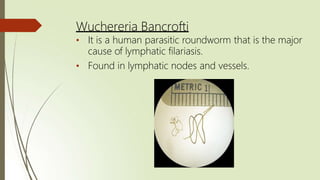
Wuchereria Bancrofti
• It is a human parasitic roundworm that is the major
cause of lymphatic filariasis.
• Found in lymphatic nodes and vessels.
W. Bancrofti was named after
physician Otto Wucherer and
parasitologist Joseph Bancroft.
Otto Wucherer Joseph Bancroft
Taxonomy
🠶Domain : Eukaryota
🠶Kingdom : Metazoa
🠶Phylum
🠶Class
🠶Order
🠶Family
🠶Genus
🠶Species
: Nematoda
: Secernentea
: Spirurida
: Filariidae
: Wuchereria
: Bancrofti
Morphology
🠶A transparent worms with a smooth cuticle.
🠶Creamy-white in colour.
🠶In females the tail tapers gradually and is
rounded at the tip.
🠶While in males the tail curves ventrally.
together
🠶Males and females live coiled
and is difficult to separate.
🠶Females are ovo-viviparous.
🠶Life span: 5-10 years
🠶Sizes:
🠶Female: 80-100 mm x 0.2-0.3 mm
🠶Male : 25-40 mm x 0.1 mm
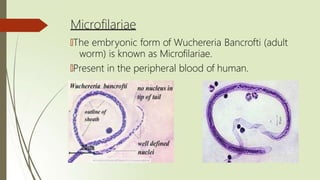
Microfilariae
🠶The embryonic form of Wuchereria Bancrofti (adult
worm) is known as Microfilariae.
🠶Present in the peripheral blood of human.
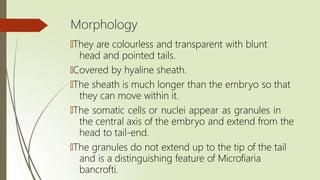
Morphology
🠶They are colourless and transparent with blunt
head and pointed tails.
🠶Covered by hyaline sheath.
🠶The sheath is much longer than the embryo so that
they can move within it.
🠶The somatic cells or nuclei appear as granules in
the central axis of the embryo and extend from the
head to tail-end.
🠶The granules do not extend up to the tip of the tail
and is a distinguishing feature of Microfiaria
bancrofti.
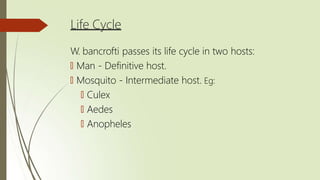
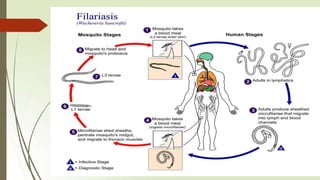
Life Cycle
W. bancrofti passes its life cycle in two hosts:
🠶 Man - Definitive host.
🠶 Mosquito - Intermediate host. Eg:
🠶 Culex
🠶 Aedes
🠶 Anopheles
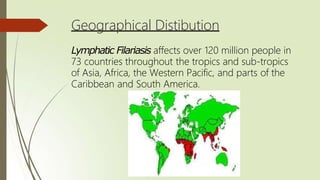
Geographical Distibution
Lymphatic Filariasis affects over 120 million people in
73 countries throughout the tropics and sub-tropics
of Asia, Africa, the Western Pacific, and parts of the
Caribbean and South America.
Pathogenesis
🠶The infection with this parasite is named wuchereriasis
or filariasis.
🠶The disease is of two types:
1. Classical filariasis:
• Caused by adult worm.
• Eg:lymphangitis, elephantiasis,lymphedema.
2. Occult filariasis:
• Caused by embryo.
• Eg: eosinophilia, hepato-splenomegaly.
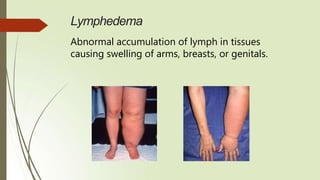
Lymphedema
Abnormal accumulation of lymph in tissues
causing swelling of arms, breasts, or genitals.
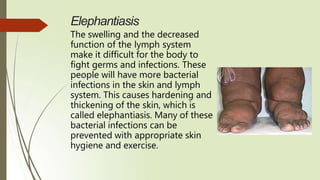
Elephantiasis
The swelling and the decreased
function of the lymph system
make it difficult for the body to
fight germs and infections. These
people will have more bacterial
infections in the skin and lymph
system. This causes hardening and
thickening of the skin, which is
called elephantiasis. Many of these
bacterial infections can be
prevented with appropriate skin
hygiene and exercise.
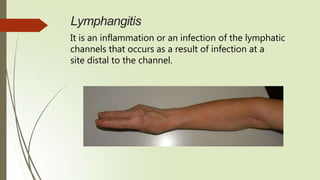
Lymphangitis
It is an inflammation or an infection of the lymphatic
channels that occurs as a result of infection at a
site distal to the channel.
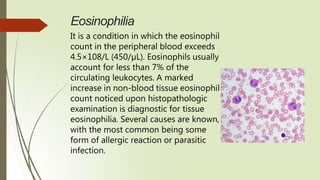
Eosinophilia
It is a condition in which the eosinophil
count in the peripheral blood exceeds
4.5×10⁸/L (450/µL). Eosinophils usually
account for less than 7% of the
circulating leukocytes. A marked
increase in non-blood tissue eosinophil
count noticed upon histopathologic
examination is diagnostic for tissue
eosinophilia. Several causes are known,
with the most common being some
form of allergic reaction or parasitic
infection.
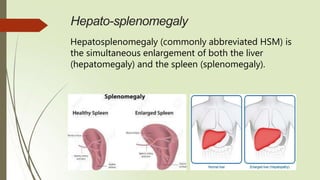
Hepato-splenomegaly
Hepatosplenomegaly (commonly abbreviated HSM) is
the simultaneous enlargement of both the liver
(hepatomegaly) and the spleen (splenomegaly).
Diagnosis
🠶Direct evidence:
 Demonstration of microfilariae in peripheral blood
film, chylous urine, hydrocele fluid & lymph varix.
 Microfilariae appear in large numbers in peripheral
blood at night. Hence, blood film should be made in
night between 10PM-2AM.
🠶Indirect evidence:
 Serological test like ELISA, IFA and IHA can be used
but these test have low sensitivity and specifity.
Treatment
🠶Antifilarial Drugs
• Diethylcarbamazine (DEC)
Dosage: 6 mg/kg/day for 12 days
• Ivermectin
Dosage: single oral dose of 150 ug/kg body weight
• Combination of 2
(better results)
Treatment
🠶General Measures:
• Rest
• Antibiotics
• Antifungal
• Physiotherapy
• Bandaging
🠶Elephantiasis
Elephantoid tissues can be corrected surgically.
Prevention And Control
Avoiding mosquito bites is the best form of
prevention. The mosquitoes that carry the
microscopic worms usually bite between the hours of
dusk and dawn. If you live in or travel to an area with
lymphatic filariasis:
🠶Sleep under a mosquito net.
🠶Wear long sleeves and trousers.
🠶Use mosquito repellent on exposed skin
between dusk and dawn

microfilariae-170105004034.pptx microrganism

  • 1.
  • 2.
    Wuchereria Bancrofti • Itis a human parasitic roundworm that is the major cause of lymphatic filariasis. • Found in lymphatic nodes and vessels.
  • 3.
    W. Bancrofti wasnamed after physician Otto Wucherer and parasitologist Joseph Bancroft. Otto Wucherer Joseph Bancroft
  • 4.
    Taxonomy 🠶Domain : Eukaryota 🠶Kingdom: Metazoa 🠶Phylum 🠶Class 🠶Order 🠶Family 🠶Genus 🠶Species : Nematoda : Secernentea : Spirurida : Filariidae : Wuchereria : Bancrofti
  • 5.
    Morphology 🠶A transparent wormswith a smooth cuticle. 🠶Creamy-white in colour. 🠶In females the tail tapers gradually and is rounded at the tip. 🠶While in males the tail curves ventrally. together 🠶Males and females live coiled and is difficult to separate. 🠶Females are ovo-viviparous. 🠶Life span: 5-10 years 🠶Sizes: 🠶Female: 80-100 mm x 0.2-0.3 mm 🠶Male : 25-40 mm x 0.1 mm
  • 6.
    Microfilariae 🠶The embryonic formof Wuchereria Bancrofti (adult worm) is known as Microfilariae. 🠶Present in the peripheral blood of human.
  • 7.
    Morphology 🠶They are colourlessand transparent with blunt head and pointed tails. 🠶Covered by hyaline sheath. 🠶The sheath is much longer than the embryo so that they can move within it. 🠶The somatic cells or nuclei appear as granules in the central axis of the embryo and extend from the head to tail-end. 🠶The granules do not extend up to the tip of the tail and is a distinguishing feature of Microfiaria bancrofti.
  • 8.
    Life Cycle W. bancroftipasses its life cycle in two hosts: 🠶 Man - Definitive host. 🠶 Mosquito - Intermediate host. Eg: 🠶 Culex 🠶 Aedes 🠶 Anopheles
  • 10.
    Geographical Distibution Lymphatic Filariasisaffects over 120 million people in 73 countries throughout the tropics and sub-tropics of Asia, Africa, the Western Pacific, and parts of the Caribbean and South America.
  • 11.
    Pathogenesis 🠶The infection withthis parasite is named wuchereriasis or filariasis. 🠶The disease is of two types: 1. Classical filariasis: • Caused by adult worm. • Eg:lymphangitis, elephantiasis,lymphedema. 2. Occult filariasis: • Caused by embryo. • Eg: eosinophilia, hepato-splenomegaly.
  • 12.
    Lymphedema Abnormal accumulation oflymph in tissues causing swelling of arms, breasts, or genitals.
  • 13.
    Elephantiasis The swelling andthe decreased function of the lymph system make it difficult for the body to fight germs and infections. These people will have more bacterial infections in the skin and lymph system. This causes hardening and thickening of the skin, which is called elephantiasis. Many of these bacterial infections can be prevented with appropriate skin hygiene and exercise.
  • 14.
    Lymphangitis It is aninflammation or an infection of the lymphatic channels that occurs as a result of infection at a site distal to the channel.
  • 15.
    Eosinophilia It is acondition in which the eosinophil count in the peripheral blood exceeds 4.5×10⁸/L (450/µL). Eosinophils usually account for less than 7% of the circulating leukocytes. A marked increase in non-blood tissue eosinophil count noticed upon histopathologic examination is diagnostic for tissue eosinophilia. Several causes are known, with the most common being some form of allergic reaction or parasitic infection.
  • 16.
    Hepato-splenomegaly Hepatosplenomegaly (commonly abbreviatedHSM) is the simultaneous enlargement of both the liver (hepatomegaly) and the spleen (splenomegaly).
  • 17.
    Diagnosis 🠶Direct evidence:  Demonstrationof microfilariae in peripheral blood film, chylous urine, hydrocele fluid & lymph varix.  Microfilariae appear in large numbers in peripheral blood at night. Hence, blood film should be made in night between 10PM-2AM. 🠶Indirect evidence:  Serological test like ELISA, IFA and IHA can be used but these test have low sensitivity and specifity.
  • 18.
    Treatment 🠶Antifilarial Drugs • Diethylcarbamazine(DEC) Dosage: 6 mg/kg/day for 12 days • Ivermectin Dosage: single oral dose of 150 ug/kg body weight • Combination of 2 (better results)
  • 19.
    Treatment 🠶General Measures: • Rest •Antibiotics • Antifungal • Physiotherapy • Bandaging 🠶Elephantiasis Elephantoid tissues can be corrected surgically.
  • 20.
    Prevention And Control Avoidingmosquito bites is the best form of prevention. The mosquitoes that carry the microscopic worms usually bite between the hours of dusk and dawn. If you live in or travel to an area with lymphatic filariasis: 🠶Sleep under a mosquito net. 🠶Wear long sleeves and trousers. 🠶Use mosquito repellent on exposed skin between dusk and dawn