“WORLD WIDE TRADE IN
MEDICINAL PLANTS”
with special reference to Diosgenin,
Taxol, Digitalis and Cinchona.
4/10/2018
Introduction
• Definition of Worldwide Trade: The worldwide trade
is intergovernmental organization which regulate
international trade related to medicinal plant.
• The term “Medicinal Plant” for worldwide trade
specifies the plant having medicinal value.
• It proved as the plant having as therapeutic value.
• The main difficulty in analyzing the world trade in
herbal drug is extremely limited statistical data
available on production trade.
• No country publish their data & trade except USA
provide the production detail.
Main trading center
• The major broker and importer of herbs are
established in major trading center as fallows
1. New York (USA)
2. Hamburg (West Germany)
3. Marseilles & Paris (France)
4. London (UK)
5. Tokyo (Japan)
6. Rotterdam (Netherland)
Demand for medicinal plant in global
market
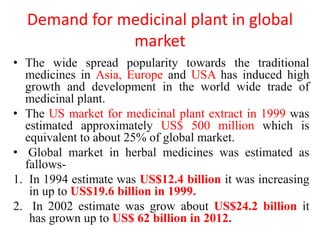
• The wide spread popularity towards the traditional
medicines in Asia, Europe and USA has induced high
growth and development in the world wide trade of
medicinal plant.
• The US market for medicinal plant extract in 1999 was
estimated approximately US$ 500 million which is
equivalent to about 25% of global market.
• Global market in herbal medicines was estimated as
fallows-
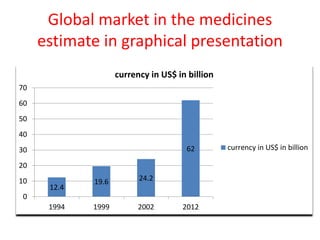
1. In 1994 estimate was US$12.4 billion it was increasing
in up to US$19.6 billion in 1999.
2. In 2002 estimate was grow about US$24.2 billion it
has grown up to US$ 62 billion in 2012.
Global market in the medicines
estimate in graphical presentation
12.4
19.6 24.2
62
0
10
20
30
40
50
60
70
1994 1999 2002 2012
currency in US$ in billion
Market Analysis - Traditional Medicine America
2018
• Traditional Medicine Strategy 2014 to 2023:
• It was developed and launched in response to the WH
Assembly resolution on traditional medicine.
• Aim to develop proactive policies and implementing
action plans that will strengthen the role of traditional
medicines plays in keeping populations healthy.
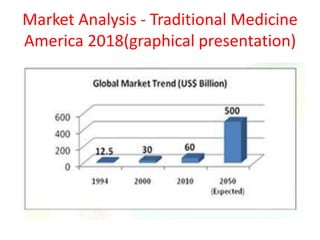
• Currently the total global market of Herbal Products &
Medicinal Plants is US$ 62 billion with a double digit
growth.
• As per the World Bank Report, world trade in medicinal
plants and related products is expected to be US$ 500
billion by 2050.
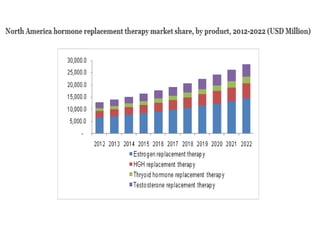
Market Analysis - Traditional Medicine
America 2018(graphical presentation)
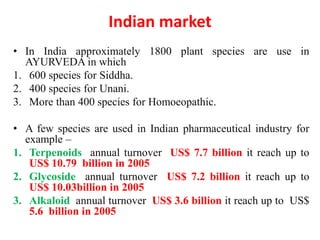
Indian market
• In India approximately 1800 plant species are use in
AYURVEDA in which
1. 600 species for Siddha.
2. 400 species for Unani.
3. More than 400 species for Homoeopathic.
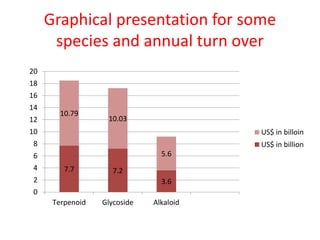
• A few species are used in Indian pharmaceutical industry for
example –
1. Terpenoids annual turnover US$ 7.7 billion it reach up to
US$ 10.79 billion in 2005
2. Glycoside annual turnover US$ 7.2 billion it reach up to
US$ 10.03billion in 2005
3. Alkaloid annual turnover US$ 3.6 billion it reach up to US$
5.6 billion in 2005
Graphical presentation for some
species and annual turn over
7.7 7.2
3.6
10.79
10.03
5.6
0
2
4
6
8
10
12
14
16
18
20
Terpenoid Glycoside Alkaloid
US$ in billoin
US$ in billion
Rapid growth of Complementary and
Alternative Medicine
• The World Health Organization (WHO) orders
65– 80% of the world's human services benefits
as 'conventional drug‘.
• CAM is easy to understand and familiar
• CAM is non-invasive, with few side effects
• CAM helps improve quality of life (QOL) or
activity of daily life (ADL)
• CAM helps one to maintain one's own health
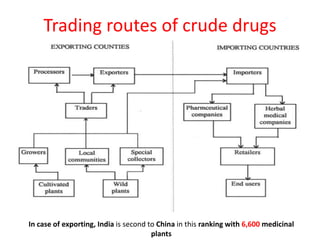
Trading routes of crude drugs
In case of exporting, India is second to China in this ranking with 6,600 medicinal
plants
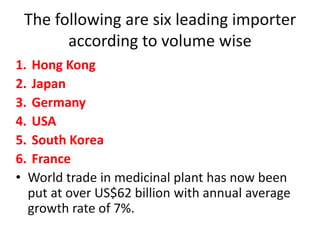
The following are six leading importer
according to volume wise
1. Hong Kong
2. Japan
3. Germany
4. USA
5. South Korea
6. France
• World trade in medicinal plant has now been
put at over US$62 billion with annual average
growth rate of 7%.
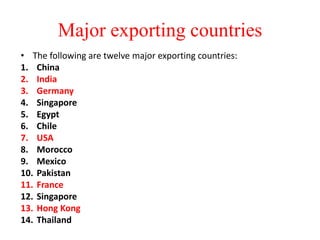
Major exporting countries
• The following are twelve major exporting countries:
1. China
2. India
3. Germany
4. Singapore
5. Egypt
6. Chile
7. USA
8. Morocco
9. Mexico
10. Pakistan
11. France
12. Singapore
13. Hong Kong
14. Thailand
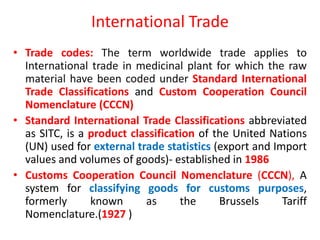
International Trade
• Trade codes: The term worldwide trade applies to
International trade in medicinal plant for which the raw
material have been coded under Standard International
Trade Classifications and Custom Cooperation Council
Nomenclature (CCCN)
• Standard International Trade Classifications abbreviated
as SITC, is a product classification of the United Nations
(UN) used for external trade statistics (export and Import
values and volumes of goods)- established in 1986
• Customs Cooperation Council Nomenclature (CCCN), A
system for classifying goods for customs purposes,
formerly known as the Brussels Tariff
Nomenclature.(1927 )
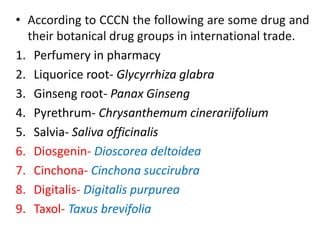
• According to CCCN the following are some drug and
their botanical drug groups in international trade.
1. Perfumery in pharmacy
2. Liquorice root- Glycyrrhiza glabra
3. Ginseng root- Panax Ginseng
4. Pyrethrum- Chrysanthemum cinerariifolium
5. Salvia- Saliva officinalis
6. Diosgenin- Dioscorea deltoidea
7. Cinchona- Cinchona succirubra
8. Digitalis- Digitalis purpurea
9. Taxol- Taxus brevifolia
Diosgenin
• B.S: Diosgenin is commercially obtained from
Root or Rhizomes/Tuber of;
~ Dioscorea floribunda
~ Dioscorea compositae
~ Dioscorea deltoida
• FAMILY: Dioscoreaceae
• 600 types of Dioscorea species.
• Generally it is collected from wild source, as for
Cultivation correct Soil, Proper drainage,
Freedom from Weed, Fungi is required.
• Depending upon different species, it requires 3–5
years for development.
Active constituents
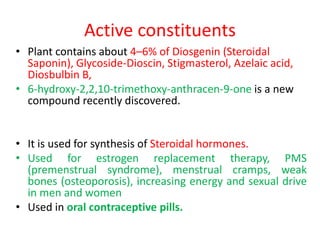
• Plant contains about 4–6% of Diosgenin (Steroidal
Saponin), Glycoside-Dioscin, Stigmasterol, Azelaic acid,
Diosbulbin B,
• 6-hydroxy-2,2,10-trimethoxy-anthracen-9-one is a new
compound recently discovered.
• It is used for synthesis of Steroidal hormones.
• Used for estrogen replacement therapy, PMS
(premenstrual syndrome), menstrual cramps, weak
bones (osteoporosis), increasing energy and sexual drive
in men and women
• Used in oral contraceptive pills.
WORLD WIDE TRADE:
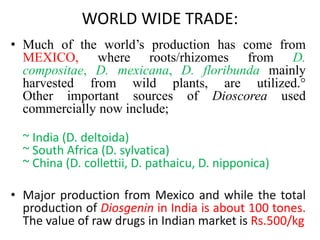
• Much of the world’s production has come from
MEXICO, where roots/rhizomes from D.
compositae, D. mexicana, D. floribunda mainly
harvested from wild plants, are utilized.
Other important sources of Dioscorea used
commercially now include;
~ India (D. deltoida)
~ South Africa (D. sylvatica)
~ China (D. collettii, D. pathaicu, D. nipponica)
• Major production from Mexico and while the total
production of Diosgenin in India is about 100 tones.
The value of raw drugs in Indian market is Rs.500/kg
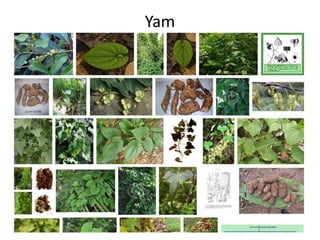
Yam
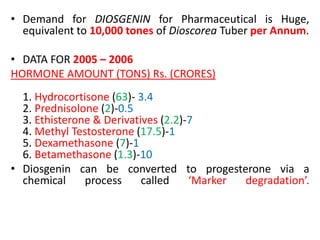
• Demand for DIOSGENIN for Pharmaceutical is Huge,
equivalent to 10,000 tones of Dioscorea Tuber per Annum.
• DATA FOR 2005 – 2006
HORMONE AMOUNT (TONS) Rs. (CRORES)
1. Hydrocortisone (63)- 3.4
2. Prednisolone (2)-0.5
3. Ethisterone & Derivatives (2.2)-7
4. Methyl Testosterone (17.5)-1
5. Dexamethasone (7)-1
6. Betamethasone (1.3)-10
• Diosgenin can be converted to progesterone via a
chemical process called ‘Marker degradation’.
Cinchona
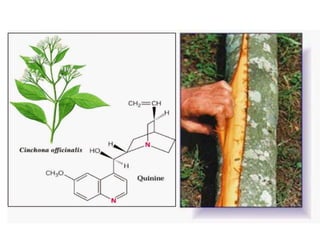
• B.S: It consists of the dried bark, stem or shoot of
Cinchona calisaya and Cinchona officinalis belonging to
family Rubiaceae.
• The bark of tree is source of a variety of alkaloids, the
most familiar of which is quinine, an antipyretic agent
especially useful in treating malaria.
• Other cinchona alkaloids are
1. Cinchonin
2. Cinchonidine
3. Quinidine
4. Dihydroquinidine
5. dihydroquinine
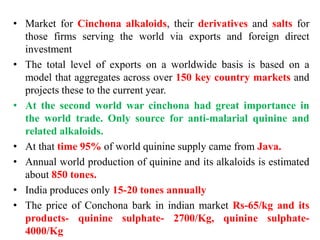
• Market for Cinchona alkaloids, their derivatives and salts for
those firms serving the world via exports and foreign direct
investment
• The total level of exports on a worldwide basis is based on a
model that aggregates across over 150 key country markets and
projects these to the current year.
• At the second world war cinchona had great importance in
the world trade. Only source for anti-malarial quinine and
related alkaloids.
• At that time 95% of world quinine supply came from Java.
• Annual world production of quinine and its alkaloids is estimated
about 850 tones.
• India produces only 15-20 tones annually
• The price of Conchona bark in indian market Rs-65/kg and its
products- quinine sulphate- 2700/Kg, quinine sulphate-
4000/Kg
Uses
• Medicine used to treat malaria.
• Used for increasing appetite.
• Promoting the release of digestive juices; and
other stomach problems.
• It is also used for blood vessel disorders
including hemorrhoids (piles), varicose veins
and leg cramps.
• Other uses are for cancer, mouth and throat
diseases, enlarged spleen, and muscle cramps.
Taxol
• B.S: Taxol is a Naturally occurring Diterpenoid
belonging to Taxane group of compounds present
in genus Taxus.
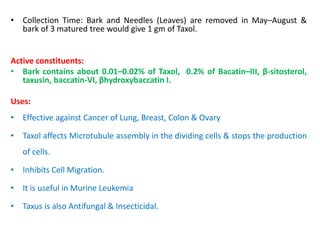
• Different species of Taxus grown in World;
1. Taxus baccata
2. T. cuspidata
3. T. Chineusis
4. T. Brevifolia
FAMILY: Taxaceae
 100 years old tree of Taxus brevifolia is 6–9
meter in height is suitable for collection of
trunk or stem bark.
• Collection Time: Bark and Needles (Leaves) are removed in May–August &
bark of 3 matured tree would give 1 gm of Taxol.
Active constituents:
• Bark contains about 0.01–0.02% of Taxol, 0.2% of Bacatin–III, β-sitosterol,
taxusin, baccatin-VI, βhydroxybaccatin I.
Uses:
• Effective against Cancer of Lung, Breast, Colon & Ovary
• Taxol affects Microtubule assembly in the dividing cells & stops the production
of cells.
• Inhibits Cell Migration.
• It is useful in Murine Leukemia
• Taxus is also Antifungal & Insecticidal.
• Collection Time: Bark and Needles (Leaves) are removed in May–August &
bark of 3 matured tree would give 1 gm of Taxol.
Active constituents:
• Bark contains about 0.01 – 0.02% of Taxol, 0.2% of Bacatin – III, β-sitosterol,
taxusin, baccatin VI, βhydroxybaccatin I.
Uses:
• Effective against Cancer of Lung, Breast, Colon & Ovary
• Taxol affects Microtubule assembly in the dividing cells & stops the production
of cells.
• Inhibits Cell Migration.
• It is useful in Murine Leukemia
• Taxus is also Antifungal & Insecticidal.
WORLD – WIDE TRADE:
• World–Wide Trade of Taxol is reached to US $
1.92 billion.
• World’s requirement 700 kg/year
• Current Production 350 kg/year
• Present production of Taxol is only 350 kg &
demand is double, therefore conserve/
propagation of the plant is very important.
• Thank you