http://www.free-powerpoint-templates-design.com
CHETNA KAUSHIK
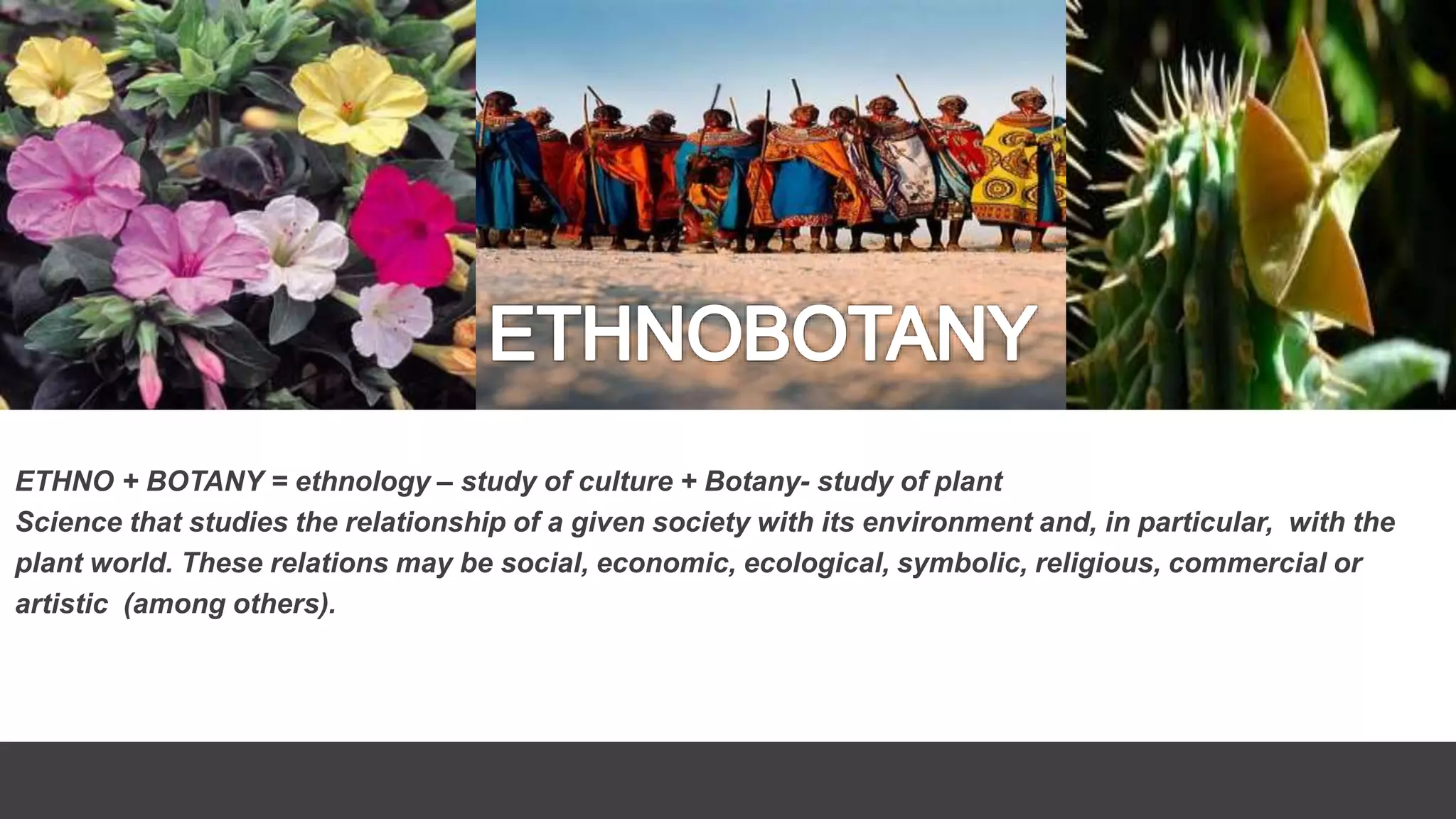
ETHNO + BOTANY = ethnology – study of culture + Botany- study of plant
Science that studies the relationship of a given society with its environment and, in particular, with the
plant world. These relations may be social, economic, ecological, symbolic, religious, commercial or
artistic (among others).
Ethnobotanical Approaches of Traditional
Medicine Studies:
Some Experiences From Asia
Vedas
4500 to 600 B.C.
oldest repository
of human
knowledge
comprises 67
plant species
Ayurveda
Traditional medicine
system practiced
widely in India and
Nepal
details for the
therapeutic use of
as many as 290
herbal drugs
Sheng-Nongs Herbal
book (China)
One of the earliest
sources of folk
knowledge on the
use of herbals;
comprises 365
plants, animals, and
minerals useful as
medication from the
period of Sheng-
Nong (3000 B.C.)
Tibetan medicine
Earliest literature
- eighth century
A.D.
Unani Medicine
South and West
Asia
Traditional use
& management
of medicinal
plants in Asian
countries
The total number of medicinal plants in the Hindu Kush
-Himalayan countries is approximately 7500 to 10,000
species
4 largest traditional medicinal systems in the world :
Ayurvedic medicine, Chinese medicine, Tibetan medicine
and Unani medicine
The Hindu Kush- Himalayas (Afghanistan, Bangladesh,
Bhutan, China, India, Nepal and Pakistan)
Field-based research and community participation in the
documentation, application, and proliferation of indigeno
us knowledge of medicinal plant resources (and their
management) can be a part of the process of coping
with changes without losing valuable local tradition and
biodiversity.
Hence, Ethnobotany is important to conservation and
community development.
Application of Ethnobotany to community
conservation and medicinal plant resource
management
THE PEOPLE AND PLANTS INITIATIVE
An International Umbrella Program operated by WWF-UNESCO-Kew Garden
Launching Since 1992
A number of field-based projects which aim at using Ethnobotany as a tool to work with
local communities to achieve sustainable management systems of plant resources.
To assess historical and contemporary changes, and their
impact on management by ethnobotanical methods both
qualitatively and quantitatively.
A better understanding of the direct interactions between
people and biotic elements in an environment, achieved
through ethnobotanical studies and helping resource
management at the local level.
To transfer replicable indigenous techniques, practices
and knowledge into other areas of the same bioregion
for resource management through farmer-to-farmer
exchange, based on the biocultural “niche-transfer”
concept of indigenous environmental management.
Goals of Ethnobotany
sustainable
development
of
plant resources
To facilitate local people’s participation in the collection
,documentation, analysis, and assessment of
indigenous knowledge through field studies.
Ethnobotanical Inventory and Documentation as an
Information Bank on Traditional Medicine
Traditional Chinese
Medicine (TCM)
11,146 plant species,
1581 animal species,
and 80 minerals. Of
these, 500 to 600 sp
ecies are commonly
used medicines in
TCM.
Tibetan Medicine
1106 plants, 448
animals, and 840
natural minerals.
India
2500 plant specie
s are used by
traditional healers
(WWF, 1990) and
100 species of
plants serve as
regular sources of
medicine
Nepal
800 medicinal
plants
Study of lead compounds of medicinal plants
for structure, activity, and formulation of new
medicines
Traditional herbs which had proven clinical
efficacy and safety were the first chosen
for screening.
Then plant materials collected and identified with refere
nce to ethnobotanical information and phytochemical
analysis were screened in consultation with local users
of the herbal medicine.
The identified lead compounds of herbal medicines are t
ested through phytochemistry, pharmacy animal experi
ments, and clinical trials.
It is then possible to use them in the formulation of new medicine
s according to government regulations concerning new medicinal
developments.
Get a modern PowerPoint Presentation
that is beautifully designed. Easy to change
colors, photos and Text. You can simply
impress your audience and add a unique
zing and appeal to your Presentations. Get
a modern PowerPoint Presentation that is
beautifully designed. Easy to change colors,
photos and Text. You can simply impress
your audience and add a unique zing and
appeal to your Presentations.
Your Text Here
Zeliangrong
Ethnically and linguistically -Mongoloid grou
p of races and speak a Tibeto-Burman lang
uage under the Naga Bodo section family
The selected tribes
Regular herbal healers - ‘Kobiraj’ or ‘Maipa’
or ‘Maipi’
19 selected villages (5 Zeme, 5 Liangmai an
d 9 Rongmei)
Altogether 27 herbal healers (23 males and
4 females) from 16 villages were selected th
rough purposive sampling techniques
Ethnomedicinal data collection
Informant consensus
factor (ICF)
ICF = Nur- Nt / Nur -1
0.0 to 0.75
Data analysis
13 disease categories .
Ailment categories
13 different plant parts
leaves 382 UR, barks (53 UR), rhizome (34 UR), fruits (33 UR)
11 different forms of the crude drug type (CDT)
Mode of drug administration - 6 categories
Drug preparation and route of administration
Ethnobotany of medicinal plants used by the
Zeliangrong ethnic group of Manipur, Northeast
India
BACKGROUND
Oroxylum indicum, Sapindus mukorossi, Z
anthoxylum armatum are represented und
er vulnerable category of IUCN while Pipe
r arunachalensis is a rare and endemic sp
ecies of the region .
The record of only 4 female he
alers, 2 each from Liangmai an
d Rongmei and absence of fe
male healer in Zeme indica
te that the medicinal knowle
dge is mostly male inherited sy
stem
Acmella paniculata (for toothache, dysent
ery and anthelmintic), Acorus calamus (fo
r cough, headache, jaundice, stomachic a
nd undefined illness), etc. are used for mu
ltiple ailments.
Phlogocanthus spp, and Psidium guajava
- bath for cold and fever
side effects
Excessive consumption of Phlo
gacanthus thyrsiflorus for coug
h and fever - temporary deafne
ss of patient, Clerodendrum gl
andulosum used for hypertensi
on - low blood pressure
Way of diagnosing and managing degenera
tive disorders
Cancerous Tumours - observing the body p
art and nature of swelling.
Hypertension and Diabetes - either by chec
king pulse rate or examining medical report
s of the patients.
Magico-Religious way
Tying dried bark of Erythrina stricta in the b
ody parts by a healer to avoid evil spirits
‘Herbal Cultural Heritage’ of the Zeliangrong people
Evil spirit.
Erythrina stricta
Diarrhea
Camelia sinensis
Jaundice.
Zehneria scabra
Ageratum conizoides
Ageratum conizoides
Hypertension
Clerodendrum glandulosum
stomachic , diarrhea and dysentery
Psidium guajava
Bone setting & Sprain
Paederia foetida
Identity blues: the Ethnobotany of the indigo dyeing by Landian
Yao (Iu Mien) in Yunnan, Southwest China
Landian Yao used to farm by
slash-and-burn agriculture,
growing dryland rice and maize
Textile production activities were
an essential part in traditional life
of Landian Yao people.
They also were an important skill of
women for seeking respect and
striving for the corresponding social
status in Landian Yao
Each man in Landian Yao must
have a religious ritual called “dujie”
when he becomes an adult.
Strobilanthes cusia is the main
Indigo source
The annual post-harvest “Pan Wang
Festival” , that links to their ancestor,
Pan Wang, also takes place in
Vietnam
Indigo yields and indigo quality from Indigofera
suffruticosa and Indigofera tinctoria are lower
than from Strobilanthes cusia
Indigo yields and indigo quality from Indigofera
suffruticosa and Indigofera tinctoria are lower
than from Strobilanthes cusia
According to the growth env
ironment and morphological
differencesStrobilanthes
cusia is divided into six
varieties or phenotypes by
Landian Yao in the region
Five cultivated types
Local names are
gam lu, gam gai,
gam sam ,gam nyoyi
bu, and akha gam
a hong gong gam
b gam sam
c gam nyoyi bu
d gam lu
e Akha gam
Traditional Indigo Pigment Extraction
A Strobilanthes cusia leaves after 24h of fermentation
B Removal of leaves using a net (called jiu in local
name)
C Oxygenation after adding lime water to reduce the pH.
D Detail of wooden tool (dongzhong) used for
oxygenation
E A half section of a gourd (Lagenaria siceraria) scoop
used to take out indigo paste at the end of the process
Traditional Dyeing
Process
A woman preparing
the dye solutions
A The large stem of Spatholobus suberectus
B Cut stem showing characteristic red exudate
C Cut sections of S.suberectus stem
D Sliced tubers of Dioscorea cirrhosa soaking in
the water
E Residue of D.cirrhosa after dyeing
F Wild harvested D.cirrhosa tuber
Ethnobotany of Meghalaya: Medicinal Plants Used by Khasi
and Garo Tribes
Common in forest cleared areas and secondary forests
The powdered rhizome is taken with water to kill the worms
of the intestine.
Curcurna aromatica Salisb. Zingiberaceae
Common climbers on other shrubs
The juice of the leaves is applied for skin
diseases. Sometimes the leaves are dried and
the resultant powder, mixed with oil, is applied
for skin diseases.
Smilax glabra Roxb
Smilacaceae
The leaves are eaten raw to cure toothache; also given for blood
purification.
Astilbe rivularis Linn. Saxifragaceae
Common in shady places near ravines at higher elevations
The crushed leaves are applied to
cuts and wounds; also applied to
treat bites of poisonous insects and
caterpillars.
Adenostemma lavenia (Linn.) Ktz.
Compositae
Weed of cultivation; common along
marshy areas
The roots are powdered, mixed with
crushed snails, and applied to cure
leprosy.
Achyranthus aspera Linn.
Amaranthaceae
Herbs in moist, shady places and in
hedges
A weed of waste places and roadsides,
common in plains
The leaves are boiled with rice and garlic,
and the water is rubbed on the body to
cure rheumatic pains; sometimes used as
bath water.
Boerhavia diffusa Linn. Nyctaginaceae
Thank you

Ethnobotany and ethnopharmacology

  • 1.
  • 2.
    ETHNO + BOTANY= ethnology – study of culture + Botany- study of plant Science that studies the relationship of a given society with its environment and, in particular, with the plant world. These relations may be social, economic, ecological, symbolic, religious, commercial or artistic (among others).
  • 3.
    Ethnobotanical Approaches ofTraditional Medicine Studies: Some Experiences From Asia Vedas 4500 to 600 B.C. oldest repository of human knowledge comprises 67 plant species Ayurveda Traditional medicine system practiced widely in India and Nepal details for the therapeutic use of as many as 290 herbal drugs Sheng-Nongs Herbal book (China) One of the earliest sources of folk knowledge on the use of herbals; comprises 365 plants, animals, and minerals useful as medication from the period of Sheng- Nong (3000 B.C.) Tibetan medicine Earliest literature - eighth century A.D. Unani Medicine South and West Asia
  • 4.
    Traditional use & management ofmedicinal plants in Asian countries The total number of medicinal plants in the Hindu Kush -Himalayan countries is approximately 7500 to 10,000 species 4 largest traditional medicinal systems in the world : Ayurvedic medicine, Chinese medicine, Tibetan medicine and Unani medicine The Hindu Kush- Himalayas (Afghanistan, Bangladesh, Bhutan, China, India, Nepal and Pakistan) Field-based research and community participation in the documentation, application, and proliferation of indigeno us knowledge of medicinal plant resources (and their management) can be a part of the process of coping with changes without losing valuable local tradition and biodiversity. Hence, Ethnobotany is important to conservation and community development.
  • 5.
    Application of Ethnobotanyto community conservation and medicinal plant resource management THE PEOPLE AND PLANTS INITIATIVE An International Umbrella Program operated by WWF-UNESCO-Kew Garden Launching Since 1992 A number of field-based projects which aim at using Ethnobotany as a tool to work with local communities to achieve sustainable management systems of plant resources.
  • 6.
    To assess historicaland contemporary changes, and their impact on management by ethnobotanical methods both qualitatively and quantitatively. A better understanding of the direct interactions between people and biotic elements in an environment, achieved through ethnobotanical studies and helping resource management at the local level. To transfer replicable indigenous techniques, practices and knowledge into other areas of the same bioregion for resource management through farmer-to-farmer exchange, based on the biocultural “niche-transfer” concept of indigenous environmental management. Goals of Ethnobotany sustainable development of plant resources To facilitate local people’s participation in the collection ,documentation, analysis, and assessment of indigenous knowledge through field studies.
  • 7.
    Ethnobotanical Inventory andDocumentation as an Information Bank on Traditional Medicine Traditional Chinese Medicine (TCM) 11,146 plant species, 1581 animal species, and 80 minerals. Of these, 500 to 600 sp ecies are commonly used medicines in TCM. Tibetan Medicine 1106 plants, 448 animals, and 840 natural minerals. India 2500 plant specie s are used by traditional healers (WWF, 1990) and 100 species of plants serve as regular sources of medicine Nepal 800 medicinal plants
  • 8.
    Study of leadcompounds of medicinal plants for structure, activity, and formulation of new medicines Traditional herbs which had proven clinical efficacy and safety were the first chosen for screening. Then plant materials collected and identified with refere nce to ethnobotanical information and phytochemical analysis were screened in consultation with local users of the herbal medicine. The identified lead compounds of herbal medicines are t ested through phytochemistry, pharmacy animal experi ments, and clinical trials. It is then possible to use them in the formulation of new medicine s according to government regulations concerning new medicinal developments. Get a modern PowerPoint Presentation that is beautifully designed. Easy to change colors, photos and Text. You can simply impress your audience and add a unique zing and appeal to your Presentations. Get a modern PowerPoint Presentation that is beautifully designed. Easy to change colors, photos and Text. You can simply impress your audience and add a unique zing and appeal to your Presentations. Your Text Here
  • 9.
    Zeliangrong Ethnically and linguistically-Mongoloid grou p of races and speak a Tibeto-Burman lang uage under the Naga Bodo section family The selected tribes Regular herbal healers - ‘Kobiraj’ or ‘Maipa’ or ‘Maipi’ 19 selected villages (5 Zeme, 5 Liangmai an d 9 Rongmei) Altogether 27 herbal healers (23 males and 4 females) from 16 villages were selected th rough purposive sampling techniques Ethnomedicinal data collection Informant consensus factor (ICF) ICF = Nur- Nt / Nur -1 0.0 to 0.75 Data analysis 13 disease categories . Ailment categories 13 different plant parts leaves 382 UR, barks (53 UR), rhizome (34 UR), fruits (33 UR) 11 different forms of the crude drug type (CDT) Mode of drug administration - 6 categories Drug preparation and route of administration Ethnobotany of medicinal plants used by the Zeliangrong ethnic group of Manipur, Northeast India
  • 10.
    BACKGROUND Oroxylum indicum, Sapindusmukorossi, Z anthoxylum armatum are represented und er vulnerable category of IUCN while Pipe r arunachalensis is a rare and endemic sp ecies of the region . The record of only 4 female he alers, 2 each from Liangmai an d Rongmei and absence of fe male healer in Zeme indica te that the medicinal knowle dge is mostly male inherited sy stem Acmella paniculata (for toothache, dysent ery and anthelmintic), Acorus calamus (fo r cough, headache, jaundice, stomachic a nd undefined illness), etc. are used for mu ltiple ailments. Phlogocanthus spp, and Psidium guajava - bath for cold and fever side effects Excessive consumption of Phlo gacanthus thyrsiflorus for coug h and fever - temporary deafne ss of patient, Clerodendrum gl andulosum used for hypertensi on - low blood pressure Way of diagnosing and managing degenera tive disorders Cancerous Tumours - observing the body p art and nature of swelling. Hypertension and Diabetes - either by chec king pulse rate or examining medical report s of the patients. Magico-Religious way Tying dried bark of Erythrina stricta in the b ody parts by a healer to avoid evil spirits
  • 11.
    ‘Herbal Cultural Heritage’of the Zeliangrong people Evil spirit. Erythrina stricta Diarrhea Camelia sinensis Jaundice. Zehneria scabra Ageratum conizoides Ageratum conizoides Hypertension Clerodendrum glandulosum stomachic , diarrhea and dysentery Psidium guajava Bone setting & Sprain Paederia foetida
  • 12.
    Identity blues: theEthnobotany of the indigo dyeing by Landian Yao (Iu Mien) in Yunnan, Southwest China Landian Yao used to farm by slash-and-burn agriculture, growing dryland rice and maize Textile production activities were an essential part in traditional life of Landian Yao people. They also were an important skill of women for seeking respect and striving for the corresponding social status in Landian Yao Each man in Landian Yao must have a religious ritual called “dujie” when he becomes an adult. Strobilanthes cusia is the main Indigo source The annual post-harvest “Pan Wang Festival” , that links to their ancestor, Pan Wang, also takes place in Vietnam Indigo yields and indigo quality from Indigofera suffruticosa and Indigofera tinctoria are lower than from Strobilanthes cusia Indigo yields and indigo quality from Indigofera suffruticosa and Indigofera tinctoria are lower than from Strobilanthes cusia
  • 13.
    According to thegrowth env ironment and morphological differencesStrobilanthes cusia is divided into six varieties or phenotypes by Landian Yao in the region Five cultivated types Local names are gam lu, gam gai, gam sam ,gam nyoyi bu, and akha gam a hong gong gam b gam sam c gam nyoyi bu d gam lu e Akha gam
  • 14.
    Traditional Indigo PigmentExtraction A Strobilanthes cusia leaves after 24h of fermentation B Removal of leaves using a net (called jiu in local name) C Oxygenation after adding lime water to reduce the pH. D Detail of wooden tool (dongzhong) used for oxygenation E A half section of a gourd (Lagenaria siceraria) scoop used to take out indigo paste at the end of the process
  • 15.
    Traditional Dyeing Process A womanpreparing the dye solutions A The large stem of Spatholobus suberectus B Cut stem showing characteristic red exudate C Cut sections of S.suberectus stem D Sliced tubers of Dioscorea cirrhosa soaking in the water E Residue of D.cirrhosa after dyeing F Wild harvested D.cirrhosa tuber
  • 16.
    Ethnobotany of Meghalaya:Medicinal Plants Used by Khasi and Garo Tribes Common in forest cleared areas and secondary forests The powdered rhizome is taken with water to kill the worms of the intestine. Curcurna aromatica Salisb. Zingiberaceae Common climbers on other shrubs The juice of the leaves is applied for skin diseases. Sometimes the leaves are dried and the resultant powder, mixed with oil, is applied for skin diseases. Smilax glabra Roxb Smilacaceae The leaves are eaten raw to cure toothache; also given for blood purification. Astilbe rivularis Linn. Saxifragaceae Common in shady places near ravines at higher elevations The crushed leaves are applied to cuts and wounds; also applied to treat bites of poisonous insects and caterpillars. Adenostemma lavenia (Linn.) Ktz. Compositae Weed of cultivation; common along marshy areas The roots are powdered, mixed with crushed snails, and applied to cure leprosy. Achyranthus aspera Linn. Amaranthaceae Herbs in moist, shady places and in hedges A weed of waste places and roadsides, common in plains The leaves are boiled with rice and garlic, and the water is rubbed on the body to cure rheumatic pains; sometimes used as bath water. Boerhavia diffusa Linn. Nyctaginaceae
  • 17.