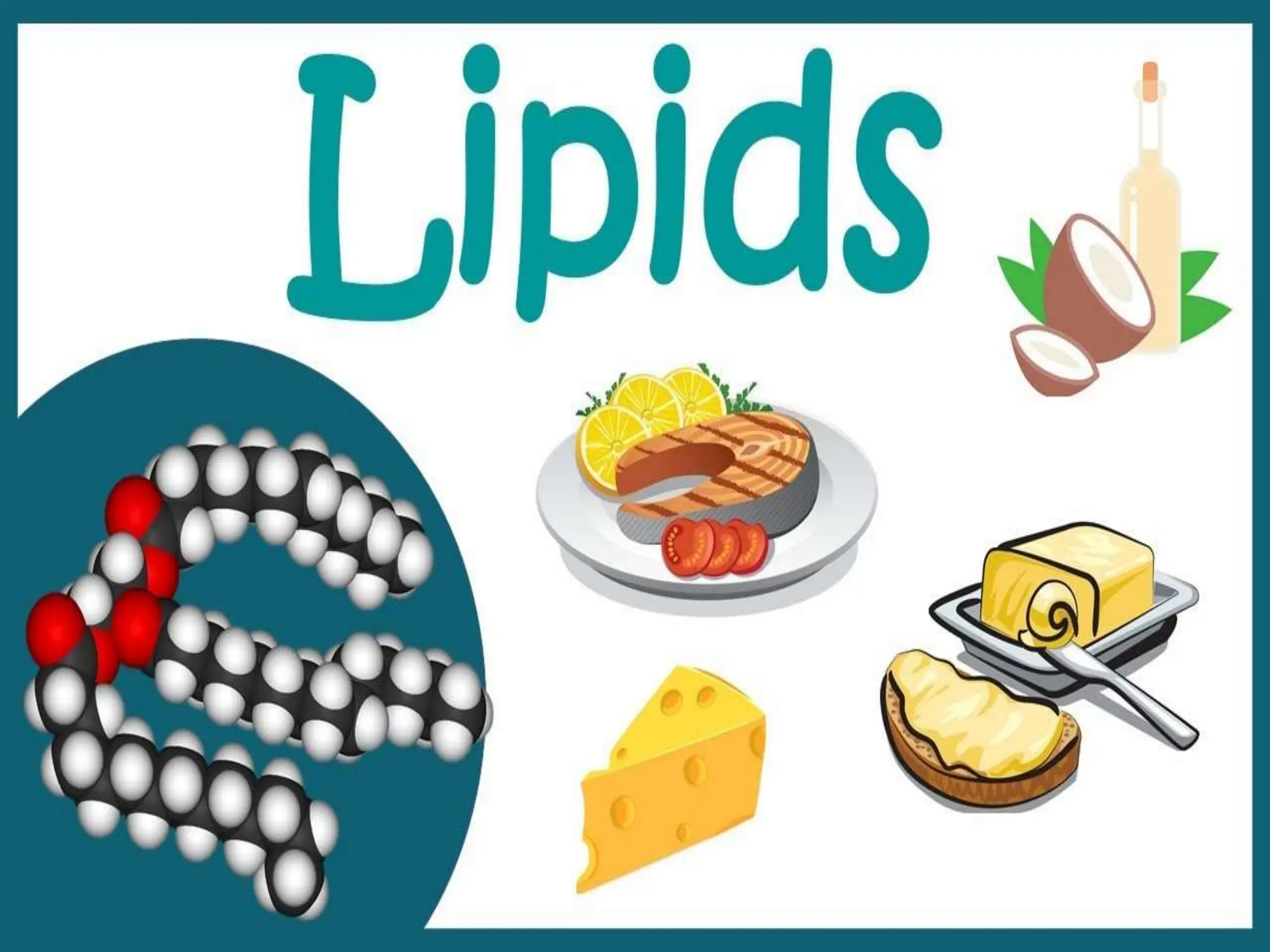
LIPIDS
LIPIDS
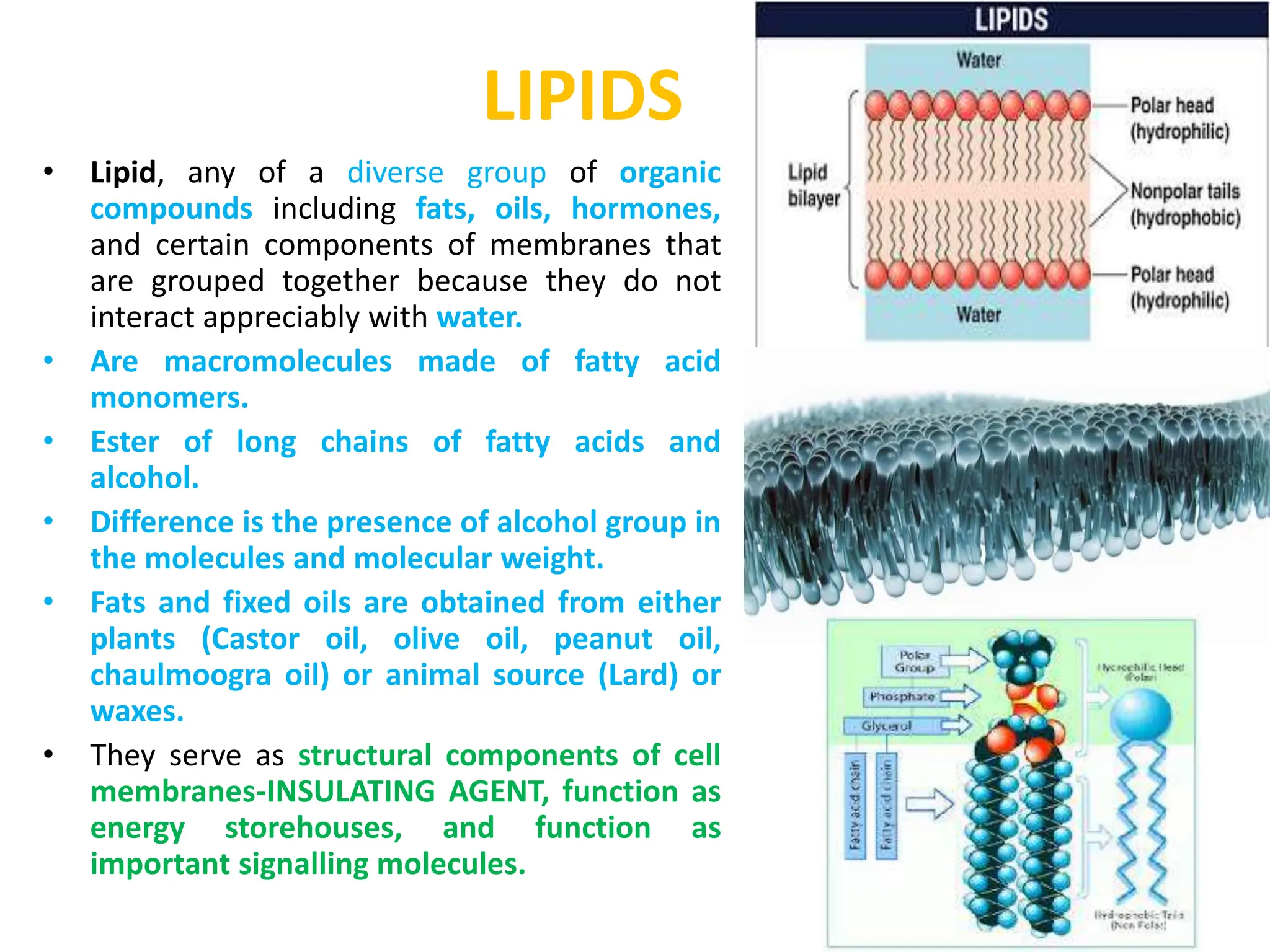
• Lipid, any of a diverse group of organic
compounds including fats, oils, hormones,
and certain components of membranes that
are grouped together because they do not
interact appreciably with water.
• Are macromolecules made of fatty acid
monomers.
• Ester of long chains of fatty acids and
alcohol.
• Difference is the presence of alcohol group in
the molecules and molecular weight.
• Fats and fixed oils are obtained from either
plants (Castor oil, olive oil, peanut oil,
chaulmoogra oil) or animal source (Lard) or
waxes.
• They serve as structural components of cell
membranes-INSULATING AGENT, function as
energy storehouses, and function as
important signalling molecules.
Classification of Lipids
Production of Fixed oil and fats
Evaluation of fixed oil
• The Acid Value is the number of milligrams of potassium hydroxide (KOH)
required to neutralize free fatty acids present in 1 gram of sample. It
indicates the number of free fatty acids present in the sample.
• The saponification value is defined as “the number of milligrams of KOH
needed to neutralize the fatty acids and saponify the esters contained in
1gram of an oil sample.”
• Iodine value, also called Iodine Number, in pharmacognostical, drug
evaluation, or in analytical chemistry, measure of the degree of
unsaturation of an oil, fat, or wax; the amount of iodine, in grams, that is
taken up by 100 grams of the oil, fat, or wax.
• Coconut oil
• Palm oil
• Coconut oil
• Coconut oil
• Nutmeg butter
• Palm oil
• Soybean
• Poultry
• Olive oil
• Sunflower
• Saturated fat is a type of dietary fat. It is one of the unhealthy fats, along with
trans fat. These fats are most often solid at room temperature, contain single
bond. Foods like butter, palm and coconut oils, cheese, and red meat have high
amounts of saturated fat.
• Unsaturated fatty acid carbon chains contain one or more double bonds with a
terminal carboxylic group (–COOH), unlike saturated fatty acids, which contain no
double bonds. These fatty acids are subdivided into two groups depending on the
number of double bonds. A single double bond is termed monounsaturated, and
those with more than one double bond are termed polyunsaturated. Olive,
peanut, and canola oils, Avocados, Nuts such as almonds, hazelnuts and Seeds
such as pumpkin and sesame seeds.
Castor oil
Biological source: Castor oil is a fixed oil
obtained by cold expression from the ripe
seeds of Ricinus communis. Family:
Euphorbiaceae.
Characteristics: pale yellowish or almost
colourless, transparent, viscid liquid. It has a
faint, mild odor and a bland, characteristics
taste.
Composition: mixtured of triglycerides, about
75% of which is tri-ricinolein. The fixed oil
consists of the glycerides of ricinoleic (87%),
isorlcinolein, steric(1%), dihydroxysteric,
linoleic (3%), oleic (7%), and palmitic (2%)
acids.
Uses:
• Oil is stimulant cathartic, Stimulant laxative,
Lubricant , Soap preparation, Paint, Dyes,
Food additives, Polish preparation ,
Ointment base
Chaulmoogra oil
Biological source: chaulmoogra oil is the
fixed oil obtained by expression
fromripe seeds of Hydnocarpus
heterophylla Blume Family:
Achariaceae.
Characteristics: oil is yellow or brownish
yellow. Beloe 25°C it is a soft solid. It
has peculiar odour and sharp taste.
Composition: It contains glyceridic acid
(27%), gorlic acid with small amounts of
glycerides of hydrocarpic acid, pamitic
acid(6%) and oleic acid(12%).
Uses: Used in Indian and Chinese
traditional medicines for the treatment of
leprosy and many skin diseases-
including psoriasis and eczema.
Wool Fat
Common Name: Lanolin, purified wool fat.
Biological Source: It is a yellow waxy
substance secreted by the sebaceous glands
of wool-bearing animals like sheep-Ovis
aries. Family: Bovidae.
Characteristics: Whitish yellow,
Characteristic odor, Bland taste, Insoluble
in water but forms turbidity with ether and
chloroform, melting point-40° to 44.4°C.
Composition: Alcohols, cholesterol, contains
acids in combination with lanoceric,
lanopalmitic, carnaubic, myristic, oleic,
cerotic, and palmitic acids. It contains 50%
of water.
Uses: Moisturizer, Skin related disorder,
Lanolin is often used as a raw material for
producing cholecalciferol in vitamin D
deficiency.
Bees Wax
Common Name: Yellow beeswax, Cera-
Flava.
Biological Source: It is a purified wax
obtained from the honeycomb of the bee
species, Apis mellifera, Family: Apidae.
Characteristics: Two types: Yellow
beeswax and white beeswax,
characteristic odour of honey, insoluble
in water, but soluble in hot alcohol and
other organic solvents, specific gravity of
about 0.95,
Chemical composition: Hydrocarbons
(12%–16%) with a predominant chain
length of C27–C33, mainly heptacosane,
nonacosane, hentriacontane, pentacosane
and tricosane, free fatty acids (12%–
14%), with a chain length of C24–C32;
free fatty alcohols.
Uses: Thickening agent, emulsifiers and as
stiffening agents in cosmetics.
LIPIDS CONTAINING CRUDE DRUGS FROM PLANTS AND ANIMALS.pptx

LIPIDS CONTAINING CRUDE DRUGS FROM PLANTS AND ANIMALS.pptx

  • 1.
  • 2.
    LIPIDS • Lipid, anyof a diverse group of organic compounds including fats, oils, hormones, and certain components of membranes that are grouped together because they do not interact appreciably with water. • Are macromolecules made of fatty acid monomers. • Ester of long chains of fatty acids and alcohol. • Difference is the presence of alcohol group in the molecules and molecular weight. • Fats and fixed oils are obtained from either plants (Castor oil, olive oil, peanut oil, chaulmoogra oil) or animal source (Lard) or waxes. • They serve as structural components of cell membranes-INSULATING AGENT, function as energy storehouses, and function as important signalling molecules.
  • 3.
  • 4.
    Production of Fixedoil and fats
  • 5.
    Evaluation of fixedoil • The Acid Value is the number of milligrams of potassium hydroxide (KOH) required to neutralize free fatty acids present in 1 gram of sample. It indicates the number of free fatty acids present in the sample. • The saponification value is defined as “the number of milligrams of KOH needed to neutralize the fatty acids and saponify the esters contained in 1gram of an oil sample.” • Iodine value, also called Iodine Number, in pharmacognostical, drug evaluation, or in analytical chemistry, measure of the degree of unsaturation of an oil, fat, or wax; the amount of iodine, in grams, that is taken up by 100 grams of the oil, fat, or wax.
  • 6.
    • Coconut oil •Palm oil • Coconut oil • Coconut oil • Nutmeg butter • Palm oil • Soybean • Poultry • Olive oil • Sunflower
  • 7.
    • Saturated fatis a type of dietary fat. It is one of the unhealthy fats, along with trans fat. These fats are most often solid at room temperature, contain single bond. Foods like butter, palm and coconut oils, cheese, and red meat have high amounts of saturated fat. • Unsaturated fatty acid carbon chains contain one or more double bonds with a terminal carboxylic group (–COOH), unlike saturated fatty acids, which contain no double bonds. These fatty acids are subdivided into two groups depending on the number of double bonds. A single double bond is termed monounsaturated, and those with more than one double bond are termed polyunsaturated. Olive, peanut, and canola oils, Avocados, Nuts such as almonds, hazelnuts and Seeds such as pumpkin and sesame seeds.
  • 8.
    Castor oil Biological source:Castor oil is a fixed oil obtained by cold expression from the ripe seeds of Ricinus communis. Family: Euphorbiaceae. Characteristics: pale yellowish or almost colourless, transparent, viscid liquid. It has a faint, mild odor and a bland, characteristics taste. Composition: mixtured of triglycerides, about 75% of which is tri-ricinolein. The fixed oil consists of the glycerides of ricinoleic (87%), isorlcinolein, steric(1%), dihydroxysteric, linoleic (3%), oleic (7%), and palmitic (2%) acids. Uses: • Oil is stimulant cathartic, Stimulant laxative, Lubricant , Soap preparation, Paint, Dyes, Food additives, Polish preparation , Ointment base
  • 9.
    Chaulmoogra oil Biological source:chaulmoogra oil is the fixed oil obtained by expression fromripe seeds of Hydnocarpus heterophylla Blume Family: Achariaceae. Characteristics: oil is yellow or brownish yellow. Beloe 25°C it is a soft solid. It has peculiar odour and sharp taste. Composition: It contains glyceridic acid (27%), gorlic acid with small amounts of glycerides of hydrocarpic acid, pamitic acid(6%) and oleic acid(12%). Uses: Used in Indian and Chinese traditional medicines for the treatment of leprosy and many skin diseases- including psoriasis and eczema.
  • 10.
    Wool Fat Common Name:Lanolin, purified wool fat. Biological Source: It is a yellow waxy substance secreted by the sebaceous glands of wool-bearing animals like sheep-Ovis aries. Family: Bovidae. Characteristics: Whitish yellow, Characteristic odor, Bland taste, Insoluble in water but forms turbidity with ether and chloroform, melting point-40° to 44.4°C. Composition: Alcohols, cholesterol, contains acids in combination with lanoceric, lanopalmitic, carnaubic, myristic, oleic, cerotic, and palmitic acids. It contains 50% of water. Uses: Moisturizer, Skin related disorder, Lanolin is often used as a raw material for producing cholecalciferol in vitamin D deficiency.
  • 11.
    Bees Wax Common Name:Yellow beeswax, Cera- Flava. Biological Source: It is a purified wax obtained from the honeycomb of the bee species, Apis mellifera, Family: Apidae. Characteristics: Two types: Yellow beeswax and white beeswax, characteristic odour of honey, insoluble in water, but soluble in hot alcohol and other organic solvents, specific gravity of about 0.95, Chemical composition: Hydrocarbons (12%–16%) with a predominant chain length of C27–C33, mainly heptacosane, nonacosane, hentriacontane, pentacosane and tricosane, free fatty acids (12%– 14%), with a chain length of C24–C32; free fatty alcohols. Uses: Thickening agent, emulsifiers and as stiffening agents in cosmetics.