HISTORY
 Most notorious poisons in the history
of civilization.
 Used by humanity for thousands of
years.
 The first civilizations to use them
were probably the ancient Sumerians
and Egyptians
 It was called a vegetable alkali.
•The name “alkaloid” comes from the Arabic word
for ash “al-qali”.
•Contain nitrogenous base in the nucleus
• Term alkaloid was coined by meissner, a German
pharmacist (1819).
• Derosne (French chemist) isolated Narcotine
(1803).
• Serturner (1803) isolated morphine from opium
???????
NO DEFINITE DEFINITION
“Naturally occurring
nitrogenous substance
which is isolated from
plants and reacts like
bases”
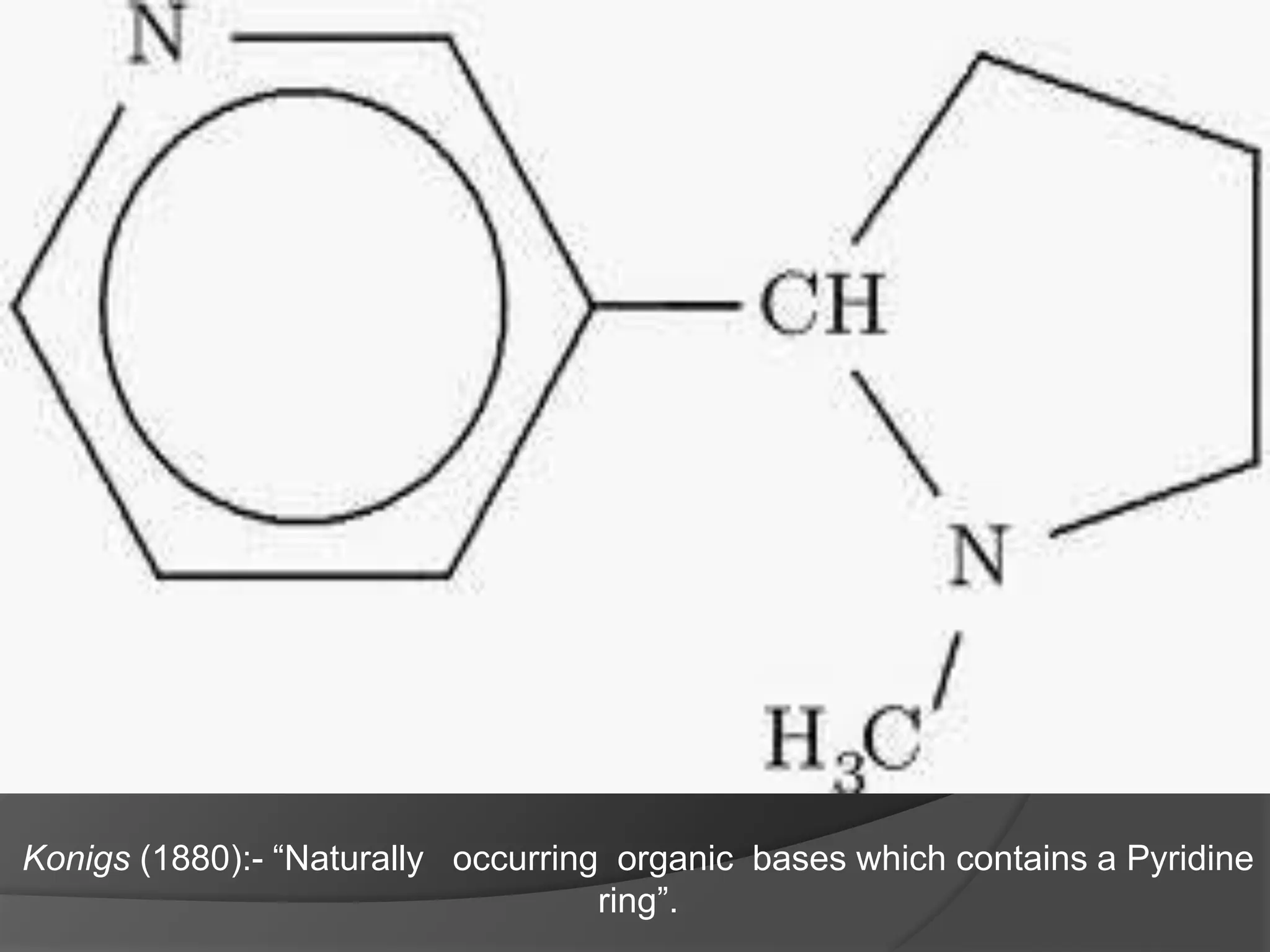
Konigs (1880):- “Naturally occurring organic bases which contains a Pyridine
ring”.
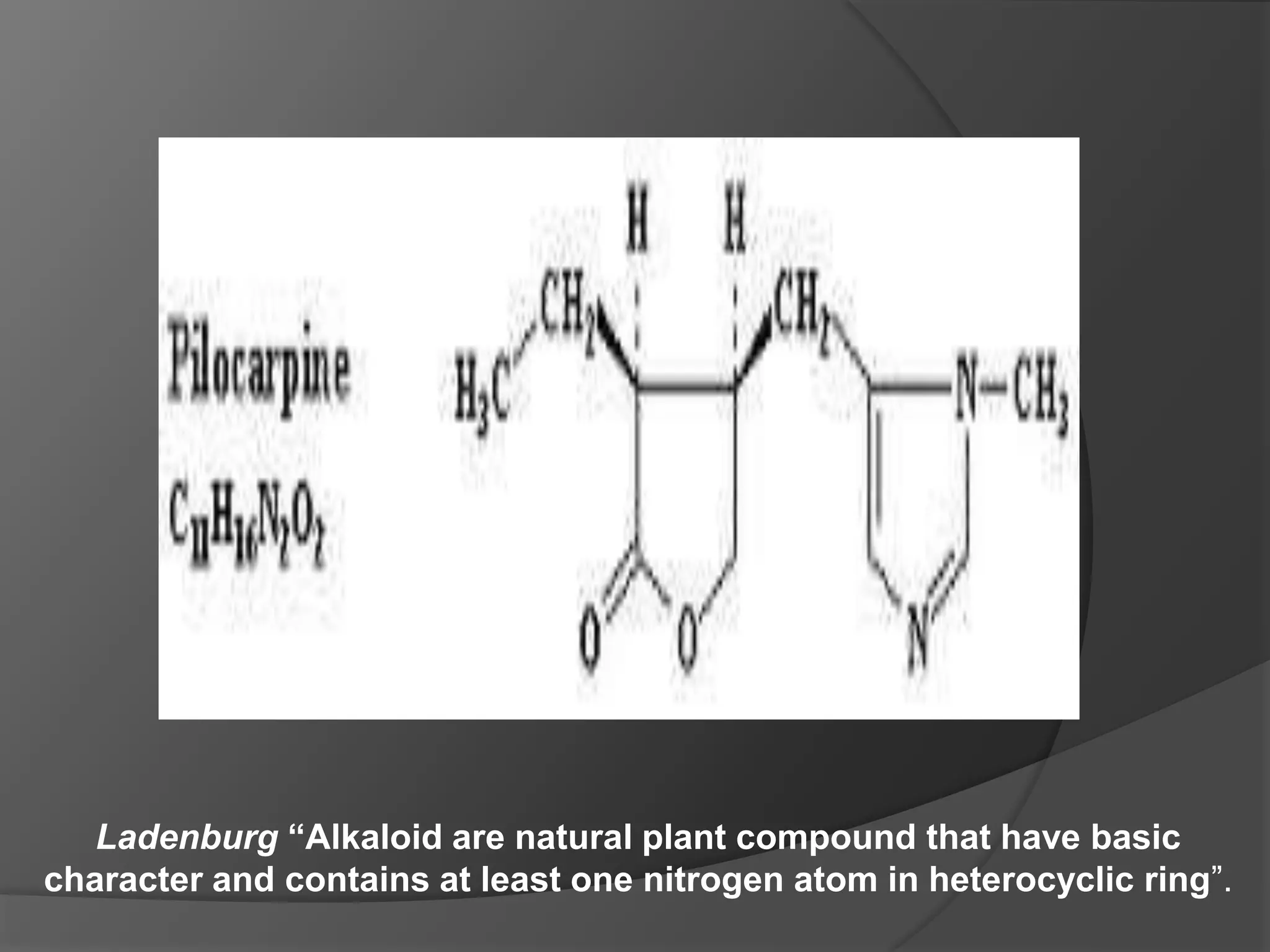
Ladenburg “Alkaloid are natural plant compound that have basic
character and contains at least one nitrogen atom in heterocyclic ring”.
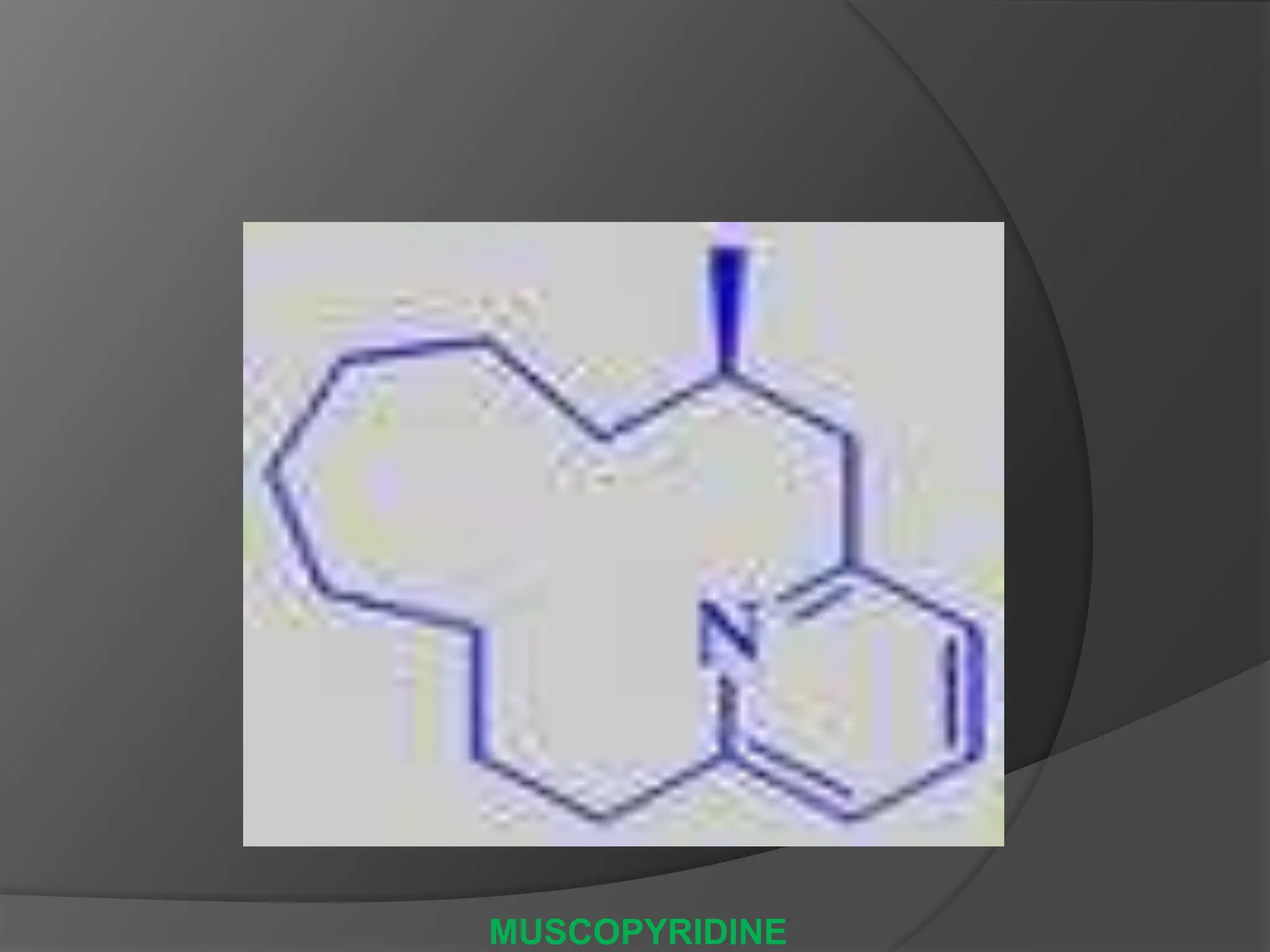
MUSCOPYRIDINE
“Basic nitrogenous compound,
contains one or more nitrogen
in heterocyclic ring system
having marked physiological
action on human and animals
when use in small quantities”.
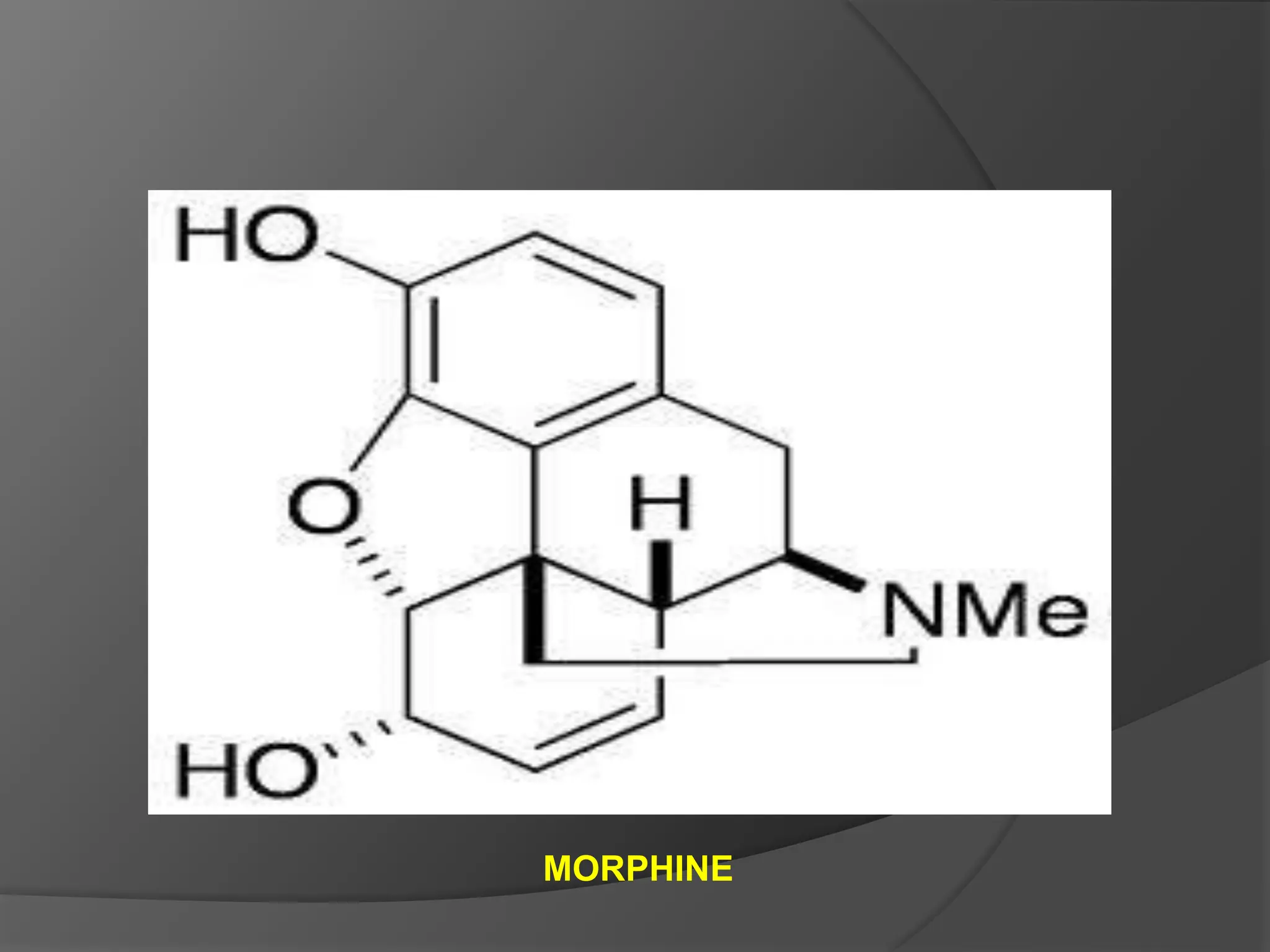
MORPHINE
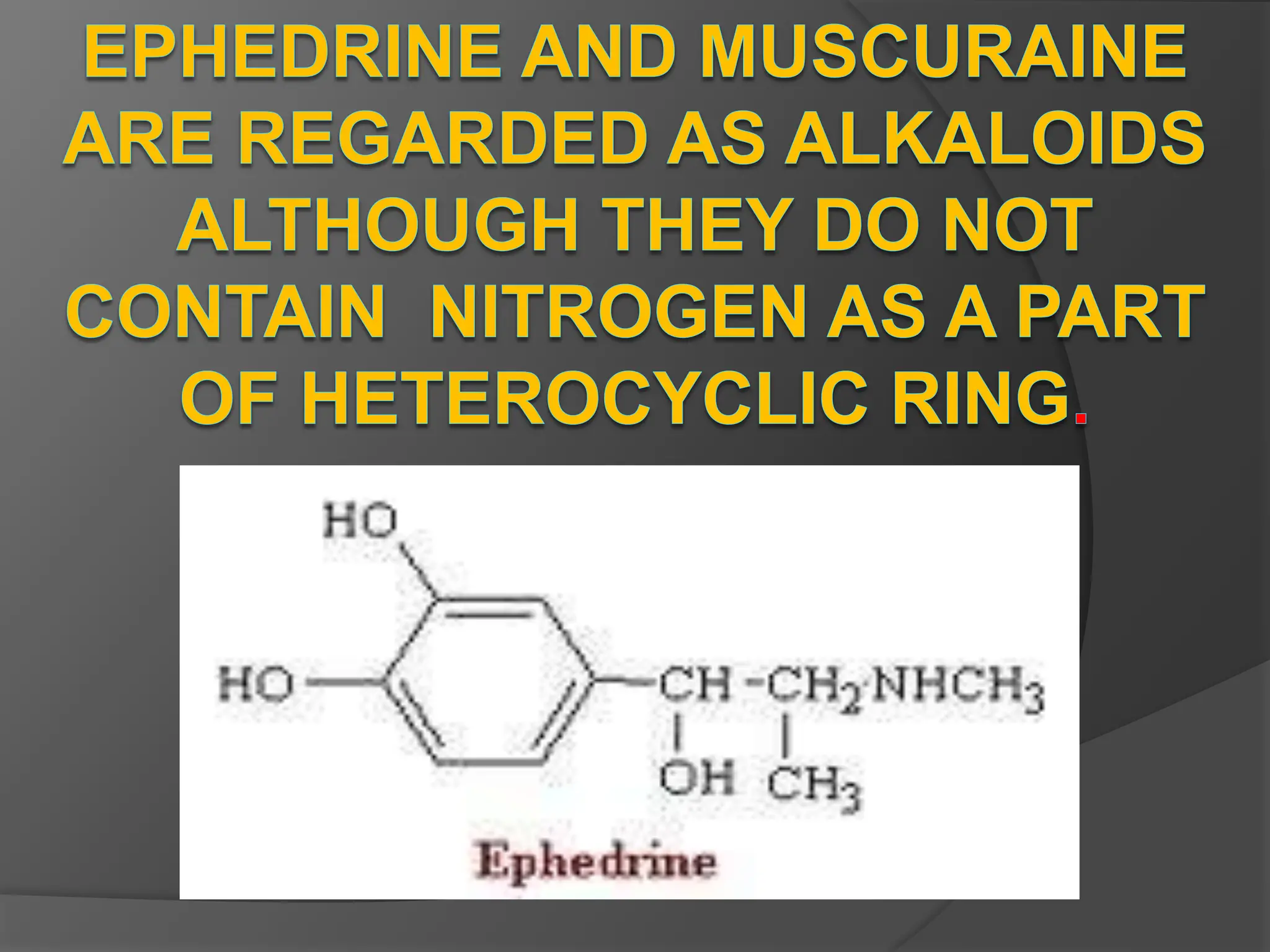
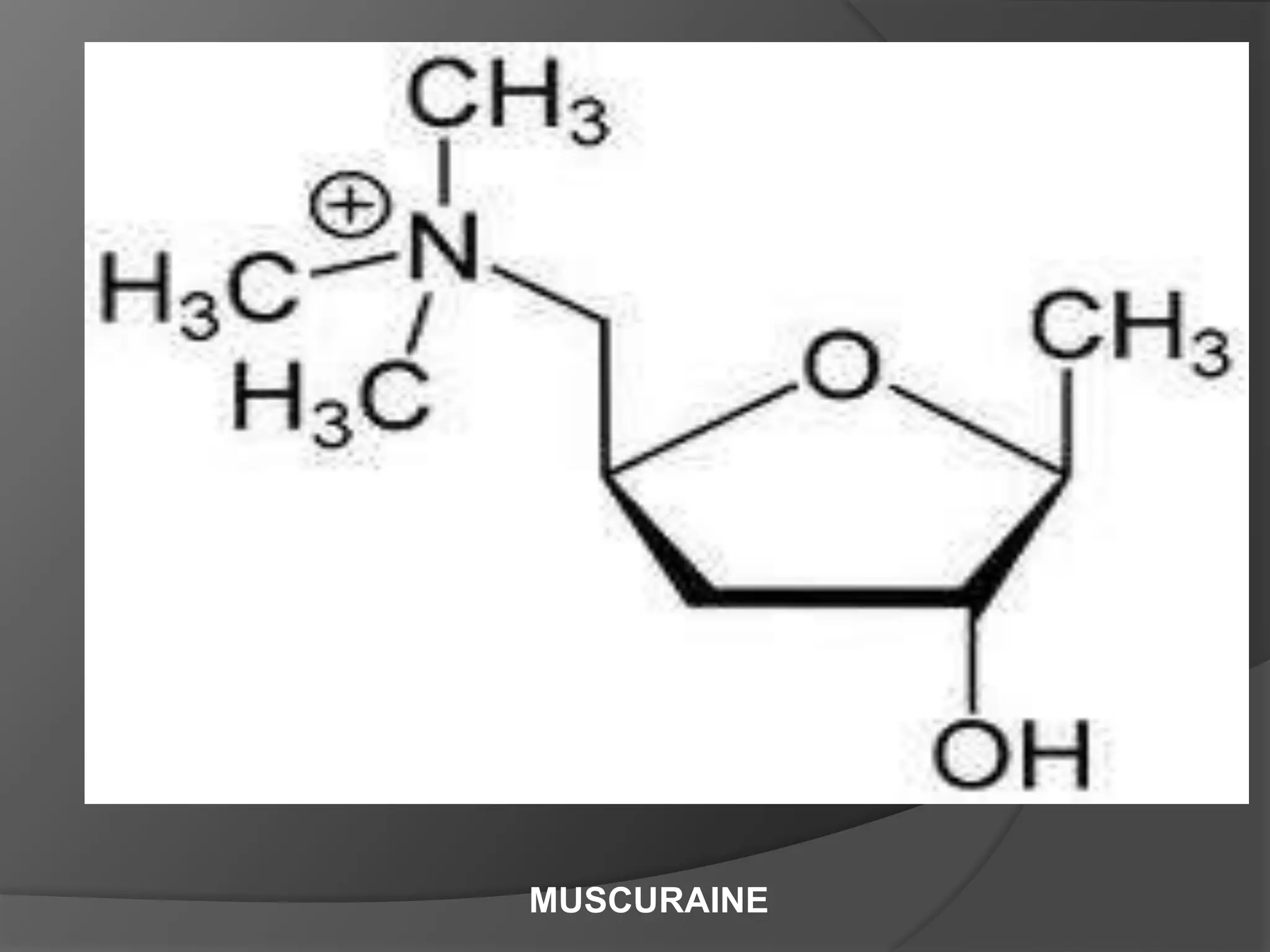
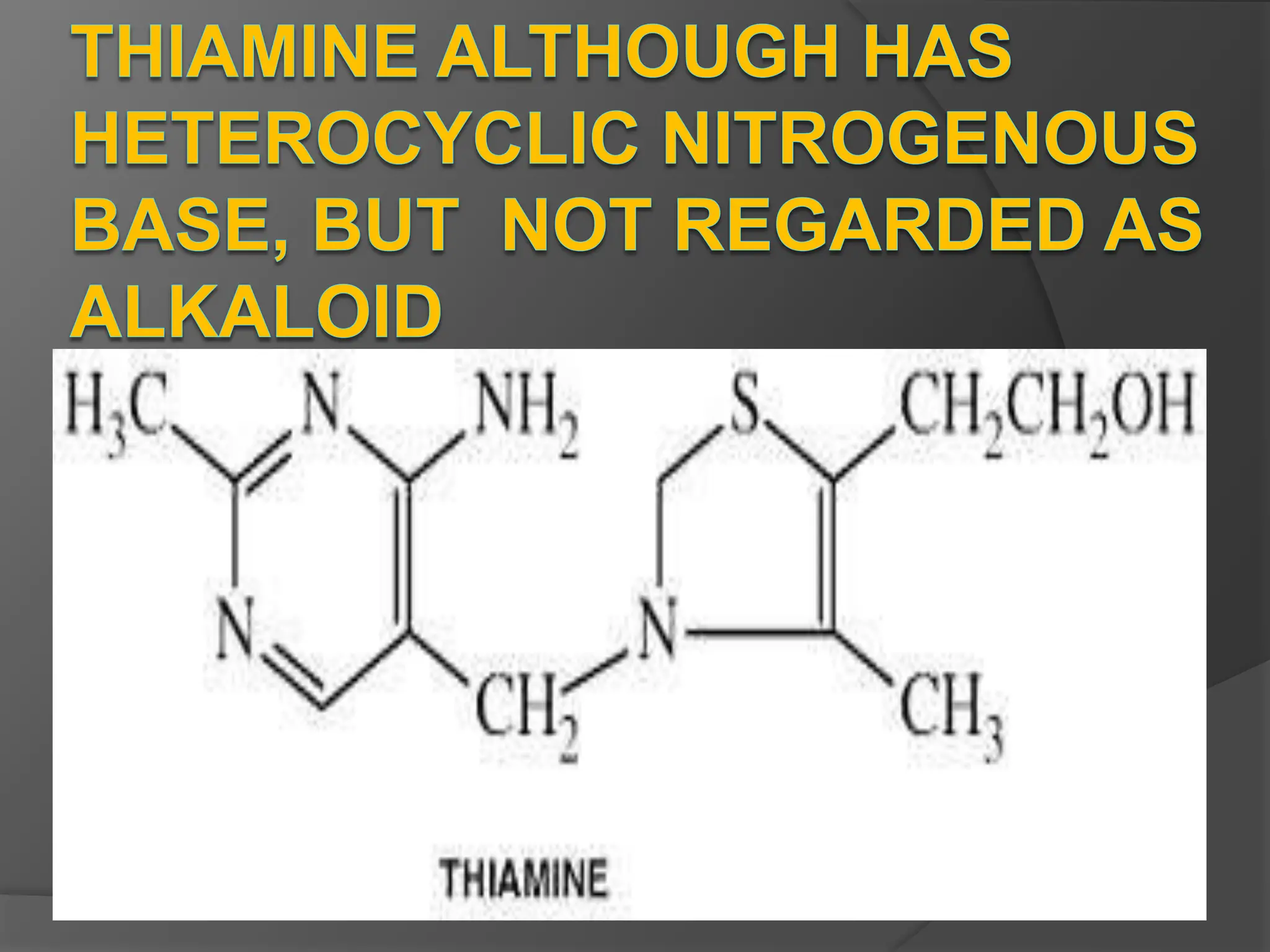
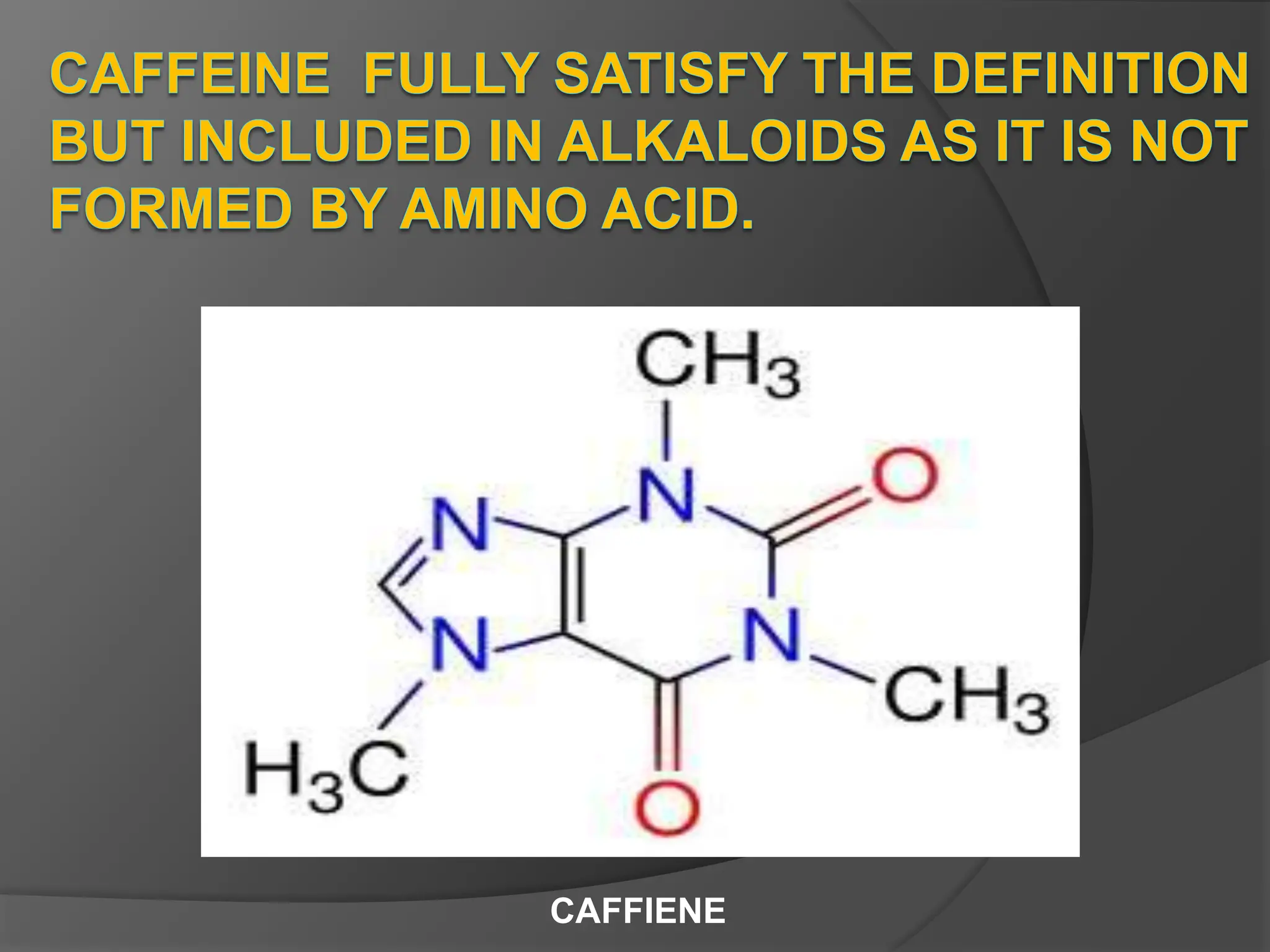
DEVIATION FROM
ABOVE MOST ACCEPTED
DEFINITION:
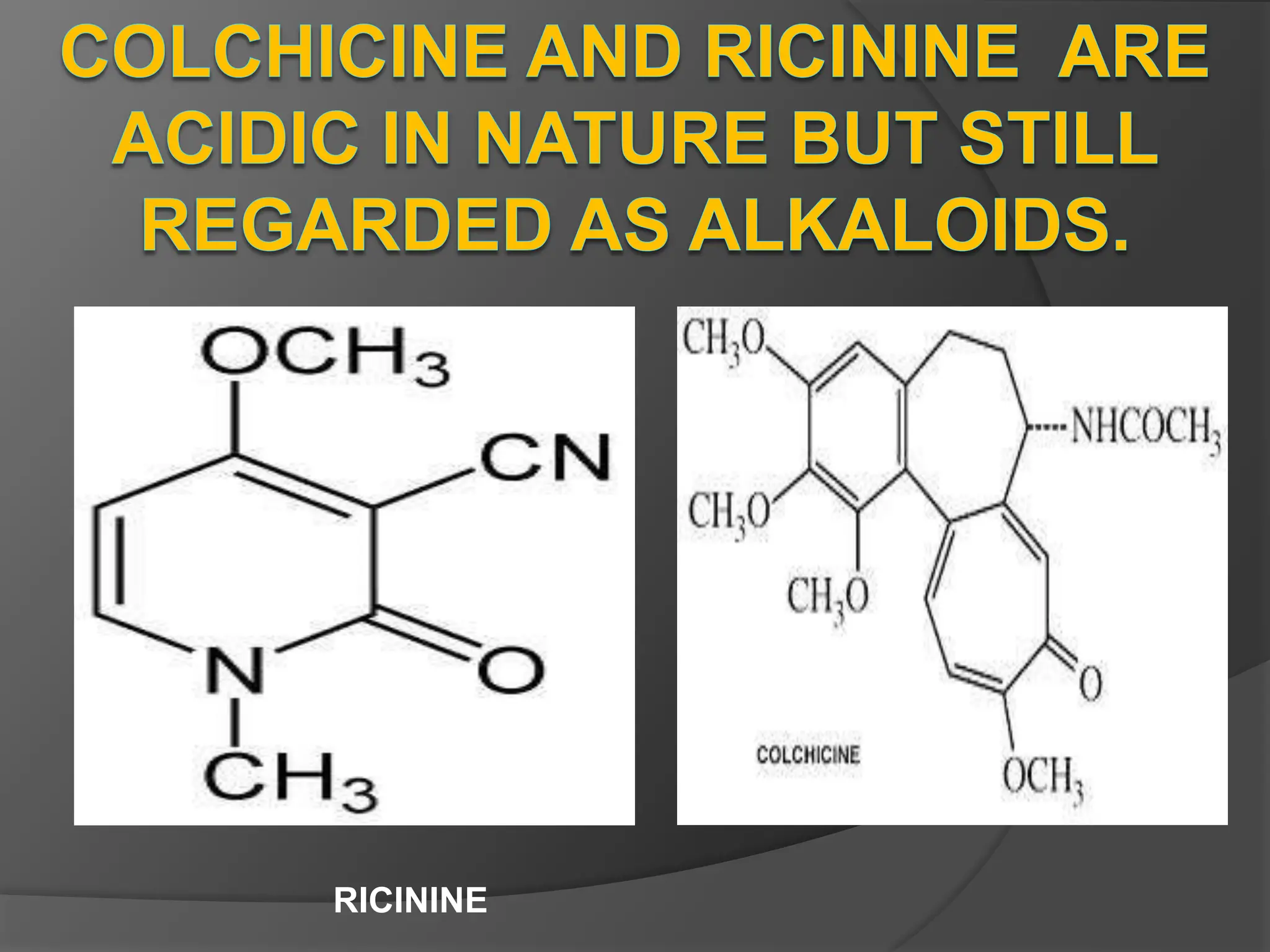
RICININE
MUSCURAINE
CAFFIENE
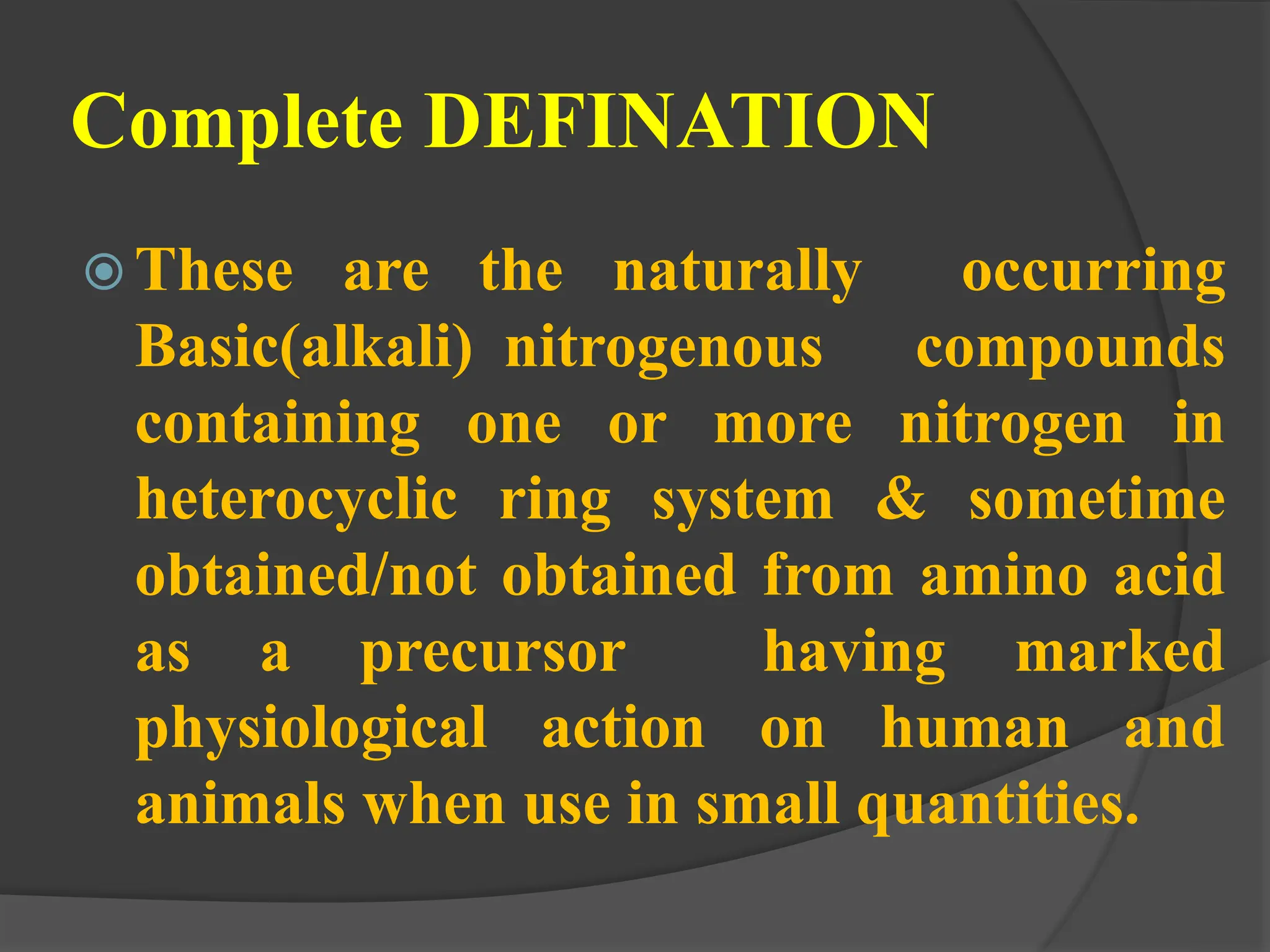
Complete DEFINATION
 These are the naturally occurring
Basic(alkali) nitrogenous compounds
containing one or more nitrogen in
heterocyclic ring system & sometime
obtained/not obtained from amino acid
as a precursor having marked
physiological action on human and
animals when use in small quantities.
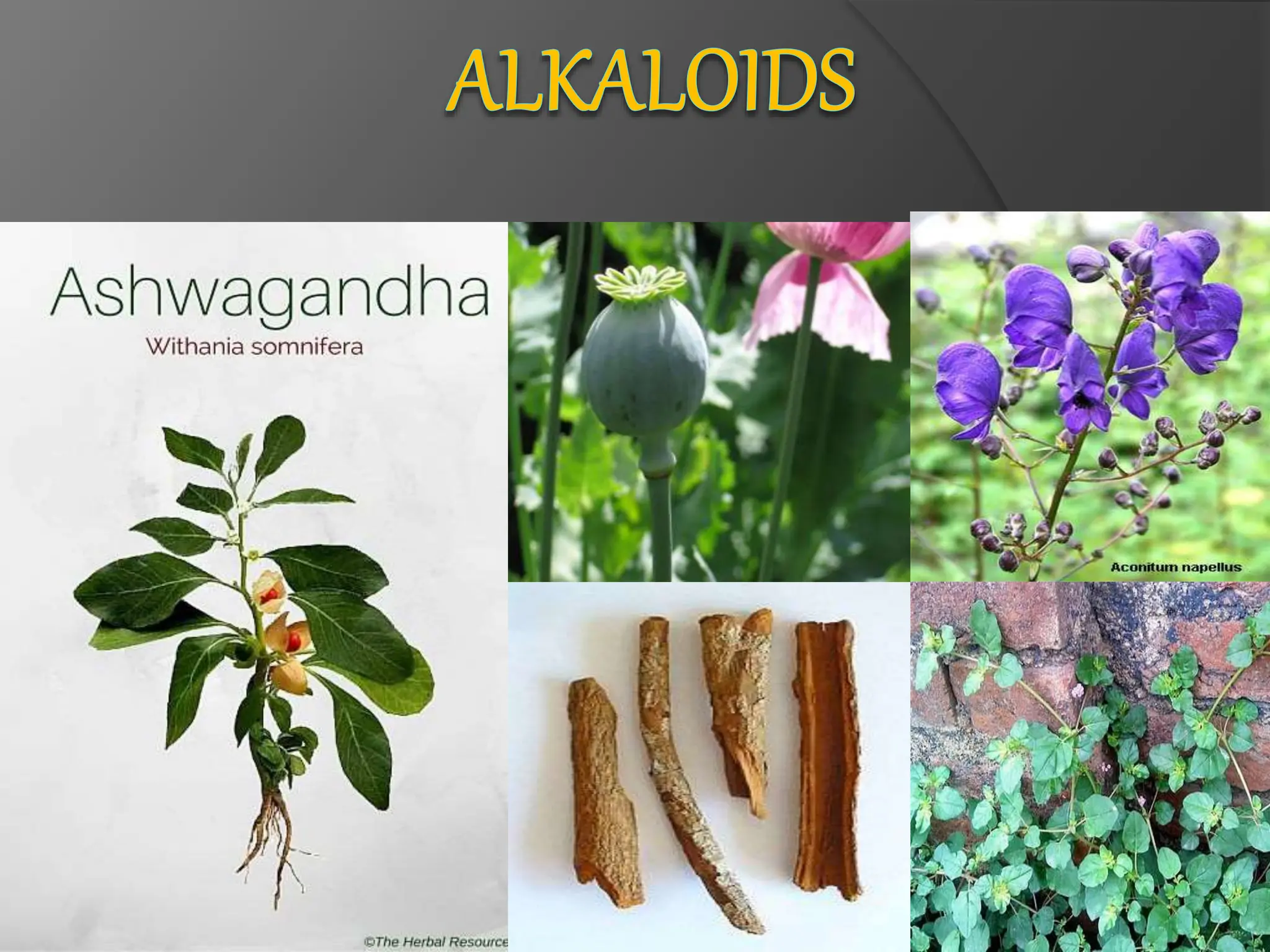
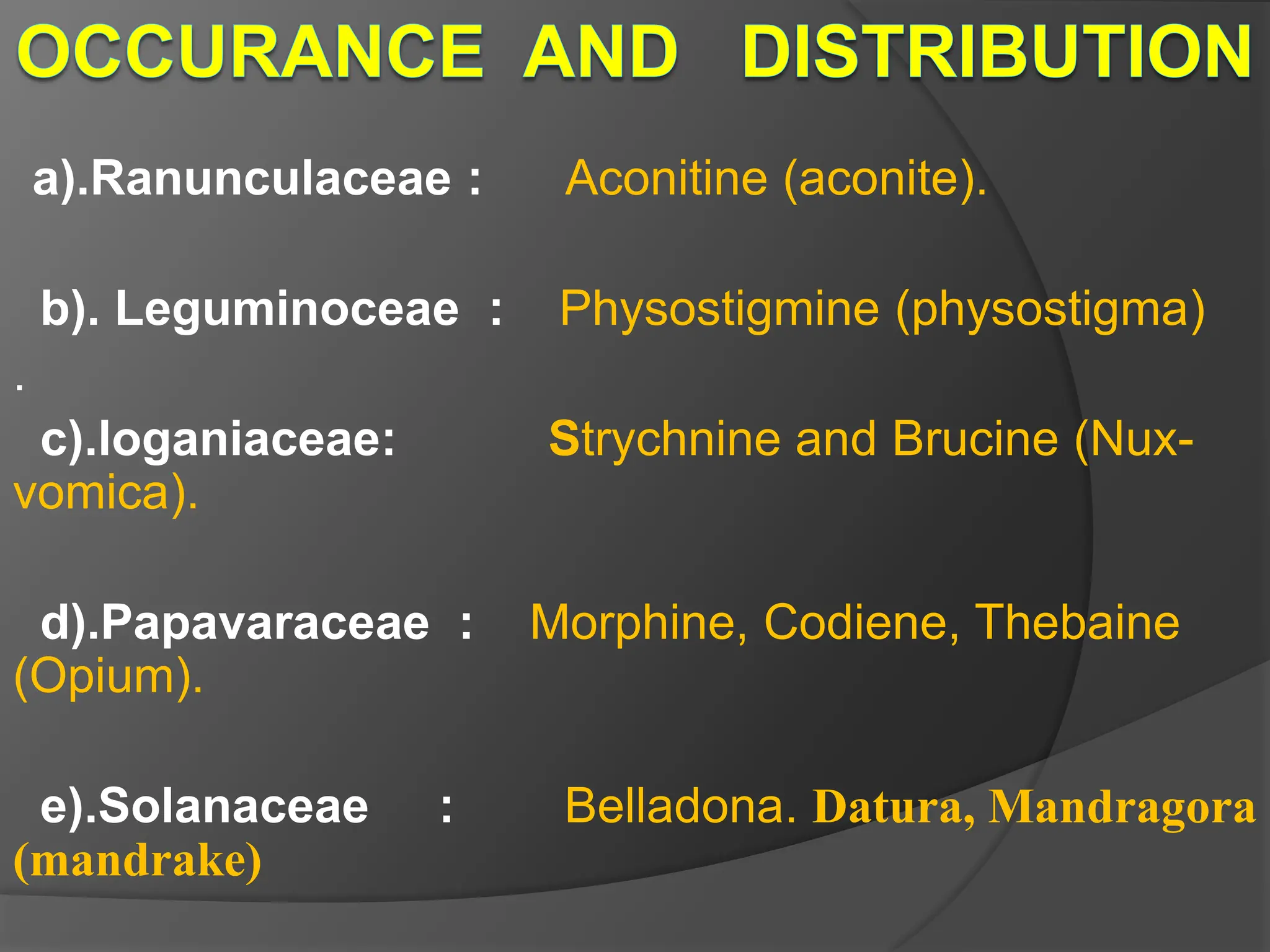
a).Ranunculaceae : Aconitine (aconite).
b). Leguminoceae : Physostigmine (physostigma)
.
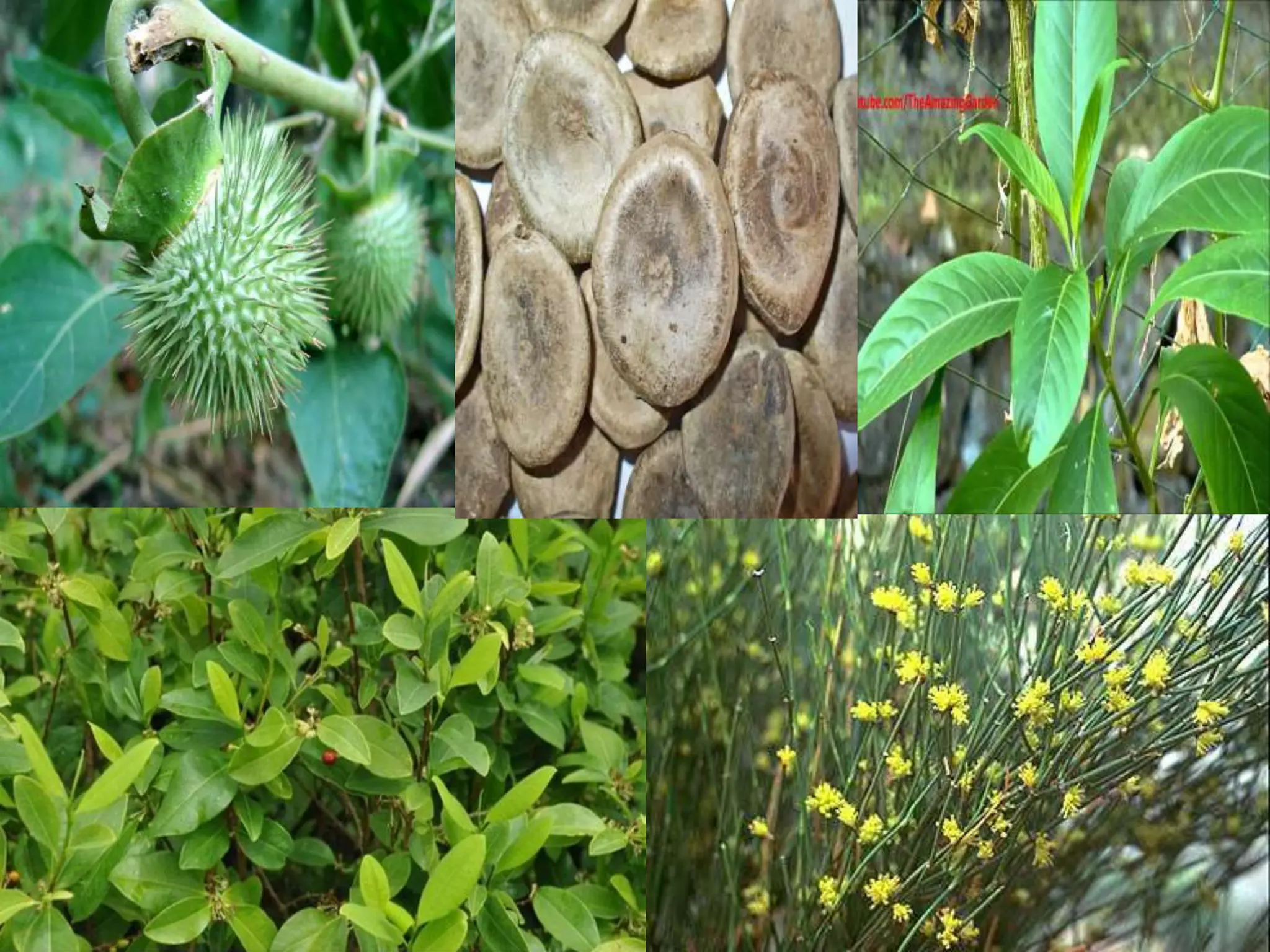
c).loganiaceae: Strychnine and Brucine (Nux-
vomica).
d).Papavaraceae : Morphine, Codiene, Thebaine
(Opium).
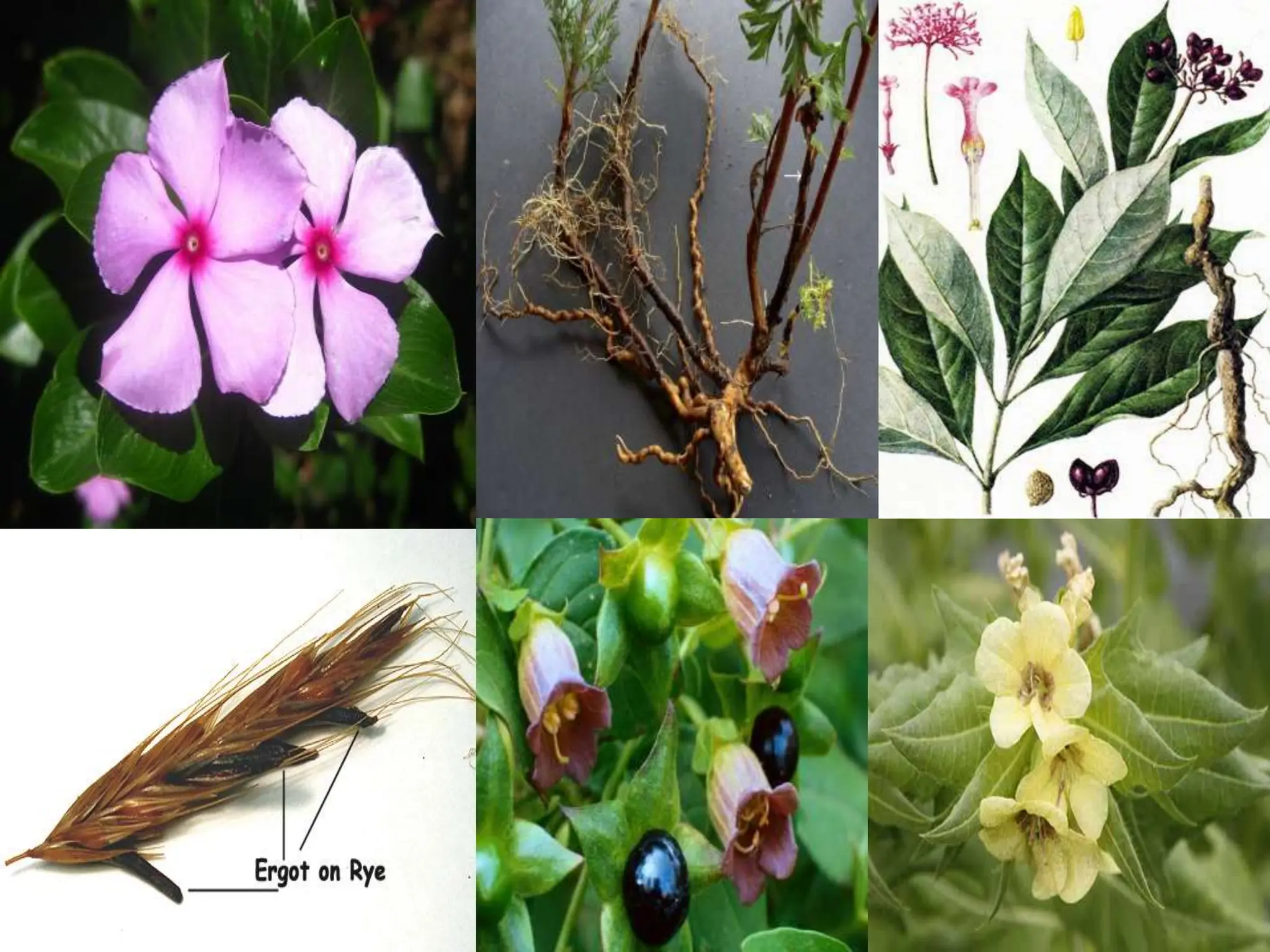
e).Solanaceae : Belladona. Datura, Mandragora
(mandrake)
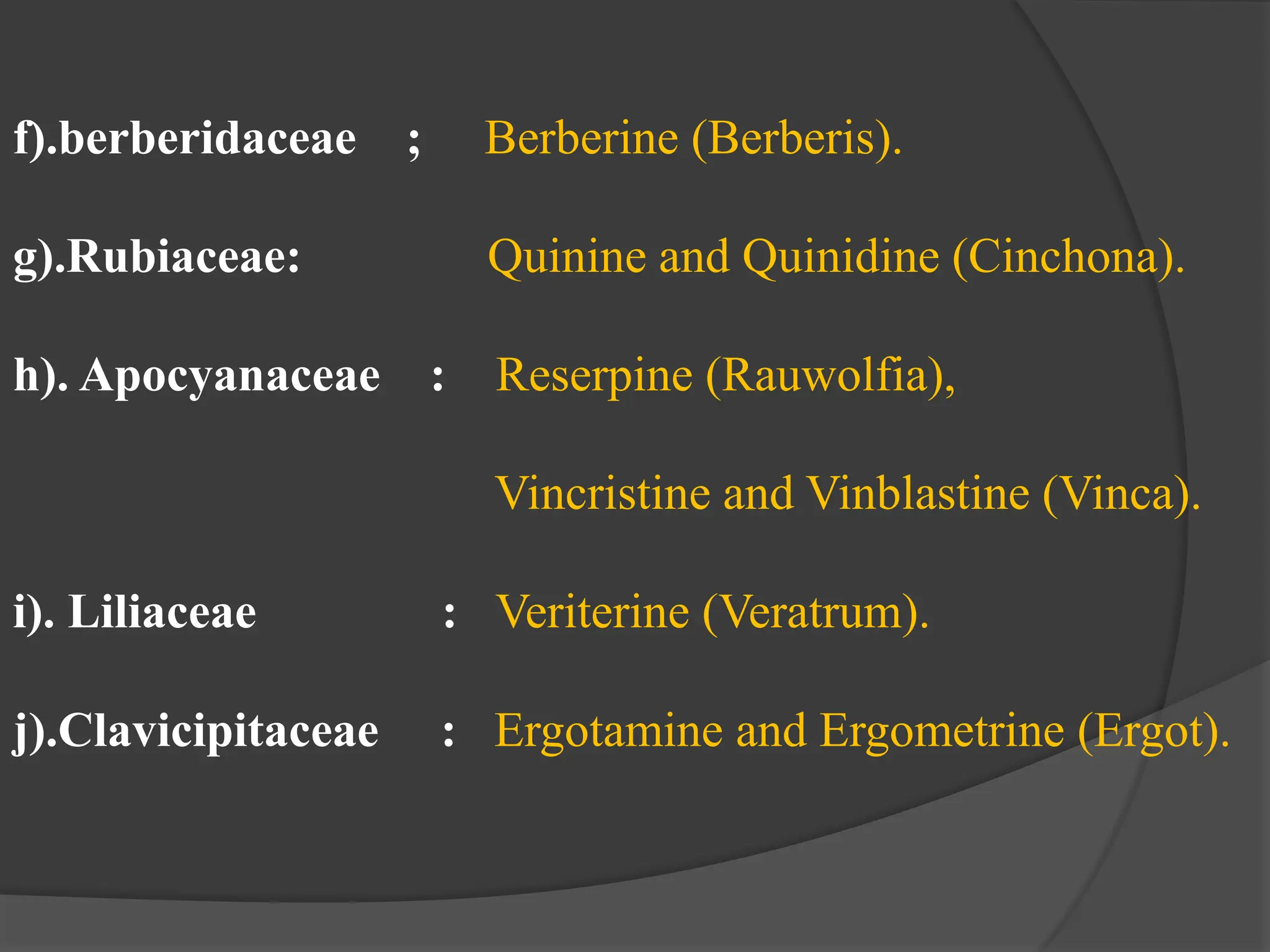
f).berberidaceae ; Berberine (Berberis).
g).Rubiaceae: Quinine and Quinidine (Cinchona).
h). Apocyanaceae : Reserpine (Rauwolfia),
Vincristine and Vinblastine (Vinca).
i). Liliaceae : Veriterine (Veratrum).
j).Clavicipitaceae : Ergotamine and Ergometrine (Ergot).
GENERAL
PROPERTIES OF
ALKALOIDS
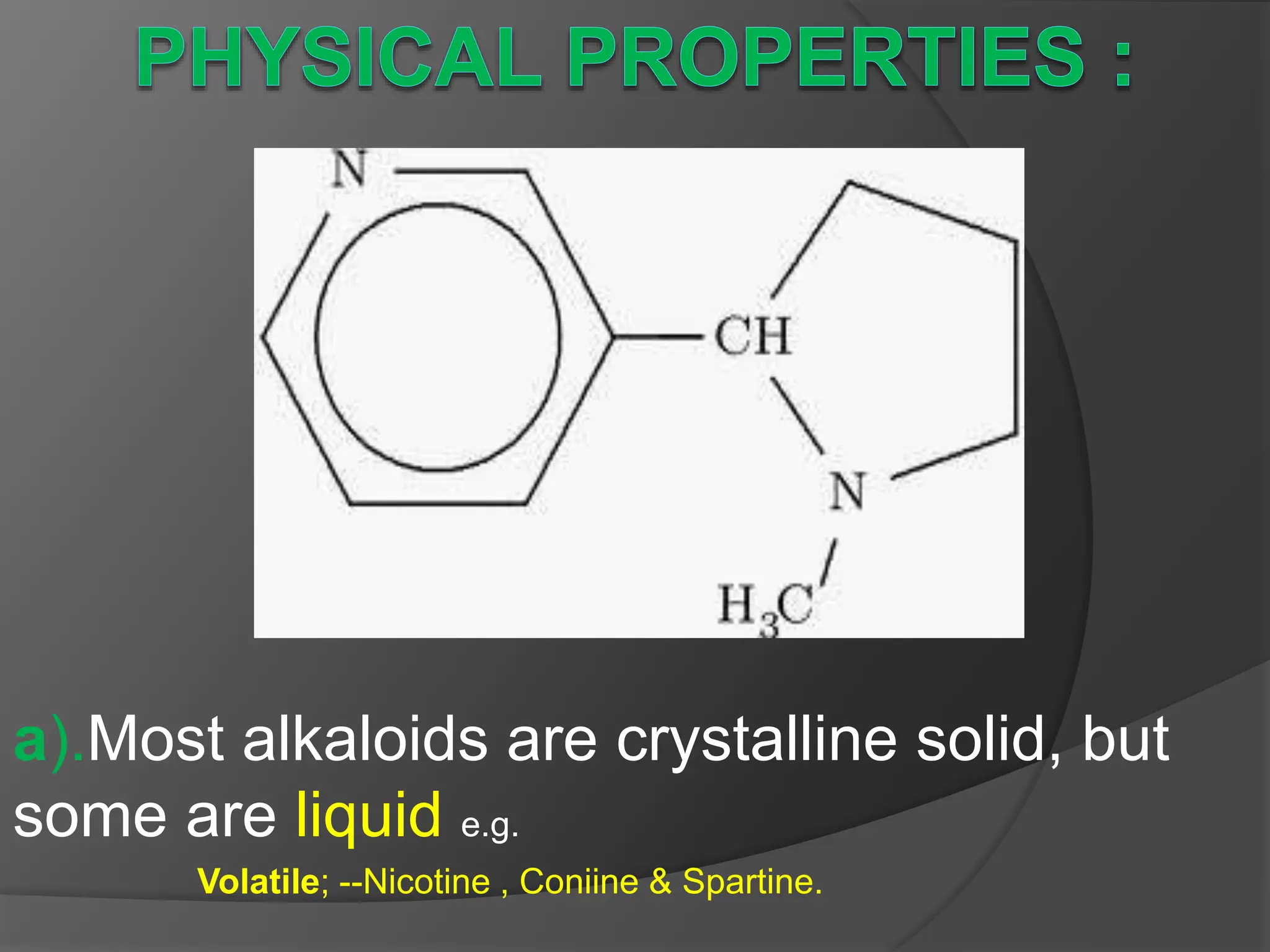
a).Most alkaloids are crystalline solid, but
some are liquid e.g.
Volatile; --Nicotine , Coniine & Spartine.
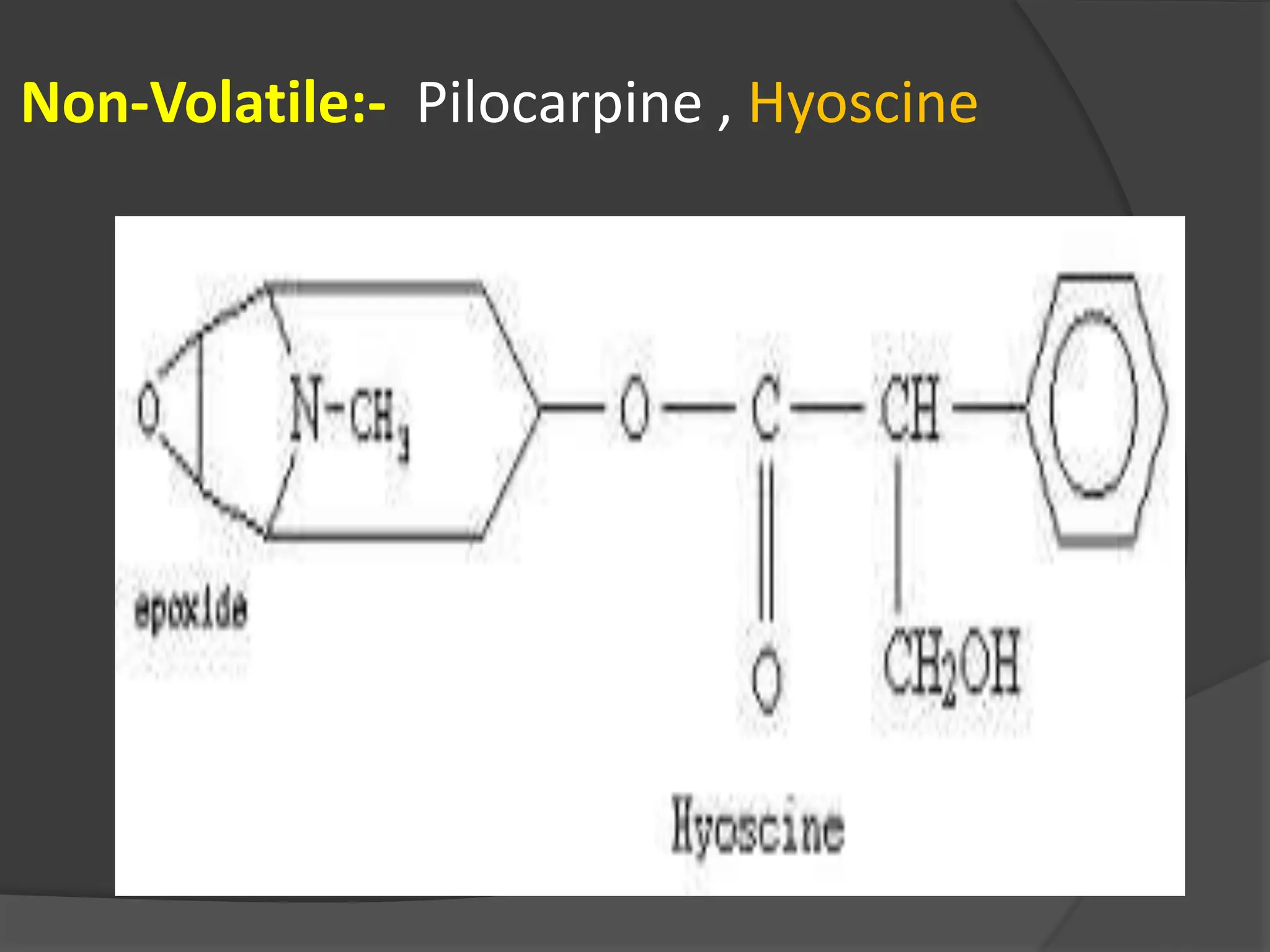
Non-Volatile:- Pilocarpine , Hyoscine
b).Majority of alkaloids are colorless but
some are colored, e.g
Colchicine and Berberine are Yellow.
Canadine is Orange.
C). SOLUBILITY:- Difference in solubility used as a
base for their isolation and purification from non-
alkaloidal bases.
The following can be mentioned :-
a).Both alkaloidal base and their salts are soluble in
alcohol.
b).Generally bases are soluble in organic solvent and
alkaloidal salts are soluble in water.
EXCEPTION :
A).Bases soluble in water:--Caffeine, Codeine, Ephedrine.
B).Bases in-soluble or sparingly soluble in certain organic solvent :-
Morphine in ether(1:5000),
C).Salt insoluble in water :---Quinine sulphate
quinine sulphate is only soluble in water to the extent of 1:1000 ,
although quinine hydrochloride is soluble 1 in less than l part of water
D).Salts soluble in organic solvents :---Lobelline and Apo atropine
HCl are soluble in chloroform.
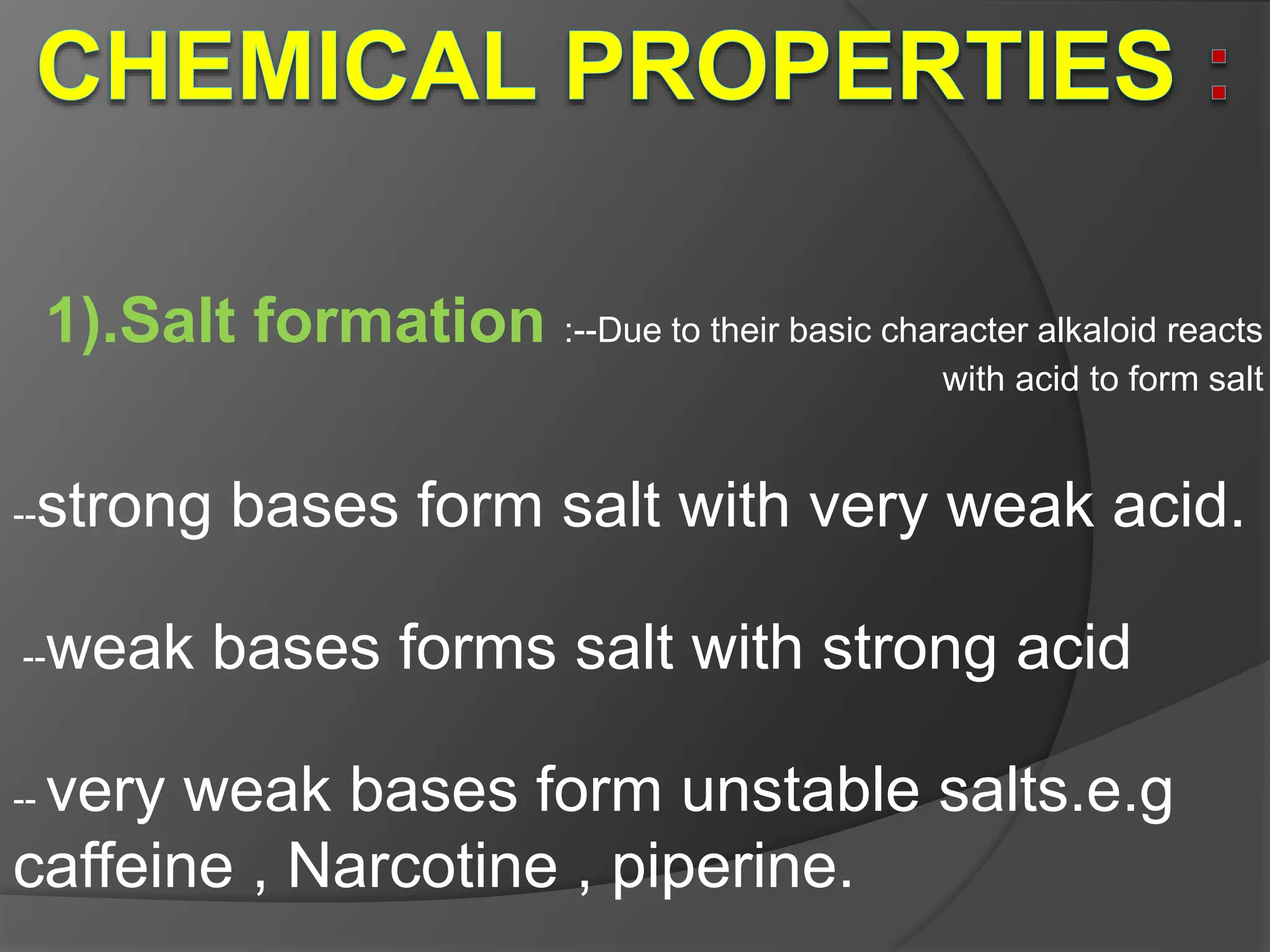
1).Salt formation :--Due to their basic character alkaloid reacts
with acid to form salt
--strong bases form salt with very weak acid.
--weak bases forms salt with strong acid
-- very weak bases form unstable salts.e.g
caffeine , Narcotine , piperine.
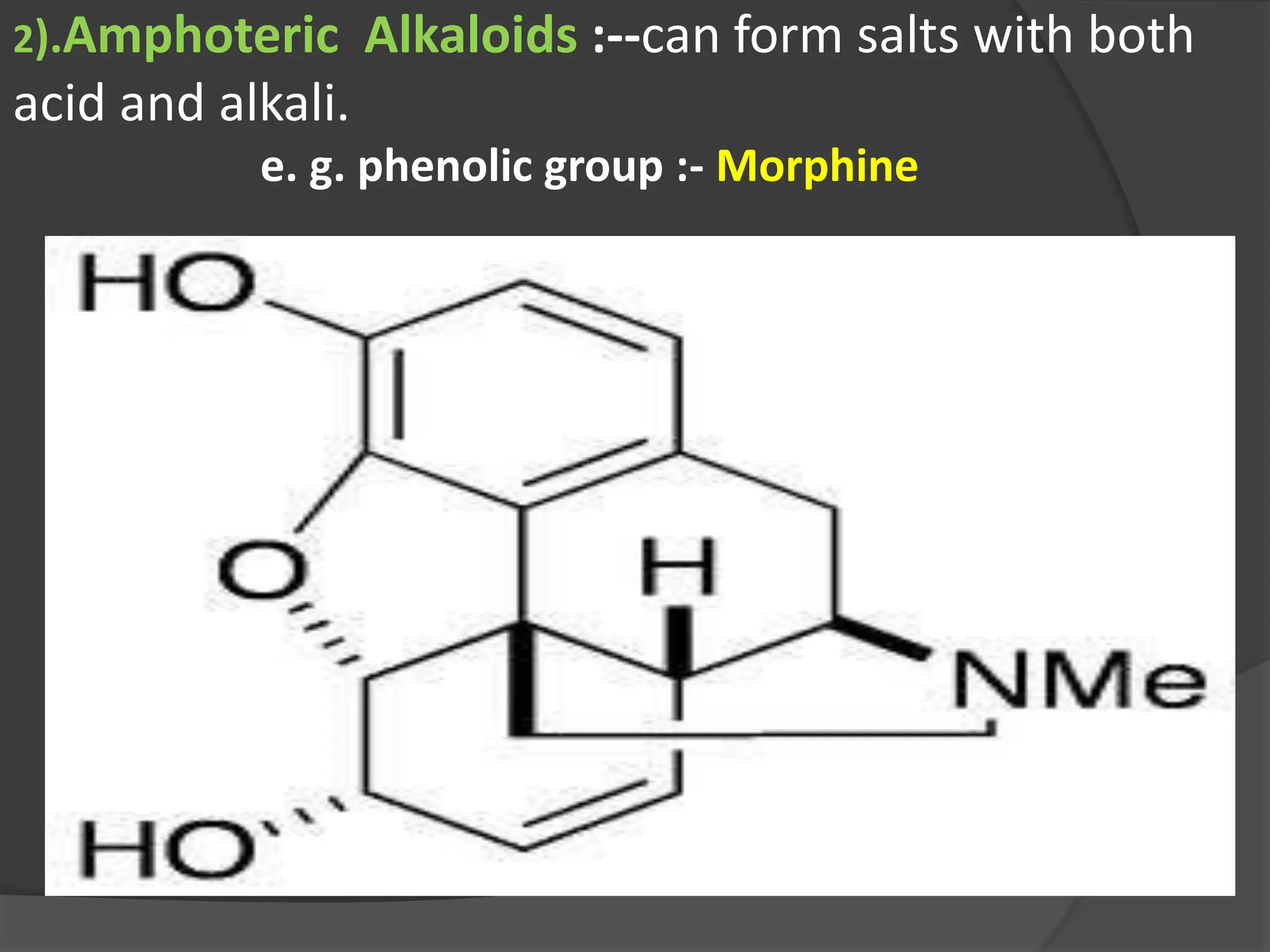
2).Amphoteric Alkaloids :--can form salts with both
acid and alkali.
e. g. phenolic group :- Morphine
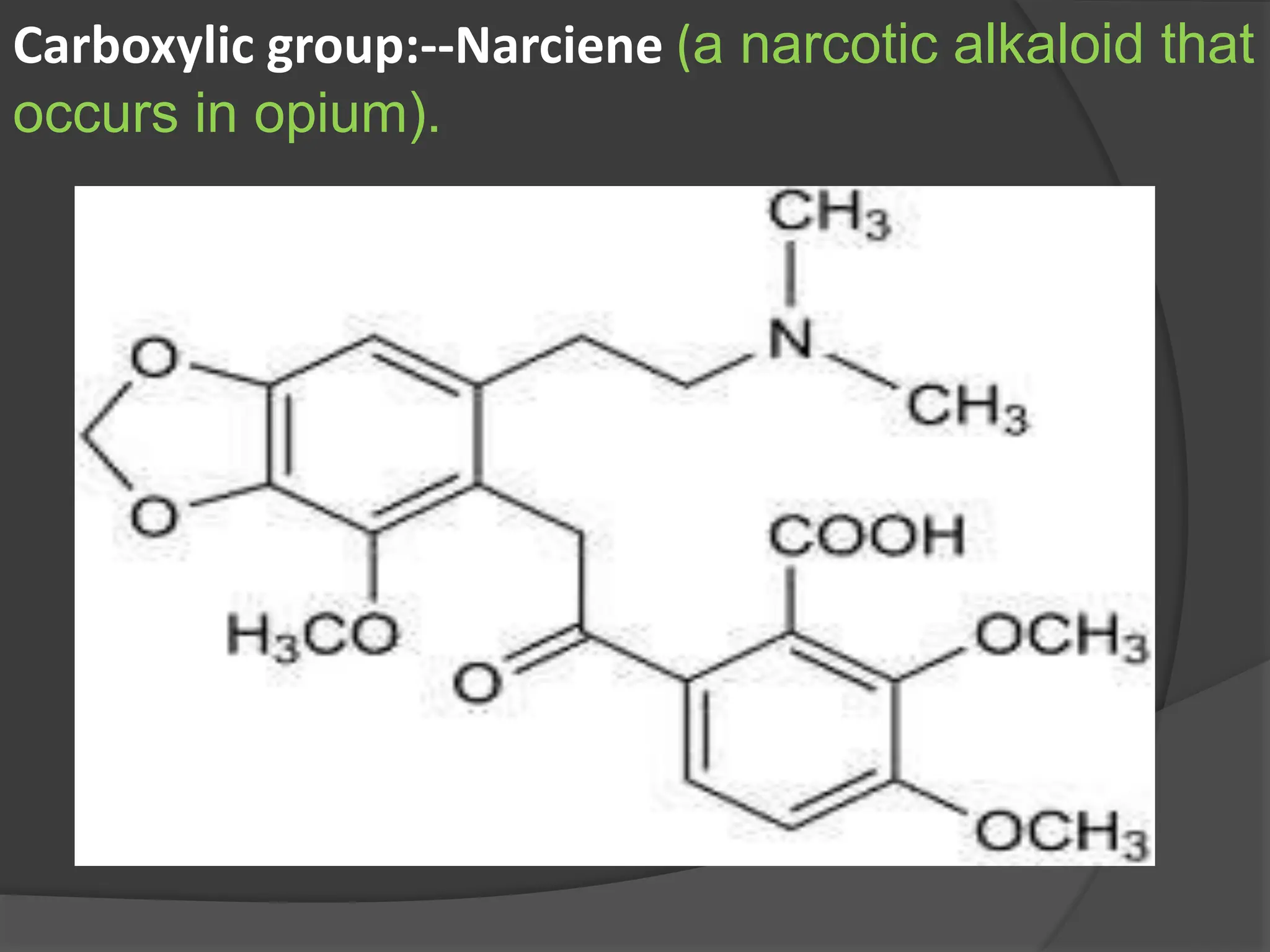
Carboxylic group:--Narciene (a narcotic alkaloid that
occurs in opium).
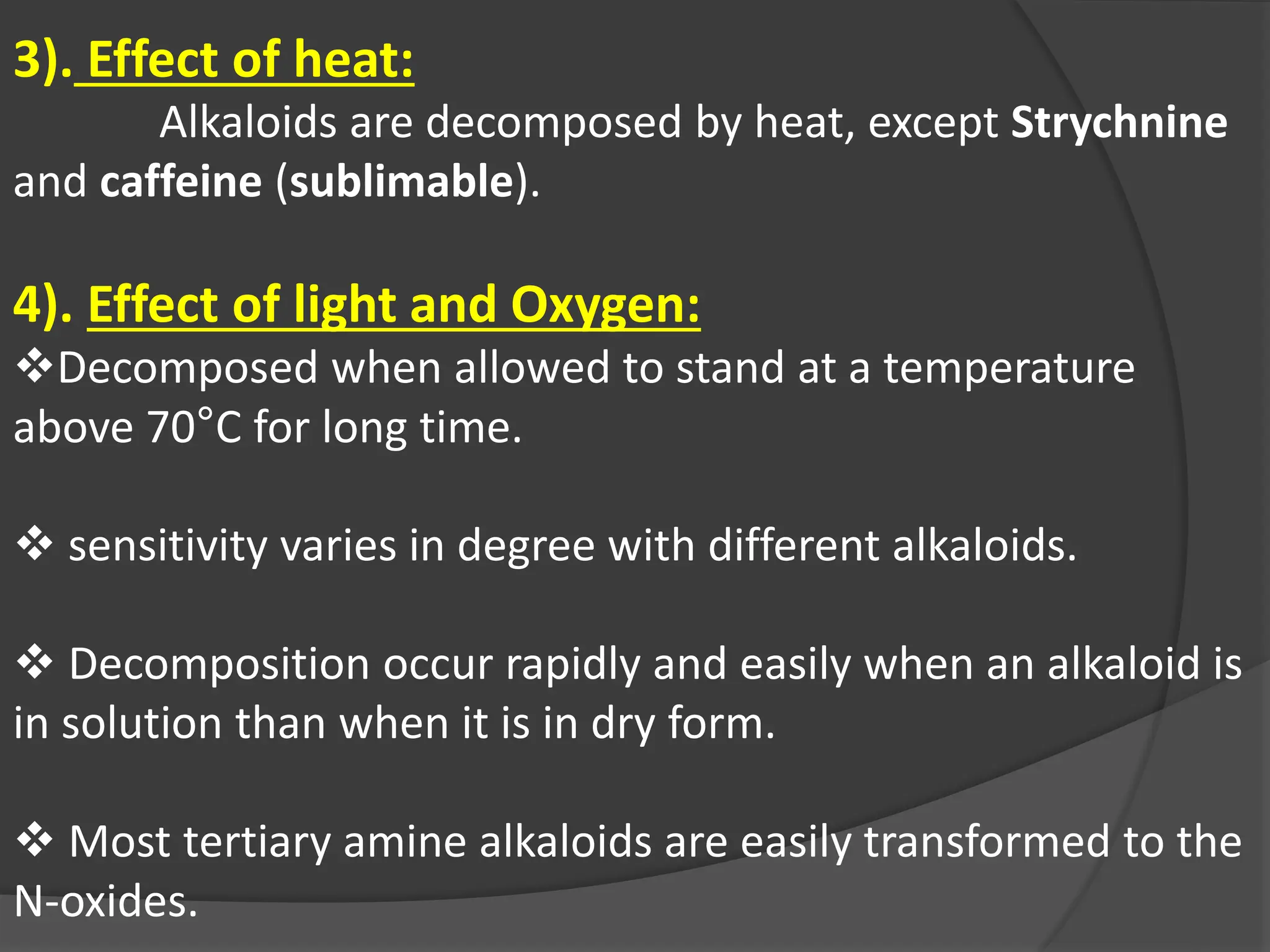
3). Effect of heat:
Alkaloids are decomposed by heat, except Strychnine
and caffeine (sublimable).
4). Effect of light and Oxygen:
Decomposed when allowed to stand at a temperature
above 70°C for long time.
 sensitivity varies in degree with different alkaloids.
 Decomposition occur rapidly and easily when an alkaloid is
in solution than when it is in dry form.
 Most tertiary amine alkaloids are easily transformed to the
N-oxides.
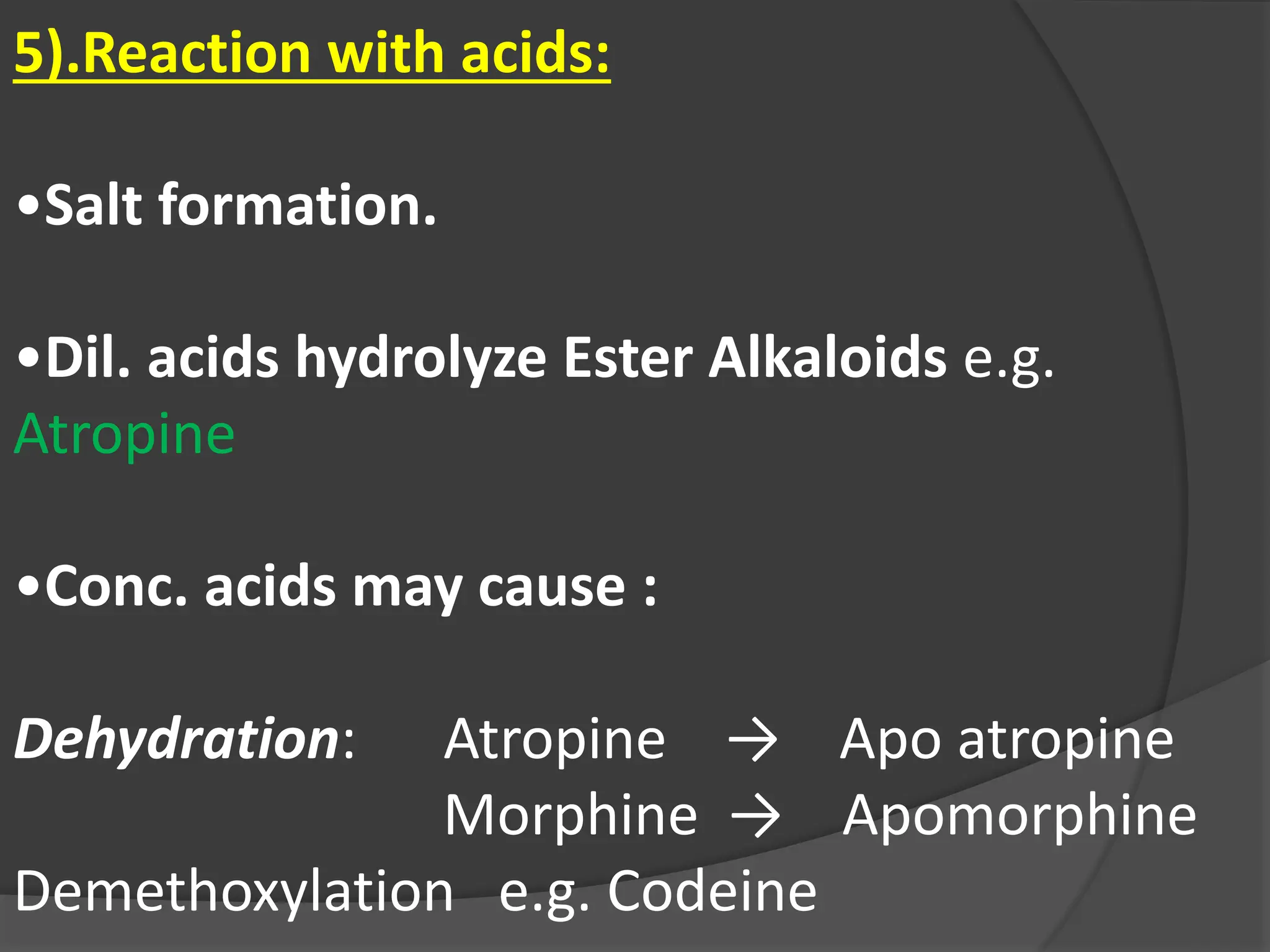
5).Reaction with acids:
•Salt formation.
•Dil. acids hydrolyze Ester Alkaloids e.g.
Atropine
•Conc. acids may cause :
Dehydration: Atropine → Apo atropine
Morphine → Apomorphine
Demethoxylation e.g. Codeine
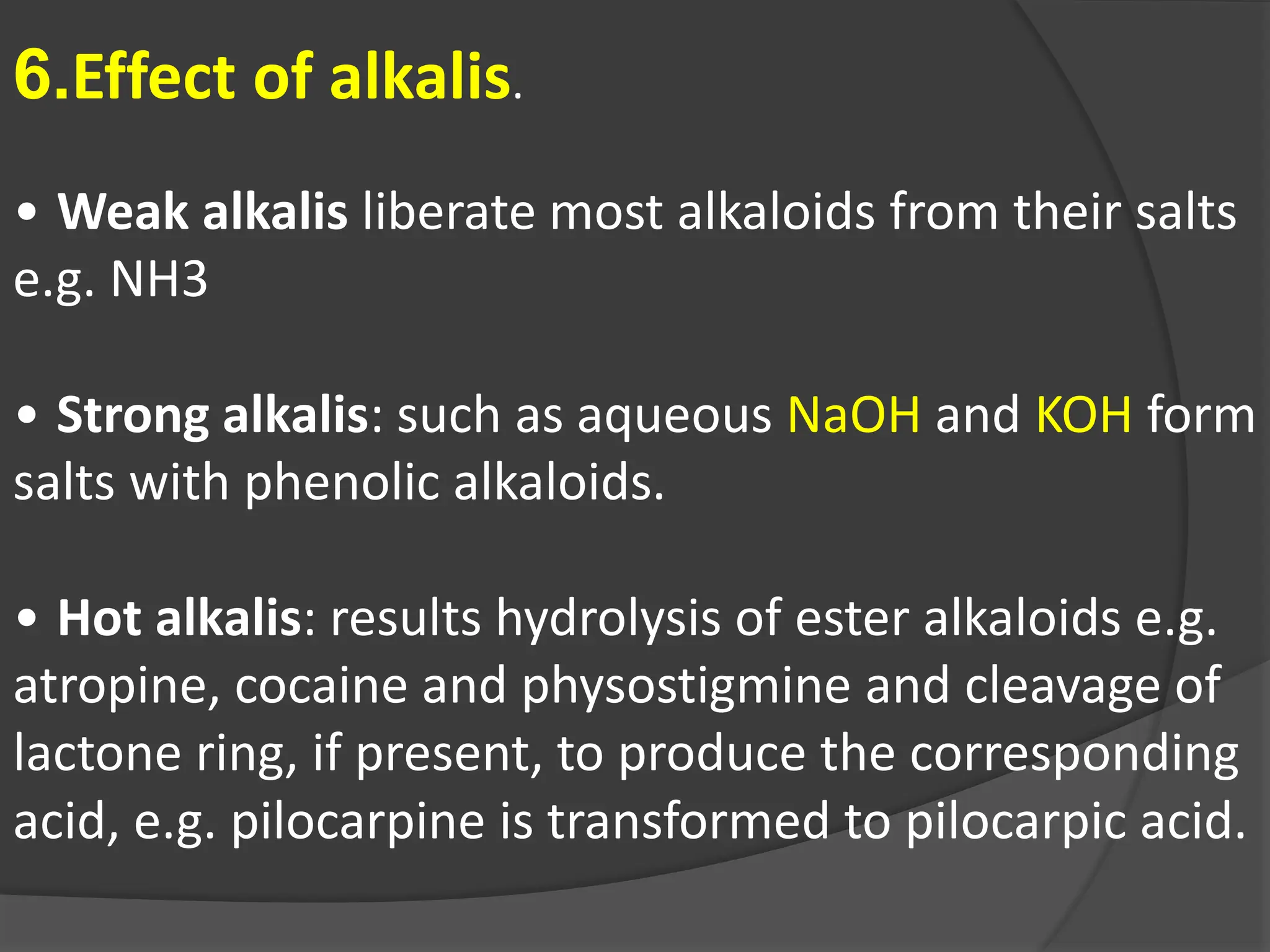
6.Effect of alkalis.
• Weak alkalis liberate most alkaloids from their salts
e.g. NH3
• Strong alkalis: such as aqueous NaOH and KOH form
salts with phenolic alkaloids.
• Hot alkalis: results hydrolysis of ester alkaloids e.g.
atropine, cocaine and physostigmine and cleavage of
lactone ring, if present, to produce the corresponding
acid, e.g. pilocarpine is transformed to pilocarpic acid.
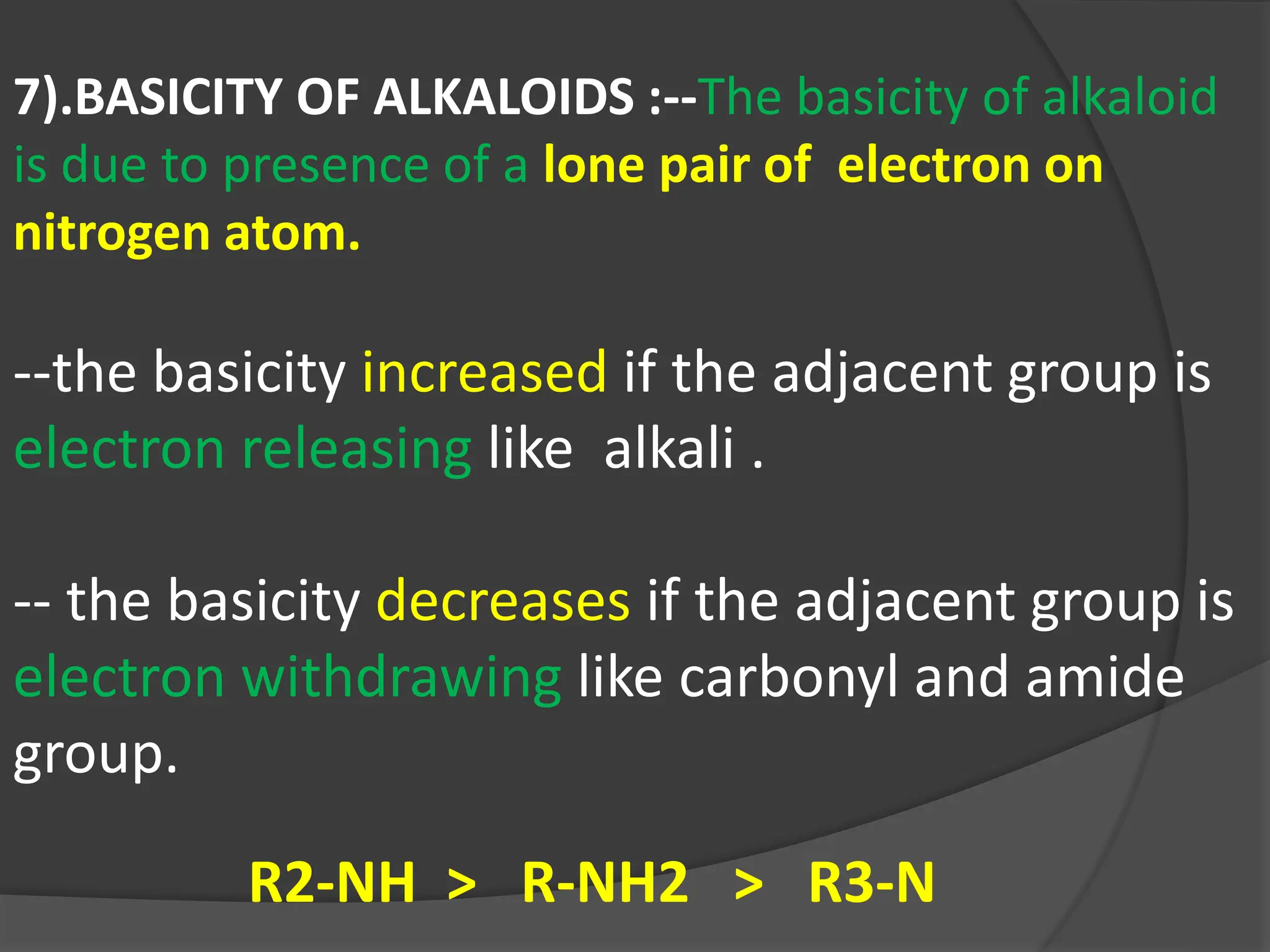
7).BASICITY OF ALKALOIDS :--The basicity of alkaloid
is due to presence of a lone pair of electron on
nitrogen atom.
--the basicity increased if the adjacent group is
electron releasing like alkali .
-- the basicity decreases if the adjacent group is
electron withdrawing like carbonyl and amide
group.
R2-NH > R-NH2 > R3-N
According to basicity Alkaloids are
classified into:
a). Weak bases e.g. Caffeine
b). Strong bases e.g. Atropine
c). Amphoteric * Phenolic Alkaloids e.g. Morphine
*Alkaloids with Carboxylic groups e.g. Narceine
d). Neutral alkaloids e.g. Colchicine
Different types of amines
present in Alkaloids
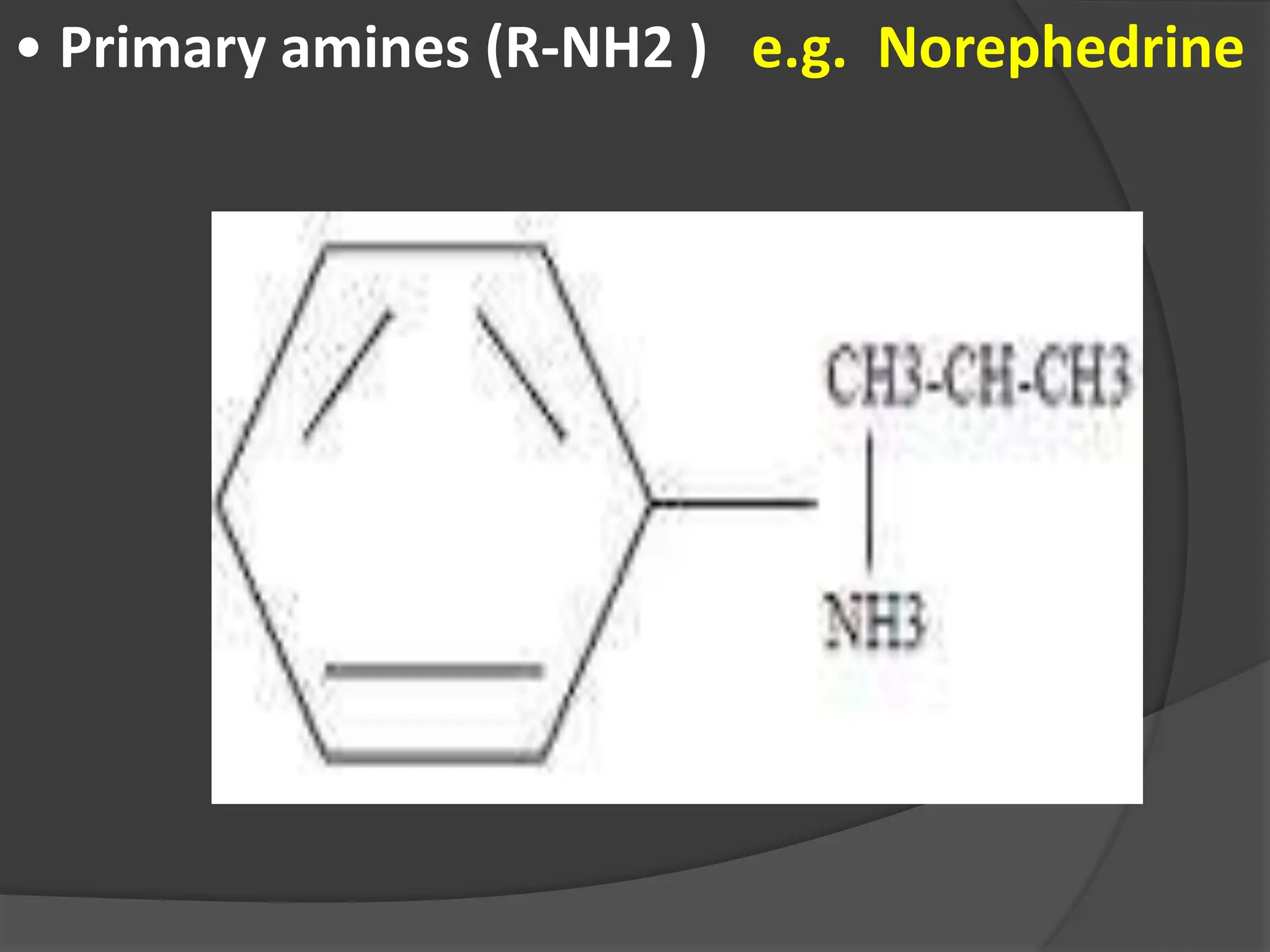
• Primary amines (R-NH2 ) e.g. Norephedrine
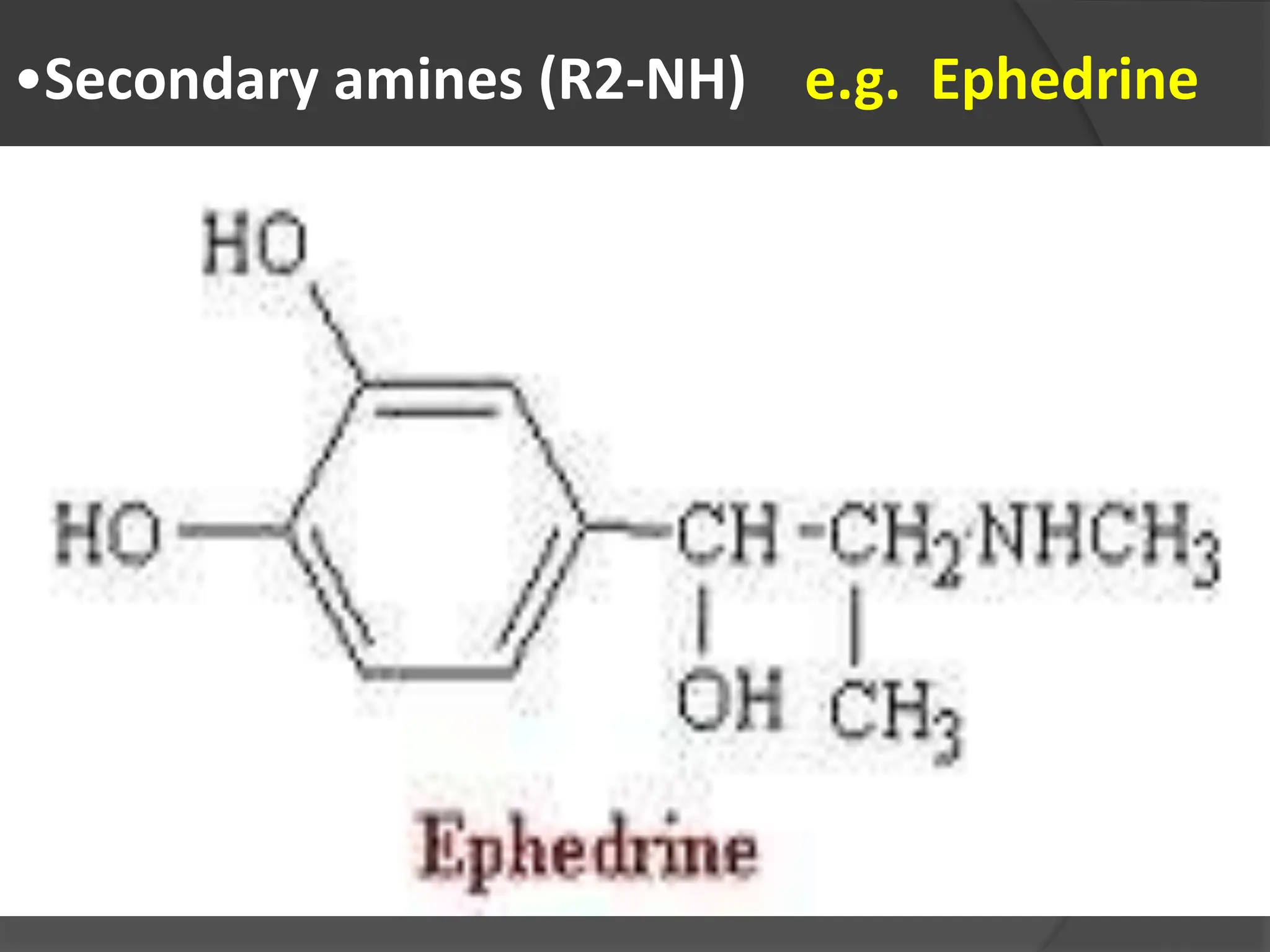
•Secondary amines (R2-NH) e.g. Ephedrine
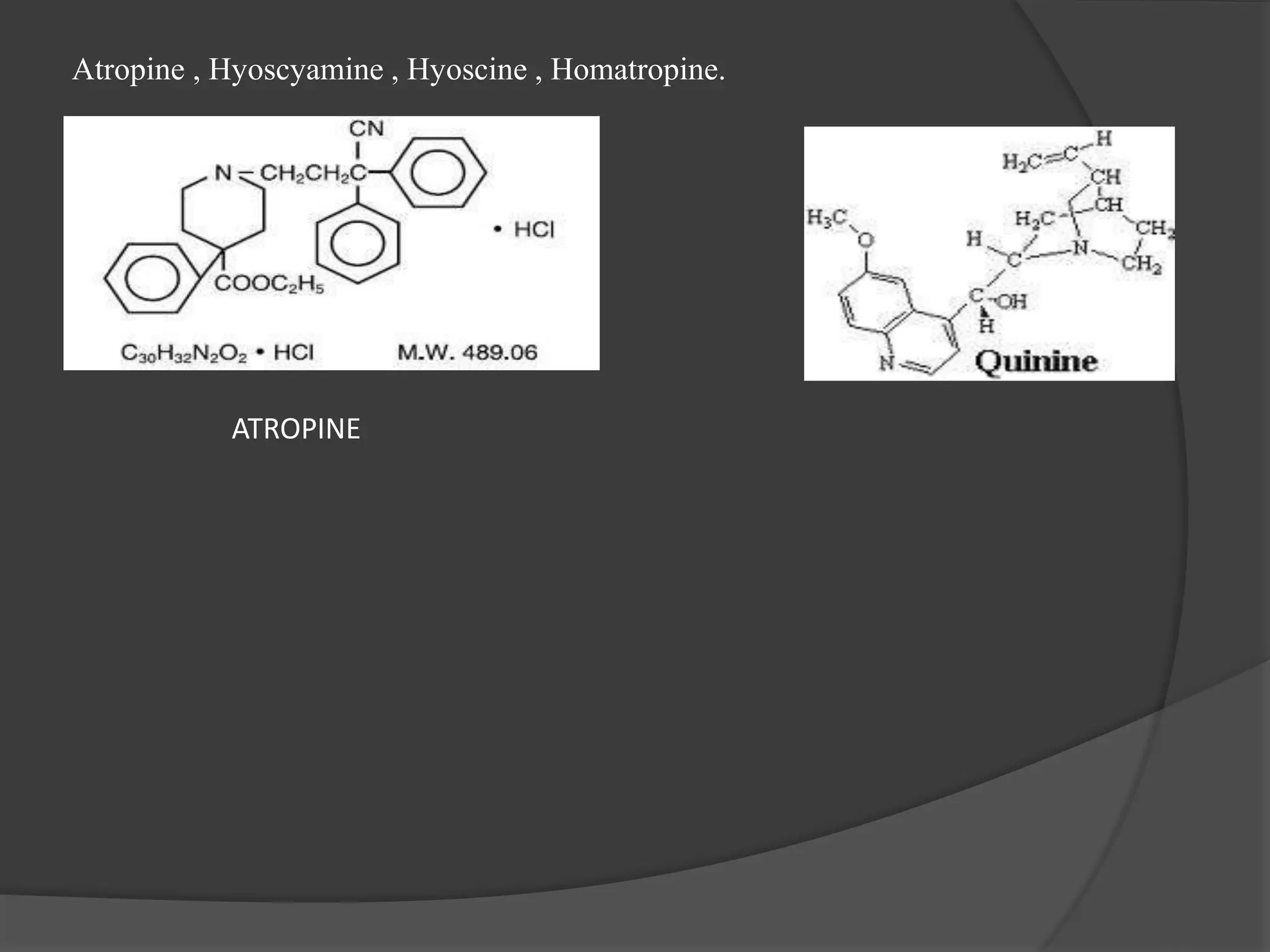
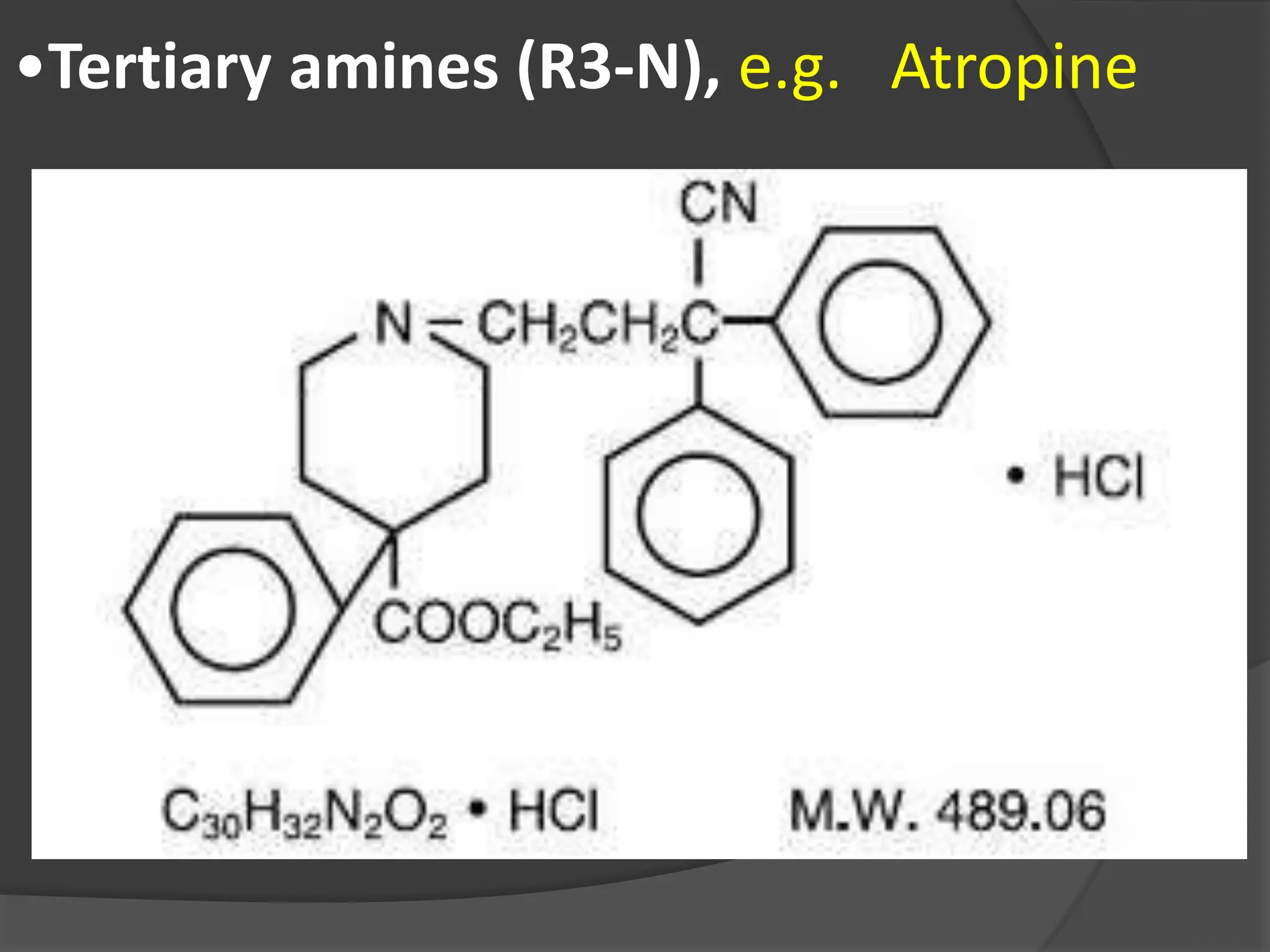
•Tertiary amines (R3-N), e.g. Atropine
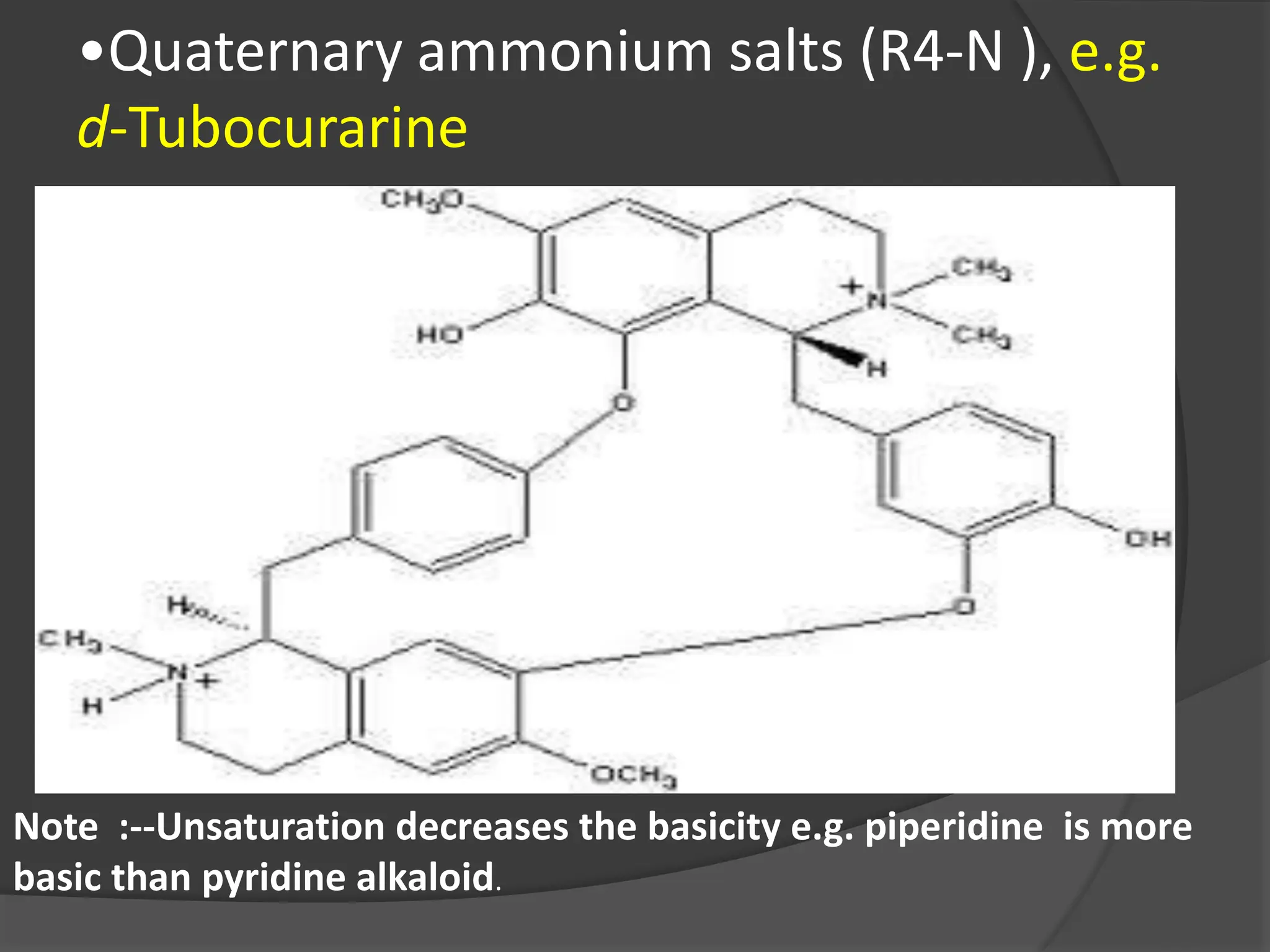
•Quaternary ammonium salts (R4-N ), e.g.
d-Tubocurarine
Note :--Unsaturation decreases the basicity e.g. piperidine is more
basic than pyridine alkaloid.
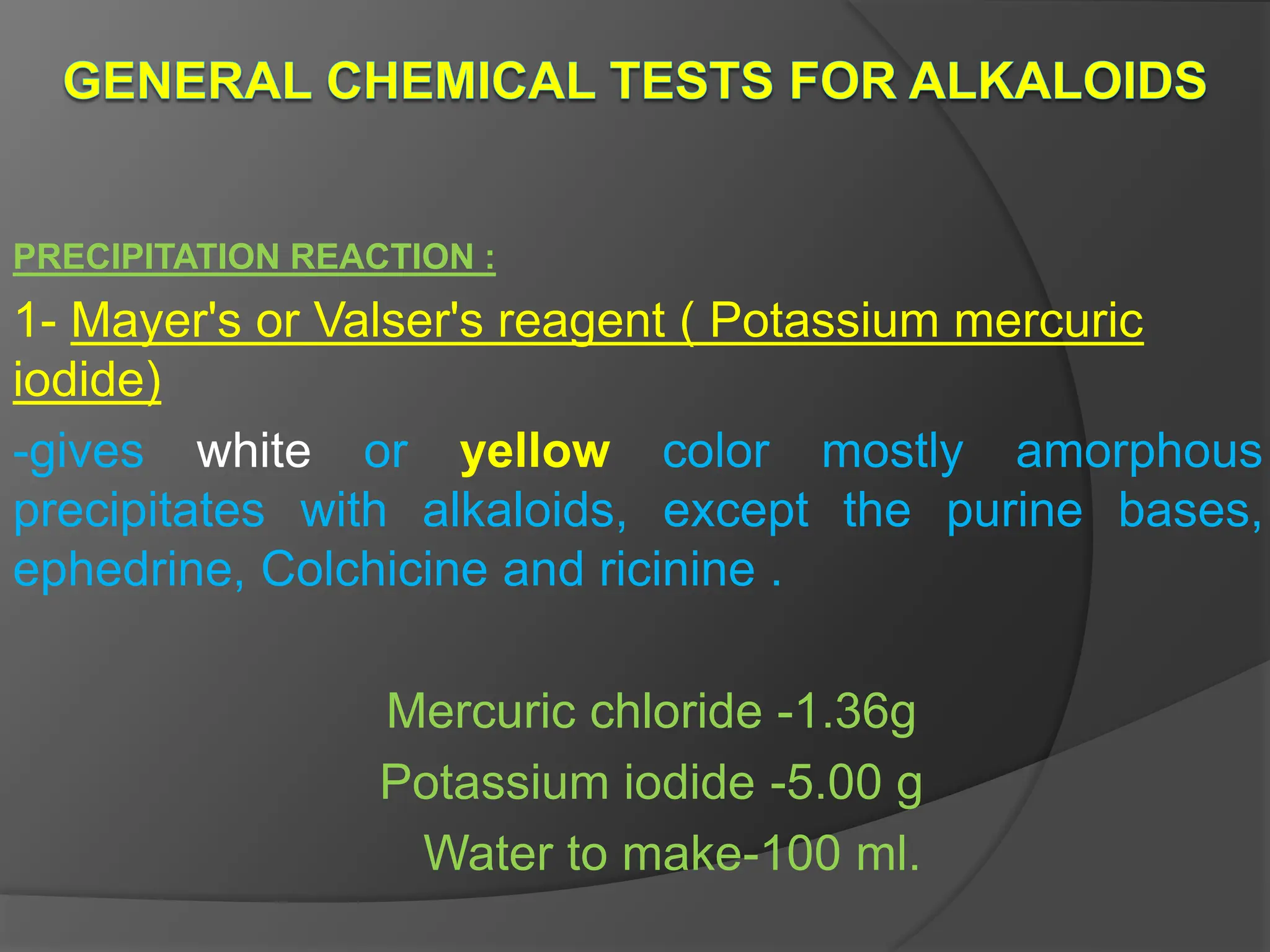
PRECIPITATION REACTION :
1- Mayer's or Valser's reagent ( Potassium mercuric
iodide)
-gives white or yellow color mostly amorphous
precipitates with alkaloids, except the purine bases,
ephedrine, Colchicine and ricinine .
Mercuric chloride -1.36g
Potassium iodide -5.00 g
Water to make-100 ml.
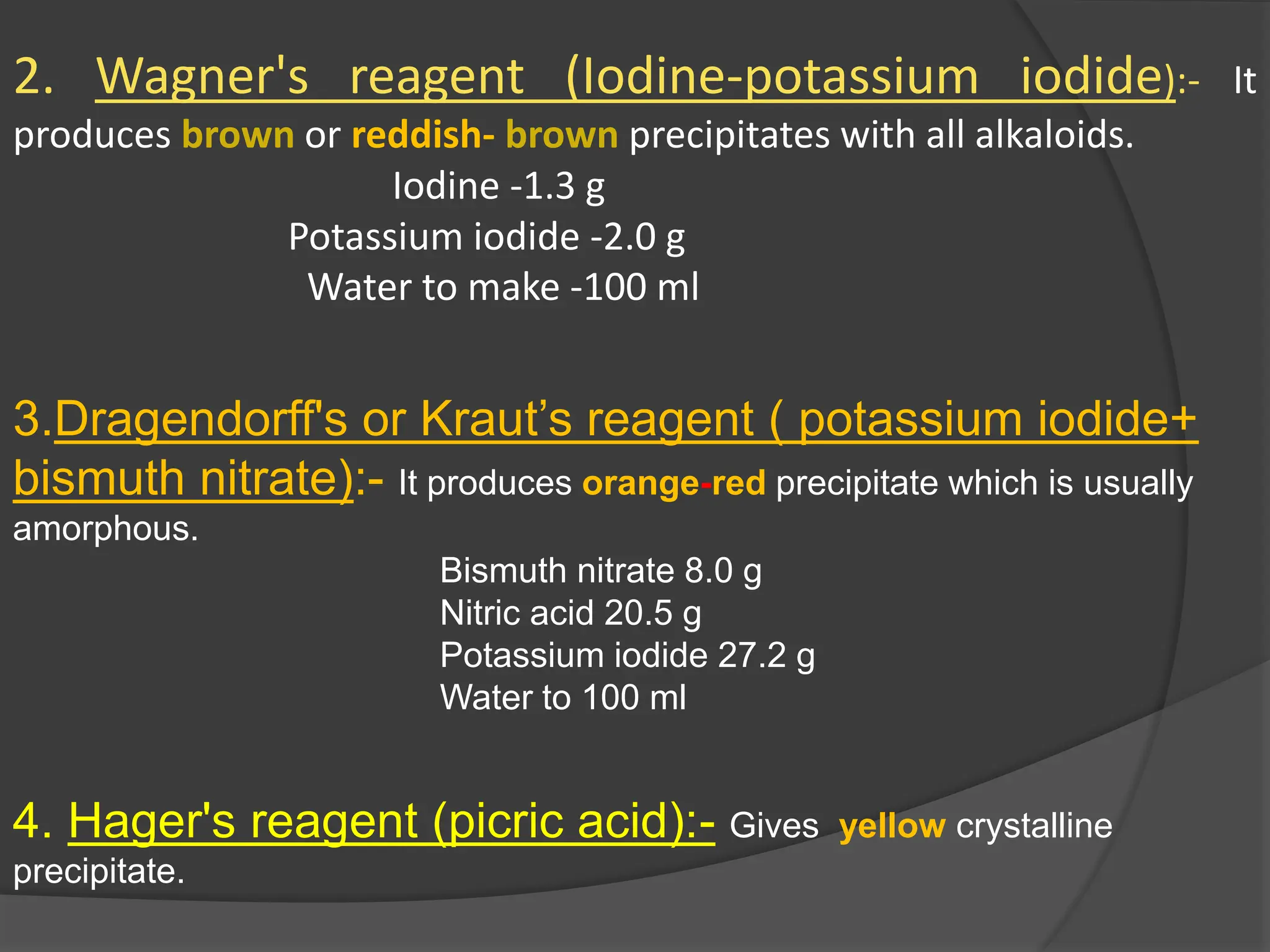
2. Wagner's reagent (Iodine-potassium iodide):- It
produces brown or reddish- brown precipitates with all alkaloids.
Iodine -1.3 g
Potassium iodide -2.0 g
Water to make -100 ml
3.Dragendorff's or Kraut’s reagent ( potassium iodide+
bismuth nitrate):- It produces orange-red precipitate which is usually
amorphous.
Bismuth nitrate 8.0 g
Nitric acid 20.5 g
Potassium iodide 27.2 g
Water to 100 ml
4. Hager's reagent (picric acid):- Gives yellow crystalline
precipitate.
5. Tannic acid solution: (5%w/v) .:--gives buff colored
ppt. which is soluble in dil.acid or ammonia.
6.Ammonium reineckate solution: 2% solution,
produces precipitates with heterocyclic nitrogen
alkaloids, with quaternary and some tertiary amines.
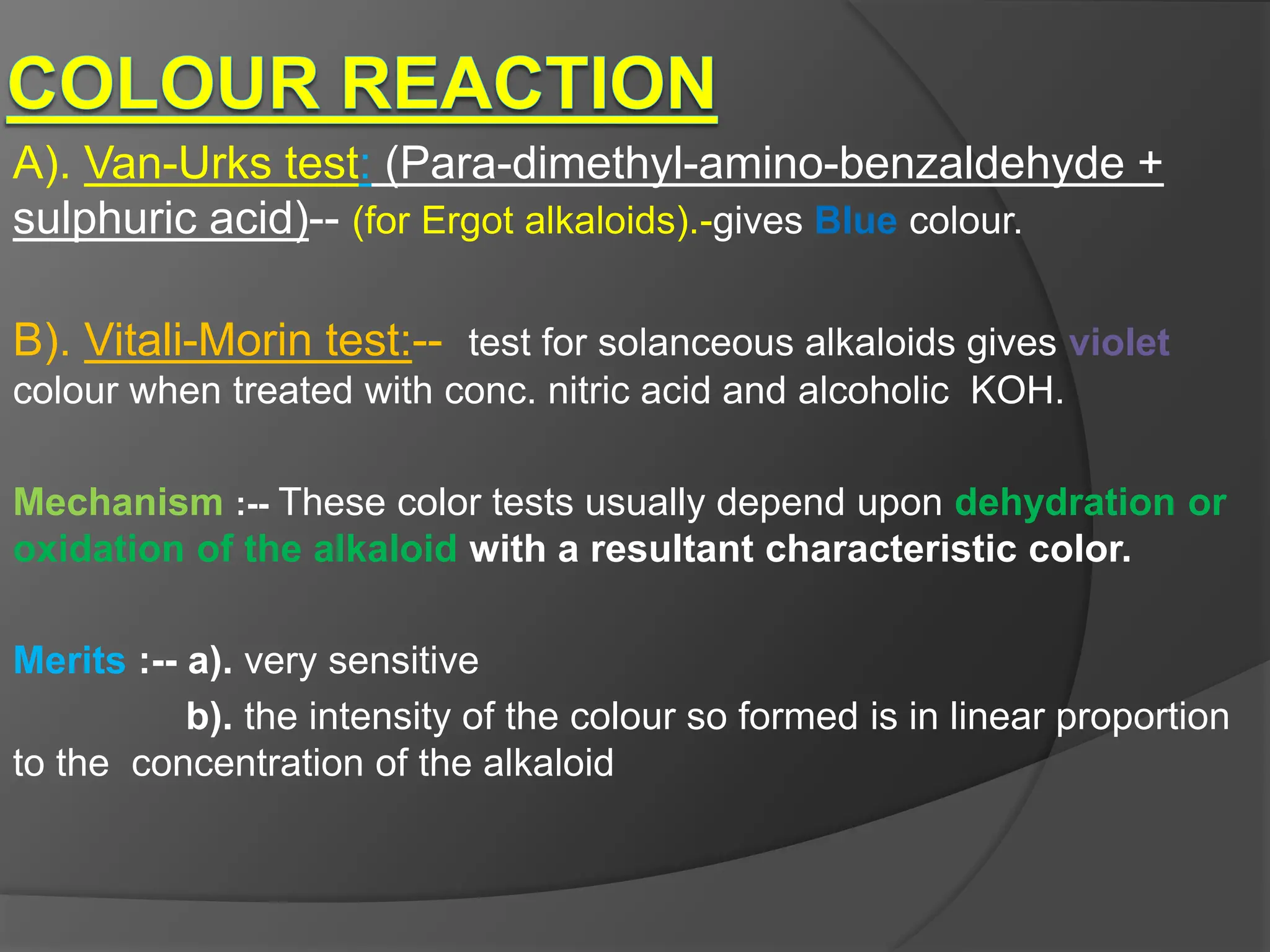
A). Van-Urks test: (Para-dimethyl-amino-benzaldehyde +
sulphuric acid)-- (for Ergot alkaloids).-gives Blue colour.
B). Vitali-Morin test:-- test for solanceous alkaloids gives violet
colour when treated with conc. nitric acid and alcoholic KOH.
Mechanism :-- These color tests usually depend upon dehydration or
oxidation of the alkaloid with a resultant characteristic color.
Merits :-- a). very sensitive
b). the intensity of the colour so formed is in linear proportion
to the concentration of the alkaloid
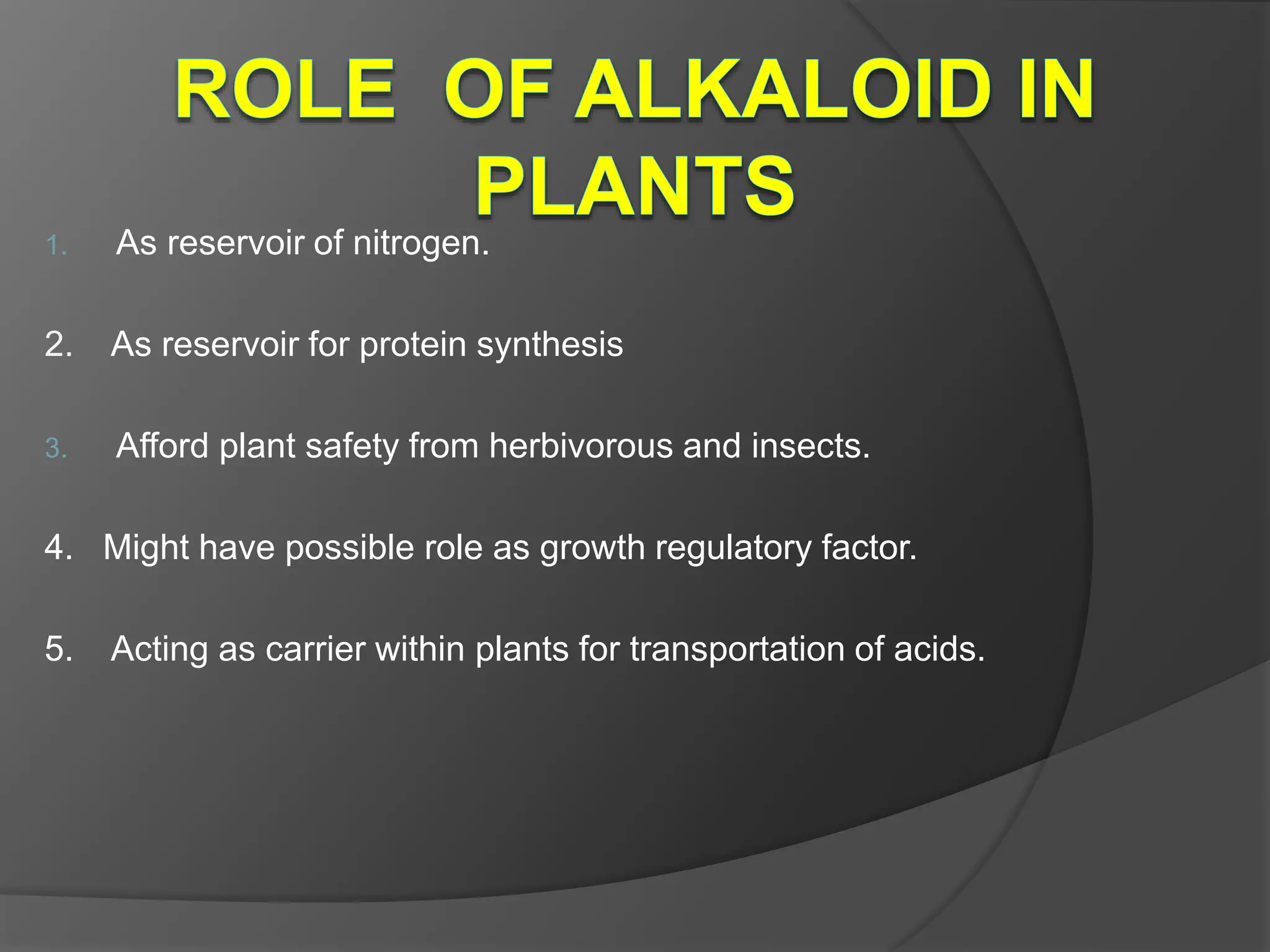
1. As reservoir of nitrogen.
2. As reservoir for protein synthesis
3. Afford plant safety from herbivorous and insects.
4. Might have possible role as growth regulatory factor.
5. Acting as carrier within plants for transportation of acids.
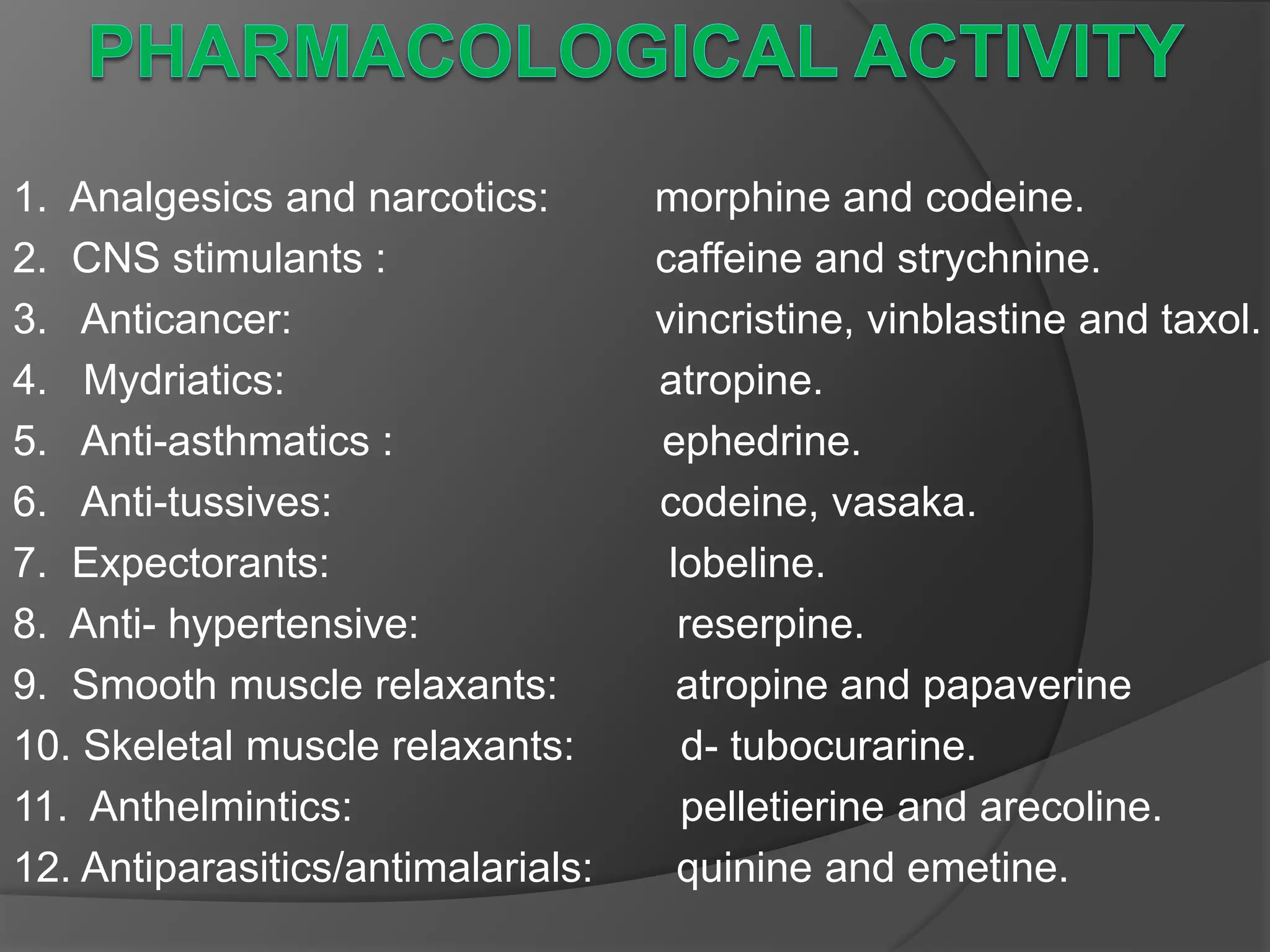
1. Analgesics and narcotics: morphine and codeine.
2. CNS stimulants : caffeine and strychnine.
3. Anticancer: vincristine, vinblastine and taxol.
4. Mydriatics: atropine.
5. Anti-asthmatics : ephedrine.
6. Anti-tussives: codeine, vasaka.
7. Expectorants: lobeline.
8. Anti- hypertensive: reserpine.
9. Smooth muscle relaxants: atropine and papaverine
10. Skeletal muscle relaxants: d- tubocurarine.
11. Anthelmintics: pelletierine and arecoline.
12. Antiparasitics/antimalarials: quinine and emetine.
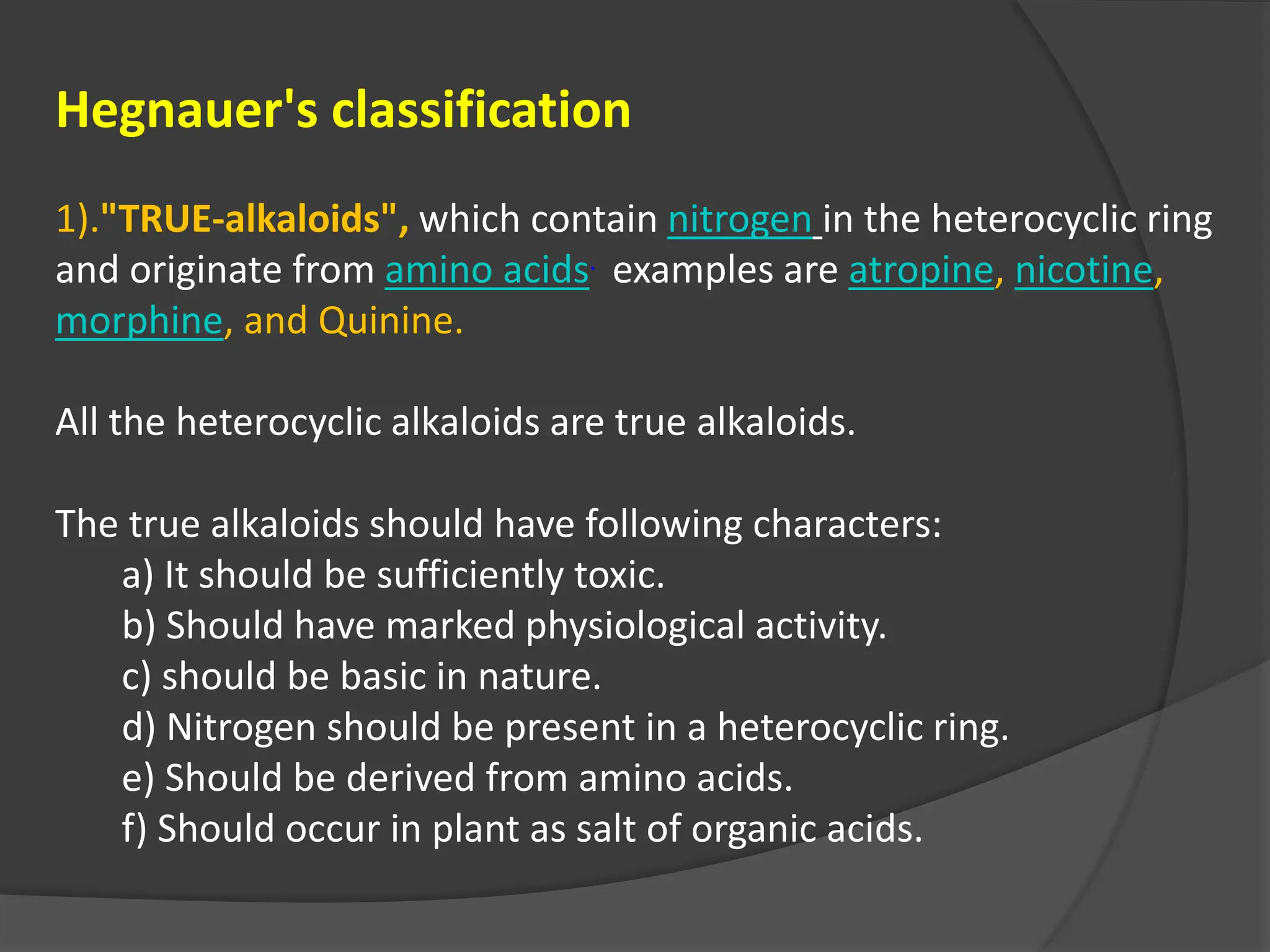
Hegnauer's classification
1)."TRUE-alkaloids", which contain nitrogen in the heterocyclic ring
and originate from amino acids. examples are atropine, nicotine,
morphine, and Quinine.
All the heterocyclic alkaloids are true alkaloids.
The true alkaloids should have following characters:
a) It should be sufficiently toxic.
b) Should have marked physiological activity.
c) should be basic in nature.
d) Nitrogen should be present in a heterocyclic ring.
e) Should be derived from amino acids.
f) Should occur in plant as salt of organic acids.
2. PROTO-Alkaloids:- These are alkaloids which are derived from
amino acid but do not have nitrogen in a heterocyclic ring. They are
also called as “Biological amine”.
Examples include:- mescaline, adrenaline and ephedrine.
3. PSEUDO-Alkaloids:--They do not derived from amino acid but
having nitrogen in heterocyclic ring .
They do not show many of the typical characters of alkaloids , but
give standard qualitative test for alkaloids.
e.g. steroidal alkaloids:-Conessine
Purine bases :-- Caffeiene
CHEMICAL CLASSIFICATION:-- According to chemical
structure, two broad division may be recognized:
• Non-heterocyclic alkaloids that are sometimes called
''proto alkaloids' or biological amines.
• Heterocyclic alkaloids that are sub-classified into
different groups according to their ring structure.
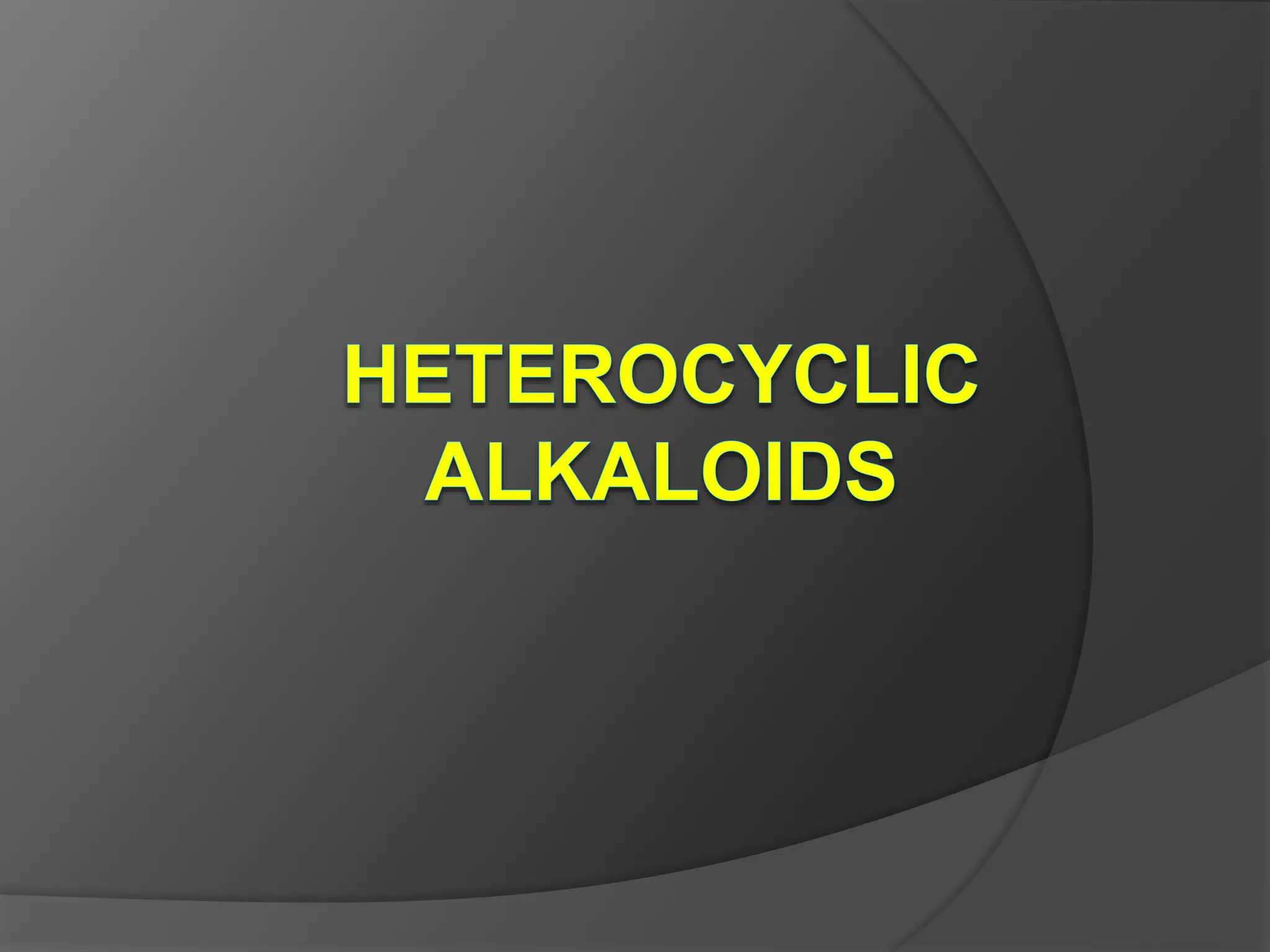
PYRROLE and
PYRROLIDINE
Hygrine , Stachydrine,
Coca species
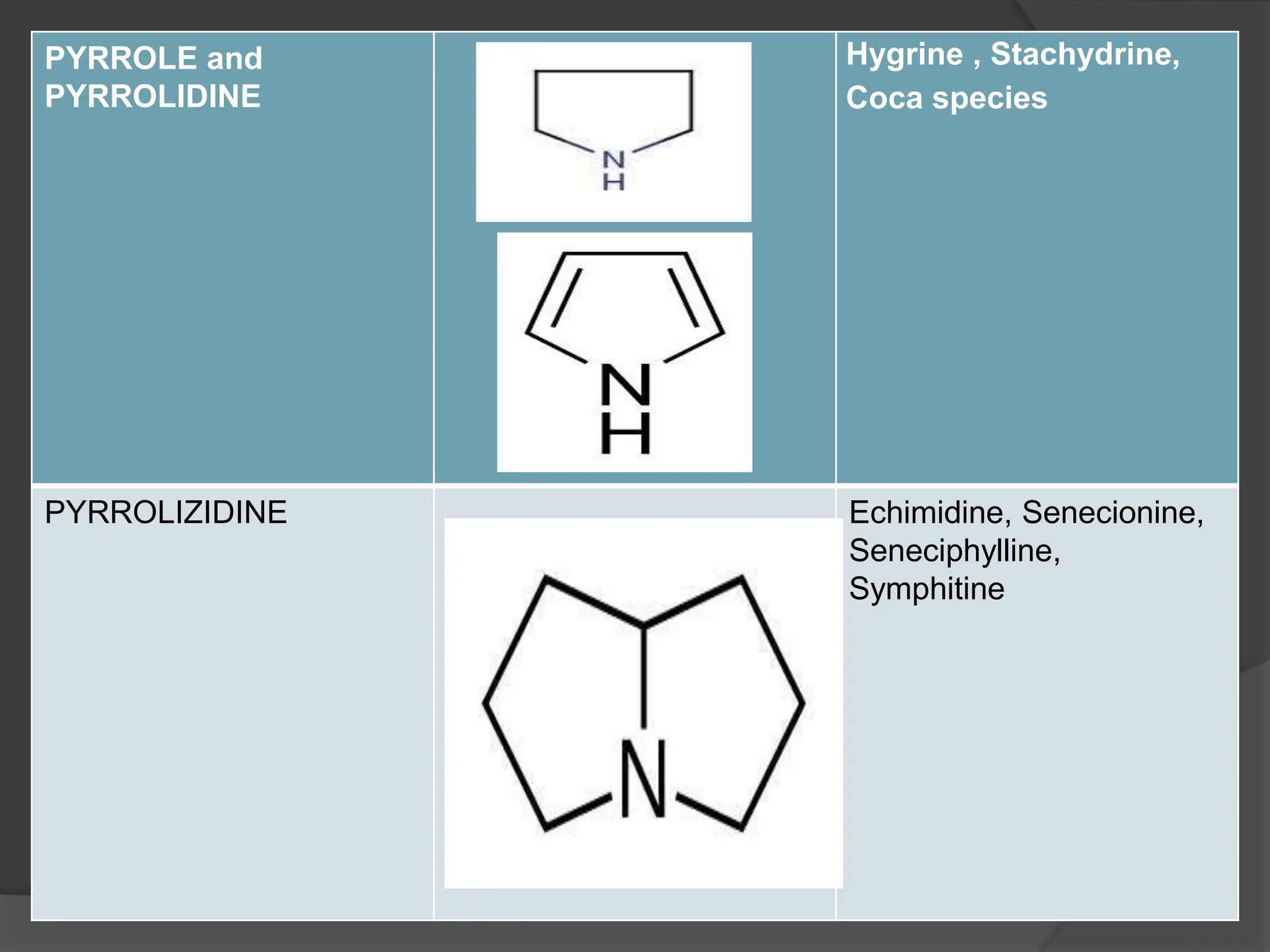
PYRROLIZIDINE Echimidine, Senecionine,
Seneciphylline,
Symphitine
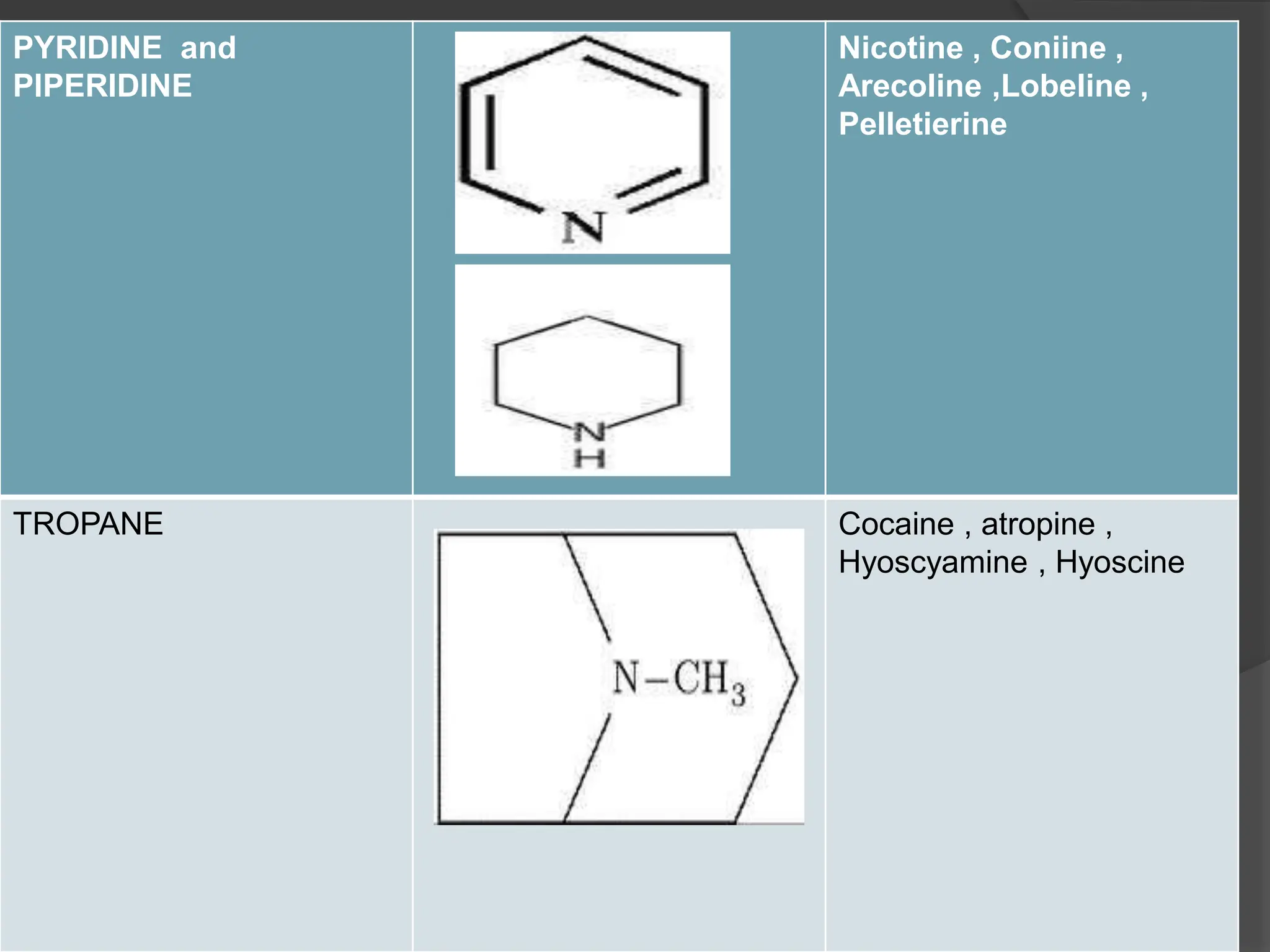
PYRIDINE and
PIPERIDINE
Nicotine , Coniine ,
Arecoline ,Lobeline ,
Pelletierine
TROPANE Cocaine , atropine ,
Hyoscyamine , Hyoscine
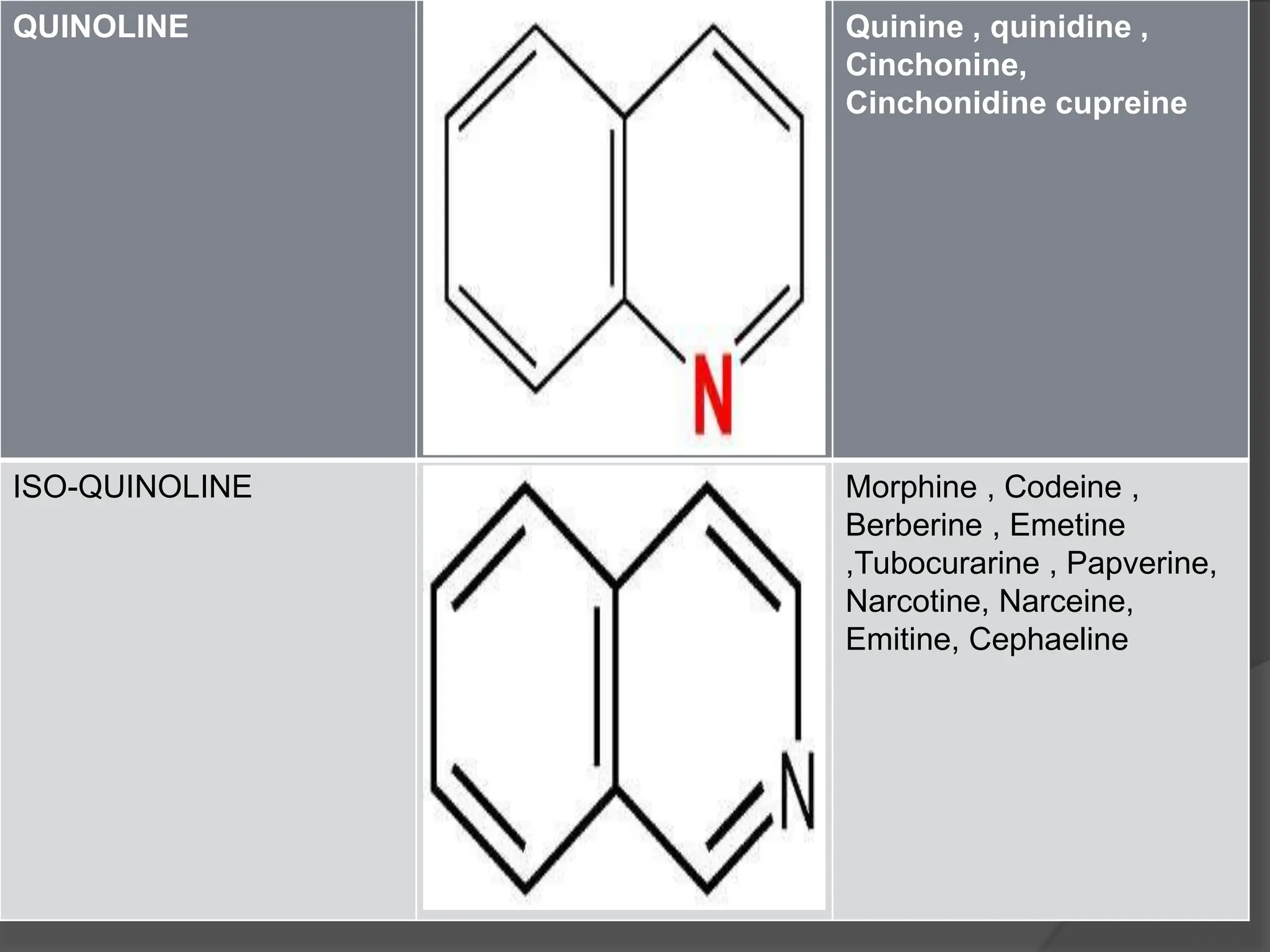
QUINOLINE Quinine , quinidine ,
Cinchonine,
Cinchonidine cupreine
ISO-QUINOLINE Morphine , Codeine ,
Berberine , Emetine
,Tubocurarine , Papverine,
Narcotine, Narceine,
Emitine, Cephaeline
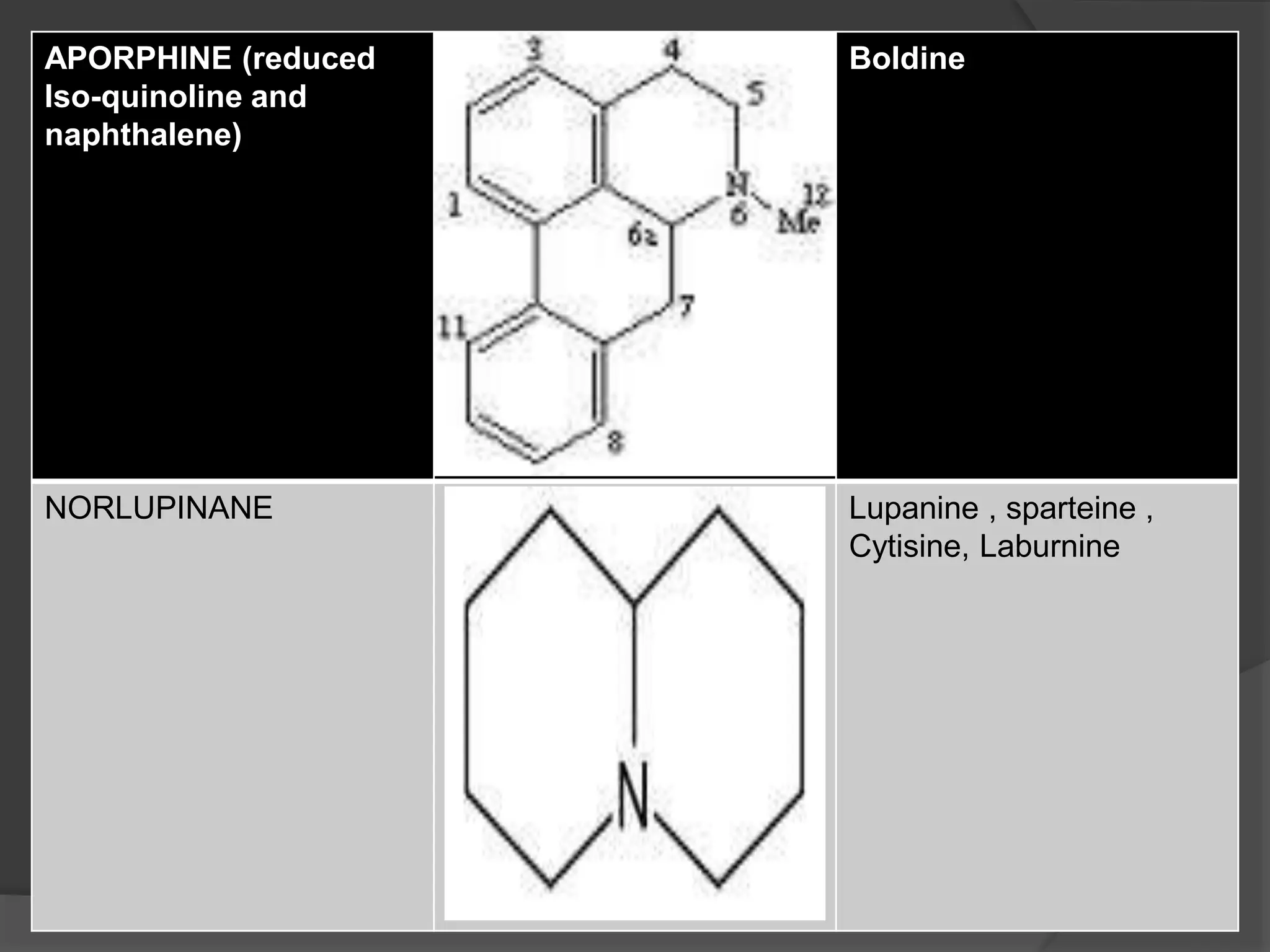
APORPHINE (reduced
Iso-quinoline and
naphthalene)
Boldine
NORLUPINANE Lupanine , sparteine ,
Cytisine, Laburnine
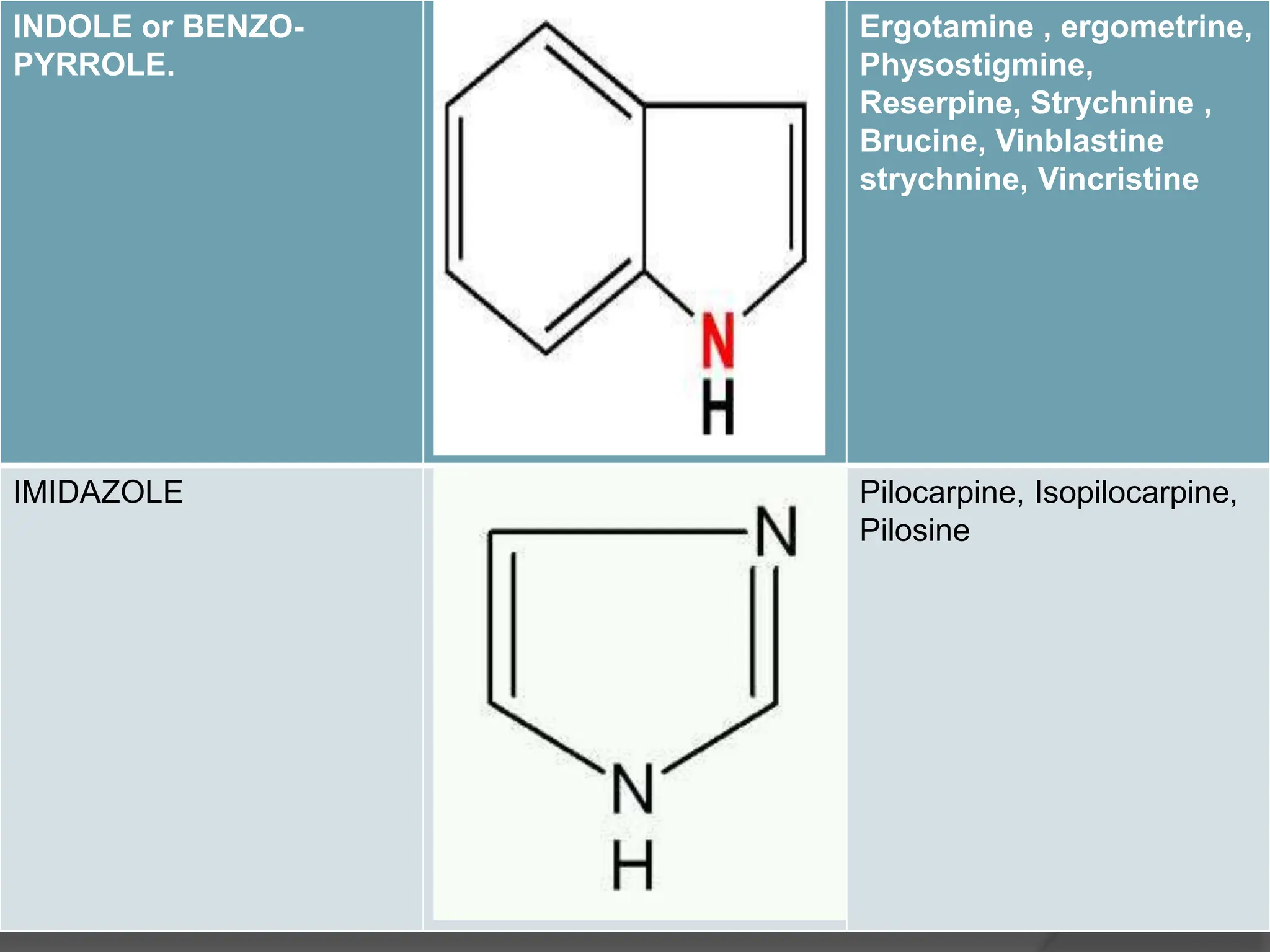
INDOLE or BENZO-
PYRROLE.
Ergotamine , ergometrine,
Physostigmine,
Reserpine, Strychnine ,
Brucine, Vinblastine
strychnine, Vincristine
IMIDAZOLE Pilocarpine, Isopilocarpine,
Pilosine
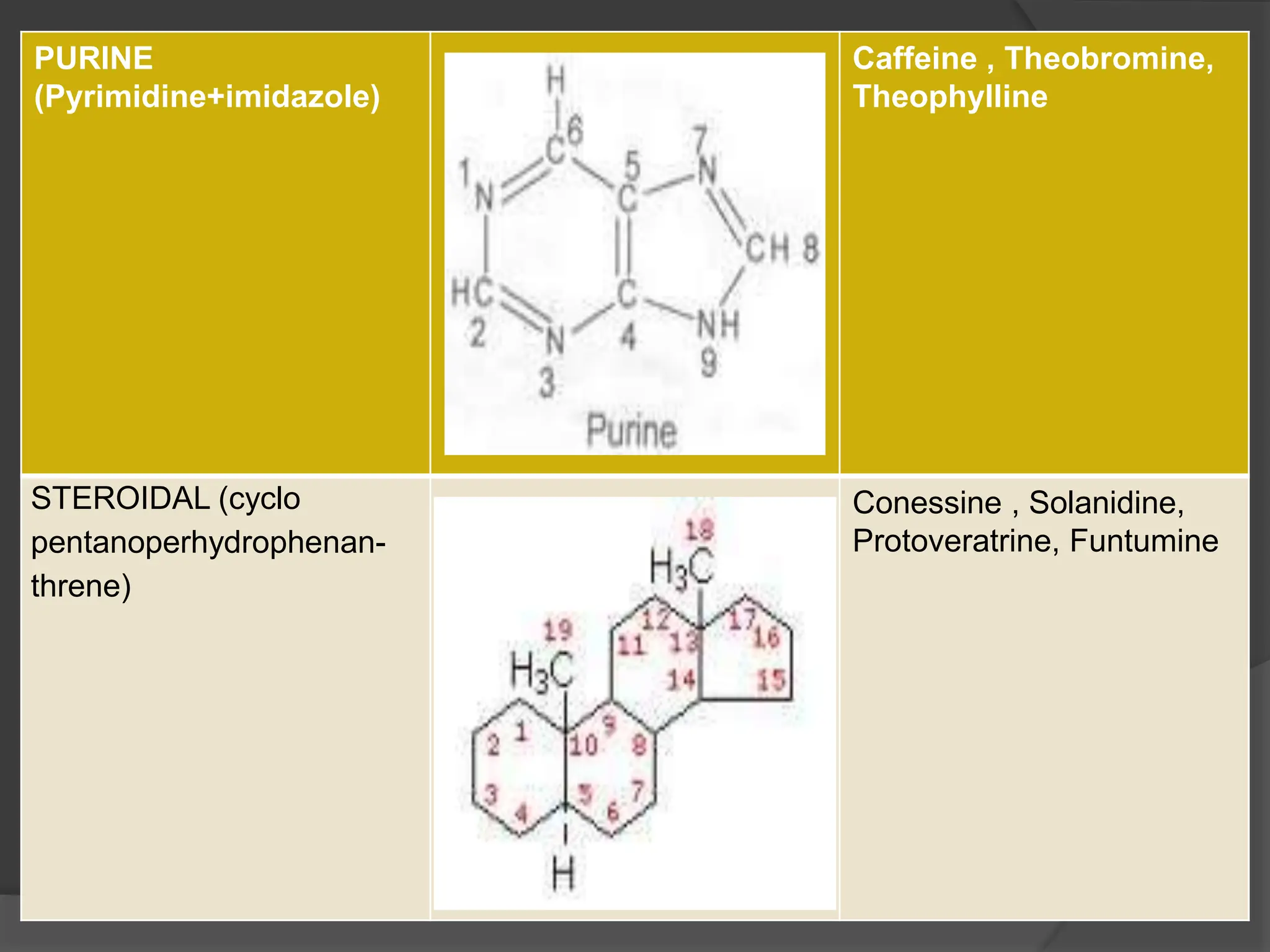
PURINE
(Pyrimidine+imidazole)
Caffeine , Theobromine,
Theophylline
STEROIDAL (cyclo
pentanoperhydrophenan-
threne)
Conessine , Solanidine,
Protoveratrine, Funtumine
NON-HETEROCYCLIC :--
1.Ephedrine
2. Colchicine
3.Erythromycin
4.Mescaline
5. Taxol
SOME IMPORTANT CRUDE DRUGS
Belladonna
Datura
Aconite
Opium
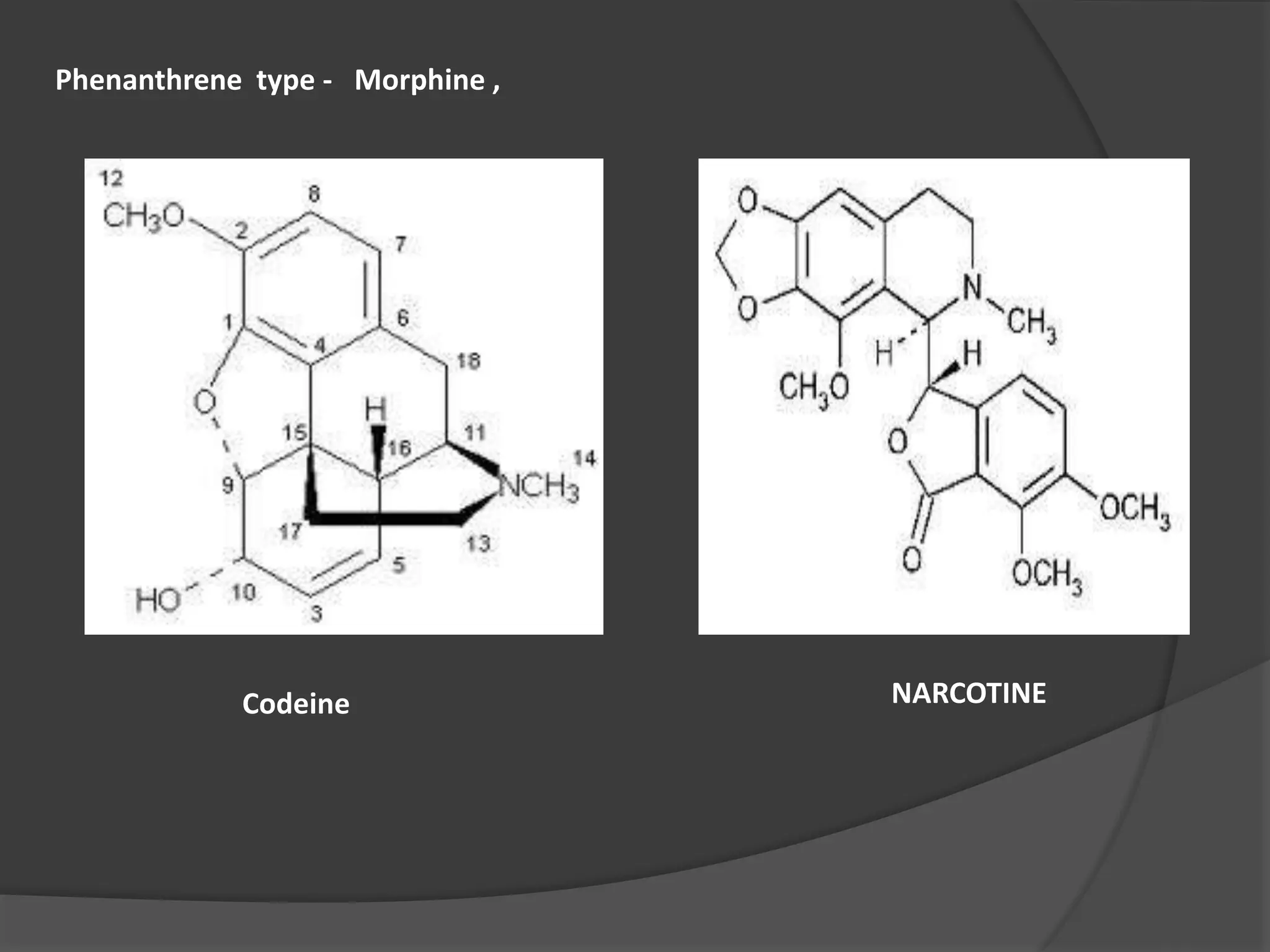
Phenanthrene type - Morphine ,
Codeine NARCOTINE
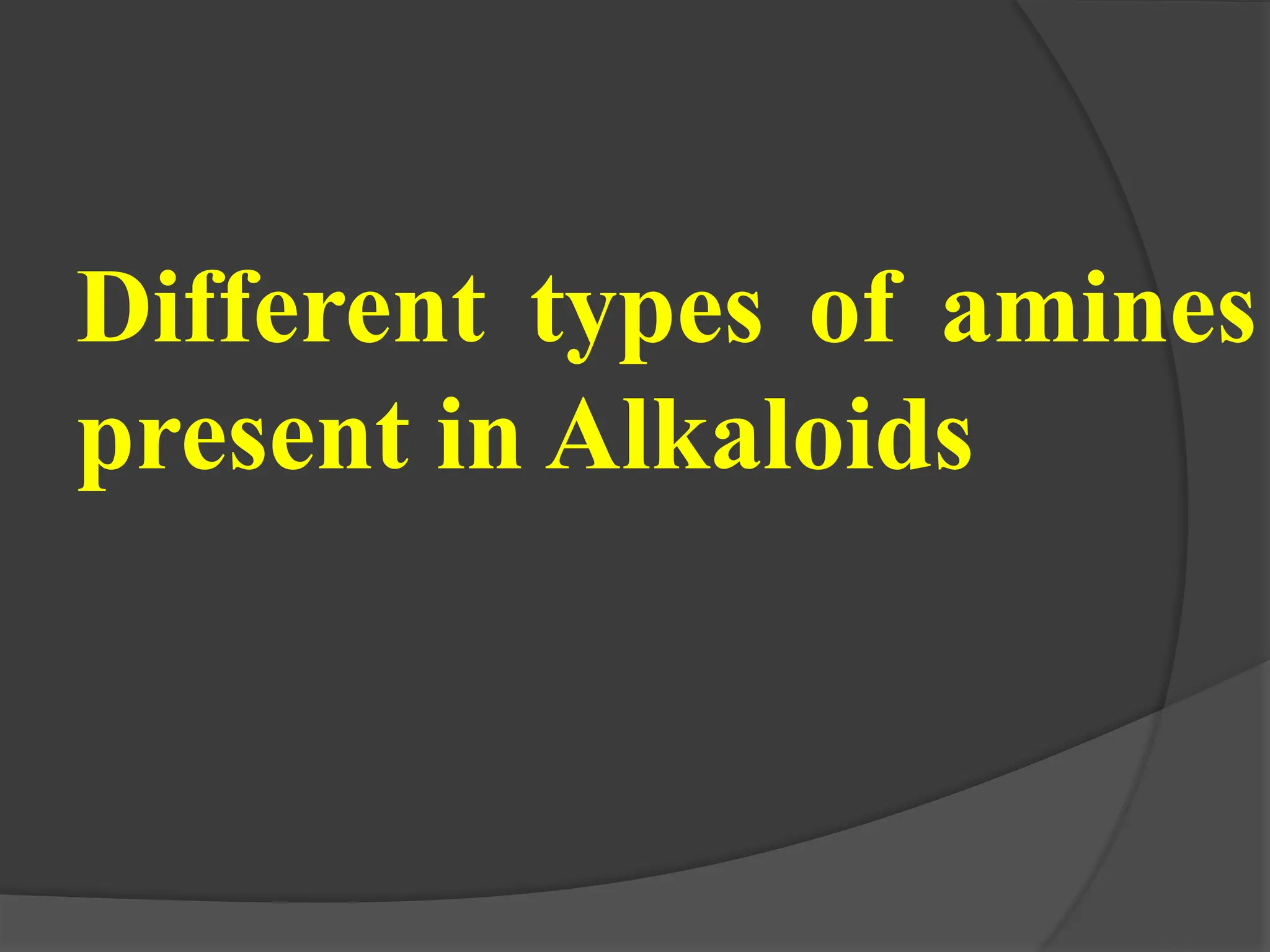
Atropine , Hyoscyamine , Hyoscine , Homatropine.
ATROPINE
Alkaloids and its containng drugs secondary metabolities.ppt

Alkaloids and its containng drugs secondary metabolities.ppt

  • 4.
    HISTORY  Most notoriouspoisons in the history of civilization.  Used by humanity for thousands of years.  The first civilizations to use them were probably the ancient Sumerians and Egyptians  It was called a vegetable alkali.
  • 5.
    •The name “alkaloid”comes from the Arabic word for ash “al-qali”. •Contain nitrogenous base in the nucleus • Term alkaloid was coined by meissner, a German pharmacist (1819). • Derosne (French chemist) isolated Narcotine (1803). • Serturner (1803) isolated morphine from opium
  • 6.
  • 7.
    “Naturally occurring nitrogenous substance whichis isolated from plants and reacts like bases”
  • 8.
    Konigs (1880):- “Naturallyoccurring organic bases which contains a Pyridine ring”.
  • 9.
    Ladenburg “Alkaloid arenatural plant compound that have basic character and contains at least one nitrogen atom in heterocyclic ring”.
  • 10.
  • 11.
    “Basic nitrogenous compound, containsone or more nitrogen in heterocyclic ring system having marked physiological action on human and animals when use in small quantities”.
  • 12.
  • 13.
    DEVIATION FROM ABOVE MOSTACCEPTED DEFINITION:
  • 14.
  • 16.
  • 18.
  • 19.
    Complete DEFINATION  Theseare the naturally occurring Basic(alkali) nitrogenous compounds containing one or more nitrogen in heterocyclic ring system & sometime obtained/not obtained from amino acid as a precursor having marked physiological action on human and animals when use in small quantities.
  • 20.
    a).Ranunculaceae : Aconitine(aconite). b). Leguminoceae : Physostigmine (physostigma) . c).loganiaceae: Strychnine and Brucine (Nux- vomica). d).Papavaraceae : Morphine, Codiene, Thebaine (Opium). e).Solanaceae : Belladona. Datura, Mandragora (mandrake)
  • 21.
    f).berberidaceae ; Berberine(Berberis). g).Rubiaceae: Quinine and Quinidine (Cinchona). h). Apocyanaceae : Reserpine (Rauwolfia), Vincristine and Vinblastine (Vinca). i). Liliaceae : Veriterine (Veratrum). j).Clavicipitaceae : Ergotamine and Ergometrine (Ergot).
  • 22.
  • 23.
    a).Most alkaloids arecrystalline solid, but some are liquid e.g. Volatile; --Nicotine , Coniine & Spartine.
  • 24.
  • 25.
    b).Majority of alkaloidsare colorless but some are colored, e.g Colchicine and Berberine are Yellow. Canadine is Orange.
  • 26.
    C). SOLUBILITY:- Differencein solubility used as a base for their isolation and purification from non- alkaloidal bases. The following can be mentioned :- a).Both alkaloidal base and their salts are soluble in alcohol. b).Generally bases are soluble in organic solvent and alkaloidal salts are soluble in water.
  • 27.
    EXCEPTION : A).Bases solublein water:--Caffeine, Codeine, Ephedrine. B).Bases in-soluble or sparingly soluble in certain organic solvent :- Morphine in ether(1:5000), C).Salt insoluble in water :---Quinine sulphate quinine sulphate is only soluble in water to the extent of 1:1000 , although quinine hydrochloride is soluble 1 in less than l part of water D).Salts soluble in organic solvents :---Lobelline and Apo atropine HCl are soluble in chloroform.
  • 28.
    1).Salt formation :--Dueto their basic character alkaloid reacts with acid to form salt --strong bases form salt with very weak acid. --weak bases forms salt with strong acid -- very weak bases form unstable salts.e.g caffeine , Narcotine , piperine.
  • 29.
    2).Amphoteric Alkaloids :--canform salts with both acid and alkali. e. g. phenolic group :- Morphine
  • 30.
    Carboxylic group:--Narciene (anarcotic alkaloid that occurs in opium).
  • 31.
    3). Effect ofheat: Alkaloids are decomposed by heat, except Strychnine and caffeine (sublimable). 4). Effect of light and Oxygen: Decomposed when allowed to stand at a temperature above 70°C for long time.  sensitivity varies in degree with different alkaloids.  Decomposition occur rapidly and easily when an alkaloid is in solution than when it is in dry form.  Most tertiary amine alkaloids are easily transformed to the N-oxides.
  • 32.
    5).Reaction with acids: •Saltformation. •Dil. acids hydrolyze Ester Alkaloids e.g. Atropine •Conc. acids may cause : Dehydration: Atropine → Apo atropine Morphine → Apomorphine Demethoxylation e.g. Codeine
  • 33.
    6.Effect of alkalis. •Weak alkalis liberate most alkaloids from their salts e.g. NH3 • Strong alkalis: such as aqueous NaOH and KOH form salts with phenolic alkaloids. • Hot alkalis: results hydrolysis of ester alkaloids e.g. atropine, cocaine and physostigmine and cleavage of lactone ring, if present, to produce the corresponding acid, e.g. pilocarpine is transformed to pilocarpic acid.
  • 34.
    7).BASICITY OF ALKALOIDS:--The basicity of alkaloid is due to presence of a lone pair of electron on nitrogen atom. --the basicity increased if the adjacent group is electron releasing like alkali . -- the basicity decreases if the adjacent group is electron withdrawing like carbonyl and amide group. R2-NH > R-NH2 > R3-N
  • 35.
    According to basicityAlkaloids are classified into: a). Weak bases e.g. Caffeine b). Strong bases e.g. Atropine c). Amphoteric * Phenolic Alkaloids e.g. Morphine *Alkaloids with Carboxylic groups e.g. Narceine d). Neutral alkaloids e.g. Colchicine
  • 36.
    Different types ofamines present in Alkaloids
  • 37.
    • Primary amines(R-NH2 ) e.g. Norephedrine
  • 38.
  • 39.
  • 40.
    •Quaternary ammonium salts(R4-N ), e.g. d-Tubocurarine Note :--Unsaturation decreases the basicity e.g. piperidine is more basic than pyridine alkaloid.
  • 41.
    PRECIPITATION REACTION : 1-Mayer's or Valser's reagent ( Potassium mercuric iodide) -gives white or yellow color mostly amorphous precipitates with alkaloids, except the purine bases, ephedrine, Colchicine and ricinine . Mercuric chloride -1.36g Potassium iodide -5.00 g Water to make-100 ml.
  • 42.
    2. Wagner's reagent(Iodine-potassium iodide):- It produces brown or reddish- brown precipitates with all alkaloids. Iodine -1.3 g Potassium iodide -2.0 g Water to make -100 ml 3.Dragendorff's or Kraut’s reagent ( potassium iodide+ bismuth nitrate):- It produces orange-red precipitate which is usually amorphous. Bismuth nitrate 8.0 g Nitric acid 20.5 g Potassium iodide 27.2 g Water to 100 ml 4. Hager's reagent (picric acid):- Gives yellow crystalline precipitate.
  • 43.
    5. Tannic acidsolution: (5%w/v) .:--gives buff colored ppt. which is soluble in dil.acid or ammonia. 6.Ammonium reineckate solution: 2% solution, produces precipitates with heterocyclic nitrogen alkaloids, with quaternary and some tertiary amines.
  • 44.
    A). Van-Urks test:(Para-dimethyl-amino-benzaldehyde + sulphuric acid)-- (for Ergot alkaloids).-gives Blue colour. B). Vitali-Morin test:-- test for solanceous alkaloids gives violet colour when treated with conc. nitric acid and alcoholic KOH. Mechanism :-- These color tests usually depend upon dehydration or oxidation of the alkaloid with a resultant characteristic color. Merits :-- a). very sensitive b). the intensity of the colour so formed is in linear proportion to the concentration of the alkaloid
  • 45.
    1. As reservoirof nitrogen. 2. As reservoir for protein synthesis 3. Afford plant safety from herbivorous and insects. 4. Might have possible role as growth regulatory factor. 5. Acting as carrier within plants for transportation of acids.
  • 46.
    1. Analgesics andnarcotics: morphine and codeine. 2. CNS stimulants : caffeine and strychnine. 3. Anticancer: vincristine, vinblastine and taxol. 4. Mydriatics: atropine. 5. Anti-asthmatics : ephedrine. 6. Anti-tussives: codeine, vasaka. 7. Expectorants: lobeline. 8. Anti- hypertensive: reserpine. 9. Smooth muscle relaxants: atropine and papaverine 10. Skeletal muscle relaxants: d- tubocurarine. 11. Anthelmintics: pelletierine and arecoline. 12. Antiparasitics/antimalarials: quinine and emetine.
  • 47.
    Hegnauer's classification 1)."TRUE-alkaloids", whichcontain nitrogen in the heterocyclic ring and originate from amino acids. examples are atropine, nicotine, morphine, and Quinine. All the heterocyclic alkaloids are true alkaloids. The true alkaloids should have following characters: a) It should be sufficiently toxic. b) Should have marked physiological activity. c) should be basic in nature. d) Nitrogen should be present in a heterocyclic ring. e) Should be derived from amino acids. f) Should occur in plant as salt of organic acids.
  • 48.
    2. PROTO-Alkaloids:- Theseare alkaloids which are derived from amino acid but do not have nitrogen in a heterocyclic ring. They are also called as “Biological amine”. Examples include:- mescaline, adrenaline and ephedrine. 3. PSEUDO-Alkaloids:--They do not derived from amino acid but having nitrogen in heterocyclic ring . They do not show many of the typical characters of alkaloids , but give standard qualitative test for alkaloids. e.g. steroidal alkaloids:-Conessine Purine bases :-- Caffeiene
  • 49.
    CHEMICAL CLASSIFICATION:-- Accordingto chemical structure, two broad division may be recognized: • Non-heterocyclic alkaloids that are sometimes called ''proto alkaloids' or biological amines. • Heterocyclic alkaloids that are sub-classified into different groups according to their ring structure.
  • 51.
    PYRROLE and PYRROLIDINE Hygrine ,Stachydrine, Coca species PYRROLIZIDINE Echimidine, Senecionine, Seneciphylline, Symphitine
  • 52.
    PYRIDINE and PIPERIDINE Nicotine ,Coniine , Arecoline ,Lobeline , Pelletierine TROPANE Cocaine , atropine , Hyoscyamine , Hyoscine
  • 53.
    QUINOLINE Quinine ,quinidine , Cinchonine, Cinchonidine cupreine ISO-QUINOLINE Morphine , Codeine , Berberine , Emetine ,Tubocurarine , Papverine, Narcotine, Narceine, Emitine, Cephaeline
  • 54.
  • 55.
    INDOLE or BENZO- PYRROLE. Ergotamine, ergometrine, Physostigmine, Reserpine, Strychnine , Brucine, Vinblastine strychnine, Vincristine IMIDAZOLE Pilocarpine, Isopilocarpine, Pilosine
  • 56.
    PURINE (Pyrimidine+imidazole) Caffeine , Theobromine, Theophylline STEROIDAL(cyclo pentanoperhydrophenan- threne) Conessine , Solanidine, Protoveratrine, Funtumine
  • 57.
  • 58.
    SOME IMPORTANT CRUDEDRUGS Belladonna Datura Aconite Opium
  • 59.
    Phenanthrene type -Morphine , Codeine NARCOTINE
  • 60.
    Atropine , Hyoscyamine, Hyoscine , Homatropine. ATROPINE