WORLDPOPULATION
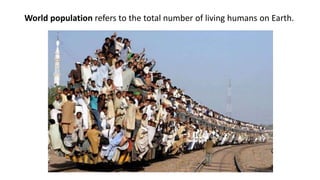
World population refers to the total number of living humans on Earth.
WORLD POPULATION 21 JULY 2015, at 8.46pm
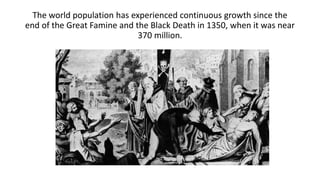
The world population has experienced continuous growth since the
end of the Great Famine and the Black Death in 1350, when it was near
370 million.
Six of Earth's seven continents are permanently inhabited on a large scale.
Asia is the most populous continent, with its 4.3 billion inhabitants
accounting for 60% of the world population.
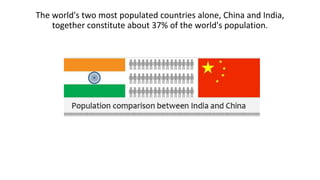
The world's two most populated countries alone, China and India,
together constitute about 37% of the world's population.
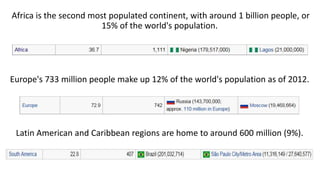
Africa is the second most populated continent, with around 1 billion people, or
15% of the world's population.
Europe's 733 million people make up 12% of the world's population as of 2012.
Latin American and Caribbean regions are home to around 600 million (9%).
Northern America (United States and Canada) has a population of around
352 million (5%).
Oceania, the least-populated region, has about 35 million inhabitants (0.5%).
Antarctica has a small, fluctuating international population, based mainly in
polar science stations.
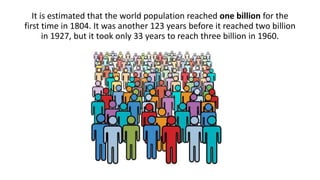
It is estimated that the world population reached one billion for the
first time in 1804. It was another 123 years before it reached two billion
in 1927, but it took only 33 years to reach three billion in 1960.
Thereafter, the global population reached four billion in 1974, five
billion in 1987, six billion in 1999 and, seven billion in March 2012.
According to current projections, the global population will reach eight
billion by 2026, and will likely reach around nine billion by 2042.
Alternative scenarios for 2050 range from a low of 7.4 billion to a high
of more than 10.6 billion.
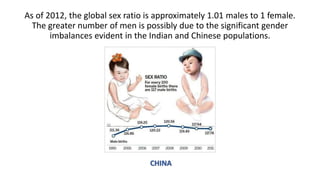
As of 2012, the global sex ratio is approximately 1.01 males to 1 female.
The greater number of men is possibly due to the significant gender
imbalances evident in the Indian and Chinese populations.
CHINA
Approximately 26.3% of the global population is aged under 15, while
65.9% is aged 15–64 and 7.9% is aged 65 or over.
The median age of the world's population was estimated to be 29.7
years in 2014, and is expected to rise to 37.9 years by 2050.
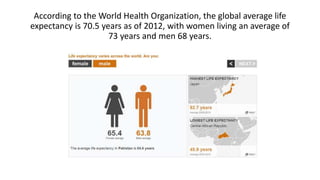
According to the World Health Organization, the global average life
expectancy is 70.5 years as of 2012, with women living an average of
73 years and men 68 years.
In 2010, the global fertility rate was estimated at 2.52 children per woman.
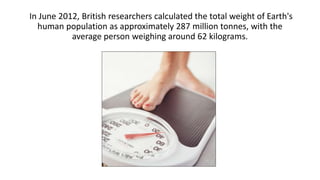
In June 2012, British researchers calculated the total weight of Earth's
human population as approximately 287 million tonnes, with the
average person weighing around 62 kilograms.
In June 2014, there were around 3.03 billion global Internet users,
constituting 42.3% of the world population.
The Han Chinese are the world's largest single ethnic group,
constituting over 19% of the global population in 2011.
The world's most-spoken first languages are Mandarin Chinese (spoken
by 12.44% of the world's population), Spanish (4.85%), English (4.83%),
Arabic (3.25%) and Hindustani (2.68%).
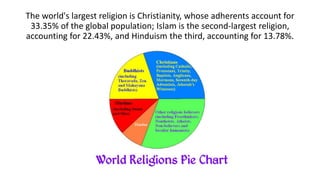
The world's largest religion is Christianity, whose adherents account for
33.35% of the global population; Islam is the second-largest religion,
accounting for 22.43%, and Hinduism the third, accounting for 13.78%.
In 2005, around 16% of the global population were reported to be non-religious.
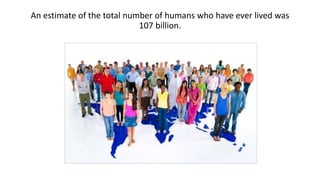
An estimate of the total number of humans who have ever lived was
107 billion.

WORLD POPULATION

  • 1.
  • 2.
    World population refersto the total number of living humans on Earth.
  • 3.
    WORLD POPULATION 21JULY 2015, at 8.46pm
  • 4.
    The world populationhas experienced continuous growth since the end of the Great Famine and the Black Death in 1350, when it was near 370 million.
  • 5.
    Six of Earth'sseven continents are permanently inhabited on a large scale. Asia is the most populous continent, with its 4.3 billion inhabitants accounting for 60% of the world population.
  • 6.
    The world's twomost populated countries alone, China and India, together constitute about 37% of the world's population.
  • 7.
    Africa is thesecond most populated continent, with around 1 billion people, or 15% of the world's population. Europe's 733 million people make up 12% of the world's population as of 2012. Latin American and Caribbean regions are home to around 600 million (9%).
  • 8.
    Northern America (UnitedStates and Canada) has a population of around 352 million (5%). Oceania, the least-populated region, has about 35 million inhabitants (0.5%). Antarctica has a small, fluctuating international population, based mainly in polar science stations.
  • 9.
    It is estimatedthat the world population reached one billion for the first time in 1804. It was another 123 years before it reached two billion in 1927, but it took only 33 years to reach three billion in 1960.
  • 10.
    Thereafter, the globalpopulation reached four billion in 1974, five billion in 1987, six billion in 1999 and, seven billion in March 2012.
  • 11.
    According to currentprojections, the global population will reach eight billion by 2026, and will likely reach around nine billion by 2042. Alternative scenarios for 2050 range from a low of 7.4 billion to a high of more than 10.6 billion.
  • 12.
    As of 2012,the global sex ratio is approximately 1.01 males to 1 female. The greater number of men is possibly due to the significant gender imbalances evident in the Indian and Chinese populations. CHINA
  • 13.
    Approximately 26.3% ofthe global population is aged under 15, while 65.9% is aged 15–64 and 7.9% is aged 65 or over.
  • 14.
    The median ageof the world's population was estimated to be 29.7 years in 2014, and is expected to rise to 37.9 years by 2050.
  • 15.
    According to theWorld Health Organization, the global average life expectancy is 70.5 years as of 2012, with women living an average of 73 years and men 68 years.
  • 16.
    In 2010, theglobal fertility rate was estimated at 2.52 children per woman.
  • 17.
    In June 2012,British researchers calculated the total weight of Earth's human population as approximately 287 million tonnes, with the average person weighing around 62 kilograms.
  • 18.
    In June 2014,there were around 3.03 billion global Internet users, constituting 42.3% of the world population.
  • 19.
    The Han Chineseare the world's largest single ethnic group, constituting over 19% of the global population in 2011.
  • 20.
    The world's most-spokenfirst languages are Mandarin Chinese (spoken by 12.44% of the world's population), Spanish (4.85%), English (4.83%), Arabic (3.25%) and Hindustani (2.68%).
  • 21.
    The world's largestreligion is Christianity, whose adherents account for 33.35% of the global population; Islam is the second-largest religion, accounting for 22.43%, and Hinduism the third, accounting for 13.78%.
  • 22.
    In 2005, around16% of the global population were reported to be non-religious.
  • 23.
    An estimate ofthe total number of humans who have ever lived was 107 billion.