CAMBRIDGEIGCSE
BLAMEFORTHECOLDWAR
03
YALTACONFERENCE1945
BACKGROUND
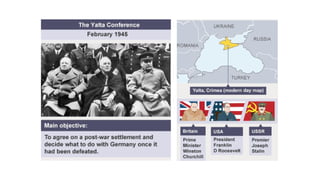
From 4 to 11 February 1945, Winston Churchill, Joseph Stalin and Franklin
D. Roosevelt met in Yalta, in the Crimea on the Black Sea, to settle the
questions raised by the inevitable German defeat.
Roosevelt was anxious to secure the cooperation of Stalin, while Churchill
was apprehensive of the Soviet power.
He wanted to avoid the Red Army exerting too widespread an influence
over Central Europe.
At this time, the Soviet troops had already reached the centre of Europe,
whereas the British and Americans had not yet crossed the Rhine.
AGREEMENT
The three Great Powers first of all agreed on the arrangements for the
occupation of Germany:
- Churchill, Stalin and Roosevelt agreed to Divide Germany into 4 zone
(France, Britain, USA, USSR).
- France was allocated a zone of occupation to be carved out in part from
the British and US zones.
- Berlin, situated in the Soviet zone, would also be divided into four
sectors.
YALTACONFERENCEFEBRUARY1945
They agreed to hold free elections in Eastern European countries.
They also agreed to set up the United Nations.
They have decided to set up a government of Communists and non-
Communists in Poland.
On the surface, everything seemed friendly, but there was tension
behind the scenes.
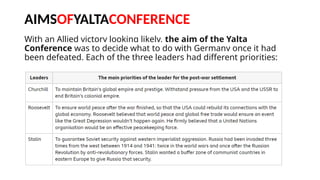
AIMSOFYALTACONFERENCE
With an Allied victory looking likely, the aim of the Yalta
Conference was to decide what to do with Germany once it had
been defeated. Each of the three leaders had different priorities:
OUTCOMES:1.DIVIDINGGERMANY
Germany would be divided into four zones of occupation
with the USSR, Britain, France and the USA each controlling a
zone.
France had been liberated from Nazi Germany and was
included at the conference partly due to pressure from the
French leader, General de Gaulle.
Britain wanted a European ally with whom it could share
the cost of the post-war reconstruction of Germany.
OUTCOMES:2.DIVIDINGBERLIN
The German capital, Berlin, was deep inside the Soviet zone
and it too was to be divided into four zones, each controlled
by one of the Allied powers.
Berlin would be a source of tension throughout the Cold
War.
OUTCOMES:3.FREEELECTIONSANDINFLUENCE
All countries freed from Nazi control were to be guaranteed
the right to hold free elections and choose their own
governments.
Stalin was offered a ‘sphere of influence’ over Eastern
Europe.
OUTCOMES:4.WARAGAINSTJAPAN
Stalin once again promised to join the war against Japan,
once Germany was defeated.
OUTCOMES:5.HUNTINGNAZICRIMINALS
All the leaders made a commitment to hunt down Nazi war
criminals.
OUTCOMES:6.SETTINGUPUNITEDNATIONS
The Allies agreed to the setting up of the United Nations, an
organisation with the objectives of ensuring international
cooperation and preventing future wars.
AGREEMENTS
The United States obtained the USSR’s agreement to enter the
fight against Japan.
Roosevelt saw the successful conclusion of his plan for the
formation of a United Nations organisation, which was to be
created on 25 April 1945.
Yalta seemed to be the final attempt to reorganise the world on
a basis of cooperation and agreement.
The world was not yet divided into two hemispheres of
influence, but the Western Powers were obliged to accept
Stalin’s role in the territories liberated by Soviet tanks.
Central and Eastern Europe were under the exclusive control of
the Red Army.
HOMEWORKDUETOMORROW
• List the Big Three at the Yalta conference and what each one’s
main priority was.
• Explain how the Big Three needed each other to fulfil their
priorities.
• Explain how the priorities of the Big Three might have been
difficult to fulfil at the same time.