Forced migration
SUBMITTED BY:
SOUMYADEEP ARINDA(18)
AKASH BRAHMANKAR(16)
VIJAYA SUBHAS KENI(17)
NIKHILA K(19)
BADAL THOOL(20)
What is Migration?
 Migration is generally defined as ‘a permanent
change in place of residence by crossing of
specified administrative or political boundaries’. The
person who fulfill these two criteria are regarded as
migrants.
 Basically there are two types of migration. One is
Voluntary Migration and the other is Non-voluntary
Migration(Forced Migration).
What is Forced Migration?
 Forced migration can be defined as any person who migrates to
escape persecution, conflict, repression, natural and human-made
disasters, ecological degradation, or other situations that
endanger their lives, freedom or livelihood.
 According to the 2012 world disaster report, over 72 million
people were forced migrants in 2011.
Types of Forced Migration:
Conflict-Induced Forced Migration
 People who are forced to flee their homes for one or more of the
following reasons and where the state authorities are unable or
unwilling to protect them: armed conflict including civil war;
generalized violence; and persecution on the grounds of
nationality, race, religion, political opinion or social group
Example: Conflict-Induced Forced
Migration
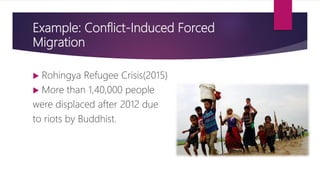
 Rohingya Refugee Crisis(2015)
 More than 1,40,000 people
were displaced after 2012 due
to riots by Buddhist.
Development-Induced Displacement
 It occurs when people are compelled to move as a
result or policies and projects implemented to
supposedly enhance ‘development’ like, dams, roads,
ports, airports; urban clearance initiatives; mining and
deforestation; and the introduction of conservation
parks/reserves and biosphere projects.
Example: Development-Induced
Displacement
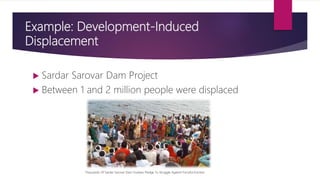
 Sardar Sarovar Dam Project
 Between 1 and 2 million people were displaced
Thousands Of Sardar Sarovar Dam Oustees Pledge To Struggle Against Forceful Eviction
Disaster-Induced Displacement
 people displaced as a result of natural disasters (floods,
volcanoes, landslides, earthquakes), environmental
change (deforestation, desertification, land
degradation, global warming) and human-made
disasters (industrial accidents, radioactivity).
Example:Disaster-Induced Displacement
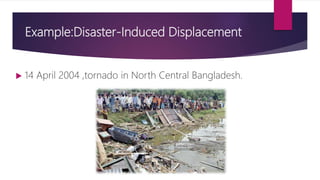
 14 April 2004 ,tornado in North Central Bangladesh.
Types of Forced Migrants
 Refugees: A refugee is someone who has been forced
to flee his or her country because of persecution, war,
or violence. A refugee is unable or unwilling to return
because of a well-founded fear of persecution for
reasons of race, religion, nationality, political opinion or
membership in a particular social group.
Types of Forced Migrants
 Internally Displace Person: An internally displaced person (IDP) is a
person who has been forced to flee his or her home for the same
reason as a refugee, but remains in his or her own country and
has not crossed an international border.
 Asylum Seeker: Asylum seekers are people who have moved
across an international border in search of protection under the
1951 Refugee Convention, but whose claim for refugee status has
not yet been determined
Types of Forced Migrants
 Trafficked People: These are people who are moved by deception
or coercion for the purposes of exploitation. The profit in
trafficking people comes not from their movement, but from the
sale of their sexual services or labour in the country of
destination.
FORCED MIGRATION IN BRITISH INDIA
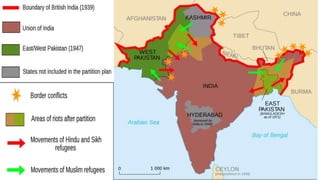
 Demographic Case Study of Forced Migration: The 1947 Partition
of British India .
 In which , The study focuses on the Punjab, using data
published in the 1931, 1941, and 1951 Censuses of India and the
1951 Census of Pakistan.
 the Partition of India in 1947 constitutes one of the greatest
instances of voluntary and involuntary mass population
migration in modern history.
 Due to that partition mainly demographically changes in north-
west part of India ( Panjab) and Pakistan .
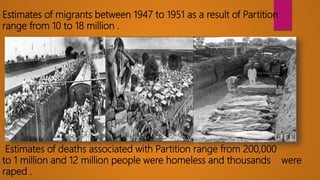
Estimates of migrants between 1947 to 1951 as a result of Partition
range from 10 to 18 million .
Estimates of deaths associated with Partition range from 200,000
to 1 million and 12 million people were homeless and thousands were
raped .
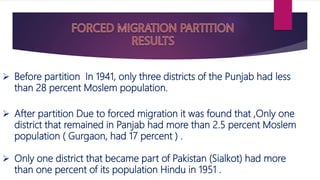
 Before partition In 1941, only three districts of the Punjab had less
than 28 percent Moslem population.
 After partition Due to forced migration it was found that ,Only one
district that remained in Panjab had more than 2.5 percent Moslem
population ( Gurgaon, had 17 percent ) .
 Only one district that became part of Pakistan (Sialkot) had more
than one percent of its population Hindu in 1951 .
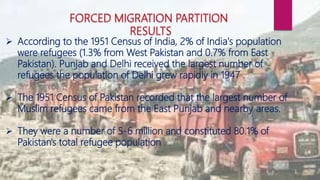
 According to the 1951 Census of India, 2% of India's population
were refugees (1.3% from West Pakistan and 0.7% from East
Pakistan). Punjab and Delhi received the largest number of
refugees the population of Delhi grew rapidly in 1947 .
 The 1951 Census of Pakistan recorded that the largest number of
Muslim refugees came from the East Punjab and nearby areas.
 They were a number of 5-6 million and constituted 80.1% of
Pakistan's total refugee population .
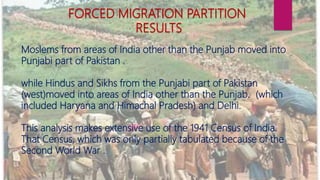
Moslems from areas of India other than the Punjab moved into
Punjabi part of Pakistan .
while Hindus and Sikhs from the Punjabi part of Pakistan
(west)moved into areas of India other than the Punjab. (which
included Haryana and Himachal Pradesh) and Delhi.
This analysis makes extensive use of the 1941 Census of India.
That Census, which was only partially tabulated because of the
Second World War .
FORCED MIGRATION PARTITION
RESULTS
Case study on, Forced migration in Syria
Presented by,
NIKHILA K
ROLL NO: 19
What is Syrian refugee crisis?
 It is the migration of millions of Syrian people due to political
persecution and civil wars in their country.
 12 million Syrians have fled their homes because of conflict; half are
children.
 4 million Syrians are refugees; most are in Turkey, Lebanon, and
Jordan.
 More than 700,000 Syrian refugees and other migrants risked their
lives this year to travel to Europe.
Why Syrians are fleeing:-
Three reasons
 Violence: Since the Syrian civil war began, more than
240,000 people have been killed ,including 12,000 children.
 Collapsed infrastructure: Within Syria, health care,
education systems, and other infrastructure have been
destroyed; the economy is shattered.
 Children’s safety: Syrian children have witnessed extreme
violence and brutality.
How it all started ?
 The Arab spring inspired the Syrian people to take to the
streets in peaceful demonstration against the Assad’s
dictatorial regime.
 The government responded fiercely, torturing, killing, and
shooting at the protesters. The situation escalated to a civil
war.
 Syria is now divide in to territory occupied by the regime,
rebel fighters and Islamic extremists. The war is still raging
today
What has been the impact of the war on people
living in Syria?
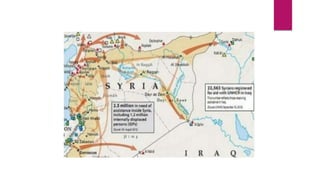
 Millions of ordinary people living in Syria have had to escape
from their homes to find somewhere safer to live.
 According to the United Nations (UN), a group that works to
try to solve some of the world's problems, almost five million
Syrians have had to leave the country. Many have gone to
neighbouring countries, like Jordan, Lebanon, Turkey or Iraq.
 Six million more people have tried to find safety elsewhere in
Syria.
 Lots of children can no longer go to school because their schools have
been destroyed or there are no teachers where they have moved to.
 Many refugees made the decision to try to reach Europe. This is because
some countries in Europe said they would accept refugees who wanted
to start a new life here.
 Millions of people both inside and outside Syria are in desperate need of
help, but aid agencies say that getting help to people inside the country
is very difficult and dangerous.
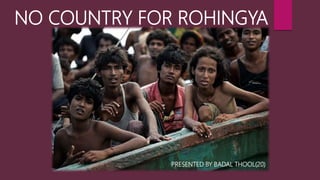
NO COUNTRY FOR ROHINGYA
PRESENTED BY BADAL THOOL(20)
Who is Rohingya?
 They have been living in the state of Arakan since 8th century in
Burma.
 They have been under extreme scrutiny by the Burmese
government.
 They haven’t been recognized as citizen of The Union of Burma
since Burmese independence in 1984, instead they are known as
non-citizen.
 Most neglected community in the world according to the United
Nations.
Why the Rohingyas are in Trouble?
 Rohingya are being discriminated because,
 Different looks.
 Different Language.
 Different Religion.
► As a means of clamping down on the Rohingya the Junta have
restricted even the most basic of rights such as education,
marriage and citizenship.
Why the Rohingyas are in Trouble?
 The Burmese government endorse Burmese culture and the
Buddhist faith for their national citizens.
 But, the Rohingyas fall outside of this ideal criteria because they
want to retain their own culture and the Muslim faith.
 As a result, the Rohingyas are sidelined and marginalized, have to
live with their derogatory national status of non-citizen.
Forced Migration Due to Rohingya Crisis
 Between 1978 and 1992 approximately 2lakh Rohingyas left Burma
to escape from persecution of Burmese Junta.
 Most of them moved to Sothern Bangladesh and India where they
remained refugees.
 In Bangladesh too life of Rohingyas has become painful.
 In india the number of Rohingyas are approximately 40,000 and
approximately 2,70,000 in Bangladesh .
Current Situation of Rohingyas
 Despite of being refugee the Rohingya are getting hardly any
protection from their host countries.
 A burden to the densely populated countries the Rohingyas are
denied humanitarian need which forces them to turn to other
means of income such as drug trafficking.
 Indian government is planning to deport 40,000 Rohingyas from
India.
Conclusion
 While aid agencies and government work towards lasting
solutions to the influx of migrants, humanitarian workers are
charged with ensuring that the migrants have right to basic
human need and their rights promoted. As much humanitarian
services cannot really change the root causes of displacement
and migration, humanitarian actors should assist people fleeing
man made or natural disasters irrespective of their nationality,
region, gender, ethnic origin or political affiliation.

Forced migration

  • 1.
    Forced migration SUBMITTED BY: SOUMYADEEPARINDA(18) AKASH BRAHMANKAR(16) VIJAYA SUBHAS KENI(17) NIKHILA K(19) BADAL THOOL(20)
  • 2.
    What is Migration? Migration is generally defined as ‘a permanent change in place of residence by crossing of specified administrative or political boundaries’. The person who fulfill these two criteria are regarded as migrants.  Basically there are two types of migration. One is Voluntary Migration and the other is Non-voluntary Migration(Forced Migration).
  • 3.
    What is ForcedMigration?  Forced migration can be defined as any person who migrates to escape persecution, conflict, repression, natural and human-made disasters, ecological degradation, or other situations that endanger their lives, freedom or livelihood.  According to the 2012 world disaster report, over 72 million people were forced migrants in 2011.
  • 4.
    Types of ForcedMigration: Conflict-Induced Forced Migration  People who are forced to flee their homes for one or more of the following reasons and where the state authorities are unable or unwilling to protect them: armed conflict including civil war; generalized violence; and persecution on the grounds of nationality, race, religion, political opinion or social group
  • 5.
    Example: Conflict-Induced Forced Migration Rohingya Refugee Crisis(2015)  More than 1,40,000 people were displaced after 2012 due to riots by Buddhist.
  • 6.
    Development-Induced Displacement  Itoccurs when people are compelled to move as a result or policies and projects implemented to supposedly enhance ‘development’ like, dams, roads, ports, airports; urban clearance initiatives; mining and deforestation; and the introduction of conservation parks/reserves and biosphere projects.
  • 7.
    Example: Development-Induced Displacement  SardarSarovar Dam Project  Between 1 and 2 million people were displaced Thousands Of Sardar Sarovar Dam Oustees Pledge To Struggle Against Forceful Eviction
  • 8.
    Disaster-Induced Displacement  peopledisplaced as a result of natural disasters (floods, volcanoes, landslides, earthquakes), environmental change (deforestation, desertification, land degradation, global warming) and human-made disasters (industrial accidents, radioactivity).
  • 9.
    Example:Disaster-Induced Displacement  14April 2004 ,tornado in North Central Bangladesh.
  • 10.
    Types of ForcedMigrants  Refugees: A refugee is someone who has been forced to flee his or her country because of persecution, war, or violence. A refugee is unable or unwilling to return because of a well-founded fear of persecution for reasons of race, religion, nationality, political opinion or membership in a particular social group.
  • 11.
    Types of ForcedMigrants  Internally Displace Person: An internally displaced person (IDP) is a person who has been forced to flee his or her home for the same reason as a refugee, but remains in his or her own country and has not crossed an international border.  Asylum Seeker: Asylum seekers are people who have moved across an international border in search of protection under the 1951 Refugee Convention, but whose claim for refugee status has not yet been determined
  • 12.
    Types of ForcedMigrants  Trafficked People: These are people who are moved by deception or coercion for the purposes of exploitation. The profit in trafficking people comes not from their movement, but from the sale of their sexual services or labour in the country of destination.
  • 14.
    FORCED MIGRATION INBRITISH INDIA  Demographic Case Study of Forced Migration: The 1947 Partition of British India .  In which , The study focuses on the Punjab, using data published in the 1931, 1941, and 1951 Censuses of India and the 1951 Census of Pakistan.  the Partition of India in 1947 constitutes one of the greatest instances of voluntary and involuntary mass population migration in modern history.  Due to that partition mainly demographically changes in north- west part of India ( Panjab) and Pakistan .
  • 15.
    Estimates of migrantsbetween 1947 to 1951 as a result of Partition range from 10 to 18 million . Estimates of deaths associated with Partition range from 200,000 to 1 million and 12 million people were homeless and thousands were raped .
  • 17.
     Before partitionIn 1941, only three districts of the Punjab had less than 28 percent Moslem population.  After partition Due to forced migration it was found that ,Only one district that remained in Panjab had more than 2.5 percent Moslem population ( Gurgaon, had 17 percent ) .  Only one district that became part of Pakistan (Sialkot) had more than one percent of its population Hindu in 1951 .
  • 18.
     According tothe 1951 Census of India, 2% of India's population were refugees (1.3% from West Pakistan and 0.7% from East Pakistan). Punjab and Delhi received the largest number of refugees the population of Delhi grew rapidly in 1947 .  The 1951 Census of Pakistan recorded that the largest number of Muslim refugees came from the East Punjab and nearby areas.  They were a number of 5-6 million and constituted 80.1% of Pakistan's total refugee population .
  • 19.
    Moslems from areasof India other than the Punjab moved into Punjabi part of Pakistan . while Hindus and Sikhs from the Punjabi part of Pakistan (west)moved into areas of India other than the Punjab. (which included Haryana and Himachal Pradesh) and Delhi. This analysis makes extensive use of the 1941 Census of India. That Census, which was only partially tabulated because of the Second World War . FORCED MIGRATION PARTITION RESULTS
  • 20.
    Case study on,Forced migration in Syria Presented by, NIKHILA K ROLL NO: 19
  • 23.
    What is Syrianrefugee crisis?  It is the migration of millions of Syrian people due to political persecution and civil wars in their country.  12 million Syrians have fled their homes because of conflict; half are children.  4 million Syrians are refugees; most are in Turkey, Lebanon, and Jordan.  More than 700,000 Syrian refugees and other migrants risked their lives this year to travel to Europe.
  • 24.
    Why Syrians arefleeing:- Three reasons  Violence: Since the Syrian civil war began, more than 240,000 people have been killed ,including 12,000 children.  Collapsed infrastructure: Within Syria, health care, education systems, and other infrastructure have been destroyed; the economy is shattered.  Children’s safety: Syrian children have witnessed extreme violence and brutality.
  • 25.
    How it allstarted ?  The Arab spring inspired the Syrian people to take to the streets in peaceful demonstration against the Assad’s dictatorial regime.  The government responded fiercely, torturing, killing, and shooting at the protesters. The situation escalated to a civil war.  Syria is now divide in to territory occupied by the regime, rebel fighters and Islamic extremists. The war is still raging today
  • 27.
    What has beenthe impact of the war on people living in Syria?  Millions of ordinary people living in Syria have had to escape from their homes to find somewhere safer to live.  According to the United Nations (UN), a group that works to try to solve some of the world's problems, almost five million Syrians have had to leave the country. Many have gone to neighbouring countries, like Jordan, Lebanon, Turkey or Iraq.  Six million more people have tried to find safety elsewhere in Syria.
  • 28.
     Lots ofchildren can no longer go to school because their schools have been destroyed or there are no teachers where they have moved to.  Many refugees made the decision to try to reach Europe. This is because some countries in Europe said they would accept refugees who wanted to start a new life here.  Millions of people both inside and outside Syria are in desperate need of help, but aid agencies say that getting help to people inside the country is very difficult and dangerous.
  • 30.
    NO COUNTRY FORROHINGYA PRESENTED BY BADAL THOOL(20)
  • 31.
    Who is Rohingya? They have been living in the state of Arakan since 8th century in Burma.  They have been under extreme scrutiny by the Burmese government.  They haven’t been recognized as citizen of The Union of Burma since Burmese independence in 1984, instead they are known as non-citizen.  Most neglected community in the world according to the United Nations.
  • 32.
    Why the Rohingyasare in Trouble?  Rohingya are being discriminated because,  Different looks.  Different Language.  Different Religion. ► As a means of clamping down on the Rohingya the Junta have restricted even the most basic of rights such as education, marriage and citizenship.
  • 33.
    Why the Rohingyasare in Trouble?  The Burmese government endorse Burmese culture and the Buddhist faith for their national citizens.  But, the Rohingyas fall outside of this ideal criteria because they want to retain their own culture and the Muslim faith.  As a result, the Rohingyas are sidelined and marginalized, have to live with their derogatory national status of non-citizen.
  • 34.
    Forced Migration Dueto Rohingya Crisis  Between 1978 and 1992 approximately 2lakh Rohingyas left Burma to escape from persecution of Burmese Junta.  Most of them moved to Sothern Bangladesh and India where they remained refugees.  In Bangladesh too life of Rohingyas has become painful.  In india the number of Rohingyas are approximately 40,000 and approximately 2,70,000 in Bangladesh .
  • 35.
    Current Situation ofRohingyas  Despite of being refugee the Rohingya are getting hardly any protection from their host countries.  A burden to the densely populated countries the Rohingyas are denied humanitarian need which forces them to turn to other means of income such as drug trafficking.  Indian government is planning to deport 40,000 Rohingyas from India.
  • 36.
    Conclusion  While aidagencies and government work towards lasting solutions to the influx of migrants, humanitarian workers are charged with ensuring that the migrants have right to basic human need and their rights promoted. As much humanitarian services cannot really change the root causes of displacement and migration, humanitarian actors should assist people fleeing man made or natural disasters irrespective of their nationality, region, gender, ethnic origin or political affiliation.