Population
Population GrowthThe worlds population is growing rapidlyThe population of the world is growing at an exponential rate- its growing faster and faster.There are two things that affect the population size of the world:Birth rate- the number of live babies born per thousand of the population per year.Death rate-the number of deaths per thousand of the  population per year.When the birth rate is higher than the death rate, more people are being born than are dying, so the population growsThis is called Natural increaseWhen the death rate is higher than the birth rate it is called the natural decrease.
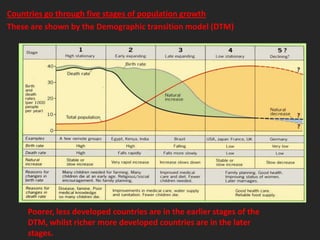
Countries go through five stages of population growthThese are shown by the Demographic transition model (DTM)Poorer, less developed countries are in the earlier stages of the DTM, whilst richer more developed countries are in the later stages.
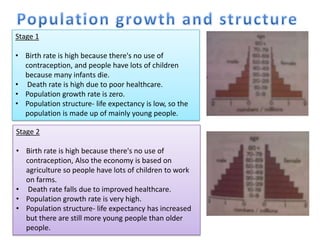
Population growth and structureStage 1Birth rate is high because there's no use of contraception, and people have lots of children because many infants die.
 Death rate is high due to poor healthcare.
Population growth rate is zero.
Population structure- life expectancy is low, so the population is made up of mainly young people.Stage 2Birth rate is high because there's no use of contraception, Also the economy is based on agriculture so people have lots of children to work on farms.
 Death rate falls due to improved healthcare.
Population growth rate is very high.
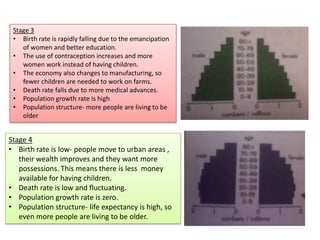
Population structure- life expectancy has increased but there are still more young people than older people.Stage 3Birth rate is rapidly falling due to the emancipation of women and better education.
The use of contraception increases and more women work instead of having children.
The economy also changes to manufacturing, so fewer children are needed to work on farms.
Death rate falls due to more medical advances.
Population growth rate is high
Population structure- more people are living to be olderStage 4Birth rate is low- people move to urban areas , their wealth improves and they want more possessions. This means there is less  money available for having children.
Death rate is low and fluctuating.
Population growth rate is zero.
Population structure- life expectancy is high, so even more people are living to be older.
Managing rapid population growthRapid population growth has social, economic and political impacts.PoliticalMost of the population is made up of young people so the government focuses on policies that are important to young people e.g. education and provision of things such as childcare.
There are fewer older people so the government doesn’t have to focus on policies that are important to older people e.g. pensions.
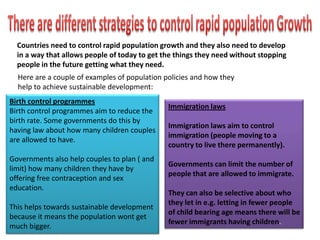
The government has to make policies to bring population growth under control so the social and economic impacts of rapid population growth don’t get any worse.SocialServices like healthcare and education cant cope with the rapid increase in population , so not everyone has access to them.
Children have to work to help support their large families , so they miss out on education.
There aren't enough houses for everyone, so people are forced to live in  makeshift houses in overcrowded settlements. This leads to health problems because the houses aren't always connected to sewers or they don’t have access to clean water.
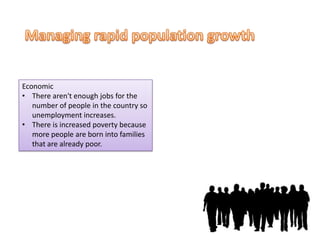
There are food shortages if the country cant grow or import enough food for the population.EconomicThere aren't enough jobs for the number of people in the country so unemployment increases.

Population ppt

  • 1.
  • 2.
    Population GrowthThe worldspopulation is growing rapidlyThe population of the world is growing at an exponential rate- its growing faster and faster.There are two things that affect the population size of the world:Birth rate- the number of live babies born per thousand of the population per year.Death rate-the number of deaths per thousand of the population per year.When the birth rate is higher than the death rate, more people are being born than are dying, so the population growsThis is called Natural increaseWhen the death rate is higher than the birth rate it is called the natural decrease.
  • 3.
    Countries go throughfive stages of population growthThese are shown by the Demographic transition model (DTM)Poorer, less developed countries are in the earlier stages of the DTM, whilst richer more developed countries are in the later stages.
  • 4.
    Population growth andstructureStage 1Birth rate is high because there's no use of contraception, and people have lots of children because many infants die.
  • 5.
    Death rateis high due to poor healthcare.
  • 6.
  • 7.
    Population structure- lifeexpectancy is low, so the population is made up of mainly young people.Stage 2Birth rate is high because there's no use of contraception, Also the economy is based on agriculture so people have lots of children to work on farms.
  • 8.
    Death ratefalls due to improved healthcare.
  • 9.
  • 10.
    Population structure- lifeexpectancy has increased but there are still more young people than older people.Stage 3Birth rate is rapidly falling due to the emancipation of women and better education.
  • 11.
    The use ofcontraception increases and more women work instead of having children.
  • 12.
    The economy alsochanges to manufacturing, so fewer children are needed to work on farms.
  • 13.
    Death rate fallsdue to more medical advances.
  • 14.
  • 15.
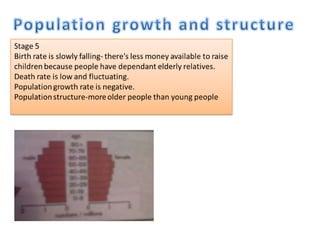
    Population structure- morepeople are living to be olderStage 4Birth rate is low- people move to urban areas , their wealth improves and they want more possessions. This means there is less money available for having children.
  • 16.
    Death rate islow and fluctuating.
  • 17.
  • 18.
    Population structure- lifeexpectancy is high, so even more people are living to be older.
  • 19.
    Managing rapid populationgrowthRapid population growth has social, economic and political impacts.PoliticalMost of the population is made up of young people so the government focuses on policies that are important to young people e.g. education and provision of things such as childcare.
  • 20.
    There are fewerolder people so the government doesn’t have to focus on policies that are important to older people e.g. pensions.
  • 21.
    The government hasto make policies to bring population growth under control so the social and economic impacts of rapid population growth don’t get any worse.SocialServices like healthcare and education cant cope with the rapid increase in population , so not everyone has access to them.
  • 22.
    Children have towork to help support their large families , so they miss out on education.
  • 23.
    There aren't enoughhouses for everyone, so people are forced to live in makeshift houses in overcrowded settlements. This leads to health problems because the houses aren't always connected to sewers or they don’t have access to clean water.
  • 24.
    There are foodshortages if the country cant grow or import enough food for the population.EconomicThere aren't enough jobs for the number of people in the country so unemployment increases.