DEPTH STUDY
WEIMAR REPUBLIC
THE BEER HALL
PUTSCH 1923
06
CAMBRIDGE IGCSE – DEPTH STUDY: GERMANY
HITLER’S PLAN TO TAKE OVER
• In November 1923,
Hitler planned to take
over the government
in Bavaria, as a start
towards
overthrowing the
Weimar Republic.
• He hoped to force the
rightwing State
Commissioner of
Bavaria, von Kahr,
and General von
Lossow (the Army
commander) to
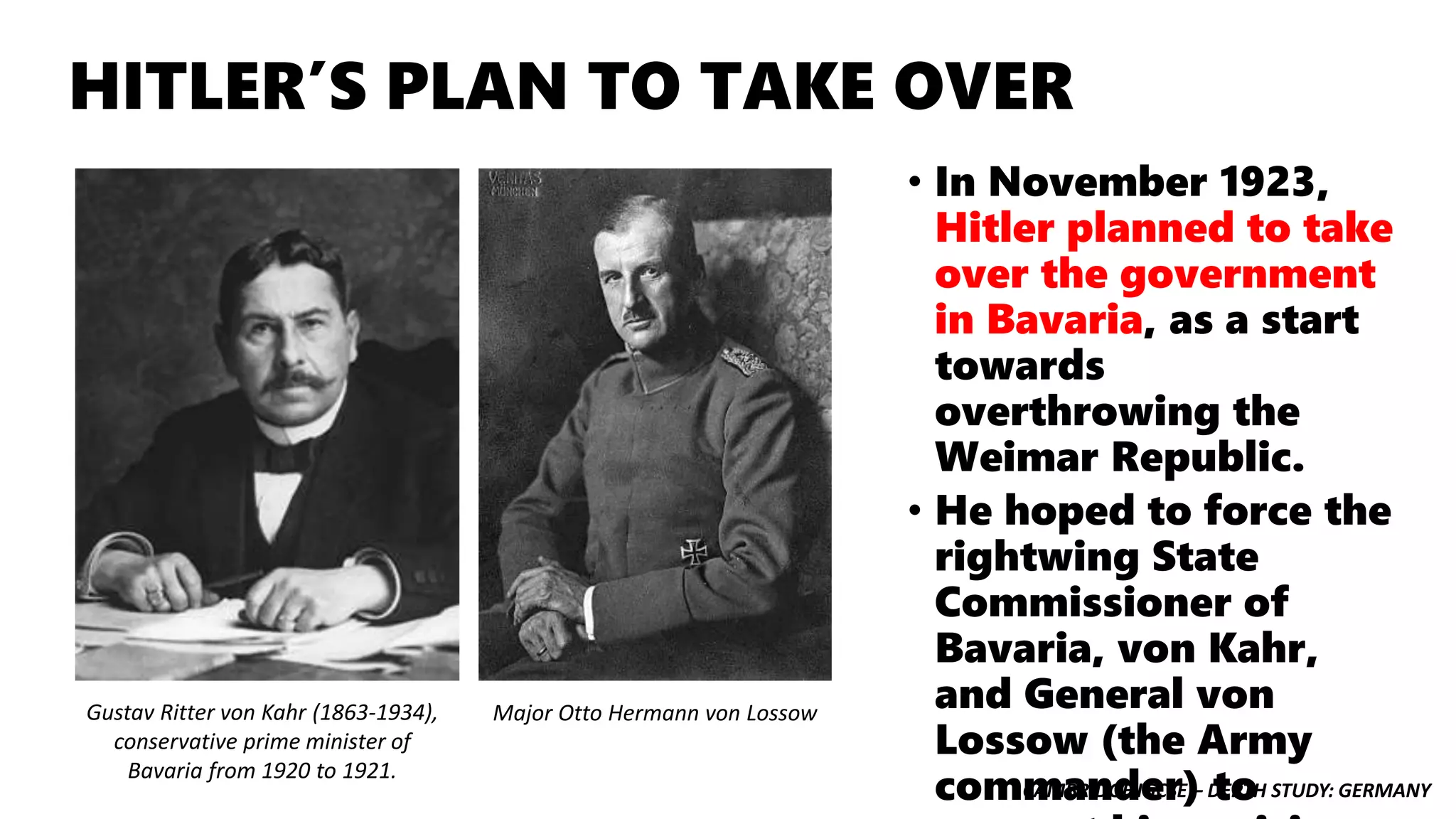
Gustav Ritter von Kahr (1863-1934),
conservative prime minister of
Bavaria from 1920 to 1921.
Major Otto Hermann von Lossow
CAMBRIDGE IGCSE – DEPTH STUDY: GERMANY
TAKING ADVANTAGE OF THE
INFLATION
• In November 1923, Hitler tried to take advantage of the
hyperinflation crisis facing the Weimar government by trying
to launch a revolution in Munich – known as the Munich
Putsch.
• It seemed like the perfect opportunity to take power, but poor
planning and misjudgement resulted in failure and the
subsequent imprisonment of Adolf Hitler.
CAMBRIDGE IGCSE – DEPTH STUDY: GERMANY
CAUSES OF THE PUTSCH
• By 1923, the Nazi party had 55,000 members and was stronger
than ever before.
• The Weimar Republic was in crisis due to hyperinflation.
• In September 1923, the Weimar government had called off the
general strike, and German nationalists were furious with the
government.
• Hitler thought he would be helped by important nationalist
politicians in Bavaria.
• Hitler had a huge army of SA members, but he knew he would
lose control of them if he did not give them something to do.
• Hitler hoped to copy Mussolini - the Italian fascist leader -
who had come to power in Italy in 1922 by marching on Rome.
CAMBRIDGE IGCSE – DEPTH STUDY: GERMANY
THE OPPORTUNITY
• During the hyperinflation crisis of 1923, Hitler saw an
opportunity.
• People across the country had many different ideas about how
Germany was being run.
• The individual states had different identities that affected
how politics was run in that area.
• In Bavaria, (capital – Munich) the majority of the population
were Catholic, and things were quite traditional.
• This meant that many disliked the new Weimar government
and saw them as weak. Hitler thought he would take
advantage of this and plotted with two nationalist politicians -
Kahr and Lossow - to take over Munich in a revolution.
• Hitler collected the SA and told them to be ready to rebel.
CAMBRIDGE IGCSE – DEPTH STUDY: GERMANY
CALLING OFF THE REBELLION
• But then, on 4 October 1923, Kahr and Lossow called off the
rebellion. This was an impossible situation for Hitler, who had
3,000 troops ready to fight.
• On the night of 8 November 1923, Hitler and 600 SA members
burst into a meeting that Kahr and Lossow were holding at the
local Beer Hall. Waving a gun at them, Hitler forced them to
agree to rebel - and then let them go home. The SA took over
the army headquarters and the offices of the local newspaper.
• The next day, 9 November 1923, Hitler and the SA went into
Munich on what they thought would be a triumphal march to
take power. However, Kahr had called in police and army
reinforcements. There was a short scuffle in which the police
killed 16 members of the SA.
• Hitler fled, but was arrested two days later.
CAMBRIDGE IGCSE – DEPTH STUDY: GERMANY
SHORT-TERM CONSEQUENCES
The Munich Putsch was a failure in the short term, but it was
also an important event in the Nazis’ rise to power. As a result
of the Putsch:
• The Nazi party was banned, and Hitler was prevented from
speaking in public until 1927.
• Hitler was tried for high treason (betraying his country) and
sentenced to five years in prison.
CAMBRIDGE IGCSE – DEPTH STUDY: GERMANY
LONG-TERM CONSEQUENCES
• He was sentenced in April and out of prison by December.
• During his time in the comfortable Landsberg Prison, he wrote
'Mein Kampf' – a propaganda book setting out Nazi beliefs.
• Millions of Germans read it, and Hitler's ideas became very
well-known.
• The fact that the judge had been so lenient with the sentence
and that Hitler had served so little time suggests that some
people in authority had sympathy with Hitler and what he had
tried to do.
• Hitler realised that he would never come to power by
revolution and that he would have to use democratic means,
so he reorganised the party to enable it to take part in
elections.
CAMBRIDGE IGCSE – DEPTH STUDY: GERMANY

DEPTH STUDY GERMANY: WEIMAR REPUBLIC - 06. THE BEER HALL PUTSCH 1923

  • 1.
    DEPTH STUDY WEIMAR REPUBLIC THEBEER HALL PUTSCH 1923 06
  • 2.
    CAMBRIDGE IGCSE –DEPTH STUDY: GERMANY HITLER’S PLAN TO TAKE OVER • In November 1923, Hitler planned to take over the government in Bavaria, as a start towards overthrowing the Weimar Republic. • He hoped to force the rightwing State Commissioner of Bavaria, von Kahr, and General von Lossow (the Army commander) to Gustav Ritter von Kahr (1863-1934), conservative prime minister of Bavaria from 1920 to 1921. Major Otto Hermann von Lossow
  • 3.
    CAMBRIDGE IGCSE –DEPTH STUDY: GERMANY TAKING ADVANTAGE OF THE INFLATION • In November 1923, Hitler tried to take advantage of the hyperinflation crisis facing the Weimar government by trying to launch a revolution in Munich – known as the Munich Putsch. • It seemed like the perfect opportunity to take power, but poor planning and misjudgement resulted in failure and the subsequent imprisonment of Adolf Hitler.
  • 4.
    CAMBRIDGE IGCSE –DEPTH STUDY: GERMANY CAUSES OF THE PUTSCH • By 1923, the Nazi party had 55,000 members and was stronger than ever before. • The Weimar Republic was in crisis due to hyperinflation. • In September 1923, the Weimar government had called off the general strike, and German nationalists were furious with the government. • Hitler thought he would be helped by important nationalist politicians in Bavaria. • Hitler had a huge army of SA members, but he knew he would lose control of them if he did not give them something to do. • Hitler hoped to copy Mussolini - the Italian fascist leader - who had come to power in Italy in 1922 by marching on Rome.
  • 5.
    CAMBRIDGE IGCSE –DEPTH STUDY: GERMANY THE OPPORTUNITY • During the hyperinflation crisis of 1923, Hitler saw an opportunity. • People across the country had many different ideas about how Germany was being run. • The individual states had different identities that affected how politics was run in that area. • In Bavaria, (capital – Munich) the majority of the population were Catholic, and things were quite traditional. • This meant that many disliked the new Weimar government and saw them as weak. Hitler thought he would take advantage of this and plotted with two nationalist politicians - Kahr and Lossow - to take over Munich in a revolution. • Hitler collected the SA and told them to be ready to rebel.
  • 6.
    CAMBRIDGE IGCSE –DEPTH STUDY: GERMANY CALLING OFF THE REBELLION • But then, on 4 October 1923, Kahr and Lossow called off the rebellion. This was an impossible situation for Hitler, who had 3,000 troops ready to fight. • On the night of 8 November 1923, Hitler and 600 SA members burst into a meeting that Kahr and Lossow were holding at the local Beer Hall. Waving a gun at them, Hitler forced them to agree to rebel - and then let them go home. The SA took over the army headquarters and the offices of the local newspaper. • The next day, 9 November 1923, Hitler and the SA went into Munich on what they thought would be a triumphal march to take power. However, Kahr had called in police and army reinforcements. There was a short scuffle in which the police killed 16 members of the SA. • Hitler fled, but was arrested two days later.
  • 7.
    CAMBRIDGE IGCSE –DEPTH STUDY: GERMANY SHORT-TERM CONSEQUENCES The Munich Putsch was a failure in the short term, but it was also an important event in the Nazis’ rise to power. As a result of the Putsch: • The Nazi party was banned, and Hitler was prevented from speaking in public until 1927. • Hitler was tried for high treason (betraying his country) and sentenced to five years in prison.
  • 8.
    CAMBRIDGE IGCSE –DEPTH STUDY: GERMANY LONG-TERM CONSEQUENCES • He was sentenced in April and out of prison by December. • During his time in the comfortable Landsberg Prison, he wrote 'Mein Kampf' – a propaganda book setting out Nazi beliefs. • Millions of Germans read it, and Hitler's ideas became very well-known. • The fact that the judge had been so lenient with the sentence and that Hitler had served so little time suggests that some people in authority had sympathy with Hitler and what he had tried to do. • Hitler realised that he would never come to power by revolution and that he would have to use democratic means, so he reorganised the party to enable it to take part in elections.
  • 9.
    CAMBRIDGE IGCSE –DEPTH STUDY: GERMANY