Telephoning at Work
Week 3
Workplace Communications
Listen to a
voicemail
Ask for
information
Sound
friendly
AGENDA
Clarify
information
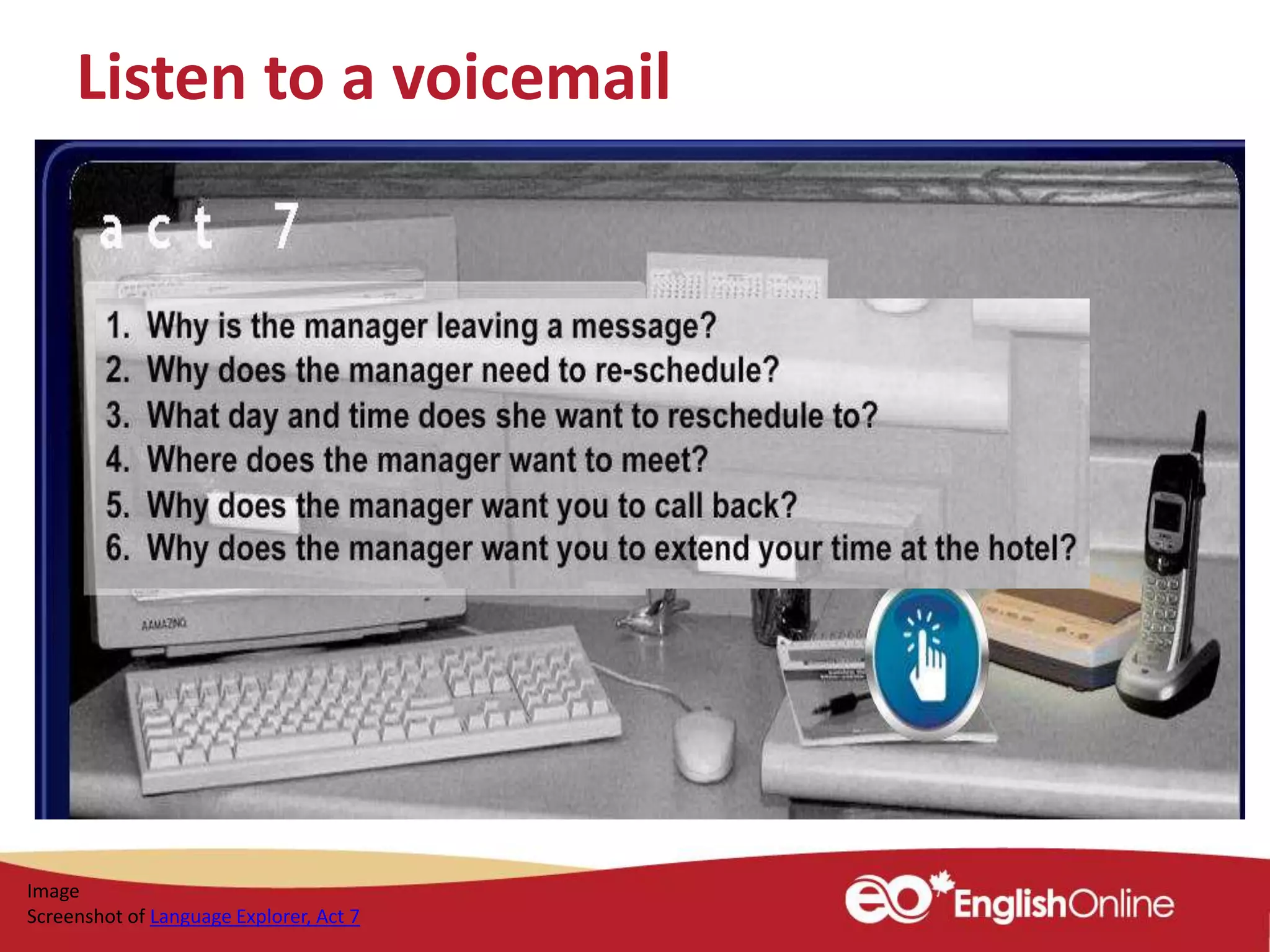
Listen to a voicemail
Image
Screenshot of Language Explorer, Act 7
Listen to a
voicemail
Some common, formal
expressions are used in
this voice message.
Listen again and try to
make notes.
..at your earliest convenience….
would be greatly appreciated…..
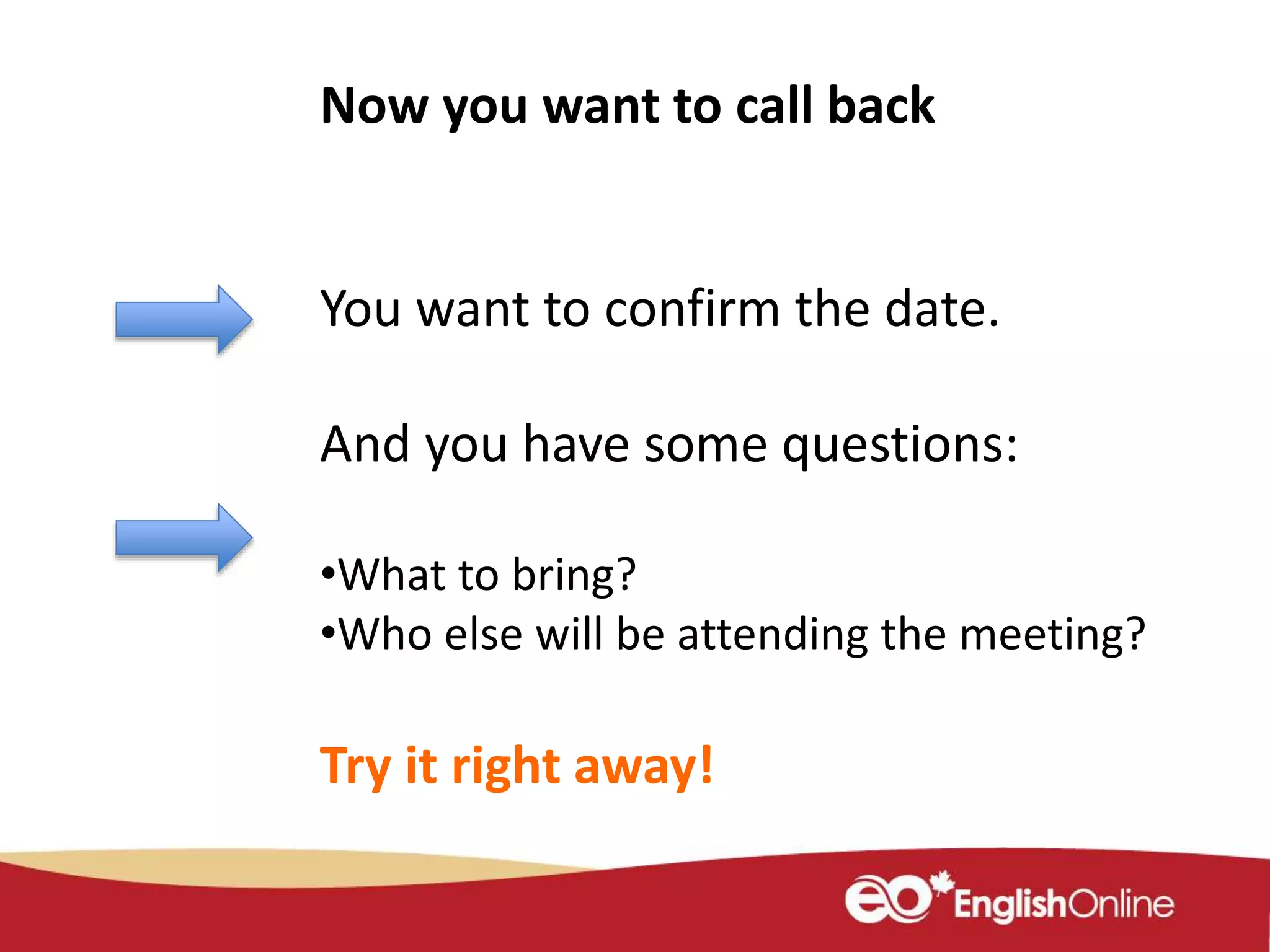
Now you want to call back
You want to confirm the date.
And you have some questions:
•What to bring?
•Who else will be attending the meeting?
Try it right away!
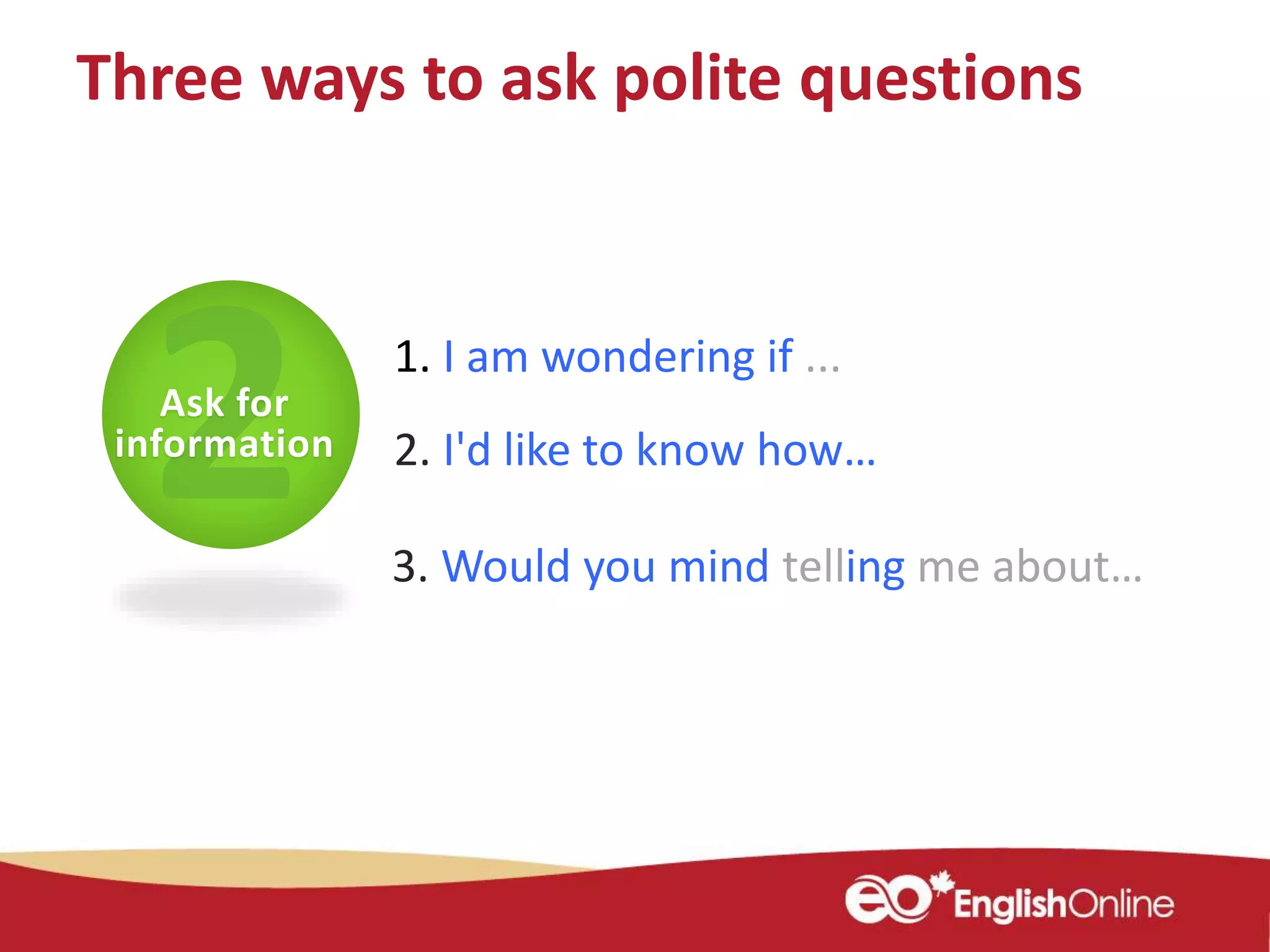
1. I am wondering if ...
Ask for
information
Three ways to ask polite questions
3. Would you mind telling me about…
2. I'd like to know how…
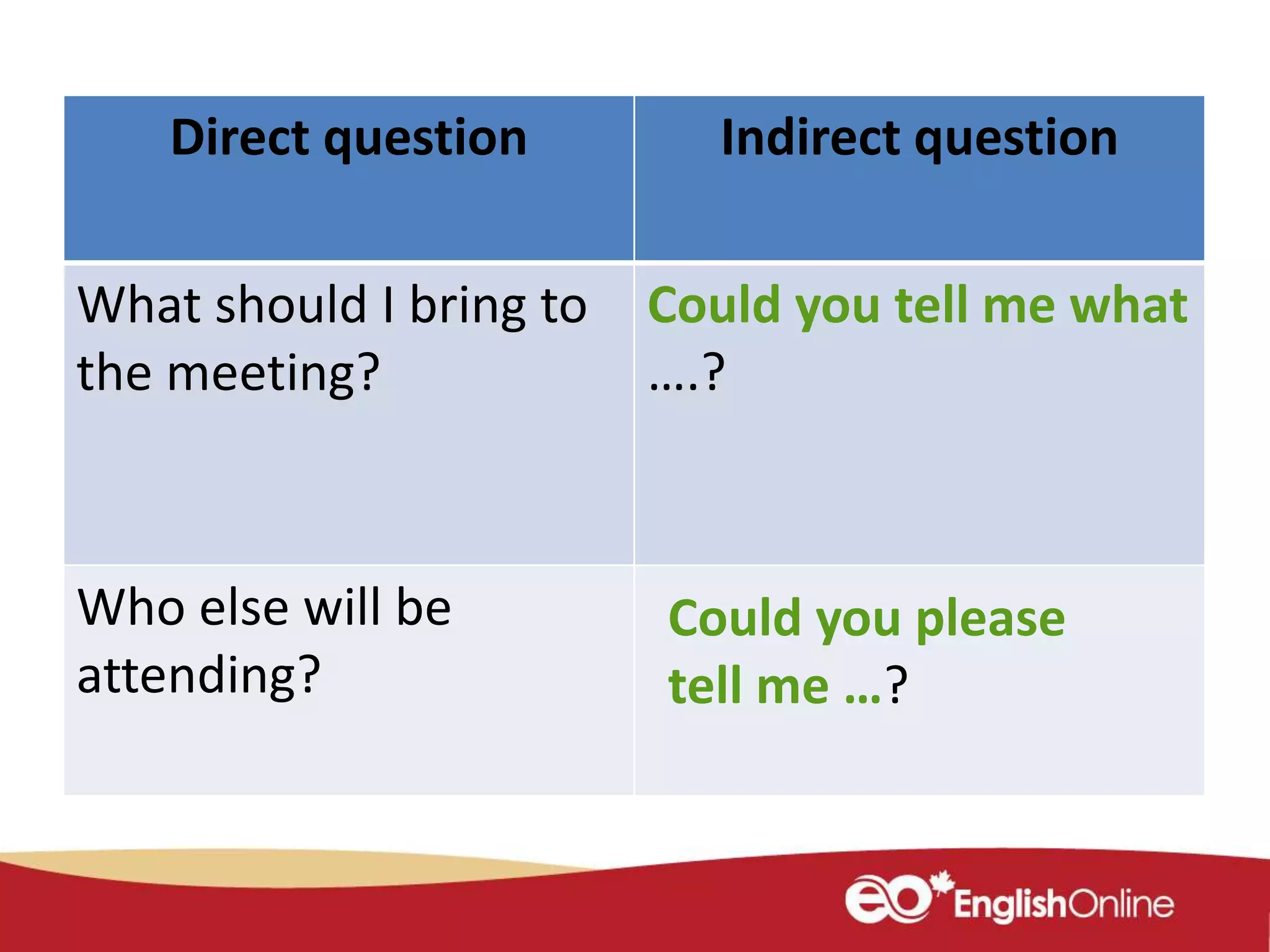
Direct question Indirect question
What should I bring to
the meeting?
Could you tell me what
….?
Who else will be
attending?
Could you please
tell me …?
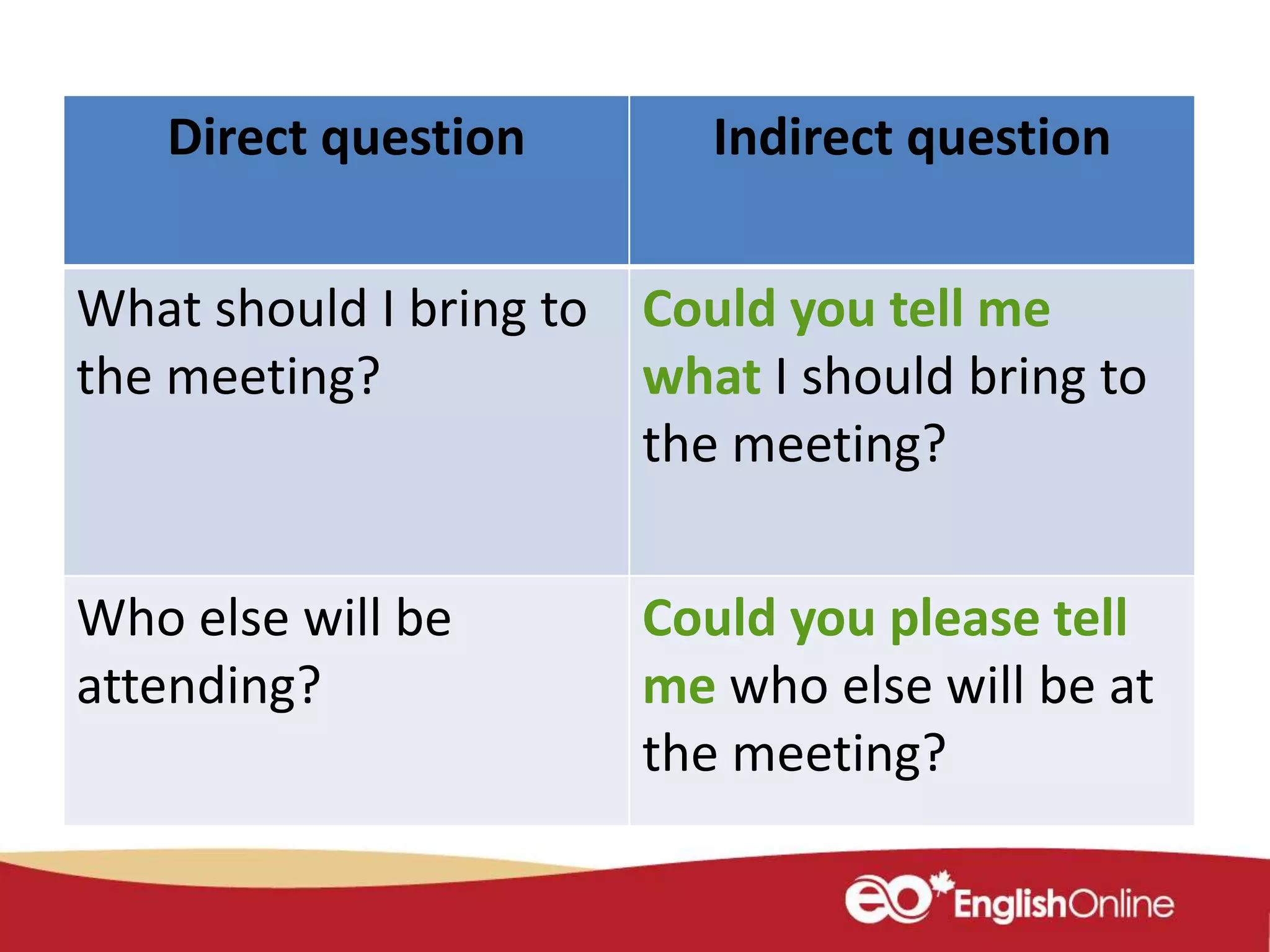
Direct question Indirect question
What should I bring to
the meeting?
Could you tell me
what I should bring to
the meeting?
Who else will be
attending?
Could you please tell
me who else will be at
the meeting?
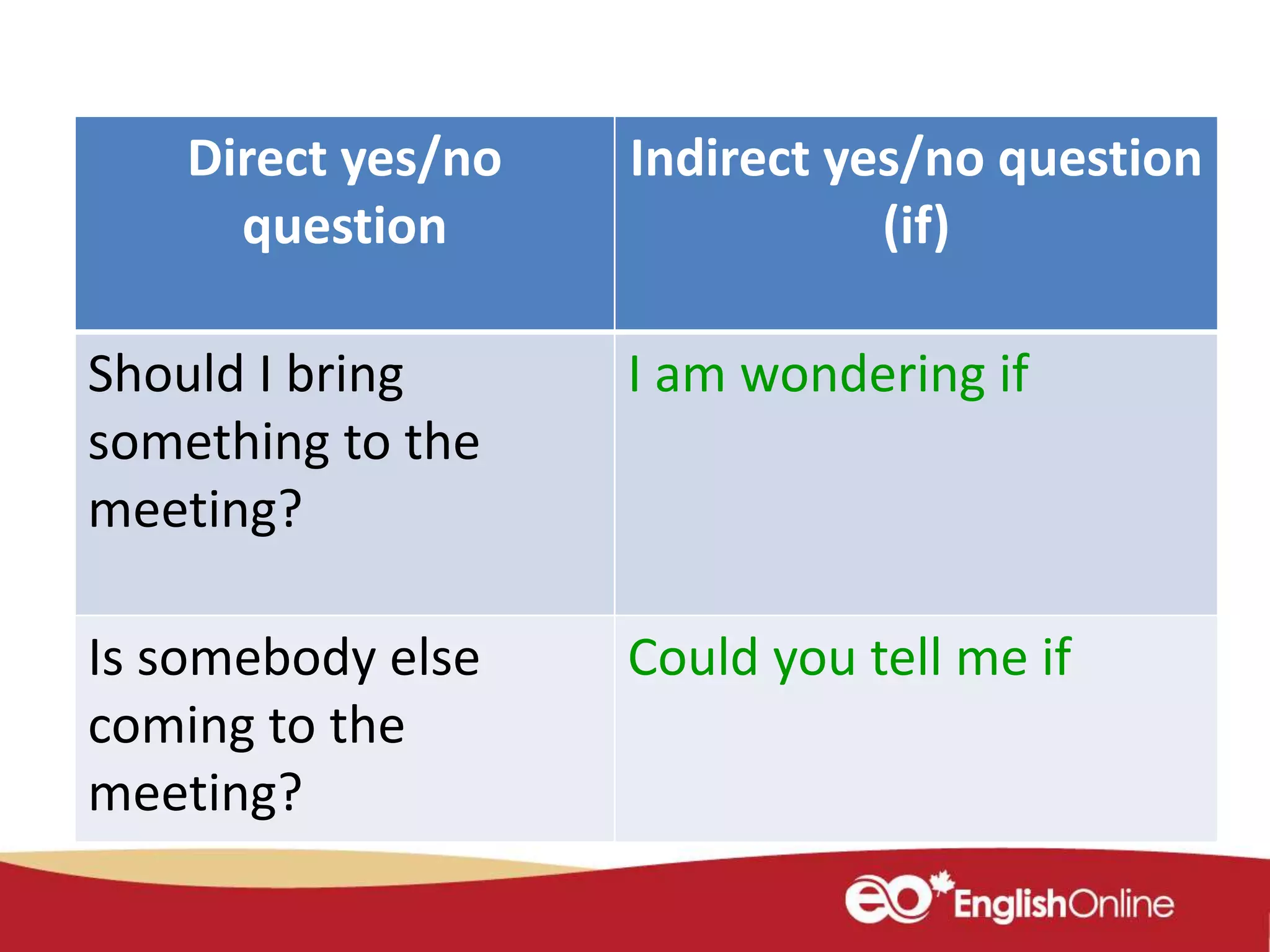
Direct yes/no
question
Indirect yes/no question
(if)
Should I bring
something to the
meeting?
I am wondering if
Is somebody else
coming to the
meeting?
Could you tell me if
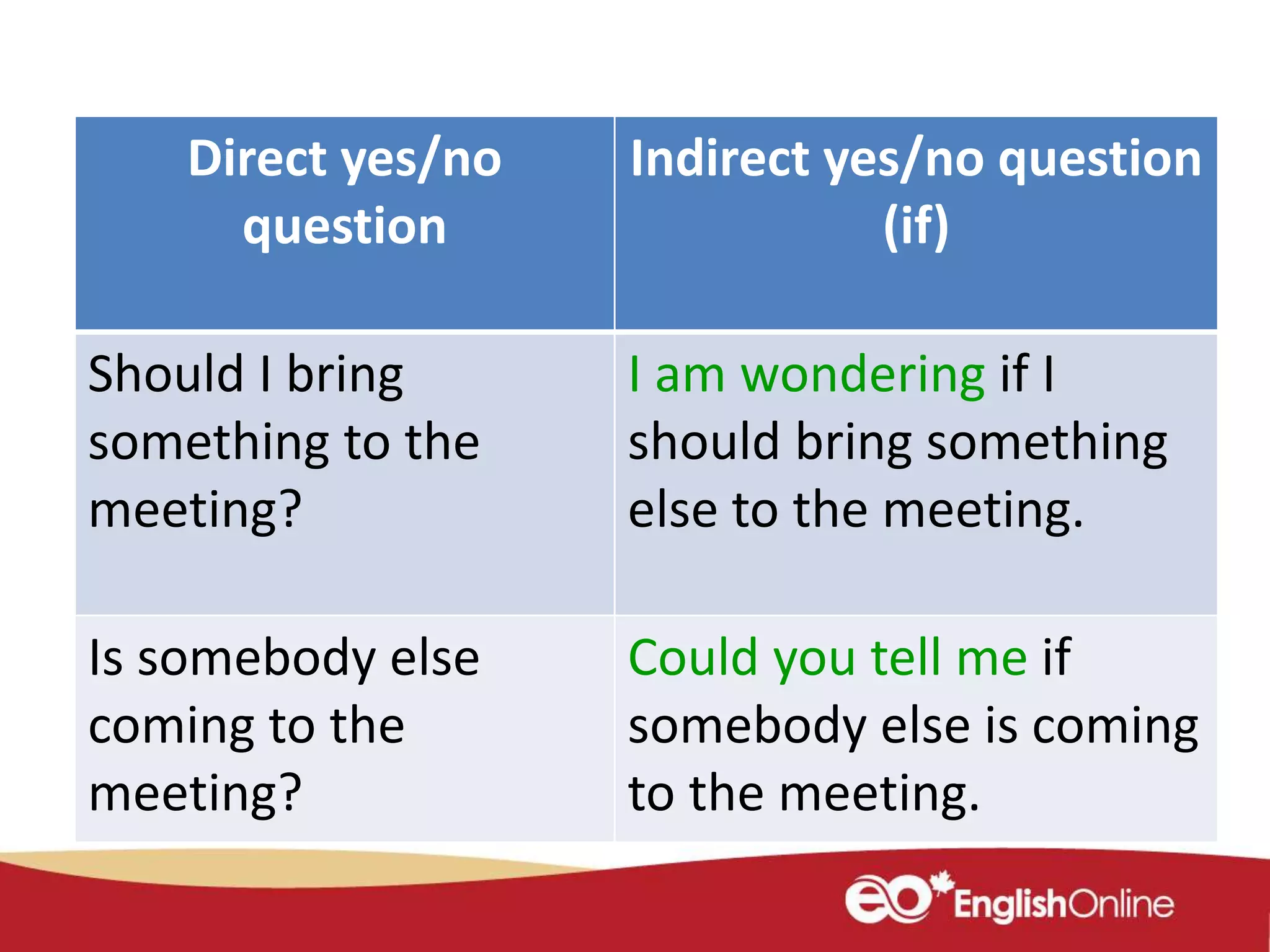
Direct yes/no
question
Indirect yes/no question
(if)
Should I bring
something to the
meeting?
I am wondering if I
should bring something
else to the meeting.
Is somebody else
coming to the
meeting?
Could you tell me if
somebody else is coming
to the meeting.
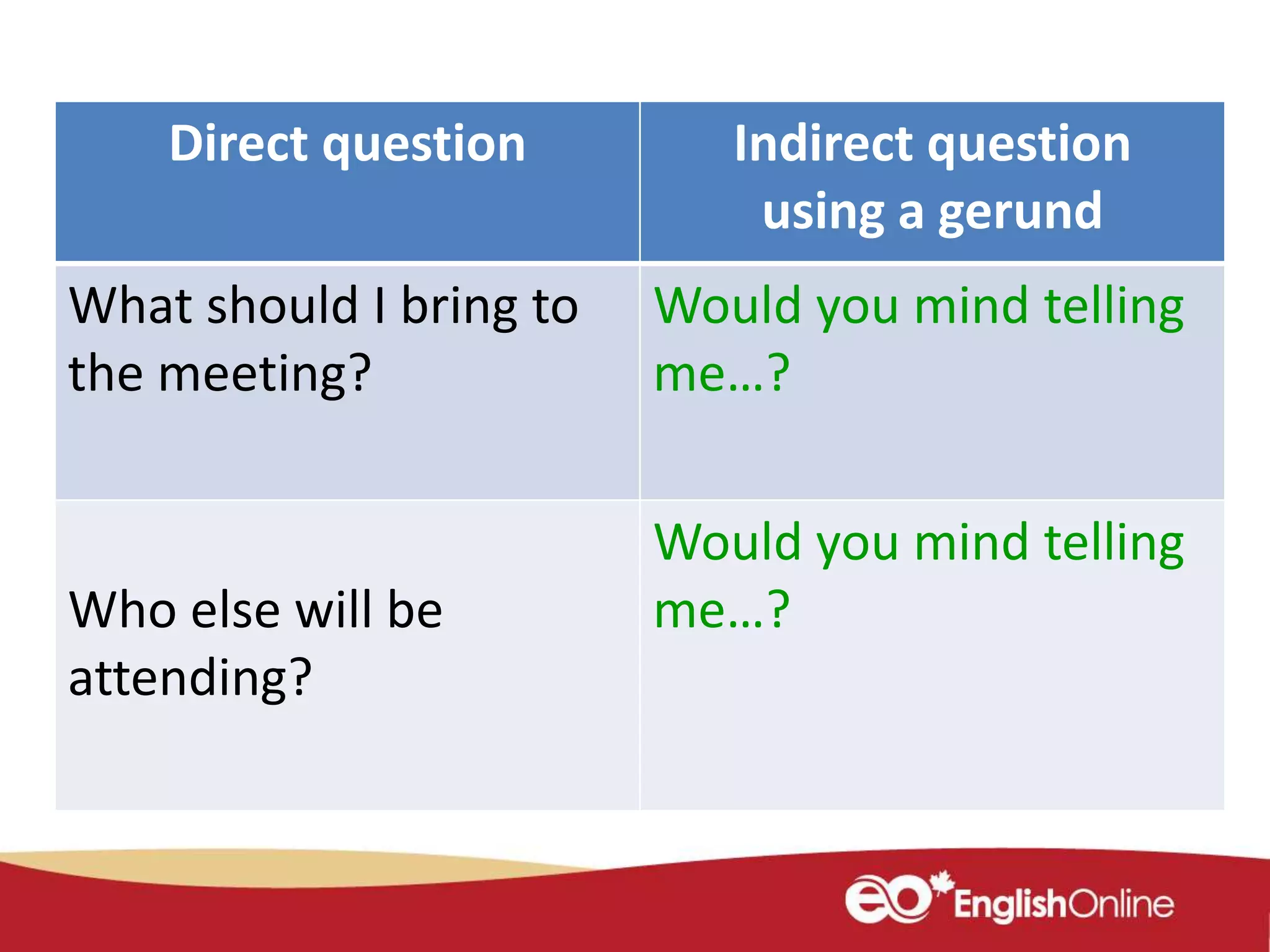
Direct question Indirect question
using a gerund
What should I bring to
the meeting?
Would you mind telling
me…?
Who else will be
attending?
Would you mind telling
me…?
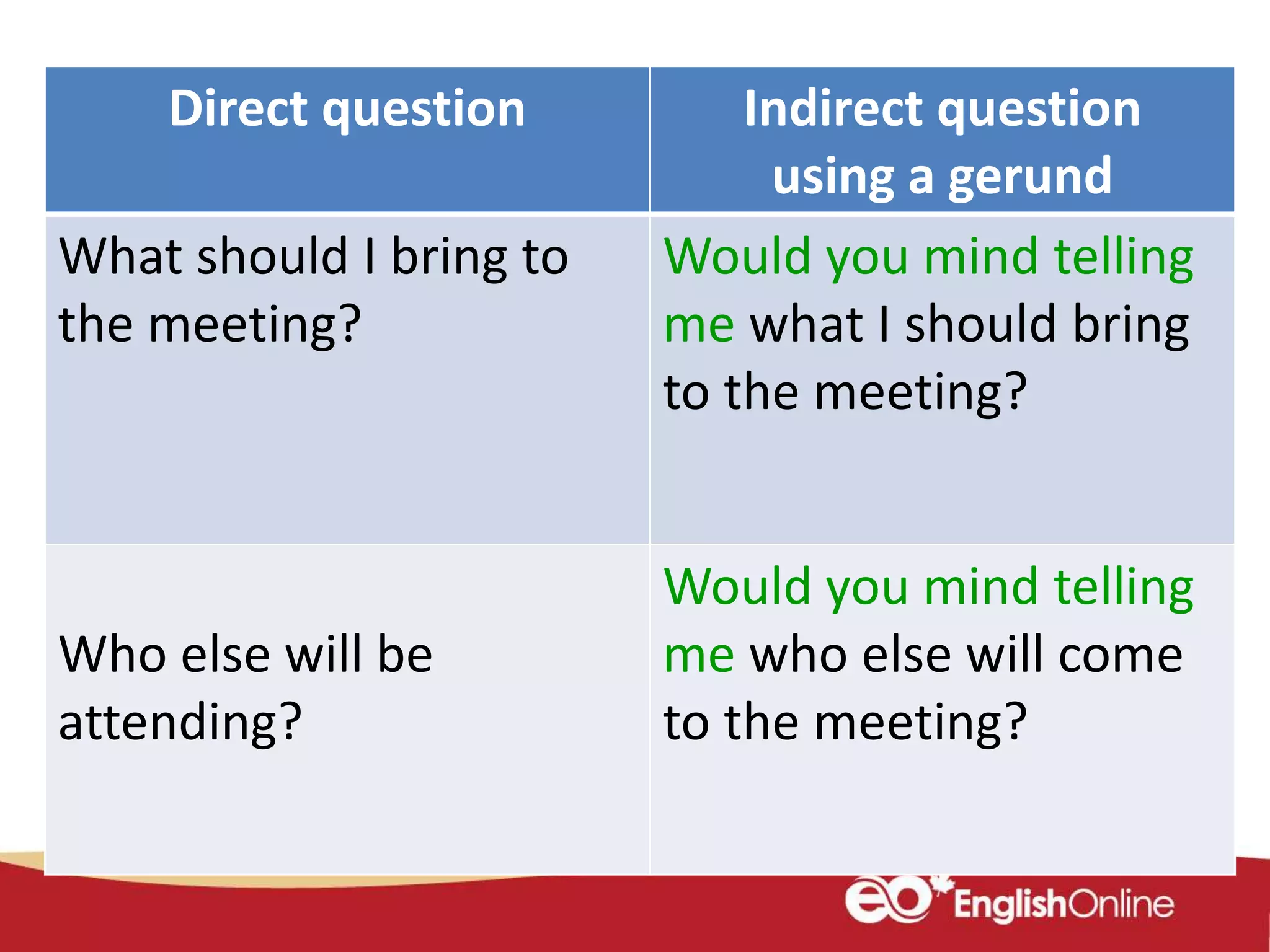
Direct question Indirect question
using a gerund
What should I bring to
the meeting?
Would you mind telling
me what I should bring
to the meeting?
Who else will be
attending?
Would you mind telling
me who else will come
to the meeting?
Listen to the recording:
• What polite question
did Sophia use?
Ask for
information
You are an office
administrator. Last week you
ordered a new laptop.
You want to call the computer
company and ask them when
it will be delivered.
Ask for
information
Let’s practise
You have an important
appointment tomorrow.
Call your colleague and ask
her if she can take over your
shift.
Ask for
information
Let’s practise
Clarify
information
Listen to the recording
one more time:
• What strategy is used
by Sophia to make sure
she understood
everything?
Clarify information
Clarify
information
Do you have any strategies
you use when phoning
somebody to make sure
that you understood
everything?
Let’s practise
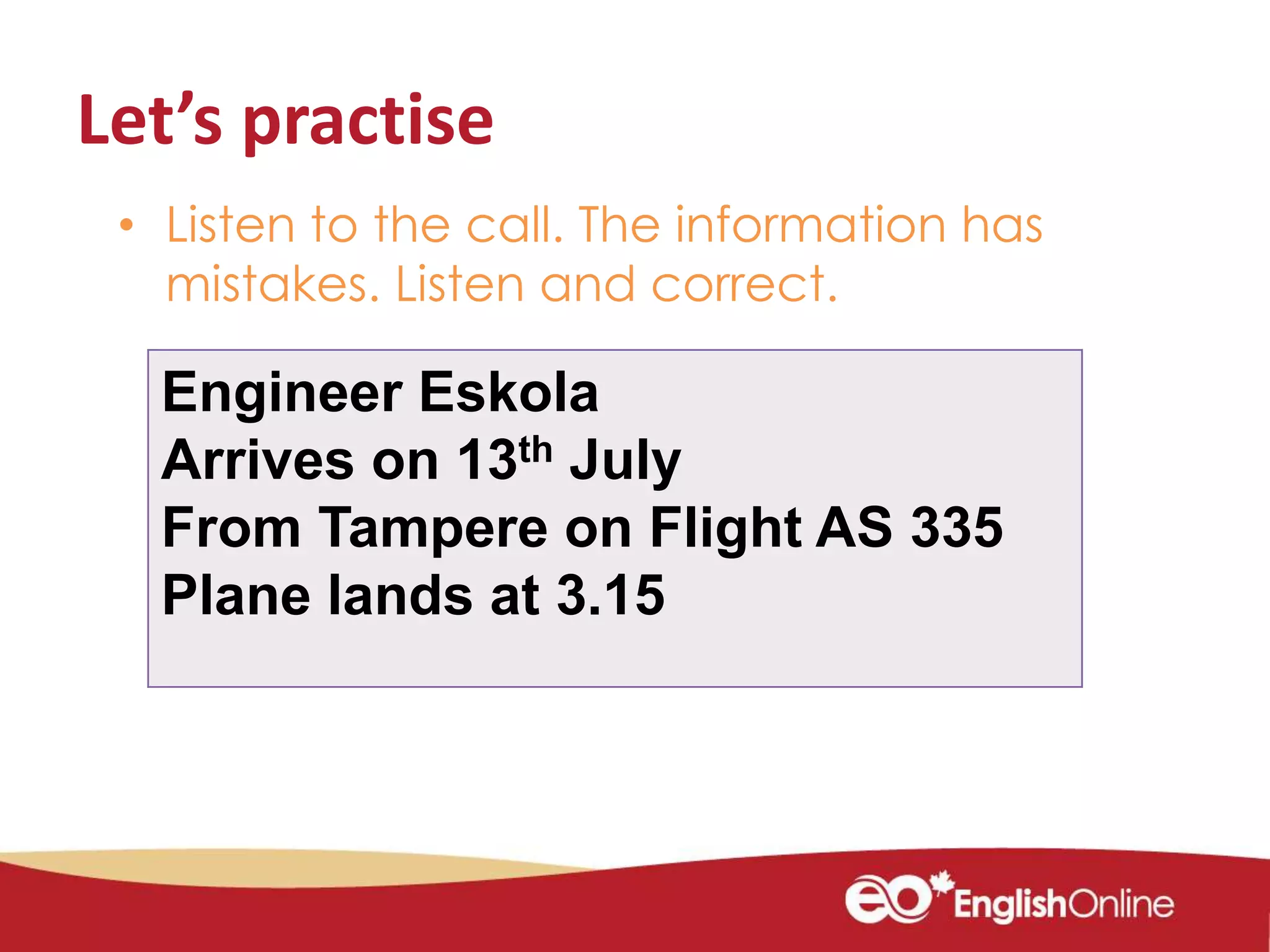
• Listen to the call. The information has
mistakes. Listen and correct.
Engineer Eskola
Arrives on 13th July
From Tampere on Flight AS 335
Plane lands at 3.15
Listening
• Listen to the call. The information has
mistakes. Listen and correct.
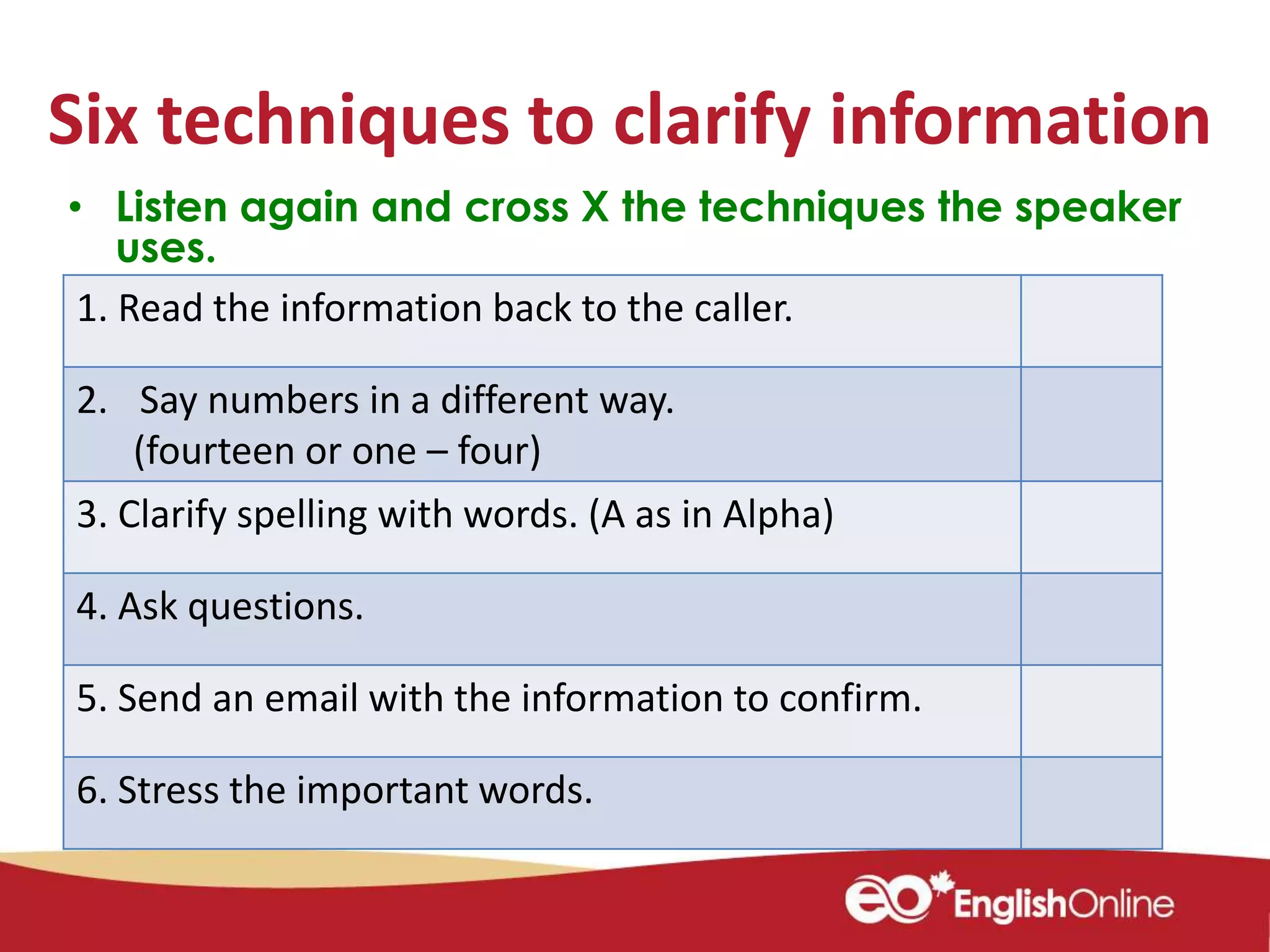
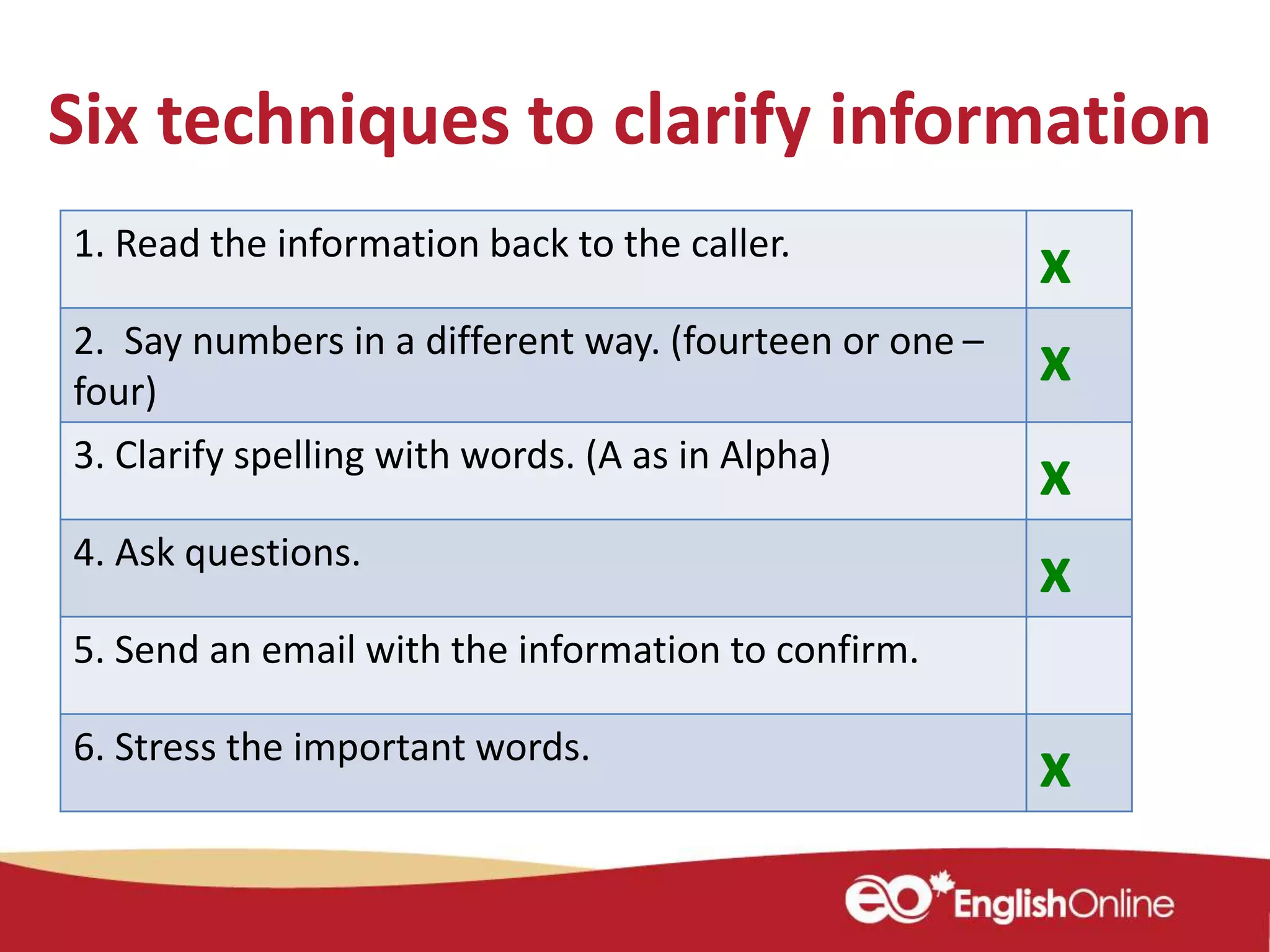
Six techniques to clarify information
• Listen again and cross X the techniques the speaker
uses.
1. Read the information back to the caller.
2. Say numbers in a different way.
(fourteen or one – four)
3. Clarify spelling with words. (A as in Alpha)
4. Ask questions.
5. Send an email with the information to confirm.
6. Stress the important words.
1. Read the information back to the caller.
x
2. Say numbers in a different way. (fourteen or one –
four)
x
3. Clarify spelling with words. (A as in Alpha)
x
4. Ask questions.
x
5. Send an email with the information to confirm.
6. Stress the important words.
x
Six techniques to clarify information
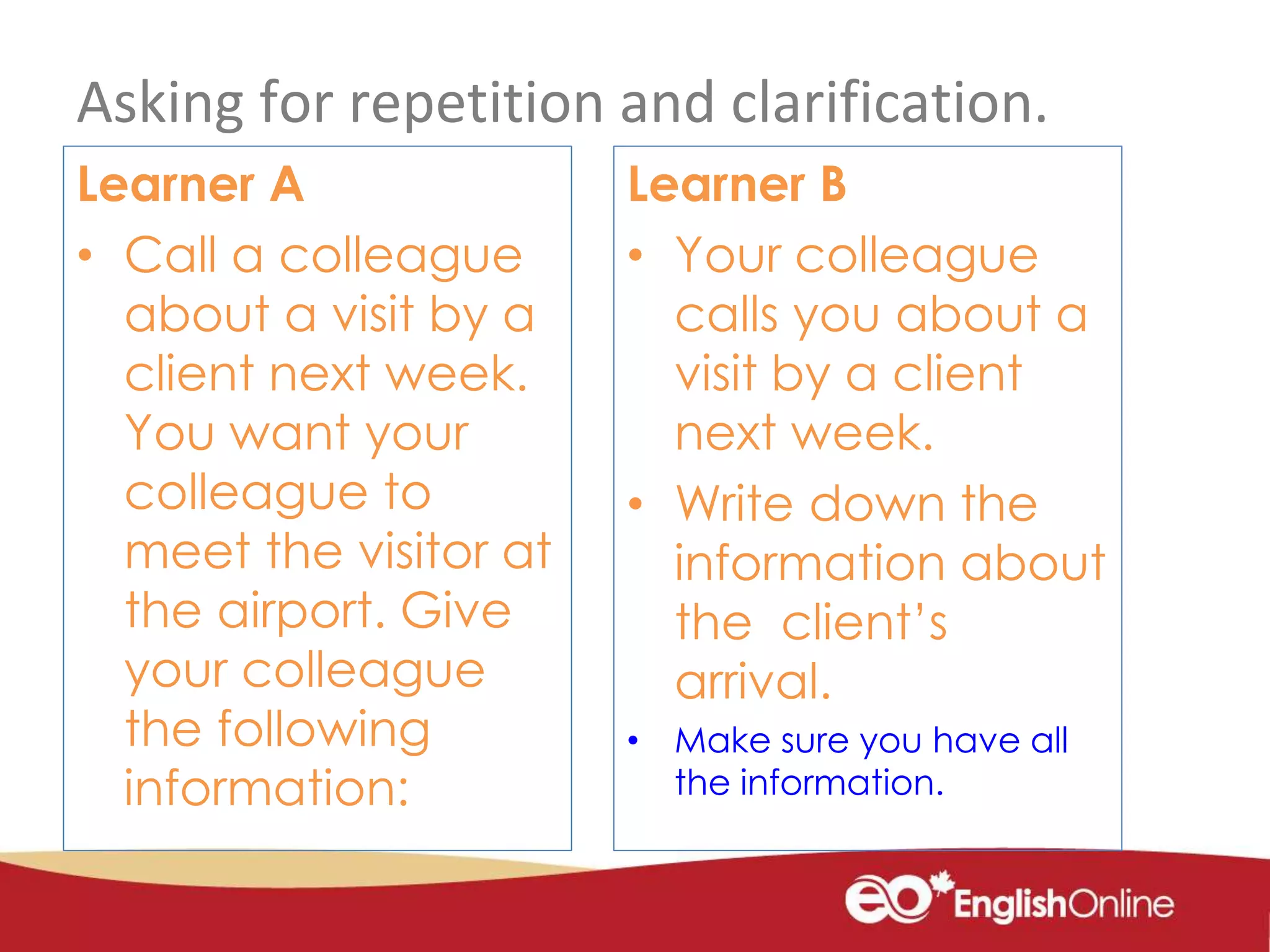
Asking for repetition and clarification.
Learner A
• Call a colleague
about a visit by a
client next week.
You want your
colleague to
meet the visitor at
the airport. Give
your colleague
the following
information:
Learner B
• Your colleague
calls you about a
visit by a client
next week.
• Write down the
information about
the client’s
arrival.
• Make sure you have all
the information.
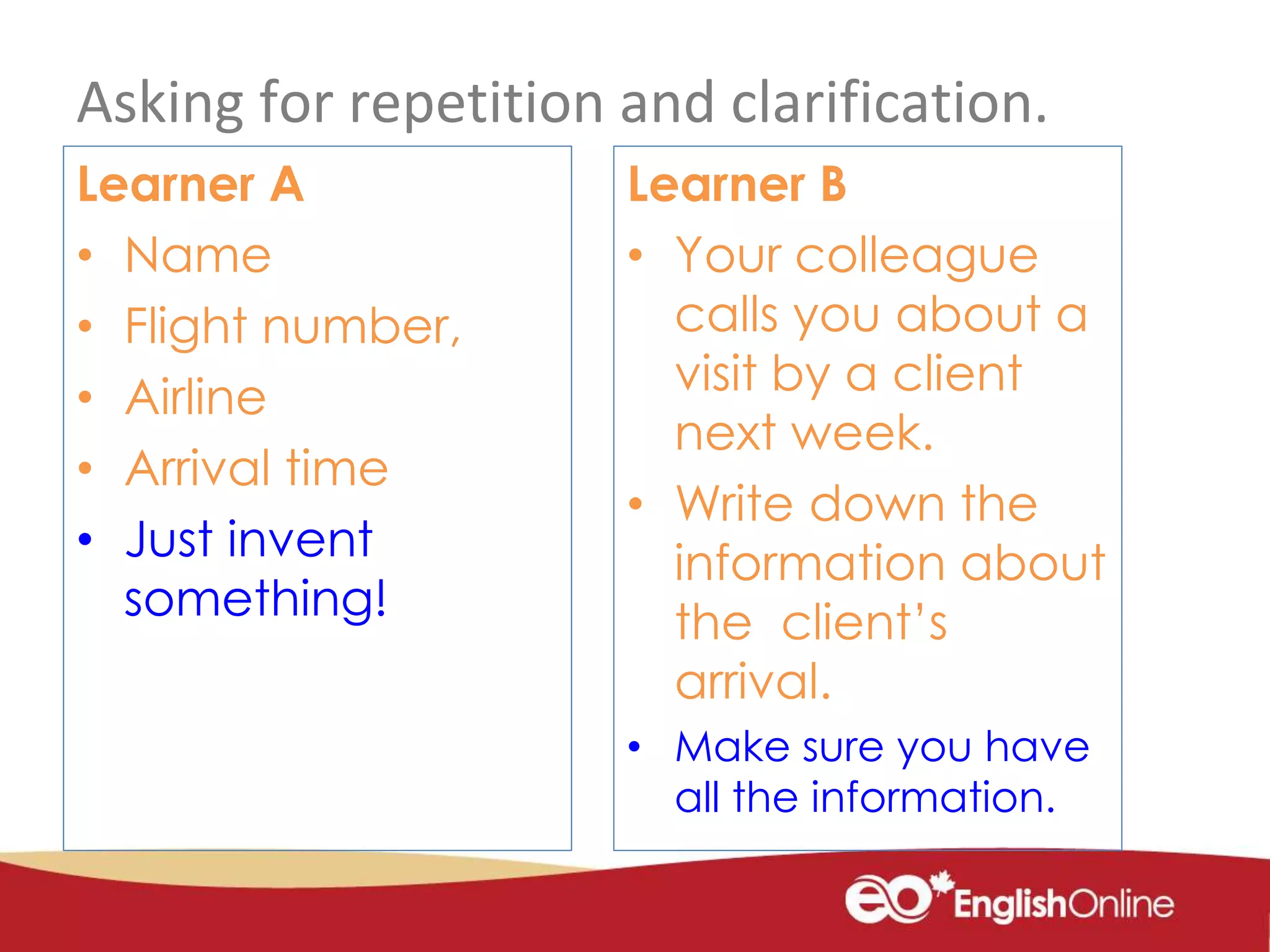
Asking for repetition and clarification.
Learner A
• Name
• Flight number,
• Airline
• Arrival time
• Just invent
something!
Learner B
• Your colleague
calls you about a
visit by a client
next week.
• Write down the
information about
the client’s
arrival.
• Make sure you have
all the information.
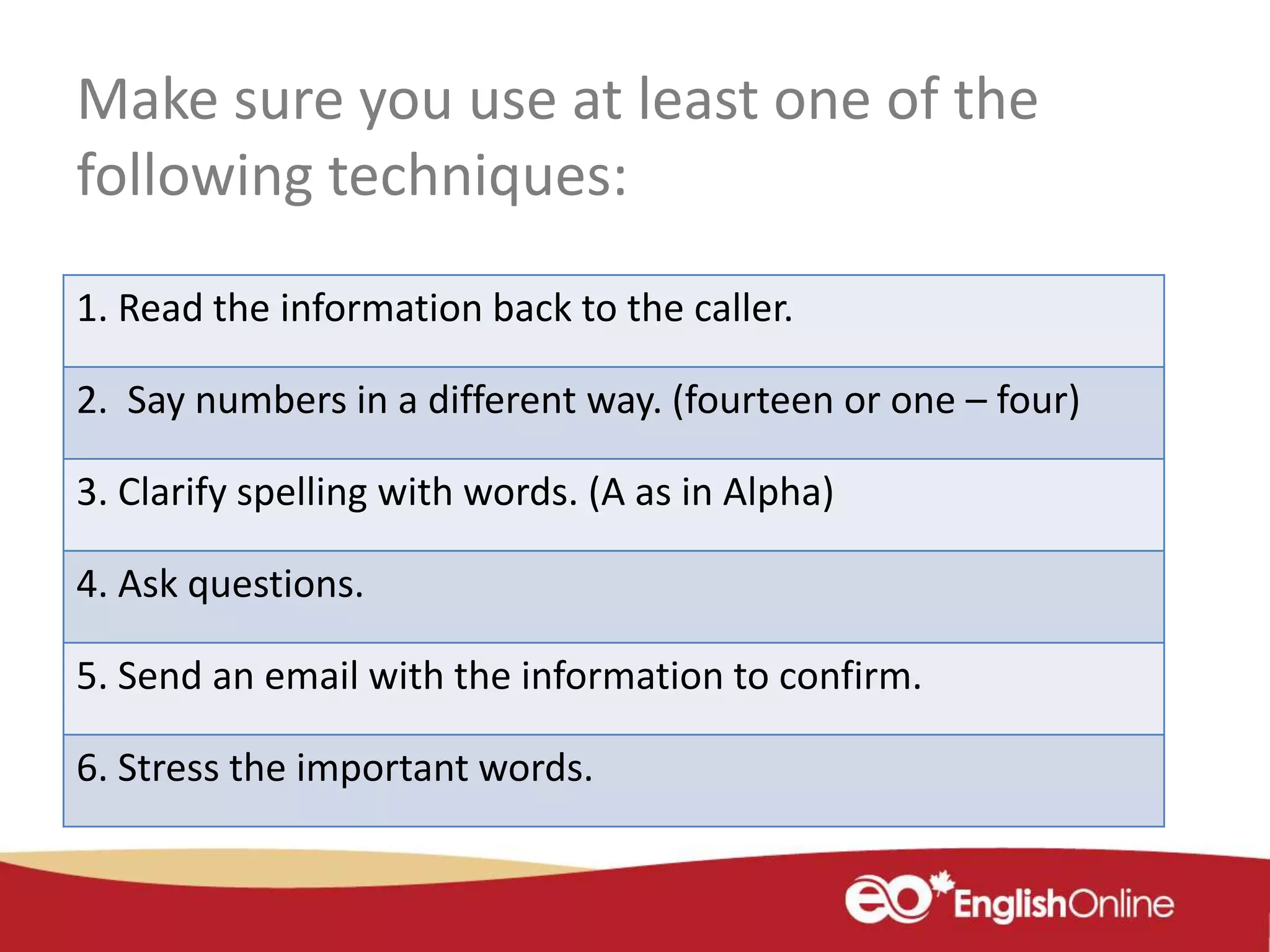
1. Read the information back to the caller.
2. Say numbers in a different way. (fourteen or one – four)
3. Clarify spelling with words. (A as in Alpha)
4. Ask questions.
5. Send an email with the information to confirm.
6. Stress the important words.
Make sure you use at least one of the
following techniques:
Clarify
information
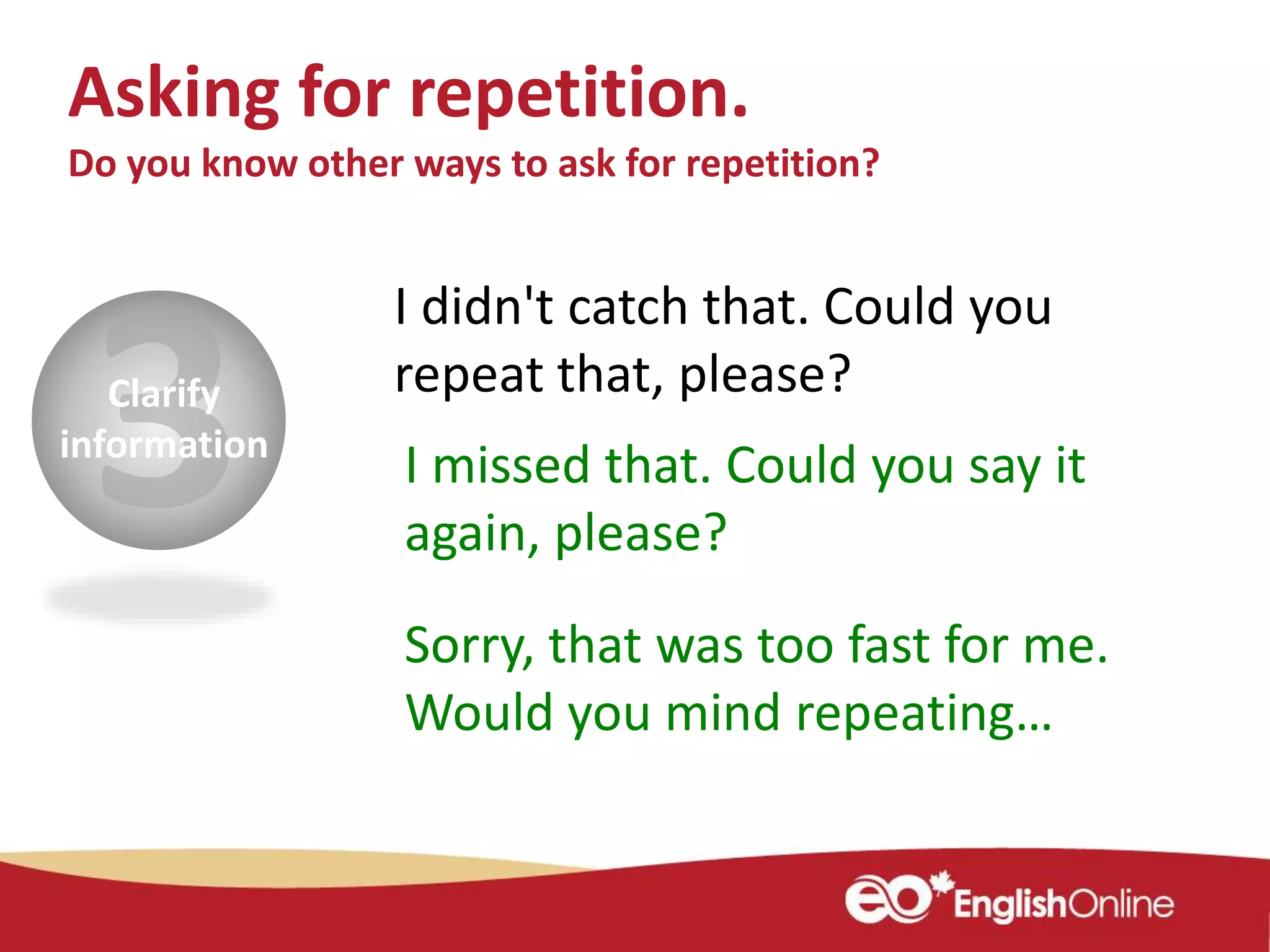
I didn't catch that. Could you
repeat that, please?
I missed that. Could you say it
again, please?
Asking for repetition.
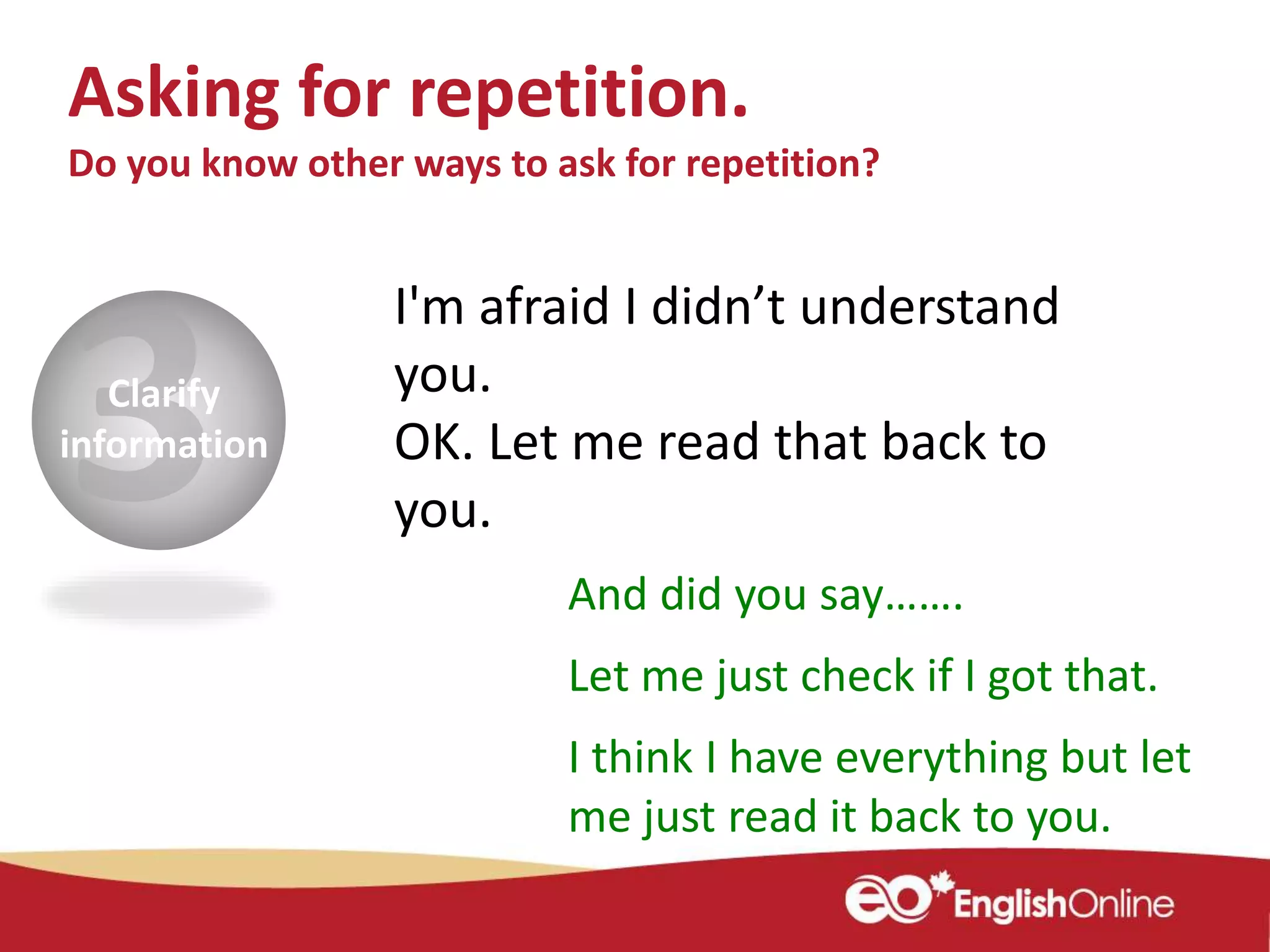
Do you know other ways to ask for repetition?
Sorry, that was too fast for me.
Would you mind repeating…
Clarify
information
I'm afraid I didn’t understand
you.
OK. Let me read that back to
you.
And did you say…….
Let me just check if I got that.
I think I have everything but let
me just read it back to you.
Asking for repetition.
Do you know other ways to ask for repetition?
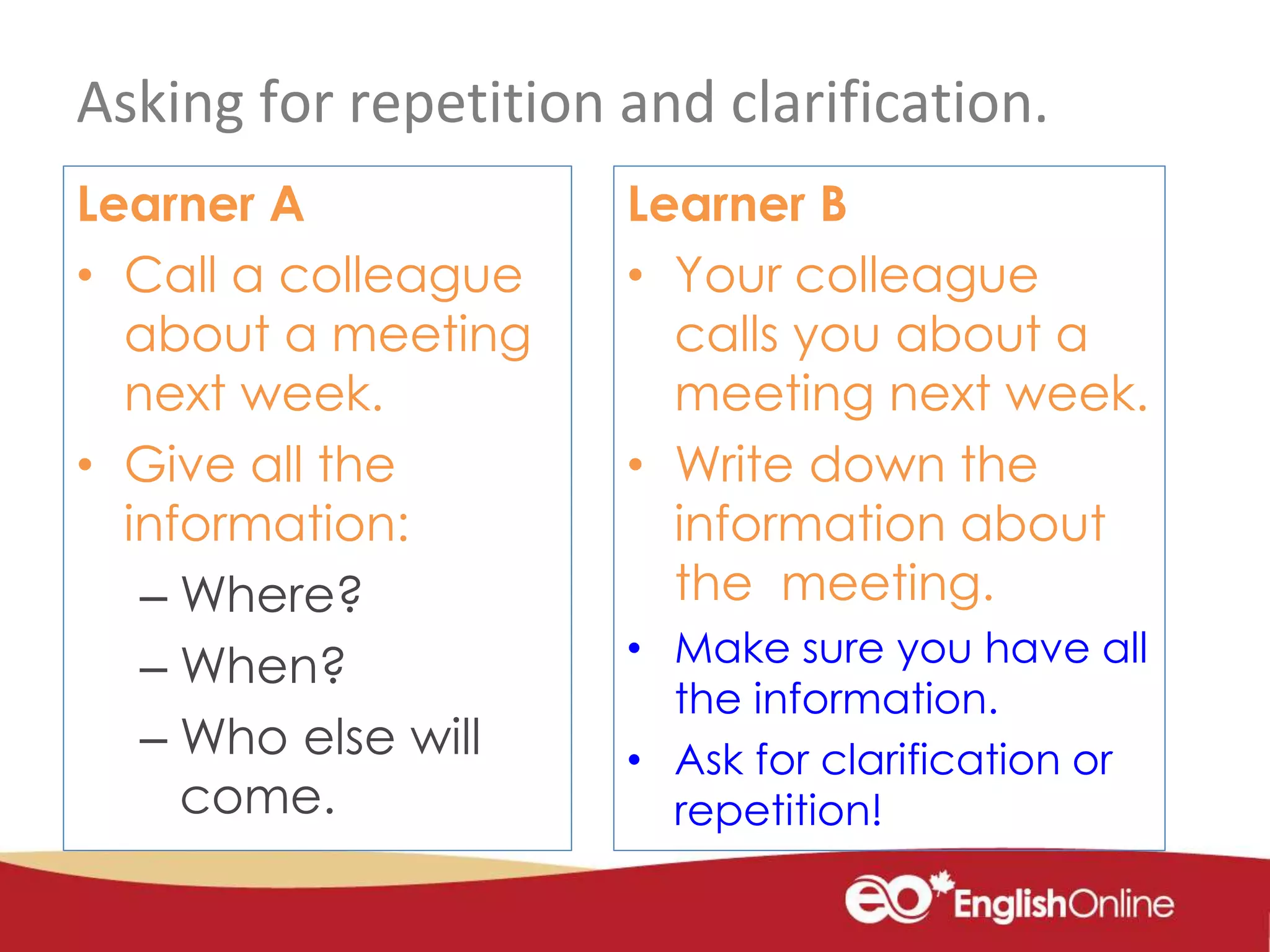
Asking for repetition and clarification.
Learner A
• Call a colleague
about a meeting
next week.
• Give all the
information:
– Where?
– When?
– Who else will
come.
Learner B
• Your colleague
calls you about a
meeting next week.
• Write down the
information about
the meeting.
• Make sure you have all
the information.
• Ask for clarification or
repetition!
Clarify
information
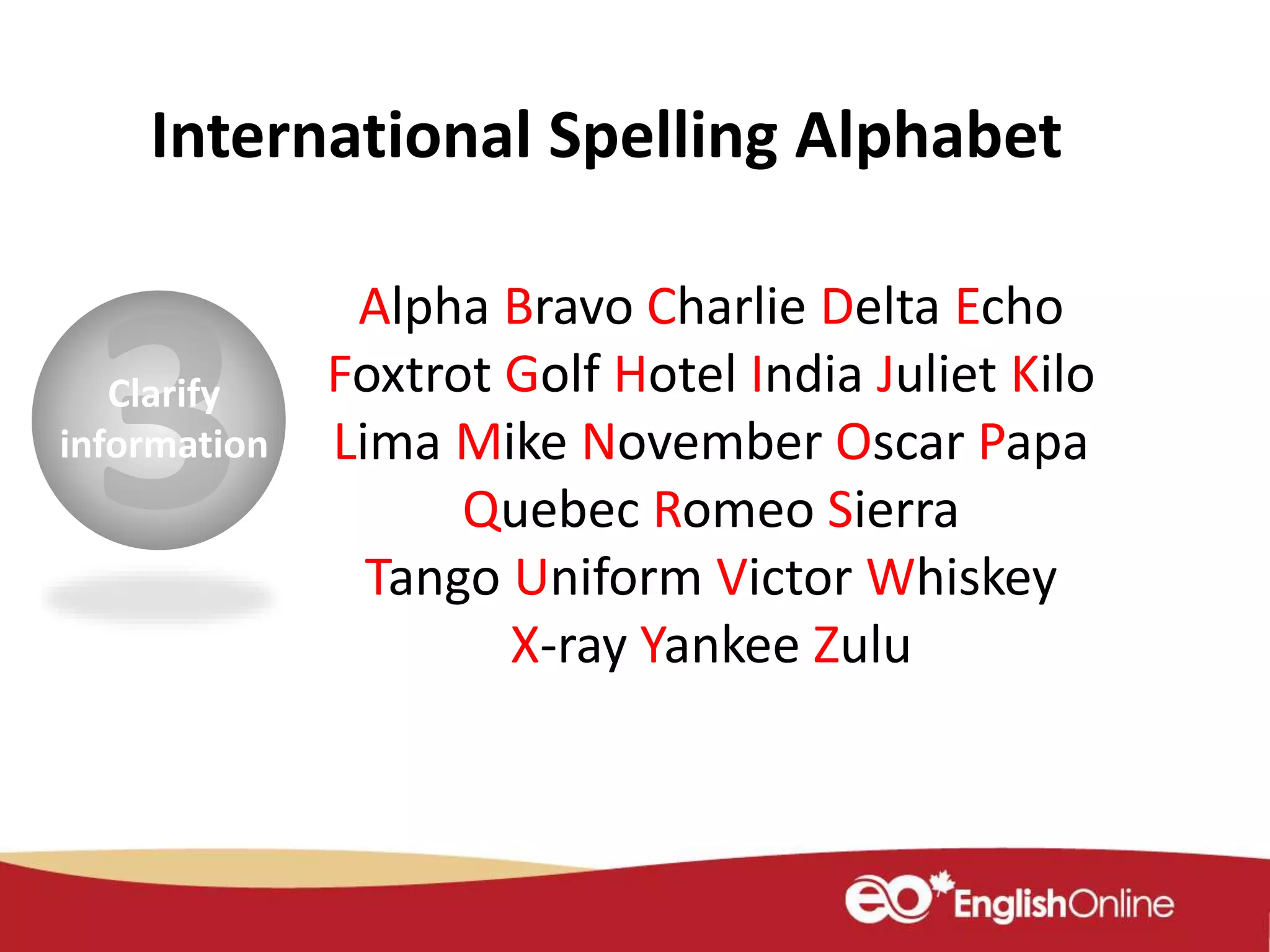
International Spelling Alphabet
Alpha Bravo Charlie Delta Echo
Foxtrot Golf Hotel India Juliet Kilo
Lima Mike November Oscar Papa
Quebec Romeo Sierra
Tango Uniform Victor Whiskey
X-ray Yankee Zulu
Asking for repetition and clarification.
Learner A
• Call a job
applicant to
schedule an
interview.
• Give all the
information:
– Where?
– When?
– What to bring.
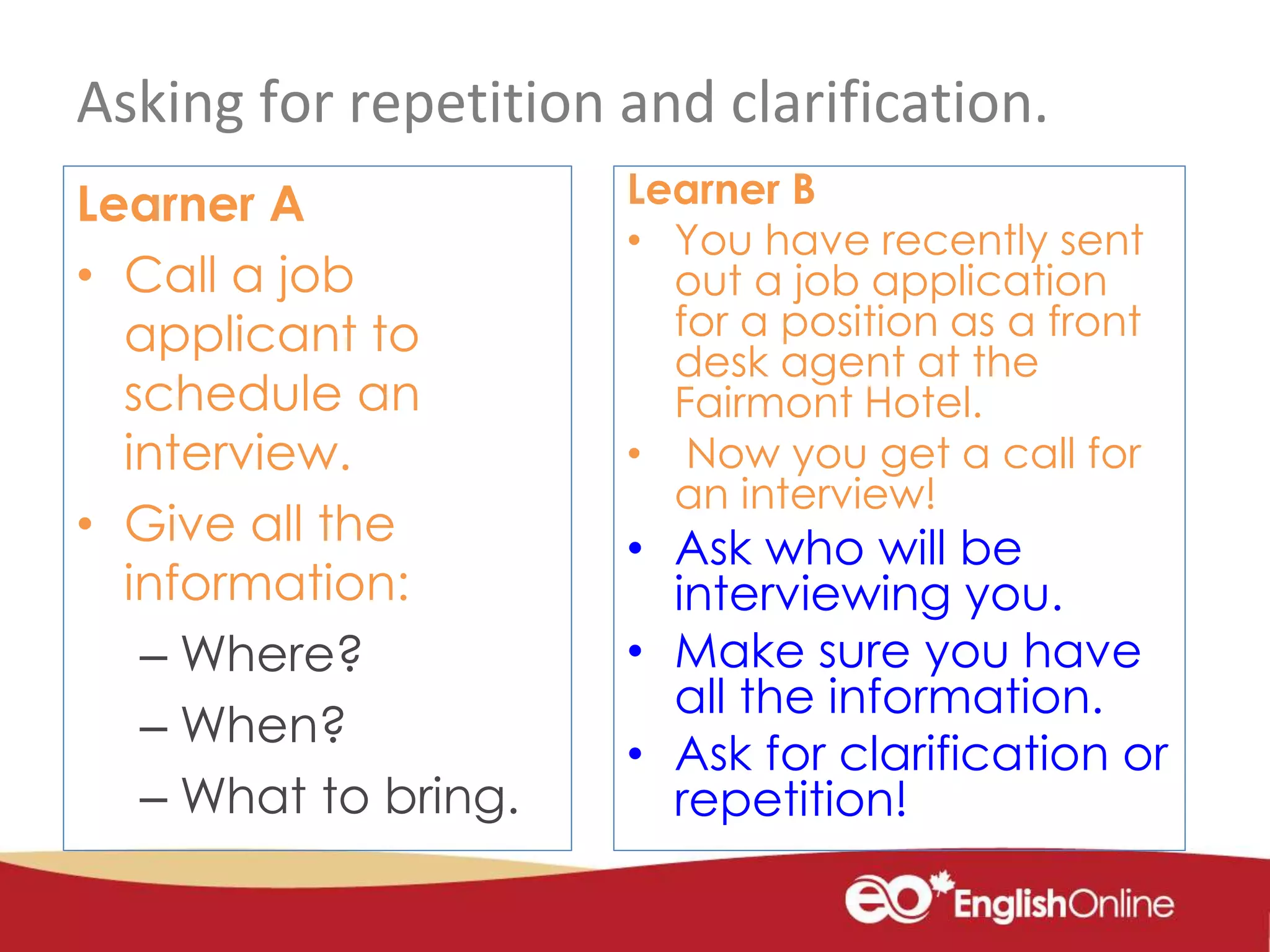
Learner B
• You have recently sent
out a job application
for a position as a front
desk agent at the
Fairmont Hotel.
• Now you get a call for
an interview!
• Ask who will be
interviewing you.
• Make sure you have
all the information.
• Ask for clarification or
repetition!
Sound
friendly
Why is it important to smile?
A smile makes your voice
sound friendly and polite –
even if the caller cannot see
you!
Sound friendly
Sound
friendly
Why is it important to smile?
Listening Activity
Listen to some expressions on
the phone.
Is the speaker smiling?
Sound
friendly
We can also sound more
friendly and polite because of
the words we use.
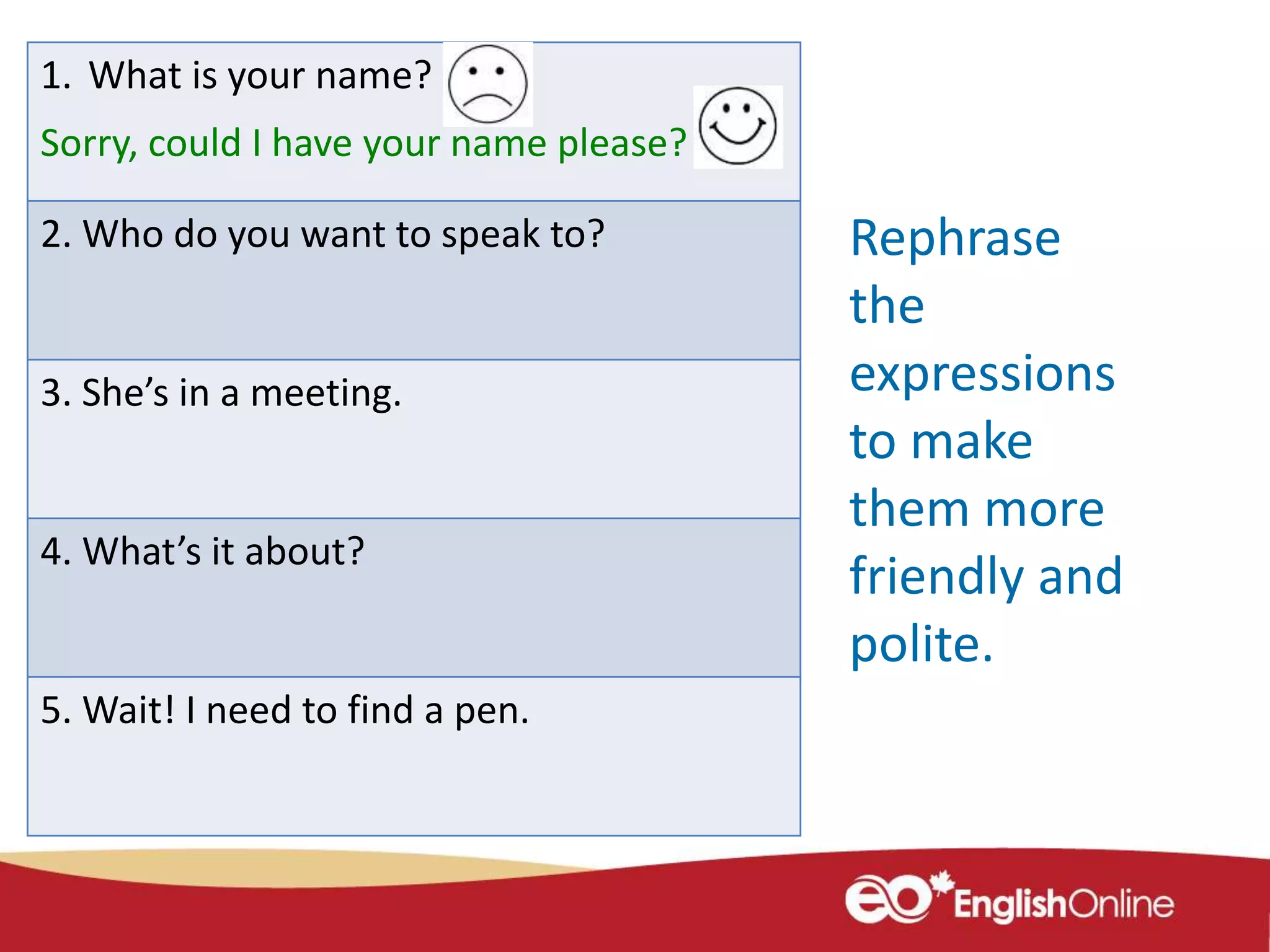
Rephrase
the
expressions
to make
them more
friendly and
polite.
1. What is your name?
Sorry, could I have your name please?
2. Who do you want to speak to?
3. She’s in a meeting.
4. What’s it about?
5. Wait! I need to find a pen.
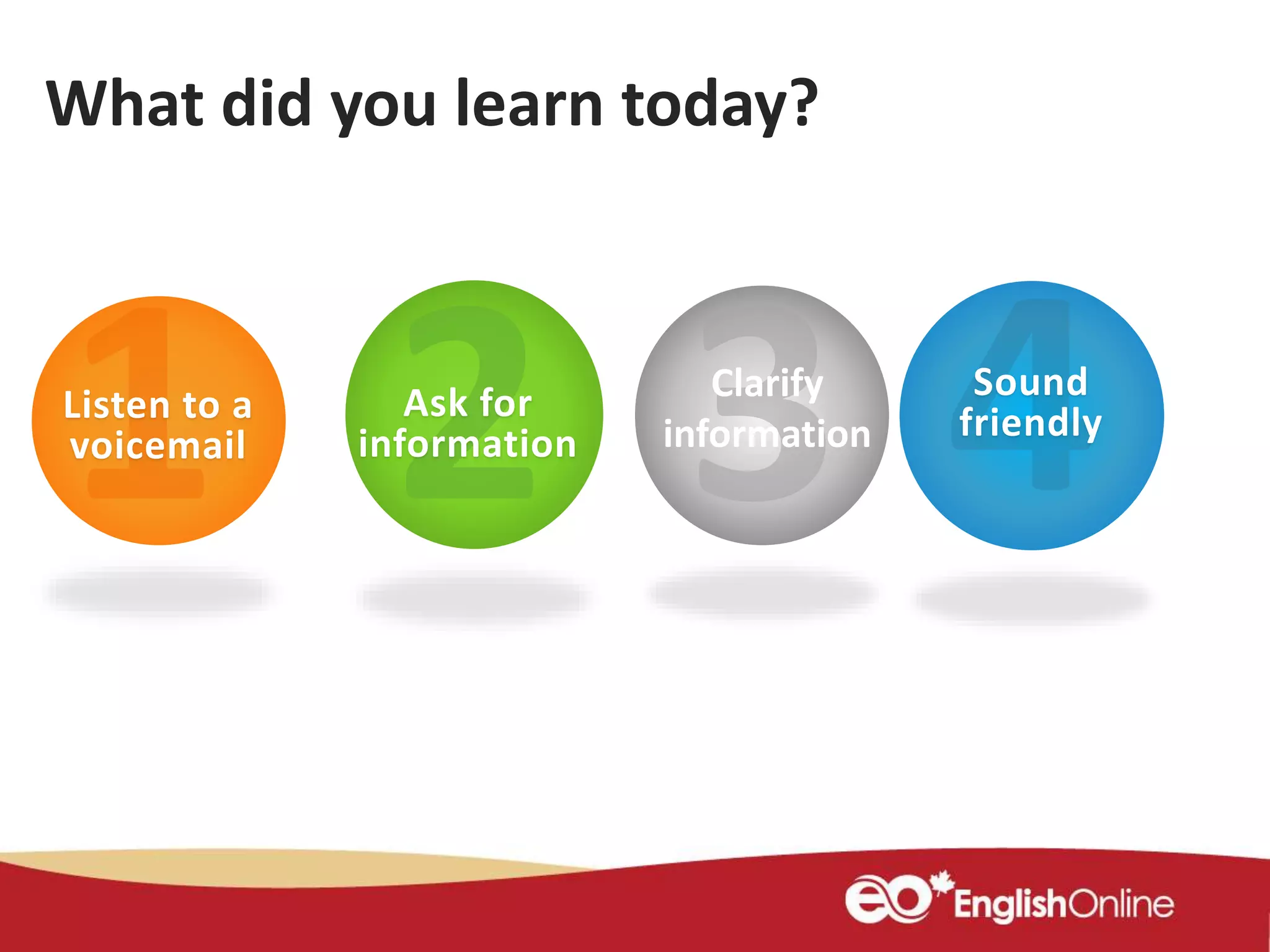
What did you learn today?
Listen to a
voicemail
Ask for
information
Clarify
information
Sound
friendly
Questions
Thank you for attending the class!
Happy Telephoning!

Workplace Communications - Telephoning at work

  • 1.
    Telephoning at Work Week3 Workplace Communications
  • 2.
    Listen to a voicemail Askfor information Sound friendly AGENDA Clarify information
  • 3.
    Listen to avoicemail Image Screenshot of Language Explorer, Act 7
  • 4.
    Listen to a voicemail Somecommon, formal expressions are used in this voice message. Listen again and try to make notes. ..at your earliest convenience…. would be greatly appreciated…..
  • 5.
    Now you wantto call back You want to confirm the date. And you have some questions: •What to bring? •Who else will be attending the meeting? Try it right away!
  • 6.
    1. I amwondering if ... Ask for information Three ways to ask polite questions 3. Would you mind telling me about… 2. I'd like to know how…
  • 7.
    Direct question Indirectquestion What should I bring to the meeting? Could you tell me what ….? Who else will be attending? Could you please tell me …?
  • 8.
    Direct question Indirectquestion What should I bring to the meeting? Could you tell me what I should bring to the meeting? Who else will be attending? Could you please tell me who else will be at the meeting?
  • 9.
    Direct yes/no question Indirect yes/noquestion (if) Should I bring something to the meeting? I am wondering if Is somebody else coming to the meeting? Could you tell me if
  • 10.
    Direct yes/no question Indirect yes/noquestion (if) Should I bring something to the meeting? I am wondering if I should bring something else to the meeting. Is somebody else coming to the meeting? Could you tell me if somebody else is coming to the meeting.
  • 11.
    Direct question Indirectquestion using a gerund What should I bring to the meeting? Would you mind telling me…? Who else will be attending? Would you mind telling me…?
  • 12.
    Direct question Indirectquestion using a gerund What should I bring to the meeting? Would you mind telling me what I should bring to the meeting? Who else will be attending? Would you mind telling me who else will come to the meeting?
  • 13.
    Listen to therecording: • What polite question did Sophia use? Ask for information
  • 14.
    You are anoffice administrator. Last week you ordered a new laptop. You want to call the computer company and ask them when it will be delivered. Ask for information Let’s practise
  • 15.
    You have animportant appointment tomorrow. Call your colleague and ask her if she can take over your shift. Ask for information Let’s practise
  • 16.
    Clarify information Listen to therecording one more time: • What strategy is used by Sophia to make sure she understood everything? Clarify information
  • 17.
    Clarify information Do you haveany strategies you use when phoning somebody to make sure that you understood everything?
  • 18.
    Let’s practise • Listento the call. The information has mistakes. Listen and correct. Engineer Eskola Arrives on 13th July From Tampere on Flight AS 335 Plane lands at 3.15
  • 19.
    Listening • Listen tothe call. The information has mistakes. Listen and correct.
  • 20.
    Six techniques toclarify information • Listen again and cross X the techniques the speaker uses. 1. Read the information back to the caller. 2. Say numbers in a different way. (fourteen or one – four) 3. Clarify spelling with words. (A as in Alpha) 4. Ask questions. 5. Send an email with the information to confirm. 6. Stress the important words.
  • 21.
    1. Read theinformation back to the caller. x 2. Say numbers in a different way. (fourteen or one – four) x 3. Clarify spelling with words. (A as in Alpha) x 4. Ask questions. x 5. Send an email with the information to confirm. 6. Stress the important words. x Six techniques to clarify information
  • 22.
    Asking for repetitionand clarification. Learner A • Call a colleague about a visit by a client next week. You want your colleague to meet the visitor at the airport. Give your colleague the following information: Learner B • Your colleague calls you about a visit by a client next week. • Write down the information about the client’s arrival. • Make sure you have all the information.
  • 23.
    Asking for repetitionand clarification. Learner A • Name • Flight number, • Airline • Arrival time • Just invent something! Learner B • Your colleague calls you about a visit by a client next week. • Write down the information about the client’s arrival. • Make sure you have all the information.
  • 24.
    1. Read theinformation back to the caller. 2. Say numbers in a different way. (fourteen or one – four) 3. Clarify spelling with words. (A as in Alpha) 4. Ask questions. 5. Send an email with the information to confirm. 6. Stress the important words. Make sure you use at least one of the following techniques:
  • 25.
    Clarify information I didn't catchthat. Could you repeat that, please? I missed that. Could you say it again, please? Asking for repetition. Do you know other ways to ask for repetition? Sorry, that was too fast for me. Would you mind repeating…
  • 26.
    Clarify information I'm afraid Ididn’t understand you. OK. Let me read that back to you. And did you say……. Let me just check if I got that. I think I have everything but let me just read it back to you. Asking for repetition. Do you know other ways to ask for repetition?
  • 27.
    Asking for repetitionand clarification. Learner A • Call a colleague about a meeting next week. • Give all the information: – Where? – When? – Who else will come. Learner B • Your colleague calls you about a meeting next week. • Write down the information about the meeting. • Make sure you have all the information. • Ask for clarification or repetition!
  • 28.
    Clarify information International Spelling Alphabet AlphaBravo Charlie Delta Echo Foxtrot Golf Hotel India Juliet Kilo Lima Mike November Oscar Papa Quebec Romeo Sierra Tango Uniform Victor Whiskey X-ray Yankee Zulu
  • 29.
    Asking for repetitionand clarification. Learner A • Call a job applicant to schedule an interview. • Give all the information: – Where? – When? – What to bring. Learner B • You have recently sent out a job application for a position as a front desk agent at the Fairmont Hotel. • Now you get a call for an interview! • Ask who will be interviewing you. • Make sure you have all the information. • Ask for clarification or repetition!
  • 30.
    Sound friendly Why is itimportant to smile? A smile makes your voice sound friendly and polite – even if the caller cannot see you! Sound friendly
  • 31.
    Sound friendly Why is itimportant to smile? Listening Activity Listen to some expressions on the phone. Is the speaker smiling?
  • 32.
    Sound friendly We can alsosound more friendly and polite because of the words we use.
  • 33.
    Rephrase the expressions to make them more friendlyand polite. 1. What is your name? Sorry, could I have your name please? 2. Who do you want to speak to? 3. She’s in a meeting. 4. What’s it about? 5. Wait! I need to find a pen.
  • 34.
    What did youlearn today? Listen to a voicemail Ask for information Clarify information Sound friendly
  • 35.
  • 36.
    Thank you forattending the class! Happy Telephoning!

Editor's Notes

  • #2 Welcome to this 4 week course!