https://pixabay.com/photos/books-bookstore-book-reading-1204029/shared under CC0
1
Modalsof
Advice
CLBlevel 5+
https://pixabay.com/photos/books-bookstore-book-reading-1204029/shared under CC0
2
Welcome to the English Online community!
Our Equity, Diversity, and Inclusion Acknowledgment
This community welcomes, appreciates, and respects everyone – it doesn’t matter
what country you’re from or who you are!
We are here today to become better at English, so let’s focus on learning!
Please remember that English Online has ZERO tolerance for discrimination of any
kind, including:
(political, religious, nationality, or gender-based).
If anyone feels uncomfortable attending the class, they are free to leave and email us
at info@myenglishonline.ca
Food for thought:
3
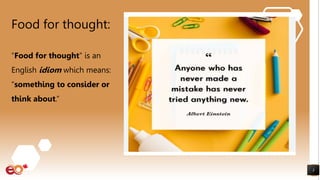
“Food for thought” is an
English idiom which means:
“something to consider or
think about.”
Modals – A quick review
What are modals…?
Modals, or modal verbs, are auxilliary or “helping” verbs.
The most common English modal verbs include:
must, shall, will, should, would, can, could, may, and might.
4
Modals – A quick review
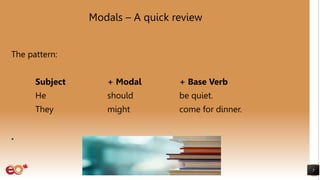
The pattern:
Subject + Modal + Base Verb
He should be quiet.
They might come for dinner.
.
5
Modals – A quick review
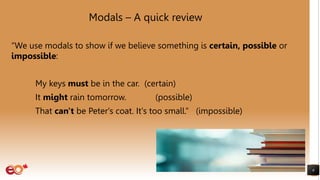
“We use modals to show if we believe something is certain, possible or
impossible:
My keys must be in the car. (certain)
It might rain tomorrow. (possible)
That can't be Peter's coat. It's too small.” (impossible)
6
Modals – A quick review
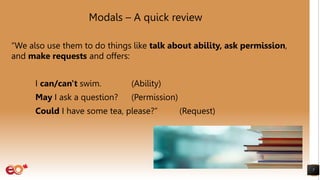
“We also use them to do things like talk about ability, ask permission,
and make requests and offers:
I can/can't swim. (Ability)
May I ask a question? (Permission)
Could I have some tea, please?” (Request)
7
Modals – A quick review
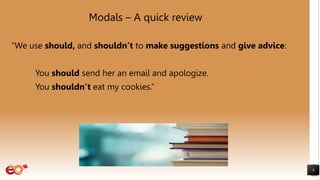
“We use should, and shouldn’t to make suggestions and give advice:
You should send her an email and apologize.
You shouldn’t eat my cookies.”
8
Modals – A quick review
Let’s take a look at how modal verbs are used.
https://www.khanacademy.org/humanities/grammar/parts-of-speech-the-
verb/verb-aspect-and-modal-verbs/v/modal-verbs-the-parts-of-speech-
grammar
9
Modals of advice
10
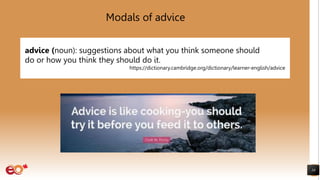
advice (noun): suggestions about what you think someone should
do or how you think they should do it.
https://dictionary.cambridge.org/dictionary/learner-english/advice
Modals of advice
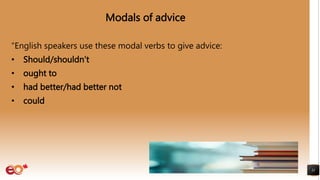
“English speakers use these modal verbs to give advice:
• Should/shouldn’t
• ought to
• had better/had better not
• could
11
Modals of advice
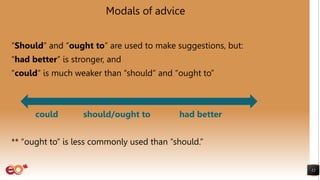
“Should” and “ought to” are used to make suggestions, but:
“had better” is stronger, and
“could” is much weaker than “should” and “ought to”
could should/ought to had better
** “ought to” is less commonly used than “should.”
12
Modals of advice
“English speakers use the modal verbs:
• should
• ought to
• had better
to express that they think something is a good (or a bad) idea.
“Should” is the most common way to give advice.”
13
Modals of advice
“Could” is also sometimes used to make “softer” suggestions:
You could talk to your teacher about the problems you are
having in English class.
You could stop for groceries after work.
We could eat out tonight.
14
Modals of advice
should, ought to, had better, could
Listen to how these different modals slightly affect how the suggestion
sounds:
You had better wait until the snow stops before you drive
home.
You should wait until the snow stops before you drive home.
You could wait until the snow stops.
15
Modals of advice
“Should” and “ought to” can mean:
• This is my advice.
• This is a good idea.
• This is an important responsibility.
You should study harder.
You ought to study harder.
Drivers should obey the speed limit.
16
Modals of advice
Notes on “ought to:”
It is much less common that “should.”
Native English speakers often pronounce “ought to” as “otta.”
This is called a reduction.
I ought to (“otta”) study tonight, but I think I’ll watch a movie
instead.
17
Modals of advice
We use “had better” when there is a possibility of something bad
happening:
1. You had better get gas at the next station. Your tank is
almost empty.
2. You had better see the dentist about that toothache.
18
Modals of advice
Notes on “had better:”
1. It has a present or future meaning.
2. It is more common in speaking than writing.
You had better see the dentist about that toothache.
3. In spoken English, it sounds like this:
You’d better see the dentist about that toothache.
(This in another reduction).
19
https://pixabay.com/photos/books-bookstore-book-reading-shop-1204038/ shared under CC0
Let’spractice!
https://pixabay.com/photos/books-bookstore-book-reading-shop-1204038/ shared under CC0
Modals of advice
Choose the answer to complete the sentences:
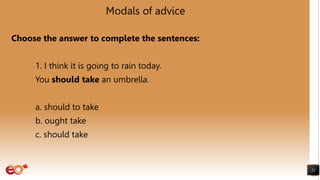
1. I think it is going to rain today.
You __________________ an umbrella.
a. should to take
b. ought take
c. should take
21
Modals of advice
Choose the answer to complete the sentences:
1. I think it is going to rain today.
You should take an umbrella.
a. should to take
b. ought take
c. should take
22
Modals of advice
Choose the answer to complete the sentences:
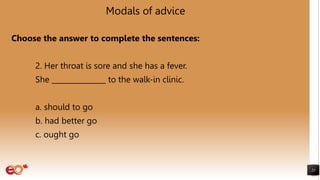
2. Her throat is sore and she has a fever.
She _______________ to the walk-in clinic.
a. should to go
b. had better go
c. ought go
23
Modals of advice
Choose the answer to complete the sentences:
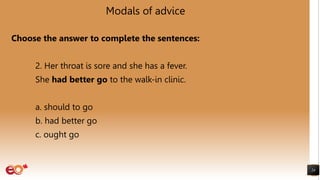
2. Her throat is sore and she has a fever.
She had better go to the walk-in clinic.
a. should to go
b. had better go
c. ought go
24
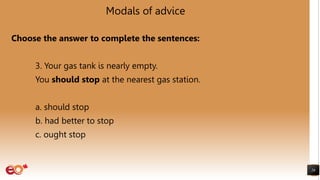
Modals of advice
Choose the answer to complete the sentences:
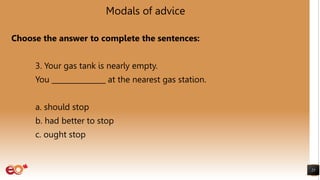
3. Your gas tank is nearly empty.
You _______________ at the nearest gas station.
a. should stop
b. had better to stop
c. ought stop
25
Modals of advice
Choose the answer to complete the sentences:
3. Your gas tank is nearly empty.
You should stop at the nearest gas station.
a. should stop
b. had better to stop
c. ought stop
26
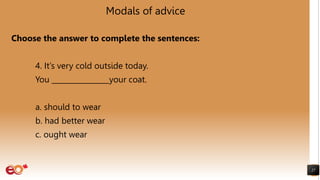
Modals of advice
Choose the answer to complete the sentences:
4. It’s very cold outside today.
You ________________your coat.
a. should to wear
b. had better wear
c. ought wear
27
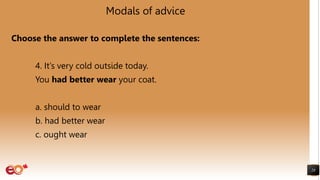
Modals of advice
Choose the answer to complete the sentences:
4. It’s very cold outside today.
You had better wear your coat.
a. should to wear
b. had better wear
c. ought wear
28
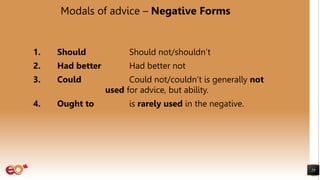
Modals of advice – Negative Forms
1. Should Should not/shouldn’t
2. Had better Had better not
3. Could Could not/couldn’t is generally not
used for advice, but ability.
4. Ought to is rarely used in the negative.
29
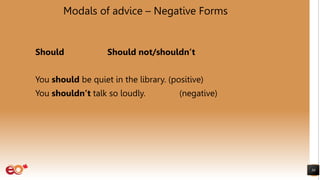
Modals of advice – Negative Forms
Should Should not/shouldn’t
You should be quiet in the library. (positive)
You shouldn’t talk so loudly. (negative)
30
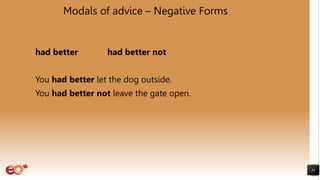
Modals of advice – Negative Forms
had better had better not
You had better let the dog outside.
You had better not leave the gate open.
31
Modals of advice – Practice Advice Giving:
What advice would you give in response to the following?
Use:
could, should, ought to, had better
shouldn’t, had better not
1. I need to get some money.
Advice? __________________________________
32
Modals of advice – More Practice
What advice would you give in response to the following?
Use:
could, should, ought to, had better
shouldn’t, had better not
1. I need to get some money.
Advice? You had better get a job.
You could go to the bank.
33
Modals of advice – More Practice
What advice would you give in response to the following?
Use:
could, should, ought to, had better
shouldn’t, had better not
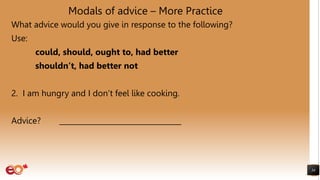
2. I am hungry and I don’t feel like cooking.
Advice? __________________________________
34
Modals of advice – More Practice
What advice would you give in response to the following?
Use:
could, should, ought to, had better
shouldn’t, had better not
2. I am hungry and I don’t feel like cooking.
Advice? You could order take-out.
You could go to the deli.
35
Modals of advice – More Practice
What advice would you give in response to the following?
Use:
could, should, ought to, had better
shouldn’t, had better not
3. I have a headache.
Advice? ___________________________________
36
Modals of advice – More Practice
What advice would you give in response to the following?
Use:
could, should, ought to, had better
shouldn’t, had better not
3. I have a headache.
Advice? You could take some Advil.
You could rest.
37
Modals of advice – More Practice
What advice would you give in response to the following?
Use:
could, should, ought to, had better
shouldn’t, had better not
4. I miss my family.
Advice? __________________________________
38
Modals of advice – More Practice
What advice would you give in response to the following?
Use:
could, should, ought to, had better
shouldn’t, had better not
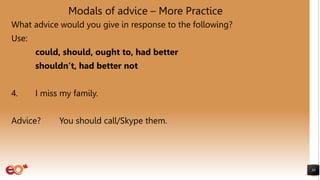
4. I miss my family.
Advice? You should call/Skype them.
39
Modals of advice – More Practice
What advice would you give in response to the following?
Use:
could, should, ought to, had better
shouldn’t, had better not
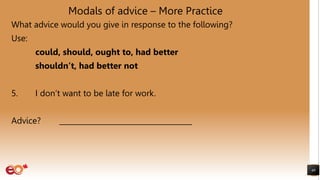
5. I don’t want to be late for work.
Advice? _____________________________________
40
Modals of advice – More Practice
What advice would you give in response to the following?
Use:
could, should, ought to, had better
shouldn’t, had better not
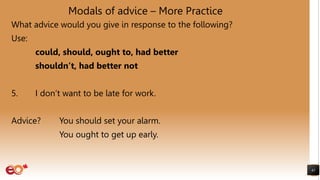
5. I don’t want to be late for work.
Advice? You should set your alarm.
You ought to get up early.
41
Modals of advice – More Practice
What advice would you give in response to the following?
Use:
could, should, ought to, had better
shouldn’t, had better not
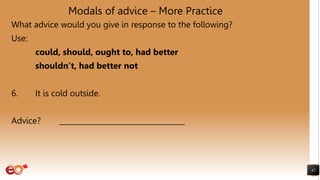
6. It is cold outside.
Advice? ___________________________________
42
Modals of advice – More Practice
What advice would you give in response to the following?
Use:
could, should, ought to, had better
shouldn’t, had better not
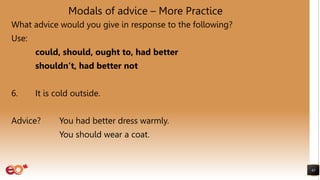
6. It is cold outside.
Advice? You had better dress warmly.
You should wear a coat.
43
Modals of advice – More Practice
What advice would you give in response to the following?
Use:
could, should, ought to, had better
shouldn’t, had better not
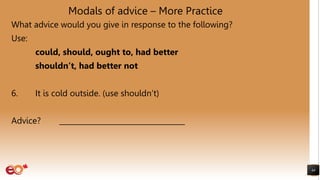
6. It is cold outside. (use shouldn’t)
Advice? ___________________________________
44
Modals of advice – More Practice
What advice would you give in response to the following?
Use:
could, should, ought to, had better
shouldn’t, had better not
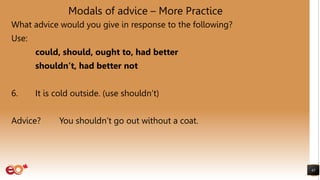
6. It is cold outside. (use shouldn’t)
Advice? You shouldn’t go out without a coat.
45
Modals of advice – More Practice
What advice would you give in response to the following?
Use:
could, should, ought to, had better
shouldn’t, had better not
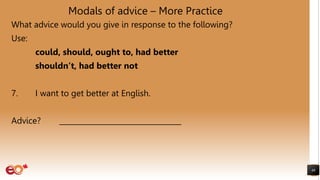
7. I want to get better at English.
Advice? __________________________________
46
Modals of advice – More Practice
What advice would you give in response to the following?
Use:
could, should, ought to, had better
shouldn’t, had better not
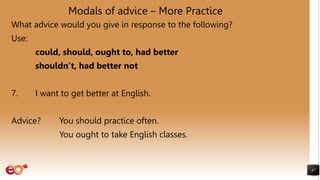
7. I want to get better at English.
Advice? You should practice often.
You ought to take English classes.
47
Modals of advice – More Practice
What advice would you give in response to the following?
Use:
could, should, ought to, had better
shouldn’t, had better not
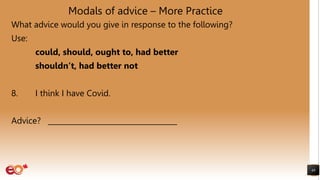
8. I think I have Covid.
Advice? ____________________________________
48
Modals of advice – More Practice
What advice would you give in response to the following?
Use:
could, should, ought to, had better
shouldn’t, had better not
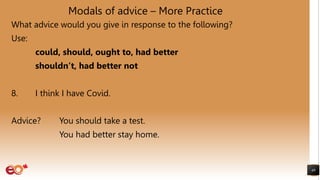
8. I think I have Covid.
Advice? You should take a test.
You had better stay home.
49
Modals of advice – More Practice
What advice would you give in response to the following?
Use:
could, should, ought to, had better
shouldn’t, had better not
9. I don’t want to miss the bus.
Advice? ______________________________
50
Modals of advice – More Practice
What advice would you give in response to the following?
Use:
could, should, ought to, had better
shouldn’t, had better not
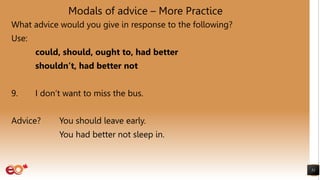
9. I don’t want to miss the bus.
Advice? You should leave early.
You had better not sleep in.
51
Modals of advice – More Practice
What advice would you give in response to the following?
Use:
could, should, ought to, had better
shouldn’t, had better not
10. I need groceries.
Advice? ______________________________
52
Modals of advice – More Practice
What advice would you give in response to the following?
Use:
could, should, ought to, had better
shouldn’t, had better not
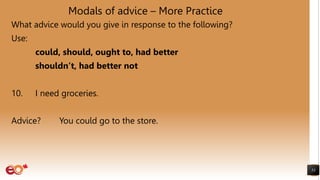
10. I need groceries.
Advice? You could go to the store.
53
Modals of advice – More Practice
Imagine you are giving advice to someone new to Canada. What
advice could you offer about each topic?
1. Mobile Phones:
You should/shouldn’t _______________________
You had better/had better not: _______________.
54
Modals of advice – More Practice
Imagine you are giving advice to someone new to Canada. What advice
could you offer about each topic?
2. Use Social Networking Sites (Facebook, Instagram, LinkedIN)
You should/shouldn’t _______________________
You had better/had better not: _______________.
55
Modals of advice – More Practice
Imagine you are giving advice to someone new to Canada. What advice
could you offer about each topic?
3. Meeting People:
You should/shouldn’t _______________________
You had better/had better not: _______________.
56
Modals of advice – More Practice
Imagine you are giving advice to someone new to Canada. What advice
could you offer about each topic?
4. Visiting Someone’s Home:
You should/shouldn’t _______________________
You had better/had better not: _______________.
57
Modals of advice – More Practice
Imagine you are giving advice to someone new to Canada. What advice
could you offer about each topic?
5. Getting around:
You should/shouldn’t _______________________
You had better/had better not: _______________.
58
Modals of advice – More Practice
Imagine you are giving advice to someone new to Canada. What advice
could you offer about each topic?
6. Improving English:
You should/shouldn’t _______________________
You had better/had better not: _______________.
59
Modals of advice – More Practice
Imagine you are giving advice to someone visiting your home country. What
advice could you offer about each topic?
1. Getting around
2. Visiting someone’s home
3. Meeting people
60
More practice:
61
https://continuingstudies.uvic.ca/elc/studyzone/330/grammar/330-
modals-advice2/
Questions?
62
https://pixabay.com/photos/cup-of-coffee-laptop-office-macbook-1280537/ shared under CC0
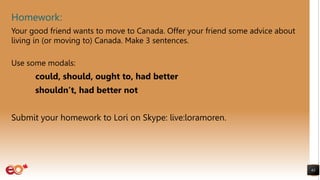
Homework:
63
Your good friend wants to move to Canada. Offer your friend some advice about
living in (or moving to) Canada. Make 3 sentences.
Use some modals:
could, should, ought to, had better
shouldn’t, had better not
Submit your homework to Lori on Skype: live:loramoren.
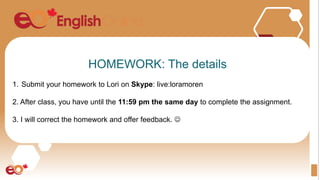
HOMEWORK: The details
1. Submit your homework to Lori on Skype: live:loramoren
2. After class, you have until the 11:59 pm the same day to complete the assignment.
3. I will correct the homework and offer feedback. 
Sources:
65
https://learnenglish.britishcouncil.org/grammar/english-grammar-reference/modal-verbs
https://www.khanacademy.org/humanities/grammar/parts-of-speech-the-verb/verb-aspect-and-
modal-verbs/v/modal-verbs-the-parts-of-speech-grammar
https://continuingstudies.uvic.ca/elc/studyzone/330/grammar/330-modals-advice/
https://continuingstudies.uvic.ca/elc/studyzone/330/grammar/330-modals-advice1/
Azar, Betty, and Hagen, S.A. (Understanding and Using English Grammar, Pearson Education, 2017.
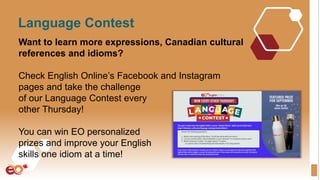
Language Contest
Want to learn more expressions, Canadian cultural
references and idioms?
Check English Online’s Facebook and Instagram
pages and take the challenge
of our Language Contest every
other Thursday!
You can win EO personalized
prizes and improve your English
skills one idiom at a time!
Thankyou!
Lori Morency
Skype: live:loramoren
livelearn.ca
Thankyou!
Blaine
broberts@myenglishonline.ca
livelearn.ca
1-204-946-5140
Website:
livelearn.ca
Email:
info@myenglishonline.ca

ModalsofAdviceRevision2EnglishOnline.pptx

  • 1.
    https://pixabay.com/photos/books-bookstore-book-reading-1204029/shared under CC0 1 Modalsof Advice CLBlevel5+ https://pixabay.com/photos/books-bookstore-book-reading-1204029/shared under CC0
  • 2.
    2 Welcome to theEnglish Online community! Our Equity, Diversity, and Inclusion Acknowledgment This community welcomes, appreciates, and respects everyone – it doesn’t matter what country you’re from or who you are! We are here today to become better at English, so let’s focus on learning! Please remember that English Online has ZERO tolerance for discrimination of any kind, including: (political, religious, nationality, or gender-based). If anyone feels uncomfortable attending the class, they are free to leave and email us at info@myenglishonline.ca
  • 3.
    Food for thought: 3 “Foodfor thought” is an English idiom which means: “something to consider or think about.”
  • 4.
    Modals – Aquick review What are modals…? Modals, or modal verbs, are auxilliary or “helping” verbs. The most common English modal verbs include: must, shall, will, should, would, can, could, may, and might. 4
  • 5.
    Modals – Aquick review The pattern: Subject + Modal + Base Verb He should be quiet. They might come for dinner. . 5
  • 6.
    Modals – Aquick review “We use modals to show if we believe something is certain, possible or impossible: My keys must be in the car. (certain) It might rain tomorrow. (possible) That can't be Peter's coat. It's too small.” (impossible) 6
  • 7.
    Modals – Aquick review “We also use them to do things like talk about ability, ask permission, and make requests and offers: I can/can't swim. (Ability) May I ask a question? (Permission) Could I have some tea, please?” (Request) 7
  • 8.
    Modals – Aquick review “We use should, and shouldn’t to make suggestions and give advice: You should send her an email and apologize. You shouldn’t eat my cookies.” 8
  • 9.
    Modals – Aquick review Let’s take a look at how modal verbs are used. https://www.khanacademy.org/humanities/grammar/parts-of-speech-the- verb/verb-aspect-and-modal-verbs/v/modal-verbs-the-parts-of-speech- grammar 9
  • 10.
    Modals of advice 10 advice(noun): suggestions about what you think someone should do or how you think they should do it. https://dictionary.cambridge.org/dictionary/learner-english/advice
  • 11.
    Modals of advice “Englishspeakers use these modal verbs to give advice: • Should/shouldn’t • ought to • had better/had better not • could 11
  • 12.
    Modals of advice “Should”and “ought to” are used to make suggestions, but: “had better” is stronger, and “could” is much weaker than “should” and “ought to” could should/ought to had better ** “ought to” is less commonly used than “should.” 12
  • 13.
    Modals of advice “Englishspeakers use the modal verbs: • should • ought to • had better to express that they think something is a good (or a bad) idea. “Should” is the most common way to give advice.” 13
  • 14.
    Modals of advice “Could”is also sometimes used to make “softer” suggestions: You could talk to your teacher about the problems you are having in English class. You could stop for groceries after work. We could eat out tonight. 14
  • 15.
    Modals of advice should,ought to, had better, could Listen to how these different modals slightly affect how the suggestion sounds: You had better wait until the snow stops before you drive home. You should wait until the snow stops before you drive home. You could wait until the snow stops. 15
  • 16.
    Modals of advice “Should”and “ought to” can mean: • This is my advice. • This is a good idea. • This is an important responsibility. You should study harder. You ought to study harder. Drivers should obey the speed limit. 16
  • 17.
    Modals of advice Noteson “ought to:” It is much less common that “should.” Native English speakers often pronounce “ought to” as “otta.” This is called a reduction. I ought to (“otta”) study tonight, but I think I’ll watch a movie instead. 17
  • 18.
    Modals of advice Weuse “had better” when there is a possibility of something bad happening: 1. You had better get gas at the next station. Your tank is almost empty. 2. You had better see the dentist about that toothache. 18
  • 19.
    Modals of advice Noteson “had better:” 1. It has a present or future meaning. 2. It is more common in speaking than writing. You had better see the dentist about that toothache. 3. In spoken English, it sounds like this: You’d better see the dentist about that toothache. (This in another reduction). 19
  • 20.
    https://pixabay.com/photos/books-bookstore-book-reading-shop-1204038/ shared underCC0 Let’spractice! https://pixabay.com/photos/books-bookstore-book-reading-shop-1204038/ shared under CC0
  • 21.
    Modals of advice Choosethe answer to complete the sentences: 1. I think it is going to rain today. You __________________ an umbrella. a. should to take b. ought take c. should take 21
  • 22.
    Modals of advice Choosethe answer to complete the sentences: 1. I think it is going to rain today. You should take an umbrella. a. should to take b. ought take c. should take 22
  • 23.
    Modals of advice Choosethe answer to complete the sentences: 2. Her throat is sore and she has a fever. She _______________ to the walk-in clinic. a. should to go b. had better go c. ought go 23
  • 24.
    Modals of advice Choosethe answer to complete the sentences: 2. Her throat is sore and she has a fever. She had better go to the walk-in clinic. a. should to go b. had better go c. ought go 24
  • 25.
    Modals of advice Choosethe answer to complete the sentences: 3. Your gas tank is nearly empty. You _______________ at the nearest gas station. a. should stop b. had better to stop c. ought stop 25
  • 26.
    Modals of advice Choosethe answer to complete the sentences: 3. Your gas tank is nearly empty. You should stop at the nearest gas station. a. should stop b. had better to stop c. ought stop 26
  • 27.
    Modals of advice Choosethe answer to complete the sentences: 4. It’s very cold outside today. You ________________your coat. a. should to wear b. had better wear c. ought wear 27
  • 28.
    Modals of advice Choosethe answer to complete the sentences: 4. It’s very cold outside today. You had better wear your coat. a. should to wear b. had better wear c. ought wear 28
  • 29.
    Modals of advice– Negative Forms 1. Should Should not/shouldn’t 2. Had better Had better not 3. Could Could not/couldn’t is generally not used for advice, but ability. 4. Ought to is rarely used in the negative. 29
  • 30.
    Modals of advice– Negative Forms Should Should not/shouldn’t You should be quiet in the library. (positive) You shouldn’t talk so loudly. (negative) 30
  • 31.
    Modals of advice– Negative Forms had better had better not You had better let the dog outside. You had better not leave the gate open. 31
  • 32.
    Modals of advice– Practice Advice Giving: What advice would you give in response to the following? Use: could, should, ought to, had better shouldn’t, had better not 1. I need to get some money. Advice? __________________________________ 32
  • 33.
    Modals of advice– More Practice What advice would you give in response to the following? Use: could, should, ought to, had better shouldn’t, had better not 1. I need to get some money. Advice? You had better get a job. You could go to the bank. 33
  • 34.
    Modals of advice– More Practice What advice would you give in response to the following? Use: could, should, ought to, had better shouldn’t, had better not 2. I am hungry and I don’t feel like cooking. Advice? __________________________________ 34
  • 35.
    Modals of advice– More Practice What advice would you give in response to the following? Use: could, should, ought to, had better shouldn’t, had better not 2. I am hungry and I don’t feel like cooking. Advice? You could order take-out. You could go to the deli. 35
  • 36.
    Modals of advice– More Practice What advice would you give in response to the following? Use: could, should, ought to, had better shouldn’t, had better not 3. I have a headache. Advice? ___________________________________ 36
  • 37.
    Modals of advice– More Practice What advice would you give in response to the following? Use: could, should, ought to, had better shouldn’t, had better not 3. I have a headache. Advice? You could take some Advil. You could rest. 37
  • 38.
    Modals of advice– More Practice What advice would you give in response to the following? Use: could, should, ought to, had better shouldn’t, had better not 4. I miss my family. Advice? __________________________________ 38
  • 39.
    Modals of advice– More Practice What advice would you give in response to the following? Use: could, should, ought to, had better shouldn’t, had better not 4. I miss my family. Advice? You should call/Skype them. 39
  • 40.
    Modals of advice– More Practice What advice would you give in response to the following? Use: could, should, ought to, had better shouldn’t, had better not 5. I don’t want to be late for work. Advice? _____________________________________ 40
  • 41.
    Modals of advice– More Practice What advice would you give in response to the following? Use: could, should, ought to, had better shouldn’t, had better not 5. I don’t want to be late for work. Advice? You should set your alarm. You ought to get up early. 41
  • 42.
    Modals of advice– More Practice What advice would you give in response to the following? Use: could, should, ought to, had better shouldn’t, had better not 6. It is cold outside. Advice? ___________________________________ 42
  • 43.
    Modals of advice– More Practice What advice would you give in response to the following? Use: could, should, ought to, had better shouldn’t, had better not 6. It is cold outside. Advice? You had better dress warmly. You should wear a coat. 43
  • 44.
    Modals of advice– More Practice What advice would you give in response to the following? Use: could, should, ought to, had better shouldn’t, had better not 6. It is cold outside. (use shouldn’t) Advice? ___________________________________ 44
  • 45.
    Modals of advice– More Practice What advice would you give in response to the following? Use: could, should, ought to, had better shouldn’t, had better not 6. It is cold outside. (use shouldn’t) Advice? You shouldn’t go out without a coat. 45
  • 46.
    Modals of advice– More Practice What advice would you give in response to the following? Use: could, should, ought to, had better shouldn’t, had better not 7. I want to get better at English. Advice? __________________________________ 46
  • 47.
    Modals of advice– More Practice What advice would you give in response to the following? Use: could, should, ought to, had better shouldn’t, had better not 7. I want to get better at English. Advice? You should practice often. You ought to take English classes. 47
  • 48.
    Modals of advice– More Practice What advice would you give in response to the following? Use: could, should, ought to, had better shouldn’t, had better not 8. I think I have Covid. Advice? ____________________________________ 48
  • 49.
    Modals of advice– More Practice What advice would you give in response to the following? Use: could, should, ought to, had better shouldn’t, had better not 8. I think I have Covid. Advice? You should take a test. You had better stay home. 49
  • 50.
    Modals of advice– More Practice What advice would you give in response to the following? Use: could, should, ought to, had better shouldn’t, had better not 9. I don’t want to miss the bus. Advice? ______________________________ 50
  • 51.
    Modals of advice– More Practice What advice would you give in response to the following? Use: could, should, ought to, had better shouldn’t, had better not 9. I don’t want to miss the bus. Advice? You should leave early. You had better not sleep in. 51
  • 52.
    Modals of advice– More Practice What advice would you give in response to the following? Use: could, should, ought to, had better shouldn’t, had better not 10. I need groceries. Advice? ______________________________ 52
  • 53.
    Modals of advice– More Practice What advice would you give in response to the following? Use: could, should, ought to, had better shouldn’t, had better not 10. I need groceries. Advice? You could go to the store. 53
  • 54.
    Modals of advice– More Practice Imagine you are giving advice to someone new to Canada. What advice could you offer about each topic? 1. Mobile Phones: You should/shouldn’t _______________________ You had better/had better not: _______________. 54
  • 55.
    Modals of advice– More Practice Imagine you are giving advice to someone new to Canada. What advice could you offer about each topic? 2. Use Social Networking Sites (Facebook, Instagram, LinkedIN) You should/shouldn’t _______________________ You had better/had better not: _______________. 55
  • 56.
    Modals of advice– More Practice Imagine you are giving advice to someone new to Canada. What advice could you offer about each topic? 3. Meeting People: You should/shouldn’t _______________________ You had better/had better not: _______________. 56
  • 57.
    Modals of advice– More Practice Imagine you are giving advice to someone new to Canada. What advice could you offer about each topic? 4. Visiting Someone’s Home: You should/shouldn’t _______________________ You had better/had better not: _______________. 57
  • 58.
    Modals of advice– More Practice Imagine you are giving advice to someone new to Canada. What advice could you offer about each topic? 5. Getting around: You should/shouldn’t _______________________ You had better/had better not: _______________. 58
  • 59.
    Modals of advice– More Practice Imagine you are giving advice to someone new to Canada. What advice could you offer about each topic? 6. Improving English: You should/shouldn’t _______________________ You had better/had better not: _______________. 59
  • 60.
    Modals of advice– More Practice Imagine you are giving advice to someone visiting your home country. What advice could you offer about each topic? 1. Getting around 2. Visiting someone’s home 3. Meeting people 60
  • 61.
  • 62.
  • 63.
    Homework: 63 Your good friendwants to move to Canada. Offer your friend some advice about living in (or moving to) Canada. Make 3 sentences. Use some modals: could, should, ought to, had better shouldn’t, had better not Submit your homework to Lori on Skype: live:loramoren.
  • 64.
    HOMEWORK: The details 1.Submit your homework to Lori on Skype: live:loramoren 2. After class, you have until the 11:59 pm the same day to complete the assignment. 3. I will correct the homework and offer feedback. 
  • 65.
  • 66.
    Language Contest Want tolearn more expressions, Canadian cultural references and idioms? Check English Online’s Facebook and Instagram pages and take the challenge of our Language Contest every other Thursday! You can win EO personalized prizes and improve your English skills one idiom at a time!
  • 67.
  • 68.