U N I T 9
Lifestyle
Welcome back
Today we will:
 Review what you did on Friday
 Take a short quiz
 Listen to a song that uses the future conditional
 Practice giving and receiving advice
 Make plans and accept/refuse invitations
 Review and practice modals and present continuous
 Learn to accept and decline invitations
 Choose people that you would invite to your own party
What did we do Friday?
1. People who use products are called ____.
A) consumers B) manufacturers C) designers D) retailers
2. _______ you roommate ________ a new cell phone?
A) Had / buy B) Has / bought C) Have / buys D) Hadn’t / buy
3. Which of the following does NOT improve creativity?
A) having more time B) earning a reward
C) caring about your work D) having the right opportunity
4. Do these phrases make or respond to a suggestion?
A) Yes, but… B) How about… C) What if we… D) That’s great.
E) Why don’t we… F) I don’t think… G) OK, I’ll…
5. Think of 4 different company slogans (口號) used in Taiwan. Which
is your favorite? Why do you like it? Do you think slogans are effective?
Unit 8
Short Quiz
You have 20 minutes for the quiz.
Please write your Chinese and
English name.
Don’t forget to guess how many
questions you will answer correctly.
When you finish, please give the test
to the teacher or one of the teaching
assistants.
Wouldn’t it Be Nice - The Beach Boys
Today’s unit talks about
future plans and
possibilities.
Put the song verses in
the correct order and fill
in any missing words.
https://www.youtube.com/watch?v=ZVlVmv0K-pk
Music Time
Did you do the homework? Page 72
Which of these places do you think are more punctual (守時)?
Switzerland or Italy? Japan or Peru?
Germany or Mexico? Taiwan or the Philippines?
Who in your family is most often _____ ?
A) late B) on time C) angry when others are late
Part 3: which words from the article mean:
1. two: _____
2. at the right time, without being late: _____
3. a very sad event that shocks people: _____
4. arrive: _____
5. not polite (two words): _____ _____
Did you do the homework? Page 72
Part 3: which words from the article mean:
1. two: couple
2. at the right time, without being late: promptly
3. a very sad event that shocks people: tragedy
4. arrive: turn up
5. not polite (two words): rude / impolite
Part 4: Answer the questions:
1: Why isn’t it polite to complain if someone arrives ten minutes late in
some countries?
2. How far behind schedule was the Japanese train? In your opinion, was it
late?
3. How late might guests arrive at a party in Peru? Do people generally
arrive on time for events in Taiwan?
4. What does ‘late’ mean to people in Taiwan? And what does it mean to you?
Did you do the homework? Page 72
Part 4: Answer the questions:
1: Why isn’t it polite to complain if someone arrives ten
minutes late in some countries?
Because there is a 10 minute ‘courtesy time’.
2. How far behind schedule was the Japanese train? In your
opinion, was it late?
The train was only 90 seconds late. Maybe a little.
3. How late might guests arrive at a party in Peru? Do people
generally arrive on time for events in Taiwan?
About an hour.
4. What does ‘late’ mean to people in Taiwan? And what does it
mean to you?
Page 73
Modal
verbs
If you would like to
review the rules, you
can look at page 169
in your student book.
Part 5:
When we are sure something is
going to happen, we use will.
Ex: I will eat lunch after this class.
When we’re unsure and we’re
talking about possibilities, we use
may, could and might.
Ex: I may / could / might fall in love
next year.
Page 73
Modal
verbs
If you would like to
review the rules, you
can look at page 169
in your student book.
Part 6:
2 Modal verbs are followed by
b an infinitive without to (do)
Ex: I might sleep all day after the TOEIC exam.
I might to sleep all day after the TOEIC exam.
3 To form questions with modal
verbs we…
b change the word order
Ex: What day will we take the test?
What day we will take the test?
4 To form negatives we use…
a not
Ex: I may not ever love anyone again.
I may don’t ever love anyone again.
Page 73
Modal
verbs
If you would like to
review the rules, you
can look at page 169
in your student book.
Part 7: Work with
your partner.
1. Think off something that you feel
sure you will do tomorrow.
2. Think of three things that might /
could / may happen.
3. Think of two things that might
not or may not happen.
Extension
Asking for
advice
• You will each be given two strips
of paper. Read the problems and
then ask 3 different classmates
to give you advice for each.
• After you have finished, explain
one problem to your teacher or
teaching assistants using your
own words.
• Who gave you the
best advice? What
they tell you?
Parts 1 & 3
Part 1: Have you ever…
1. forgotten a family
member’s or a close
friend’s birthday? Whose?
2. left your homework at
home? What happened?
3. arrived at the wrong time
for an appointment? What
happened?
Part 3: Read the article.
1. Where’s Judith going
next weekend?
2. What’s happening next
Thursday?
3. How much does Judith
pay Gyan?
4. How has Gyan changed
Judith’s life?
5. What’s Gyan doing
tomorrow?
Page 74 - Reading
Page 74 - Part 3 Answers
1. Where’s Judith going next weekend?
She’s going to Dallas.
2. What’s happening next Thursday?
It’s her aunt’s birthday.
3. How much does Judith pay Gyan?
She pays him about eight dollars an hour.
4. How has Gyan changed Judith’s life?
She says her life isn’t falling apart anymore.
5. What’s Gyan doing tomorrow?
He’s reading a bedtime story to her kids.
Extension
What will you
be doing…
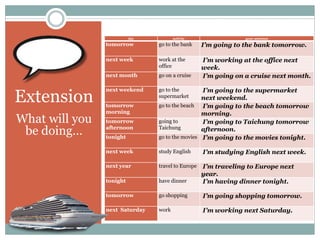
day activity your sentence
tomorrow go to the bank I’m going to the bank tomorrow.
next week work at the
office
next month go on a cruise
next weekend go to the
supermarket
tomorrow
morning
go to the beach
tomorrow
afternoon
going to
Taichung
tonight go to the movies
next week study English
next year travel to Europe
tonight have dinner
tomorrow go shopping
next Saturday work
Extension
What will you
be doing…
day activity your sentence
tomorrow go to the bank I’m going to the bank tomorrow.
next week work at the
office
I’m working at the office next
week.
next month go on a cruise I’m going on a cruise next month.
next weekend go to the
supermarket
I’m going to the supermarket
next weekend.
tomorrow
morning
go to the beach I’m going to the beach tomorrow
morning.
tomorrow
afternoon
going to
Taichung
I’m going to Taichung tomorrow
afternoon.
tonight go to the movies I’m going to the movies tonight.
next week study English I’m studying English next week.
next year travel to Europe I’m traveling to Europe next
year.
tonight have dinner I’m having dinner tonight.
tomorrow go shopping I’m going shopping tomorrow.
next Saturday work I’m working next Saturday.
Extension
Now ask your
partner
What will
you be
doing…
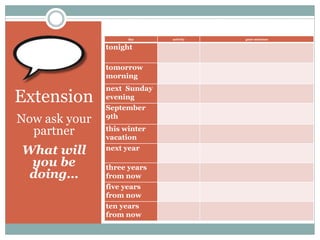
day activity your sentence
tonight
tomorrow
morning
next Sunday
evening
September
9th
this winter
vacation
next year
three years
from now
five years
from now
ten years
from now
Page 75
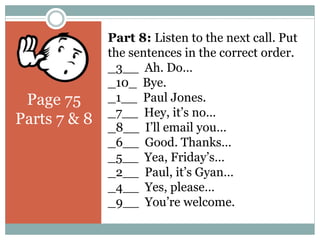
Parts 7 & 8
Part 7: Listen. What’s the problem?
Part 8: Listen to the next call. Put
the sentences in the correct order.
____
_10_
_1__
____
____
____
____
____
____
____
Page 75
Parts 7 & 8
Part 8: Listen to the next call. Put
the sentences in the correct order.
_3__ Ah. Do…
_10_ Bye.
_1__ Paul Jones.
_7__ Hey, it’s no…
_8__ I’ll email you…
_6__ Good. Thanks…
_5__ Yea, Friday’s…
_2__ Paul, it’s Gyan…
_4__ Yes, please…
_9__ You’re welcome.
Part 1: Read the situations
Part 2: Match the words
and phrases
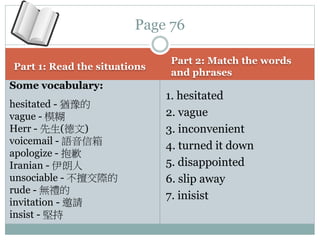
Some vocabulary:
hesitated - 猶豫的
vague - 模糊
Herr - 先生(德文)
voicemail - 語音信箱
apologize - 抱歉
Iranian - 伊朗人
unsociable - 不擅交際的
rude - 無禮的
invitation - 邀請
insist - 堅持
1. h________
2. v ________
3. i ________
4. t________ it d_____
5. d ________
6. s _______ a _______
7. i ________
Page 76
Part 1: Read the situations
Part 2: Match the words
and phrases
Some vocabulary:
hesitated - 猶豫的
vague - 模糊
Herr - 先生(德文)
voicemail - 語音信箱
apologize - 抱歉
Iranian - 伊朗人
unsociable - 不擅交際的
rude - 無禮的
invitation - 邀請
insist - 堅持
1. hesitated
2. vague
3. inconvenient
4. turned it down
5. disappointed
6. slip away
7. inisist
Page 76
Page 76
Part 3
Listen to some other views of the
misunderstandings. Write A - F next
to the situations they talk about.
1. ____
2. ____
3. ____
4. ____
5. ____
6. ____
Page 76
Part 3
Listen to some other views of the
misunderstandings. Write A - F next
to the situations they talk about.
1. _C__
2. _D__
3. _F__
4. _B__
5. _A__
6. _E__
Part 6 Part 7
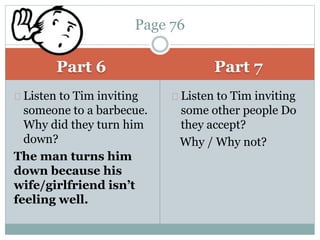
Listen to Tim inviting
someone to a barbecue.
Why did they turn him
down?
Listen to Tim inviting
some other people Do
they accept?
Why / Why not?
Page 76
Part 6 Part 7
Listen to Tim inviting
someone to a barbecue.
Why did they turn him
down?
The man turns him
down because his
wife/girlfriend isn’t
feeling well.
Listen to Tim inviting
some other people Do
they accept?
Why / Why not?
Page 76
Part 6 Part 7
Listen to Tim inviting
someone to a barbecue.
Why did they turn him
down?
The man turns him
down because his
wife/girlfriend isn’t
feeling well.
Listen to Tim inviting
some other people Do
they accept?
Why / Why not?
They don’t accept
because they are
visiting the woman’s
mother that day.
Page 76
Page 76
Part 8
Complete the
phrases in the
chart
Invitations
Preparing to
invite
1. Are you ______
2. What _____ ______ ____
Inviting 1. ______ you _____
2. ______ you ______
Positive
responses
1. Oh, it’s ______ ______
2. ______ be great! ______
Saying ‘no’ 1. I’m ______
2. ______ be lovely ______
Responding
to ‘no’
1. Oh, that’s a ______
2. Not to ______
Suggesting
alternatives
1. ______ love to come ______
2. ______ ______ …. ______
Page 76
Part 8
Complete the
phrases in the
chart
Invitations
Preparing to
invite
1. Are you doing
2. What are you doing
Inviting 1. Would you like
2. Do you want
Positive
responses
1. Oh, it’s very kind
2. That’d be great! We’d
Saying ‘no’ 1. I’m afraid
2. It’d be lovely but
Responding
to ‘no’
1. Oh, that’s a shame
2. Not to worry
Suggesting
alternatives
1. We’d love to come another
2. How about …. instead
Invitations
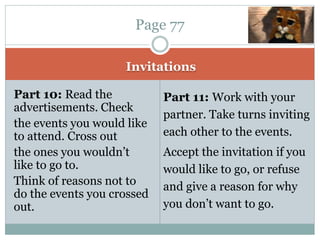
Part 10: Read the
advertisements. Check
the events you would like
to attend. Cross out
the ones you wouldn’t
like to go to.
Think of reasons not to
do the events you crossed
out.
Part 11: Work with your
partner. Take turns inviting
each other to the events.
Accept the invitation if you
would like to go, or refuse
and give a reason for why
you don’t want to go.
Page 77
Page 79
Expressions
with give
Part 5: Match the expressions with give
1. ___________
2. ___________
3. ___________
4. ___________
5. ___________
6. ___________
7. ___________
8. ___________
9. ___________
Page 79
Expressions
with give
Part 5: Match the expressions with give
1. gave a speech
2. give us some help
3. give you some advice
4. give me a chance
5. give him a lift
6. gave me a kiss
7. gave us permission
8. give you more information
9. gave / has given us any explanation
Part 6 Part 7
Listen to people planning
another surprise party.
1. Who’s the party for?
2. How are they going to
get him to the party?
3. What’s the extra
surprise?
Are the plans definite or
possible?
1. ______
2. ______
3. ______
4. ______
5. ______
6. ______
7. ______
Page 79
Part 6 Part 7
Listen to people planning
another surprise party.
1. Ivan
2. Invite him to play
squash
3. Ivan’s
sister
Are the plans definite or
possible?
1. ______
2. ______
3. ______
4. ______
5. ______
6. ______
7. ______
Page 79
Part 6 Part 7
Listen to people planning
another surprise party.
1. Ivan
2. Invite him to play
squash
3. Ivan’s
sister
Are the plans definite or
possible?
1. __D___
2. __D___
3. __D___
4. __P___
5. __P___
6. __P___
7. __D___
Page 79
Handout
The great
dinner party
You and your group are going to have
a dinner party for 6 guests.
Use the handout to decide who you
like to invite, and add some more
people.
You also need to think of three people
you wouldn’t invite.
T O D A Y W E :
Reviewed what you did on Friday
Took a short quiz
Listened to a song that used the future conditional
Practiced giving and receiving advice
Made plans and accepted/refused invitations
Reviewed and practiced modals and present continuous
Learned to accept and decline invitations
Chose people that you would invite to your own party
Finished!
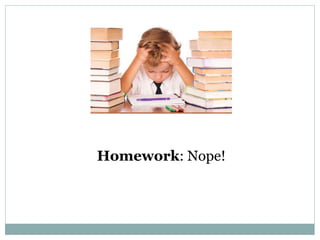
Homework: Nope!

Lifestyle unit 9

  • 1.
    U N IT 9 Lifestyle
  • 2.
    Welcome back Today wewill:  Review what you did on Friday  Take a short quiz  Listen to a song that uses the future conditional  Practice giving and receiving advice  Make plans and accept/refuse invitations  Review and practice modals and present continuous  Learn to accept and decline invitations  Choose people that you would invite to your own party
  • 3.
    What did wedo Friday? 1. People who use products are called ____. A) consumers B) manufacturers C) designers D) retailers 2. _______ you roommate ________ a new cell phone? A) Had / buy B) Has / bought C) Have / buys D) Hadn’t / buy 3. Which of the following does NOT improve creativity? A) having more time B) earning a reward C) caring about your work D) having the right opportunity 4. Do these phrases make or respond to a suggestion? A) Yes, but… B) How about… C) What if we… D) That’s great. E) Why don’t we… F) I don’t think… G) OK, I’ll… 5. Think of 4 different company slogans (口號) used in Taiwan. Which is your favorite? Why do you like it? Do you think slogans are effective?
  • 4.
    Unit 8 Short Quiz Youhave 20 minutes for the quiz. Please write your Chinese and English name. Don’t forget to guess how many questions you will answer correctly. When you finish, please give the test to the teacher or one of the teaching assistants.
  • 5.
    Wouldn’t it BeNice - The Beach Boys Today’s unit talks about future plans and possibilities. Put the song verses in the correct order and fill in any missing words. https://www.youtube.com/watch?v=ZVlVmv0K-pk Music Time
  • 6.
    Did you dothe homework? Page 72 Which of these places do you think are more punctual (守時)? Switzerland or Italy? Japan or Peru? Germany or Mexico? Taiwan or the Philippines? Who in your family is most often _____ ? A) late B) on time C) angry when others are late Part 3: which words from the article mean: 1. two: _____ 2. at the right time, without being late: _____ 3. a very sad event that shocks people: _____ 4. arrive: _____ 5. not polite (two words): _____ _____
  • 7.
    Did you dothe homework? Page 72 Part 3: which words from the article mean: 1. two: couple 2. at the right time, without being late: promptly 3. a very sad event that shocks people: tragedy 4. arrive: turn up 5. not polite (two words): rude / impolite Part 4: Answer the questions: 1: Why isn’t it polite to complain if someone arrives ten minutes late in some countries? 2. How far behind schedule was the Japanese train? In your opinion, was it late? 3. How late might guests arrive at a party in Peru? Do people generally arrive on time for events in Taiwan? 4. What does ‘late’ mean to people in Taiwan? And what does it mean to you?
  • 8.
    Did you dothe homework? Page 72 Part 4: Answer the questions: 1: Why isn’t it polite to complain if someone arrives ten minutes late in some countries? Because there is a 10 minute ‘courtesy time’. 2. How far behind schedule was the Japanese train? In your opinion, was it late? The train was only 90 seconds late. Maybe a little. 3. How late might guests arrive at a party in Peru? Do people generally arrive on time for events in Taiwan? About an hour. 4. What does ‘late’ mean to people in Taiwan? And what does it mean to you?
  • 9.
    Page 73 Modal verbs If youwould like to review the rules, you can look at page 169 in your student book. Part 5: When we are sure something is going to happen, we use will. Ex: I will eat lunch after this class. When we’re unsure and we’re talking about possibilities, we use may, could and might. Ex: I may / could / might fall in love next year.
  • 10.
    Page 73 Modal verbs If youwould like to review the rules, you can look at page 169 in your student book. Part 6: 2 Modal verbs are followed by b an infinitive without to (do) Ex: I might sleep all day after the TOEIC exam. I might to sleep all day after the TOEIC exam. 3 To form questions with modal verbs we… b change the word order Ex: What day will we take the test? What day we will take the test? 4 To form negatives we use… a not Ex: I may not ever love anyone again. I may don’t ever love anyone again.
  • 11.
    Page 73 Modal verbs If youwould like to review the rules, you can look at page 169 in your student book. Part 7: Work with your partner. 1. Think off something that you feel sure you will do tomorrow. 2. Think of three things that might / could / may happen. 3. Think of two things that might not or may not happen.
  • 12.
    Extension Asking for advice • Youwill each be given two strips of paper. Read the problems and then ask 3 different classmates to give you advice for each. • After you have finished, explain one problem to your teacher or teaching assistants using your own words. • Who gave you the best advice? What they tell you?
  • 13.
    Parts 1 &3 Part 1: Have you ever… 1. forgotten a family member’s or a close friend’s birthday? Whose? 2. left your homework at home? What happened? 3. arrived at the wrong time for an appointment? What happened? Part 3: Read the article. 1. Where’s Judith going next weekend? 2. What’s happening next Thursday? 3. How much does Judith pay Gyan? 4. How has Gyan changed Judith’s life? 5. What’s Gyan doing tomorrow? Page 74 - Reading
  • 14.
    Page 74 -Part 3 Answers 1. Where’s Judith going next weekend? She’s going to Dallas. 2. What’s happening next Thursday? It’s her aunt’s birthday. 3. How much does Judith pay Gyan? She pays him about eight dollars an hour. 4. How has Gyan changed Judith’s life? She says her life isn’t falling apart anymore. 5. What’s Gyan doing tomorrow? He’s reading a bedtime story to her kids.
  • 15.
    Extension What will you bedoing… day activity your sentence tomorrow go to the bank I’m going to the bank tomorrow. next week work at the office next month go on a cruise next weekend go to the supermarket tomorrow morning go to the beach tomorrow afternoon going to Taichung tonight go to the movies next week study English next year travel to Europe tonight have dinner tomorrow go shopping next Saturday work
  • 16.
    Extension What will you bedoing… day activity your sentence tomorrow go to the bank I’m going to the bank tomorrow. next week work at the office I’m working at the office next week. next month go on a cruise I’m going on a cruise next month. next weekend go to the supermarket I’m going to the supermarket next weekend. tomorrow morning go to the beach I’m going to the beach tomorrow morning. tomorrow afternoon going to Taichung I’m going to Taichung tomorrow afternoon. tonight go to the movies I’m going to the movies tonight. next week study English I’m studying English next week. next year travel to Europe I’m traveling to Europe next year. tonight have dinner I’m having dinner tonight. tomorrow go shopping I’m going shopping tomorrow. next Saturday work I’m working next Saturday.
  • 17.
    Extension Now ask your partner Whatwill you be doing… day activity your sentence tonight tomorrow morning next Sunday evening September 9th this winter vacation next year three years from now five years from now ten years from now
  • 18.
    Page 75 Parts 7& 8 Part 7: Listen. What’s the problem? Part 8: Listen to the next call. Put the sentences in the correct order. ____ _10_ _1__ ____ ____ ____ ____ ____ ____ ____
  • 19.
    Page 75 Parts 7& 8 Part 8: Listen to the next call. Put the sentences in the correct order. _3__ Ah. Do… _10_ Bye. _1__ Paul Jones. _7__ Hey, it’s no… _8__ I’ll email you… _6__ Good. Thanks… _5__ Yea, Friday’s… _2__ Paul, it’s Gyan… _4__ Yes, please… _9__ You’re welcome.
  • 20.
    Part 1: Readthe situations Part 2: Match the words and phrases Some vocabulary: hesitated - 猶豫的 vague - 模糊 Herr - 先生(德文) voicemail - 語音信箱 apologize - 抱歉 Iranian - 伊朗人 unsociable - 不擅交際的 rude - 無禮的 invitation - 邀請 insist - 堅持 1. h________ 2. v ________ 3. i ________ 4. t________ it d_____ 5. d ________ 6. s _______ a _______ 7. i ________ Page 76
  • 21.
    Part 1: Readthe situations Part 2: Match the words and phrases Some vocabulary: hesitated - 猶豫的 vague - 模糊 Herr - 先生(德文) voicemail - 語音信箱 apologize - 抱歉 Iranian - 伊朗人 unsociable - 不擅交際的 rude - 無禮的 invitation - 邀請 insist - 堅持 1. hesitated 2. vague 3. inconvenient 4. turned it down 5. disappointed 6. slip away 7. inisist Page 76
  • 22.
    Page 76 Part 3 Listento some other views of the misunderstandings. Write A - F next to the situations they talk about. 1. ____ 2. ____ 3. ____ 4. ____ 5. ____ 6. ____
  • 23.
    Page 76 Part 3 Listento some other views of the misunderstandings. Write A - F next to the situations they talk about. 1. _C__ 2. _D__ 3. _F__ 4. _B__ 5. _A__ 6. _E__
  • 24.
    Part 6 Part7 Listen to Tim inviting someone to a barbecue. Why did they turn him down? Listen to Tim inviting some other people Do they accept? Why / Why not? Page 76
  • 25.
    Part 6 Part7 Listen to Tim inviting someone to a barbecue. Why did they turn him down? The man turns him down because his wife/girlfriend isn’t feeling well. Listen to Tim inviting some other people Do they accept? Why / Why not? Page 76
  • 26.
    Part 6 Part7 Listen to Tim inviting someone to a barbecue. Why did they turn him down? The man turns him down because his wife/girlfriend isn’t feeling well. Listen to Tim inviting some other people Do they accept? Why / Why not? They don’t accept because they are visiting the woman’s mother that day. Page 76
  • 27.
    Page 76 Part 8 Completethe phrases in the chart Invitations Preparing to invite 1. Are you ______ 2. What _____ ______ ____ Inviting 1. ______ you _____ 2. ______ you ______ Positive responses 1. Oh, it’s ______ ______ 2. ______ be great! ______ Saying ‘no’ 1. I’m ______ 2. ______ be lovely ______ Responding to ‘no’ 1. Oh, that’s a ______ 2. Not to ______ Suggesting alternatives 1. ______ love to come ______ 2. ______ ______ …. ______
  • 28.
    Page 76 Part 8 Completethe phrases in the chart Invitations Preparing to invite 1. Are you doing 2. What are you doing Inviting 1. Would you like 2. Do you want Positive responses 1. Oh, it’s very kind 2. That’d be great! We’d Saying ‘no’ 1. I’m afraid 2. It’d be lovely but Responding to ‘no’ 1. Oh, that’s a shame 2. Not to worry Suggesting alternatives 1. We’d love to come another 2. How about …. instead
  • 29.
    Invitations Part 10: Readthe advertisements. Check the events you would like to attend. Cross out the ones you wouldn’t like to go to. Think of reasons not to do the events you crossed out. Part 11: Work with your partner. Take turns inviting each other to the events. Accept the invitation if you would like to go, or refuse and give a reason for why you don’t want to go. Page 77
  • 30.
    Page 79 Expressions with give Part5: Match the expressions with give 1. ___________ 2. ___________ 3. ___________ 4. ___________ 5. ___________ 6. ___________ 7. ___________ 8. ___________ 9. ___________
  • 31.
    Page 79 Expressions with give Part5: Match the expressions with give 1. gave a speech 2. give us some help 3. give you some advice 4. give me a chance 5. give him a lift 6. gave me a kiss 7. gave us permission 8. give you more information 9. gave / has given us any explanation
  • 32.
    Part 6 Part7 Listen to people planning another surprise party. 1. Who’s the party for? 2. How are they going to get him to the party? 3. What’s the extra surprise? Are the plans definite or possible? 1. ______ 2. ______ 3. ______ 4. ______ 5. ______ 6. ______ 7. ______ Page 79
  • 33.
    Part 6 Part7 Listen to people planning another surprise party. 1. Ivan 2. Invite him to play squash 3. Ivan’s sister Are the plans definite or possible? 1. ______ 2. ______ 3. ______ 4. ______ 5. ______ 6. ______ 7. ______ Page 79
  • 34.
    Part 6 Part7 Listen to people planning another surprise party. 1. Ivan 2. Invite him to play squash 3. Ivan’s sister Are the plans definite or possible? 1. __D___ 2. __D___ 3. __D___ 4. __P___ 5. __P___ 6. __P___ 7. __D___ Page 79
  • 35.
    Handout The great dinner party Youand your group are going to have a dinner party for 6 guests. Use the handout to decide who you like to invite, and add some more people. You also need to think of three people you wouldn’t invite.
  • 36.
    T O DA Y W E : Reviewed what you did on Friday Took a short quiz Listened to a song that used the future conditional Practiced giving and receiving advice Made plans and accepted/refused invitations Reviewed and practiced modals and present continuous Learned to accept and decline invitations Chose people that you would invite to your own party Finished!
  • 37.